


 Copy Link
 Share on X
 Share on Facebook
 Share on LinkedIn
Always Active
Required for core functionality such as security, network management, and accessibility. These cannot be disabled.

Uncover the transformative potential of digital and mobile solutions for your industry.





 Last Updated: Sep 18, 2026
Aug 6, 2026
Last Updated: Sep 18, 2026
Aug 6, 2026  324
324  16 min. Read


Key Takeaways
Selecting a software development company in USA that buyers can trust has become harder, not easier, in the last eighteen months. The reason is not a shortage of vendors. It is that artificial intelligence has changed what a competent partner is supposed to deliver, how fast, and at what cost. A firm that looked strong in 2024 may now be shipping code faster while quietly accumulating defects, security gaps, and technical debt that surface only after go-live. For a CEO or executive buyer signing a multi-year engagement, that shift raises the stakes of getting the decision right.
The uncomfortable part is that speed alone has stopped being a useful signal. In a controlled 2025 study, the research nonprofit METR found that experienced developers were about 19% slower when using AI tools, even though they believed those tools had made them faster. Perceived velocity and real delivery, in other words, can move in opposite directions.
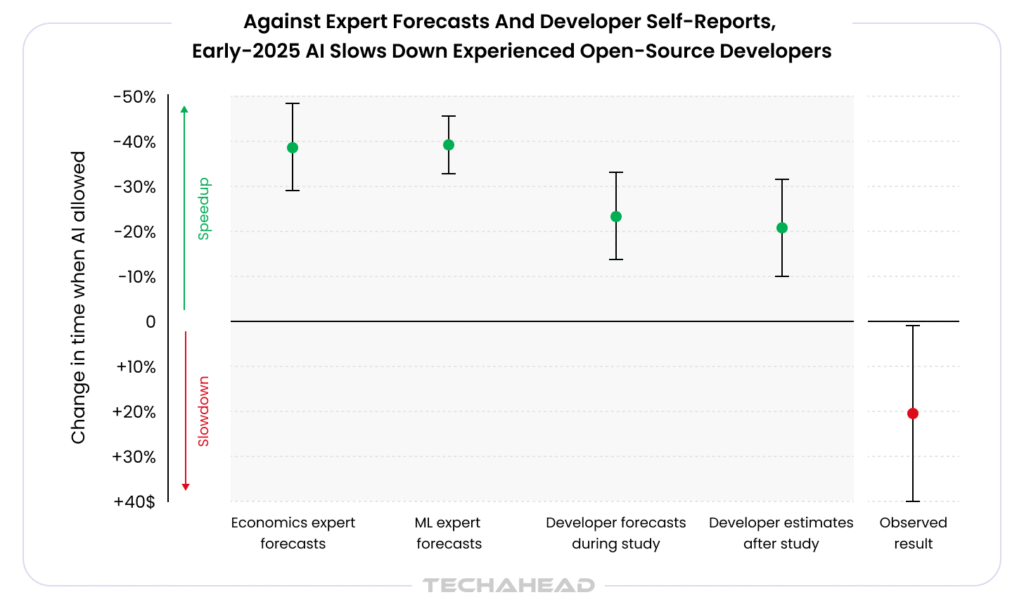
The gap between a promising demo and a governed, production-grade system is exactly where partner selection now succeeds or fails, and it is why so many buyers are re-examining why enterprise AI pilots fail to reach production before they commit a budget cycle.
This guide is written for that decision. It sets out what an AI-native software development partner actually is, why the evaluation criteria changed, and the five things you should verify before you sign. The short version of our thesis: AI-native is not about raw speed. It is about governed speed you can ship to production and defend to your board.
The term is used loosely, so define it before you buy on it. An AI software development company that is genuinely AI-native embeds AI across the delivery lifecycle, from discovery and architecture through coding, testing, and operations, with human engineering judgment governing every stage. It is a change in method, not a marketing label fixed onto a traditional shop.
What it is not is a team that simply lets developers use AI assistants and calls the result modern. Mature software development companies usually pair AI use with Agile or iterative project management instead of ad hoc execution. That distinction matters because the productivity story is more complicated than vendors admit. A useful reference point here is what changes when AI agents join the SDLC: the work does not disappear, it moves. Code gets written faster, but review, integration, and quality control absorb the new load. A partner who has not re-engineered those downstream stages will hand you speed on paper and slower, riskier releases in practice.
The firms worth shortlisting treat AI as an engineering discipline. They can explain which tasks they accelerate with AI, which they deliberately keep under human control, and how they choose models for a given problem rather than defaulting to one brand. If you want to see how that reasoning looks in practice, the way a serious team compares the best AI models for developers by task is a good proxy for engineering maturity.
For most of the last decade, buyers evaluated a software development company in USA on a familiar checklist: portfolio, hourly rate, team size, references. The same checklist still shapes top software development companies for 2026, but on its own, it is no longer sufficient.
The US software market is large enough to make old shortcuts unreliable, with projections putting it at roughly $409 billion by 2030 (Grand View Research). That scale runs across the wider industry, where an estimated 585,000 software and IT services companies operate in the United States (CompTIA, via the US Department of Commerce), and North America holds the largest share of the global software market at over 40%.
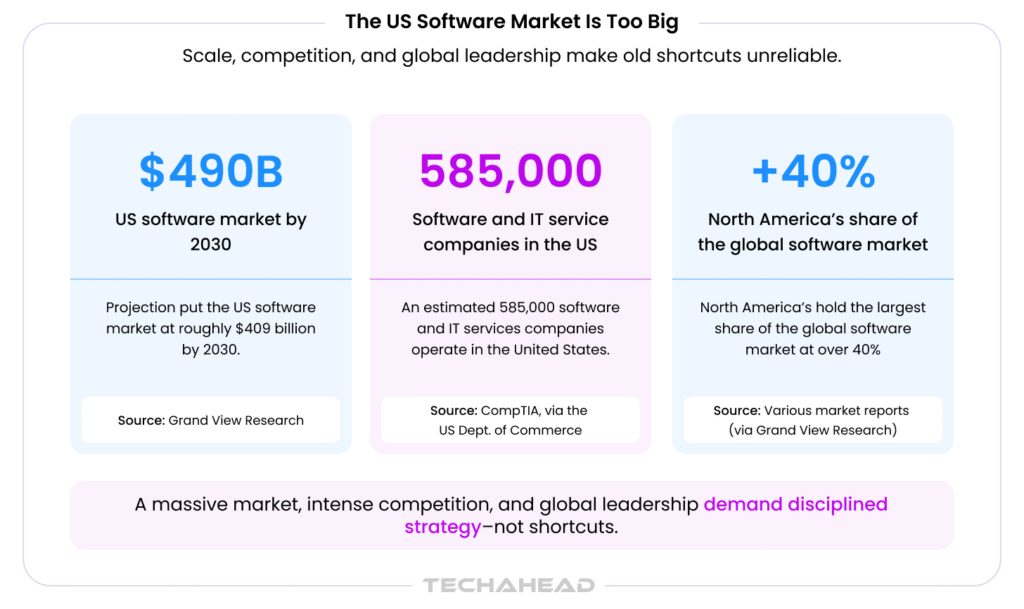
Three shifts explain why:
The practical consequence is that a modern evaluation has to test for engineering rigor under AI conditions, not just delivery capacity. The five criteria below are how you do that.
Use these as a scorecard. A strong custom software development services partner should be able to answer each with specifics, not slogans.
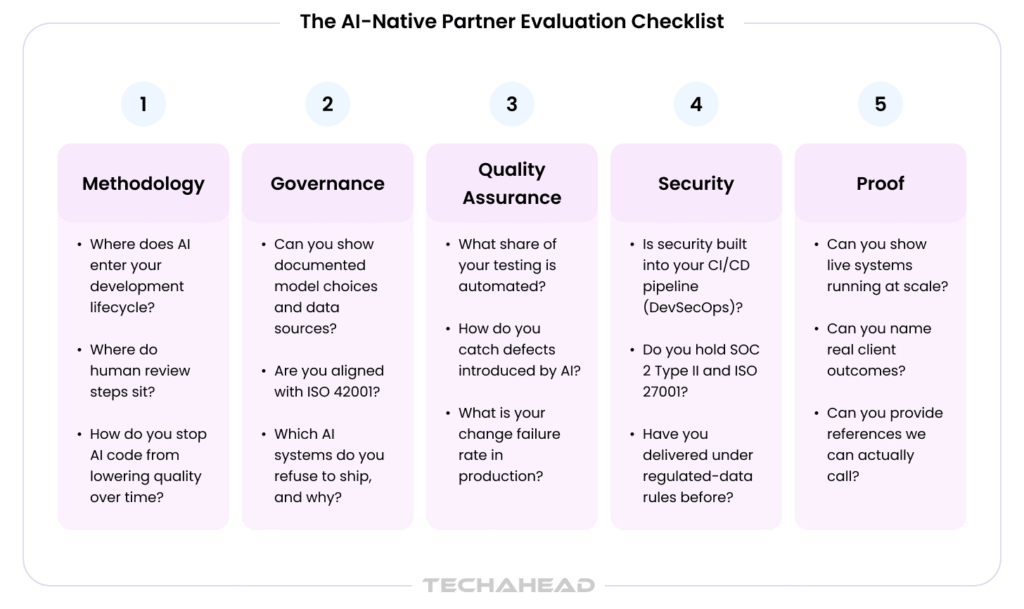
Ask how AI actually enters their development process. UX/UI design should be integral to that process, not treated as a separate downstream activity. A credible answer describes where AI accelerates work, where human review gates sit, and how they prevent AI-generated code from degrading the codebase over time. Vague answers about “using AI to move faster” are a warning sign.
The strongest partners run a disciplined path from prototype to production rather than an open-ended build. If you want a concrete model of what that looks like, a structured AI pilot to production delivery blueprint shows the controls that separate a demo from a deployable system. Methodology is the foundation of everything else on this list, because governance, QA, and security are only as good as the process they are embedded in, starting with MVP development to validate ideas before production hardening.
This is where most traditional vendors fall short and where an AI-native software development company earns its premium. Governance and Compliance means documented model selection, data provenance, evaluation, and the ability to produce an audit trail your compliance team will accept. It should also define intellectual property ownership clearly in the contract.
For a US executive buyer, the credential to look for is ISO 42001, the international standard for AI management systems, alongside a partner who can operationalize it rather than frame it. The mechanics matter here: the orchestration controls that move stalled pilots into production are the same controls that make a system governable. Ask specifically how they decide which agentic AI systems scale in production and which they refuse to ship based on risk, auditability, and regulatory compliance. A partner with an opinion on that has done the work.
QA is the criterion the speed narrative hides. When AI writes more code, the review and testing burden grows, not shrinks, and teams that ignore this ship faster into a bottleneck. Teams with real technical expertise also apply that same discipline to customer-facing UI/UX, validating not just functionality but experience quality before release.
The data is direct on this point. DORA and Faros AI research found that teams leaning heavily on AI coding tools completed roughly 21% more tasks, but pull request review times jumped about 91%, creating a downstream drag that erases much of the upstream gain.
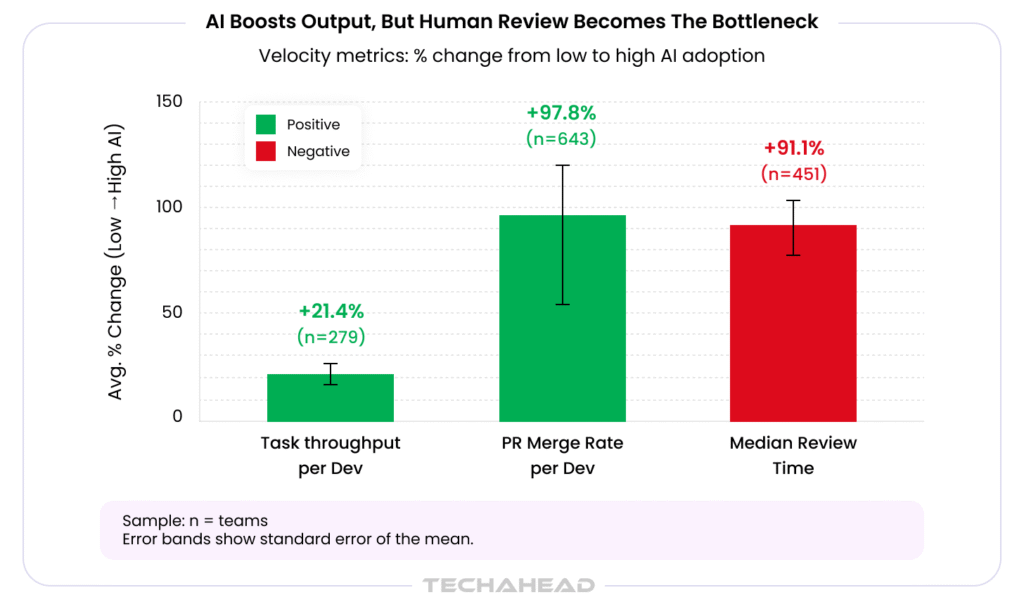
A partner practicing real QA automation treats testing as a continuous, automated quality gate rather than a phase at the end. Ask what percentage of their pipeline is automated, how they catch AI-induced defects, and what their change failure rate looks like in production. The answers separate an engineering partner from a basic development one.
Security in an AI-native context extends beyond application hardening to how models handle sensitive data, how prompts and outputs are controlled, and how the delivery pipeline itself is protected. AI-native security reviews should also extend across cloud consulting decisions, including architecting scalable environments on major cloud platforms such as AWS, Azure, and Google Cloud Platform.
AI and machine learning integration should be reviewed the same way, especially when it includes generative AI workflows and predictive analytics. DevSecOps, meaning security embedded across CI/CD and infrastructure rather than bolted on at the end, is the baseline expectation. Large multi-year digital transformation programs often require enterprise integration patterns that are more typical of Global System Integrators.
For US buyers, SOC 2 Type II and ISO 27001 are the certifications that signal a partner has independently audited controls, not just internal policies. If your software will touch regulated data in finance, healthcare, or insurance, verify that the partner has delivered under those constraints before, not just that they mention compliance on a slide.
Everything above is testable against evidence. A serious software development partner should show production systems running at scale, named client outcomes, and references you can actually call. External proof can also include market standing on platforms like Clutch, where the best software development firms are often grouped by operational tier. Be skeptical of portfolios heavy on prototypes and light on systems that have survived years in production.
This is also the criterion where the sibling question of how to evaluate a generative AI development company overlaps directly, because the proof standard is identical: verifiable outcomes over marketing claims.
Here is how those five criteria separate an AI-native partner from a traditional one.
Table 1: AI-Native vs Traditional Software Development Partner
| Evaluation Dimension | Traditional Partner | AI-Native Partner |
| Delivery methodology | AI used ad hoc by individual developers | AI embedded across the SDLC with human review gates |
| Governance | Minimal AI-specific controls | ISO 42001-aligned model governance and audit trails |
| Quality assurance | Manual or late-stage testing | Continuous automated quality gates, defect tracking |
| Security | Perimeter and app-layer focus | DevSecOps with SOC 2 Type II and ISO 27001 controls |
| Proof | Portfolio and reviews | Production systems, named outcomes, callable references |
Choosing the right software development company USA that buyers shortlist is only half the decision. The engagement model has to fit your internal strength. The same firm can be the right or wrong choice depending on how much technical leadership you already have.
There is also a newer model worth understanding for AI-heavy work. When the hard part is the last mile of getting a model into production, forward-deployed engineers who own last-mile deployment close the gap that stalls many pilots. And if your goal is consolidating expensive tooling, the logic of replacing high-cost SaaS with custom AI software often points toward a full-cycle build rather than augmentation.
Table 2: Engagement Model Fit by Buyer Situation
| Your Situation | Best-Fit Model | Why |
| Limited internal engineering leadership | Full-cycle product engineering | Single accountable owner for outcomes |
| Scaling a defined product or platform | Dedicated product pod | Continuity and retained knowledge |
| Strong internal team, need capacity | Staff augmentation | You keep control of architecture |
| Model built, deployment stalling | Forward-deployed engineering | Closes the last-mile production gap |
For enterprise-scale builds that span multiple workstreams, a partner offering enterprise app development services with a unified delivery structure reduces the vendor-management overhead of stitching several suppliers together.
For buyers evaluating a software development company in USA, geography carries real weight beyond a search phrase. Three factors are worth pressing on:
A partner who reasons clearly about AI development economics and token-level cost will protect your budget better than the cheapest hourly rate that misses an architecture decision in week two, improving cost efficiency over the life of the work.
The point is not that onshore is always right. It is that these variables should be evaluated explicitly rather than assumed, especially when AI infrastructure and governance requirements are involved. A partner offering full custom software development under one governed delivery structure makes these variables easier to control than splitting them across suppliers.
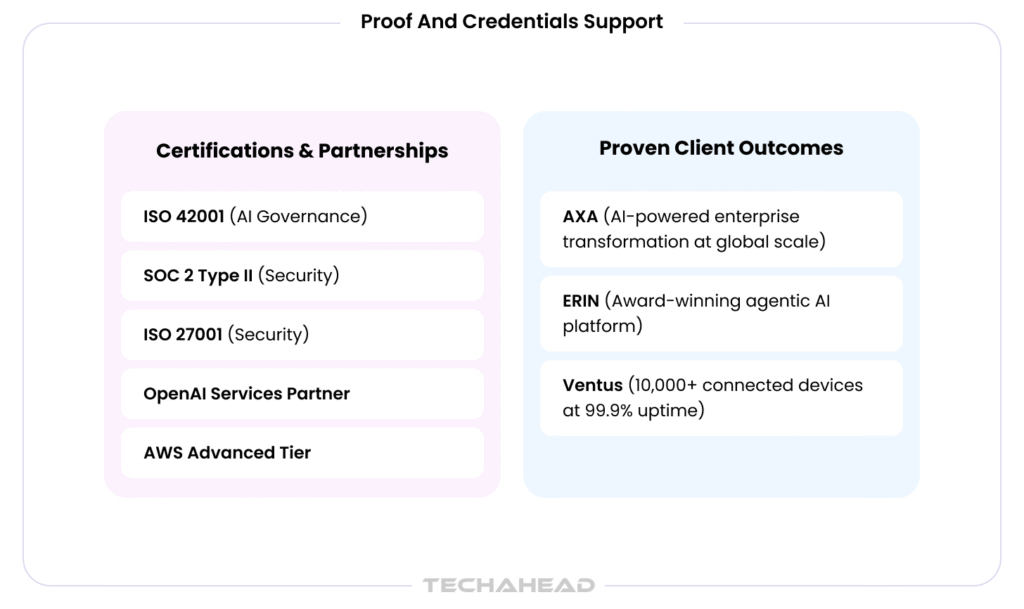
Criteria are only as convincing as the evidence behind them. The proof standard we set out above is one we hold our own work to, and the pattern across various collaborations is consistent: governed delivery at enterprise scale, not demos.
Many enterprise engagements also involve legacy enterprise systems, and over 60% of IT budgets often go to maintaining them; modernization can reduce maintenance costs by 40% while improving operational efficiency by 30-50%.
These outcomes rest on independently verified controls: ISO 42001 for AI governance, SOC 2 Type II and ISO 27001 for security, and Claude & OpenAI Services Partner and AWS Advanced Tier status for platform depth. For a software development company in USA that buyers evaluate against the five criteria above, a combination of governed method and named proof is the standard to hold every shortlisted partner to. It is the same governed, AI-native approach our custom software development services apply across every engagement.
Understanding what separates the best custom software development companies from the rest, in the AI era, comes down to a single question: can they ship governed speed to production, and prove it. If a partner can answer the five criteria with specifics and evidence, you have found one worth signing. If they answer with slogans, keep looking.
Start with proof, not pitch. Buyers should trust on portfolio, verifiable references, a clear delivery process, QA depth, and security posture. The right software development partner answers each with specifics, not slogans. Strong vendors also usually provide both web development and mobile app development as part of broader software development solutions.
Look past speed. A real AI-native software development partner embeds AI across the lifecycle with human review gates, documented governance, and automated testing. If they can only talk about shipping faster, keep looking. Governed delivery is the actual signal.
A traditional shop uses AI ad hoc, developer by developer. An AI software development company that’s genuinely AI-native builds governance, QA automation, and security into delivery itself. The difference tends to show up in production, not the demo.
Ask what they’ve actually shipped, not just piloted. Look for named, live systems running at scale under real governance. TechAhead, for instance, delivered AI-powered enterprise transformation for AXA at global scale, which is the kind of production track record worth checking for. Software integration also matters here because it improves productivity and data accuracy in production environments.
For AI work, look for ISO 42001 for AI governance, plus SOC 2 Type II and ISO 27001 for security. TechAhead holds all three, alongside Claude & OpenAI Services Partner and AWS Advanced Tier status, the independently audited controls enterprise buyers should expect.
Short answer: yes, for AI systems. SOC 2 covers security and data controls but says nothing about model risk, bias, or AI transparency. ISO 42001 fills that gap, and serious custom software development services now carry both.
When AI writes more code, review and testing grow, they don’t shrink. A strong partner runs continuous QA automation and DevSecOps, meaning security is built into the pipeline rather than bolted on at the end. Ask for their change failure rate.
It’s rarely either-or. Many buyers evaluating a software development company in USA land on a hybrid: US-based accountability and architecture, with a governed distributed team. What matters is data residency, timezone overlap, and proven compliance, not just location.
Depends on your bench. Limited internal engineering leadership points to full-cycle ownership. Strong internal teams needing extra capacity are better served by staff augmentation. Scaling one product? A dedicated pod keeps knowledge in-house. Match the model to your situation. The dedicated team model is usually best when continuity matters and you want stable development teams over a longer roadmap.
The best custom software development companies for enterprise AI combine governed delivery, real certifications, and named production outcomes. TechAhead fits that profile, with AI-native delivery, ISO 42001 governance, and Fortune 500 clients. Mobile development here generally covers iOS and Android and may include high-performance native or cross-platform application engineering. Still, verify every partner’s proof against your own evaluation checklist.
We use cookies to ensure our website functions properly, improve performance, and provide a personalized experience. You can choose which types of cookies to allow below.
Required for core functionality such as security, network management, and accessibility. These cannot be disabled.
Help us understand site traffic and user interactions so we can improve performance and usability.
Enable enhanced functionality and personalization such as language or region preferences.
Used to deliver relevant ads, track campaign performance, and measure advertising effectiveness.