


 Copy Link
 Share on X
 Share on Facebook
 Share on LinkedIn
Always Active
Required for core functionality such as security, network management, and accessibility. These cannot be disabled.

Uncover the transformative potential of digital and mobile solutions for your industry.





 Last Updated: Sep 22, 2026
Jul 1, 2026
Last Updated: Sep 22, 2026
Jul 1, 2026  512
512  16 min. Read


Key Takeaways
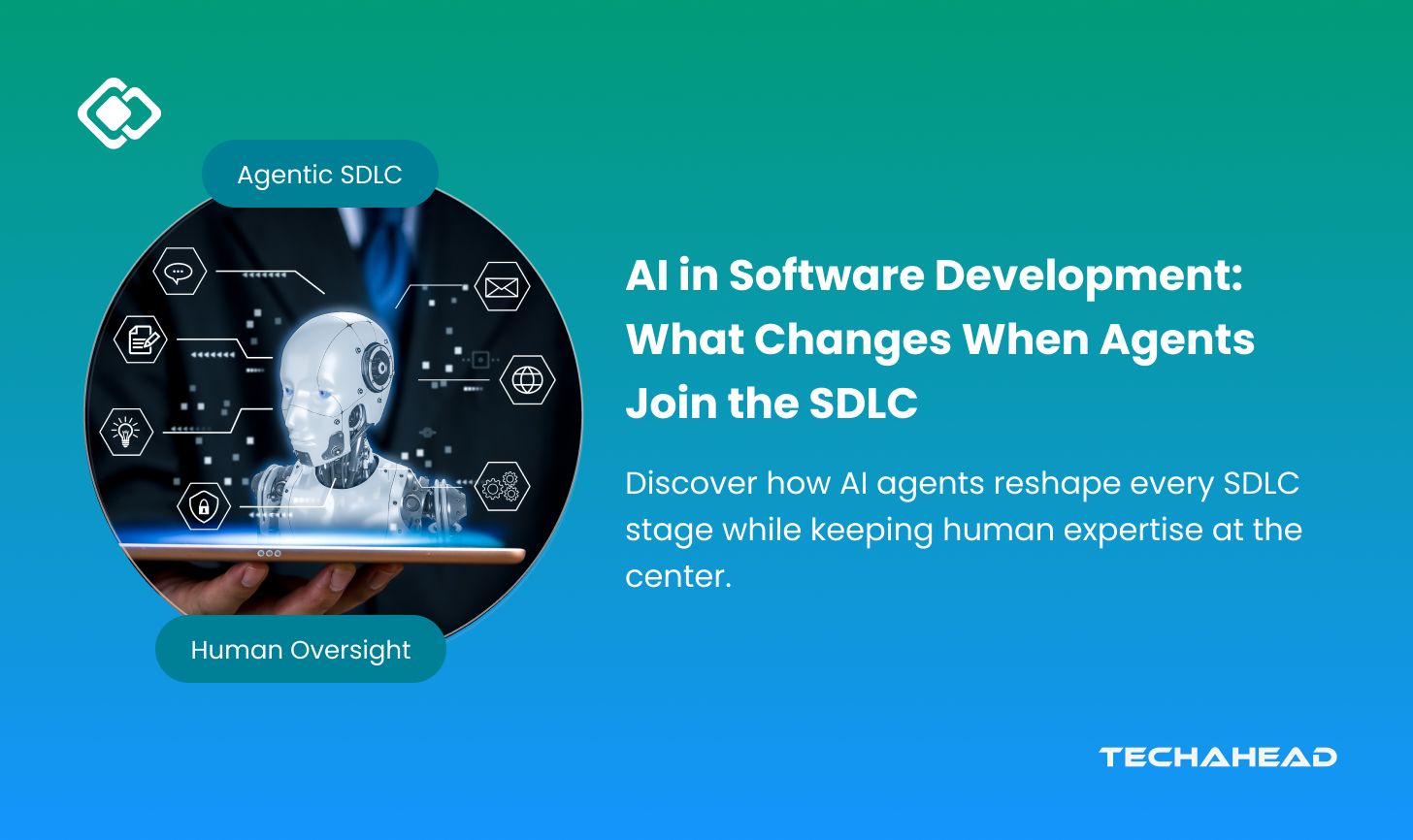
AI in software development used to mean one thing: a smarter autocomplete. A developer typed a few lines, a model suggested the rest, and the human accepted, edited, or discarded the suggestion. That was the first decade of AI tools in engineering, and it delivered real, measurable gains. McKinsey’s research on generative AI in coding found that developers using AI-based tools completed tasks up to twice as fast on well-scoped work, and reported markedly higher satisfaction in the process.
That data point alone reshaped how engineering leaders thought about developer productivity, but it was still a story about assistance. What is happening now is a different story altogether.
AI agents in SDLC workflows plan and execute multi-step tasks. They use other tools, call external tools, read context, and hand off work to other agents without waiting for a human to type the next prompt. Gartner predicts that by the end of 2026, 40 percent of enterprise applications will be integrated with task-specific AI agents, up from less than 5 percent in 2025, one of the fastest technology adoption curves Gartner has tracked.
This is a useful benchmark for any leader trying to size the shift correctly. Also, it is one of the reasons why the global AI in software market size, which was estimated at USD 674.3 million in 2024, is expected to reach $15,704.8 million by 2033, showing a CAGR of 42.3% from 2025 to 2033.
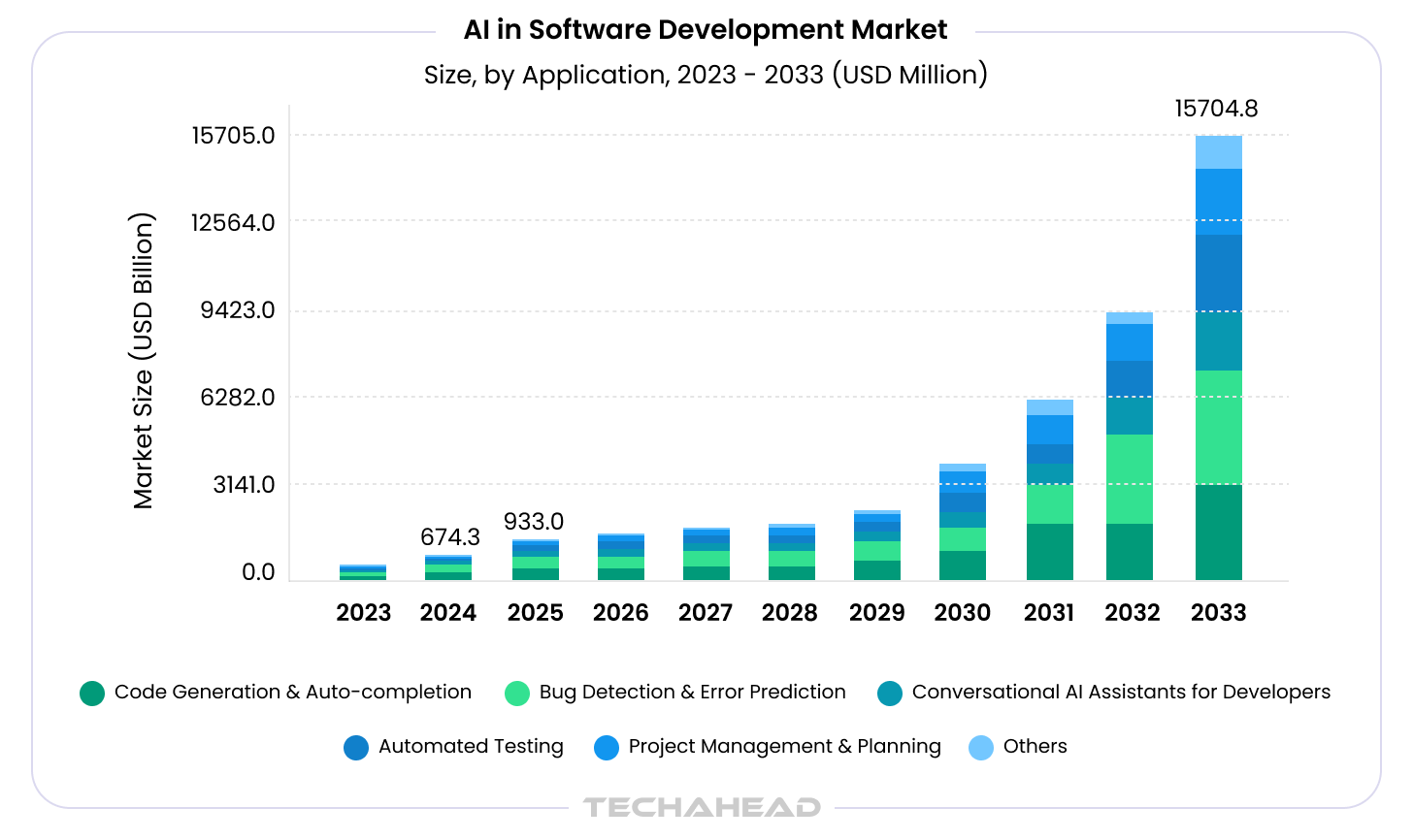
This blog presents clarity around one question: what actually changes, stage by stage, when AI agents in SDLC processes take on real work, and where human judgment still has to hold the line. For enterprises, realizing these gains requires AI development services that integrate agents into existing engineering workflows with the right governance, security, and review controls. We will walk through the traditional SDLC stages, show where agentic systems are already changing the development cycle, and be honest about where the hype outruns the substance.
| Feature | Coding Assistant | AI Agent |
| Input | Single prompt | High-level goal |
| Planning | User-driven | Autonomous |
| Execution | One task | Multi-step workflow |
| Tool Usage | Limited | Automatic |
| Human Role | Every step | Final approval |
Before going further, it helps to separate two things that get conflated constantly: coding assistants and AI agents.
Coding assistants are reactive. They offer code completion, generate code snippets on request, or answer a question in natural language. The developer remains the one driving every decision, and the tool responds only when prompted. This is where most teams started, and for many, it is still where AI in software development begins.
An AI agent can take a goal, break it into steps through task decomposition, choose which tools to use, execute those steps, evaluate the result, and adjust its approach, often without a human intervention at every checkpoint. Large language models are the reasoning engine behind most of these systems, but the agent wrapper is what turns a model that predicts text into a system that can actually perform tasks inside a development workflow. Specialized agents now exist for writing code, generating test cases, reviewing pull requests, and even flagging security vulnerabilities before code reaches production.
This distinction changes the conversation from “which AI tool should we buy” to “which parts of our development workflow are we comfortable delegating, and to what degree.”
To learn more, read our blog Agentic AI development guide, compiling everything from technical complexity to architectural decisions.
The traditional SDLC stages, planning, design, development, testing, deployment, and maintenance, have run in roughly the same sequence for decades. Each stage handed off to the next, mostly through documentation, tickets, and meetings, with human developers doing the implementation work at every point. An AI-driven SDLC keeps the same backbone but changes what happens inside each stage and how much of the implementation work moves to agentic systems rather than people.
Gartner’s research on enterprise AI coding agents describes this directly: agentic coding now spans the SDLC from planning to creating to reviewing code, marking a shift from AI-assisted development to genuinely agentic software development.
Gartner goes further, predicting that by 2027, over 65% of engineering teams using agentic coding will treat integrated development environments as optional, shifting control, governance, and validation to automated platforms.
It does not mean engineers disappear from the picture. It means the center of gravity in the development workflow moves from typing code in an editor to defining intent, reviewing output, and governing how AI agents in SDLC pipelines are allowed to operate.
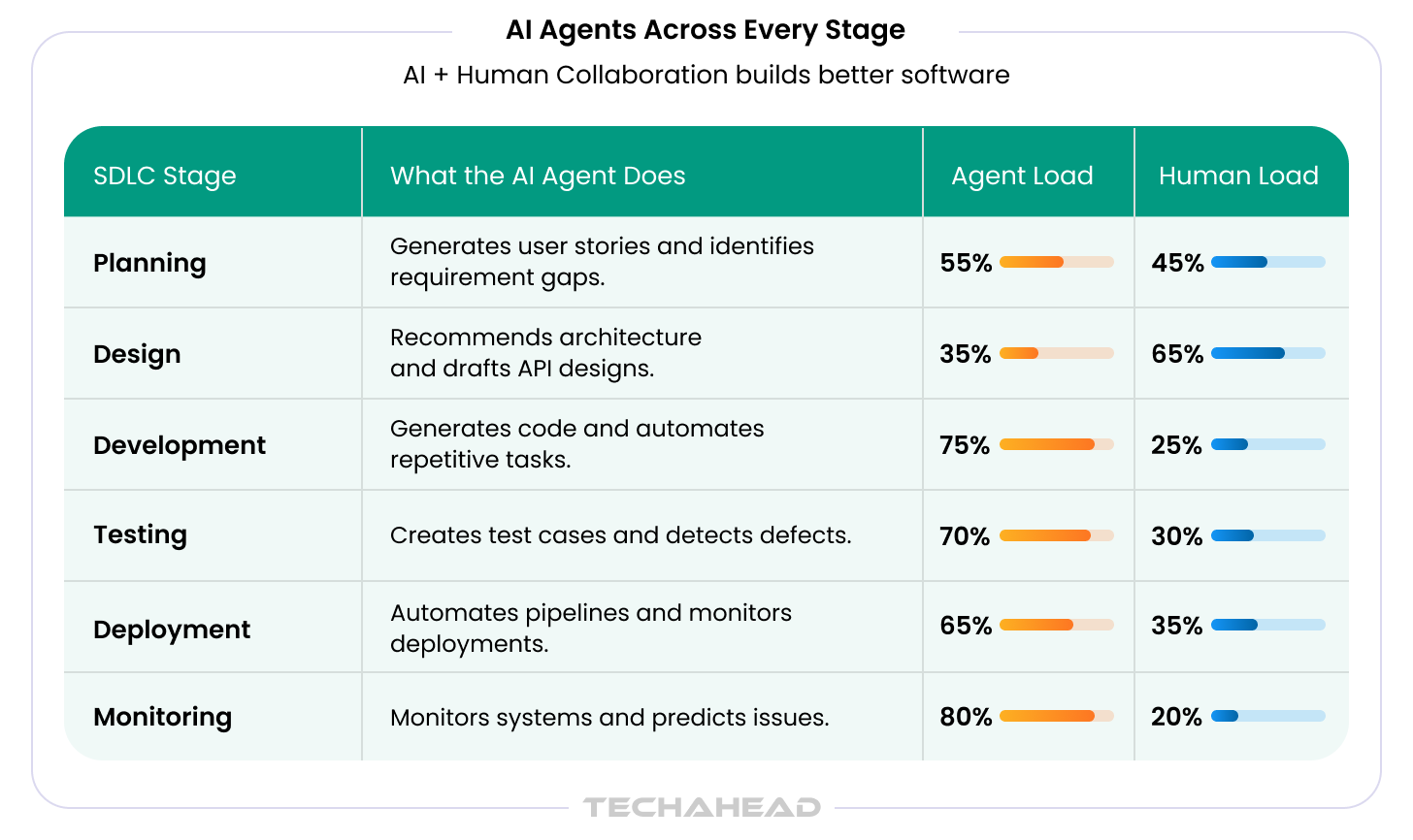
The clearest way to understand AI in software development is to walk through the same sequence every engineering team already knows, and look at what an agent actually does differently at each point.
This is where agents are quietly doing some of their most useful work. Given a product brief in natural language, an agent can draft user stories, flag ambiguous requirements, and perform early task decomposition, breaking a feature into smaller, well-scoped units of work before a single line of code gets written. This does not replace product managers. It gives them a faster first draft to react to, and it shortens the planning loop in ways that compound across a development cycle.
Software design decisions still belong to architects and senior engineers, but agents are increasingly part of the conversation. They can compare design patterns, surface tradeoffs from similar systems, and draft initial architecture documentation. Different agents may be assigned to different parts of a design problem, one focused on data modeling, another on API design, with a human architect synthesizing the output into a coherent system.
This is the stage most people picture when they think about AI agents in SDLC work, and it is where multiple AI agents are now operating in parallel rather than one tool handling everything. One agent might be writing code for a specific feature, another generating code snippets for a utility function, a third handling repetitive tasks like boilerplate generation or dependency updates. Each agent is typically narrow and focused on specific tasks, which is a deliberate design choice we will come back to. The output still moves through a pull request, where a human developer reviews what was generated before it merges.
Test case generation is one of the strongest current use cases for agentic systems. Agents can generate test cases from requirements or from existing code, run them, and flag failures. Some go further, performing early root cause analysis on a failing test by tracing the issue back through recent changes. This does not eliminate the need for human oversight on test strategy, but it removes a large share of the repetitive tasks that used to consume QA time.
Agents are increasingly embedded directly into CI/CD pipelines, monitoring build failures, suggesting fixes, and in some governed environments, executing low-risk deployment steps. Resource allocation decisions, like scaling infrastructure ahead of an expected load spike, are also moving toward predictive models that act on real time data rather than static rules.
Predictive analytics now flag likely failure points before they become incidents, using patterns drawn from logs and historical defects. Agents monitoring production systems can triage anomalies and draft an initial incident summary long before a human engineer would have noticed the issue manually.
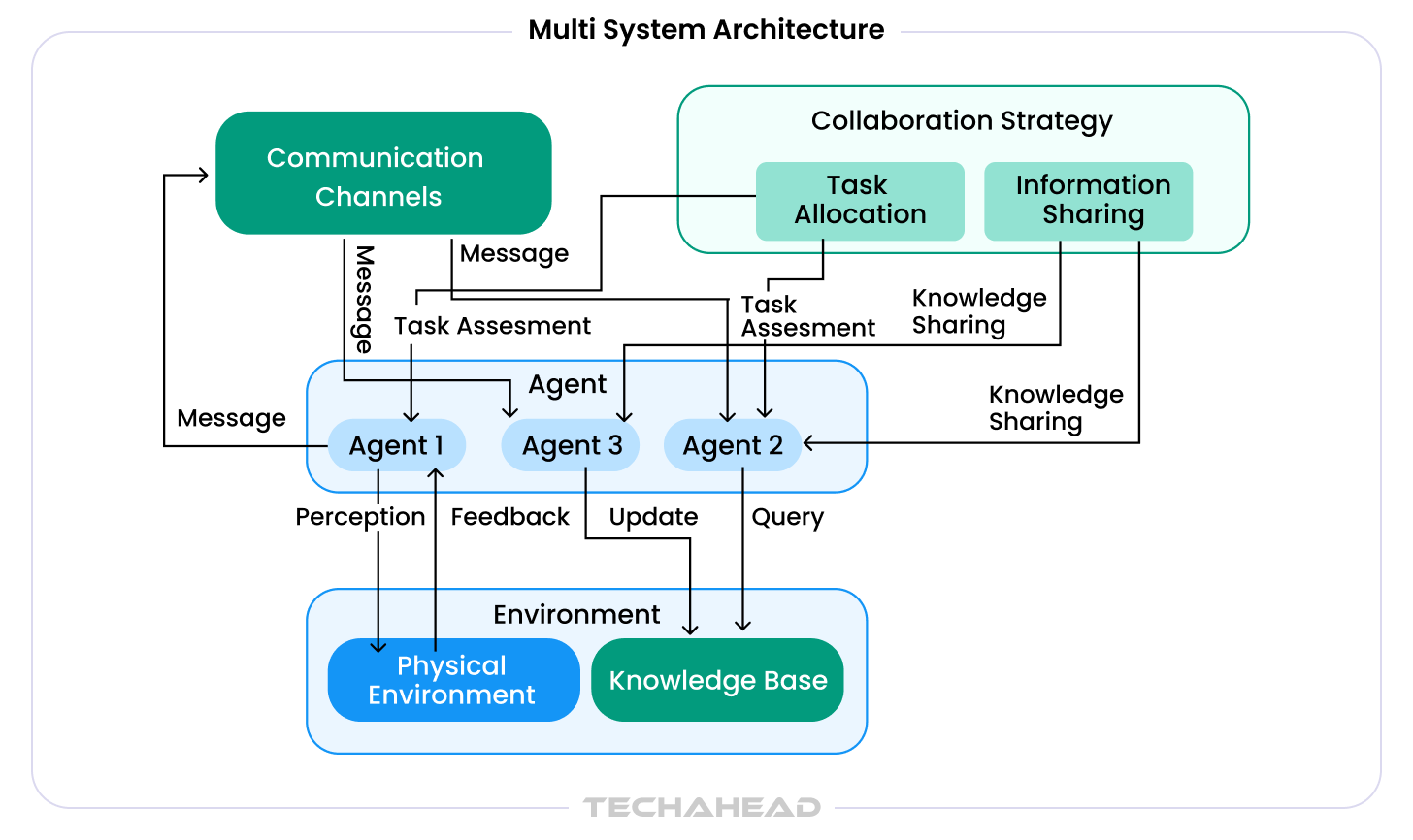
One of the more important shifts in how teams build agentic systems is the move away from a single, generalized agent trying to do everything, toward specialized agents handling narrow, well-defined tasks. Think of it the way you would think about an engineering org chart. You do not hire one engineer to do design, security review, and deployment all at once. You build a team of specialists who hand off work cleanly. Multi-agent systems apply the same logic. One agent might focus on code generation, another on code review, another on resource allocation, each using different tools suited to its specific tasks, with an orchestration layer coordinating the handoffs.
This is also where real value tends to show up. A single broad agent trying to manage an entire complex system often produces inconsistent output. A set of specialized agents, each narrowly scoped, tends to produce more reliable results and is far easier to govern, because you can audit what each agent is responsible for rather than trying to interpret one black box doing everything at once.
Also Read: AutoGen vs watsonx vs Kubiya
Human oversight is not a temporary training-wheels phase that disappears once agents get better. It is a permanent feature of any responsible AI-driven SDLC, for a simple reason: agents can be confidently wrong, and confidently wrong code is more dangerous than obviously broken code.
Code review remains the checkpoint that matters most. Every pull request, whether the code came from a human developer or an agent, should go through the same review discipline. McKinsey’s developer productivity research found that participants using generative AI tools still needed to examine code carefully for bugs and errors, correct erroneous assumptions through repeated prompts, and in some cases spend real time getting a tool to produce a workable answer, which is a useful reminder that speed and correctness are not the same thing.
This is also where the term “vibe coding” deserves a direct comment. Vibe coding, the practice of accepting AI-generated code based on whether it looks right and runs without immediate errors, without genuine review, is a fast way to ship and a fast way to accumulate hidden risk. It works fine on a side project. It does not belong anywhere near a production system handling real users or real data. Human intervention at the review stage is not bureaucracy. It is the mechanism that catches the gap between code that compiles and code that is actually correct, secure, and maintainable.
Human error and AI error are also not interchangeable risks. A human developer who introduces a bug usually does so inconsistently, in ways that are often caught by pattern-matching reviewers who have seen similar mistakes before. AI generated code can introduce a different category of error: confidently structured, syntactically clean code that quietly gets the logic wrong, or pulls in a dependency that does not actually exist. Review processes built for human work do not always catch this automatically. They need to be adjusted.
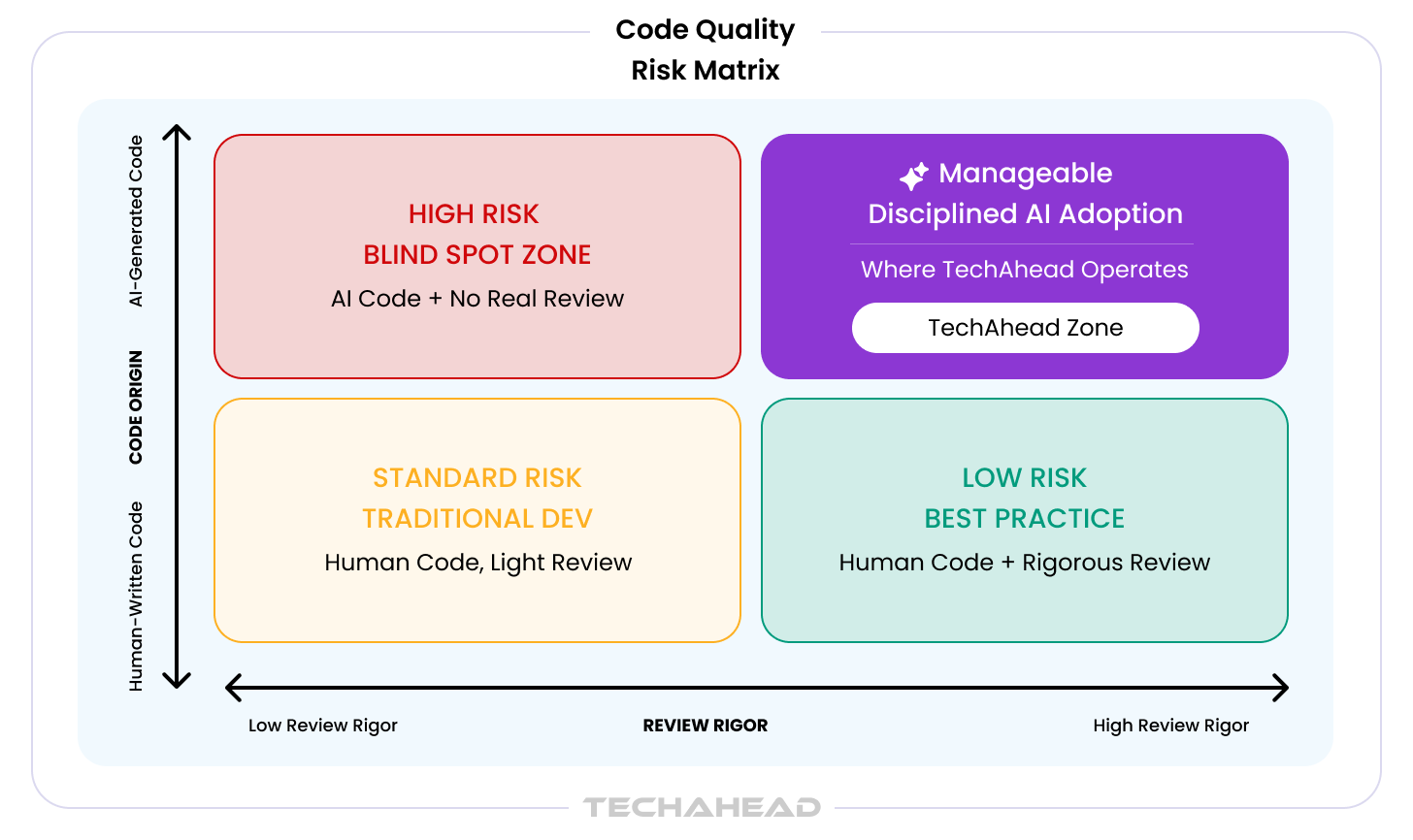
Code quality and software quality conversations have changed shape now that a meaningful share of a codebase may be AI generated. The concerns are specific. Agents can produce code that is internally consistent but inconsistent with the rest of the codebase’s conventions. They can hallucinate library functions that sound plausible but do not exist. They can miss the kind of context a senior engineer would know intuitively, like which parts of a system are fragile and should not be touched casually.
Security vulnerabilities deserve their own mention. Agents trained primarily to make tests pass and code run can optimize for the wrong target, producing code that works functionally but introduces a vulnerability a security-focused review would catch immediately. This is precisely why feedback loops matter so much in an AI-driven SDLC. Every agent’s output needs a path back to human judgment, automated security scanning, and test suites built specifically to catch the failure modes agents are prone to, not just the ones human developers are prone to. Done well, this does not slow teams down. It is what allows teams to actually improve quality while moving faster, rather than trading one for the other.
Engineering leaders sometimes pitch AI agents in SDLC adoption purely as a productivity story, and that undersells it. The business value runs deeper. When agents absorb the repetitive tasks and implementation work that used to eat a developer’s day, what shifts is not just speed. It is focus. Developers focus on complex problems, architecture decisions, and the kind of work that actually requires judgment, while agents handle the volume work underneath.
This also reshapes project management. Task decomposition handled partly by agents means project leads get a more granular, more current view of where work actually stands, which improves estimation and resource allocation across a team. And because agents can be narrowly scoped to specific tasks, the cost of experimenting with a new capability drops. Teams can pilot an agent on one workflow without committing to a wholesale platform change, which makes the entire approach more cost effective for organizations still deciding how far to go.
None of this replaces the discipline good engineering teams already have. It compounds it. Teams that already run a tight development workflow with strong code review and clear ownership tend to get outsized value from agents, because the governance structure that makes agentic systems safe is already in place. Teams without that discipline tend to inherit the same problems agents have, just faster.
Most teams do not need a sweeping transformation plan to begin. A few principles consistently separate the organizations getting real value from the ones funding an expensive learning experience.
TechAhead has spent 16+ years building software for enterprises, and the shift toward AI in software development has been a defining part of how that work looks today. As an AI software development company, TechAhead recently became Claude & OpenAI Services Partner, a collaboration built specifically to help organizations move from AI experimentation to genuine AI driven solutions using Claude & OpenAI’s models and APIs.
It means TechAhead’s engineering teams build with direct access to the model capabilities organizations are trying to adopt, while applying the same governance discipline this piece has argued for throughout: specialized agents scoped to specific tasks, human oversight built into every pull request, and feedback loops designed to catch the failure modes that are unique to agentic AI rather than assuming traditional review processes will catch everything automatically.
For enterprises trying to figure out where agentic AI actually belongs in their development cycle, that combination of deep AI capability and disciplined engineering practice is the difference between a pilot that generates a good demo and a system that survives contact with real repositories and real production traffic.
AI tools, like coding assistants, respond to a single prompt and wait for the next instruction. AI agents can plan a sequence of steps, choose tools, execute multi-step tasks, and adjust their approach with limited human intervention, which makes them suited to larger, multi-stage work inside a development workflow.
AI agents in SDLC workflows take on parts of planning, development, testing, and maintenance that previously required manual effort, including drafting user stories, generating code, writing test cases, and flagging issues in production. The traditional SDLC stages stay the same; what changes is how much of the implementation work moves to agentic systems and how much shifts to human review and governance. AI agents learn from deployment logs to optimize the continuous integration and continuous deployment process.
It can be, provided it goes through the same rigorous code review and testing as human-written code, plus additional checks for the specific failure modes agents are prone to, like hallucinated dependencies or subtle logic errors. AI-generated code without genuine review, often called vibe coding, is not appropriate for production systems handling real users or sensitive data.
Most current research, including from Gartner and McKinsey, points to agents augmenting human work rather than replacing it. Developers focus shifts toward architecture, complex problem solving, and reviewing agent output, while agents absorb repetitive tasks and a meaningful share of implementation work.
Vibe coding describes accepting AI-generated code because it looks correct and runs without errors, without a genuine review process behind it. It can work for a side project or quick prototype, but it introduces real risk in production environments, where confidently wrong code is harder to catch than obviously broken code.
TechAhead is an AI-native app and enterprise software development company and an official Claude & OpenAI Services Partner, helping organizations adopt AI-driven solutions using OpenAI and Claude’s models and APIs, with engineering governance built around human oversight and specialized, scoped agentic systems.
We use cookies to ensure our website functions properly, improve performance, and provide a personalized experience. You can choose which types of cookies to allow below.
Required for core functionality such as security, network management, and accessibility. These cannot be disabled.
Help us understand site traffic and user interactions so we can improve performance and usability.
Enable enhanced functionality and personalization such as language or region preferences.
Used to deliver relevant ads, track campaign performance, and measure advertising effectiveness.