


 Copy Link
 Share on X
 Share on Facebook
 Share on LinkedIn
Always Active
Required for core functionality such as security, network management, and accessibility. These cannot be disabled.

Uncover the transformative potential of digital and mobile solutions for your industry.





 Last Updated: Sep 22, 2026
Jul 9, 2026
Last Updated: Sep 22, 2026
Jul 9, 2026  820
820  22 min. Read


Key Takeaways
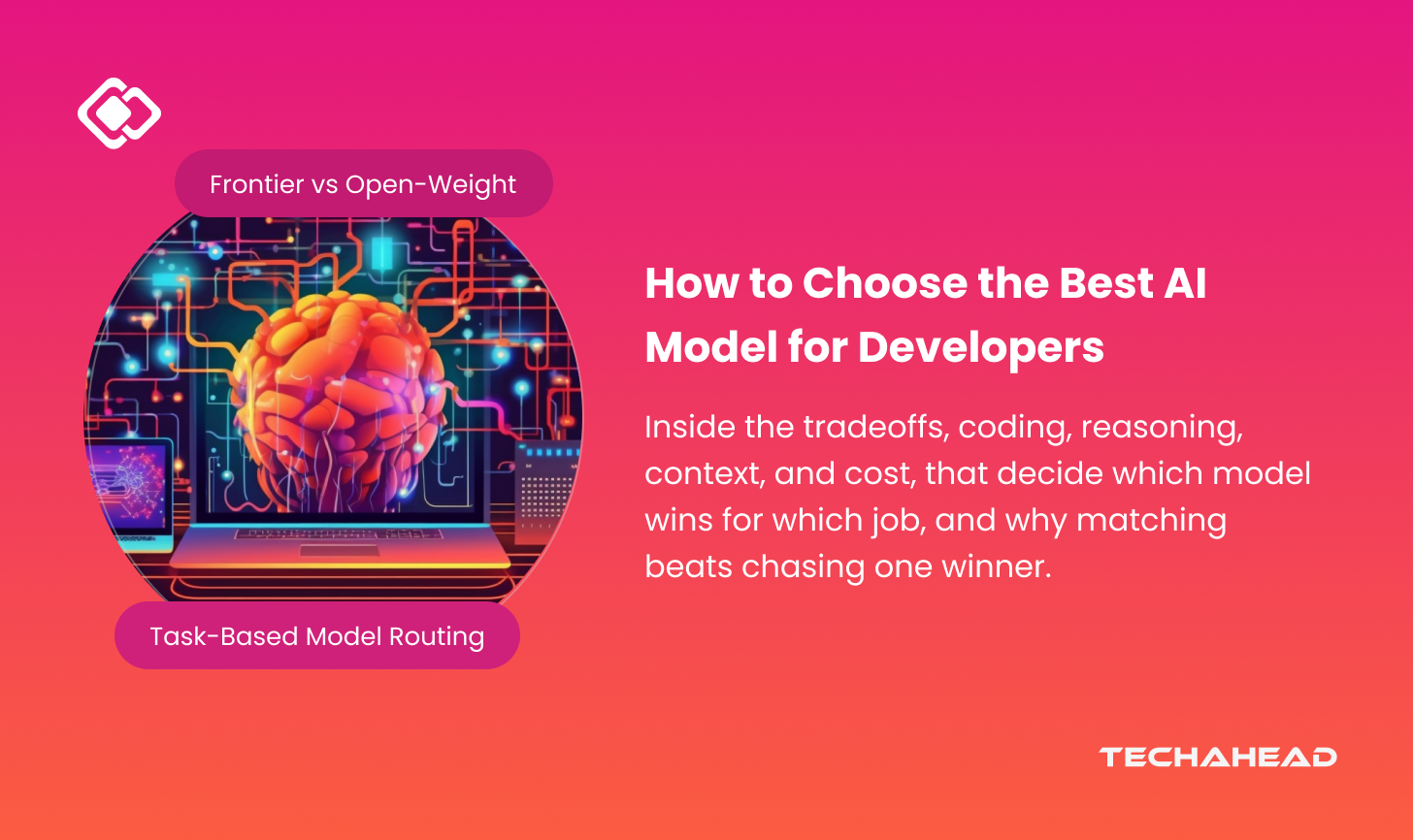
If you have tried to pick a model for a real project this year, you already know the problem. There are too many good options, the leaderboards contradict each other, and every number you find is out of date by the time you have finished reading it. A benchmark that felt impressive in January looks ordinary by summer.
The pace is not your imagination. According to Stanford’s 2026 AI Index Report, performance on SWE-bench Verified, a test of whether a model can resolve real GitHub issues, climbed from roughly 60 percent to near 100 percent in a single year.
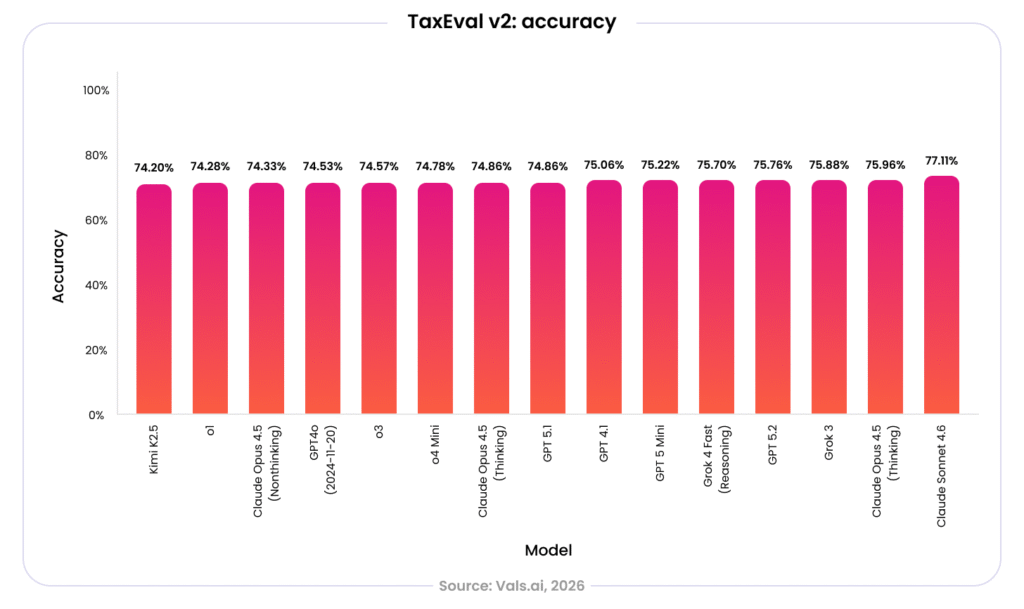
That kind of jump is why last year’s shortlist is useless today, and why picking the best AI models for developers has become less about finding the single smartest model and more about matching the right model to the work in front of you.
This guide does that matching. We cover coding, reasoning, tool use, multimodal ability, context window, latency, and cost, then we tell you which model tends to win for which job. If you are a developer choosing what to build on, or a CTO deciding where to place a bet, the goal is a credible shortlist you can act on without reading forty leaderboard tabs, along with the reasoning behind each call so you can adapt it as the landscape shifts.
Also Read: Claude Vs. OpenAI (Choosing the Best Model)
Before any table, it helps to agree on what you are comparing. Most teams overweight a single benchmark score and underweight the things that decide whether a project ships. Here is the short version of how to choose an AI model without getting lost.
Start with the task shape, not the leaderboard. A model that tops a coding chart may be overkill for classification and underpowered for a twenty-file refactor. Then weigh these dimensions against each other:
There is an eighth factor that rarely appears on a spec sheet and often decides the outcome:
Total Cost of Ownership
Sticker price per token is only the visible part. The real number folds in retries when a model fails a task, human review time when you cannot trust the output unattended, latency-driven churn in user-facing features, and the engineering cost of switching later if you pick wrong. A model that costs more per token but finishes reliably on the first attempt is frequently the cheaper choice once you count all of that.
One honest warning on benchmarks: The same model can post very different scores depending on the harness, meaning the scaffolding and agent setup used to run the test. Vendors publish numbers from their own tuned stacks, while independent leaderboards run every model through identical scaffolding and tend to report lower figures. Both are real. When you see a coding score, ask which harness produced it before you trust it, and treat any single number as one data point rather than a verdict. The official SWE-bench leaderboard is a useful neutral reference point.
This framework is also the difference between a model that demos well and one that survives production. Picking the model is only half the challenge. The same production discipline decides what happens once you put these models to work as agents across your development lifecycle, which we covered in AI in software development: what changes when agents join the SDLC.
Here is the current shortlist, as of July 2026. Prices are standard API rates per million tokens, input then output. Context is the input window. Read the notes column as the one-line reason to care. The table below highlights the key features that matter most when comparing these models for real development work.
| Model | Provider | Best for | Context (input) | Price in / out per 1M | License |
| Claude Fable 5 | Anthropic | Hardest reasoning and long-horizon agentic work | 1M | $10 / $50 | Proprietary |
| Claude Opus 4.8 | Anthropic | Premium agentic coding, reliable daily driver | 1M | $5 / $25 | Proprietary |
| GPT-5.5 | OpenAI | General agentic coding, tool use, computer use | ~1.05M | $5 / $30 | Proprietary |
| Gemini 3.1 Pro | Long context, multimodal, capability per dollar | 1M | $2 / $12, then $4 / $18 above 200K | Proprietary | |
| Claude Sonnet 5 | Anthropic | Balanced price to performance, high-volume production | 1M | $2 / $10 intro, then $3 / $15 | Proprietary |
| DeepSeek V4 | DeepSeek | Cost-sensitive workloads, self-hosting, data residency | Deployment-dependent | Low-cost hosted or self-hosted | Open weight |
| Qwen3-Coder | Alibaba | Open-weight coding agents, local development | Deployment-dependent | Self-host or low-cost API | Open weight |
Sources for pricing and context: Anthropic’s Opus page and pricing docs, OpenAI’s GPT-5.5 announcement and model docs, and Google’s Gemini API pricing. For the open-weight models, confirm current context limits and pricing on each project’s own page, since those change often and vary by how you deploy them.
Also Read: AI Development Guide 2026
At the top of the market, the honest answer is that no single model dominates everything, and the gaps are small. Stanford’s index documents the same convergence at the frontier. As of March 2026, the top four models sat within roughly 25 Arena Elo points of each other, and the US-China performance gap had narrowed to about 2.7 percent, which is why competition is shifting toward cost and reliability rather than raw capability.
That is good news for buyers, because it means price and fit matter more than chasing the number one slot. It also means the smarter question is not “which model is best” but “which model is best for this specific job at a price I can defend,” which is also how most teams end up defining the best AI coding model for their environment.
Claude Opus 4.8 has become many teams’ default for serious coding and agentic work. Anthropic positions it as a daily driver for software engineering, and its own release notes highlight better judgment in long, multi-step tasks, the kind where a model needs to catch its own mistakes and push back on a shaky plan rather than barrel ahead. It ships with a 1M token context window and sits at $5 input and $25 output per million tokens.
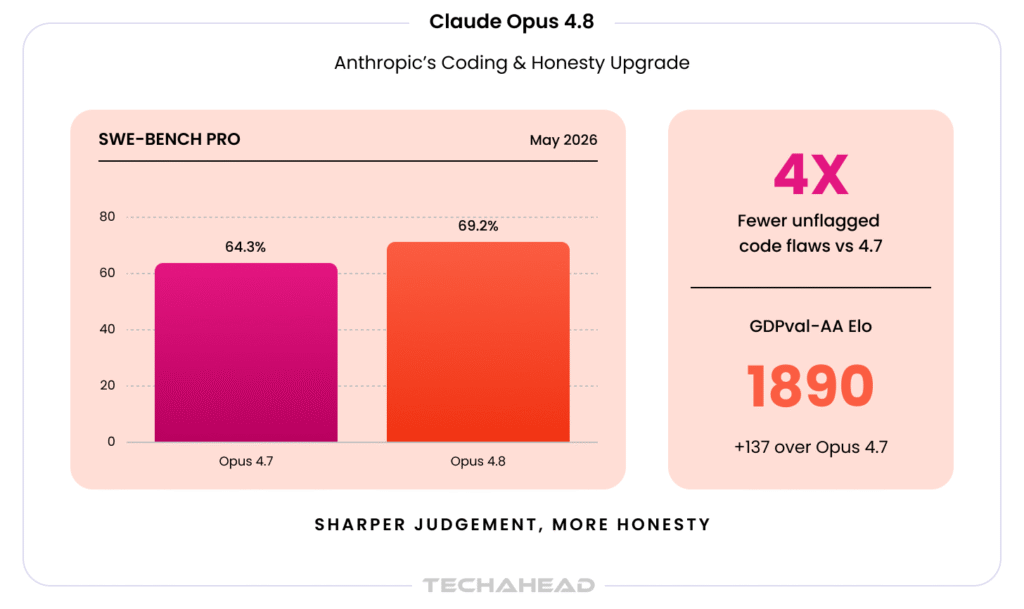
For a lot of production teams, this is the sensible center of gravity: strong enough for the hard work, priced below the very top tier, and reliable enough to leave running on long tasks without constant supervision.
Fable 5 sits above it as Anthropic’s most capable widely available model, aimed at the hardest reasoning, where advanced reasoning is most useful for system design and other planning-heavy work, and long-horizon agentic jobs, priced at $10 input and $50 output per million tokens with the same 1M window. Worth knowing if you are evaluating it: access was briefly suspended in June 2026 under a US export-control directive and restored on July 1. It is powerful, but the premium only pays off when a single avoided failure in an agent loop is worth more than the extra token cost.
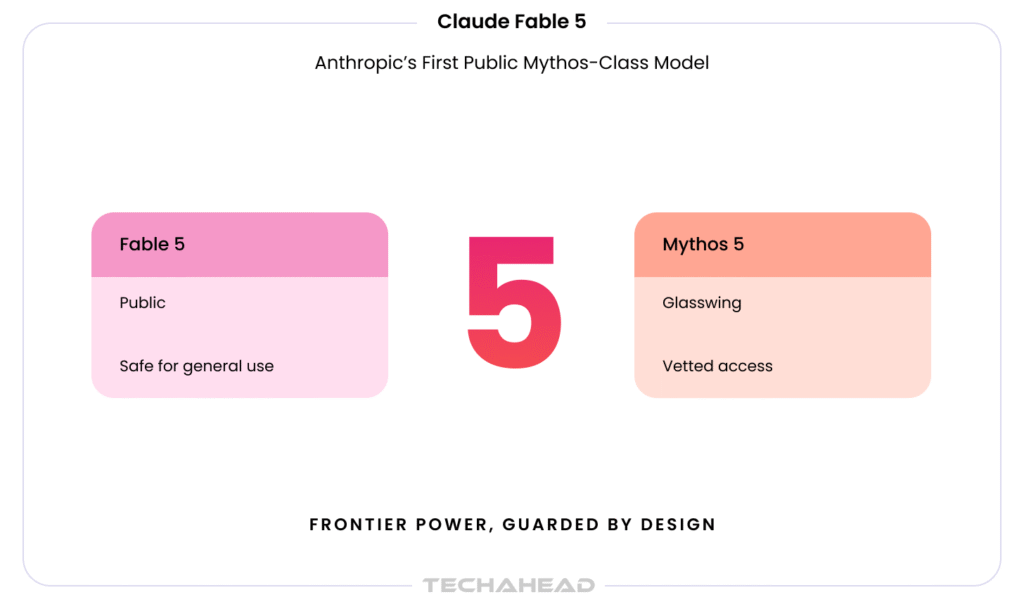
A useful rule of thumb: reserve Fable 5 for the steps where an error is genuinely expensive, and fall back to Opus 4.8 for everything else in the same workflow. For most day-to-day work, Opus 4.8 is the more economical pick.
GPT 5.5 is OpenAI’s frontier model for complex professional work, and it is especially strong at agentic coding, computer use, and moving across tools until a task is done, per OpenAI’s own announcement. It carries a context window of just over 1 million tokens and is priced at $5 input and $30 output per million. If your stack already lives in the OpenAI ecosystem, or you lean heavily on terminal and computer-use workflows, this is a natural first choice.
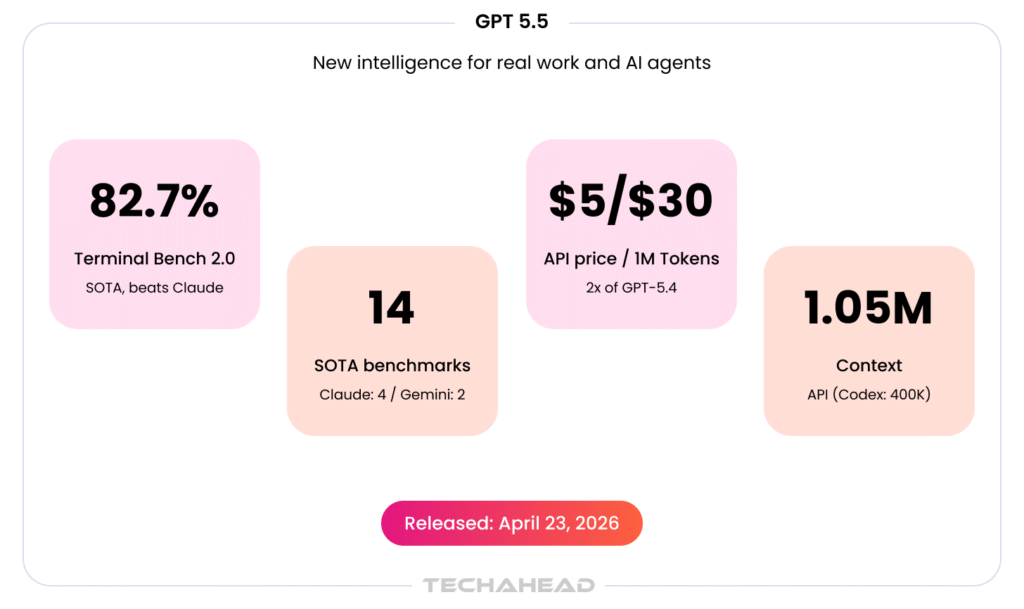
Its ecosystem maturity, with well-worn SDKs and tooling, is a real advantage that does not show up in a benchmark but shortens the distance between idea and working feature, with solid support inside the code editor workflow through integrated tooling, though GitHub Copilot remains widely adopted for real-time code support across teams.
Gemini 3.1 Pro is the value story at the frontier. Google prices it at $2 input and $12 output per million tokens for prompts up to 200K, stepping up above that, which undercuts the other flagships meaningfully. It is natively multimodal across text, images, video, and code, and Google documents a 1M token context window; for enterprise users, Gemini Code Assist is Google’s developer-facing layer on top of that stack. It supports AI-powered development through Google’s developer tooling layer.
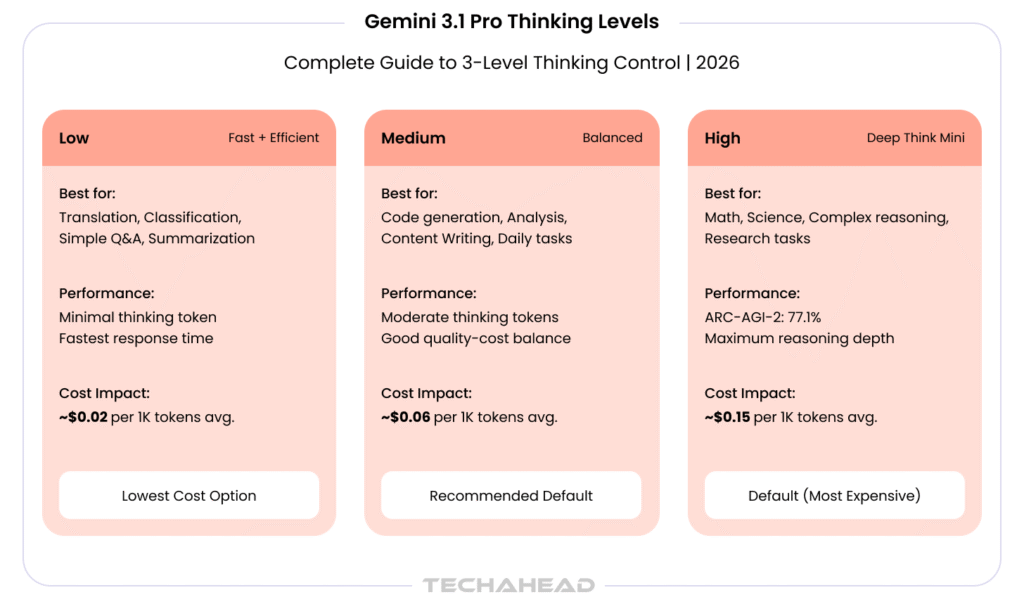
It integrates with Google Cloud for enterprise use and emphasizes enterprise-grade security and compliance. If your workload is document-heavy, multimodal, or simply cost-sensitive at the frontier, it earns a serious look.
These brand-name models are not all the same kind of system underneath. Coding assistants, reasoning models, small on-device models, and action-focused agents are architecturally distinct, and knowing which type fits which job is its own skill. We mapped out the main categories in 8 types of LLMs powering modern AI agents. Teams building custom generative features on top of these models can see how we approach it on our generative AI practice page.
Architectural differences, including a MoE model design, can help explain why frontier systems vary in efficiency and coding performance.
Not every task needs a frontier model, and paying frontier prices for classification or routine summarization is how AI budgets quietly balloon. This is where the mid-tier earns its keep, and where a good AI model comparison saves real money.
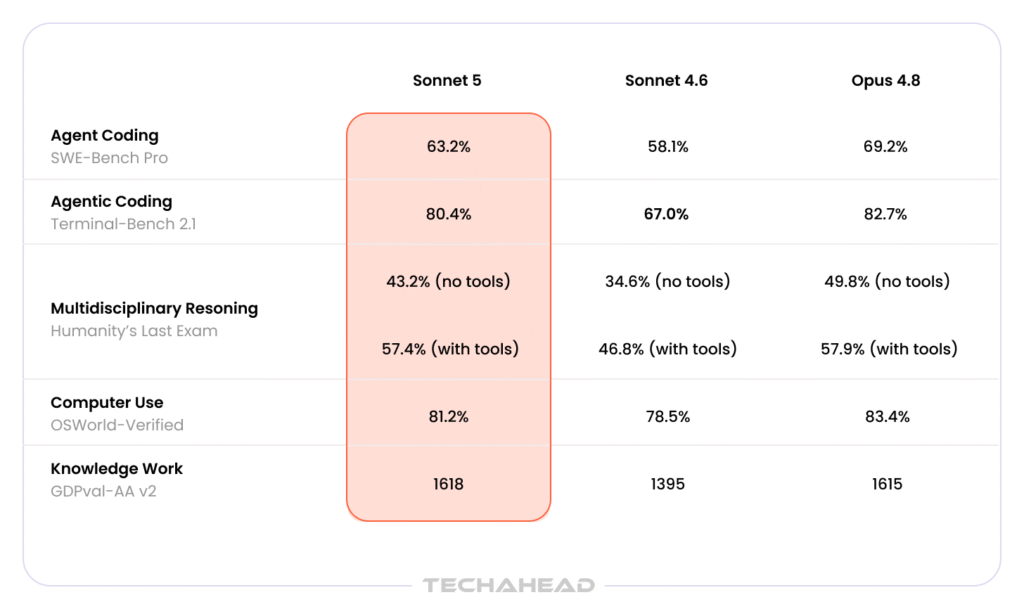
The broader point holds across every provider: route the hard problems to a frontier model and everything else to a cheaper one. Model routing, rather than standardizing on a single expensive model, is one of the highest-leverage cost decisions a team makes, and enterprise teams often mix different coding models based on task difficulty and cost.
In practice this means classifying incoming work by difficulty and sending each class to the cheapest model that can handle it reliably, then escalating only when a task genuinely needs more capability. Teams that do this well often cut their model spend substantially without any drop in output quality, because most production traffic turns out to be routine. When you need engineers who can design that routing logic and wire it into a real product, that is what our AI developers do day to day.
When teams are testing options, it is also worth checking whether a free tier exists. Many providers reserve some advanced features for higher-priced plans, so cost comparisons should include capability tiers rather than token pricing alone.
Related: Hire OpenAI and Claude FDEs
Closed frontier models are convenient, but they are not always the right call. Two situations push teams toward open weights. The first is data residency, where sensitive code or regulated data cannot leave your network, which is common in finance, healthcare, and government work, so some teams also weigh local AI models or self-hosted assistants for privacy and compliance. The second is cost at extreme scale, where hosted API pricing stops making sense and running the model on your own hardware pays for itself.
The encouraging trend here is real. Stanford’s index reported that open-weight models have nearly closed the gap with closed ones, shrinking a performance difference that used to be wide down to a small margin in a single year.
DeepSeek V4 is the headline example, an open-weight model with very low hosted pricing and the option to self-host. Qwen3-Coder from Alibaba targets coding agents and local development specifically. Tabnine also offers on-premises deployment for regulated industries and privacy-focused teams handling sensitive data. Qodo can run in private cloud environments for tighter data control.
Also Read: Private Cloud for AI Workloads
| Name | Type | Deployment | Licensing / Access | Standout Strength |
| DeepSeek V4 | Open-weight model | Self-host or low-cost hosted API | Open weights | Frontier-adjacent capability at very low cost |
| Qwen3-Coder | Open-weight model | Self-host, local, or hosted | Open weights | Coding-specialized, strong for local and agentic dev |
| Tabnine | Commercial coding assistant | SaaS, on-premises, or air-gapped | Paid subscription (per seat) | Air-gapped deployment for regulated, privacy-strict teams |
| Qodo | Commercial code-integrity platform | SaaS or private cloud | Freemium plus paid tiers | Test generation and code review with tighter data control |
Open weights are not a free lunch, and this is where teams most often underestimate the bill. Choosing to self-host means you own the infrastructure:
Self-hosted options are often weighed alongside AI coding assistance tools built for regulated or controlled environments.
Open weights make the most sense when you have either a hard data-residency requirement that leaves no choice, or enough scale that the savings clearly justify the operational investment. In regulated fields like finance, that same logic pushes teams toward smaller, purpose-built models for cost, speed, and auditability, a tradeoff we covered in AI risk modeling with SLMs in financial services.
If you want the short answer for a specific job, here is the routing most teams land on. Treat these as starting points, not verdicts, and validate against your own workload.
| Model | Best Role | Agentic Coding | Image Input | Context | Price (in / out per 1M) |
| Claude Fable 5 | Premium, high-stakes | Top tier | Yes | 1M | $10 / $50 |
| Claude Opus 4.8 | Everyday frontier | Top tier | Yes | 1M | $5 / $25 |
| GPT-5.5 | OpenAI-native, terminal | Top tier | Yes | ~1.05M | $5 / $30 |
| Gemini 3.1 Pro | Long context, multimodal | Strong | Yes | 1M | $2 / $12 (up to 200K), then $4 / $18 |
| Claude Sonnet 5 | Balanced production | Strong | Yes | 1M | $2 / $10 intro, then $3 / $15 |
| DeepSeek V4 | Self-host, data residency | Capable (open) | Yes | Deploy-dependent | Low-cost / self-hosted |
Stronger tools can also trace dependencies across services during refactoring, which matters more in larger systems. Specialized tools like Snyk Code focus on security scanning for vulnerabilities, while broader assistants cover wider coding workflows.
One more layer worth understanding if you are building agents: how models talk to tools and to each other is becoming its own design decision. As multi-agent systems move from experiments to production, the way agents coordinate turns into an architectural choice with real consequences for reliability and cost. We compared the emerging standards in MCP vs A2A vs ACP: AI agent interoperability standards. Getting those coordination and reliability decisions right is the hard part of moving agents into production, which is the core of our agentic AI development work.
Here is the part that separates a developer’s model preference from a CTO’s decision. The best AI models for software development in a benchmark are not automatically the best models for your production system. A model that scores well on public tests can behave very differently on your private, messy, real-world code. Independent testing has repeatedly shown that models topping public leaderboards do not always lead on unseen proprietary codebases, and the drop can be significant once a model faces code it was never trained on.
Fit also depends on where your team actually works, since the development environment can matter as much as the model. A few practical differentiators worth weighing:
So the enterprise AI model comparison that matters is not the leaderboard. It is the evaluation you run on your own repositories, with your own tasks. And it should measure more than accuracy:
A cheaper model that finishes the job on the first try often beats an expensive one that needs three attempts. Model choice is only part of it. What separates a demo agent from a production one is often scope, not raw intelligence, since narrow, well-defined agents survive real conditions where sprawling do-everything agents stall, a theme we explored in agentic AI in production: narrow vs broad agents.
The most useful evaluation you can build is a small, representative set of real tasks from your own backlog, scored the way you actually care about, run against each candidate model under the same conditions. That kind of internal benchmark predicts production behavior far better than any public score, and it takes surprisingly little time to set up relative to the cost of choosing wrong. It is also worth assessing your code review workflow, not just the model, since a tool like Qodo brings automated test generation and documentation into that process for assistants built around existing code. The best tools for development teams tend to support collaborative coding as well as individual productivity.
This is exactly where most AI initiatives stall. The model works in a notebook and then fails to reach production, undone by edge cases, latency, integration friction, or costs that only appear at scale. We wrote about why that happens, and how to avoid it, in why enterprise AI development pilots fail to reach production.
Choosing well also means building responsibly from the start. As a company that builds AI systems for regulated industries, TechAhead holds a set of credentials that reflect real operational discipline rather than decoration:
Those standards reflect the security, governance, and quality discipline that decides whether a model you picked in a benchmark becomes a system you can actually run in front of real users and auditors. For teams in regulated fields, that readiness is what turns a promising model into one that survives compliance review, with the audit trails and documentation those environments demand. If you are past the evaluation stage and need to turn a model choice into a shipped product, an AI development company can help translate evaluation results into a secure, governed, and production-ready implementation. That is the core of TechAhead’s AI development practice.
The single most useful habit in this space is to hold your conclusions loosely. The market for the best AI coding tools reshuffles constantly, prices change, and a model that was clearly best in one quarter is merely competitive the next.
For your own decisions, the durable advice outlasts any specific model name.
Get those four habits right and the specific model you pick this quarter matters far less than the discipline you bring to picking it. When you are ready to turn that decision into something real, our AI development team is built for precisely that handoff, with effective adoption depending on practical AI assistance across the full development workflow, not just benchmark wins.
There’s no single winner. The best AI models for developers depend on the job: Claude Opus 4.8 or GPT-5.5 for heavy agentic coding, Gemini 3.1 Pro for long-context and multimodal work. Match the model to the task, not the leaderboard.
Start with the work, not the hype. Weigh coding quality, reasoning, tool use, context window, and latency against each other, then test your shortlist on your own repositories. Those AI model selection criteria matter far more than any single benchmark.
Honestly, no. The frontier has converged, so the best LLMs for coding now sit within a fraction of a point of each other. The smarter question is which model fits which task, which is why routing beats standardizing on one.
Trust them, but read the fine print. LLM benchmarks for coding like SWE-bench Verified vary a lot by test harness, so vendor scores run higher than standardized ones. Treat any single number as one data point, then validate on your own code.
For whole-repo work, reach for the 1M-context models. Gemini 3.1 Pro and the Claude lineup can each hold an entire codebase in a single prompt, though strong context management and dependency awareness matter just as much as raw window size.
Lead with governance, not raw capability. In regulated fields, data residency, audit trails, and human oversight often decide the model before performance does. TechAhead builds AI for regulated industries under ISO 42001 and SOC 2 Type II, where that discipline is the real differentiator.
It depends on your constraints. Proprietary frontier models are convenient, but open-weight options like DeepSeek V4 win when data-residency rules or extreme scale push you toward self-hosting. Just remember you then own the hosting, scaling, and security burden yourself.
Because a benchmark isn’t your codebase. Models that top public leaderboards often stumble on private, messy, real-world code, undone by edge cases, latency, or integration friction. It’s exactly the gap TechAhead focuses on when moving AI pilots into production.
Use several, in most cases. Enterprise teams rarely standardize on one model; they route hard problems to a frontier model and lighter work to cheaper ones. That routing, backed by a real AI model comparison, is one of the highest-leverage decisions you’ll make.
Picking the model is the easy part. The real work is the governance and evaluation discipline that turns a promising model into a system users and auditors can trust. That handoff is the core of TechAhead’s AI development practice.
We use cookies to ensure our website functions properly, improve performance, and provide a personalized experience. You can choose which types of cookies to allow below.
Required for core functionality such as security, network management, and accessibility. These cannot be disabled.
Help us understand site traffic and user interactions so we can improve performance and usability.
Enable enhanced functionality and personalization such as language or region preferences.
Used to deliver relevant ads, track campaign performance, and measure advertising effectiveness.