


 Copy Link
 Share on X
 Share on Facebook
 Share on LinkedIn
Always Active
Required for core functionality such as security, network management, and accessibility. These cannot be disabled.

Uncover the transformative potential of digital and mobile solutions for your industry.





 Last Updated: Sep 18, 2026
Aug 27, 2026
Last Updated: Sep 18, 2026
Aug 27, 2026  317
317  24 min. Read


Key Takeaways
Pharma has never been short on ambition for artificial intelligence. What it has been short on is a clear answer to a question:
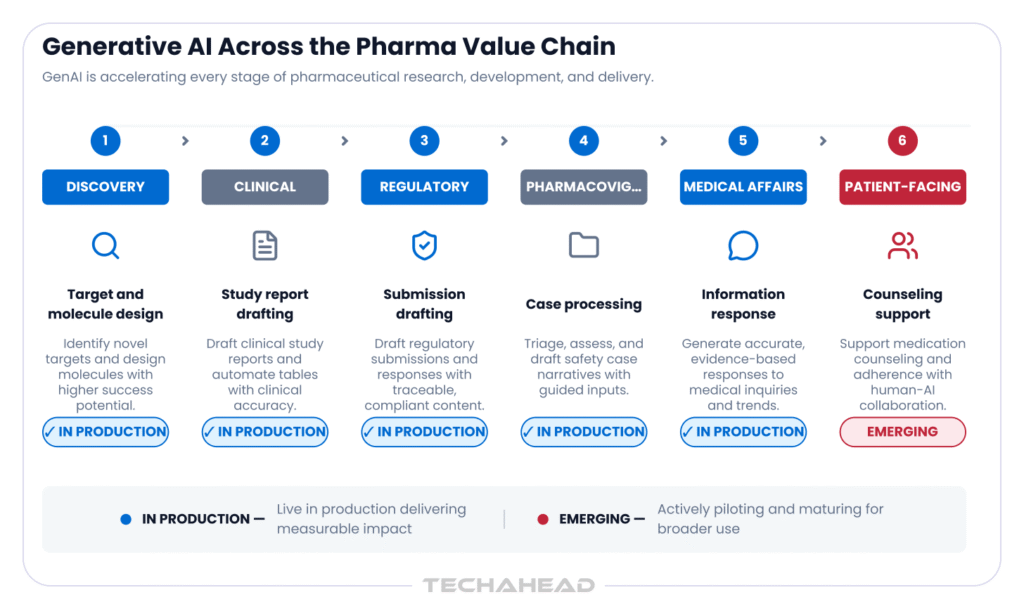
Where does generative AI in pharma actually fit into work that is bound by evidence, review, and accountability at every step? In practice, generative AI in pharma is used to prepare drafts, assemble evidence-based summaries, and coordinate regulated workflows across drug discovery, clinical study report authoring, regulatory submission drafting, pharmacovigilance, medical affairs, and patient counselling.
The value shows up only when the technology is tied to a specific workflow, a defined output, and a named person who signs off before anything moves forward.
That distinction is the whole game. As of mid-2026, roughly 80 percent of enterprises are expected to have used generative AI in some form, and analysts place the potential annual value of the technology to pharma in the tens of billions of dollars (McKinsey).
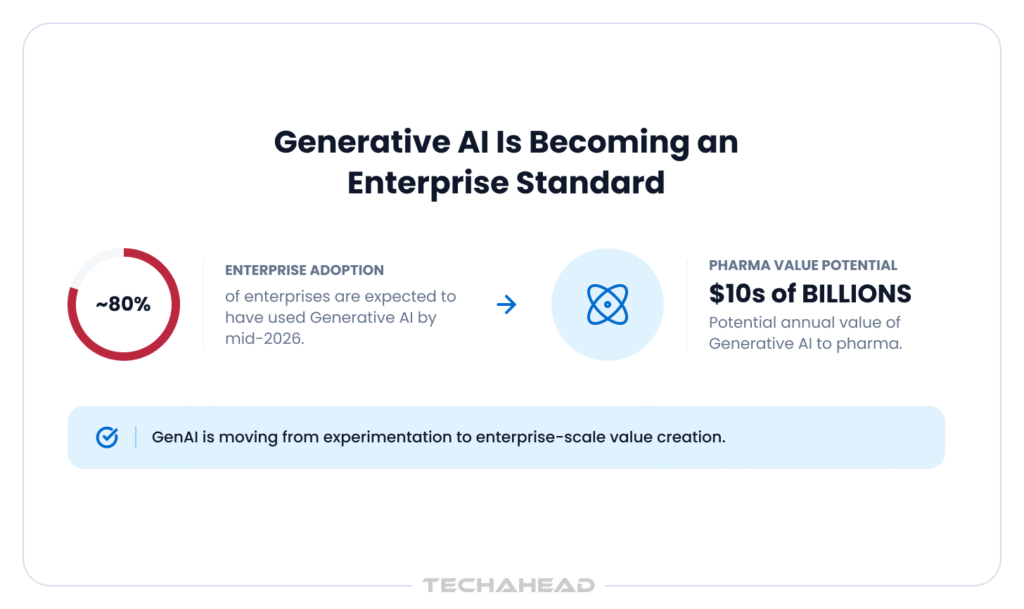
But that value is not evenly distributed, and it is not automatic. It accrues to pharmaceutical organizations, healthcare and life-sciences enterprises, and technology leaders that need production-grade AI systems with governance, security, traceability, and human oversight inside regulated processes. Those are the teams that can reduce manual effort in document-heavy work, improve speed and accuracy, and still meet compliance requirements. It also accrues to the teams that treat generative AI as an engineering problem, not a magic trick, and that is exactly how a generative AI development partner has to approach it.
This guide walks through the use cases that have real deployments behind them, the operating model that keeps humans accountable, the governance and regulatory frameworks that shape adoption, the engineering constraints such as hallucinations and data scarcity, how to prioritize AI deployment across the pharma value chain, and where the field is heading through 2027.
Must Read: GenAI in Healthcare
The bottleneck in most pharma functions is not creativity, but reconciliation. Clinical, regulatory, quality, safety, and medical teams spend enormous stretches of time gathering evidence scattered across protocols, study reports, batch records, and standard operating procedures, then turning it into something structured enough to review.
Traditional automation handles the predictable parts, such as field validation and rules-based routing, but falls apart when the task requires reading and interpreting narrative sources. Generative AI extends what can be supported, because it assembles, summarizes, and drafts from approved material and points back to the evidence it used. That is why it lands hardest where expert time goes to preparation rather than judgment, and why getting your data foundations right separates working systems from expensive experiments. In a regulated setting, a drafted output that cannot be traced to its sources is worse than none at all.
Must Read: AI Ready Data (The Missing Layer Between Demos & ROI)
It helps to be concrete about where the pressure sits. Three kinds of work absorb most of the expert hours that generative AI can give back:
Generative AI supports the first two by preparing drafts and summaries, and agentic systems support the third by packaging each issue with its background and a recommended next step. In every case, the pattern holds: the technology compresses the preparation, and the accountable expert keeps the decision. That is what makes the difference between a tool a regulated team can actually adopt and one that sits unused because nobody can stand behind its output.
Bonus Read: Use Cases of Agentic AI Across Industries in 2026
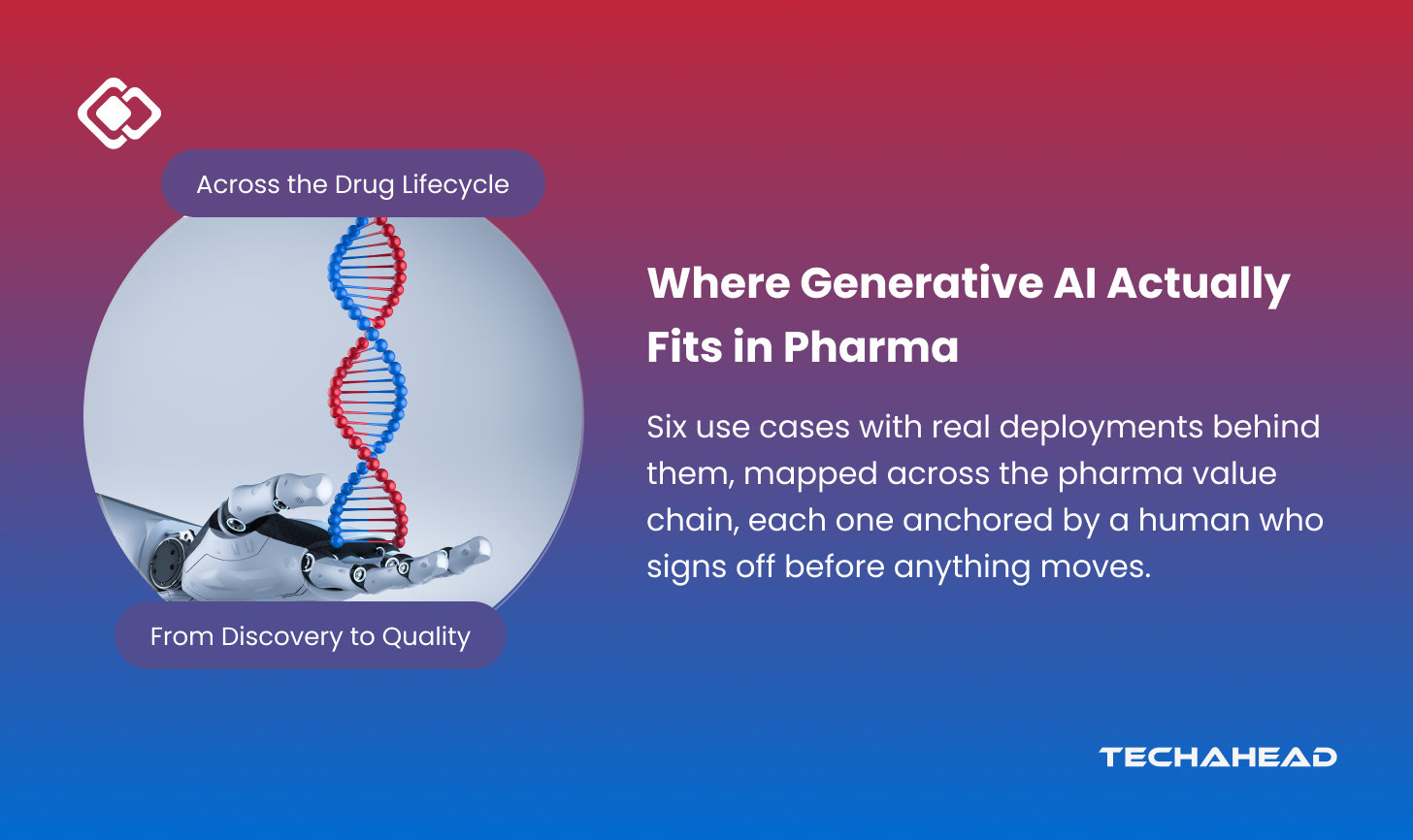
The most useful way to see generative AI use cases in pharma is to follow the drug lifecycle, because that is how the industry itself is organized and where the work actually changes. Each use case below has a real deployment or study behind it:
Insilico Medicine designed rentosertib, a treatment for idiopathic pulmonary fibrosis, using its generative platform to both discover the target and generate the molecule, and in July 2026 the company moved the candidate into a Phase III trial (Noah AI). The Phase IIa data, published in Nature Medicine, showed a mean lung-function improvement of 98.4 mL against a placebo decline.
In the broader drug discovery process, AI models can analyze large biological datasets, propose novel molecular structures, predict how those structures interact with biological targets, and forecast absorption, distribution, metabolism, excretion, and toxicity profiles. They can also surface likely safety and efficacy risks before development, improve target selection through biomarker signals in clinical data, and suggest alternative therapeutic applications for existing drugs. It is, to date, the clearest proof that generative AI in drug discovery can carry a fully AI-originated molecule through meaningful clinical endpoints, and it broke a long stretch where AI claims went unconfirmed by human trial outcomes.
Medical writing is one of the heaviest manual loads in the pipeline. A McKinsey collaboration with Merck built an AI-supported platform that cut first-draft clinical study report writing time from 180 hours to 80 hours while reducing errors by roughly half (IntuitionLabs). The broader effect on clinical development is earlier, better drafting and review decisions that can reduce spending tied to failed studies.
Synthetic control arms generated through generative AI can also simulate patient populations in trial design. The pattern here is consistent: the system prepares the draft from locked data and the statistical analysis plan, and the medical writer verifies every claim before it advances.
Named pharma leaders are now on record using generative AI for regulatory writing rather than treating it as a side project. Teams at Eli Lilly and Novo Nordisk have described applying the technology to accelerate regulatory document production while holding to compliance requirements (Applied Clinical Trials). The work involves drafting sections from approved source documents and checking them against submission structures, with regulatory reviewers confirming content before anything is filed.
Case processing consumes up to two-thirds of a typical company’s drug-safety resources, which makes it the single largest cost driver in the function. In a Novartis causality study, AI assistance cut case processing time from days to hours (IntuitionLabs). Generative systems draft case narratives in regulatory-standard format and flag potential signals, while pharmacovigilance scientists review and approve rather than write from scratch.
This is a use case where agentic patterns matter, because the work is a chain of retrieval, drafting, and routing steps rather than a single action.
The move from experiment to enterprise scale is furthest along here. Pfizer, Novartis, Sanofi, GSK, and AstraZeneca have all shifted from small trials to enterprise-scale generative AI deployments for medical information, literature monitoring, and field-team enablement (IntuitionLabs). McKinsey estimates the medical affairs function alone could see 3 to 5 billion dollars in annual efficiency gains from the technology.
Generative AI is being tested directly in care settings under controlled study conditions. A cluster-randomized controlled trial run by the University of Petra evaluated generative AI for medication counselling and adherence in community pharmacies, completing in 2026 (ClinicalTrials.gov). The framing of the study is titled around human-AI collaboration, not replacement, which is the only posture a patient-facing use case can responsibly take. It can also analyze patient data to deliver actionable insights for personalized treatment, predict treatment response to improve patient outcomes, and support personalized medicine through targeted therapies.
Building assistants like these well means designing them the way any enterprise assistants and chatbots should be built, with grounding, guardrails, and validation rather than raw model output.
Also Read: 2026 Health IT Trends
Across all six, the pattern holds: the system prepares, a qualified person decides, and the earliest wins cluster where work is high in volume and rich in documents. The table below shows where each sits today.
| Lifecycle stage | Primary use case | Real-world reference point | Maturity |
| Discovery | Target and molecule design | Insilico rentosertib, Phase III (2026) | Clinical-stage proof |
| Clinical | Clinical study report drafting | McKinsey-Merck platform, 180 to 80 hours | Enterprise use |
| Regulatory | Submission section drafting | Eli Lilly, Novo Nordisk regulatory writing | Enterprise use |
| Pharmacovigilance | Case processing and narratives | Novartis causality study, days to hours | Enterprise use |
| Medical affairs | Information response, literature monitoring | Pfizer, Novartis, Sanofi, GSK, AstraZeneca | Enterprise scale |
| Patient-facing | Medication counselling support | University of Petra RCT (2026) | Controlled study |
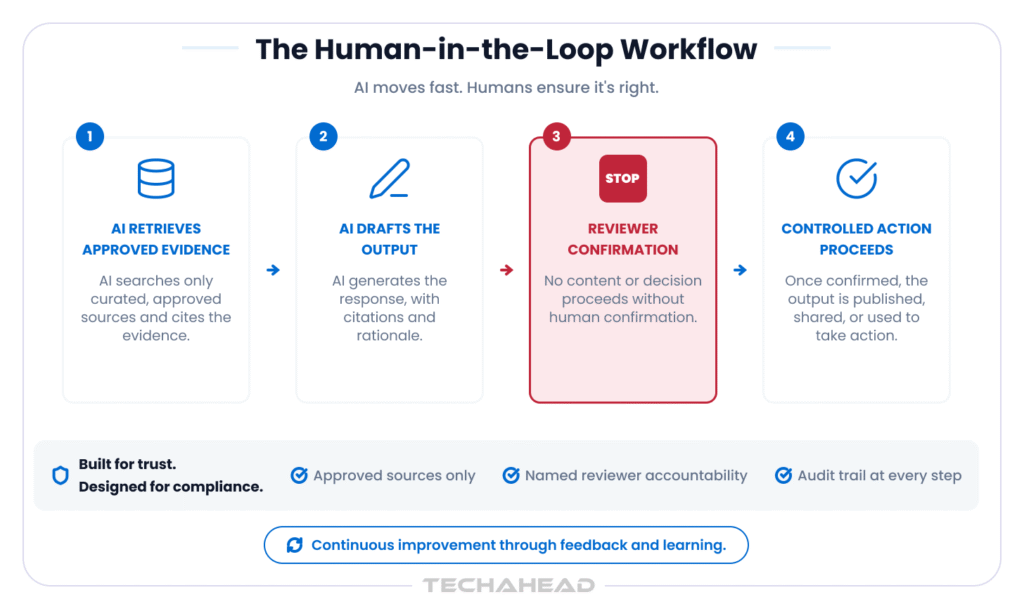
Use cases only become buildable when they are anchored to a workflow, so the operating model matters as much as the model. The operating model must also cover support functions beyond core R&D, including commercial operations and supply chain workflows. The organizing principle that holds across every pharma function is simple to state and hard to engineer: generative AI prepares the work, retrieves the evidence, drafts the output, and routes it to the accountable reviewer, and a named person confirms the evidence and wording before any controlled record changes or any external action is taken. That single control point is what separates a governable system from a chatbot operating outside approved processes.
Related Read: Model Intelligence is No Longer the Bottleneck
This is where agentic AI in pharma earns its place. A generative model drafts. An agentic system coordinates the steps around the draft so the human is handed a prepared package rather than a blank page:
The same retrieve-draft-route pattern also supports knowledge management, enterprise resource planning handoffs, and supply chain work such as demand planning and optimizing inventory levels.
The design question is not whether the agent can act, but where it must stop and wait for confirmation. Getting that boundary right is an operating-model decision before it is a technical one, and it is the difference between a system that speeds a team up and one that quietly introduces risk into a regulated workflow.
TechAhead’s work on ERIN, an award-winning agentic AI platform that has processed more than 1.1 million referrals out of over 2.2 million submitted, is a direct reference point. ERIN coordinates multi-step workflows and keeps humans in the decision loop, precisely the architecture a pharma safety-case or submission-readiness workflow requires. The domain differs, but the discipline of building agents that plan, retrieve, and route while leaving judgment to a person is the same. The agentic workflow patterns that make a referral platform reliable are what make a pharmacovigilance triage system trustworthy.
Building this in a regulated setting is not a generic software exercise. It requires a partner that understands both the AI and the constraints of the domain, which is why healthcare and life-sciences AI development is a distinct discipline rather than a coat of paint on a general model.
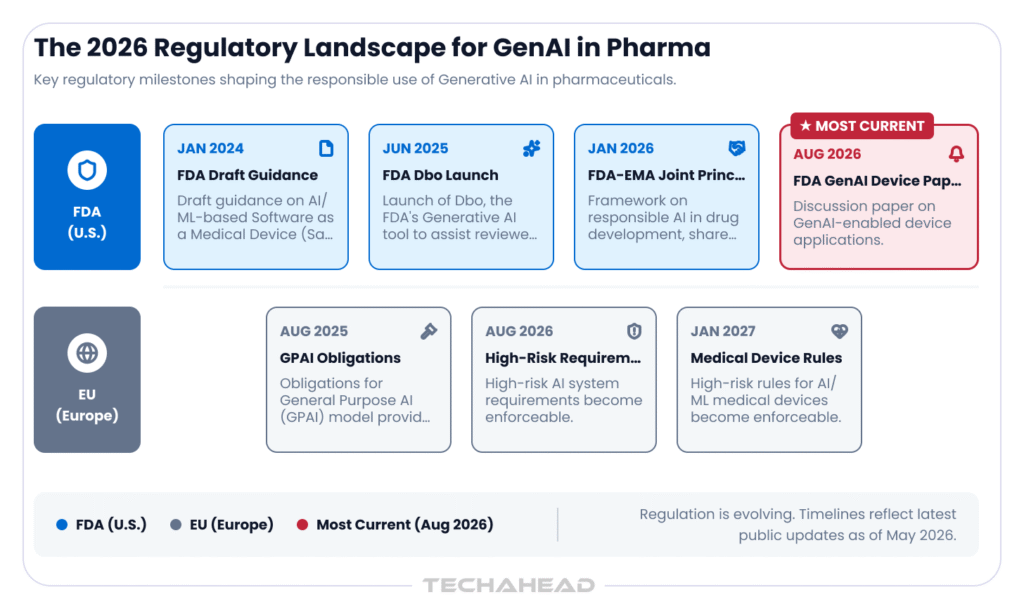
Governance is where a 2026 treatment of this topic either earns trust or loses it, because the regulatory ground moved this month. The timeline that any pharma AI system now has to be built against looks like this:
The direction is unmistakable. AI used in pharmaceutical development and safety is widely expected to fall into the high-risk category, which makes traceability, human oversight, and documented data governance not optional design features but regulatory prerequisites.
Also Read: Why Enterprise AI Needs Audit Trails
There is a signal worth reading in that Elsa entry above: regulators and industry are moving the same way, toward supported human review rather than autonomous decisions, and toward demanding evidence that a system does what it claims.
For any pharma organization, and for the Generative AI development partner building its systems, that sets a clear mandate: auditability, bias monitoring, and data-integrity controls belong in the design from the first line, not added once procurement asks, because the biggest challenges are not only compliance but also data security, data quality, integration, and governance at scale.
Model choice is part of that posture too, which is why questions about model provider partnerships and accountability are worth asking before a system is built, not after, and why leading organizations and leadership teams are treating governance as a design requirement from the start.
| TechAhead’s engineering discipline around regulated data reflects this. CloseLoops, a health platform TechAhead built for real-time data sharing between patients and doctors, was engineered with a data-management, data security, and cybersecurity spine because health data does not tolerate shortcuts. That same posture, security and compliance designed into the architecture rather than added late, is the baseline requirement for any generative system touching regulated pharma data. |
Also Read: AI Bias Audit
“In the pharma industry, the AI model itself is actually the easy bit. The real challenge is being able to show at any given moment, exactly what evidence a system used, who reviewed the final result, and the reasoning behind each decision. That’s why we build generative AI for regulated workflows with the audit trail baked right into the architecture, rather than having to piece it together later. We don’t view human accountability as an obstacle; it’s the cornerstone that our entire system is built around.”
— Deepak Sinha, CTO, TechAhead
The use cases are real and the deployments are named, but the biggest challenges are:
The use cases are real and the deployments are named, but the failure modes are just as real, and a development partner that glosses over them is not one worth trusting with a regulated system. Generative AI in pharma is hard for reasons specific to the industry, and four challenges do the most damage in production.
A model can produce plausible-sounding but incorrect output with unwarranted confidence. Where a fabricated dosage or a misstated safety finding can cause direct harm, that is not a cosmetic flaw. One evaluation of consultation transcripts using a leading model reported a 1.47 percent hallucination rate, with 44 percent of those errors classified as major and concentrated in treatment plans (arXiv). In addition, a 2025 cross-industry survey found 44 percent of organizations reported negative consequences from generative AI use, at average losses of 4.4 million dollars per incident (pharmaphorum). The answer is not to hope the model behaves. It is retrieval grounding so outputs trace to approved sources, output validation logic, and a human confirmation gate.
This is worse in pharma than almost anywhere. Training and grounding data is expensive to collect, constrained by privacy, and thin for rare diseases, with only about a quarter of pharmaceutical data estimated to be available for research (Binariks). It is also scattered across research papers, lab notes, and electronic records in formats that resist aggregation. This is why the unglamorous work of data engineering, ingestion, and pipeline design determines whether a system works at all, and why a retrieval architecture that grounds outputs in trusted records is the line between a usable system and a liability.
New tools alone solve nothing without the people and maturity to run them. A BCG roundtable of pharma R&D leaders found most generative AI efforts still sit at the pilot or proof-of-concept stage, spread across a wide maturity range (ScienceDirect). Data science talent stays in high demand, which makes building the capability in-house harder than it looks, and fragmented clinical data plus scarce internal expertise are what most often slow delivery to a crawl.
Non-representative training data can amplify demographic bias in ways that carry real clinical and ethical weight, and model performance degrades over time as data patterns shift. Both demand ongoing monitoring rather than one-time validation, which is precisely why governance has to be continuous and built into the system’s operation. The table below maps these core challenges to how they are engineered around in production.
Also Read: GenAI in Data Governance
The table below maps the core challenges to how they are engineered around in production.
| Challenge | Why it bites harder in pharma | How it is engineered around |
| Hallucination | Fabricated clinical facts can cause direct patient harm | Retrieval grounding, source citation, output validation, human confirmation |
| Data Scarcity and Fragmentation | Only about a quarter of pharma data is research-available; formats resist aggregation | Data engineering, ingestion pipelines, structured knowledge bases |
| Bias | Non-representative data amplifies clinical and demographic bias | Bias monitoring, representative datasets, evaluation across subgroups |
| Model drift | Performance degrades as data patterns change | Continuous monitoring, scheduled retraining, drift detection |
| Traceability | Regulators require proof of what evidence produced each output | Audit trails designed into the architecture, versioned data lineage |
None of these are reasons to avoid generative AI in pharma. They are the reasons the build has to be done by a team that treats them as first-order design requirements, and not like the edge cases that will be handled late
Not every use case deserves to be first, and one of the failures that quietly drains AI budgets in the pharmaceutical industry is treating a risk-bearing workflow like a simple drafting task. A workable way to prioritize is to score each candidate on three axes:
Companies should rank use cases by potential value, favor low risk starting points, and use support functions for early proof where appropriate.
The use cases that rank highest are usually the ones that are high-volume, evidence-rich, and have clean review boundaries, which is why clinical study report authoring, pharmacovigilance case processing, and regulatory drafting tend to surface first. The ones that need the most caution are those where an error carries direct patient or compliance consequences, because those demand the strongest oversight and the most rigorous validation before anything is entrusted to a system. The best genAI projects often begin in high-volume workflows that can show tangible value quickly and help reduce costs.
Cost belongs in the conversation honestly. Enterprise initiatives typically fall into planning bands that scale with complexity:
Where a given system lands depends on integration depth, data readiness, and security needs. And with 85 percent of top pharma executives now calling AI an immediate priority and over 80 percent increasing their AI budgets (IntuitionLabs, citing Define Ventures), the pressure to prioritize the right initiatives is only rising.
Understanding the true running cost of production AI matters as much as the build cost, since generative systems carry ongoing inference and monitoring expenses a one-time view misses. TechAhead’s delivery in regulated sectors, including pharmaceutical workforce software through platforms like Recrupharm, informs how these bands map to real scope, which is where a healthcare technology partner adds value before a model is selected.
The direction of travel through 2027 is reasonably clear, even if the pace is not. Three shifts stand out:
They will move from producing single outputs to orchestrating multi-step workflows across functions, which raises the engineering bar for orchestration, monitoring, and the placement of human control points; as digital transformations mature, biopharma organizations are already extending these systems into commercial teams and other support functions. Roughly 90 percent of biopharma companies surveyed by Deloitte aimed to reduce case processing costs, and agentic pharmacovigilance is one of the clearest near-term expressions of that pressure (IntuitionLabs).
The FDA’s August 2026 discussion paper, the finalization of its credibility guidance expected during 2026, and the EU AI Act’s 2027 medical-device provisions together mean the compliance bar for generative AI in pharma will be higher next year than it is today. Foundation-model accountability, still an open question in the FDA’s paper, is likely to become a defined obligation somewhere along the chain from model developer to system integrator, and new initiatives will require prompt engineering discipline and governance as AI capabilities expand.
The field is moving from text-only systems toward multimodal models that combine text, images, and omics data, and toward wider use of synthetic data to ease the scarcity and privacy constraints that limit pharma training sets. Both raise the engineering bar rather than lower it, because a multimodal system touching imaging and molecular data carries more validation surface, and synthetic data has to be generated and governed carefully to avoid encoding the very biases it was meant to sidestep. AI tools will keep improving, but human expertise remains essential to interpret outputs and act on critical insights.
Recent market data shows 85% of life sciences organizations increased AI investments, suggesting many are still early in the AI journey but accelerating quickly.
The organizations that benefit will be the ones that built for this trajectory rather than against it, treating governance as a design input and human oversight as the point of the system rather than a constraint on it. That is a build philosophy as much as a compliance stance, and it favors teams that ship production systems with life-sciences AI engineering discipline over those chasing capability alone. Eli Lilly’s reported 1.4 million hours saved through automation since 2022 is one clear example of the value that scaled execution can produce.
Generative AI in pharma rewards engineering discipline over enthusiasm. The use cases with real deployments behind them share a common shape: the system prepares, a person decides, and the evidence is traceable end to end. In a regulated environment, the right partner can jump start the AI journey and move teams beyond isolated pilots by treating security, governance, and human accountability as architecture rather than afterthought.
TechAhead builds generative and agentic AI systems for regulated and enterprise environments, and pharmaceutical companies often use strategic partnerships to accelerate commercial operations, support functions, and broader enterprise adoption. The governance credentials behind that work are the ones a pharma organization should expect from any team it trusts with production systems:
Leading organizations pair external partners with internal expertise and data science teams to scale genAI projects responsibly.
That combination of AI engineering and certified governance is the baseline, not the differentiator. If you are evaluating what to look for, our guidance on choosing a generative AI development company lays out the questions worth asking, and our broader healthcare technology work shows how we approach regulated delivery.
You can also review our full portfolio of client success stories to see how this discipline translates into shipped systems. When you are ready, a strategy conversation is the fastest way to map generative AI to your highest-value workflows so experienced partners can help pharma companies get therapies and operations to market faster by focusing on the highest-potential workflows first.
Yes, with conditions. The FDA’s 2025 draft guidance lays out a risk-based credibility framework, and its own tool Elsa shows regulators are on board. The catch: you need documented evidence your generative AI in pharma system performs reliably, plus human oversight on every output.
You validate it much like a lab assay: define acceptable error rates, test worst-case scenarios, and monitor for performance drift over time. Generative outputs carry a higher evidence burden than traditional AI because each one needs independent verification before anyone relies on it.
Honestly, it depends on the capability. Off-the-shelf tools rarely fit regulated workflows, and building in-house needs talent most teams lack. With digital and data science talent in high demand, many teams use strategic partnerships. When something is too strategic to rent but too urgent to wait on hiring, partnering with a specialized AI development company tends to win.
Most fail on sourcing strategy, not technology. Roughly 95 percent of enterprise pilots showed no measurable impact in one 2025 study, usually because teams picked a tool before defining the problem; the biggest challenges are often weak data maturity, unclear governance, and poor selection of low risk use cases with real potential value. The ones that work start with a few high-value use cases and measure a hard metric early.
Ask for the same evidence a regulator would: documented validation data, training-data provenance, and clear governance. A partner who can’t produce that, however polished the walkthrough, is a risk signal. TechAhead brings ISO 42001 and SOC 2 Type II discipline to exactly this kind of regulated build.
Always. Across every credible framework, the system prepares and a qualified person decides. That means AI drafts the case narrative or submission section, and a named reviewer confirms the evidence and wording before anything moves to a controlled record or a regulator.
You engineer around them rather than hope they vanish. Retrieval grounding ties outputs to approved sources, citation lets reviewers trace claims, and the human confirmation gate catches the rest. In pharma, an ungrounded generative system isn’t a shortcut, it’s a liability waiting to surface.
Increasingly, yes. If a prompt decides how GMP data gets analyzed or how a batch release is supported, it functions as controlled logic. That means version control, change management, and documentation, the same governance you’d apply to any validated component, regardless of it being plain language.
Realistically, months, not weeks, if it’s done right. Data readiness usually sets the pace, since generative AI in the pharmaceutical industry lives or dies on clean, well-governed source records. Enterprise resource planning and other system integrations often affect timing. Enterprise deployments often roll out in under eight months when the data foundation is already in shape.
The document-heavy, high-volume ones with clean review boundaries. Clinical study report drafting, pharmacovigilance case processing, and regulatory writing tend to surface first because expert time goes to preparation there. Support functions like knowledge management and commercial operations can also deliver early value. TechAhead typically maps these healthcare AI workflows against effort and readiness before a build starts.
We use cookies to ensure our website functions properly, improve performance, and provide a personalized experience. You can choose which types of cookies to allow below.
Required for core functionality such as security, network management, and accessibility. These cannot be disabled.
Help us understand site traffic and user interactions so we can improve performance and usability.
Enable enhanced functionality and personalization such as language or region preferences.
Used to deliver relevant ads, track campaign performance, and measure advertising effectiveness.