


 Copy Link
 Share on X
 Share on Facebook
 Share on LinkedIn
Always Active
Required for core functionality such as security, network management, and accessibility. These cannot be disabled.

Uncover the transformative potential of digital and mobile solutions for your industry.





 Last Updated: Sep 22, 2026
Jun 29, 2026
Last Updated: Sep 22, 2026
Jun 29, 2026  403
403  14 min. Read


Key Takeaways
Let’s be honest about what’s happening out there. You’re preparing to invest a substantial budget in a mobile app with AI features.
You’ve done your homework: Compared portfolios, asked about tech stacks, reviewed timelines, and negotiated pricing. You feel ready to make a decision.
Here’s what most app development companies won’t tell you: the technical build is rarely what kills an AI project.
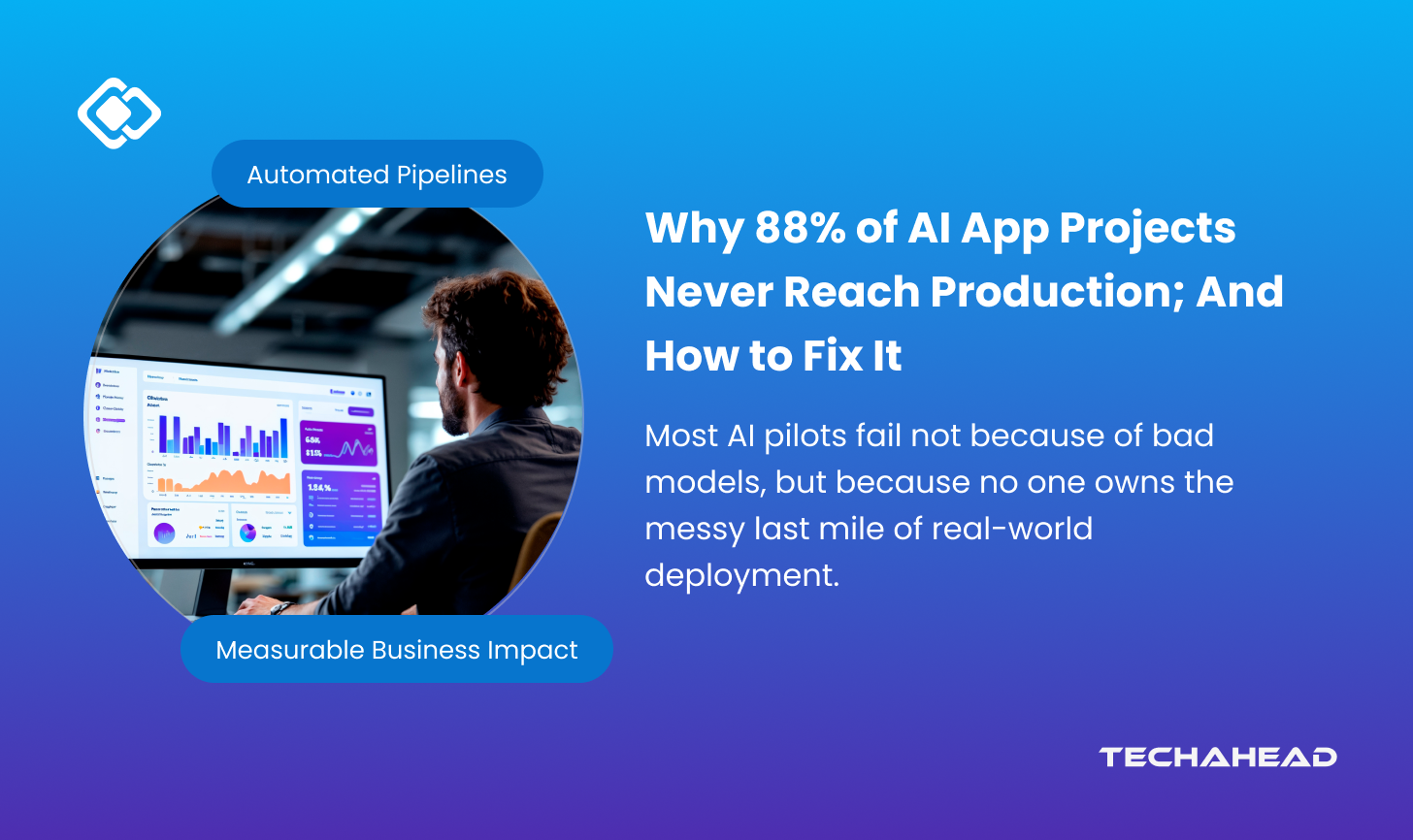
According to IDC’s AI CIO Playbook 2025, a study conducted with Lenovo across hundreds of enterprise AI initiatives, 88% of AI proofs-of-concept never graduate to full production deployment.
For every 33 pilots a company launches, only four make it out alive.
MIT’s Project NANDA found something even more sobering: 95% of generative AI pilots delivered zero measurable return on investment, not because the models underperformed, but because the deployment infrastructure, governance, and real-world integration were never part of the pilot scope.
“The model was fine. What wasn’t ready was everything around it, data access, workflow integration, compliance, and the gap between demo and production. That’s where the $547 billion leaked.”
This is called AI pilot purgatory: a project that neither gets cancelled nor shipped, perpetually extended, perpetually underfunded, existing as a demo that impresses the boardroom but never touches a real user.
McKinsey found that nearly two-thirds of organizations remain stuck there, unable to scale AI across the enterprise.
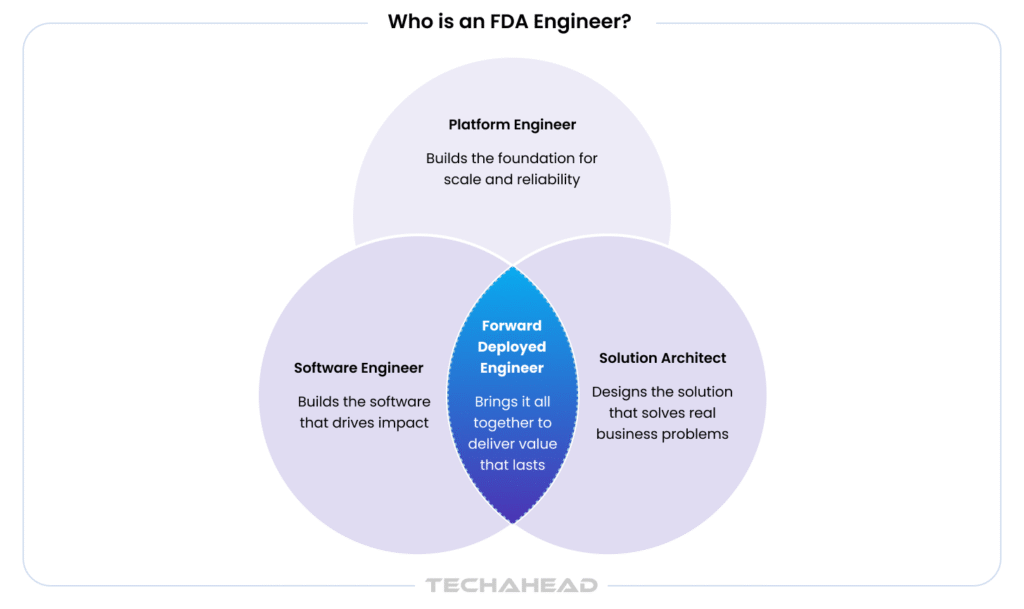
Who is an FDA Engineer?
Source: TechAhead AI Team
The failure isn’t about intelligence. The demos are often brilliant. The failure is about the last mile, the messy, unglamorous work of making an AI system actually function inside your specific environment, with your specific data, your specific compliance requirements, and your specific end users who weren’t involved in the design.
This blog is about the one role that solves that problem, why most app dev companies don’t have it, and exactly how to find the ones that do.
The Forward-Deployed Engineer (FDE) is one of the most consequential and least understood roles in enterprise technology. The term was coined by Palantir, which pioneered the model in the early 2010s for complex government and defense deployments.
Until 2016, Palantir actually had more FDEs than software engineers, a radical organizational bet on embedded field engineering that paid off and became the template for the AI era.
OpenAI formalized the role in 2023.
Anthropic, Databricks, Stripe, and Scale AI followed in 2024.
By September 2025, FDE job postings had surged 800% across major hiring platforms.
A16Z, the prominent VC firm, dubbed it “the hottest job in tech.”
There are now 224+ active FDE openings across 118 companies, including Palantir (51 open roles), OpenAI (31), Databricks (12), and Mistral (11).
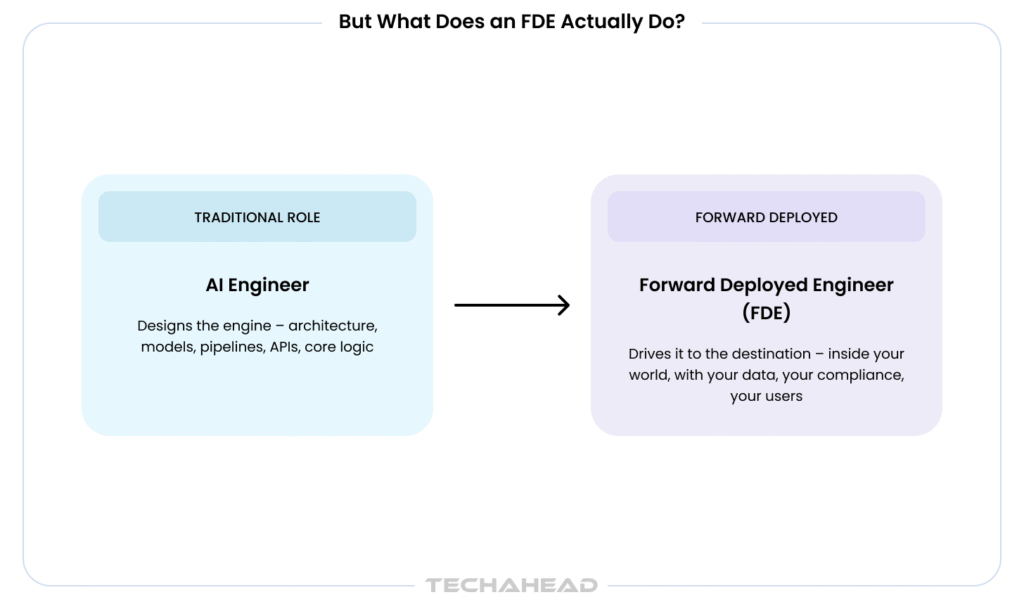
But what does an FDE actually do?
Source: TechAhead AI Team
The FDE’s core mission is simple to state and hard to execute: they own the deployment end-to-end inside your real environment. Not a handoff. Not a documentation package.
They physically (or virtually) embed with your team, understand how your systems connect, write integration code, navigate your security requirements, translate ambiguous field feedback into shipped features, and stay through adoption, until you can prove the thing actually works.
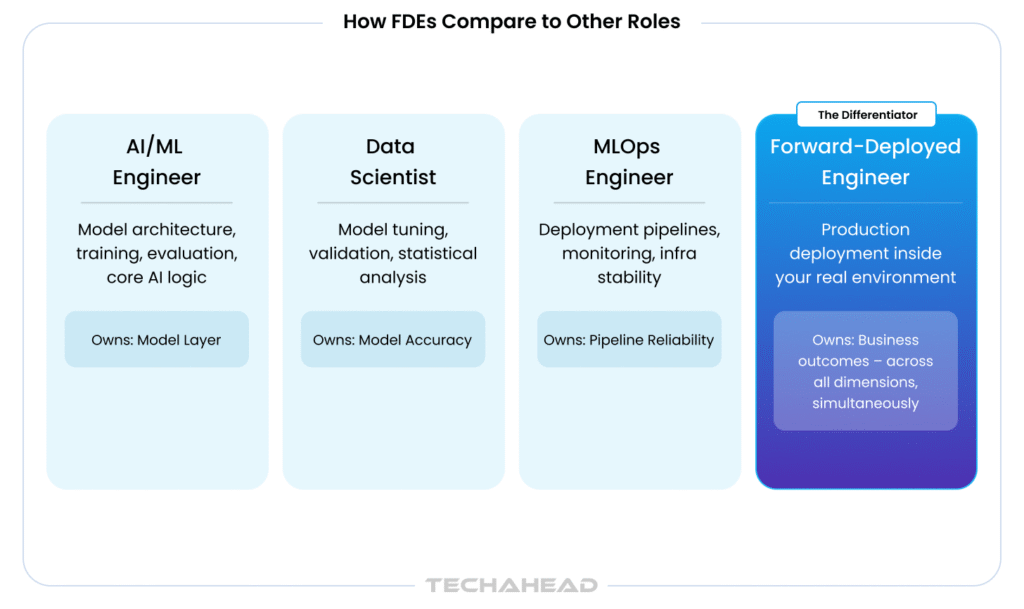
Source: TechAhead AI Team
Palantir’s “Delta”, their name for FDEs, passed the same technical interview as core product architects. They were not solutions consultants. They were engineers who happened to work inside a customer environment instead of a corporate campus. One former FDE spent three months on Airbus’s final assembly line. Others worked in airgapped military networks. That’s the profile: deep technical depth, extreme comfort with ambiguity, and the ability to produce something that functions in a broken, messy, real-world environment.
Understanding the failure patterns isn’t academic; it’s the exact thing you need to interrogate when evaluating your app development partner.
Each failure mode is predictable. Each one has a specific FDE solution.
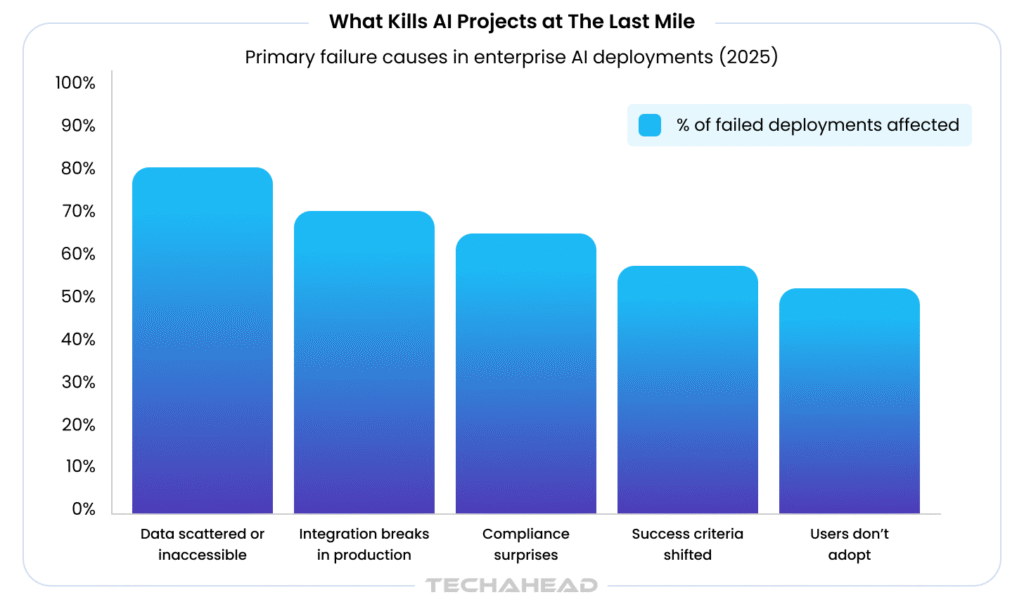
Source: TechAhead AI Team
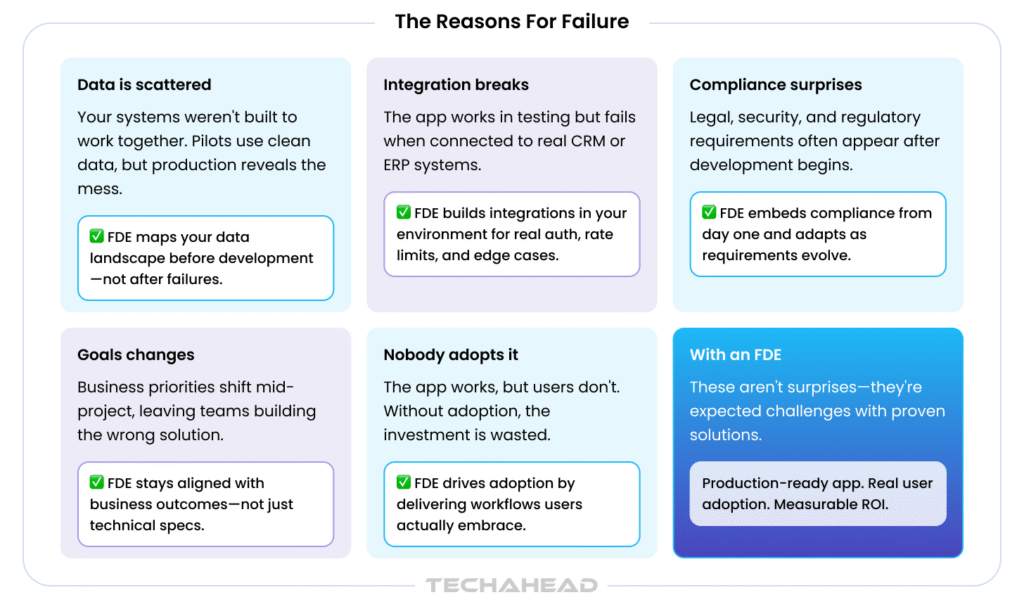
The Reasons For Failure (Source: TechAhead AI Team)
An AI Engineer can fix a broken pipeline. A Data Scientist can improve accuracy. An MLOps Engineer can stabilize deployment. But none of these roles are structured to sit inside your world and own the outcome across all dimensions at once. That’s precisely what the FDE does.”
When you’re evaluating mobile app development companies, the standard evaluation criteria, portfolio quality, team size, tech stack, pricing, timeline, are necessary but insufficient.
The question that separates the 12% who succeed from the 88% who stall is whether your partner has a dedicated FDE capability, or whether deployment is just “the last step” for their team.
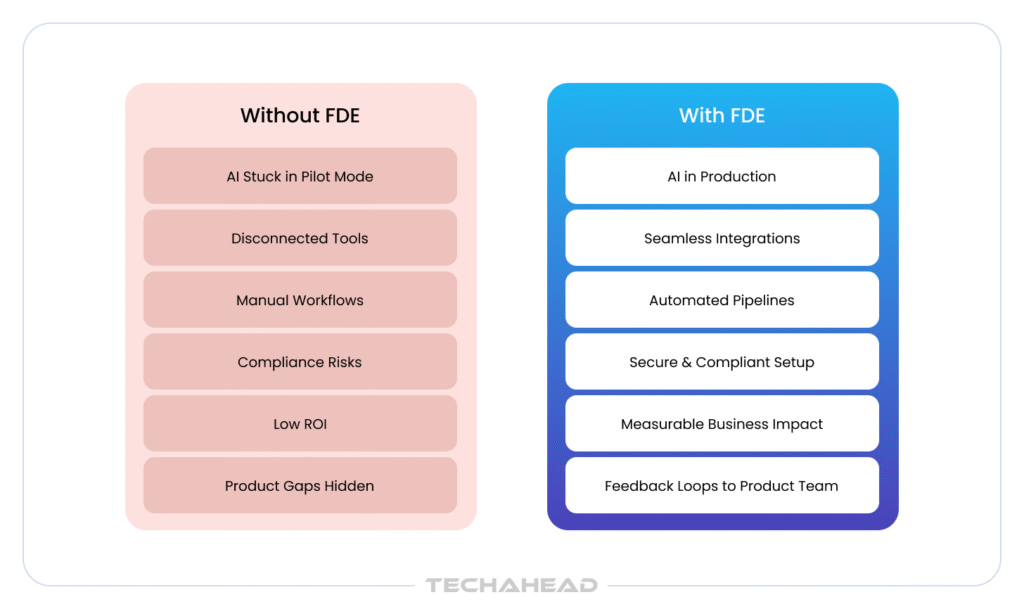
Source: TechAhead AI Team
Here are the critical five questions to ask every potential partner, along with exactly what their answers reveal:
Q1. “Do you have Forward-Deployed Engineers on your team?”
✅ “Yes, our FDEs own deployment end-to-end inside your environment”
Our Forward-Deployed Engineers work directly within your business environment to ensure successful deployment, integration, adoption, and long-term performance. They bridge the gap between technical implementation and business outcomes, taking responsibility for the entire journey from pilot to production. Instead of simply delivering software, they ensure your AI solution delivers measurable value.
❌ “We have AI engineers and MLOps, deployment is just the last step”
Many vendors view deployment as a final checklist item after development is complete. This approach often overlooks the operational, organisational, and integration challenges that emerge in real-world environments. As a result, projects frequently stall after launch despite having technically sound AI models.
Companies without FDEs treat go-live as the finish line. Companies with FDEs treat deployment as an engineering discipline.
Q2. “Who owns the outcome after your app launches?”
✅ “Our FDE stays with you 3-6 months post-launch to ensure adoption and ROI”
The real test of an AI application begins after launch. Our FDEs remain actively involved to monitor adoption, optimise workflows, address user feedback, and ensure the solution generates tangible business results. This ongoing partnership significantly increases the likelihood of long-term success and return on investment.
❌ “We hand off to your internal team after launch”
Traditional handoff models assume internal teams have the time, expertise, and resources to drive adoption independently. In reality, many AI projects lose momentum once the vendor exits. Without dedicated ownership, promising initiatives often struggle to achieve meaningful usage across the organisation.
Handoff is where AI projects go to die. FDEs ensure field-tested workflows move from discovery to real use.
Q3. “How do you handle integration with our existing systems?”
✅ “Our FDE maps your CRM, ERP, and databases, then writes integration code inside your security boundaries”
Enterprise AI only creates value when it works seamlessly with the systems your business already relies on. Our FDEs analyse your technology ecosystem, identify integration requirements, and implement secure connections across platforms. This creates a unified workflow that allows AI to operate within your existing business processes rather than alongside them.
❌ “We build the app, you handle integrations on your side”
Separating application development from integration often creates unnecessary delays, complexity, and operational risk. Internal teams are left to solve critical connectivity challenges without the original builders’ involvement. This frequently results in underutilised AI applications that never become part of everyday operations.
A standalone AI app that doesn’t talk to your existing systems is a demo, not a product.
Q4. “What happens when compliance requirements change mid-project?”
✅ “Our FDE owns the deployment layer and adjusts for compliance in real-time, it’s expected”
Regulatory requirements, internal policies, and security standards often evolve during enterprise AI deployments. Our FDEs work closely with compliance, legal, and security stakeholders to adapt deployments without disrupting business objectives. Compliance is built into the deployment process rather than treated as an afterthought.
❌ “That’s outside our scope, you’ll need to work with your legal team separately”
When compliance ownership is fragmented, projects slow down and risks increase. Critical decisions become delayed as teams coordinate across multiple vendors and departments. This lack of accountability often creates bottlenecks that can derail deployment timelines.
In regulated industries, compliance surprises are not surprises, they’re structural. Your partner needs to own this layer.
Q5. “How do you measure success for an AI app project?”
✅ “Success = measurable workflow improvement + working integrations + documented adoption rate”
We measure success based on business impact, not technical completion. That means tracking workflow efficiency gains, successful integrations, user adoption metrics, operational improvements, and return on investment. The goal is not simply to deploy AI but to ensure it becomes an indispensable part of your organisation.
❌ “Success = app delivered on time and within budget”
Delivering software on schedule and within budget is important, but it doesn’t guarantee business value. An AI application that isn’t adopted, integrated, or used effectively can still be considered a failed project despite meeting delivery deadlines. Success should be measured by outcomes, not outputs.
On-time and on-budget is table stakes. Business outcomes are the actual deliverable.
The numbers behind FDE-led deployments are stark.
Pilots that reached FDE-qualified teams at Block (the fintech company behind Square and Cash App) reported 50-75% time savings on common engineering tasks after deploying their MCP-powered internal agent Goose, built and maintained by teams with explicit FDE methodology.
Organizations adopting FDE-structured delivery broadly report around a 30% reduction in integration development overhead.
The ROI compounds on four dimensions that traditional delivery teams can’t optimize simultaneously:
| ROI Dimension | What FDEs Do | The Business Outcome |
| Closes the deployment gap | Bridge the last mile between AI demo and operational change | App works in production, not just in testing |
| Translates AI to outcomes | Combine technical expertise with business acumen, simultaneously | Measurable business results, not just “AI features shipped” |
| Captures field intelligence | Leave reusable workflow maps, integration patterns, adoption playbooks | Faster second deployment with significantly less risk |
| Prevents catastrophic failure | Surface compliance, security, and adoption blockers before scale | Avoid the $7.2M average sunk cost of a cancelled AI initiative |
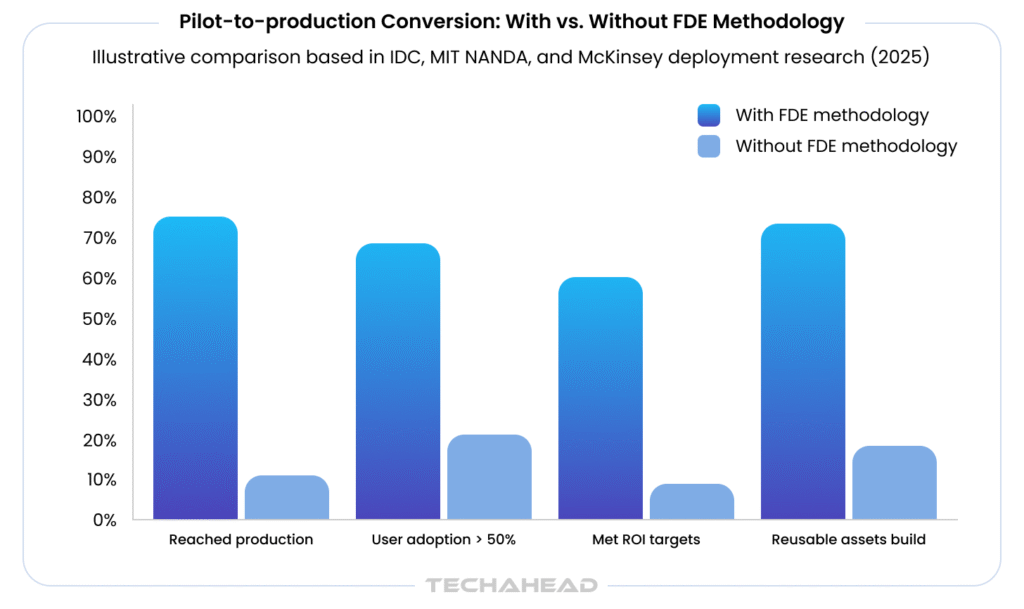
Source: TechAhead AI Team
The market has already made its verdict.
The 800% surge in FDE job postings between January and September 2025 wasn’t a trend, it was a reckoning.
Every AI company that sells to enterprises hits the same wall in 2024-2025: demos close deals. Production deployments keep them. The gap in between was killing retention, burning engineering capacity, and stalling customer expansion.
As AI moves from generative to agentic, systems that coordinate across tools, make decisions, handle approvals, and operate with increasing autonomy, the deployment complexity doesn’t decrease.
It explodes. An agentic AI system that goes live without proper environment mapping, integration code, and governance architecture doesn’t just fail quietly. It makes autonomous decisions with bad data, in the wrong systems, for users who were never trained to work alongside it.
Trivia: The Agentic Stakes
Deloitte found that close to 75% of companies plan to deploy agentic AI within two years, yet only 21% have mature agent governance frameworks. The companies hiring FDEs now are building the institutional knowledge to navigate that gap. The companies that aren’t will face it unprepared.
The forward-deployed model is also becoming a competitive moat for app development companies themselves. A2Z-style portfolio wins, tight timelines, and low pricing are commoditizing fast. The differentiator that’s hardest to copy is a team of battle-tested FDEs who have seen every last-mile failure pattern, built the institutional playbooks for handling each one, and can embed with your team as genuine engineering partners.
“Do you have dedicated Forward-Deployed Engineers, or is deployment handled by the same team that builds?” The answer tells you everything about how this company is structured and what it’s optimized for.
“Who owns the deployment end-to-end after go-live, and for how long?” Three to six months of FDE presence post-launch is the standard for production-grade AI apps. Anything less is a handoff.
“Walk me through how you’d handle our CRM and ERP integrations, specifically.” If the answer is generic, be concerned. If they ask clarifying questions about your specific systems, that’s the FDE instinct at work.
“What measurable outcomes will you commit to, beyond delivery date and budget?” If they can’t answer in business terms, adoption rate, workflow improvement, specific ROI indicators, they’re optimizing for ship, not succeed.
“Do you have a purpose-built FDE methodology, or is deployment borrowed from your consulting practice?” A true FDE function has playbooks, productization targets, and reusable integration patterns, not just engineers who’ve done some client-facing work.
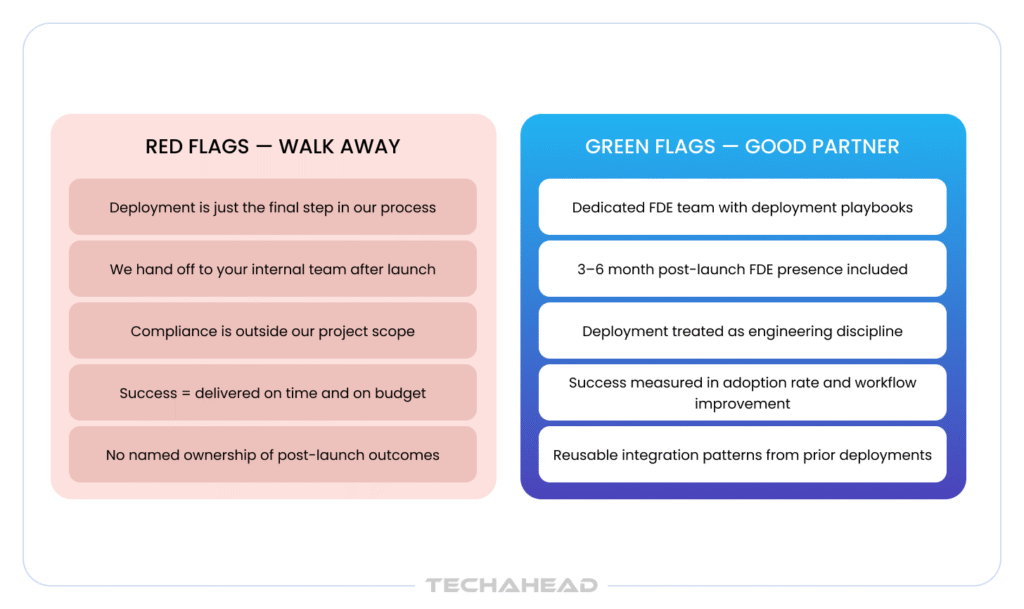
Source: TechAhead AI Team
Don’t Let the Last Mile Kill Your AI App!
Your AI app project deserves to reach production, and to stay there.
Here’s how TechAhead helps you turn promising AI prototypes into real-world business outcomes.
Build Your AI App With Deployment Built In
Most AI development companies stop at delivering the application. TechAhead goes further by deploying Forward-Deployed Engineers (FDEs) who take ownership of integration, compliance, workflow alignment, and user adoption. This ensures your AI solution doesn’t just work in a demo environment but delivers measurable value in production from day one.
Architect Your Enterprise AI System With Us
Successful AI deployment requires far more than writing code. Our FDE team works closely with your stakeholders to understand existing systems, map business processes, identify integration challenges, and create a deployment strategy that scales. From architecture planning to post-launch optimisation, we treat deployment as a core engineering discipline, not a final handoff.
Talk to a TechAhead AI Deployment Expert
Whether your AI initiative is still an idea, stuck in a pilot phase, or struggling after launch, our experts can help identify the obstacles holding it back.
We’ll assess your current stage, uncover deployment risks, and provide a practical roadmap to production success. The sooner deployment challenges are addressed, the faster your AI investment can start generating returns.
An AI Engineer designs architecture and builds core AI systems, models, pipelines, APIs. A Forward-Deployed Engineer takes that system and makes it work inside your specific environment, with your real data, compliance constraints, and end users. One builds the engine; the other drives it to the destination and confirms the passengers actually arrived.
The industry benchmark for AI app deployments is 3-6 months post-launch. The first 60–90 days cover integration, environment mapping, and initial deployment. The following 90 days focus on adoption, feedback loops, and productization of learnings. Engagements shorter than this rarely capture the adoption signal that determines real ROI.
The failure pattern is consistent regardless of company size, 88% of AI pilots fail across enterprises and SMBs alike. The difference is that smaller companies often have less internal IT capacity to absorb a failed deployment, making FDE coverage even more valuable. Any organization deploying AI into a real workflow with real users needs this capability.
The FDE’s core value in security-sensitive environments is building compliance into the architecture from day one, not retrofitting it after the legal team raises flags. This includes mapping access control requirements early, structuring data flows within existing security boundaries, and building audit trails into the deployment layer rather than bolting them on later.
Ask three questions: Do they have a named FDE methodology with documented playbooks? Can they show productization rates, how much of FDE work from past clients ended up in their reusable frameworks? And do their FDEs report into engineering or into sales? If FDEs report to a CRO, it’s a consulting shop using a fashionable label.
We use cookies to ensure our website functions properly, improve performance, and provide a personalized experience. You can choose which types of cookies to allow below.
Required for core functionality such as security, network management, and accessibility. These cannot be disabled.
Help us understand site traffic and user interactions so we can improve performance and usability.
Enable enhanced functionality and personalization such as language or region preferences.
Used to deliver relevant ads, track campaign performance, and measure advertising effectiveness.