


 Copy Link
 Share on X
 Share on Facebook
 Share on LinkedIn
Always Active
Required for core functionality such as security, network management, and accessibility. These cannot be disabled.

Uncover the transformative potential of digital and mobile solutions for your industry.





 Last Updated: Sep 22, 2026
Jul 27, 2026
Last Updated: Sep 22, 2026
Jul 27, 2026  324
324  18 min. Read


Key Takeaways
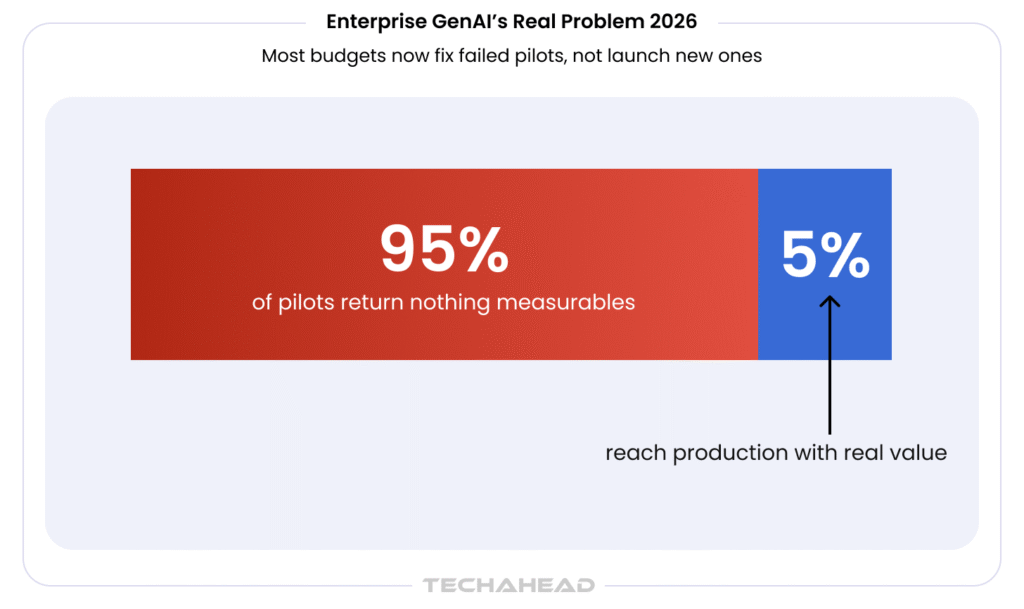
Most enterprise generative AI budgets in 2026 are not being spent on new pilots. They are being spent on fixing pilots that never shipped. MIT’s Project NANDA study put a number on the problem: roughly 95% of enterprise generative AI pilots return nothing measurable, and only about 5% reach production with real value.
That shift changes what buyers should be looking for. Two years ago, choosing a generative AI development company meant checking whether a vendor had access to frontier models and engineers who understood prompting, or even whether they could explain generative artificial intelligence as software that generates new content. Both of those are now commodities. Model access is a billing relationship. Prompt engineering is a skill an internal team can build in a quarter.
What has not commoditized is production discipline: the ability to take a system that works on a curated demo dataset and make it survive real users, real latency budgets, real compliance review, and real cost ceilings, especially in enterprise use cases focused on automating business processes and improving customer interactions. That gap is where vendor selection actually gets decided.
Identifying the best generative AI development company for a specific enterprise program therefore has less to do with capability comparison than most buyers expect, and far more to do with evidence of operational maturity and measurable business value in operational efficiency and customer engagement.
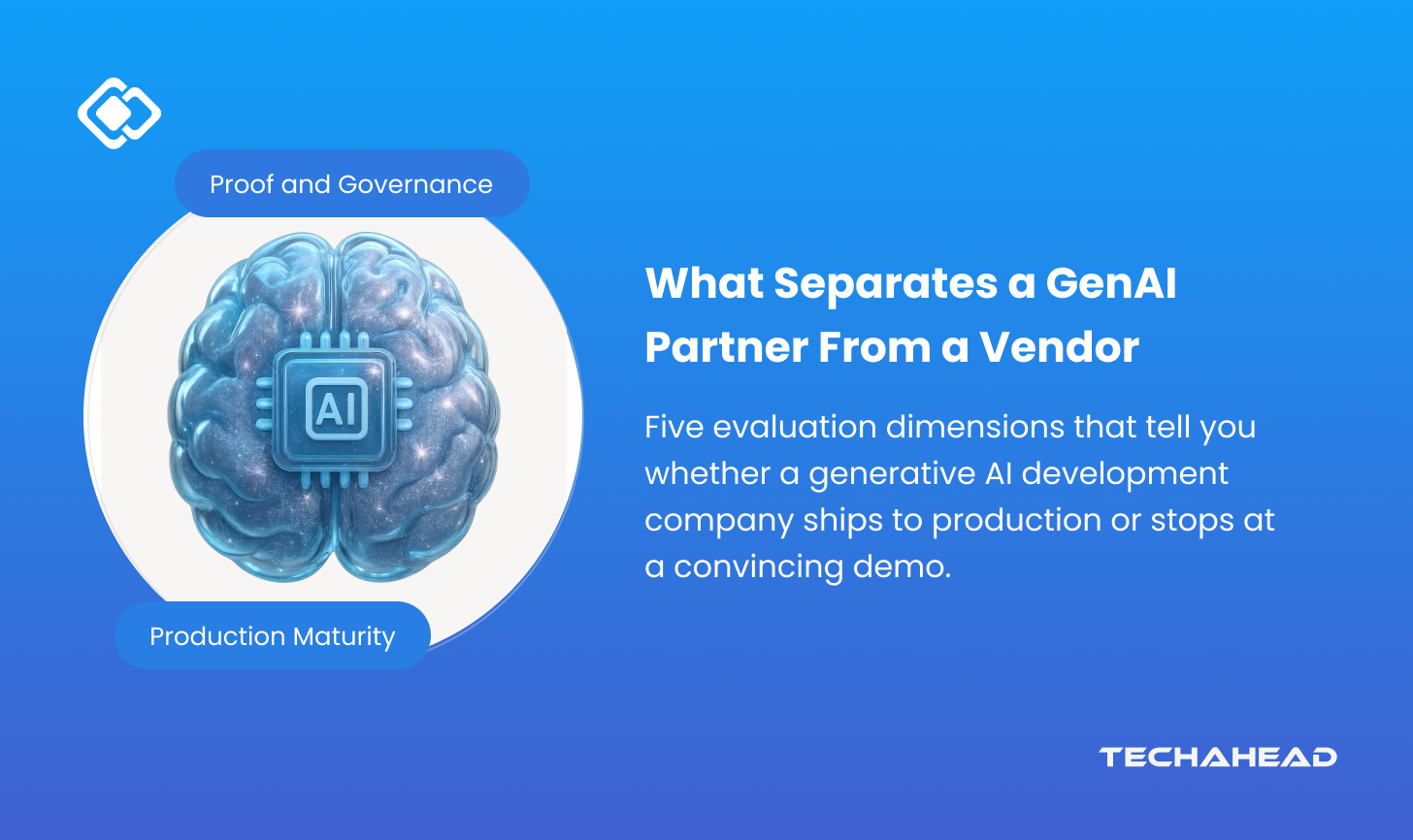
This piece breaks that evaluation into five dimensions that separate vendors who ship from vendors who demo: comparison criteria, implementation proof, governance posture, model stack architecture, and pricing structure. It is written for the executive who has already been through one disappointing pilot and does not want a second.
Also Read: How Generative AI is Transforming Mobile App Experiences
Across generative AI companies delivering AI powered systems, the standard vendor evaluation process was built for software delivery. It asks about team size, tech stack, delivery methodology, and past projects. Those questions still matter, but they no longer discriminate between good and bad generative AI development services, because every vendor now answers them identically.
Three things broke the old process.
Capability Claims Converged – When every provider can call the same set of foundation models, capability decks stop carrying information. Most firms selling generative AI services now list retrieval augmented generation, agentic workflows, and multimodal support in identical language, which describes an API surface rather than a competency.
Demos Got Easier Than Deployments – A retrieval system that answers questions correctly against fifty clean documents can be assembled in days. The same system against three million documents with inconsistent formatting, access controls, and a two second latency budget is a different engineering problem entirely. Most vendor demos are the first thing. Most enterprise requirements are the second.
Failure Moved Downstream – Pilots rarely fail during the build. They fail at security review, at cost modeling, at the point where someone asks who is on call when the model starts returning wrong answers unexpectedly. Vendors who have never reached that stage have no scar tissue, and no process built from it.
The practical consequence: evaluation has to move away from what a vendor can build and toward what a vendor has already operated. TechAhead’s generative AI development service is structured around that distinction, and the criteria below reflect what tends to expose it.
Ranking exercises that promise to identify the top generative AI companies rarely help, because they score marketing surface rather than delivery capability. A criteria matrix applied to a buyer’s own shortlist produces a better answer. Seven dimensions matter more than the rest.
| Dimension | What to ask for | What a weak answer sounds like |
| Technical Depth | Architecture walkthrough of a shipped system, including what was rejected and why | Capability lists, model names, and framework logos without a decision trail |
| Eval and Testing Rigor | The actual eval suite used on a past project, plus the pass threshold enforced before release | “We test thoroughly” or “the client validated outputs” with no measurable gate |
| Governance Posture | Named certifications with scope, plus how data residency and PII handling were solved on a specific engagement | Policy documents with no evidence of operational enforcement |
| Production Track Record | Systems currently running in production, with reference contacts who own them | Pilot counts, proof of concept volume, or awards used as substitutes for deployments |
| Model-Agnostic Architecture | Evidence of a system where the underlying model was swapped after launch | Single provider commitment presented as a strategic advantage |
| Engagement Structure | Team composition by role, and who remains after go-live | Blended headcount with no named ownership post-deployment |
| Post-deployment Ownership | Monitoring, drift detection, retraining cadence, incident response | Warranty periods framed as ongoing support |
The pattern across all seven is the same. Specific artifacts beat descriptions. A vendor who can show an eval suite, an architecture decision record, or a production runbook is describing work that happened. A vendor who cannot is describing work they intend to do on your budget.
One question tends to be more diagnostic than any of the others: ask what the vendor has built that did not work, and what they changed as a result. Teams with production history answer this immediately and in detail. Teams without it treat the question as a trap.
Case studies tell you what a vendor delivered. What they rarely show is how the work held up once it hit production. The strongest signal in vendor evaluation is not the polish of a case study but what a buyer uncovers when they probe past it.
Three tests are worth running on any shortlisted vendor.
There is a distinction worth being explicit about here, because most vendors blur it.
TechAhead’s portfolio spans the kind of regulated, high-load, consumer-facing environments where generative AI systems actually have to survive. That includes American Express in banking, Argo in insurance, the ICC at global consumer scale, The Healthy Mummy in consumer health, Tripple in social platform delivery, and Unchecked Fitness, where AI-driven behavior sits directly inside the user experience and is judged by end users in real time; for enterprise buyers, adjacent experience can also matter where generative AI supports healthcare decision-making or AI-driven diagnostics workflows.
What that range establishes is the operational baseline generative AI work depends on: security review, data governance, uptime accountability, and integration into systems that were never designed with AI in mind.
In regulated environments, that often means delivering custom generative AI solutions that are fine-tuned for specific business needs before they are cleared for use. This is the harder half of the job, and it is where most vendors without real enterprise delivery history come apart. When evaluating a generative AI development company, buyers should be weighing this kind of sustained production track record as heavily as any capability claim, including evidence a partner can build reliable AI systems and custom AI systems under real production constraints, because a partner who has shipped under real scrutiny carries far less delivery risk than one who has only demoed.
Across TechAhead’s enterprise generative AI engagements, the internal delivery figures currently sit at roughly 76% of proofs of concept reaching production deployment, with a typical enterprise retrieval system moving from kickoff to production in 14 to 18 weeks. Systems are held to a minimum retrieval accuracy gate of 92% against the client’s own document corpus before release, and roughly one in three builds fail that gate on first attempt and return to the retrieval layer for rework.
That last number is the one worth reading twice. A vendor whose eval gates never fail is not running eval gates.
Also Read: Build an Enterprise AI Roadmap in 90 Days
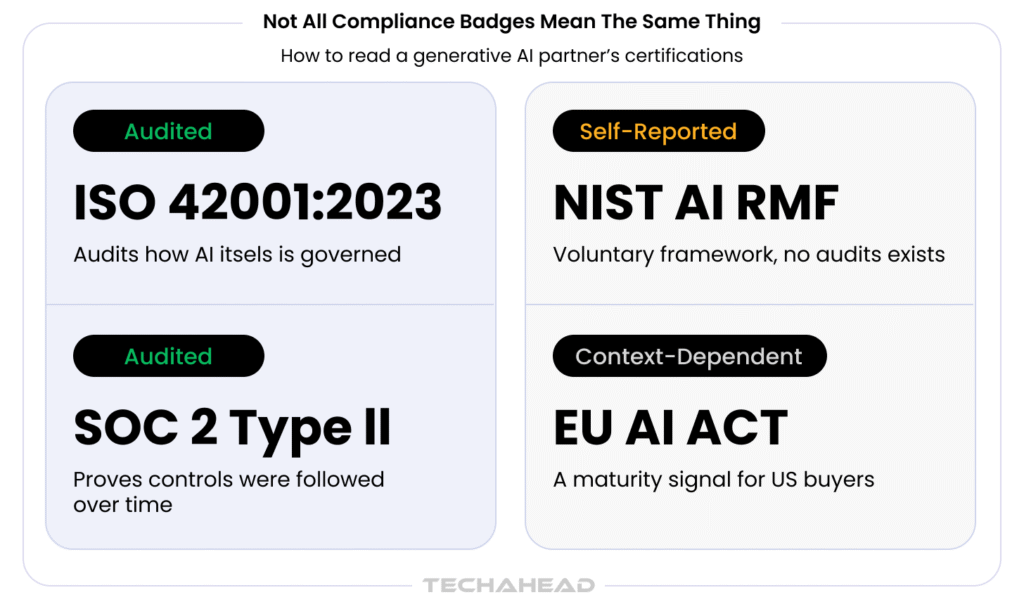
Governance is where enterprise generative AI programs stall most predictably, and where vendor claims are hardest for a non-specialist buyer to interrogate. Most certifications sound equivalent. They are not.
ISO 42001:2023 is the AI-specific management system standard. It certifies that an organization has documented, auditable processes governing how AI systems are designed, assessed for risk, deployed, and monitored over time. Strong governance also reduces data-readiness risk, since 85% of enterprise ai projects fail when that foundation is weak. It is the only widely recognized certification that addresses AI governance specifically rather than information security generally. TechAhead holds it, which matters before model deployment, not just after.
SOC 2 Type II certifies operational security controls over an observed period, typically six to twelve months, rather than at a single point in time. The Type II distinction matters. Type I confirms controls exist on paper. Type II confirms they were followed. TechAhead holds Type II.
NIST AI RMF is a voluntary framework rather than a certification, which means no vendor can be audited against it. A partner who references it should be able to describe how its four functions map to their delivery process. If they cannot, the reference is decorative.
EU AI Act obligations do not apply to most US-only deployments, but familiarity with it is a reasonable proxy for how seriously a partner treats risk classification and documentation. For a buyer evaluating a generative AI development company in the USA, it functions as a maturity signal rather than a domestic compliance requirement, though any program touching European users or data should treat it as in scope.
Beyond certifications, four operational questions separate governance capability from governance vocabulary:
The fourth question is the one most vendors handle poorly. Human-in-the-loop is easy to promise and expensive to implement, because it requires designing the workflow around review rather than bolting review onto a finished system.
Buyers running a structured governance program alongside vendor selection tend to get better results from both. TechAhead’s AI Center of Excellence is built for that pattern, where the governance model is established before the first system ships rather than retrofitted after the first audit finding.
The model stack question is not “which model does the vendor use.” It is “how does the vendor decide,” because that decision gets made repeatedly over the life of a system as models, prices, and capabilities change.
Three architectural choices reveal judgment quickly.
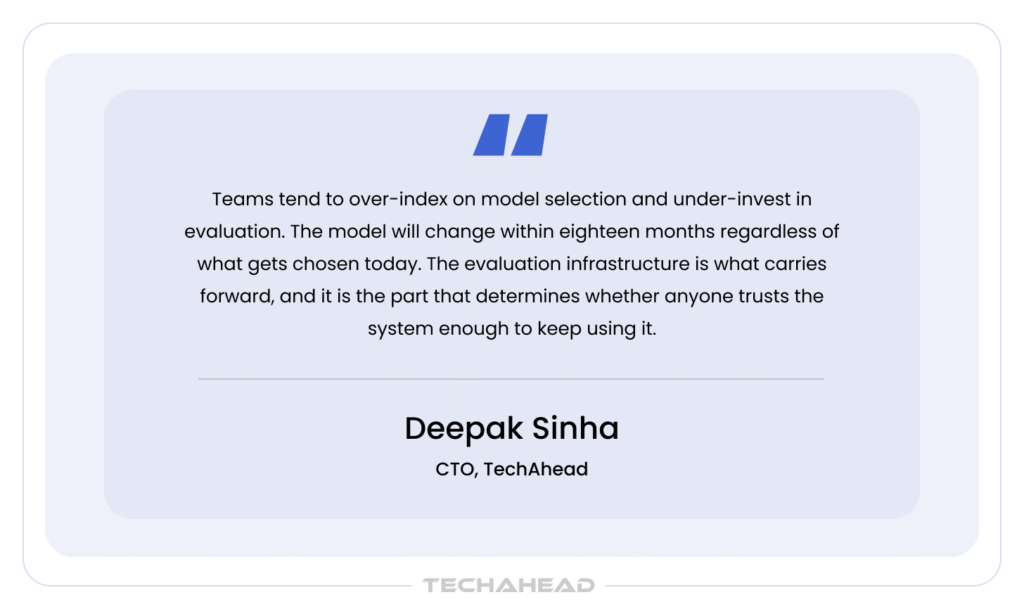
Enterprise generative AI solutions architected without regard to the broader generative AI landscape and how vendors choose among AI models are cheaper to build and materially more expensive to change. Given how quickly the model landscape has moved, an abstraction layer between application logic and model calls is now closer to a requirement than an optimization. The test is simple: ask whether the vendor has ever swapped the underlying model on a live system, and what that cost.
Recommended: Best AI Models for Developers
These solve different problems and a partner’s default choice is diagnostic. Retrieval suits factual grounding against changing information, and RAG combines large language models with live enterprise data for accuracy. Fine-tuning suits consistent format, tone, or narrow classification where the underlying knowledge is stable, especially when building generative AI models or adapting generative AI models for business-specific outputs. Agentic architectures suit multi-step tasks requiring tool use, and carry meaningfully higher testing and failure-mode complexity. A vendor who proposes fine-tuning for a problem that retrieval solves is either optimizing for billable hours or has not thought carefully. Autonomous AI agents execute complex tasks, while conversational AI and an AI chatbot may only handle dialogue.
LLMs can generate human-like text and automate tasks, while diffusion models and GANs support image generation use cases; diffusion models generate images from text prompts, and GANs generate photorealistic images from real photos.
Also Read: Claude Vs. OpenAI (Choosing by Task, not by Name)
Inference cost scales with usage in a way that traditional software licensing does not, which surprises finance teams roughly a quarter after launch. Model routing, where simple queries go to smaller models and only complex ones reach frontier models, is one of the most reliable levers available. On TechAhead engagements, routing and caching strategies have reduced production token spend by approximately 40% against an unoptimized baseline.
Also Read: Tokenomics for Enterprise AI
Then there are the layers buyers forget to ask about, which is where most production failures originate.
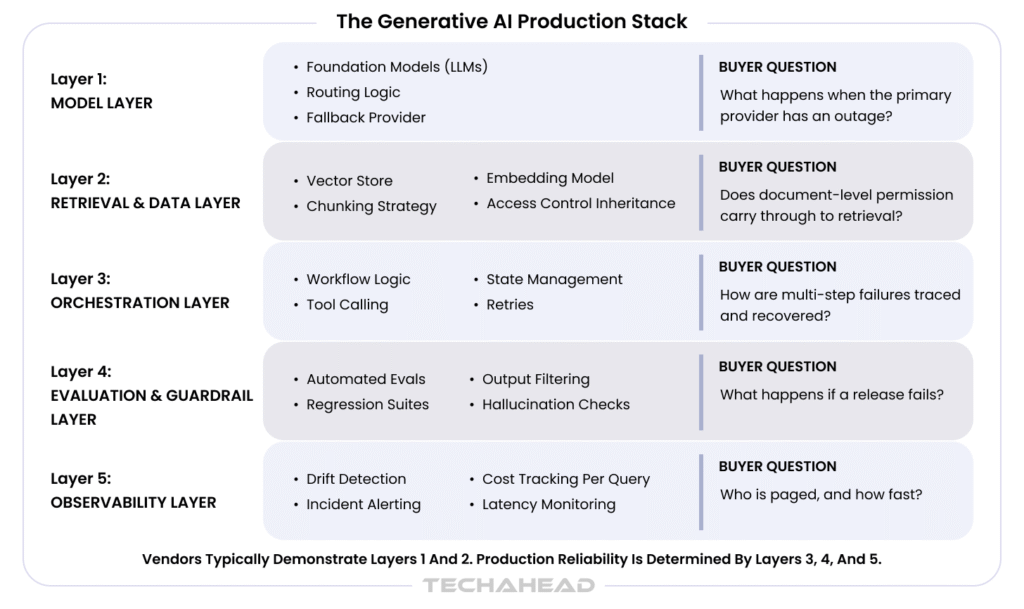
Vendors will happily discuss layers one and two, because that is where the interesting technology lives, though multimodal AI systems often combine text and image workflows and raise integration and testing demands. The questions that separate a generative AI development services company with production experience from one without it are almost entirely in layers four and five.
TechAhead’s position as Claude & OpenAI Services Partner reflects direct engineering work with those models, though the architectural default remains provider-flexible. Broader system integration, including the surrounding data and application engineering that generative AI systems depend on, sits within TechAhead’s AI development practice.
Pricing opacity is standard in this category, which makes budget planning difficult and comparison nearly impossible. The ranges below reflect TechAhead’s own engagement structure for generative AI development services, stated so that scope can be matched to budget before an RFP goes out.
| Engagement band | Range | Typical scope | Timeline | Team composition |
| Focused deployment | $50,000 to $100,000 | Single use case, one to two data sources, standard retrieval architecture, limited integration surface | 8 to 14 weeks | AI engineer, backend engineer, part-time architect and QA |
| Enterprise integration | $100,000 to $200,000 | Multiple use cases or complex retrieval, three to six system integrations, custom eval suite, compliance review cycle | 14 to 24 weeks | 2 to 3 AI engineers, backend and data engineering, dedicated architect, QA, part-time governance lead |
| Platform build | $200,000 to $500,000 | Multi-workflow agentic systems, enterprise-wide data layer, full governance implementation, regulated environment delivery, ongoing model operations | 24 to 40 weeks | Full pod including AI, data, backend, DevOps, security, governance, and dedicated delivery management |
Where a specific engagement lands inside these bands is driven by six variables, in rough order of impact.
Data readiness is the largest single factor. Clean, well-structured, accessible source data can move an engagement to the bottom of its band. Fragmented data spread across systems with inconsistent access control can add a discovery and data engineering phase that pushes it to the top.
Integration surface compounds quickly. Each system the AI layer must read from or write into brings authentication, rate limiting, error handling, and its own testing burden.
Compliance overhead varies sharply by industry. A deployment in banking, insurance, or healthcare carries documentation, review cycles, and audit requirements that a lower-risk internal tool does not.
Evaluation complexity scales with how expensive a wrong answer is. A system summarizing internal documents needs lighter evaluation than one supporting customer-facing financial guidance.
Inference volume affects both architecture and ongoing operating cost, and should be modeled before build rather than discovered after launch.
Model operations covers monitoring, drift detection, and retraining after go-live. It is frequently excluded from vendor quotes, which is one of the more common reasons a comparison between two proposals turns out to be invalid.
The evaluation reduces to a short set of questions:
TechAhead works with enterprise teams across regulated and high-load environments, delivering generative AI integration services that fit into existing systems rather than sitting beside them. That work spans:
The common thread is delivery shaped around measurable business value and production constraints, not capability for its own sake. To discuss scope, timeline, and where a specific program would fall within the engagement bands above, explore TechAhead’s generative AI development services or request a technical consultation with the delivery team.
The best generative AI development company proves production track record, not demo polish. Ask for a live system, its eval pass threshold, and audited certifications. Most vendors build convincing prototypes; few operate systems that survive real data, latency, and compliance load. The strongest partner is usually one of the leading generative AI companies with real enterprise software development experience, not just model access.
Look for ISO 42001:2023 for AI-specific governance and SOC 2 Type II for operational security. Type II matters because it proves controls were followed over months, not just written down. A serious generative AI development company holds both, and can show the reports.
Type I confirms controls exist on paper at a single moment. Type II confirms they actually operated over six to twelve months. For enterprise generative AI services, Type II is the real baseline. Treat Type I alone as an incomplete answer.
Stop reading case studies and start testing them. Ask for a reference call, then ask what broke in the first month and who fixed it. Request an architecture walkthrough with the engineer who built it, not a sales lead.
Pilots rarely fail on the build. They fail at security review, cost modeling, poor data readiness, and the moment someone asks who is on call when the model returns wrong answers. Weak cloud infrastructure is another common blocker before production. Production discipline, not model access, separates generative AI solutions that ship from those that stall.
No. Single-provider architectures are cheaper to build and expensive to change. Since model pricing, limits, and capabilities shift constantly, a mature partner keeps the architecture model-agnostic and builds scalable AI solutions that integrate with existing systems rather than locking buyers into one stack. TechAhead builds provider-flexible systems while holding OpenAI Services Partner and AWS Advanced Tier standing for depth where it counts.
Ask where inference data resides, how PII is kept out of prompts, what gets logged for audit, and who can override model output. Vague answers signal governance vocabulary without governance capability. Specific answers signal a partner who has shipped under real scrutiny.
ISO 42001:2023 is the first AI-specific management system standard. It certifies auditable processes for how AI is designed, risk-assessed, deployed, and monitored. Unlike general security standards, it addresses AI governance directly. TechAhead holds it, which is still uncommon among generative AI development services providers.
Plan for roughly eight to twelve weeks: shortlisting, questionnaires, reference and security checks, a proof of concept, then contract terms. Use certifications as an early filter so deep due diligence stays focused on your two or three real finalists.
Watch for demo-only proof, “compliance in progress,” single-model lock-in, blended teams with no named owner after go-live, and eval gates that supposedly never fail. Another red flag is a vendor calling itself a custom software development company or software development company without proving generative AI consulting depth. A generative AI app development company worth hiring welcomes scrutiny on all five rather than deflecting it.
We use cookies to ensure our website functions properly, improve performance, and provide a personalized experience. You can choose which types of cookies to allow below.
Required for core functionality such as security, network management, and accessibility. These cannot be disabled.
Help us understand site traffic and user interactions so we can improve performance and usability.
Enable enhanced functionality and personalization such as language or region preferences.
Used to deliver relevant ads, track campaign performance, and measure advertising effectiveness.