


 Copy Link
 Share on X
 Share on Facebook
 Share on LinkedIn

Always Active
Required for core functionality such as security, network management, and accessibility. These cannot be disabled.

Uncover the transformative potential of digital and mobile solutions for your industry.





 Last Updated: Sep 22, 2026
Jul 15, 2026
Last Updated: Sep 22, 2026
Jul 15, 2026  413
413  21 min. Read


Key Takeaways
For most of the last three years, the enterprise AI conversation revolved around a single question: which model is the smartest? Boards asked it, procurement teams benchmarked around it, and entire strategies were built on the assumption that picking the leading frontier model was the decision that mattered most.
That assumption has quietly stopped being true. The frontier did not produce one runaway winner. It produced a cluster. And in that shift lies the most important reframe for any executive planning AI investment this year:
The hardest AI implementation challenges are no longer about model intelligence. They are about speed, accuracy, and cost, along with the operational issues underneath them: model evaluation, workflow redesign, data quality, latency, governance, and cost control. Those are the constraints that decide whether a promising pilot ever becomes a system your business can depend on.
The numbers make the shift concrete. In McKinsey’s State of AI 2025 survey of nearly 2,000 organizations across 105 countries, 88 percent now report using AI in at least one business function, up from 78 percent a year earlier.
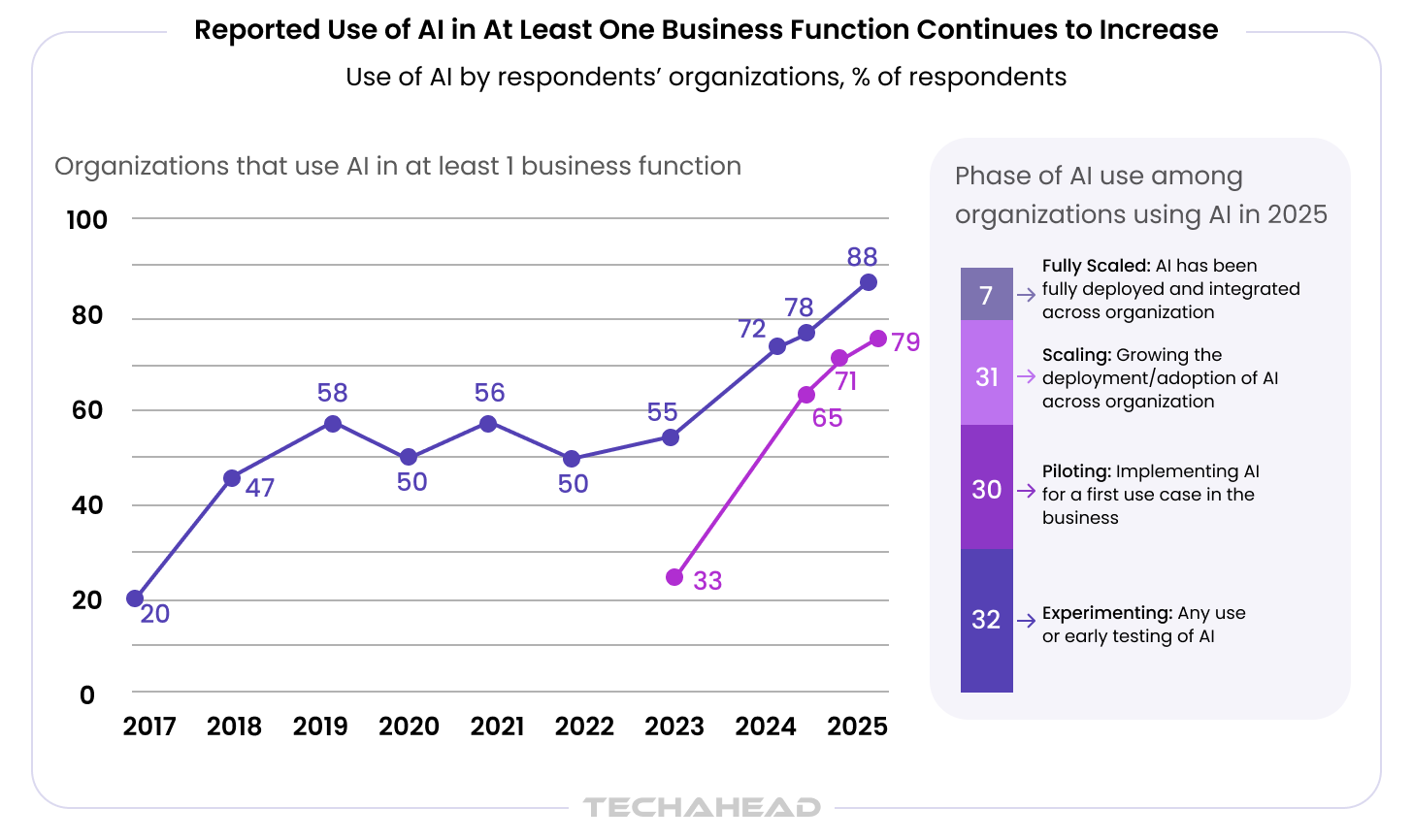
Yet only 39 percent report any measurable impact on enterprise profit. Near-universal enterprise AI adoption, and almost no measurable transformation. That gap is the real story of AI right now, especially for enterprise leaders, AI strategy teams, and technology organizations in Fortune 500 companies, startups, and scale-ups trying to deploy AI in regulated or integration-heavy environments.
This piece makes the case that the gap is an implementation problem, not an intelligence problem, and more importantly it lays out what to do about it. It focuses on the six production constraints that determine AI success in practice, why they block scale, and the practical fixes that help organizations turn pilots into reliable, cost-effective systems. The encouraging news is that each of these constraints is solvable, once you stop treating AI as a model selection exercise and start treating it as a production engineering discipline.
Related: Is Your Organization Ready for Enterprise-wide AI Adoption?
Look closer and the gap gets starker. Beyond the 39 percent that report any profit impact, only about 6 percent of organizations qualify as genuine AI high performers, meaning they see significant, measurable value from AI at the enterprise level. Nearly 79% of executives expect AI to drive significant revenue by 2030, yet only 24% know where that revenue will come from. Everyone else sits somewhere between experimenting and stuck.
The lesson is uncomfortable but clarifying. The organizations parked at “we use AI” and the organizations capturing real EBIT impact are, for the most part, choosing from the same shelf of frontier models.
What separates them is everything that happens after the model is chosen: companies need clear business strategies, defined objectives, and a strategic approach that ties AI investments to measurable business outcomes. It is a pattern we have examined closely in our breakdown of why enterprise AI pilots fail to reach production, and the McKinsey data is simply the macro proof of it, at the scale of the whole economy. AI projects launched without defined measurable goals often fail to create business value.
To understand why so much executive attention is aimed at the wrong target, look at what has happened at the frontier itself.
As of March 2026, according to Stanford HAI’s 2026 AI Index, the leading models from Anthropic, xAI, Google, OpenAI, Alibaba, and DeepSeek all sit in the top tier of the Chatbot Arena leaderboard, clustered within roughly 25 rating points of one another.
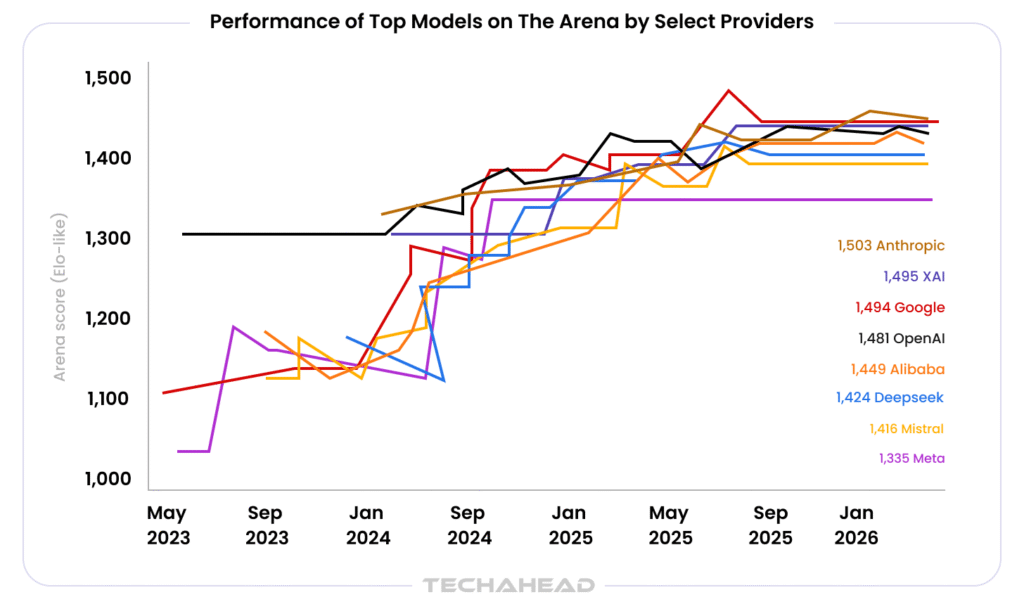
Stanford’s own read on what that means is unambiguous: as raw capability converges, competitive pressure shifts toward cost, reliability, and domain-specific performance. The intelligence race, at the very top, has largely resolved into a photo finish.
The pace of that convergence is worth appreciating. Stanford found that frontier models gained 30 percentage points in a single year on Humanity’s Last Exam, a benchmark deliberately built to resist AI, and that evaluations designed to stay hard for years are now being saturated in months. On the software engineering benchmark SWE-bench Verified, performance climbed from 60 percent to near 100 percent of the human baseline in about a year.
The practical consequence for a buyer is uncomfortable but clarifying. On most general-purpose tasks, the difference between the leading models is now smaller than the difference between two well-designed prompts, or two well-designed systems. Choosing a model by leaderboard rank buys you a rounding error, not an advantage. This is exactly why the smarter framing is to choose a model by task rather than by brand: the question is no longer which model is best in the abstract, but which model fits which job.
None of this means intelligence stopped mattering. It means intelligence stopped being scarce. And when a resource stops being scarce, value migrates to whatever is still hard. In AI in production, three things are still genuinely hard: getting the system to respond fast enough, getting it to be reliably correct on your specific work, and getting it to run at a cost that makes economic sense. Those are the real AI implementation challenges, and they break down into six operating constraints.
Also Read: Build an Enterprise AI Roadmap in 90 Days
The six constraints below are not exotic. They are the unglamorous engineering disciplines that separate the 6 percent from the 94 percent. They also apply regardless of which model sits underneath, whether that is a large frontier model or a smaller, domain-tuned one built for a specific job, an approach we have shown in one of our blogs named risk modeling with small language models in financial services.
At a glance, the constraints that actually decide production success are:
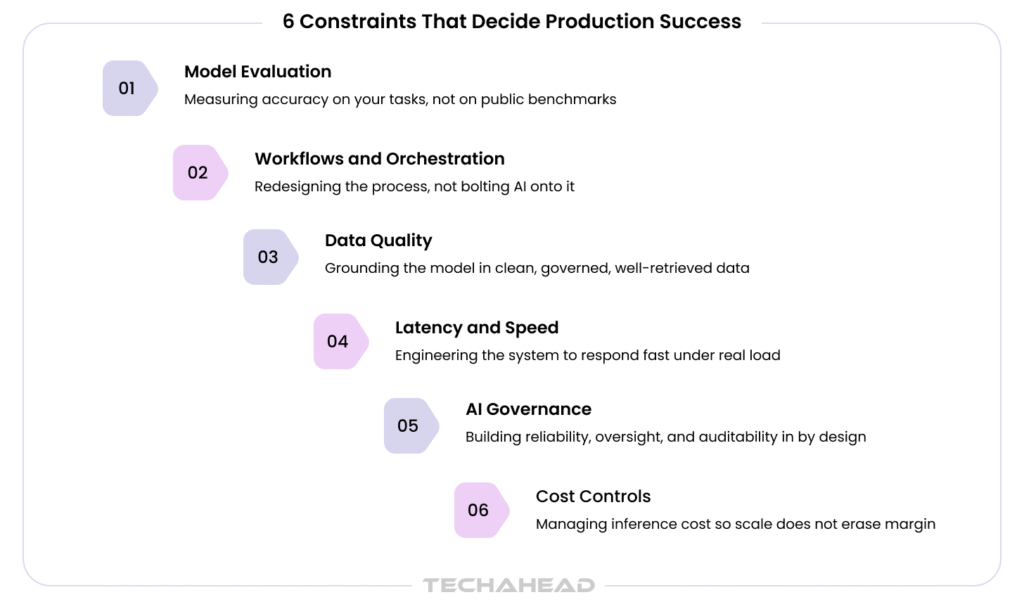
For each, we lay out the problem honestly, then the concrete way it gets solved in production.
The Problem
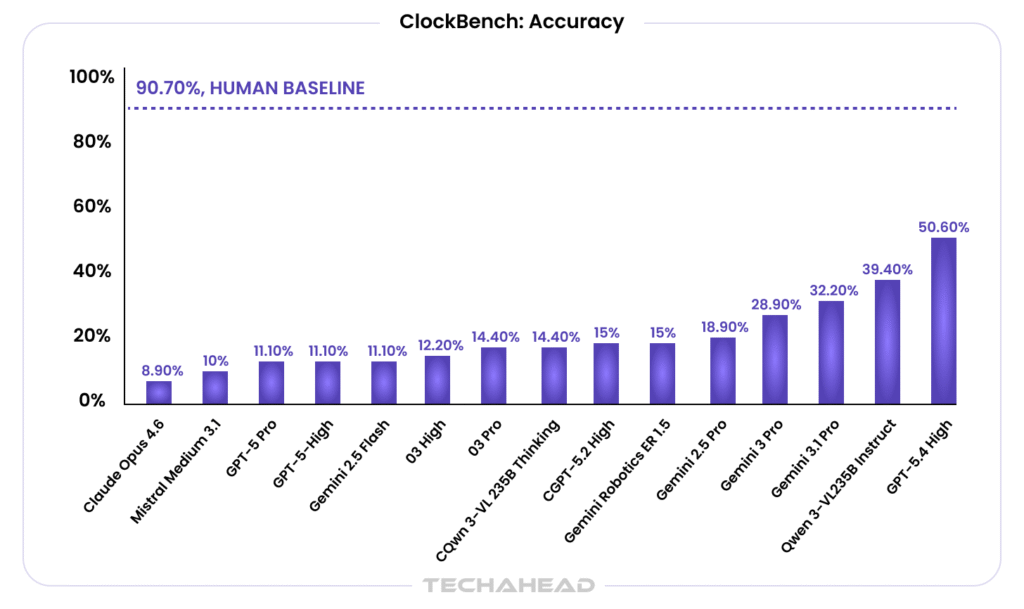
A model’s public benchmark score tells you almost nothing about how it will behave on your data, in your workflows, against your edge cases. Stanford calls this the jagged frontier, and the illustration is striking: the same class of top-tier model that can win a gold medal at the International Mathematical Olympiad reads an analog clock correctly only 50.1 percent of the time, against 90.1 percent for humans. Brilliant in one cell of the spreadsheet, unreliable in the one beside it.
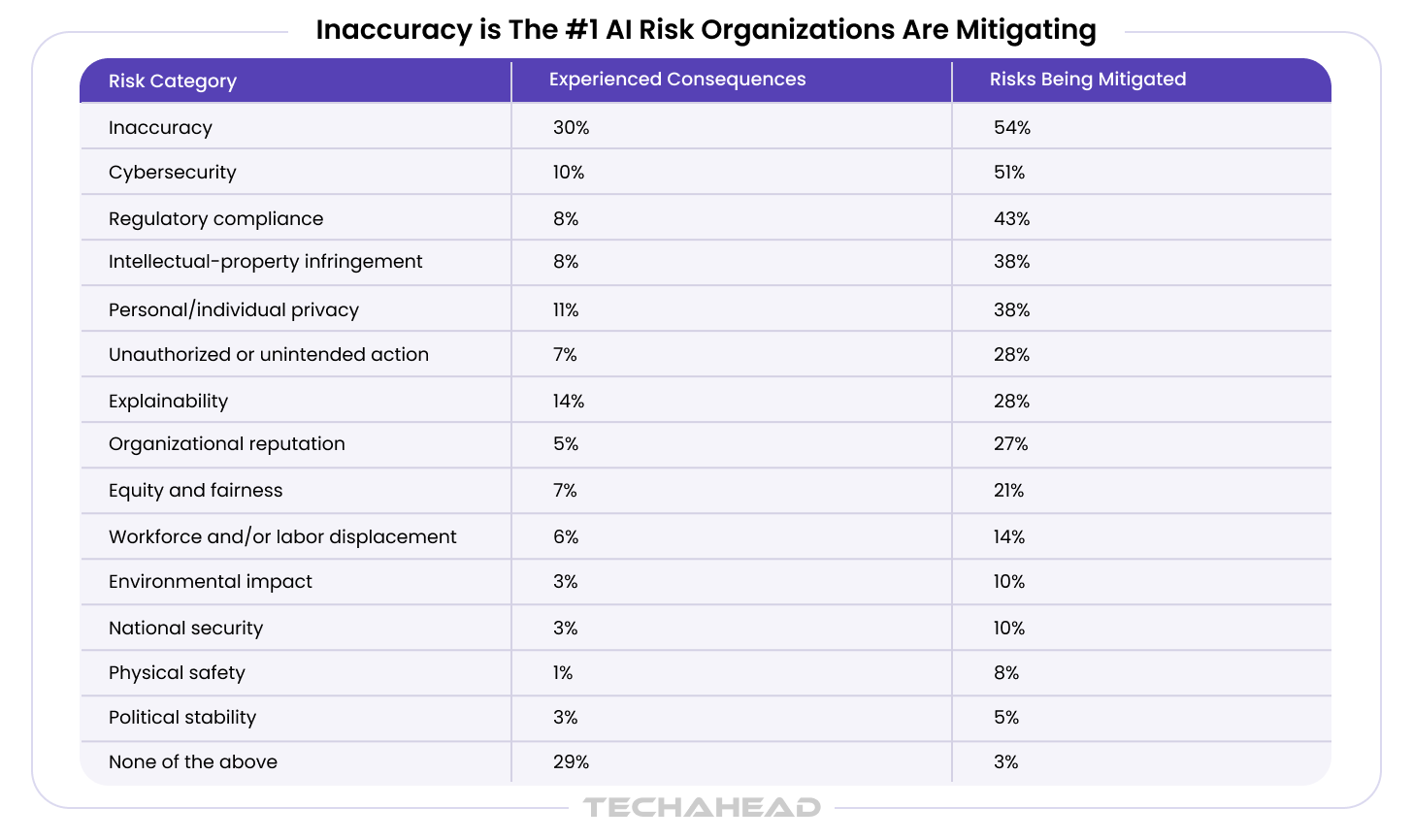
This is not an abstract risk. In McKinsey’s survey, inaccuracy was the most commonly reported negative consequence organizations experienced from their AI use. A model that dazzles in a demo can still misread your invoices, mishandle a compliance case, or state a policy that does not exist.
The Solution
Accuracy that matters is accuracy measured on your tasks, which means model evaluation has to be built as infrastructure, not run as a one-off check before launch, with tests against historical data and training data drawn from real world data. High-performing teams ship an evaluation harness alongside the product: a repeatable, versioned test suite drawn from real cases, with clear pass and fail criteria, run continuously as models and prompts change. This reframes model selection as an evidence-based exercise rather than a branding one, which is the spirit behind our comparison of the best AI models for developers in H2 2026.
Teams that treat evals as a permanent capability catch jagged-frontier failures before customers do, and should also catch bias because AI can reproduce or amplify human bias.
The Problem
The single most consistent finding in the McKinsey research is that value comes from redesigning work, not from bolting a model onto an existing process. High performers are far more likely to fundamentally redesign workflows around AI rather than layering it on top.
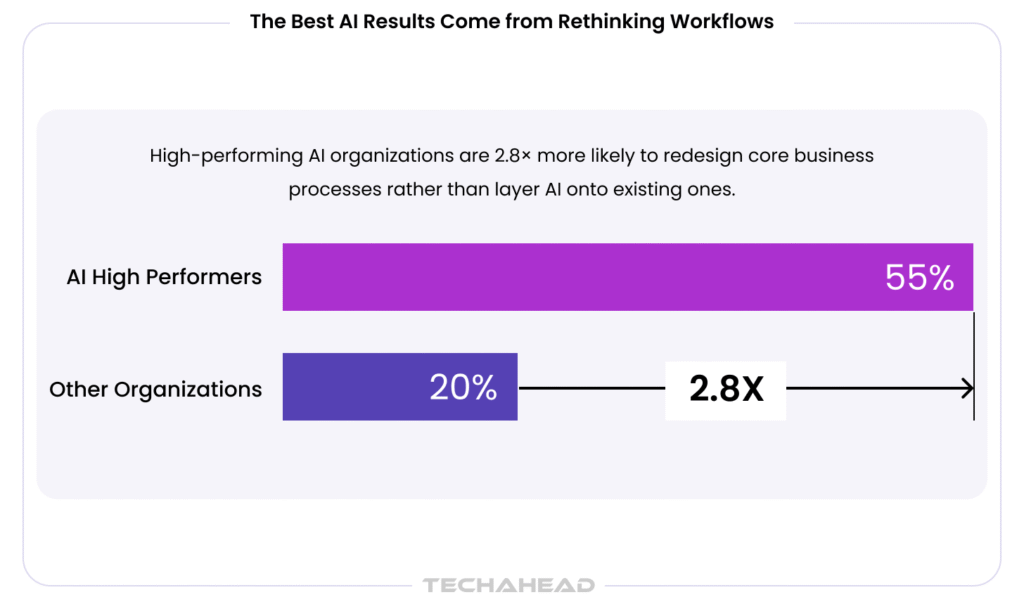
Most organizations do the opposite, which is precisely why so many stall in the 88-to-39 gap. Many pilot projects also spend over six months moving to production, and 70% take longer than six months. A capable model dropped into an unchanged, brittle process produces a capable demo and an unreliable system.
The Solution
When models are close to interchangeable, the orchestration around them becomes the primary lever for real-world performance, and a cross-functional team that includes business leaders and technical teams should own those decisions jointly. That means routing tasks to the right model, handling AI integration through API development and data mapping across existing systems, chaining steps reliably, handling retries and failures gracefully, and designing the human handoffs deliberately while integrating AI into real business processes.
A phased approach is the safest way to reduce disruption to legacy systems and operations. We have documented this shift in detail in our work on moving stalled pilots to production with an orchestration harness, where engineering the connective tissue between steps, not swapping in a smarter model, is what turns a fragile prototype into a dependable system.
Recommended: Enterprise AI Orchestration
The Problem
Enterprise AI does not fail on the model’s general knowledge. It fails when the model is asked to reason over fragmented data sources, data silos, and messy, ungoverned, or poorly retrieved enterprise data. A frontier model with no reliable grounding will confidently generate plausible answers that happen to be wrong, and no amount of model intelligence fixes bad inputs. Matching the right class of model to the data and task matters here too, a decision we break down in our guide to the types of LLMs that power modern AI agents.
The Solution
Production reliability depends on the data layer as much as the model layer: clean, governed, well-structured data, paired with retrieval that surfaces the right context at the right moment, all supported by strong data governance, disciplined data management, and a scalable data infrastructure. Teams also need clear data ownership when AI systems rely on vendor or partner access to proprietary information. This is where disciplined data engineering and retrieval-augmented generation do the quiet heavy lifting, grounding responses in your own knowledge rather than the model’s assumptions. The organizations that win here invest in the pipeline, not just the prompt.
Protecting sensitive data, meeting data security requirements, now a top barrier for over 50% of leaders, and complying with GDPR are core parts of that foundation. Strong data quality is not a preliminary step you finish and forget; poor data quality remains an ongoing operational risk that determines every answer the system gives.
The Problem
Benchmark leaderboards say nothing about how fast a system responds under real load, yet latency is what customers and employees actually experience. The problem compounds in agentic systems. When a model plans, calls tools, reflects, and retries in a loop, every step inherits the delay of the last. A workflow with ten sequential model calls turns a two-second-per-call delay into twenty seconds of visible waiting, which is the difference between a feature people rely on and one they quietly abandon. This is one practical reason narrow, tightly scoped agents tend to scale in production while broad ones stall: fewer steps means less accumulated latency and fewer points of failure.
The Solution
Speed is an architecture decision, not a model setting, and organizations should assess technical capabilities before scaling latency-sensitive AI systems. It is solved through model routing that reserves the heavy, slower models for the genuinely hard steps and hands everything else to fast, cheap ones; through caching, streaming, and parallelization where the workflow allows; and through infrastructure tuned for model deployment and inference rather than treated as an afterthought, with a clear check that current systems support the throughput and compatibility those workloads require.
Running these environments reliably at scale is a discipline in its own right, which is why AI infrastructure management has become a core production competency rather than a plumbing detail.
The Problem
As AI moves into real decisions, the cost of getting it wrong rises, and the evidence shows the risk is climbing. Stanford documented that reported AI incidents rose to 362 in 2025, up from 233 the year before.
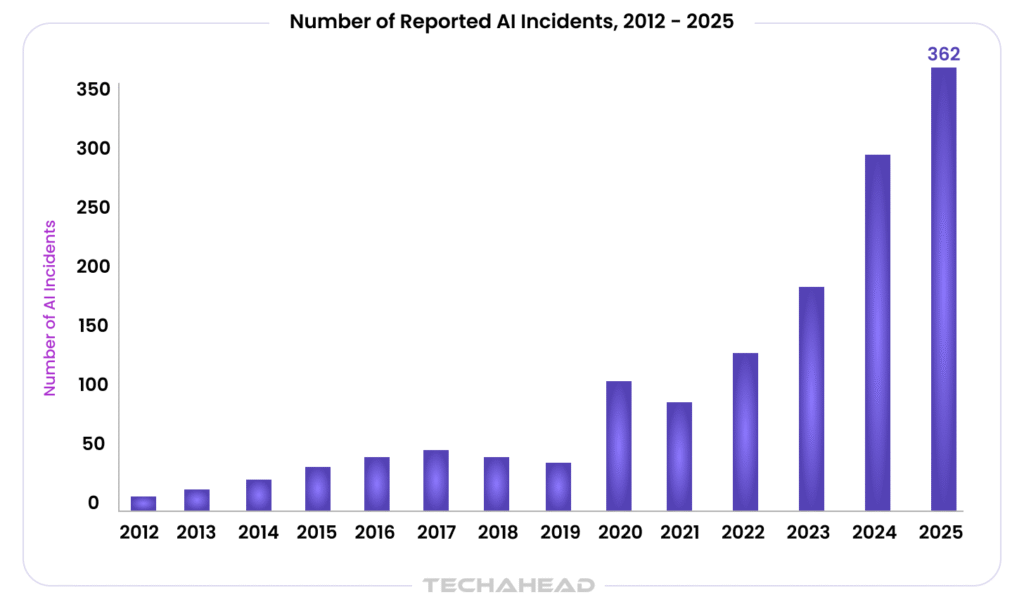
Many organizations still lack responsible AI policies and dedicated governance roles, even as AI-specific governance roles grew 17% in 2025 and 24% of businesses had no responsible AI policies in 2025. At the same time, the transparency you would rely on to vet a vendor’s claims is going the wrong way: Stanford found that model transparency scores fell from 58 to 40, which makes vendor-reported benchmarks a weaker basis for procurement than they used to be. Capability is accelerating while accountability is thinning, and that combination is an operational risk, not just an ethical one.
The Solution
AI governance is what converts a clever system into a trustworthy one by addressing trust, compliance, and ethical concerns, and it is a concrete engineering practice, not a policy binder. It includes human-in-the-loop validation designed into the workflow at the points where errors are costly, a discipline McKinsey found high performers adopt at 65 percent versus 23 percent for everyone else. It also includes continuous monitoring, audit trails, bias testing, and alignment to recognized standards.
Many organizations also lack people with practical experience deploying and helping manage AI systems responsibly; Standards adoption is becoming a genuine market signal here: Stanford reports that ISO/IEC 42001, the AI management system standard, was cited by 36 percent of organizations as a regulatory influence on their work.
Also Read: Human in the Loop AI
TechAhead builds to that bar directly, holding ISO/IEC 42001 and SOC 2 certifications and operating as Claude & OpenAI Services Partner, so that governance is engineered into delivery rather than retrofitted after an incident. In regulated environments this discipline is the entire game, and it is where the gap between a demo and a deployable system is most visible, as our guide on AI agents for KYC and customer onboarding in banking reflects.
The Problem
Cost is the most counterintuitive constraint, because on paper it keeps falling, even though AI implementation costs are not limited to tokens and also include infrastructure and model licensing. Epoch AI estimates that the price to reach a fixed level of model performance has been dropping between 9 and 900 times per year, depending on the task, with the steepest declines arriving most recently. So why is cost a bottleneck at all?
Because usage expands faster than price falls. When intelligence gets cheap, teams put it everywhere: every ticket, every document, every agent loop, every user session. The per-token price drops while total volume climbs, and the bill grows regardless. Over a system’s life, recurring inference cost typically dwarfs the one-time build cost, and organizations that treat inference as a fixed line item end up quietly subsidizing waste.
That risk compounds because generative AI tools and other advanced AI tools can spread through workflows quickly, raising total cost even as unit prices fall.
The Solution
Cost control in production is an active discipline, not a hope. In practice it means:
Done well, cost management turns inference from a month-end surprise into an operational dial you control, and it frequently becomes the single largest source of margin in an AI product. Building for that economic reality from the first day is central to how we approach enterprise AI development, because the difference between a strong AI ROI and a runaway bill is almost always an engineering choice, not a model choice.
| Constraint | The Problem | The Solution |
| Model evaluation | Public benchmark scores say little about how a model behaves on your data and edge cases. | Build evaluation as continuous infrastructure: a versioned test suite from real cases, run as models change. |
| Workflows and orchestration | A capable model dropped into an unchanged, brittle process produces a demo, not a system. | Redesign the process and engineer the orchestration layer: routing, chaining, retries, and deliberate human handoffs. |
| Data quality | Models fail when grounded in messy, ungoverned, or poorly retrieved enterprise data. | Invest in the data layer: clean, governed data plus retrieval that surfaces the right context. |
| Latency and speed | Agentic loops stack delay, and slow responses are what users actually abandon. | Treat speed as architecture: model routing, caching, streaming, and infrastructure tuned for inference. |
| AI governance | Incidents are rising and vendor transparency is falling as AI enters real decisions. | Engineer oversight in: human-in-the-loop checks, monitoring, audit trails, bias testing, and recognized standards. |
| Cost controls | Per-token prices fall, but usage expands faster, so total inference cost climbs. | Manage cost actively: route to the cheapest capable model, right-size, cache, and instrument spend as a metric. |
Step back and a pattern emerges. Every one of the six constraints points to the same conclusion: production AI advantage is a systems capability, not a model choice. In enterprise settings, this is really about operationalizing artificial intelligence as a business capability, not just picking a model. The frontier model is a commodity input. The value you capture depends on the evaluation harness, the workflow design, the data foundation, the latency architecture, the governance layer, and the cost discipline you wrap around it.
Whether the end product is a copilot, an agentic workflow, or a generative AI application, the model is the ingredient and the system is the recipe.
This is precisely the discipline an AI Center of Excellence exists to provide. Rather than treating each project as a fresh experiment, it gives an organization a repeatable operating model that provides reusable support for enterprise AI implementation across multiple initiatives, built on a few durable foundations:
Many organizations need cross functional operating structures and internal systems to support AI because they lack enough hands-on deployment experience.
That is the organizational answer to the 88-to-39 gap. It industrializes the exact capabilities the McKinsey high performers share and makes scaling AI across the enterprise repeatable rather than accidental. That repeatability is what turns isolated experiments into durable outcomes, and it pays off in a few specific ways:
With 33 percent of enterprise software expected to include agentic AI by 2028, the ability to standardize and keep deploying AI only grows more important.
It is worth being honest about what this requires. The teams that consistently reach production tend to combine strategy, engineering, and last-mile deployment skill, which is why the forward-deployed engineering role has become so central to enterprise AI success. Many organizations still face talent gaps across AI, data science, and deployment-focused engineering, and because AI capabilities keep evolving, the operating model has to keep helping over time rather than just launch a single project. It is less about hiring the smartest researchers and more about pairing production engineers with the people who own the business problem. For organizations that need to close critical capability gaps, the right AI development company can bring together the strategy, engineering, governance, and deployment expertise required to make that operating model work in practice.
TechAhead operates as this kind of production partner. Recognized by Clutch as a top generative AI company, certified to ISO/IEC 42001 and SOC 2, an AWS Advanced Tier partner, and Claude & OpenAI Services Partner, the work is measured by systems that run reliably in the real world for enterprises including AXA, American Express, JLL, and the ICC, not by demos that impress in a boardroom and stall in a backlog.
The question “which model is the smartest?” has quietly become the wrong question to organize a strategy around. The leading models are close enough that the answer barely moves your outcomes. Many organizations are increasing AI investments because 79% of executives expect AI to drive significant revenue by 2030, even though only 24% of executives know where that revenue will come from. The questions that now decide whether your AI investment pays off are sharper and more operational:
Get those right, and the specific model underneath becomes a swappable component rather than a strategic bet, which is how AI initiatives deliver measurable business outcomes. That is the real work of solving today’s AI implementation challenges, and it is the difference between joining the 88 percent who use AI and the small group who actually transform with it.
If your organization is somewhere in that gap, and most are, the fastest way forward is not another model evaluation. It is a serious look at the operating model around the model. That is the conversation an AI Center of Excellence is built to have, and it is where the next phase of enterprise AI advantage will be won. Let’s connect and talk over your requirements.
Less than most boards think. Today’s frontier models are clustered so tightly that model selection rarely decides outcomes. What separates winners is the production system around the model: evals, workflows, data quality, and governance.
Rarely because the model underperforms. Pilots stall on integration, messy data, unclear ownership, and governance bolted on too late. Moving from pilot to production is an engineering and operating-model problem, not an intelligence one.
The hardest AI implementation challenges are speed, accuracy, and reliability, not model choice. Think evaluation on real tasks, workflow redesign, data quality, latency under load, and governance. Nail those and enterprise AI adoption finally turns into measurable impact.
Stop trusting public benchmarks. Build model evaluation into the system as a versioned test suite drawn from your own real cases, run continuously as models and prompts change. That’s how teams catch failures before customers do.
Usually it’s the architecture, not the model. In agentic loops, every step stacks delay. Fixing latency means model routing, caching, and infrastructure tuned for inference, so the system stays fast under real production load.
Treat the pilot as a production rehearsal, not a demo: real data, proper integration, monitoring, MLOps, and governance from day one, with a named owner. It’s the core of how TechAhead moves enterprise pilots into dependable production systems.
When results are repeatable, data pipelines are stable, integrations hold under real volume, and governance and ownership are clear. Honestly, scaling AI just amplifies whatever you’ve built, so weak foundations fail louder at production scale.
Shared model evaluation standards, reusable orchestration patterns, governed data pipelines, and monitored deployments that carry across projects. That’s what an AI Center of Excellence provides, and how TechAhead helps enterprises make AI in production repeatable instead of rebuilding each time.
Engineer it in from day one, not after an incident: human-in-the-loop checks, audit trails, bias testing, and alignment to standards like ISO 42001. TechAhead bakes SOC 2 and ISO/IEC 42001 discipline into delivery, building compliant, bias-tested AI.
Look past the demo. Ask for production references, a real integration architecture document, and proof they own last-mile deployment, not just proof of concept. The strongest enterprise AI development partners combine strategy, engineering, and governance in one team.
We use cookies to ensure our website functions properly, improve performance, and provide a personalized experience. You can choose which types of cookies to allow below.
Required for core functionality such as security, network management, and accessibility. These cannot be disabled.
Help us understand site traffic and user interactions so we can improve performance and usability.
Enable enhanced functionality and personalization such as language or region preferences.
Used to deliver relevant ads, track campaign performance, and measure advertising effectiveness.