


 Copy Link
 Share on X
 Share on Facebook
 Share on LinkedIn
Always Active
Required for core functionality such as security, network management, and accessibility. These cannot be disabled.

Uncover the transformative potential of digital and mobile solutions for your industry.





 Last Updated: Sep 22, 2026
Jul 13, 2026
Last Updated: Sep 22, 2026
Jul 13, 2026  437
437  24 min. Read


Key Takeaways
LLM cost optimization is the practice of designing a layered cost architecture for AI systems, measuring token use, choosing and routing models intelligently, caching repeat work, compressing context, orchestrating workflows, and continuously evaluating quality, so enterprise teams can control LLM spend without breaking performance. Your token prices are falling. Your AI bill is going up anyway. That contradiction is why it has moved from a nice-to-have into a board-level line item in 2026.
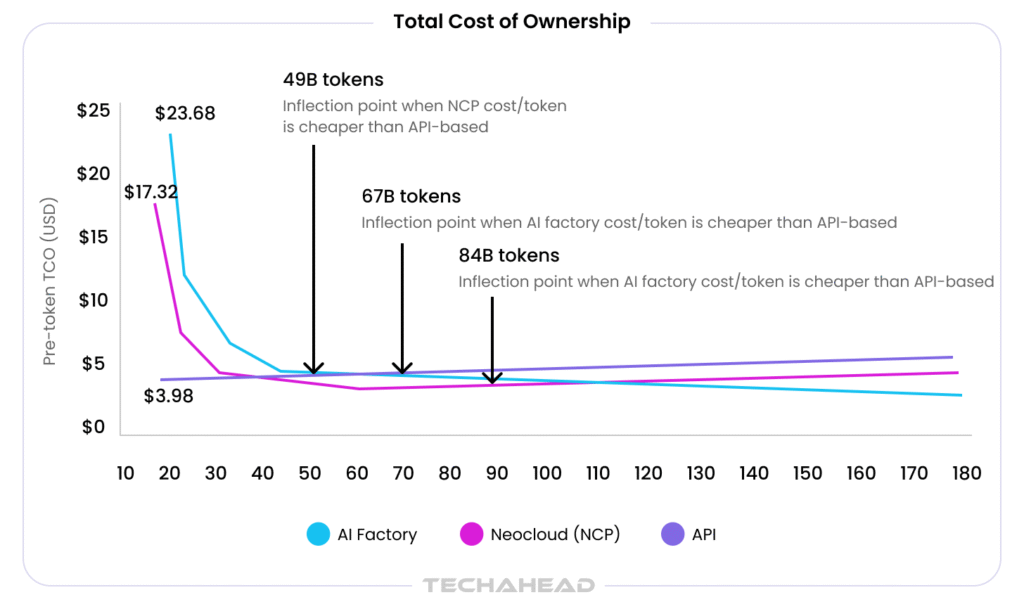
Per-token prices have dropped hard over the past two years and keep falling as volume climbs. Deloitte’s modeling shows per-token total cost of ownership dropping more than 90 percent for a self-hosted “AI factory” as annual usage scales, with self-hosting overtaking both neocloud and API pricing once volume passes roughly 84 billion tokens a year. The catch is that per-unit savings only matter if consumption stays in check, and it rarely does. Agentic products now fire dozens to hundreds of model calls per task, and most of the tokens in those calls are context the model never needed. Cheap tokens multiplied by enormous call volume still add up to a very large invoice.
For senior business executives running complex AI workloads, especially in regulated or integration-heavy environments – the real risk is waiting to manage cost after usage patterns are already locked in. The teams that keep this under control stopped treating cost as something they clean up after the invoice scares them. They engineer it from the start, the way they treat latency or uptime.
What follows breaks down the economics behind rising AI bills and the practical levers that change them: model selection and routing, caching, context compression, workflow orchestration, continuous evaluation, and how TechAhead applies them to help enterprises scale AI profitably instead of quietly bleeding margin on every request.
Also Read: Why AI Agents Cost Explode & How to Cap Them
For twenty years, enterprise software was priced by the seat: add headcount, costs rise in a straight line, finance forecasts it in a spreadsheet. Token-based consumption broke that logic. Costs no longer track headcount. They track behavior, system complexity, and the number of model calls your workflows generate, and those scale in ways that are volatile and often non-linear.
The result is a widening gap between the price on the pricing page and the number on the invoice. Deloitte documented a healthcare enterprise whose token usage grew 8 to 10 percent per month, hitting one trillion tokens over six months and more than $6 million in unplanned annualized cost before finance had visibility into what was driving it. That is what happens when consumption-based economics meet an architecture never designed with cost in mind.
| Driver | Description | Figure (per Deloitte) |
| Tokens generated | Every prompt generates input and output tokens | ~1,500 words ≈ 2,048 tokens generated; an iterative conversation may reach ~5,000 tokens including input and output |
| User token consumption | A single user can generate millions of tokens in production | ~9.4 million tokens per year per subscriber for a basic chatbot, rising to as much as ~356 million tokens per year per user for super agents |
| Cost variability | Tokens per month vary dramatically, so cost does too | One Seattle-based software startup reported nearly 1 billion tokens consumed in 30 days; Google processed 480 trillion tokens per month in 2025 across its products and APIs, up 50 times year over year |
Agentic workflows, the engine behind most serious generative AI products today, make this sharper. A simple chatbot answers once: one input, one output, one billable call. An agent does far more on every task, and each step is a billable event:
Related: Custom GPTs vs. APIs, Agents, and Chatbots
So a five-step workflow at scale does not cost five times a single call, it costs far more, because the bill scales with the product of workflow length and run volume, not the sum. We covered this in our breakdown of why AI agent economics break at scale. The costs that sink projects almost never show up in the prototype. They show up after the product works, when usage grows and the architecture that felt fine at demo scale starts compounding against you.
The most common driver of a bloated bill is also the most avoidable. Teams default to the most capable, most expensive model for every task, wire it in once, and never revisit it. Deloitte’s guidance to CTOs names this directly: treating all prompts equally is how you lose control of tokenomics, because a large share of enterprise workloads do not require frontier-scale reasoning. You pay a premium many times over on requests a smaller model would have handled without any user noticing.
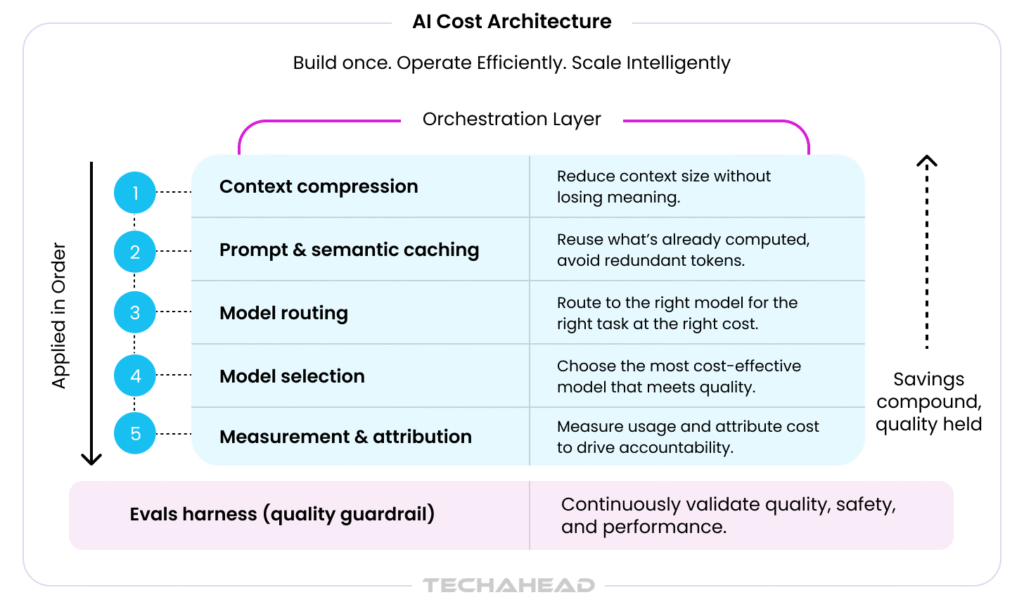
One reframe matters more than any single tactic. LLM cost optimization is not prompt-tweaking, and it is not a discount you negotiate. It is a layered cost architecture, applied in a deliberate order, where each layer attacks a different part of the bill and the savings compound rather than overlap:
The order is not arbitrary. You measure before you optimize, because you cannot tune what you cannot see. You cache before you route, because caching is usually the fastest win and needs no architecture change. You right-size models before you self-host, because self-hosting only pays off once volume justifies it. Each layer also changes what the layers above it work with, so a lean, compressed prompt is cheaper whether it lands on a small model or a frontier one.
The layer teams skip is the one that gets them burned. Aggressive cost cutting without evals does not save money, it defers a cost and hides it. You trade a visible line item for an invisible one: silent quality regression that surfaces weeks later as churned users and support tickets, long after anyone connects it to the routing change that caused it.
One word on the “premature optimization” objection, because someone can & will raise it. Optimization is premature when it complicates a system nobody uses yet. It is not premature when your agents are live, your bill compounds monthly, and re-architecting later costs more in engineering time than designing correctly now.
Every cost architecture starts with the model you reach for first, and most teams reach too high. The price spread between a small model and a frontier model is not a rounding error, it runs to a large multiple per token. The same request can cost a fraction of a cent or several cents depending purely on which model answers it, and at production volume that multiple is the difference between a sustainable unit economic and a bleeding one.
The discipline is right-sizing: match the model to the job, not to your ambition or to whichever model was newest when you built the feature. The practical way to do this is to profile your actual traffic and sort tasks into capability bands:
When you map real requests honestly, most enterprise traffic lands in the lower two bands, which is why this lever has such reach. If matching model class to task is new territory for your team, our breakdown of eight different types of LLMs powering modern AI agents is a useful place to start.
A second decision hides inside model selection: prompt engineering versus fine-tuning versus retrieval. For a stable, high-volume task, fine-tuning a smaller model on your own examples frequently beats prompting a frontier model on both cost and consistency, because you stop paying to re-explain the task on every call. For knowledge that changes, retrieval keeps a smaller model accurate without inflating its base prompt. This is where small language models and open-weight options earn their place, often delivering the same result at a fraction of frontier cost. Choosing by task rather than by brand reputation is the highest-leverage decision you make, and we broke it down in our guide on choosing between Claude and OpenAI by task, not by name.
Here is a simplified way to think about the tiers:
| Task Type | Recommended Tier | Relative Cost | Latency | Example Workloads |
| Simple, high-volume | Small / open-weight model | Lowest | Fastest | Classification, intent detection, tagging, extraction |
| Standard production | Mid-tier model | Moderate | Fast | Customer support replies, summarization, routine drafting |
| Complex reasoning | Frontier model | Highest | Slower | Multi-step analysis, long-context synthesis, ambiguous judgment |
| Stable and high-volume | Fine-tuned smaller model | Low at scale | Fast | Repetitive domain tasks with consistent structure |
| Latency-critical or private | Self-hosted model | Volume-dependent | Tunable | High-throughput, data-residency, or compliance-bound workloads |
Recommended: AI Risk Modeling with SLMs in Financial Services
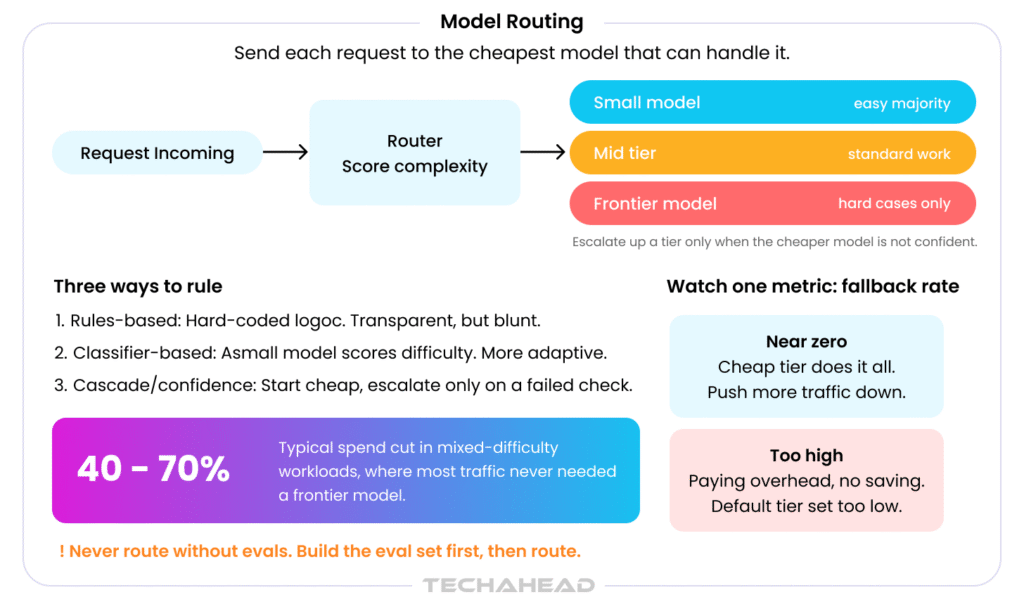
If model selection sets your defaults, model routing makes the decision dynamic, request by request. Instead of paying frontier prices for every call, a router inspects each incoming request and uses intelligent routing to send it to the cheapest model that can still handle it, with an escalation path for the cases the cheap model cannot.
Deloitte describes LLM routing as a core enterprise control mechanism, a way to shape demand, latency, and token burn in real time by matching prompt complexity to the minimum viable model. It captures more savings than caching or compression for a simple reason: when most of your LLM traffic never needed a frontier model, routing is the only lever that stops you paying for one anyway. In mixed-difficulty workloads, intelligent model routing often delivers significant savings, commonly cutting LLM deployment spend by 40–70%.
Routers come in a few flavors, and the right one depends on how much engineering you want to invest:
The detail that makes or breaks a router is the fallback path and the metric you watch. Track your fallback rate, the share of requests that had to escalate, because it tells you whether your tiers are tuned:
Note where routing does not help. If every request in a workload genuinely needs frontier quality, there is nothing to optimize, and the routing layer only adds latency. Routing pays off in mixed-difficulty traffic, which is most enterprise workloads, but not all of them.
One warning, and it is the one every serious practitioner repeats: routing without evals is dangerous. A router that quietly sends hard queries to a weak model degrades output while your cost dashboard shows nothing but green. Build the evaluation set first, wire it into the confidence check, then route.
Must Read: Best AI Models for Developers (2026 H2 Edition)
Caching is often the highest-return move on this list, and usually the fastest to ship because it rarely requires you to rearchitect anything. It attacks a specific waste: paying full price to compute a result you already computed. Two forms do most of the work:
Also Read: LLM Deployment Optimization
The workloads that benefit most have repetition baked in: support bots fielding variations of the same questions, retrieval pipelines pulling the same documents, agents reloading identical context on every loop. Exact-match caching returns the same cached response for the same prompt, while a same prefix across requests increases cache hits and can improve time to first token. Watch your cache hit rate as a first-class metric, because it converts directly into lower cost and lower latency. If a meaningful share of your queries are repeats or near-duplicates, including requests that share cached tokens, caching is very likely your single highest-return starting point, and it stacks cleanly with every other lever here.
Most production prompts are bloated. Teams stack in few-shot examples that stopped earning their keep three iterations ago, regenerate static context on every query, dump entire documents into the prompt when a relevant paragraph would do, and pad instructions the model already internalized. Every one of those tokens is billable, on every call, forever. In many deployments, a large share of the budget is pure waste: in one arXiv study, a prompt-optimization pipeline cut token usage by 57 percent while slightly improving accuracy.
Context compression is the practice of sending only the number of tokens the model actually needs. Several techniques are worth applying deliberately:
Concise prompts reduce costs for both million input tokens and million output tokens, and explicit instructions on output length can cut output fewer tokens by 50–90%.
Compression pairs tightly with the rest of the architecture because it shrinks the input side of the bill, which caching and routing largely leave untouched. Input tokens are billed on every call regardless of which model answers, so a leaner prompt is cheaper on the frontier model and the small one alike, and the saving compounds across your entire request volume. Because compression changes what the model sees, it is another lever you validate against your eval set. A shorter prompt that quietly degrades output is not a saving, it is a regression with a discount attached.
Individual levers save money in isolation. Orchestration turns them into a system, and it is where cost control becomes durable rather than a one-time cleanup that erodes the moment your traffic shifts.
Orchestration is the coordination layer, often an LLM gateway, that sits between your applications and your models. Every request flows through it, and it owns the decisions individual applications should not be making on their own:
For non-real-time tasks, batch processing typically reduces costs by about 50% versus on-demand inference.
Bonus Read: AI Orchestrator’s Role in Managing LLMs & APIs
Concentrating those decisions in one place lets you change routing, swap models, or tighten caching globally without touching every application that calls them.
Measurement lives here too, and it is the prerequisite for everything above it. You cannot optimize what you cannot see, so before any routing or caching can be tuned, you need per-request cost visibility tagged by team, feature, and use case, with cost tracking and request tagging for document analysis and other workloads. Most enterprise cost overruns trace back to the same sequence: the team shipped, then measured, when the order should have been reversed. This is the same discipline cloud teams built for rightsizing compute and resource utilization, now applied to models, which we explore in our piece on FinOps as Code for automated cost governance.
Orchestration is also where the self-hosting question gets answered honestly, because it is a genuine trade-off. At lower volumes, cloud APIs are usually more economical once you account for the engineering and operational burden of running your own inference. At sustained high volume, or under strict data-residency requirements, self-hosted or fine-tuned models can deliver the lowest unit cost, but they demand real upfront investment in hardware and MLOps maturity, and there is a well-known cliff where infrastructure cost jumps before it settles lower. That decision deserves its own analysis, which is why we wrote a full decision model comparing cloud, edge, and on-premises inference. Getting the orchestration layer right is the heart of what our strong AI infrastructure management delivers: a system where cost, performance, and governance are designed together rather than bolted on after the bill arrives.
Evals are not the last lever you add, they are the foundation the other five stand on. Without them, the whole architecture is a bet you are making blind.
An evaluation harness is a held-out set of representative tasks, scored continuously against a quality bar, that tells you whether a cheaper path preserved the output your users depend on. It has two halves:
Scoring usually combines two methods: deterministic checks such as exact-match or rule-based validation, where the correct answer is knowable, and model-graded evaluation for open-ended output, where a separate model judges quality against a rubric.
Good evals do more than catch regressions. They give you:
This is what lets you route to a smaller model with confidence, compress a prompt without guessing, and change a default without crossing your fingers. The eval harness is what converts a pile of tactics into an actual LLM cost optimization practice you can trust, repeat, and prove.
Case Study: A US Fintech Lending Platform
| One of our engagements involved a US-based fintech lending platform running its entire document-processing and customer-query workload on a single frontier model, with costs climbing faster than usage. Much of that traffic was routine enough that smaller specialized models built for fintech risk work could handle it at a fraction of the cost. TechAhead introduced a cost-attribution layer, confidence-based model routing, semantic and prompt caching, and context compression, all governed by a continuous eval harness. Blended token spend dropped substantially across production workloads, with no measurable drop in output quality, freeing budget the team redirected into new feature development. |
We treat token cost as an engineering discipline, not a procurement exercise. Cutting a bill once is easy. Building a system where the savings hold as your traffic grows, your workloads change, and new models ship every few weeks is the hard part, and it is the part we are built for. As a development and consulting partner that builds generative AI systems end to end, TechAhead does not hand you a slide deck and leave. We design the cost architecture, build it into your stack, and manage it in production so the gains compound instead of decaying.
A typical engagement follows a clear sequence rather than a generic checklist:
This work sits inside our broader AI infrastructure management practice, the same practice that governs any large-scale deployment, from GPU right-sizing to autoscaling to multi-cloud cost visibility. Those foundations rest on years of cloud engineering work, so your token-cost architecture inherits the same rigor as the infrastructure beneath it.
For enterprises standardizing AI practice across many teams, our AI Center of Excellence turns these tactics into repeatable internal standards, so a cost discipline you build once does not have to be relearned by every new team that ships an agent. Because we build for regulated industries, every layer is designed with security and governance from day one, backed by our ISO 27001 and SOC 2 Type II certified practices, so cost control never comes at the expense of compliance or auditability.
The outcome we aim for is a durable operating capability: a cost architecture your team understands, an eval harness that keeps it honest, and an orchestration layer that lets you adapt as models and prices keep moving. If your AI agents are already live and the economics are starting to wobble, that is where this work pays for itself.
Talk to our AI infrastructure team to start with a clear assessment of where your token spend is going and the fastest path to bringing it down.
Start with measurement, not optimization. Costs depend on token count, with input and output tokens often billed separately. Deploy visibility that tags every model call with team and use-case metadata, then find your top few cost drivers. Apply caching and routing to those first, since they usually deliver the fastest returns. Once savings are proven against a quality baseline, decide whether deeper governance is worth building out.
Only if you route without evaluation. Done properly, routing sends the easy majority of requests to cheaper models and reserves frontier models for genuinely hard tasks, with an escalation path when confidence is low. An eval harness measures quality continuously, so you capture the savings while proving the output your users depend on never quietly degraded.
It depends on your workload shape. If a large share of requests are repeats, caching wins first. If you run everything on one expensive model, routing and model selection deliver more. If your prompts are long, compression pays off fast. Output length also matters because output tokens are billed separately; for example, GPT-5.1 output tokens cost $10 per million. Measure your top cost drivers, then sequence the levers against what you actually see.
Not always. At lower volumes, cloud APIs are usually more economical once you account for the engineering and operational burden of self-hosting. At sustained high volume, or under strict data-residency rules, self-hosted or fine-tuned models can deliver the lowest unit cost. The break-even depends on your traffic, compliance needs, and team maturity.
Savings vary widely by workload and starting point, and any specific percentage should be treated as directional rather than guaranteed. The pattern we see consistently is that stacking measurement, caching, routing, compression, and right-sized model selection, with evals underneath, produces meaningful reductions in blended token spend without a measurable quality drop. When validated by evals, combining routing, caching, compression, and prompt changes can create compound savings without sacrificing performance.
Increasingly it is shared between engineering, platform, and finance, coordinated through FinOps-style discipline. The technical decisions about routing, caching, and model selection live with engineering and platform leads, while finance needs the visibility to forecast and govern. Alignment across all three keeps token costs from drifting out of control as usage scales.
We use cookies to ensure our website functions properly, improve performance, and provide a personalized experience. You can choose which types of cookies to allow below.
Required for core functionality such as security, network management, and accessibility. These cannot be disabled.
Help us understand site traffic and user interactions so we can improve performance and usability.
Enable enhanced functionality and personalization such as language or region preferences.
Used to deliver relevant ads, track campaign performance, and measure advertising effectiveness.