


 Copy Link
 Share on X
 Share on Facebook
 Share on LinkedIn
Always Active
Required for core functionality such as security, network management, and accessibility. These cannot be disabled.

Uncover the transformative potential of digital and mobile solutions for your industry.





 Last Updated: Sep 22, 2026
Jul 6, 2026
Last Updated: Sep 22, 2026
Jul 6, 2026  453
453  25 min. Read


Key Takeaways
Enterprise AI development is the work of building AI systems for production use inside organizations, where success depends less on choosing a better model and more on getting governance, data readiness, integration, and engineering discipline right. You probably think you have an AI adoption problem. You almost certainly have a production problem instead. The distinction matters, because the two send you down completely different roads. One sends you shopping for better models and bigger pilots. The other sends you to fix the unglamorous things that actually decide whether AI ships: ownership, data, integration, and engineering discipline. Guess which road most enterprises take, and guess which one the results reward.
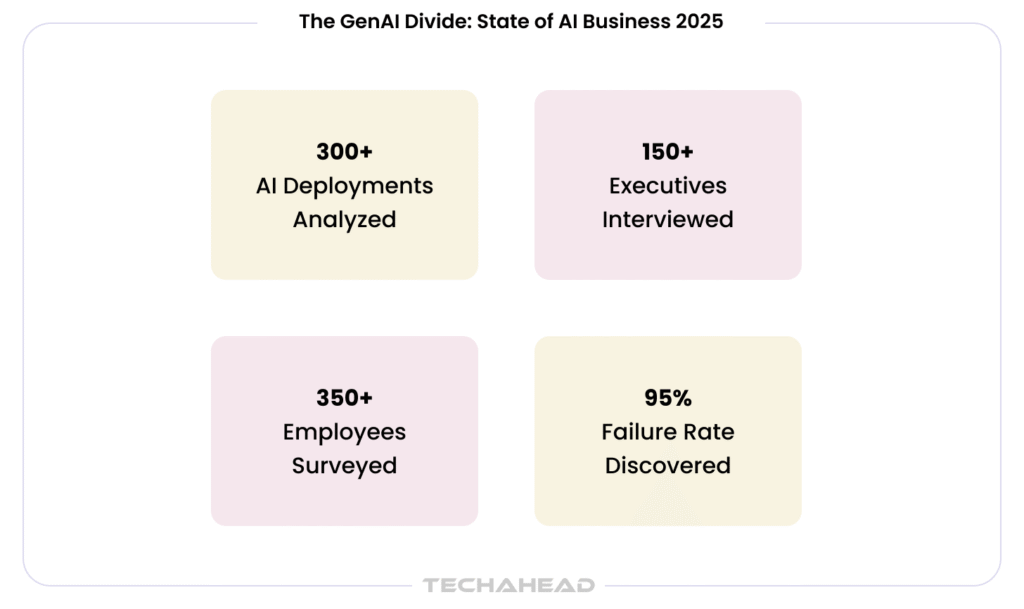
Start with the one that made the rounds last year. MIT’s Project NANDA published a study titled “The GenAI Divide: State of AI in Business 2025,” and its headline finding was brutal: about 95% of generative AI pilots delivered no measurable impact on profit and loss, while only around 5% achieved rapid revenue acceleration. Not low return. No measurable return, for the overwhelming majority.
Gartner has been circling the same problem from different angles. Back in 2024, it predicted that at least 30% of generative AI projects would be abandoned after proof of concept by the end of 2025, citing poor data quality, inadequate risk controls, escalating costs, and unclear business value. And more recently, in April 2026, Gartner reported that only 28% of AI use cases in infrastructure and operations fully succeed and meet ROI expectations, while 20% fail outright, based on a survey of 782 infrastructure and operations leaders.
For CTOs, enterprise technology leaders, AI project owners, and delivery teams trying to move AI from pilot to production in complex organizations, the diagnosis in those numbers is consistent: the failure is rarely the technology. It is data, integration, governance, lifecycle readiness, and unrealistic expectations. Getting something to work in a demo and getting something to pay off in production are two completely different problems. Most organizations are far better at the first than the second.
This playbook is about closing that gap. It lays out why pilots stall, what production-ready enterprise AI requires, and how to use a staged path from governance and data quality to integration and engineering execution to turn AI experiments into scalable, reliable systems that deliver measurable business impact.
Also Read: Enterprise AI Scaling
Let’s clear something up early. When a pilot dies on the way to production, the postmortem almost never reads “the model was not smart enough.” The frontier models are, frankly, more capable than most of the workflows you are trying to point them at.
What actually kills pilots is the stuff nobody demos:
Both the MIT and Gartner findings point the same direction. MIT called the core barrier a “learning gap,” where tools do not retain feedback, adapt to context, or fit real workflows. Gartner attributed much of the failure to unrealistic expectations, skills gaps, poor data quality, and difficulty integrating AI into existing operations.
Related: AI Development Guide 2026
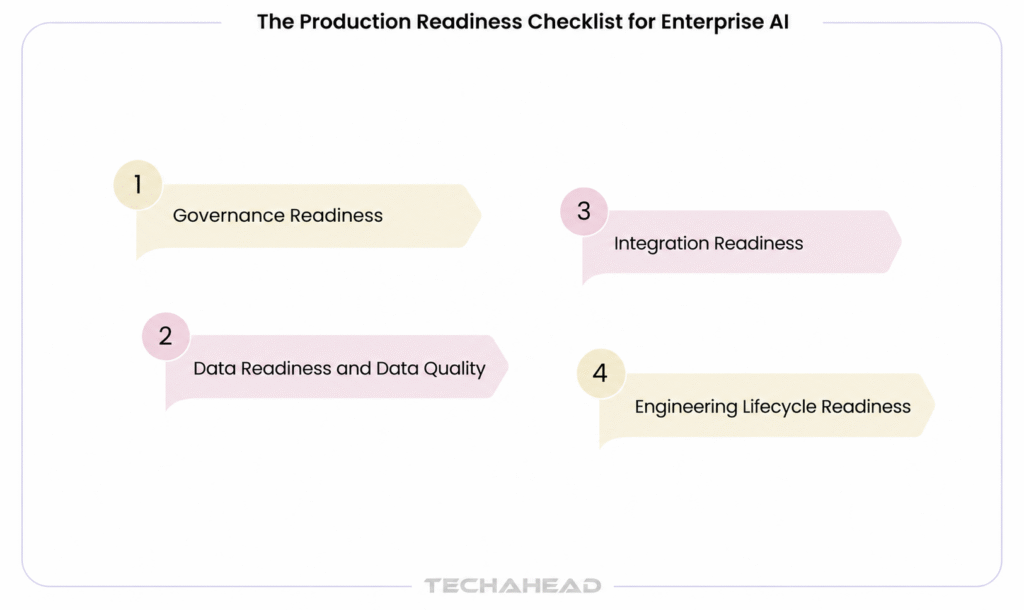
So the useful question is not “which model should we use?” It is “what has to be true for this thing to survive contact with production?” That question has four answers, and they are the spine of this playbook: governance, data, integration, and engineering lifecycle. Serious enterprise AI development lives or dies on these four, so let us walk each one.
Think of the next four sections as the checklist you run before a pilot earns the right to become a production system. If you can honestly clear each block, you are building something that will survive. If you cannot, you have just found exactly where the work is.
Governance is the part everyone agrees is important and almost nobody does before the pilot. It sounds like a compliance chore. It is actually the thing that decides whether your AI development services can move beyond experimentation and be allowed to support real business decisions or is forever stuck making suggestions a human has to double-check, because developing AI solutions means balancing rapid innovation with strict governance.
Here is the honest test. Before a pilot goes anywhere near production, you should be able to answer these without a meeting:
None of this is exciting. Responsible AI governance is increasingly a board-level concern, not just an IT task. All of it is what lets you say yes to production without lying awake about it. And here is the part that trips up smart teams: governance is not something you bolt on at the end. Retrofitting it after deployment is slower, costlier, and politically miserable compared to designing it in from the start.
This is precisely why more mature organizations stand up a dedicated function for it, an AI Center of Excellence that owns standards, review, and reusable governance patterns so every new pilot does not reinvent the rulebook from scratch, which only works with executive sponsorship and cross-functional collaboration.
If your governance answer to any of the above is “we will figure that out later,” later is where your pilot goes to die. OECD’s AI Principles and NIST’s AI RMF v1.0 are useful guides for trustworthy AI development and AI risk management, and strict data governance frameworks help maintain privacy and regulatory compliance.
| Verification Item | Description |
| Ownership | Name one accountable owner, not a committee. If ownership is fuzzy, you have found your first failure point. |
| Risk tier | Internal helper, or something touching customers, money, or regulated decisions? The production bar shifts entirely with the answer. |
| Human-in-the-loop design | Specify where a human reviews, approves, or overrides. Name the trigger, the reviewer, and the escalation path. |
| Auditability | Weeks later, can you reconstruct why the system did what it did? If not, you are one bad output from an ugly conversation. |
| Model documentation and testing | Keep model cards, known limitations, and bias and fairness checks. The paperwork that turns ‘trust me’ into evidence. |
If governance is the block people skip, data is the block people underestimate. Almost everyone nods along that data matters. Almost nobody budgets for how much it matters. It is worth remembering that when Gartner listed the reasons GenAI projects get abandoned after proof of concept, poor data quality was a primary barrier to enterprise AI success.
Related: Build Enterprise AI Roadmap in 90 Days
The demo ran on a clean, curated slice of data that somebody lovingly prepared. Production runs on the real thing: incomplete records, inconsistent formats, three “sources of truth” that disagree, and a pipeline that breaks quietly on a Sunday night. The model did not get dumber between the demo and production. The data got real. AI models are only as good as the data they consume.
Ask yourself:
Data silos reduce visibility and limit model access to comprehensive enterprise data, while data warehouses help organize information for training and operational use.
This is painstaking work. It is also the work that most reliably separates the pilots that scale from the ones that stall. If you are not willing to invest in the data foundation, you are not really investing in the AI. You are investing in a demo.
| Checkpoint | What to verify before production |
| Quality | Is the data accurate, complete, and consistent, or just fine in aggregate? Messy data yields confident, well-formatted wrongness. |
| Availability | Can you get the data the model needs, at the freshness it needs, at the moment of decision? |
| Pipelines | A real engineered flow from source to model with monitoring, or a human quietly exporting spreadsheets to fake it? |
| Access and permissions | Who is allowed to see what? At real data scale, access rules stop being theoretical. |
Now we get to the quiet killer. A pilot can have a great model, decent governance, and clean data, and still die here, because it was never actually wired into existing enterprise systems.
You have almost certainly seen an AI tool that lives in its own tab, requires people to change their habits to use it, and therefore quietly does not get used. Adoption craters. The pilot is declared a disappointment. The model was never the problem. The integration was. MIT’s research made the same point bluntly: pilots stall when tools do not fit day-to-day operations.
Real integration readiness means asking:
When AI solutions are embedded into business operations, they can automate processes and improve operational efficiency; predictive analytics is a simple example of how enterprise AI solutions show up inside daily business functions instead of outside them.
Getting this right is genuinely hard engineering, not a configuration setting. It usually leans on solid AI infrastructure management and mature cloud engineering underneath, because production integration is where “it works” meets “it works reliably, at scale, every day, for everyone.” Those are not the same sentence, and pretending they are is how pilots stall. This last-mile integration problem is exactly why so many enterprises now hire forward-deployed engineers to sit between the model and the messy reality of production systems.
A common example is natural language processing, which enables AI to understand human language for integration-heavy use cases like automated customer support.
| Checkpoint | What to Verify |
| Workflow fit | Does it live inside the tools people already use, or force them into a separate tab they will quietly ignore? |
| Systems of record | Does it connect to the real CRM, ERP, and ticketing? Sandbox-only means integration is postponed, not tested. |
| Load and latency | A response that delights in a demo can break when a thousand people hit it at once. Confirm it holds under real traffic. |
| Failure behavior | When the model or an upstream service goes down, does the workflow degrade gracefully or just break? |
Here is the mindset shift that fixes more than almost anything else: a pilot is an experiment, but a production AI system is a product. Products have lifecycles. Experiments have expiration dates, and enterprise AI systems need product-grade lifecycle management at enterprise scale.
Most pilots are built with experiment discipline and then quietly expected to behave like products. They cannot, because the engineering scaffolding was never there. If you would not ship traditional software this way, do not ship AI this way either.
Production readiness on the engineering side means:
This is the block where the “playbook” framing earns its name, because none of it is optional and all of it is learnable. It is the same rigor you already apply to critical software, extended to systems that happen to be probabilistic. If you want a closer look at how the software lifecycle itself is shifting, our blog on what changes when agents join the SDLC goes deep on it. Teams that treat generative AI features with the same lifecycle seriousness as any other production software are the ones whose pilots actually graduate, especially since AI agents perform multi-step tasks rather than simple queries.
| Checkpoint | Description |
| Versioning | Can you version prompts, models, and data, ideally in a model registry? When behavior changes, you need to know what changed. |
| Monitoring | Not ‘is the server up’ but ‘is the model still behaving?’ Models drift as data and behavior shift. |
| Evaluation | A repeatable, ideally automated way to measure quality, so you know if a change helped or hurt before users feel it. |
| Rollback | When a new version misbehaves, can you return to the known-good state quickly? Panic-and-hotfix is not a strategy. |
| Skills | MLOps and LLMOps are real disciplines. The skills gap is a top reason pilots fail, and traditional ops teams are not automatically equipped. |
| This is exactly the terrain TechAhead works in. As an enterprise AI development company, TechAhead builds production-grade AI systems with governance, data readiness, integration, and engineering discipline handled from day one, so what leaves the pilot stage is a system your business can actually depend on. |
Let me make this concrete, because the abstraction can hide how sharp the cliff really is.
In a demo, you control everything. You pick the inputs. You know the happy path. If something looks off, you rerun it. The audience is rooting for you. It is theater, and there is nothing wrong with theater, as long as you remember that is what it is.
Production is the opposite of theater. Production is:
The gap between those two worlds is exactly the four blocks above. Every pilot that stalls, stalls somewhere in that gap. And the reason it feels sudden (“it worked so well last month!”) is that the demo never tested any of it. The failure was baked in from the start. It just took production to reveal it.
The good news, if you want to call it that: the gap is predictable. Which means it is plannable. Which means it is preventable.
| TechAhead approaches enterprise AI development with production in mind from the first conversation. The team engineers the unglamorous foundations, ownership, clean data, real integration, and lifecycle discipline that decide whether AI ships. That is the difference between another stalled proof of concept and a reliable operating system. |
Fair question, and it is the one the checklist sets up but does not fully answer. The four blocks tell you what has to be true. This tells you the order in which to make them true, so you are never left staring at a stalled pilot wondering which fire to fight first. Treat it as a staged path with a go or no-go gate at the front, because a clear AI strategy or enterprise AI strategy should determine which pilots deserve budget first and in what order, and the most valuable thing you can do early is decide which pilots do not deserve production budget against business objectives at all.
A quick note before the steps: the sequence below is practitioner judgment about what tends to work, not a certified industry standard, and any timeframes are directional. Your risk tier, data maturity, and regulatory exposure will stretch or compress every phase.
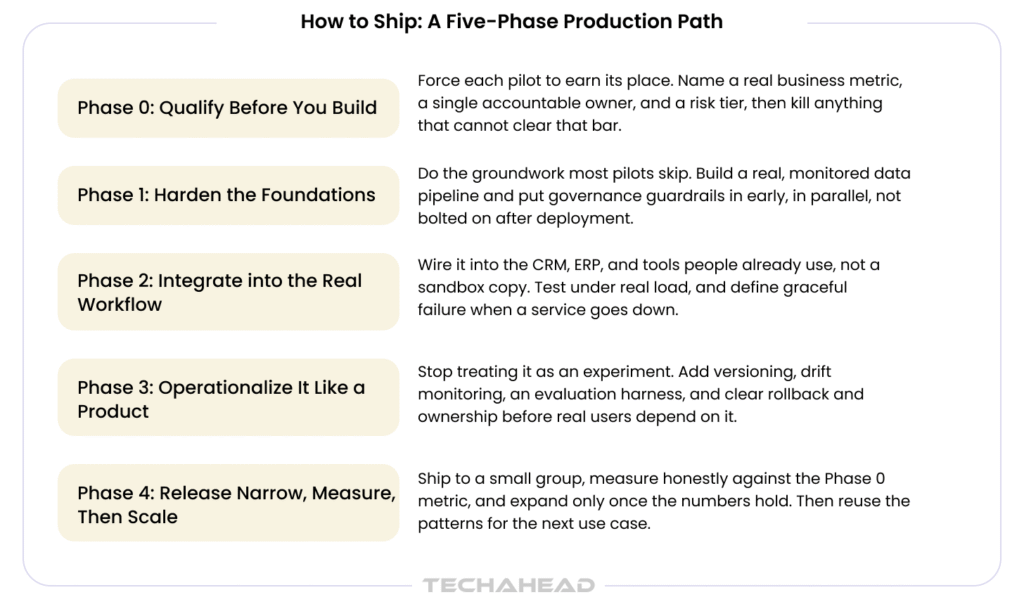
Before a single sprint, identify high-impact business problems and force the pilot to earn its place.
This is the unglamorous groundwork most pilots skip.
This is where a pilot stops being an experiment, especially as advanced ai technologies make stronger operational discipline non-negotiable.
The reason this order matters is that each phase de-risks the next. Skip the gate and you pour money into pilots that were never viable. Skip the foundations and integration collapses. Skip operationalization and the thing works right up until the day it quietly stops. Mature enterprise AI development is mostly the discipline of doing these in sequence instead of rushing to the demo and backfilling the hard parts later, usually under pressure and usually at several times the cost.
So what are the teams that make it to production doing differently? Across the research and, frankly, across every successful deployment worth studying, the same handful of themes keep showing up. And notice what is not on the list: nobody wins because they found a secret better model.
If you read that list and thought “this sounds less like a model problem and more like an operating-model problem,” you have understood the entire playbook. That is exactly what it is. The organizations that consistently get enterprise AI development across the finish line have usually built the muscle for it deliberately, and that is precisely where TechAhead comes in.
This is the problem TechAhead is built to solve. The team approaches enterprise AI development with production in mind from the first conversation, so the things that usually sink a pilot get handled early: clear governance, a real data foundation, integration into the systems your people already use, and the engineering discipline to keep it running once it ships. A stalled proof of concept, an AI system that needs to scale, a project you are starting fresh, these all come down to the same challenge, which is closing the distance between something that works in a demo and something your business can actually rely on.
You do not have to work through that alone. Talk to TechAhead’s team and take your AI initiative from pilot to production, the right way.
Most fail because production readiness was never built in. The model usually works fine. What breaks is governance, data quality, workflow integration, and engineering discipline. Fix those four and the pilot-to-production gap mostly closes on its own.
Honestly? When you can name a clear owner, prove your data holds up outside the sandbox, show it fits real workflows, and demonstrate monitoring and rollback. If any of those are fuzzy, it is production-ready in name only.
A proof of concept shows something can work under perfect conditions. A production-ready AI system holds up under messy ones: real data, real load, edge cases, and model drift. Most enterprise AI development effort actually lives in that gap.
Run a staged path. Qualify the use case against a real metric, harden data and governance in parallel, integrate into actual systems, then operationalize with versioning and monitoring. Scope tight, ship narrow, and expand only once the numbers hold.
At minimum, a named owner, a risk tier, clear human-in-the-loop checkpoints, audit logging, and model documentation. Mature teams map this to frameworks like the NIST AI RMF so AI governance is designed in early, not bolted on after a pilot stalls.
They raise the bar on documentation, risk classification, and auditability, especially for high-risk use cases. You do not need to fear them, but you do need to map obligations to each use case early. Worth verifying current rules, since these keep evolving.
Be honest about where your muscle is. Research suggests externally built, well-integrated systems reach production more often than pure in-house builds. The right enterprise AI development partner gets you past the pilot-to-production cliff without learning every hard lesson yourself.
TechAhead builds production-first, not demo-first. Governance, data foundations, integration, and engineering lifecycle discipline go in from day one. So instead of another slick pilot that quietly stalls, you get an AI system your business can genuinely run on.
You need real MLOps and LLMOps capability, not just the data scientists who built the demo. Someone has to own monitoring, versioning, evaluation, and rollback. That skills gap is one of the most common reasons production AI quietly falls over.
It varies, but a focused pilot often runs weeks while a real production rollout takes months, not days. The honest driver is scope and readiness, not model choice. Tight scoping and early governance are what keep timelines from slipping.
We use cookies to ensure our website functions properly, improve performance, and provide a personalized experience. You can choose which types of cookies to allow below.
Required for core functionality such as security, network management, and accessibility. These cannot be disabled.
Help us understand site traffic and user interactions so we can improve performance and usability.
Enable enhanced functionality and personalization such as language or region preferences.
Used to deliver relevant ads, track campaign performance, and measure advertising effectiveness.