


 Copy Link
 Share on X
 Share on Facebook
 Share on LinkedIn
Always Active
Required for core functionality such as security, network management, and accessibility. These cannot be disabled.

Uncover the transformative potential of digital and mobile solutions for your industry.





 Last Updated: Sep 14, 2026
Sep 14, 2026
Last Updated: Sep 14, 2026
Sep 14, 2026  689
689  19 min. Read


Key Takeaways
The internet runs on several invisible agreements: TCP/IP, HTTP, and SMTP.
Nobody notices them until something breaks. AI agents are about to have the same reckoning.
In 2025, a new class of software emerged: autonomous AI agents capable of calling APIs, querying databases, orchestrating tasks, and delegating work to other agents.
What also emerged, almost immediately, was a coordination nightmare.
Enterprises deploying multi-agent systems discovered that every new tool integration required custom code, every agent-to-agent handoff required bespoke logic, and every expansion of the system required re-engineering what came before.
Source: TechAhead AI Team
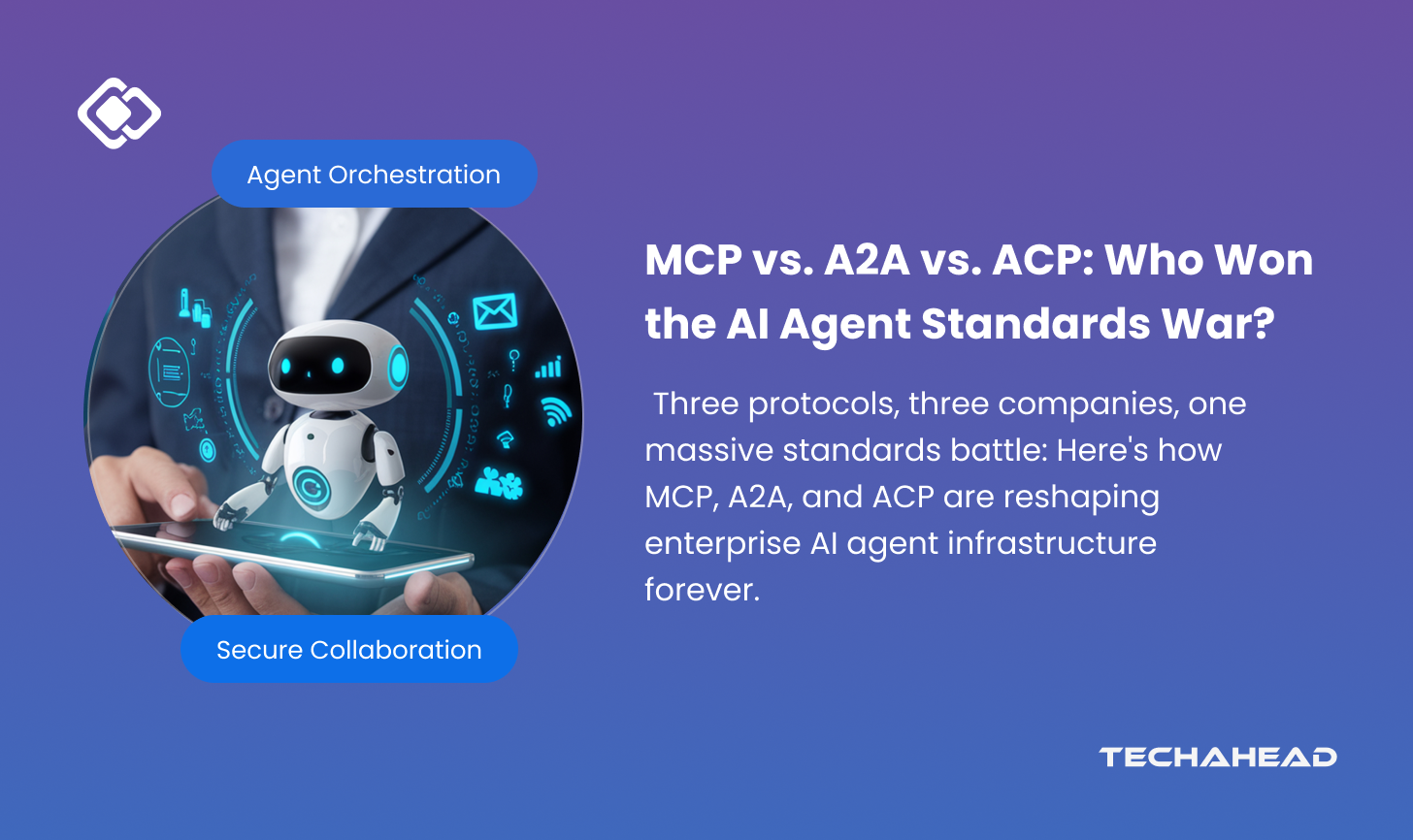
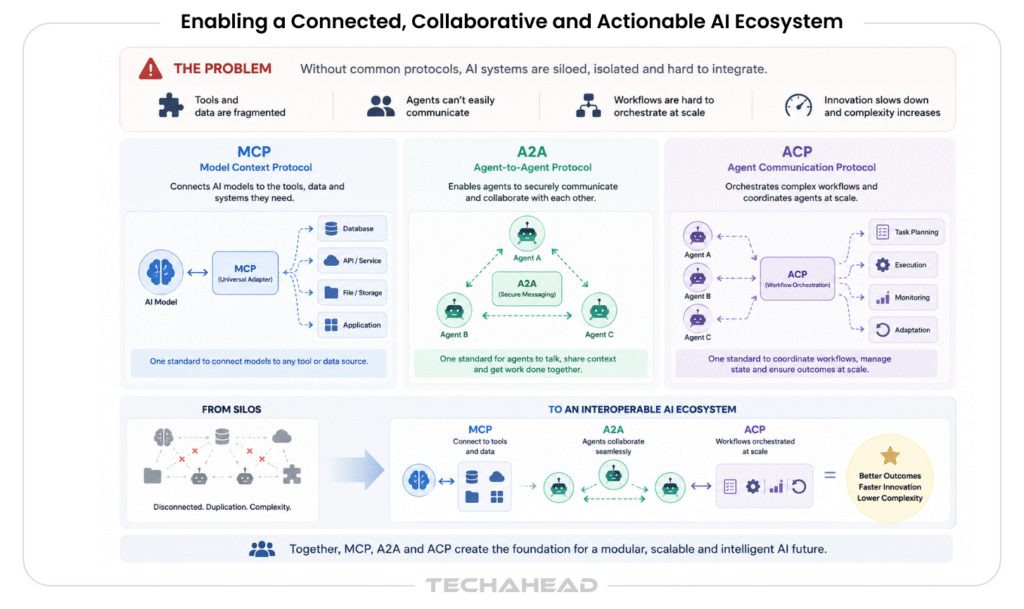
Three protocols appeared in rapid succession to solve this:
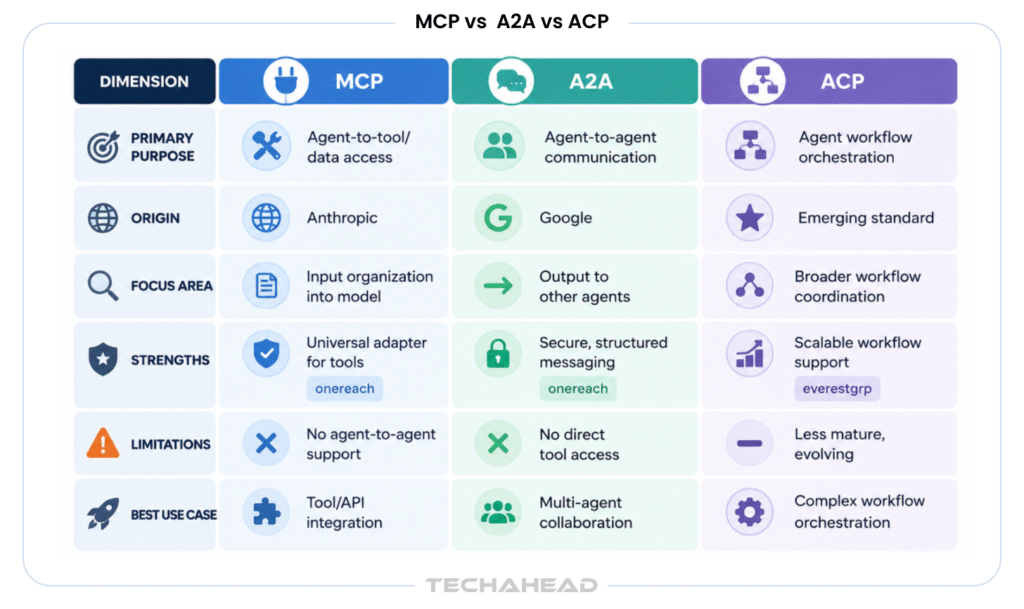
MCP (Model Context Protocol) from Anthropic, which standardizes how AI agents connect to tools and data
A2A (Agent-to-Agent Protocol) from Google, which standardizes how agents talk to other agents; and
ACP (Agent Communication Protocol) from IBM Research, which offered a REST-native alternative before ultimately merging with A2A in August 2025.
This blog unpacks each protocol in depth, compares them head-to-head, and analyzes what their convergence and continued divergence mean for developers, enterprises, and the future of AI infrastructure. For organizations turning these standards into production systems, AI development services are essential for aligning protocol choices with enterprise architecture, security requirements, and real operational workflows.
Source: TechAhead AI Team
Because the standards battle happening right now will determine how the next decade of AI gets built.
AI workloads are no longer monolithic.
A modern enterprise AI system might deploy a planning agent, a data retrieval agent, a code execution agent, and a reporting agent, each specialized, each built on different frameworks, possibly by different vendors.
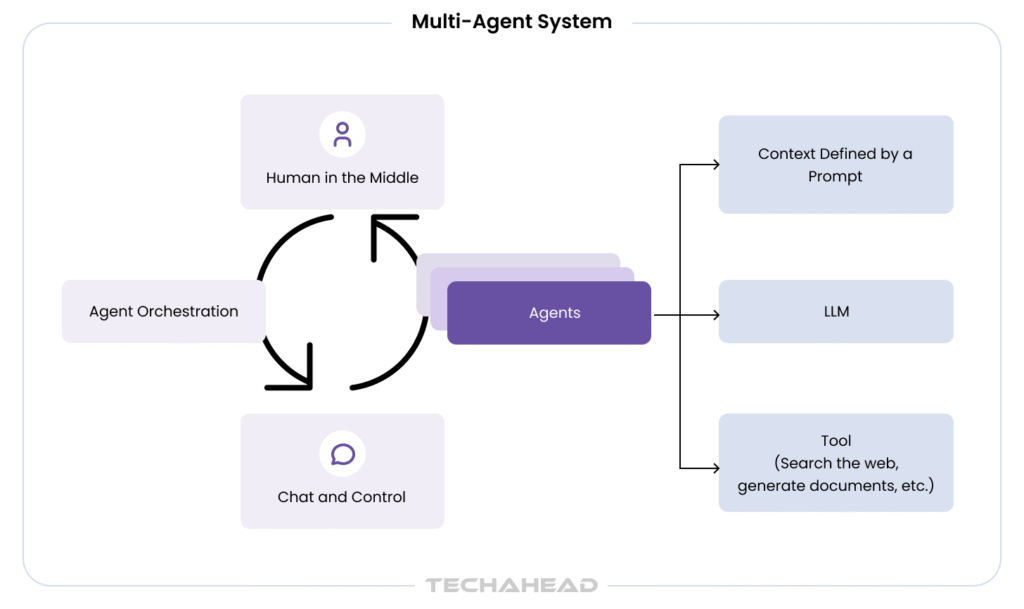
Multi-Agent System (Source)
According to research from industry analysts, 85% of enterprises were expected to implement AI agents by the end of 2025. The architecture shift from single-model assistants to coordinated agent networks happened faster than most anticipated.
In practice, multi-agent systems now power real-world use cases across enterprise automation (automated procurement-to-pay pipelines), IT operations (self-healing incident response chains), customer service (intent routing between specialized support agents), and cybersecurity (coordinated threat detection, triage, and remediation).
Before standardized protocols, connecting an AI agent to a tool meant writing a custom adapter. Connecting it to three tools meant writing three adapters. Connecting ten agents across five tools from four vendors meant an unmaintainable hairball of one-off integrations, each with its own error handling, authentication scheme, and context format.
This isn’t theoretical. Early enterprise AI pilots consistently reported that 60–80% of engineering effort went into integration plumbing rather than actual AI capability development. The situation mirrored the pre-USB era of device connectivity: every device had its own proprietary cable, and swapping hardware meant starting over.
Standardized protocols collapse that complexity. Instead of writing N×M custom integrations (N agents, M tools), you write to one protocol and get connectivity to the entire ecosystem. Enterprises get plug-and-play agent architectures.
Developers get reusable components. Security teams get standardized access controls and audit trails. Everyone benefits when the plumbing disappears.
MCP: The Universal Adapter Between Agents and the World
Model Context Protocol was released by Anthropic in November 2024 as an open standard with Python and TypeScript SDKs. Its origin story is refreshingly unglamorous: developer David Soria Parra was frustrated with constantly copying context between Claude Desktop and his IDE.
The solution he built became the foundation of the most widely adopted AI integration standard in the world.
MCP was donated to the Linux Foundation’s newly formed Agentic AI Foundation (AAIF) in December 2025, ensuring vendor-neutral governance alongside Kubernetes, PyTorch, and other critical open-source infrastructure.
As Anthropic’s Chief Product Officer Mike Krieger put it: “A year later, it’s become the industry standard for connecting AI systems to data and tools, used by developers building with the most popular agentic coding tools and enterprises deploying on AWS, Google Cloud, and Azure.”
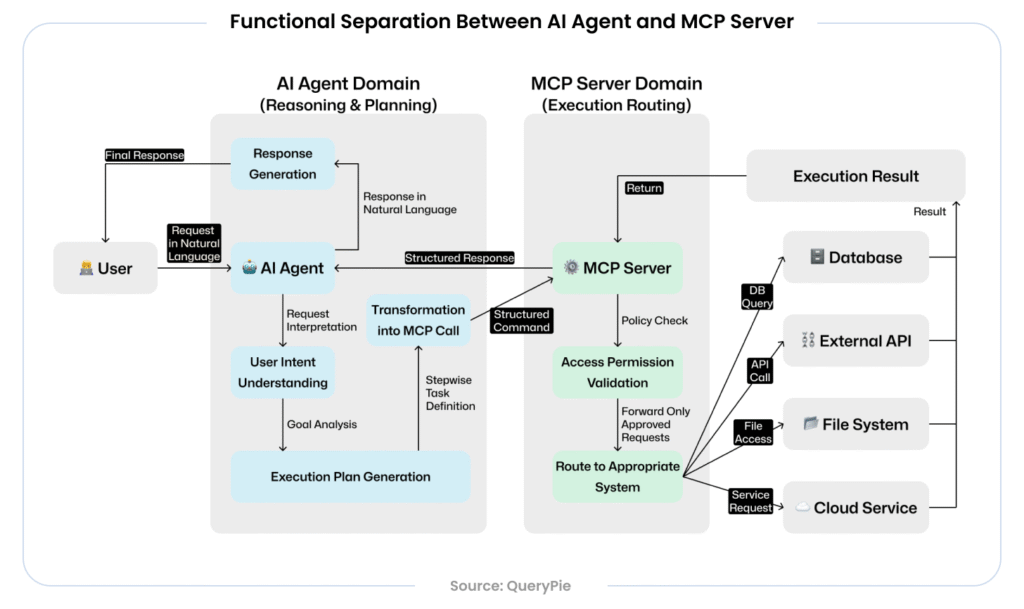
Functional Separation Between AI Agent and MCP Server (Source)
MCP uses JSON-RPC 2.0 for communication and organizes its ecosystem around three roles:
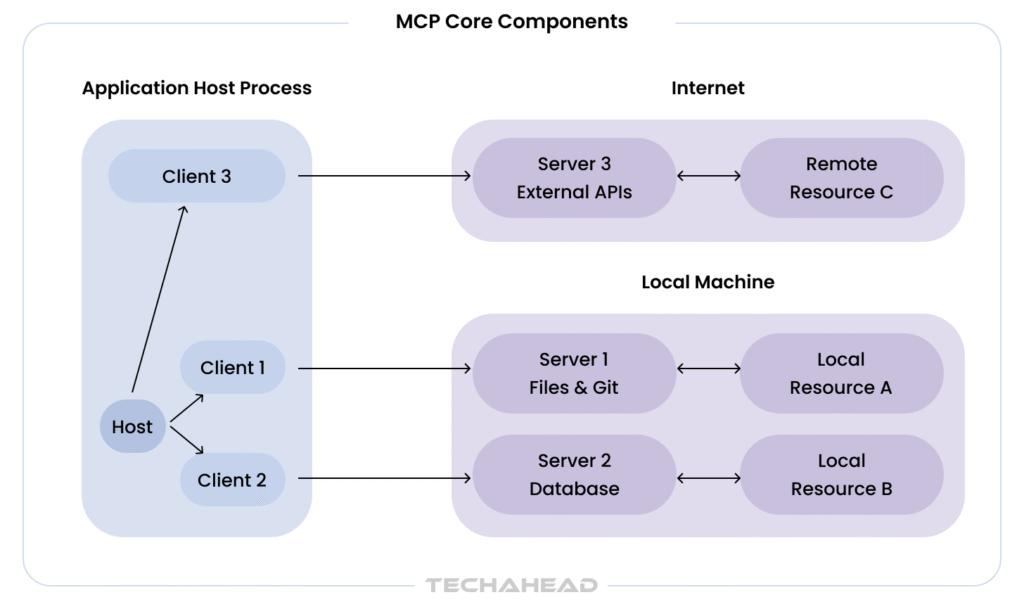
MCP Core Components (Source)
The four core primitives MCP exposes are Resources (data and files), Tools (functions the agent can invoke), Prompts (pre-defined interaction templates), and Sampling (allowing servers to request model completions). Transport runs via stdio for local servers and Streamable HTTP for remote ones. Authorization uses OAuth 2.1 for secure remote access, with specifications released in March 2025.
The “write once, use everywhere” model is what drives adoption. A Postgres MCP server built today works with every major AI client without modification.
The adoption velocity of MCP has been remarkable. MCP server downloads grew from roughly 100,000 in November 2024 to over 8 million by April 2025. By October 2025, the PulseMCP registry listed over 5,500 community-built MCP servers.
In March 2025, OpenAI adopted MCP across its Agents SDK, Responses API, and ChatGPT desktop.
Sam Altman posted simply: “People love MCP and we are excited to add support across our products.” Google DeepMind’s Demis Hassabis confirmed MCP support in Gemini models that April. By year-end, MCP had 97 million monthly SDK downloads and support from every major cloud platform.
Block (formerly Square, the FinTech company behind Cash App) represents one of the most documented enterprise MCP implementations. Block built an internal AI agent called Goose on MCP architecture, deployed across both desktop and command-line environments for thousands of engineers.
Critically, Block built all their MCP servers in-house rather than using third-party ones, giving complete control over security and custom workflow integration.
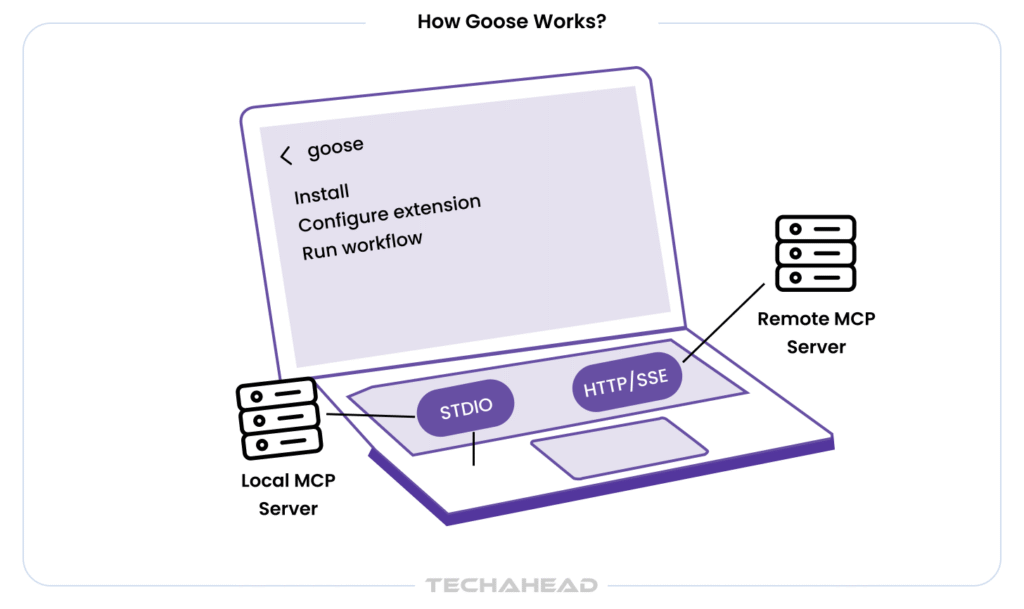
How Goose Works?
The results, shared publicly by Block’s VP of Engineering Angie Jones: code migration, database migration, QA automation, and support ticket triage that reduced multi-day tasks to hours. The overall reported outcome was 50–75% time savings on common engineering tasks. Organizations adopting MCP are broadly reporting around a 30% reduction in development overhead compared to custom integration approaches.
MCP’s greatest strength is precisely what drove its adoption: simplicity in the right places. It abstracts the complexity of connecting AI to external systems without over-engineering the agent-to-agent coordination problem, which it explicitly doesn’t try to solve.
That’s also its intentional limitation. MCP does not define how one AI agent communicates with another agent, delegates tasks, or negotiates capabilities. For single-agent-to-tool architectures, it’s near-perfect. For multi-agent orchestration, you need something else.
Google announced the Agent-to-Agent (A2A) Protocol on April 9, 2025, at Google Cloud Next, releasing it as open source under the Apache 2.0 license.
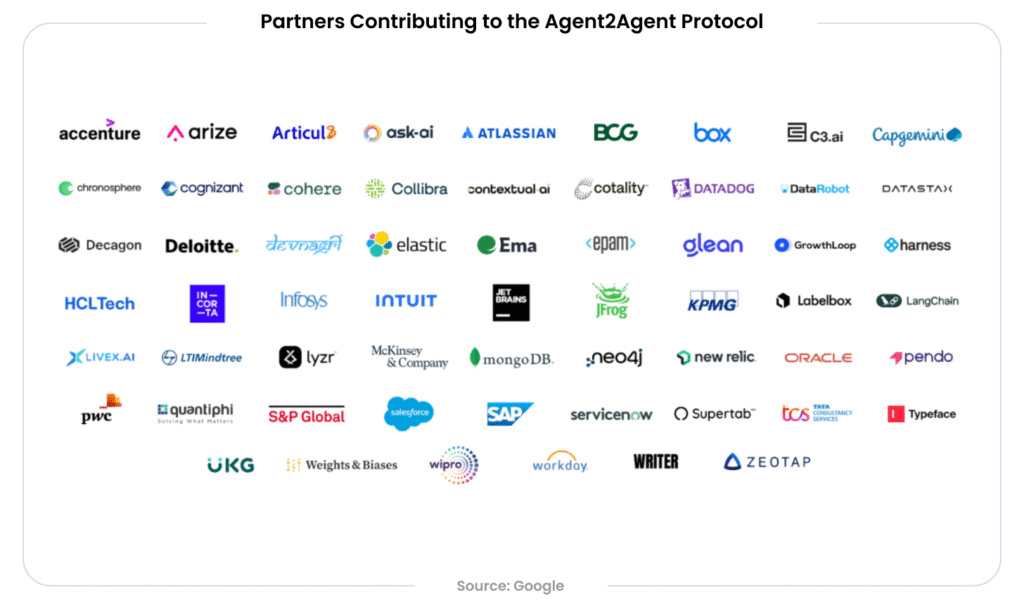
Source: Google
The initial release came with 50+ founding partners, including Atlassian, Salesforce, SAP, ServiceNow, PayPal, Workday, Accenture, Deloitte, McKinsey, and PwC. On June 23, 2025, at Open Source Summit North America in Denver, Google donated A2A to the Linux Foundation, where it now operates as the Agent2Agent project under vendor-neutral governance.
A2A was designed to answer a different question than MCP: not “how does an agent access a tool?” but “how do independently built agents find each other, authenticate, and delegate work across organizational boundaries?”
A2A uses HTTP, Server-Sent Events (SSE), and JSON-RPC 2.0 for transport, no new protocol layer required. Its architecture rests on three foundations:
Agent Cards are JSON documents every A2A-compliant agent publishes at /.well-known/agent-card.json.
They declare the agent’s name, capabilities, supported task types, communication modalities (text, audio, video), authentication requirements, and service endpoint. Any A2A client reads this card to decide whether to delegate a task, no centralized registry required.
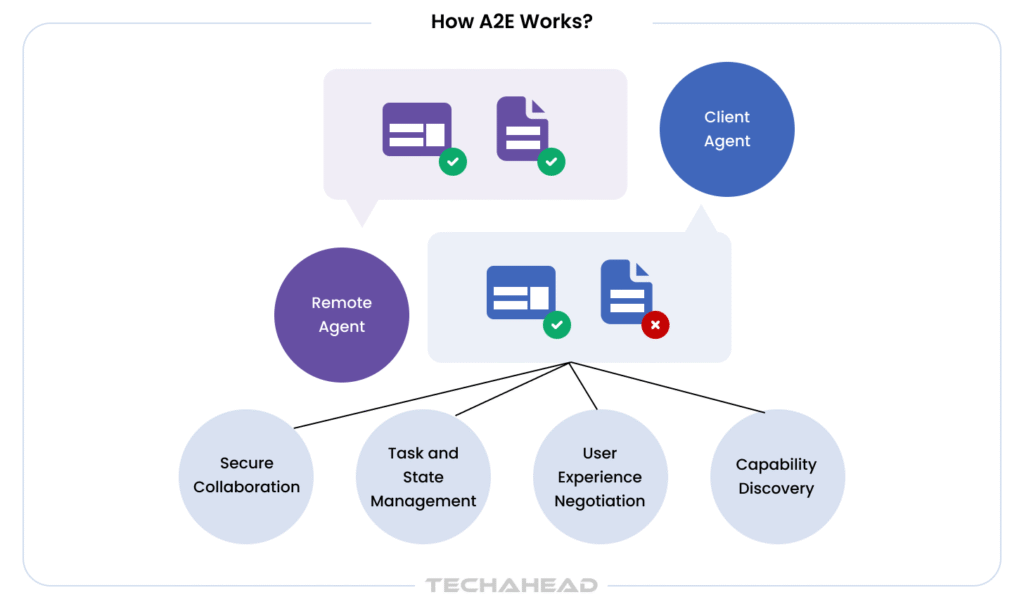
How A2E Works? (Source: Google blog)
Tasks are the structured work units exchanged between agents, with a defined lifecycle: submitted → working → input-required → completed/failed/canceled. This lifecycle model, partially influenced by IBM’s ACP, handles both quick synchronous exchanges and long-running asynchronous workflows.
Transport over HTTP/SSE provides three interaction modes: synchronous (single prompt-response), streaming (for complex tasks requiring progress updates), and webhook-based async (for tasks that may take hours or days). Support for multimodal data means agents can exchange not just text but images, audio, and structured files.
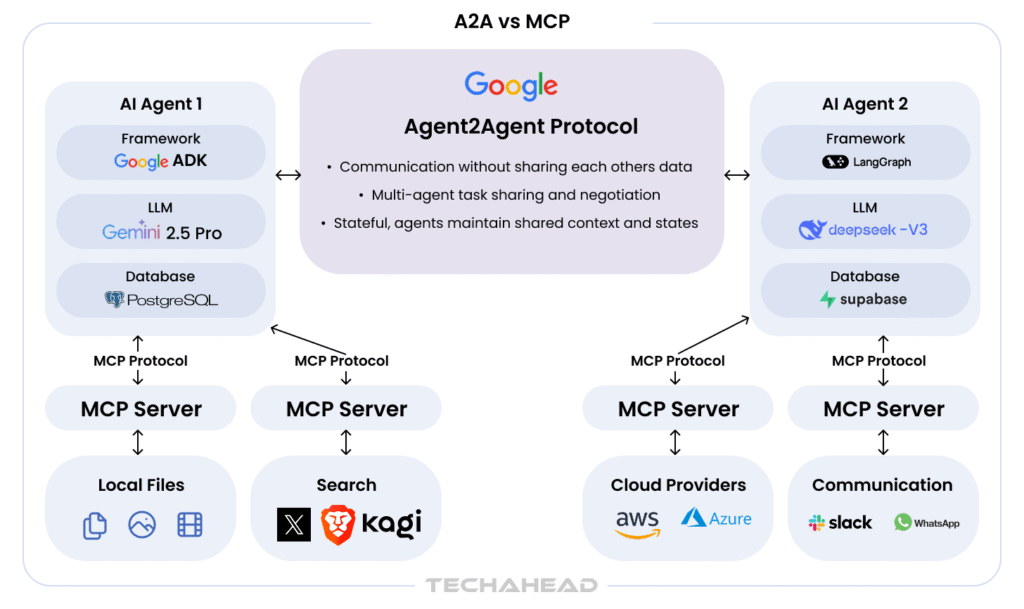
By April 2026, exactly one year after launch, A2A surpassed 150 supporting organizations including AWS, Cisco, Google, IBM, Microsoft, Salesforce, SAP, and ServiceNow. Azure AI Foundry, Amazon Bedrock AgentCore, and Google Cloud have all integrated A2A natively into their platforms.
The GitHub repository crossed 22,000 stars. The SDK ecosystem expanded from a single Python implementation to five production-ready languages: Python, JavaScript, Java, Go, and .NET.
Vertical adoption spans supply chain, financial services, insurance, and IT operations.
Google showcased enterprise A2A deployments at its one-year milestone announcement.
Tyson Foods and Gordon Food Service used A2A agents to share product data and optimize supply chain operations between independently managed systems.
Rather than building custom EDI-like integrations, their agents used A2A’s Agent Card discovery and task delegation to coordinate across organizational boundaries, a use case that would have required months of custom integration work using traditional approaches.
Another illustrated use case from SiliconAngle’s reporting on the protocol: a network troubleshooting platform uses one A2A agent to diagnose router issues and another to remediate switch malfunctions. When a problem spans both domains, the agents exchange technical data through A2A without requiring a human to bridge the gap or an engineer to write a new connector.
While Anthropic and Google were building MCP and A2A respectively, IBM Research was working on its own answer to the agent interoperability problem. In March 2025, IBM launched the Agent Communication Protocol (ACP) as the operational core of its BeeAI Platform, an open-source framework designed to orchestrate AI agents regardless of their underlying framework or codebase.
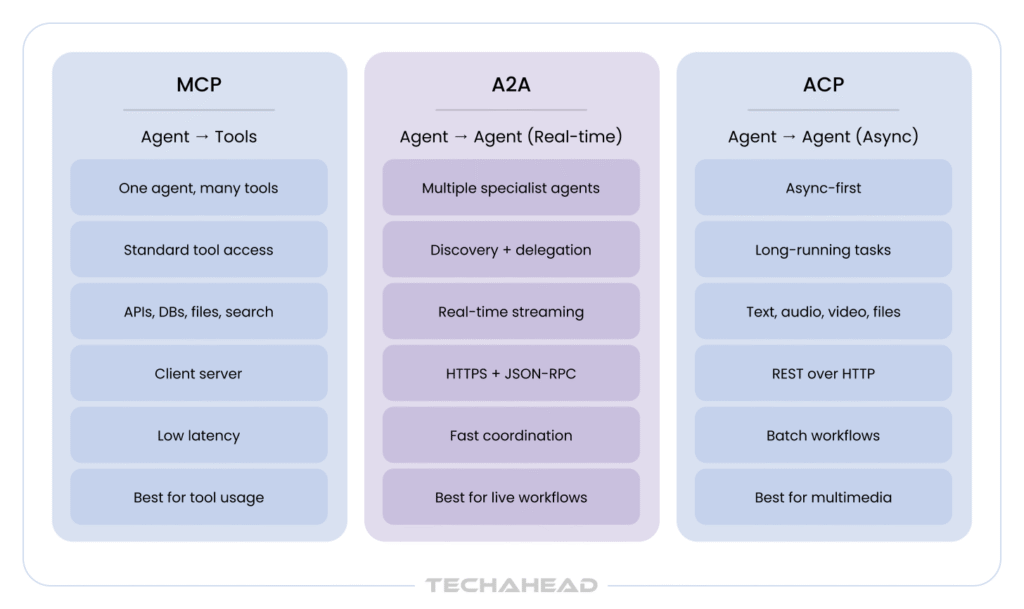
ACP’s founding premise was straightforward but distinct: enterprise AI workflows are not simple request-response exchanges. They are long-running, stateful, mission-critical processes that need to survive failures, resume mid-task, and report progress asynchronously. Neither MCP nor early A2A addressed this with enough depth for IBM’s enterprise customers.
ACP was REST-native by design. Where A2A introduced new concepts like Agent Cards and task lifecycle schemas, ACP mapped agent interactions directly onto standard HTTP verbs: POST to create a task, GET to check status, PUT to update, DELETE to cancel. The entire API was specified in OpenAPI, meaning any HTTP client: Curl, Postman, any language’s standard HTTP library, could interact with an ACP agent without specialized SDKs or new transport layers.
This gave ACP a meaningful advantage in enterprise environments where teams already had mature REST API workflows: zero barrier to entry. No new message format to learn. No new transport to implement. Just HTTP, which every engineering team already knew.
Three capabilities defined ACP’s technical identity:
IBM’s BeeAI platform, built on ACP, targeted enterprise teams running heterogeneous agent environments, scenarios where a LangChain agent, a CrewAI agent, and a custom enterprise agent needed to coordinate without being rewritten to share a common framework. ACP treated framework-agnosticism as a first-class requirement, not an afterthought.
This positioned ACP less as a consumer-facing developer tool (like MCP’s early appeal) and more as enterprise middleware, the kind of infrastructure that IT architects specify, not the kind that individual developers adopt because it’s fun to hack on. That distinction partly explains why ACP never achieved MCP’s grassroots momentum, even as its technical contributions were widely respected.
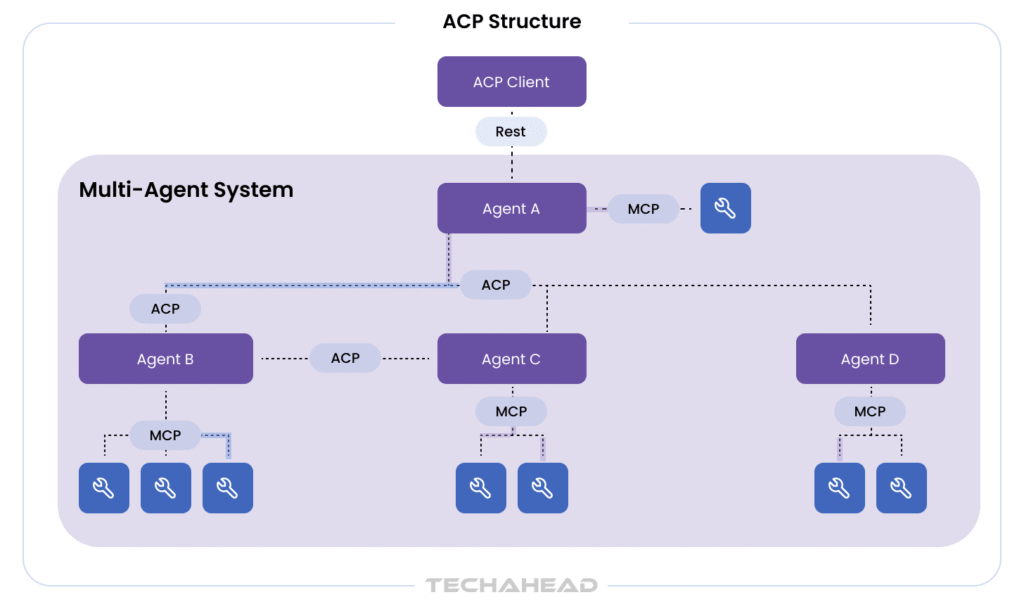
ACP Structure (Source)
In August 2025, IBM Research and Google made a joint announcement: ACP would formally merge with A2A under the Linux Foundation’s LF AI & Data umbrella. ACP development would wind down as a standalone protocol. Its assets, specifications, and engineering expertise would be contributed directly to A2A.
The merger was not a defeat, it was a consolidation. Every capability that defined ACP is now native to A2A v1.0: task persistence, asynchronous resumption, webhook-based progress notification, and the long-running orchestration patterns IBM had pioneered. As one technical analysis put it, “The reliability features that distinguished ACP are all part of A2A today.”
The historical parallel is apt. Enterprise networks once ran fragmented protocols: DECnet, NetWare IPX/SPX, IBM’s own SNA. They consolidated around TCP/IP not because TCP/IP beat them in a fight, but because consolidation made the entire ecosystem more valuable. ACP and A2A followed the same logic.
What the merger confirmed is that no single vendor, not even Google with A2A’s early lead, could define the enterprise agent communication standard alone. IBM’s technical contributions were necessary to make A2A production-ready for the mission-critical workloads enterprises actually run.
IBM Research launched its own Agent Communication Protocol (ACP) in March 2025 as the core of its BeeAI open-source platform. ACP introduced important concepts: persistent state for long-running tasks, asynchronous resumption, and webhook-based progress notification , features designed for mission-critical enterprise workflows.
In August 2025, IBM and Google announced that ACP would formally merge with A2A under the Linux Foundation’s LF AI & Data umbrella. ACP’s task persistence, async resumption, and webhook patterns are now native to A2A v1.0. As one analysis noted, it’s “the protocol equivalent of competing network standards consolidating around TCP/IP in the 1990s.”
A2A’s strength is architectural completeness for multi-agent scenarios: discovery without a central registry, secure cross-vendor authentication, structured task delegation, and support for long-running workflows. Its initial weakness was complexity, early developers found the full specification harder to approach than MCP’s simpler surface area, which contributed to MCP’s faster grassroots adoption.
A2A deliberately does not handle tool or data access. An A2A agent still needs MCP (or equivalent) to interact with databases, APIs, and external resources. The two protocols are explicitly designed as complements.
The industry has largely settled on a two-protocol architecture for production multi-agent systems. As the Linux Foundation itself describes it: “A2A defines how agents communicate and coordinate with each other across organizational boundaries, while MCP defines how agents connect to internal tools and data sources. Together, they form a foundational layer for interoperable, multi-agent systems.”
| Dimension | MCP | A2A |
| Primary Purpose | Agent-to-tool/data access | Agent-to-agent communication |
| Origin | Anthropic (Nov 2024) | Google (Apr 2025) |
| Governance | Linux Foundation / AAIF (Dec 2025) | Linux Foundation / Agent2Agent Project (Jun 2025) |
| Transport | stdio / Streamable HTTP | HTTP + SSE + JSON-RPC 2.0 |
| Discovery | MCP server registries | Agent Cards at /.well-known/ |
| Auth | OAuth 2.1 | Per-card authentication schemes |
| State Model | Stateless by default | Stateful task lifecycle |
| Best For | Tool/API/data integration | Multi-agent delegation and orchestration |
| Key Limitation | No agent-to-agent support | No direct tool/data access |
| SDK Downloads | 97M+ monthly (as of late 2025) | 5 languages, 22K+ GitHub stars |
| Enterprise Supporters | OpenAI, Google, Microsoft, AWS | AWS, Cisco, Microsoft, SAP, Salesforce, 150+ orgs |
The practical pattern in 2026 is: individual agents use MCP to access their tools and data; those same agents use A2A to coordinate with other agents. Neither replaces the other.
The battle over AI agent protocols is not an academic exercise. For enterprises, the choice of foundational protocols determines vendor dependency, integration costs, security posture, and the ability to compose multi-vendor agent systems without re-engineering everything each time.
The historical parallel is instructive. Enterprise networks in the 1980s and early 1990s ran fragmented protocols, DECnet, NetWare IPX/SPX, IBM SNA. Vendors competed for lock-in. The consolidation around TCP/IP created the internet economy. The same consolidation is happening now for AI agents, and the early decisions will have decade-long implications.
Without open standards, each AI agent platform becomes an island. A Salesforce Agentforce agent can’t natively talk to a ServiceNow agent without custom middleware. An AWS Bedrock agent can’t delegate to an Azure AI Foundry agent without bespoke integration work. Open protocols remove this tax. The reason AWS, Microsoft, Salesforce, and Google all joined the Linux Foundation’s A2A project, despite being fierce competitors, is that they recognized open agent interoperability grows the overall pie faster than proprietary lock-in would.
Both MCP and A2A now sit under Linux Foundation governance. This is significant because it means neither protocol can be steered unilaterally by Anthropic or Google.
It mirrors the model that made Kubernetes the universal container orchestration standard and PyTorch the universal ML framework: Vendor contributions under neutral governance.
The honest assessment, as noted by protocol analysts at Atlan, is that “A2A compliance alone is insufficient, agents still need a shared context layer to align definitions and business knowledge.” A2A and MCP give you the transport and the handshake. What they don’t give you is shared understanding of what, say, “invoice” or “customer” means across two independently built agents from different organizations. That semantic interoperability layer remains an unsolved problem, and it will drive the next phase of standards work.
The landscape is converging toward coexistence: MCP for vertical tool integration, A2A for horizontal agent coordination, rather than a single protocol winning all layers. This mirrors how TCP/IP, HTTP, and SMTP each handle different layers of internet communication without competing. The more realistic risk isn’t fragmentation between MCP and A2A (their purposes are distinct enough), but fragmentation within the semantic layer built on top of them.
The practical guidance for developers in 2026 is to think in layers.
If you are building an AI application that needs to access databases, call APIs, run scripts, or retrieve documents, MCP is your integration layer, and with 5,800+ available servers covering Postgres, GitHub, Slack, Salesforce, Google Drive, and hundreds more, you probably don’t need to build your own.
If you are building a multi-agent system where specialized agents need to discover and delegate tasks to each other across vendor boundaries, A2A is your coordination layer, particularly if your agents need to work with systems outside your organizational perimeter.
For most production systems, you’ll use both.
The 85% of enterprises expected to adopt AI agents by end of 2025 cannot afford to build onproprietary agent-to-agent communication schemes that will need to be replaced when open standards mature further. MCP and A2A are stable, Linux Foundation-governed, and actively supported by every major cloud provider. Enterprises adopting them now are building on infrastructure that will still be relevant in 2030.
Security deserves specific attention. MCP’s tool poisoning vulnerability, discovered by Invariant Labs in April 2025, illustrated that protocol standardization doesn’t automatically mean security. Enterprise deployments need governance layers, access controls, audit trails, and monitoring, on top of the protocols themselves.
MCP’s tool-chaining capability is particularly valuable for security operations. A security agent can use MCP to query a SIEM, invoke a threat intelligence API, retrieve CVE data, and chain those results: All through a standardized protocol layer rather than custom integrations for each tool. This reduces the attack surface inherent in one-off integration code while enabling richer security automation.
A2A’s coordination model is equally relevant for incident response. A detection agent, a triage agent, a remediation agent, and a reporting agent can coordinate an entire incident response workflow via A2A task delegation, with each agent using MCP to interact with its respective tools. The two protocols together enable the kind of coordinated, automated SecOps response that security teams have wanted for years.
At TechAhead, we design and develop multi-agent AI architectures for enterprises, from initial protocol strategy to production deployment. Whether you’re exploring MCP-based tool integration, building A2A-compliant agent networks, or architecting a full agentic platform, our team has the technical depth and enterprise experience to get it right.
Explore our work in agentic AI, multi-agent orchestration, and enterprise AI infrastructure. Or subscribe to our technical blog for weekly breakdowns of the protocols, frameworks, and architectural patterns shaping the next generation of AI systems.
MCP is Anthropic’s open protocol standardizing how AI agents connect to external tools and data sources.
IBM built ACP for long-running, stateful enterprise agent workflows, filling gaps MCP and early A2A left open.
No. ACP officially merged into A2A under the Linux Foundation in August 2025, contributing its core enterprise capabilities.
No. Most production systems use both: MCP for tool access, A2A for cross-agent coordination and task delegation.
Both are maturing rapidly, but enterprises must layer governance, access controls, and monitoring on top.
We use cookies to ensure our website functions properly, improve performance, and provide a personalized experience. You can choose which types of cookies to allow below.
Required for core functionality such as security, network management, and accessibility. These cannot be disabled.
Help us understand site traffic and user interactions so we can improve performance and usability.
Enable enhanced functionality and personalization such as language or region preferences.
Used to deliver relevant ads, track campaign performance, and measure advertising effectiveness.