


 Copy Link
 Share on X
 Share on Facebook
 Share on LinkedIn


Always Active
Required for core functionality such as security, network management, and accessibility. These cannot be disabled.

Uncover the transformative potential of digital and mobile solutions for your industry.





 Last Updated: Sep 18, 2026
Aug 1, 2026
Last Updated: Sep 18, 2026
Aug 1, 2026  688
688  15 min. Read


Key Takeaways
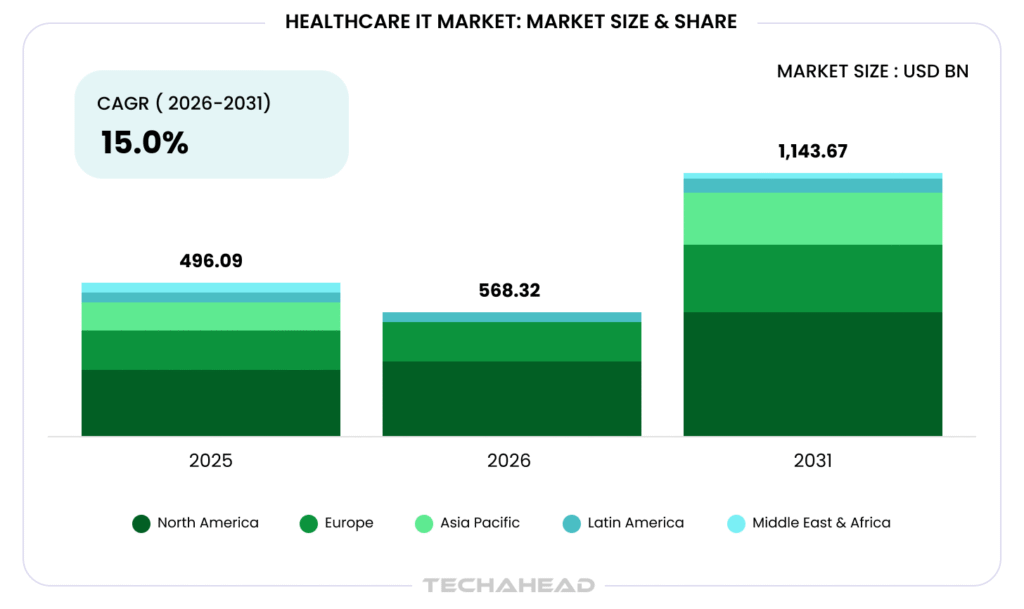
Healthcare software used to imply one thing: an EHR system that hospital personnel accepted because they had no choice. That description no longer reflects what customers are really building. A 2026 healthcare software project may be a patient-facing app that communicates with an Apple Watch, an AI model that reads radiological images, a revenue cycle platform that bridges the gap between a claim and a payment, or a HIPAA-compliant telehealth portal designed for a single-specialty clinic network. The global healthcare IT market reflects that expansion: it is projected to grow from USD 568.32 billion in 2026 to USD 1,143.67 billion by 2031, a 15.0% CAGR driven by hospital digital transformation, cloud adoption, and the deeper integration of AI into clinical and operational workflows.
That growth has changed what “good” looks like in a development partner. Buyers are no longer comparing vendors purely on hourly rate or headcount. They are asking whether a team understands HL7 and FHIR without a ramp-up period, whether their QA process holds up to an FDA or HITRUST audit, and whether the AI features they are proposing are production-tested or still theoretical. Getting this decision wrong is expensive in ways that go beyond budget: a delayed EHR integration disrupts patient care, and a compliance gap discovered after launch can halt a product entirely.
This list breaks down the healthcare software development companies best positioned to handle that complexity in 2026, based on their compliance credentials, technical depth, and the specificity of their healthcare portfolios.
Several forces are defining what a competitive healthcare software build looks like this year.
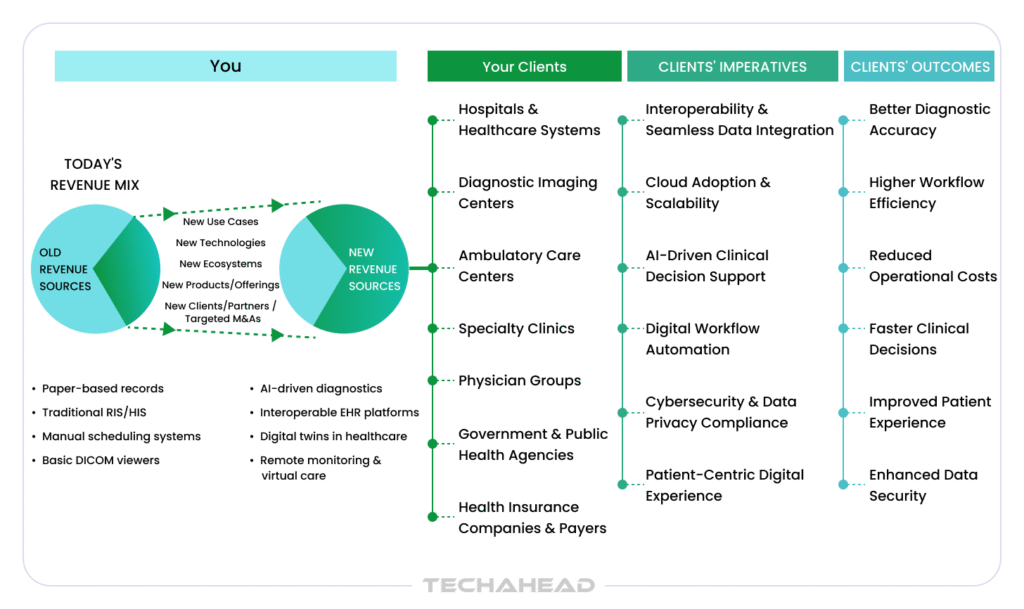
Portfolio size and marketing claims are not reliable indicators of healthcare readiness. The companies on this list were evaluated against criteria specific to what a regulated healthcare build actually demands.
| Evaluation Criteria | Why It Matters |
| Healthcare-Specific Portfolio | Demonstrated delivery of EHR/EMR systems, telemedicine platforms, RPM tools, or clinical software, not general-purpose apps repositioned for healthcare. |
| Regulatory Compliance | Verifiable experience with HIPAA, HITECH, FDA 21 CFR Part 11, GDPR, and, where relevant, ISO 13485 for medical device software. |
| Interoperability Expertise | Working knowledge of HL7, FHIR, DICOM, and direct integration experience with major EHR platforms such as Epic and Cerner. |
| AI & Data Capabilities | Production experience with AI-driven diagnostics, clinical decision support, predictive analytics, or NLP-based documentation tools. |
| Security Architecture | Encryption standards, HIPAA-compliant cloud infrastructure (AWS, Azure, GCP), and formal security certifications such as SOC 2 or ISO 27001. |
| Engineering Depth | Full-stack capability across mobile, web, and cloud, sufficient to support a product beyond its first release. |
| Client Reviews & Track Record | Verified feedback on platforms like Clutch, alongside case studies with measurable outcomes. |
Each company below was assessed against these standards rather than ranked by size alone.
TechAhead builds custom healthcare software like a regulated product, not just an app. It has 16+ years of experience and holds SOC 2 Type II and ISO 27001 certifications. Its team works directly with HL7, FHIR, and EHR platforms like Epic and Cerner. The company’s AI work aims at real business outcomes, not AI for its own sake.
Best for: Healthcare organizations that need AI engineering and audit-ready compliance from one team and HIPAA-compliant custom healthcare software development.
Key features:
ScienceSoft has worked in healthcare IT since 2005. It holds ISO 13485 certification, which covers quality standards for medical device software. Its 750+ person healthcare team includes an in-house doctor who reviews clinical workflows before code is written.
Best for: Organizations building FDA-regulated medical device software.
Key features:
Simform is built for scale first, healthcare second. Based in Orlando with roughly 1,300 employees, it is a Microsoft Gold Partner and Azure Expert MSP. It holds SOC 2 Type II certification and builds EHR tools, clinical dashboards, and AI-driven decision support on solid cloud architecture.
Best for: Healthcare organizations planning rapid growth or heavy data workloads.
Key features:
Intellectsoft has operated since 2007, with its main US office in New York. It holds ISO 27001 certification and counts Ernst & Young and the London Stock Exchange among its clients. Its healthcare work centers on AI-driven hospital management and predictive analytics.
Best for: Large hospital networks running long-term AI modernization projects.
Key features:
Arkenea has worked only in healthcare since 2011. It holds a 4.9 rating on Clutch. Every project starts with a paid discovery phase that locks in scope before pricing, which keeps budgets from drifting once development starts.
Best for: Startups and clinics that want a partner focused only on healthcare.
Key features:
Folio3 Digital Health is an official Epic vendor services member, which speeds up integration for Epic-based hospitals. Based in California, it has built telehealth, diagnostic, and remote monitoring tools for more than a decade.
Best for: Hospitals running Epic that need certified integration support.
Key features:
Empeek is based in New York, with engineering teams in Eastern Europe. It focuses on modernizing legacy healthcare systems, and one case study shows it saved a client more than $1.7 million a year through better system design.
Best for: Providers replacing outdated systems without losing compliance.
Key features:
Glorium Technologies, founded in 2010, holds ISO 13485 certification for medical device software. It has made the Inc. 5000 list four years running. Its best-known project is Doxy.me, a telemedicine platform built for multiple countries at once.
Best for: MedTech companies that need medical device-grade compliance across regions.
Key features:
TATEEDA GLOBAL has worked out of San Diego since 2013. It built a remote heart-monitoring app that syncs with a biosensor to catch abnormal heart rhythms in real time. Every client gets a dedicated, US-based project manager.
Best for: Teams that want US-based project management with offshore engineering.
Key features:
Innowise is the largest company on this list, with 3,500+ IT professionals worldwide and a US office alongside its European base. It holds ISO 13485 certification and is approved to build Class II and Class III medical device software under FDA rules.
Best for: Teams building higher-risk, FDA-regulated medical device software.
Key features:
The “healthcare software” label covers a wide range of products. Knowing the type you need helps narrow down which vendor above fits best.
Most companies on this list can build more than one of these. The right pick depends on which type matches your project and how much of that type they have shipped before.
Picking a vendor from a list is the easy part. Checking fit takes real work, especially on points that surface only after a contract is signed.
Ranking ten companies is the easy part. Trusting one with a hospital’s patient data is not. Every firm on this list can point to a real HIPAA-compliant build, a named certification, or a case study with actual numbers attached, and that is what separates a credible healthcare partner from one that just says the right words on a homepage.
TechAhead’s edge is that it does not force a trade-off between the two things buyers need most: a compliance record that would survive an audit and AI engineering that has shipped past the pilot stage. As a custom healthcare software development company, it builds SOC 2 Type II and ISO 27001 certification into every engagement, brings a team that has actually shipped Epic and Cerner integrations, and treats AI as a tool for outcomes, not a demo reel. CEO Vikas Kaushik has put it plainly: “The goal is real business outcomes, not AI for its own sake.”
For a hospital system, clinic, or health tech startup choosing a build partner in 2026 for healthcare digital transformation means learning the difference between a product that launches and one still running cleanly three audits from now.
Look beyond the development team’s general software experience. Check whether the company has built healthcare products similar to yours, worked with HL7 or FHIR, integrated platforms such as Epic or Cerner, handled healthcare data securely, and supported products after launch. For regulated products, certifications and experience with relevant compliance requirements should also be part of the evaluation.
Custom healthcare software development costs vary significantly depending on the product. A patient engagement app, EHR integration, telehealth platform, remote patient monitoring system, and medical device software all have very different requirements. Integration work, compliance, AI capabilities, cloud infrastructure, security, and the number of platforms involved can all increase development costs.
Companies with healthcare-specific integration experience can work with standards such as HL7 and FHIR and connect applications with established EHR platforms. When comparing vendors, ask for examples of integrations with the specific EHR your organization uses rather than accepting a general claim of “EHR experience.”
Healthcare software development companies can build EHR and EMR systems, telemedicine platforms, remote patient monitoring software, healthcare CRM platforms, patient portals, medical billing and revenue cycle systems, clinical decision support tools, hospital management software, healthcare analytics platforms, and mHealth applications.
AI can be built into clinical and operational workflows rather than treated as a standalone feature. Common applications include clinical decision support, diagnostic assistance, predictive analytics, automated documentation, patient chatbots, scheduling, and revenue cycle automation. The important question is whether the AI has a practical role in the product and can operate reliably with real healthcare data.
Software that handles protected health information may need to meet HIPAA requirements depending on how it is used and the organizations involved. Compliance should influence the architecture, data handling, access controls, security practices, and development process from the beginning rather than being treated as a final-stage requirement.
Healthcare app development usually focuses on a specific mobile or web application, such as a patient app, telehealth app, or medication management tool. Healthcare software development is broader and can include enterprise platforms, EHR systems, healthcare integrations, cloud infrastructure, analytics, AI systems, and other technology supporting healthcare operations.
The timeline depends on the type and complexity of the product. A focused healthcare MVP can move faster than an enterprise platform requiring EHR integrations, complex permissions, real-time data, AI, or medical device connectivity. A proper discovery and architecture phase is usually needed before a realistic development timeline can be established.
Healthcare software often has to work within regulated environments, handle sensitive patient information, integrate with existing healthcare systems, and support workflows where reliability matters. That creates additional requirements around interoperability, security, compliance, testing, data management, and long-term maintenance.
We use cookies to ensure our website functions properly, improve performance, and provide a personalized experience. You can choose which types of cookies to allow below.
Required for core functionality such as security, network management, and accessibility. These cannot be disabled.
Help us understand site traffic and user interactions so we can improve performance and usability.
Enable enhanced functionality and personalization such as language or region preferences.
Used to deliver relevant ads, track campaign performance, and measure advertising effectiveness.