


 Copy Link
 Share on X
 Share on Facebook
 Share on LinkedIn
Always Active
Required for core functionality such as security, network management, and accessibility. These cannot be disabled.

Uncover the transformative potential of digital and mobile solutions for your industry.





 Last Updated: Sep 25, 2026
May 28, 2026
Last Updated: Sep 25, 2026
May 28, 2026  764
764  33 min. Read


Key Takeaways
Enterprise AI adoption has accelerated dramatically, but a critical compliance gap threatens to derail market entry for vendors pursuing enterprise contracts. Organizations building AI-powered platforms discover too late that traditional security frameworks don’t address the unique risks of systems that continuously learn and evolve post-deployment. While engineering teams focus on model accuracy and inference latency, enterprise buyers won’t sign contracts without verified SOC 2 Type II certification, creating an unexpected bottleneck between technical capability and commercial readiness.
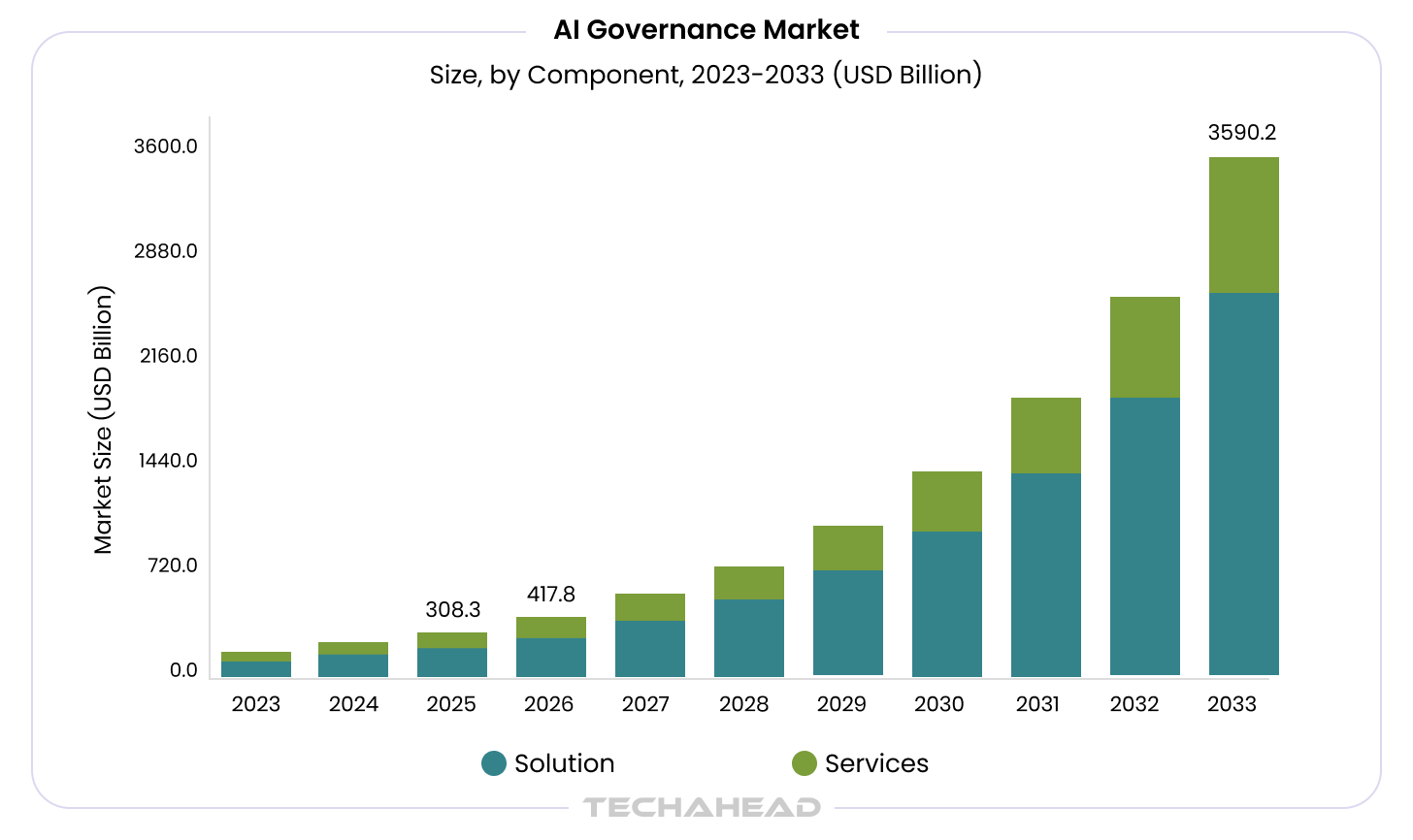
The urgency tells it all: The global AI governance market was valued at $308.3 million in 2025 and is projected to reach $3.59 billion by 2033, growing at a CAGR of 36%, according to Grand View Research. This explosive expansion reflects enterprises racing to implement governance frameworks before regulatory deadlines hit and procurement teams tighten vendor requirements.
Here’s what makes this painful: traditional SOC 2 AI frameworks weren’t designed for systems that continuously learn and evolve post-deployment. Critical AI operations fall outside conventional security controls:
When auditors arrive, they demand six to twelve months of operational evidence for controls most AI teams haven’t even built yet. Retrofitting compliance after launch costs two to three times what building it correctly from day one would cost.
This blog solves that problem for two audiences: engineering leads implementing AI-specific controls that pass auditor scrutiny, and CTOs evaluating whether AI vendors actually have compliant systems or just impressive documentation. You’ll learn the eight control areas auditors scrutinize, how TechAhead embeds compliance into AI architecture from day one, and why building governance from inception costs significantly less than retrofitting it after launch.
Also Read: Enterprise AI Compliance & Governance
SOC 2 Type II wasn’t designed for AI. The framework from AICPA evaluates service organizations on five Trust Services Criteria: Security, Availability, Processing Integrity, Confidentiality, and Privacy.
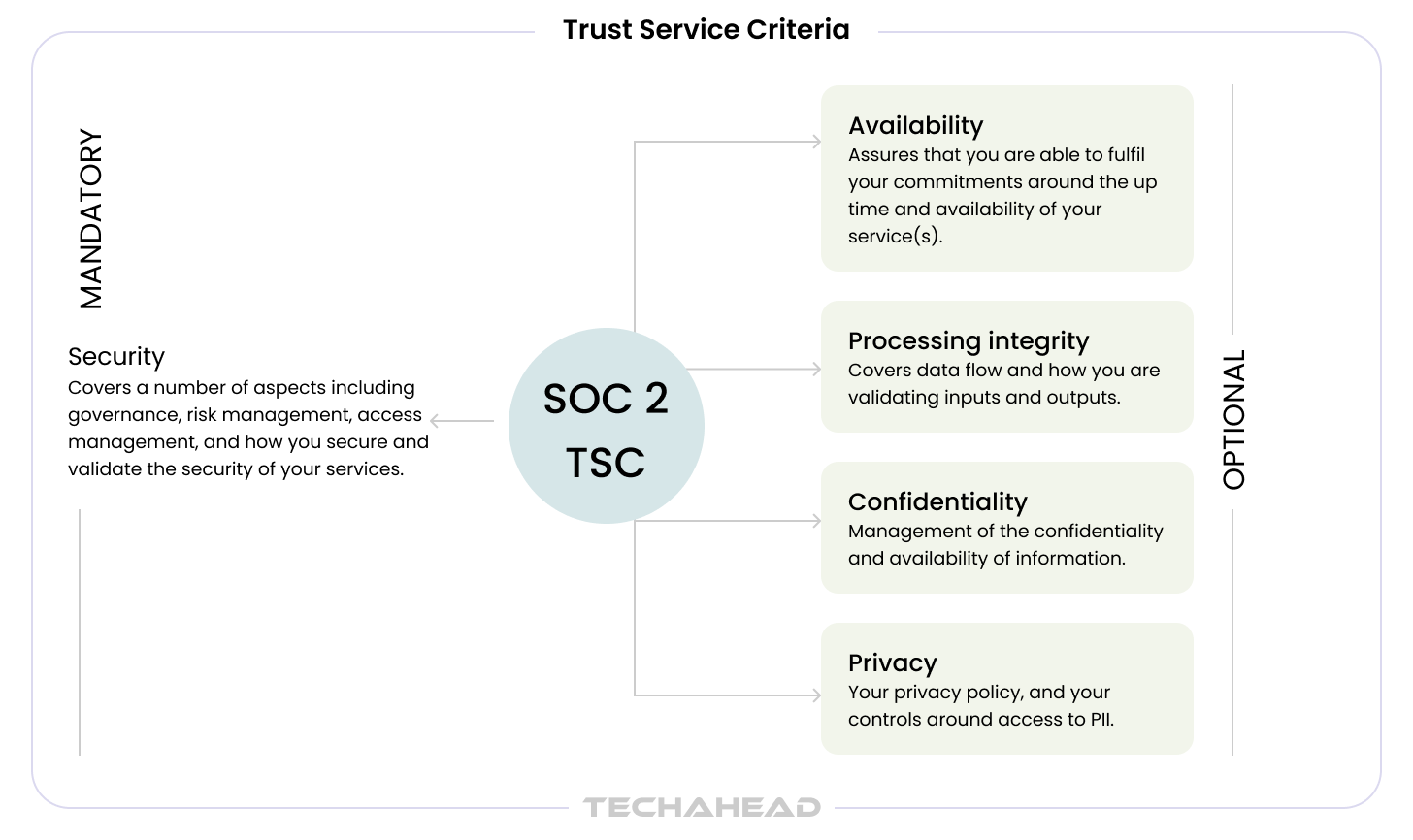
These work perfectly for traditional SaaS applications with static codebases and deterministic behavior. But AI systems operate fundamentally differently, and that difference creates compliance gaps that traditional controls simply don’t address.
The core problem is that SOC 2 was built on three assumptions that AI systems routinely violate.
Bonus Read: AI Pipeline Security
Consider a practical example. Your AI-powered fraud detection system was retrained last quarter with fresh transaction data, improving precision by 3.2 percentage points. From a product perspective, that’s progress. From a SOC 2 audit perspective, you simultaneously changed production behavior without change management approval, introduced new training data without provenance documentation, and altered system outputs without validation testing. Each represents a control deficiency unless AI-specific governance is in place.
This is the gap most engineering teams don’t see until auditors arrive.
Related: AI Model Cards & Data Provenance
Traditional software has bugs that engineers debug and patch. AI systems experience entirely different failure modes that require specialized monitoring, testing, and incident response procedures:
None of these failure modes are covered by conventional SOC 2 controls. Auditors increasingly know this, which is why AI-specific governance requirements have become standard practice for SOC 2 compliance for AI platforms in 2026.
Read our blog on NIST AI RMF for a complete guide and roadmap for compliance.
Organizations in the AI industry pursuing SOC 2 AI certification typically arrive from one of two directions, each with distinct challenges.
The first path is extending existing SOC 2 certification to cover newly added AI capabilities, a common route for AI companies building on an established compliance program. The advantage here is institutional familiarity – you already understand audit processes, have auditor relationships, and know what evidence looks like. The challenge is that retrofitting AI controls into an established compliance program often requires architectural changes to production systems, typically adding six to twelve months to existing compliance cycles.
The second path is pursuing SOC 2 for the first time with AI development included from day one. This is actually the cleaner approach:
Both paths converge on the same eight AI-specific control areas that auditors now mandate. Understanding these controls and the evidence required to demonstrate them is what separates organizations that pass on the first audit from those that spend months remediating findings before they can close enterprise contracts.
Must Read: Enterprise AI Roadmap in 90 Days
Enterprise AI audits have evolved significantly. Auditors no longer limit their review to infrastructure security and access logs. They now examine controls specific to how AI systems are built, trained, monitored, and maintained. The following eight control areas represent the minimum governance auditors expect from any organization claiming SOC 2 compliance for AI platforms in 2026. For each control, understanding what auditors check and where teams commonly fail is as important as knowing how to implement it correctly.
| Control Area | What Auditors Check | Common Failure |
| AI Model Versioning and Change Management | Immutable model registry, approval trails, rollback procedures | Version mismatches between documentation and production |
| Training Data Provenance and Lineage | Dataset origin, transformation logs, deletion compliance | Generic dataset descriptions without specific lineage |
| AI Model Access Controls and Segmentation | RBAC, environment segregation, secrets management | Shared API keys across dev, staging, and production |
| Bias Testing and Fairness Monitoring | Pre-deployment bias assessments, continuous fairness monitoring | One-time testing at launch, no ongoing monitoring |
| Model Performance Monitoring and Drift Detection | Baseline metrics, drift thresholds, response playbooks | No baselines established at deployment |
| AI Incident Response and Post-Mortem Process | AI-specific classification, escalation paths, root cause analysis | Generic bug processes applied to model quality events |
| Adversarial Attack Prevention and Detection | Input validation, robustness testing, anomaly detection | Inference APIs accepting arbitrary inputs without validation |
| AI Explainability and Audit Trail Documentation | Prediction traceability, explainability tooling, retention policies | Black box models deployed in regulated domains |
Every model deployment changes system behavior. Traditional change management controls require documented approval workflows, testing procedures, and rollback plans. For AI systems, those requirements extend to model artifacts themselves. Auditors want to see an immutable registry tracking every version deployed to production, complete with training timestamps, dataset identifiers, hyperparameter configurations, and approval trails linking back to accountable individuals.
The most common failures in this area stem from how informally most teams manage model deployments. Teams deploy multiple model updates during the observation period but only document approval for one. Others acknowledge rollback capability but cannot demonstrate a tested procedure when auditors ask. Version mismatches between documentation and what is actually running in production are among the most frequently cited findings in first-time AI audits.
Most AI systems fail SOC 2 audits because controls are retrofitted after the fact, not architected from day one. When you build model versioning into your deployment pipeline from the first sprint, compliance becomes a byproduct of good engineering rather than a separate workstream that competes with feature development.
— Vikas Kaushik, CEO, TechAhead
Your model’s predictions are only as trustworthy as the data it learned from. Auditors need to trace every dataset back to its origin, understand how it was cleaned and transformed, and verify that data retention and deletion policies were enforced throughout the lifecycle, with SOC 2 controls preserving the confidentiality of confidential data across collection, storage, processing, and disposal. This becomes particularly complex for AI systems because training often combines multiple data sources, applies sophisticated preprocessing pipelines, and maintains separate datasets for training, validation, and testing.
Audit failures here typically stem from documentation gaps rather than intentional violations. Generic descriptions like “we used publicly available datasets” without specific lineage to sources and versions fail immediately. Missing transformation logs are equally problematic when teams cannot demonstrate each preprocessing step with logged evidence.
Most critically, teams often cannot prove GDPR or CCPA deletion compliance because they never built verification mechanisms into their data pipelines, even though AI applications often process sensitive information, making data privacy and confidentiality essential for alignment with regulations such as GDPR and HIPAA.
Cost of Failure: The average healthcare data breach cost $7.42 million in 2025, according to IBM’s Cost of a Data Breach Report. Incomplete data lineage directly multiplies liability exposure in regulated industries.
Who can modify your production model? Who can access training data? Who can deploy new versions? These questions matter more for AI systems than traditional applications because training datasets often contain sensitive personal information, and inference endpoints process real-time sensitive data at scale.
Access control complexity grows significantly with AI systems, and auditors have become increasingly specific about what they expect to see, including access management that protects AI systems, servers, and networks against unauthorized access and data breaches with firewalls, multi-factor authentication, and encryption. Confidentiality also extends to sensitive intellectual property, including data used to train large language models, so teams must prevent unauthorized access to proprietary models and related assets.
The most common failures reveal how teams underestimate this complexity. Shared API keys across development, staging, and production environments create a control deficiency because development access should never grant production permissions. Data scientists deploying models directly to production without approval violates separation of duties. Hardcoded credentials in old training scripts create vulnerabilities that auditors flag immediately, especially when employee training does not reinforce required security protocols.
AXA Insurance Platform Challenge: AXA’s existing claims automation lacked clear access control boundaries between data science experimentation and production model serving, creating audit risk as the platform scaled.
TechAhead Solution: Implemented environment-segregated model registries with cloud IAM policies enforcing strict least-privilege access. Production model deployment required engineering lead approval through automated workflow gates. Achieved SOC 2 Type II certification in 8 months, 40% faster than industry average.
AI models can amplify historical biases present in training data, leading to discriminatory outcomes that violate both ethical standards and regulatory requirements. SOC 2 audits now treat fairness as a processing integrity concern, meaning auditors want evidence of pre-deployment bias testing and continuous production fairness monitoring. This extends beyond legal protected classes to any systematic difference in model performance across demographic groups or input characteristics.
Also Read: Responsible & Ethical AI
Audit failures in this area consistently reveal one-time testing rather than continuous monitoring. Testing only aggregate metrics without demographic disaggregation fails auditor scrutiny because strong overall accuracy can mask significant performance variance across customer segments. Most critically, teams that detect bias during testing but have no documented remediation process demonstrate a control that exists on paper but not in practice.
Regulatory Context: The EU AI Act imposes fines up to €35 million or 7% of global revenue for high-risk AI systems with inadequate bias controls, effective August 2026.
Must Read: EU AI Act Compliance Checklist for Vendors
Models that performed well during offline validation can degrade in production as real-world data distributions shift over time. SOC 2 treats drift detection as an availability and processing integrity control. You committed to a certain level of service quality, and drift undermines that commitment. Demonstrating effective drift monitoring means showing that you detect degradation early, respond with documented procedures, and maintain model performance within acceptable bounds throughout the observation period.
The most common failures stem from inadequate baseline establishment and the absence of response procedures. Tracking current accuracy without establishing deployment baselines means you cannot prove whether current performance represents degradation. Systems that flag drift but have no documented playbook for responding create an incomplete control. Perhaps most problematic for auditors is the inability to distinguish data drift from concept drift, because the appropriate response to each is fundamentally different.
Being a dedicated MLOps development company, TechAhead implements MLOps monitoring from project launch, establishing performance baselines at initial deployment and tracking deviations continuously. Automated alerts notify engineering teams when drift exceeds defined thresholds, with response playbooks specifying exactly what to do:
Warning and critical thresholds are documented before production deployment so auditors see both detection capability and structured response as operational controls.
AI systems fail differently than traditional software. A misclassification in a fraud detection model might cost millions in undetected fraud. A bias amplification event might create regulatory exposure and reputational damage. Traditional incident response designed for infrastructure outages does not adequately address these failure modes. Auditors want to see AI-specific incident classification, escalation procedures, and post-mortem practices that reflect the actual risks AI systems create while managing AI risks and other risks related to model incidents, bias events, and privacy failures, including broader AI risks.
Audit failures in this area reveal generic processes applied to specialized problems. Teams file AI quality events as standard software bugs without recognizing them as model incidents.
Organizations have escalation procedures for infrastructure outages but nothing defining when bias amplification events require executive notification. Post-mortems describe symptoms without tracing failures to training data quality or model architecture decisions, which tells auditors the team does not understand root causes.
Related: Prompt Injection Risks in Agentic AI Systems
American Express Payment Platform Challenge: AmEx’s fraud detection system experienced increasing false positives, but engineering lacked processes to distinguish model drift from data quality issues, making root cause investigation slow and inconsistent.
TechAhead Solution: Implemented AI-specific incident classification integrated with their existing alerting workflows. Added model performance degradation and data quality failure categories with defined escalation paths. Reduced false positive rate by 28% through faster, more structured incident resolution.
Malicious actors actively probe AI systems to find exploitable weaknesses. In fraud detection systems via data analytics, adversaries systematically probe decision boundaries to find patterns the model does not catch. In NLP models, carefully constructed prompts attempt to bypass safety guardrails.
Traditional security controls like input sanitization for web applications do not address these AI-specific attack vectors, and auditors now specifically ask whether organizations have tested and defended against them.
Audit failures in adversarial security typically result from treating AI endpoints like conventional APIs. Inference APIs that accept arbitrary inputs without validation create immediate red flags. Never having evaluated model response to intentionally misleading inputs demonstrates no adversarial testing program. Monitoring endpoint latency and error rates without tracking unusual input patterns that might indicate systematic probing shows incomplete production security coverage.
Also Read: AI Orchestrator’s Role in Managing LLMs & APIs
When your model denies a loan application, adjusts an insurance premium, or flags a transaction as fraudulent, that decision affects a real person. Regulators across healthcare, finance, and employment increasingly require that automated decisions be explainable.
From a SOC 2 processing integrity perspective, explainability serves as evidence that your model processes data correctly and produces decisions for valid, traceable reasons. Audit trails linking predictions to model versions and input data demonstrate complete accountability for every automated decision your system makes. Privacy controls also govern how PII is handled to protect sensitive data, including preventing cross-contamination of user profiles and unauthorized retention of customer data prompts.
Common failures reveal a tension between model complexity and interpretability that teams have not resolved before audit. Black box models in regulated domains fail auditor scrutiny immediately. The inability to trace which model version generated a specific prediction months ago demonstrates missing audit trail infrastructure. Logs that capture prediction events but not input-output pairs with model version references cannot reconstruct decision-making when disputes arise.
“The technical challenge isn’t just building ML models that work. It’s building ML systems with sufficient observability and audit trails that auditors can verify operational effectiveness six months after deployment. That requires thinking about compliance as a first-class system requirement from architecture design through production operations.”
— Deepak Sinha, Chief Technology Officer, TechAhead
GDPR Article 22 explicitly grants individuals the right to explanation for automated decisions. For AI systems operating across borders, this is a present obligation that SOC 2 audit trails must support.
JLL Intellicommand Platform Challenge: JLL needed to integrate real-time IoT data from smart building systems into predictive maintenance AI, but their existing architecture had no mechanism to trace predictions back to specific model versions or explain maintenance recommendations to facility managers.
TechAhead Solution: Built a unified platform combining IoT data pipelines with ML model serving, embedding prediction traceability and explainability from the first deployment. Every maintenance recommendation links to the model version and input sensor data that generated it. Deployment met SOC 2 requirements from day one with fully automated audit trail generation.
Most enterprises don’t pursue SOC 2 in isolation. Depending on the industry and customer base, organizations providing artificial intelligence systems often face multiple certification requirements simultaneously. Healthcare clients demand HIPAA alignment, and European customers trigger GDPR and EU AI Act obligations, so SOC 2 alignment also helps reduce legal risks. Enterprise procurement teams increasingly ask for ISO 27001 alongside SOC 2. Pursuing these certifications sequentially means redundant audits, duplicated controls, and documentation sets that drift out of sync over time. The smarter approach is designing a single control library that satisfies multiple frameworks from the start.
The overlap between SOC 2 and other compliance frameworks is more significant than most teams realize. Controls built for one framework frequently satisfy requirements in another, which means organizations implementing AI governance don’t have to start from scratch for each certification they pursue.
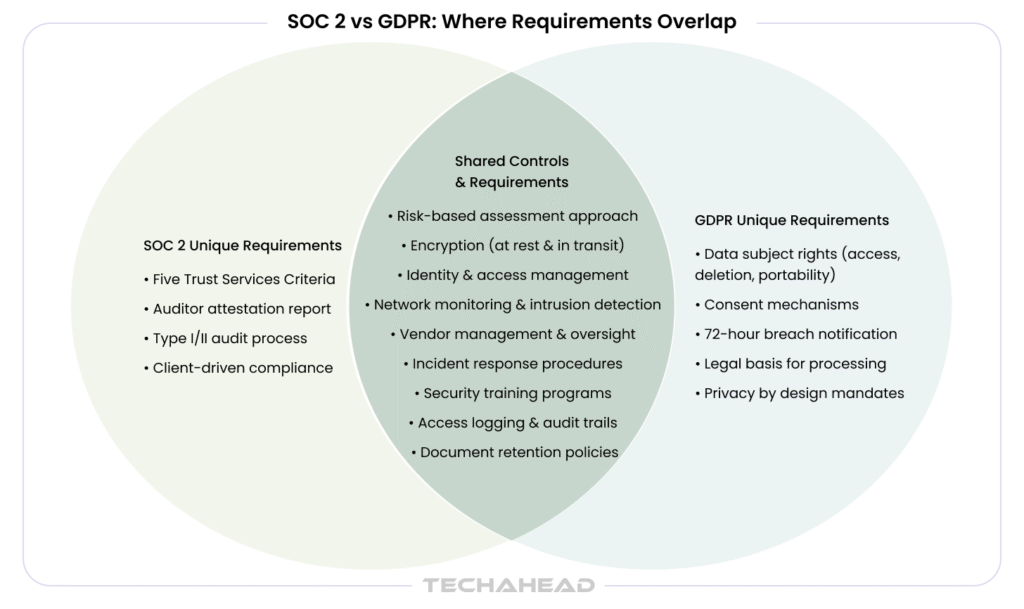
Consider how drift monitoring serves multiple compliance objectives simultaneously. For SOC 2, it functions as a processing integrity control demonstrating that model performance remains within acceptable bounds. For ISO 42001, it addresses performance monitoring requirements across the AI system lifecycle. For the EU AI Act, it supports post-market monitoring obligations for high-risk AI systems. Rather than building four separate monitoring systems, organizations implement one system and document how it maps across frameworks. ISO 42001 also adds a dedicated risk management framework for AI specific risks that SOC 2 and ISO 27001 do not fully address on their own.
The same logic applies to other controls:
Our 240-plus engineers build AI platforms where compliance controls are architectural decisions, not documentation exercises. When we implement drift monitoring, access controls, or bias testing into a system, we design them to satisfy multiple framework requirements simultaneously. The result is a platform that generates audit evidence as a natural byproduct of normal operations, whether auditors arrive with SOC 2, ISO 42001, or ISO 27001 requirements. Clients pursuing multiple certifications don’t pay for separate compliance workstreams because the system itself was built to satisfy all of them from day one.
The financial case for unified compliance is straightforward. Pursuing SOC 2, ISO 42001, and ISO 27001 sequentially means three separate audit preparation cycles, three sets of documentation, and three rounds of gap remediation spread across multiple years. Pursuing them together through shared controls and a unified evidence repository compresses both timeline and cost considerably, while also helping organizations safeguard personal data, reduce the risk of data breaches, and strengthen customer trust across AI systems.
Organizations that build unified compliance from inception avoid the most expensive part of sequential certification: discovering that controls implemented for one framework need architectural changes to satisfy the next. When compliance architecture is designed holistically from day one, each new certification becomes an incremental documentation effort rather than a fresh implementation project.
Recommended: Private Cloud for AI Workloads
The most expensive path to SOC 2 certification for AI systems is building first and adding compliance later. It’s a pattern that repeats across the industry: engineering teams prioritize shipping features, compliance gets deferred until a major prospect demands certification, and suddenly the architecture that powers your production system needs fundamental changes to satisfy auditor requirements. By that point, the cost of fixing it is significantly higher than building it correctly from the start would have been.
Retrofitting compliance into an existing AI system creates three compounding cost layers that teams rarely anticipate upfront, and these late-stage fixes are often resource intensive.
The first is architectural rework. Monolithic training pipelines need approval workflows added. Shared environments need segregation into distinct development, staging, and production infrastructure. Access controls need tightening across systems that were built without least-privilege in mind. AI teams also rely on third-party services and cloud infrastructure, which makes retrofitting controls more complex across external dependencies and internal systems alike. Each change carries risk because it touches production systems that customers depend on, requiring careful migration planning alongside the compliance work itself.
The second cost is evidence reconstruction. Controls implemented today cannot produce historical evidence. Auditors require evidence covering the full observation period, which means retrofitted controls push certification timelines out by at least that duration. Teams spend significant engineering time reconstructing documentation for deployments that were never designed to generate audit trails.
The third and most commercially damaging cost is delayed revenue:
Together these costs make retrofitting a significantly more expensive path than building compliance into the architecture from day one.
When compliance is treated as an architectural requirement from project inception, the dynamic changes entirely. Controls are implemented while the codebase is small and flexible, before production dependencies make changes risky. Evidence accumulates automatically through normal operations rather than being reconstructed manually before each audit.
The process unfolds in natural phases alongside product development. In the earliest weeks, model registries, access policies, and environment segregation are configured as part of infrastructure setup, not as separate compliance workstreams. During active development, bias testing gates, data lineage tracking, and drift monitoring are built into pipelines as standard engineering deliverables. By the time six months of operation have passed, audit evidence has accumulated continuously without any dedicated collection effort. When auditors arrive, the system itself demonstrates operational effectiveness rather than requiring teams to piece together historical records.
The advantages compound over time:
TechAhead’s Compliance-First Development:
TechAhead builds AI platforms where SOC 2 controls are engineering deliverables from Sprint 1, not features added after the fact. Our engineers treat model versioning, access controls, bias testing, and audit trail generation the same way they treat performance and scalability: as baseline requirements that ship with the product, not technical debt to address later. Clients who build with us from inception reach SOC 2 Type II certification in six to nine months because the architecture was designed to satisfy auditors from the first deployment, not retrofitted to satisfy them after the fact.
The compliance landscape for AI systems has fundamentally shifted. SOC 2 Type II certification is no longer a differentiator that sets vendors apart in business buyer procurement conversations. It is the baseline requirement that gets you into the conversation in the first place and signals commercial readiness, not just compliance. Organizations still treating compliance as a post-launch consideration are discovering this the hard way, losing enterprise deals to competitors who embedded governance into their systems from day one.
That approach is particularly important for AI applications handling regulated or sensitive workflows.
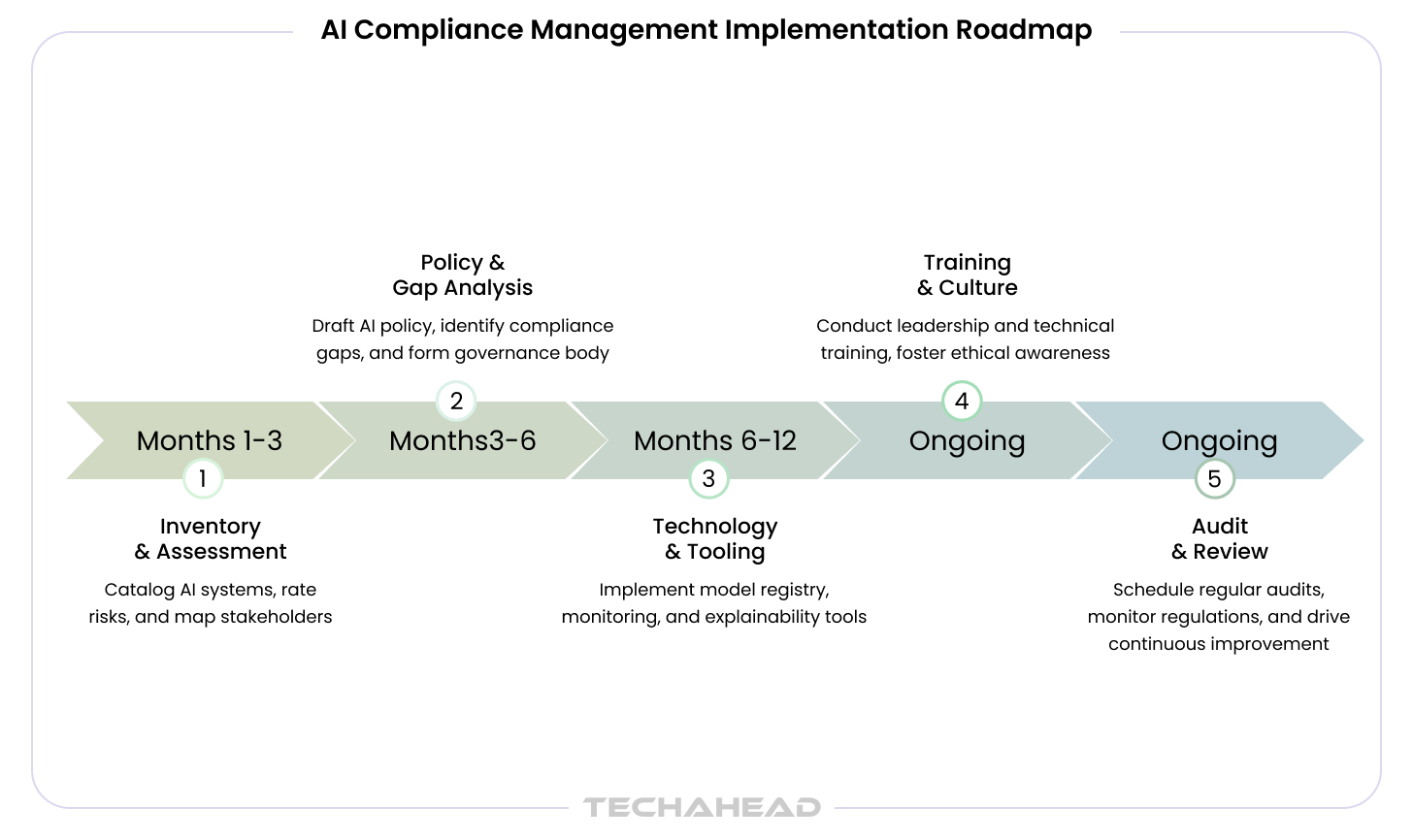
The strategic question isn’t whether to pursue SOC 2 compliance for AI platforms. Enterprise buyers have already answered that for you. The question is when to start and how to approach it.
Starting compliance architecture in the earliest stages of development means controls grow alongside the system rather than being imposed on top of it. Model versioning, access controls, bias testing, and audit trail generation become standard engineering outputs. Evidence accumulates through normal operations rather than being manually collected before each audit cycle. The organizations that recognize this early reach certification faster, spend less doing it, and arrive at enterprise procurement conversations with operational compliance history rather than a certification that is still months away.
Compliance handled correctly becomes a commercial asset. Enterprise buyers evaluate AI vendors on security posture before technical capability in many procurement processes today. Vendors who arrive with current SOC 2 Type II reports, clear audit trails, and documented governance processes signal security and privacy priorities to customers and move through procurement faster than those who don’t. That speed difference translates directly into revenue, and a current SOC 2 report reduces procurement friction, increases deal velocity, and supports partnerships with larger enterprises:
The organizations gaining ground in enterprise AI markets right now are those that made compliance an engineering priority early enough that it became a strength rather than a liability, while SOC 2 Type II also demonstrates security and ethics in regulated industries, reinforcing customer trust and a competitive edge.
Not every development partner understands this. Generic development shops treat compliance as a late-stage checklist because their engineers aren’t trained to build systems where governance is a first-class requirement. The result is client systems that perform well technically but fail audit scrutiny because controls were never properly embedded into the architecture.
We hold ISO 42001:2023, SOC 2 Type II, ISO 27001:2022, and ISO 13485 certifications, meaning we build AI systems to the same standards we are audited against ourselves. Clients benefit from an engineering team that understands audit requirements not from documentation but from operational experience.
Most AI vendors treat compliance as a late-stage project triggered by the first enterprise prospect who asks for a SOC 2 report. TechAhead approaches it differently. As an enterprise AI development company, we architect SOC 2 controls into every platform from the moment architecture decisions are made, not after they’ve hardened into production constraints.
Before writing a single line of code, our engineers map the compliance landscape applicable to your platform. We identify which frameworks apply, whether SOC 2 Type II, ISO 27001, sector-specific regulations, or a combination, and design control architecture that satisfies multiple certifications through a single implementation. Environment segregation, access control boundaries, and audit trail infrastructure are blueprinted at this stage rather than added later when changing them carries production risk.
Getting these decisions right early is what makes everything downstream cheaper and faster.
Controls become engineering deliverables, not separate workstreams running alongside development. Our sprints integrate:
Each feature ships with its compliance controls operational. There is no compliance backlog accumulating while features ship.
A well-built AI system generates audit evidence as a natural byproduct of normal operations, and automated evidence collection can streamline compliance evidence collection during ongoing operations. Every model deployment logs approval trails. Every training run produces data manifests. Every prediction creates traceable audit records that link back to the model version and input data that generated it.
When auditors arrive months later, clients present continuously generated evidence rather than scrambling to reconstruct compliance history from systems that were never designed to produce it. This is the practical difference between building compliance in and bolting it on.
As the observation period progresses, our team works alongside clients to ensure evidence is organized and complete. Our engineers understand audit requirements from operational experience, not documentation. We know what auditors look for because we go through the same process ourselves.
Clients building with TechAhead from inception typically reach SOC 2 Type II certification significantly faster than organizations retrofitting compliance into existing systems, because the architectural decisions made at project start eliminated the control gaps that cause most audit findings.
The enterprise AI market has reached an inflection point where SOC 2 Type II certification determines which vendors enter procurement conversations and which get eliminated before technical evaluations begin. Organizations still approaching compliance as a post-launch consideration face a compounding set of problems that architectural rework, extended observation periods, and lost enterprise deals make increasingly difficult to recover from.
The strategic case is straightforward. Building compliance into AI architecture from day one costs significantly less than retrofitting it after launch, takes considerably less time, and produces a better outcome because controls are embedded rather than imposed. More importantly, it transforms compliance from a sales obstacle into a commercial asset:
For organizations serious about enterprise AI contracts, the question was never whether to pursue SOC 2 compliance for AI platforms. Enterprise buyers settled that question. The only decision remaining is whether to build it correctly from inception or spend significantly more fixing it later.
If your AI platform needs to be enterprise-ready, audit-proof, and built correctly from day one, TechAhead’s engineering team is ready to help. Connect today.
SOC 2 Type II for AI systems goes beyond traditional security controls. It verifies that your model versioning, training data governance, and drift monitoring operated effectively over six to twelve months, not just existed on paper. In 2026, enterprise buyers treat it as a procurement baseline, not a differentiator.
Traditional SaaS has static, deterministic code. Machine learning models retrain continuously, produce non-deterministic outputs, and ingest diverse training datasets that conventional controls never anticipated. Auditors now examine model change management, bias testing, and data provenance as distinct control areas that standard SaaS audits don’t even address.
Auditors typically ask for model registry logs showing deployment history and approval trails, training data lineage documentation, bias testing reports with demographic breakdowns, drift detection dashboards covering the observation period, AI incident response logs categorized by failure type, and prediction audit trails demonstrating explainability for high-stakes decisions.
Yes, and it’s the smarter approach. Controls like drift monitoring, model versioning, and access controls satisfy requirements across both frameworks simultaneously when designed with that intent from the start. Organizations that map controls across SOC 2 and ISO 42001 from day one avoid redundant implementation cycles and documentation duplication.
The most frequent failures involve model deployments with missing approval trails, training data described generically without provenance documentation, and bias assessments conducted only at launch without continuous monitoring. Auditors also flag AI-specific incident response gaps where teams apply generic software bug processes to model quality events.
Model drift directly undermines SOC 2’s processing integrity and availability criteria because your system’s behavior changes without corresponding governance evidence. Controls that satisfy auditors include baseline performance documentation at deployment, automated drift detection thresholds with defined response playbooks, and incident records showing how engineering teams responded to degradation events.
Practically speaking, Type II is what enterprise procurement teams require. Type I proves controls existed at a point in time. Type II proves they operated effectively across six to twelve months, which is what regulated industry buyers, security-conscious enterprises, and healthcare clients demand before signing vendor agreements involving sensitive data.
They complement rather than conflict. SOC 2 Type II addresses operational security controls. The EU AI Act imposes specific fairness, transparency, and human oversight obligations for high-risk systems. Organizations building with both frameworks in mind from day one design controls that satisfy SOC 2 auditors while simultaneously addressing EU AI Act requirements, rather than treating them as separate compliance workstreams.
Look for a partner that holds its own SOC 2 Type II certification alongside ISO 42001 and ISO 27001, meaning they build to the same standards they are audited against. Avoid partners who treat compliance as a late-stage checklist. The right partner embeds AI audit controls, data lineage tracking, and evidence generation into the architecture from Sprint 1, not as retrofit work after your first enterprise prospect asks for a report.
Explainability directly supports SOC 2’s processing integrity criterion by demonstrating that automated decisions are produced for valid, traceable reasons. In regulated industries like healthcare and finance, it also satisfies sector-specific legal obligations. Auditors want to see prediction logs linking outcomes to specific model versions, input data, and feature importance scores, not just evidence that predictions occurred.
We use cookies to ensure our website functions properly, improve performance, and provide a personalized experience. You can choose which types of cookies to allow below.
Required for core functionality such as security, network management, and accessibility. These cannot be disabled.
Help us understand site traffic and user interactions so we can improve performance and usability.
Enable enhanced functionality and personalization such as language or region preferences.
Used to deliver relevant ads, track campaign performance, and measure advertising effectiveness.