


 Copy Link
 Share on X
 Share on Facebook
 Share on LinkedIn
Always Active
Required for core functionality such as security, network management, and accessibility. These cannot be disabled.

Uncover the transformative potential of digital and mobile solutions for your industry.





 Last Updated: Sep 22, 2026
Jul 10, 2026
Last Updated: Sep 22, 2026
Jul 10, 2026  410
410  14 min. Read


Key Takeaways
Enterprise AI has moved well past the hype phase and into serious budget territory. Boards are approving investment, teams are running pilots, and demos are landing well in steering committee meetings.
Yet the conversion rate from pilot to production remains shockingly low, with many organizations reporting that 80% to 90% of their AI pilots never make it into a live, revenue-generating system.
This matters because every stalled pilot is a wasted budget line, a stalled roadmap commitment, and unrealized ROI that someone on the leadership team will eventually have to explain. CTOs and product leaders are under real pressure to deliver measurable outcomes, not another round of impressive demos that never ship.
The core problem, in plain terms:
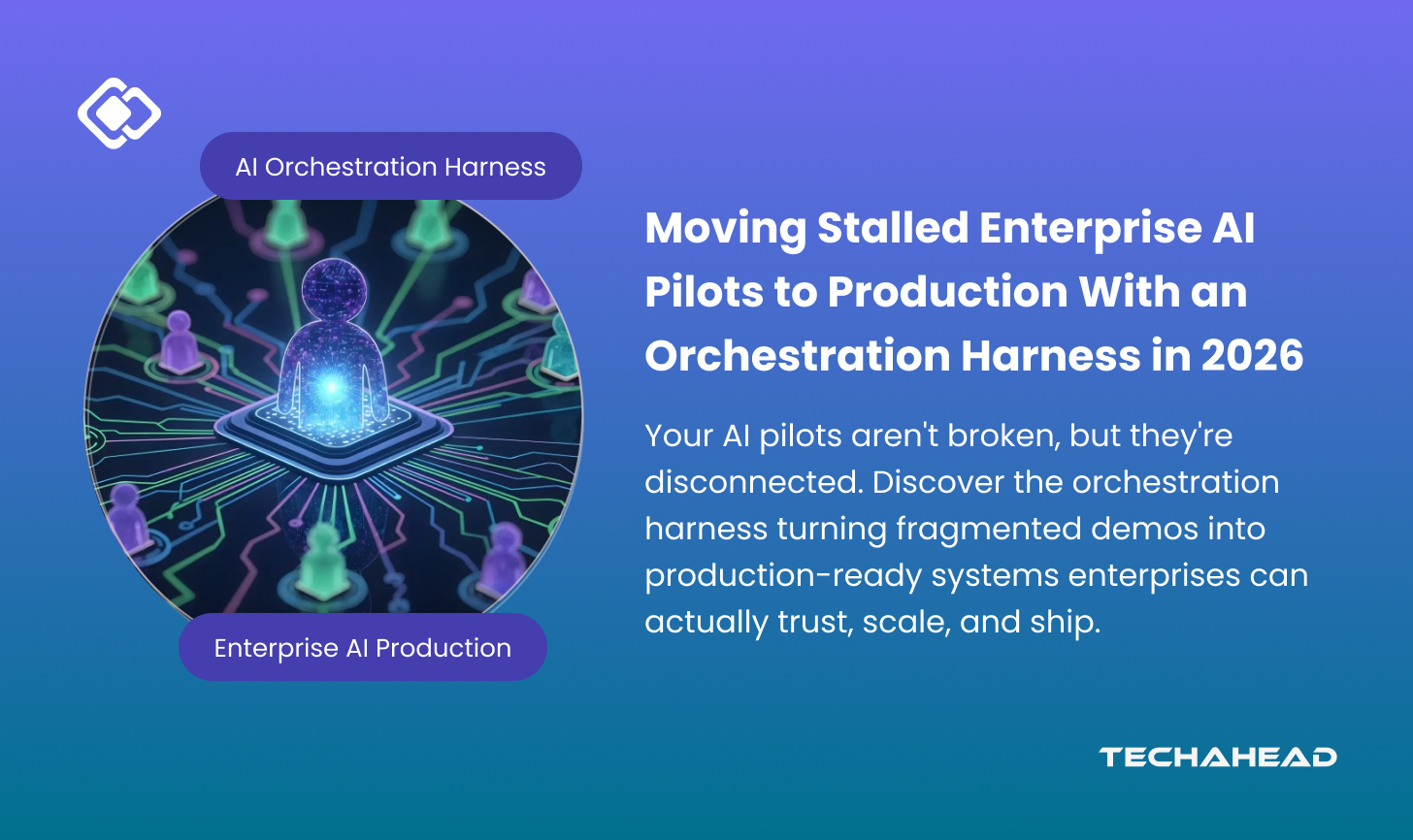
The concept that bridges this gap is an orchestration harness: a structured layer that coordinates models, tools, workflows, governance, and data into one composable system. It’s what a growing number of enterprises are using to move AI from pilot purgatory into durable production.
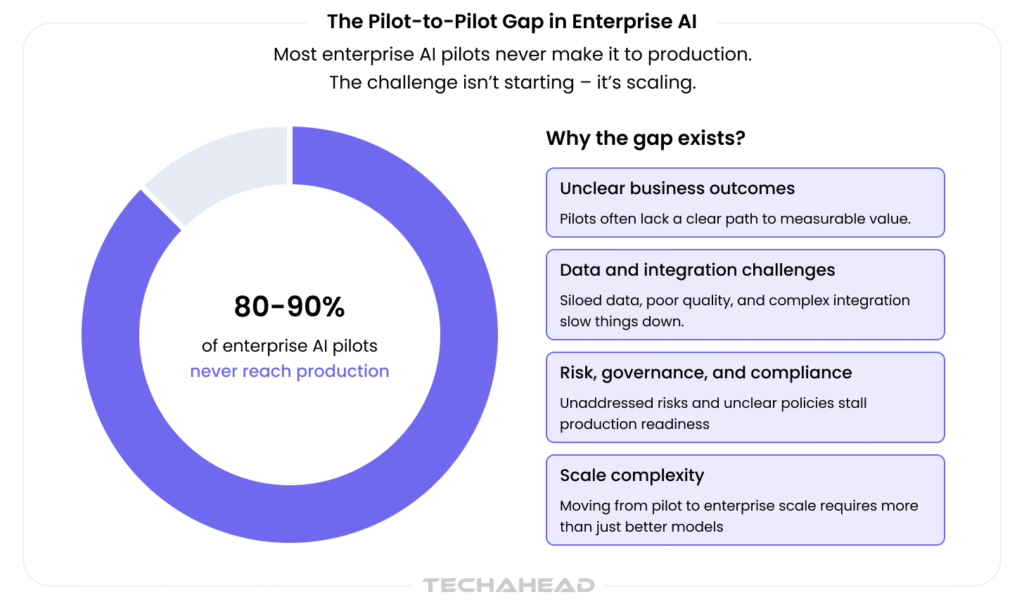
Source: TechAhead AI Team
The thesis of this blog:
Stalled pilots aren’t stuck because of model quality alone. They’re stuck due to integration gaps, workflow fragmentation, governance bottlenecks, and the absence of a unified orchestration layer, and an orchestration harness is what unblocks each of those bottlenecks at once.
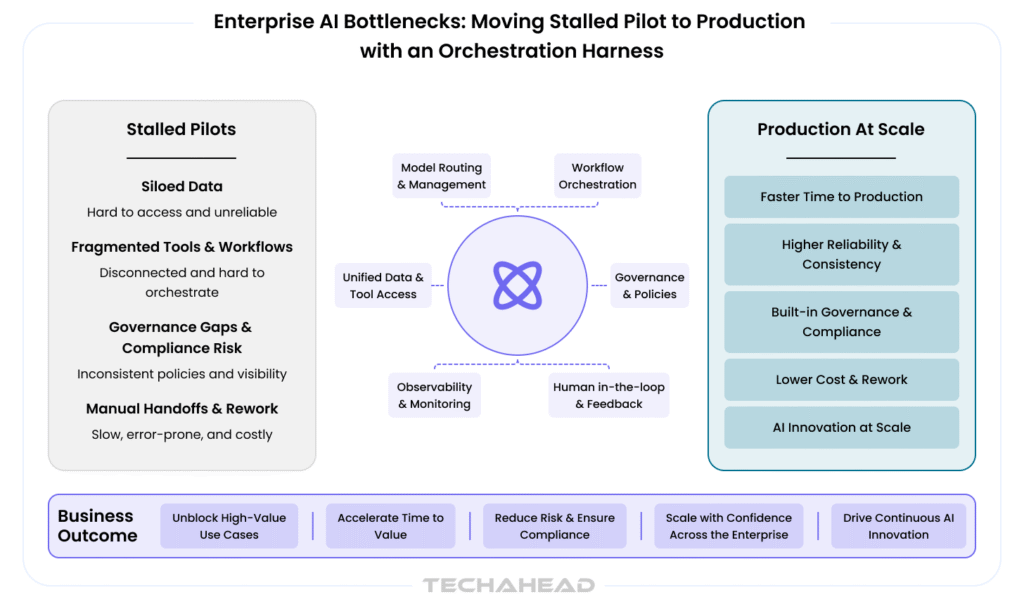
Source: TechAhead AI Team
Every stalled pilot tends to trace back to one, or several, of the same five root causes. The table below lays out why each bottleneck is invisible during a pilot, and exactly where it breaks once real production load hits.
| Bottleneck | Why It Happens in Pilots | What Breaks in Production |
| Data Fragmentation & Quality Gaps | Pilots use clean, curated datasets built specifically by the AI team. | Real data is scattered across CRM, ERP, and databases, inconsistent and often low-quality. |
| Integration & Workflow Fragmentation | Pilots run as standalone tools or narrow dashboards, disconnected from real systems. | Production needs deep integration, multi-step workflows, and human-plus-AI collaboration. |
| Governance, Compliance & Security | Pilots often bypass or simplify compliance to move fast | Production must meet strict security, audit, and regulatory requirements like GDPR, HIPAA, and SOC2. |
| Scaling & Reliability Under Load | Pilots handle small, controlled user loads with no real concurrency. | Production must handle thousands of users, high concurrency, latency limits, and failover. |
| Lack of End-to-End Ownership | Pilots are owned solely by the AI/ML team, isolated from product and engineering. | Production demands cross-functional ownership across product, infra, security, and operations. |
Pilots typically run on data created specifically for the pilot, clean, complete, and conveniently structured. In production, that same data lives across multiple systems with different schemas, arrives with missing fields, duplicates, and legacy formats, and often needs to be accessed in real time through event streaming or complex API integrations that were never part of the original pilot.
Pilots almost always operate in isolation, a standalone tool or a narrow internal dashboard. Production requires connecting to existing tools like CRMs, ticketing systems, and ERPs, embedding AI into multi-step workflows such as approval chains and escalation paths, and supporting genuine human-in-the-loop collaboration rather than pure automation.
Compliance is frequently treated as an afterthought during a pilot. Production cannot afford that: it must enforce access controls and least-privilege, log every action for auditability, handle sensitive data in line with regulations, and apply content filters, PII redaction, and policy enforcement consistently.
Pilots assume small, stable user loads that never really stress the system. Production has to handle high concurrency and burst traffic, maintain low, predictable latency, implement failover, retries, and circuit breakers, and continuously monitor and tune resource usage to keep costs under control.
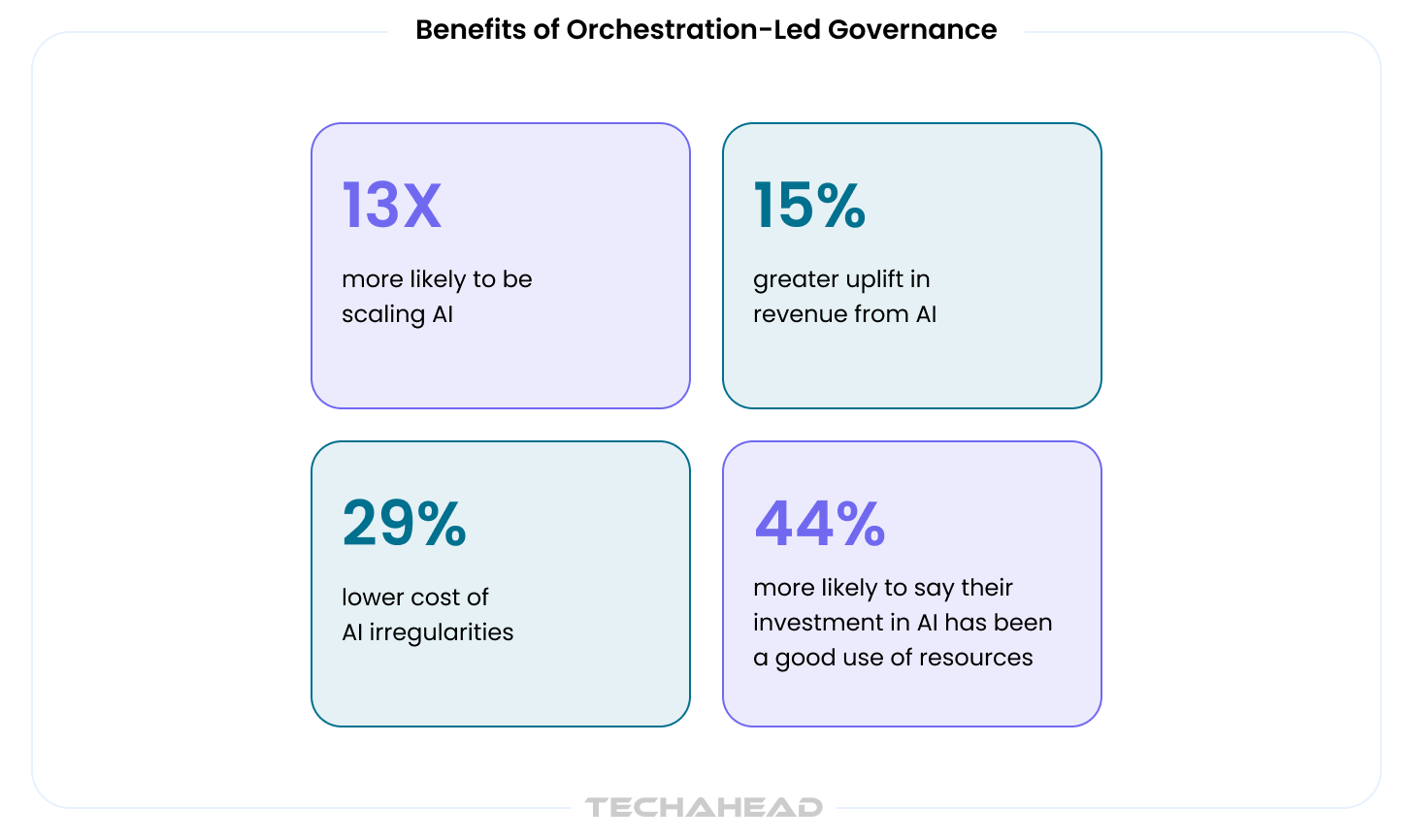
Benefits of orchestration-led governance (Source)
Pilots are usually “AI team projects,” built and owned without clear product or engineering accountability. Production demands cross-functional teams spanning product, engineering, security, and operations, with clear accountability for outcomes and a genuine shift from an experimental mindset to a product mindset.
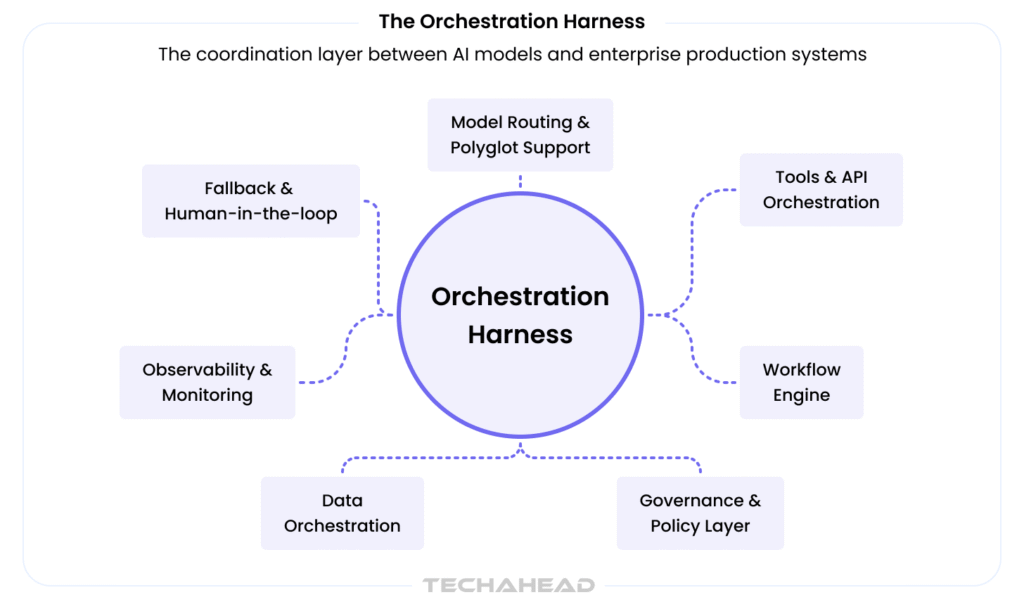
An orchestration harness is a structured, composable layer that coordinates AI and ML models, the tools and APIs those models need to call, the workflows and business logic that wrap around them, the governance and policy rules that constrain them, and the data pipelines that feed them. Think of it as the operating system for enterprise AI, the infrastructure and coordination layer that lets models and tools work together reliably instead of each pilot reinventing its own plumbing.
| Component | Role in the Harness |
| Model Routing & Polyglot Support | Routes requests to the right model, LLM, classifier, or embedding model, based on task, cost, and latency. |
| Tool & API Orchestration | Coordinates calls to CRMs, databases, external APIs, and internal services. |
| Workflow Engine | Defines and executes multi-step workflows with conditional logic, human steps, and retries. |
| Governance & Policy Layer | Enforces access control, audit logs, compliance rules, content filters, and PII redaction. |
| Data Orchestration | Manages data ingestion, transformation, caching, and streaming across systems. |
| Observability & Monitoring | Provides logs, traces, metrics, and alerting for AI behavior and system health. |
| Fallback & Human-in-the-Loop | Defines fallback paths and human escalation whenever AI confidence is low. |
Source: TechAhead AI Team
It’s worth being precise about what makes an AI orchestration harness different from tools enterprises already run, like Airflow, Kubernetes operators, or traditional workflow schedulers. Engineering teams sometimes assume they can bolt an LLM call onto an existing pipeline tool and call it “orchestration.” In practice, that approach breaks down quickly, because these tools were never designed to reason about AI-specific risk, confidence, or non-deterministic behavior.
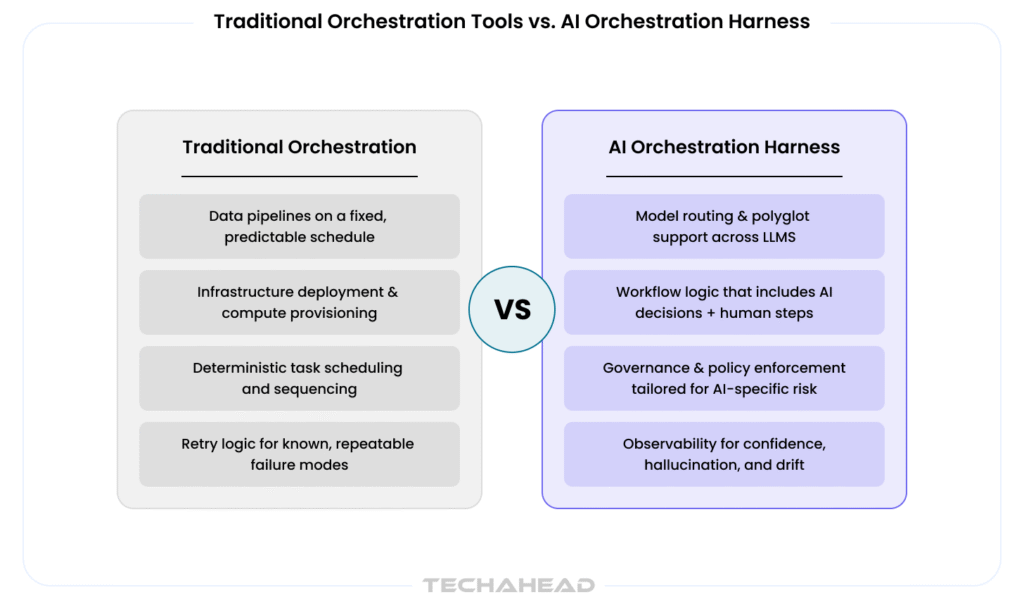
Source: TechAhead AI Team
What traditional orchestration tools are built for:
What an AI orchestration harness adds on top:
The distinction that matters:
Traditional orchestration tools assume every task behaves the same way each time it runs. An orchestration harness is built for the opposite assumption, that AI outputs are inherently variable, and layers the routing, governance, and observability needed to make that variability safe to run in production.
The harness’s data orchestration layer unifies access across CRM, ERP, and database systems, applies transformations, caching, and streaming as needed, and implements data quality checks with sensible fallback strategies. The result: models receive consistent, preprocessed data without every pilot needing to build its own data pipeline from scratch.
Tool and API orchestration combined with the workflow engine provide a standardized way to call CRMs, APIs, and internal services, and define multi-step workflows with conditional logic, retries, and human steps. The result: AI becomes embedded in real business workflows instead of operating as a disconnected standalone tool.
Source: TechAhead AI Team
The governance and policy layer enforces access control and least-privilege, logs every action for auditability, and applies content filters, PII redaction, and policy enforcement automatically. The result: compliance is built into the platform itself, not re-solved per pilot.
Built-in scaling and reliability features handle high concurrency and burst traffic, implement failover, retries, and circuit breakers, and monitor and tune resource usage to control cost. The result: AI can scale across a real user base without breaking.
Because the harness is a unified platform owned by a cross-functional team spanning product, engineering, security, and operations, AI teams can build on top of it without recreating infrastructure each time. The result: clear accountability, and a genuine shift from experiment to product mindset.
Consider a retail company piloting AI-powered customer support triage. It works cleanly in testing, then stalls the moment it needs to go live. Here’s what changes with a harness in place:
| Without an Orchestration Harness | With an Orchestration Harness |
| Each pilot has its own ad-hoc integration with CRM and ticketing systems. | CRM and ticketing access is standardized through the harness’s tool orchestration. |
| Governance and compliance are applied inconsistently, if at all. | Access control, audit logs, and PII redaction are enforced centrally. |
| Scaling is not planned; concurrency and failover are afterthoughts. | The workflow engine defines the triage process with built-in escalation paths. |
| No central observability into model or workflow behavior. | Logs, traces, and metrics give full visibility into the triage workflow. |
The result is a pilot that moves into production with predictable performance and governance already in place, rather than one more promising demo that never ships.
Four patterns show up repeatedly across enterprises that have successfully operationalized orchestration harnesses, each suited to a different organizational shape and risk profile.
| Pattern | Setup | Example Use Cases |
| Centralized AI Platform | One central team builds and maintains the harness; product teams build features on top. | Customer support triage across multiple products; document processing across departments. |
| Domain-Specific Harnesses | Domain teams build tailored harnesses for critical workflows, each with domain-specific governance. | HIPAA-compliant medical record summarization; financial transaction fraud monitoring. |
| Hybrid Cloud-Edge Orchestration | Some orchestration logic runs in the cloud, some at the edge, for latency-sensitive decisions. | Real-time inventory optimization; quality control on manufacturing lines. |
| Multi-Model Orchestration | The harness routes requests to different models based on task complexity, cost, and latency. | Simple query routing vs. complex document analysis; content filtering vs. generative tasks. |
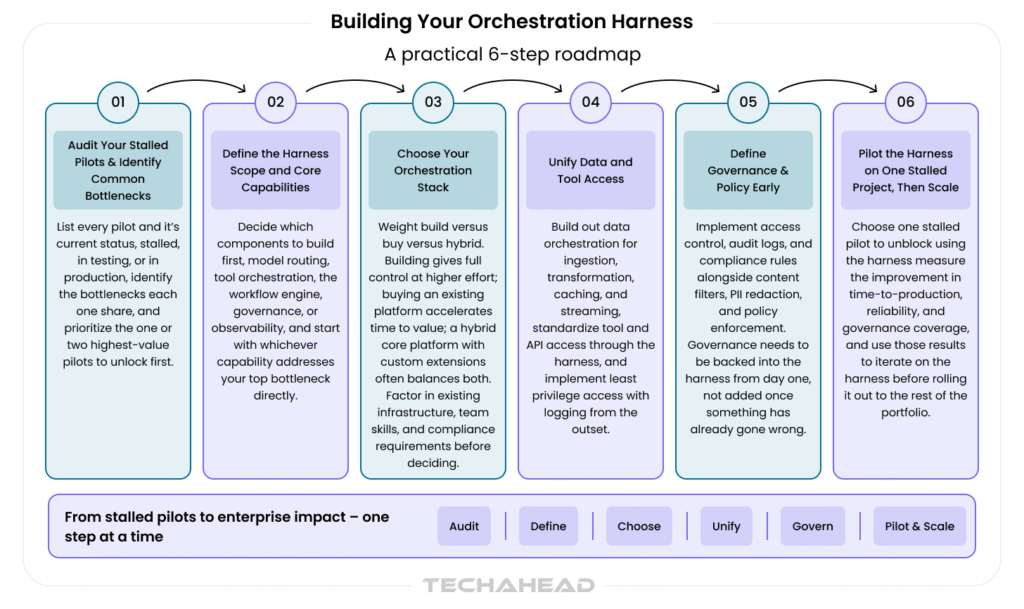
Step 1: Audit Your Stalled Pilots and Identify Common Bottlenecks
List every pilot and its current status, stalled, in testing, or in production, identify the bottlenecks each one shares, and prioritize the one or two highest-value pilots to unblock first.
Step 2: Define the Harness Scope and Core Capabilities
Decide which components to build first, model routing, tool orchestration, the workflow engine, governance, or observability, and start with whichever capability addresses your top bottleneck directly.
Step 3: Choose Your Orchestration Stack
Weigh build versus buy versus hybrid. Building gives full control at higher effort; buying an existing platform accelerates time to value; a hybrid core platform with custom extensions often balances both. Factor in existing infrastructure, team skills, and compliance requirements before deciding.
Source: TechAhead AI Team
Step 4: Unify Data and Tool Access
Build out data orchestration for ingestion, transformation, caching, and streaming, standardize tool and API access through the harness, and implement least-privilege access with logging from the outset.
Step 5: Define Governance and Policy Early
Implement access control, audit logs, and compliance rules alongside content filters, PII redaction, and policy enforcement. Governance needs to be baked into the harness from day one, not added once something has already gone wrong.
Step 6: Pilot the Harness on One Stalled Project, Then Scale
Choose one stalled pilot to unblock using the harness, measure the improvement in time-to-production, reliability, and governance coverage, and use those results to iterate on the harness before rolling it out to the rest of the portfolio.
Treat orchestration as a core platform capability, not a one-off AI project. Invest in cross-functional ownership across product, engineering, security, and operations, reusable infrastructure that multiple teams can build on, and governance and observability that are part of the platform from the start.
Focus on high-value, bounded workflows that can be unblocked quickly, insist on clear ownership and accountability for production outcomes, and use the harness to iterate faster instead of reinventing infrastructure with every new pilot.
Ask vendors directly whether they provide an orchestration harness or an equivalent coordination layer, request clarity on how they handle data, governance, and workflow integration, and prioritize an AI development company that can show real production case studies built on orchestration, not just polished pilot demos.
Orchestration harnesses are the backbone that enables scalable AI across multiple teams, consistent governance and compliance, and reliable workflows with genuine human collaboration. Without orchestration, enterprise AI stays a collection of fragmented pilots. With it, enterprise AI becomes a production capability that drives measurable ROI.
The core problem is well documented at this point: 80 to 90 percent of enterprise AI pilots stall due to data fragmentation, integration gaps, governance bottlenecks, scaling issues, and a lack of clear ownership. The solution is equally clear: an orchestration harness unifies models, tools, workflows, governance, and data into a single, composable layer that bridges the gap between a working pilot and a production system.
Orchestration is not about replacing models. It’s about connecting them to real-world systems and workflows so they can actually do the job they were piloted to do. Enterprises that build or adopt an orchestration harness move from stalled pilots to production faster, with better reliability and governance built in from the start, not bolted on after the fact.
Orchestration is the backbone of scalable enterprise AI, not a nice-to-have feature reserved for later. Audit your stalled pilots, identify the bottlenecks they share, build or adopt an orchestration harness, and unblock one pilot to learn from before you scale the rest.
Ready to Move Your Stalled Pilots Into Production?
TechAhead helps enterprises design and implement orchestration harnesses that connect AI models to real systems, real governance, and real scale, so pilots stop stalling and start shipping.
They stall on messy real-world data, missing integrations, weak governance, unplanned scaling, and unclear cross-functional ownership.
A coordination layer that unifies AI models, tools, workflows, governance, and data pipelines into one composable production system.
It adds AI-specific model routing, human-in-the-loop workflow logic, AI-tailored governance, and observability for drift and hallucination.
It depends on existing infrastructure, team skills, and compliance needs; many enterprises succeed with a hybrid build-and-buy approach.
Audit stalled pilots, pick one high-value workflow, unblock it with a minimal harness, then expand based on measured results.
We use cookies to ensure our website functions properly, improve performance, and provide a personalized experience. You can choose which types of cookies to allow below.
Required for core functionality such as security, network management, and accessibility. These cannot be disabled.
Help us understand site traffic and user interactions so we can improve performance and usability.
Enable enhanced functionality and personalization such as language or region preferences.
Used to deliver relevant ads, track campaign performance, and measure advertising effectiveness.