


 Copy Link
 Share on X
 Share on Facebook
 Share on LinkedIn
Always Active
Required for core functionality such as security, network management, and accessibility. These cannot be disabled.

Uncover the transformative potential of digital and mobile solutions for your industry.





 Last Updated: Sep 22, 2026
Jul 3, 2026
Last Updated: Sep 22, 2026
Jul 3, 2026  413
413  13 min. Read


Key Takeaways
Walk through any technology conference held in 2026 and you’ll see the same demo, repackaged a dozen different ways: a single AI agent that books your travel, writes your code, answers your customer emails, and updates your CRM, all in one continuous, dazzling loop.
It’s compelling on stage.
It’s a different story once that same agent has to survive contact with a real production environment, real customers, real compliance teams, and a real budget.
Agentic AI, put simply, refers to AI systems that can plan, act, and reflect across multi-step workflows, typically by calling tools, APIs, and other services rather than simply answering a single question. That capability is genuinely transformative.
But the way most organizations are choosing to deploy it is quietly determining whether it succeeds or stalls.
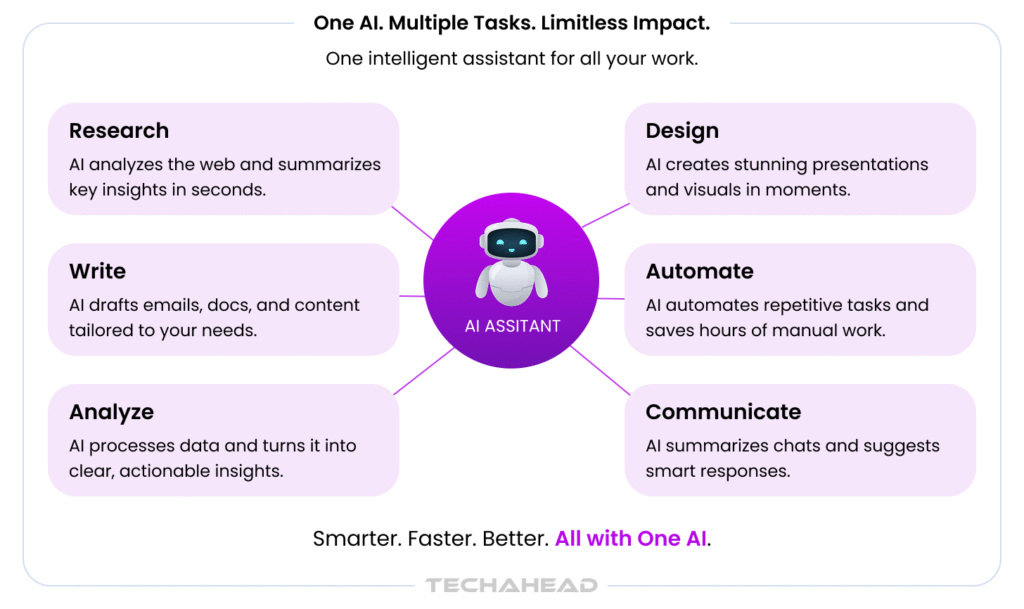
Image Source: TechAhead AI Team
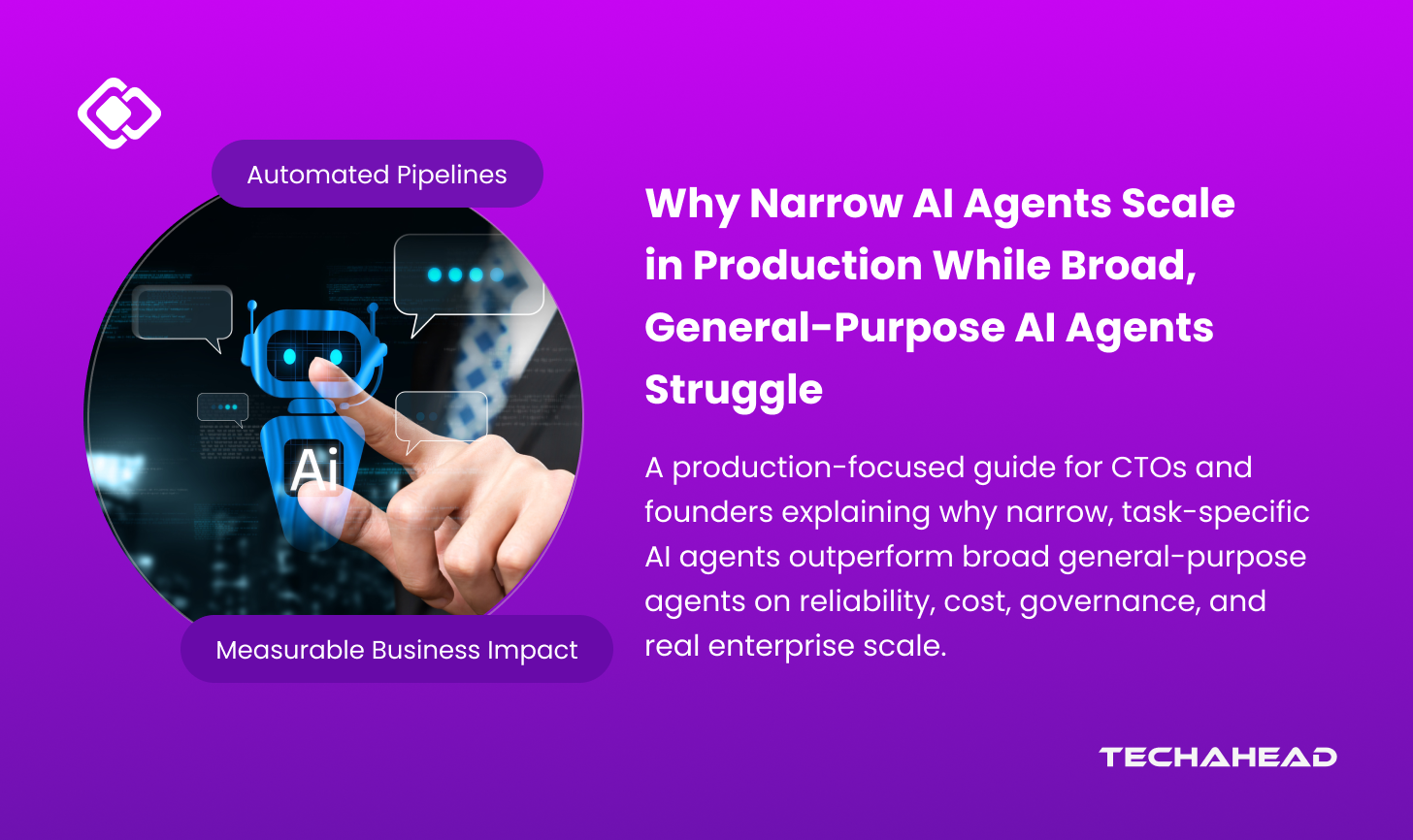
Here is the pattern emerging across enterprises that have actually shipped agentic systems at scale: narrow, task-focused agents are the ones quietly doing the heavy lifting in production, while broad, do-everything agents keep getting stuck in pilot purgatory. The reasons are not about model intelligence.
They are about reliability, governance, user experience, and cost, the unglamorous constraints that decide what survives contact with a real business.
Effective AI development services help enterprises address these constraints from the start by defining agent scope, designing secure integrations, and establishing governance before an agentic system reaches production.
What you’ll get from this in-depth blog:
A practical framework for designing agentic systems that actually work in production, including the architecture patterns, decision criteria, and rollout playbook that separate durable AI investments from expensive demos.
The last three years have followed a clear arc.
Between 2023 and 2024, most enterprise AI investment went into chatbots, essentially conversational interfaces layered on top of large language models. They answered questions well but couldn’t act on the world.
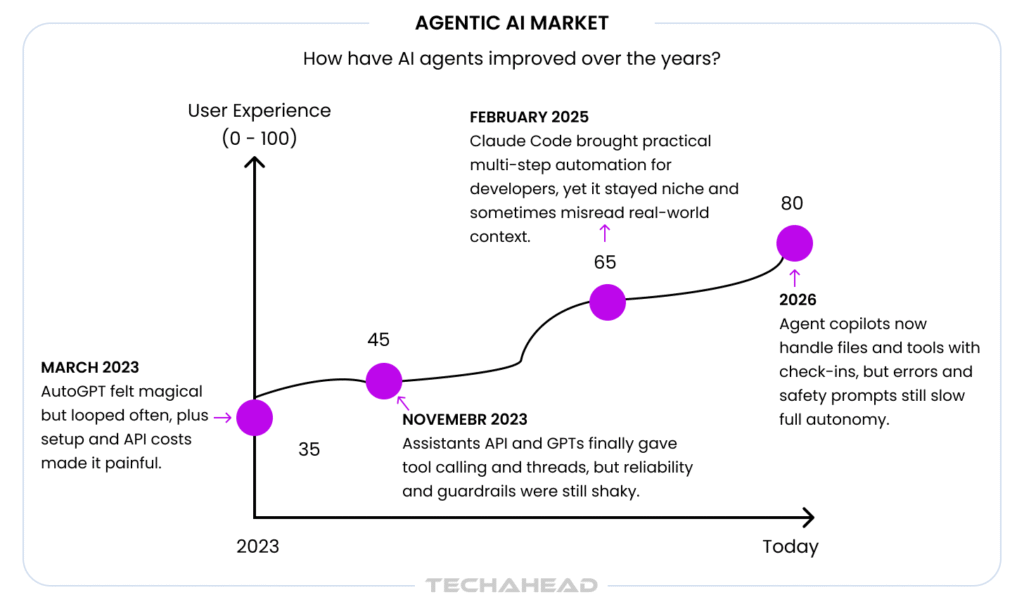
From 2024 into 2026, the center of gravity shifted toward agents: systems that can call tools, plan multi-step tasks, and interact with other software on a business’s behalf. This is a meaningful jump in both capability and risk.
It’s worth being precise here: “agentic” is not simply a synonym for “tool calling.” A system only earns the label when it combines planning, memory, and feedback loops, deciding what to do next, retaining relevant context, and correcting course when something goes wrong.
Every one of these components adds real complexity to a system. That complexity is manageable when it’s scoped to a single, well-understood job. It becomes very difficult to manage when a single agent is expected to carry all four across dozens of unrelated domains at once, which is precisely where broad agents start to stumble.
A narrow agent is built to solve one bounded workflow extremely well: filing an insurance claim, triaging a support ticket, or generating secure infrastructure-as-code from a known template. It has clear inputs and outputs, operates under stable environment assumptions, and works within tight guardrails and a limited tool surface.
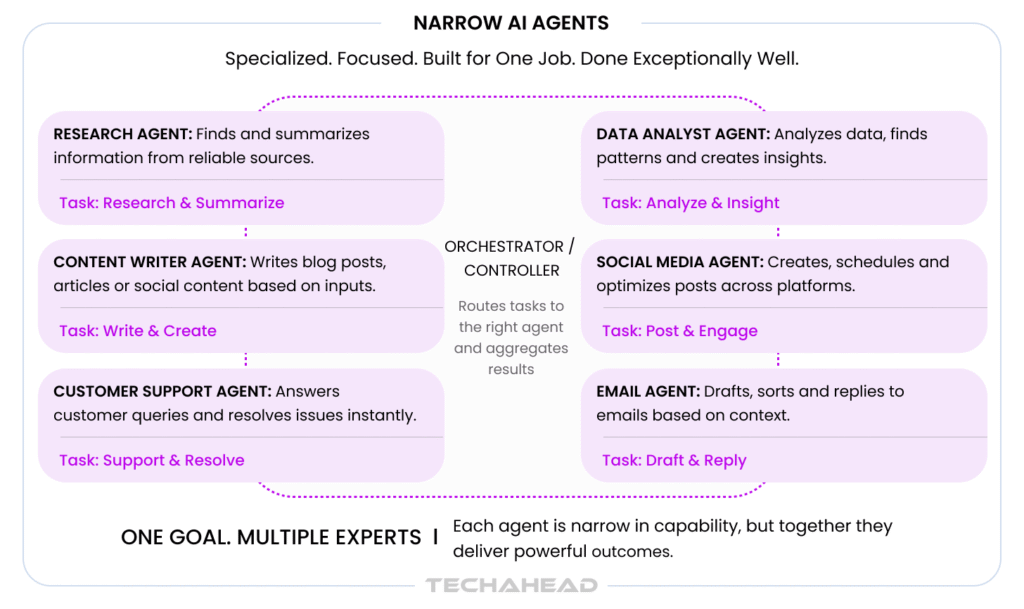
Source: TechAhead AI Team
Think of narrow agents as microservices with cognition.
Each one owns a single job, does it reliably, and can be reasoned about in isolation, the same discipline that made microservice architectures scale in the first place.
A broad agent is pitched as an “AI teammate” that can handle almost anything: scheduling, code changes, marketing copy, and customer support, all inside a single generalized system. It operates over a large, open-ended action space, juggles many tools with unclear priorities, and leans heavily on implicit reasoning and constant user guidance to stay on track.
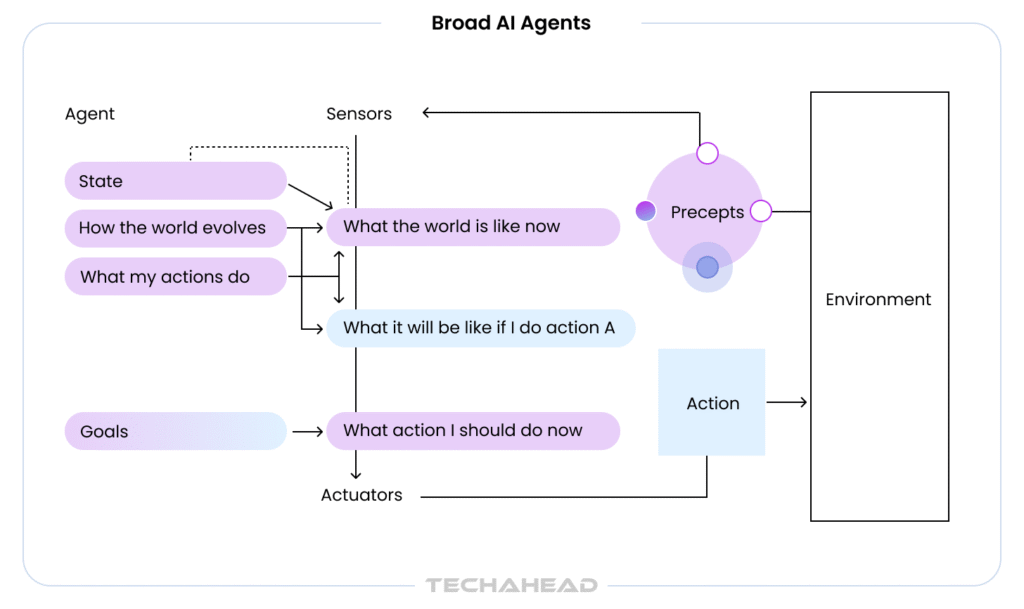
Broad AI Agents (Source)
A useful mental model: it’s an intern dropped into your entire company without a job description, talented, well-intentioned, but structurally set up to struggle.
The narrow-versus-broad distinction has nothing to do with how intelligent the underlying model is. It’s about scope and operational envelope, how much surface area a single agent is responsible for. As the rest of this article will show, scope, not raw capability, is the decisive factor in whether an agentic system scales.
Businesses don’t just want impressive outputs; they want repeatable ones, predictable failure modes, and debugging paths a human engineer can actually follow at 2 a.m. Broad agents accumulate too many branches in their decision tree to test exhaustively, and that makes them genuinely difficult to certify for regulated industries. Narrow agents, with far fewer paths, are easier to test, monitor, and validate against clear acceptance criteria.
Every step in an agentic loop, thinking, planning, calling a tool, adds latency and inference cost. Broad agents tend to overthink, running multiple planning and reflection loops and chaining long sequences of tool calls across many systems. Narrow agents run shorter, well-defined sequences that are far easier to optimize through caching, partial evaluation, and pre-computation.
Every tool or system an agent can touch is both an attack surface and a governance question. Broad agents carry a huge permission surface that’s genuinely hard to model under least-privilege principles, and it becomes difficult to answer a simple but critical question: what exactly can this agent do? Narrow agents carry permissions aligned to one workflow, which makes policy-as-code, audit trails, and approval steps dramatically easier to apply.
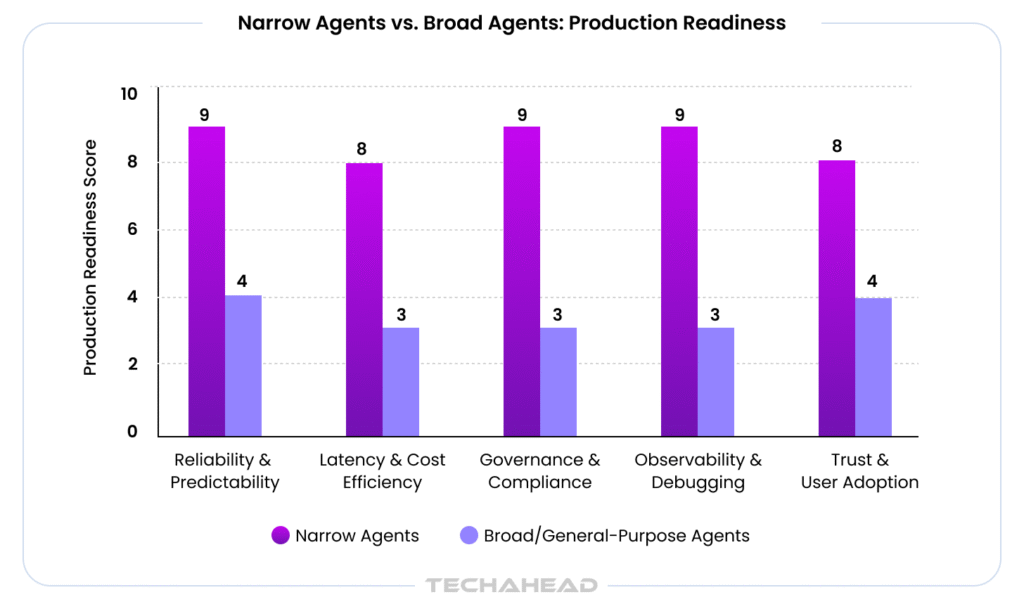
Illustrative comparison: narrow, single-purpose agents consistently outperform broad, general-purpose agents on the dimensions that actually determine production survival.
Source: TechAhead AI Team
Narrow agents map cleanly onto business processes: this agent owns invoice extraction, that one owns lead qualification. That clarity makes it straightforward to attach SLAs, KPIs, and monitoring, accuracy, throughput, and error rate, for one specific workflow rather than an ambiguous bundle of responsibilities.
Narrow agents behave like composable building blocks. Each one is a service with a defined contract, and a higher-level orchestrator, whether a workflow engine, a BPM platform, or another meta-agent, can coordinate several of them together. That modularity shrinks the blast radius of any single failure and lets teams upgrade or A/B test one agent without touching the rest of the system.
With narrow agents, logs and traces tie back to a single workflow, so teams can replay specific scenarios, write synthetic tests, and inspect individual tool calls with confidence. Broad agents, by contrast, generate noisy observability data where it’s genuinely unclear whether a failure stemmed from planning, tool misuse, hallucination, or a UX problem. Narrow scope translates directly into simpler incident response and clearer root-cause analysis.
Narrow agents can be deployed behind feature flags, rolled out to a subset of users or markets, and swapped for a human fallback quickly if something goes wrong. That’s exactly the kind of change management enterprises already know how to run, which is a large part of why narrow agents keep clearing the bar that broad agents struggle to reach.
Because broad agents promise to do anything, teams keep adding tools and workflows to them over time. Ownership blurs, and no one is quite sure who is accountable for the agent’s behavior in any specific domain. The result is messy responsibility lines, conflicting expectations, and a backlog no one can prioritize cleanly.
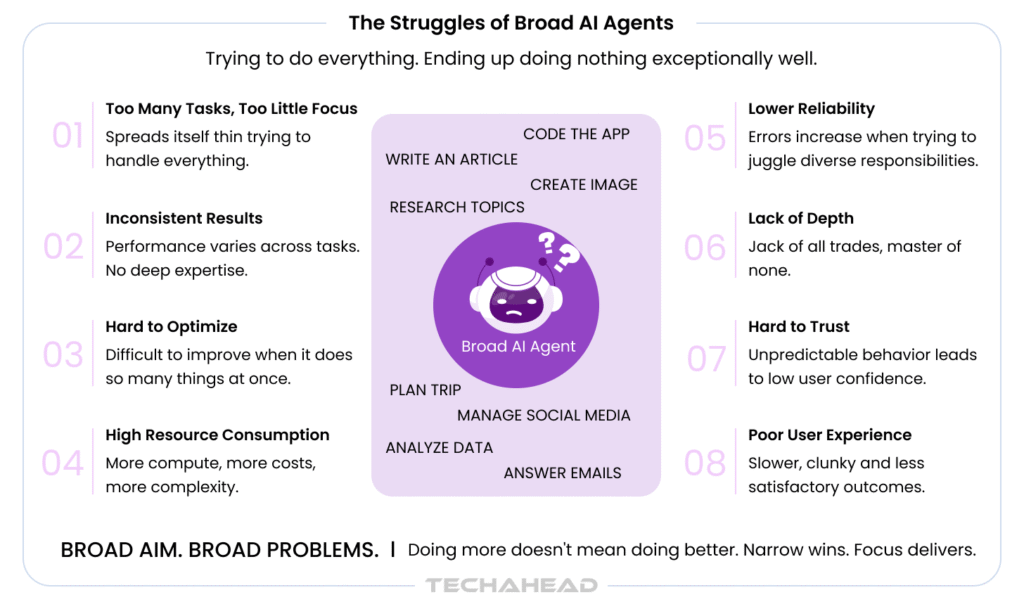
Source: TechAhead AI Team
How do you even test a system that spans dozens of domains, each requiring its own benchmarks and ground truth? Without clearly bounded tasks, offline evaluation stays weak and online evaluation demands sprawling, complex experiment design. Narrow agents, by contrast, can lean on familiar QA frameworks built for one specific task.
Users trust systems that behave predictably and are transparent about what they can and can’t do. Broad agents frequently over-promise and under-deliver, confidently agreeing to a task and then failing partway through, forcing users to learn a kind of “prompt gymnastics” just to get consistent results. Narrow agents offer a clear affordance: this agent does X, and it does it the same way every time, which builds trust far faster.
Broad agents pull in infra, security, legal, domain experts, and product managers all at once, turning what should be a shippable capability into a never-ending project. Narrow agents map far more naturally onto the product and engineering org structures enterprises already have in place.
The core idea is straightforward: maintain a fleet of narrow agents, each handling exactly one workflow, and let a central orchestrator, a rule-based engine, a workflow platform, or a lightweight meta-agent, route tasks to the right one. This gives you clear boundaries, the ability to add or remove agents without re-architecting the system, and far simpler compliance and monitoring.
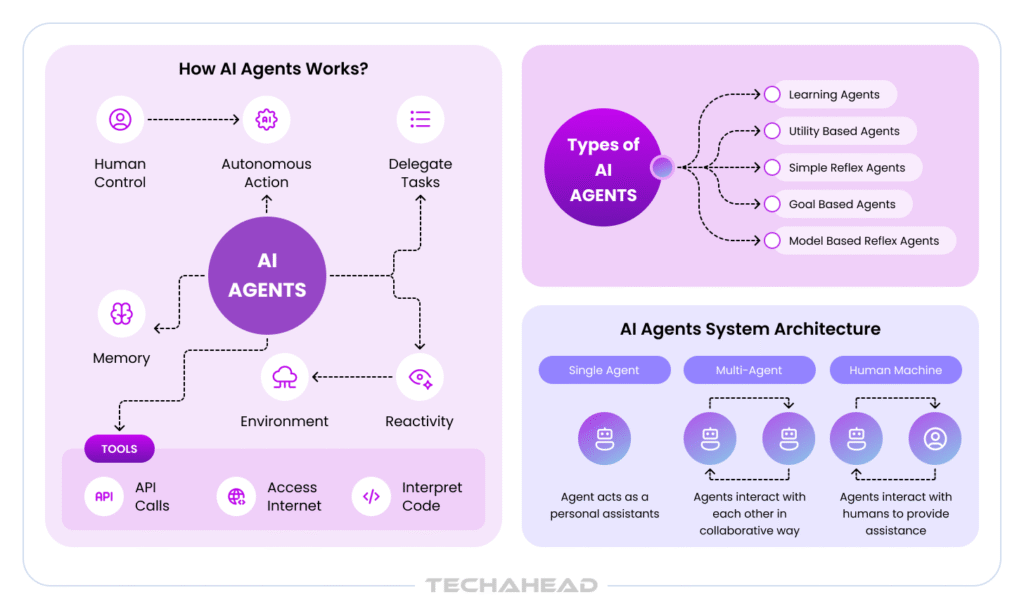
A production-grade agentic stack tends to resolve into three layers: the tools and APIs (CRM, ticketing systems, databases, third-party services), the narrow agents that wrap those tools for a specific job, and the orchestrator that manages which agent runs, in what order, under what conditions. If this sounds familiar, it should. It closely mirrors the microservices and service-mesh patterns most enterprises have already invested years into understanding.
There are legitimate cases for broader scope, an internal copilot for developers or analysts, for instance, where the stakes are lower and the scope naturally spans many tasks. Even then, the discipline holds: treat the broad agent as a front door that delegates to narrow backend agents rather than a monolith trying to do everything internally, and implement tight guardrails with explicit tool-routing logic.
Governance belongs at the orchestrator layer: access control over which agent can call which tools, audit logs for every agent action, and approval workflows for sensitive tasks such as financial or security changes. Governance only becomes genuinely manageable once agents are narrow and responsibilities are clear, which is the throughline of everything in this section.
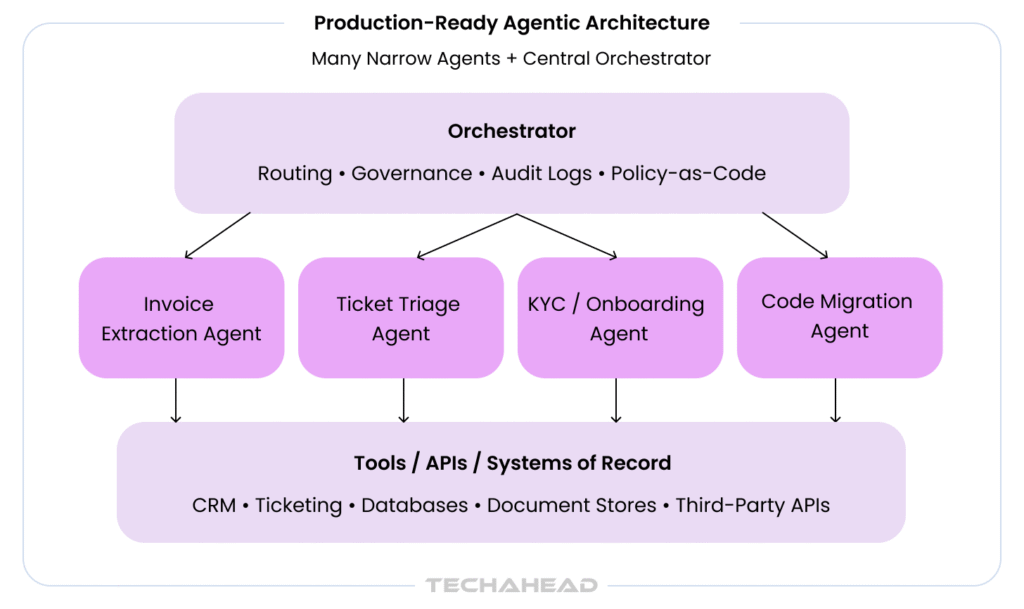
A layered, orchestrator-led architecture keeps each narrow agent’s scope, permissions, and blast radius contained, while still enabling coordinated, complex outcomes.
Source: TechAhead AI Team
Start with processes that are repetitive, well-defined, and have measurable success criteria, time saved, resolution rate, revenue impact. Strong early candidates include onboarding KYC, claims triage, ticket routing, and code migration for a known pattern.
Define inputs (data formats, context), outputs (structured results, status codes), and error behavior (fallbacks, escalation paths) up front. Clarify what “done” actually means for this agent before a single line of orchestration logic gets written.
Plan explicit integrations across APIs, event buses, and data warehouses, and implement least-privilege access and logging from day one, not as an afterthought once something has already gone wrong.
Build metrics around task success rate, latency, and human intervention or fallback rate. Start with a human in the loop, then expand autonomy only as those metrics stabilize and confidence genuinely grows.
Once one agent is working well, replicate the pattern for adjacent workflows and reuse the tooling, governance, and observability you’ve already built. Resist the temptation to bloat a successful agent into a do-everything system, that’s the single most common way a working pilot turns into a stalled program.
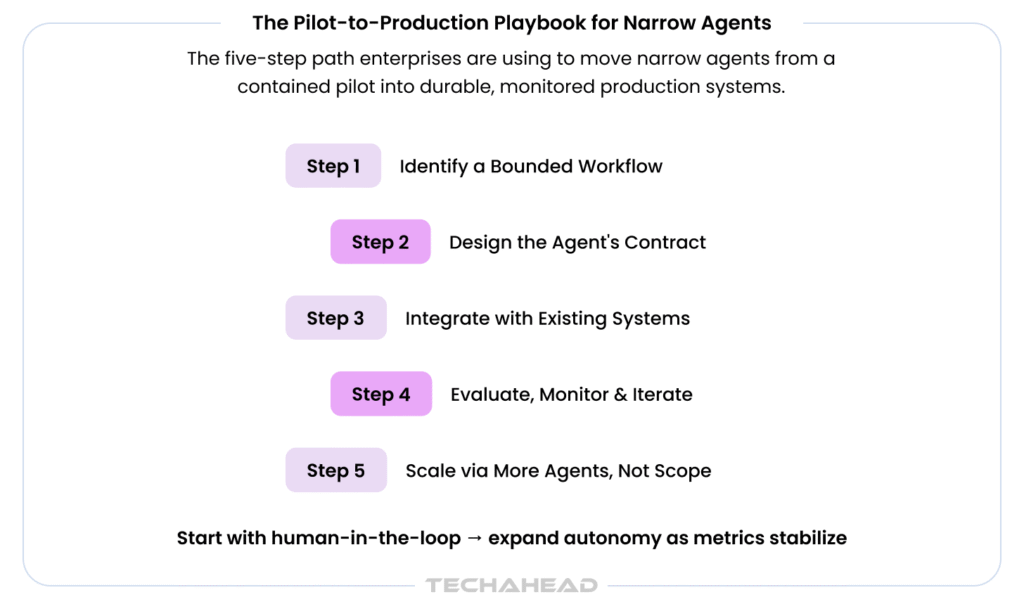
The five-step path enterprises are using to move narrow agents from a contained pilot into durable, monitored production systems.
Source: TechAhead AI Team
Avoid pitching “AI that does everything.” Build roadmaps around specific, outcome-based agents and workflows rather than vague “AI copilot for everything” slogans that are difficult to scope, sell, or support.
Treat agentic capability as a platform investment: provide reusable infrastructure for tool calling, logging, and policy, then let product teams build narrow agents on top of it. Consider internal “agent marketplaces” where teams publish and reuse narrow agents rather than rebuilding similar capability from scratch.
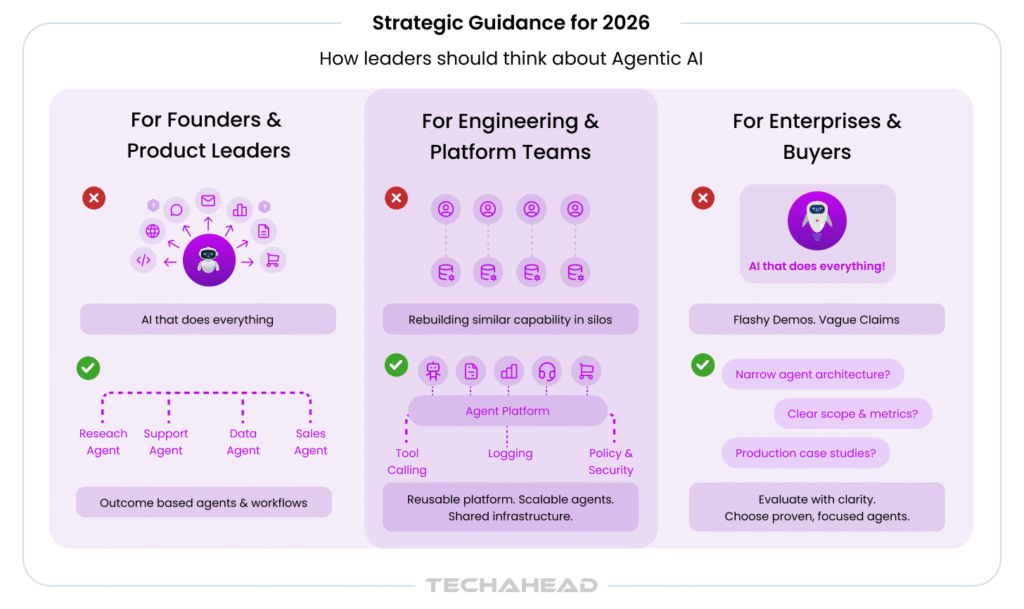
Image Source: TechAhead AI Team
When evaluating vendors, ask directly whether they use a narrow-agent architecture, request clarity on each agent’s scope and metrics, and prioritize partners who can show production case studies built on narrow agents, not just flashy demos of broad, general-purpose ones.
General-purpose agents make for genuinely impressive demos. But narrow, well-scoped agents are what actually scale in real production environments, and that distinction is worth internalizing before the next roadmap gets written.
Narrow doesn’t mean less powerful. It means more controllable, more testable, and more composable, the exact qualities that let a system earn trust incrementally instead of demanding it all at once. Broad agents will still have a role to play, largely as orchestrators or UX layers, but the real workhorses of agentic AI will be fleets of specialized agents doing one job extremely well.
By 2026 and beyond, the organizations that win with agentic AI will be the ones that treat agents like robust, composable services, not magic general-purpose interns. That’s a discipline, not a demo, and it’s the one worth building toward now.
If you’re planning an agentic AI roadmap, start by mapping your top three workflows that can be handled by narrow agents, and design outward from there.
TechAhead helps enterprises design, build, and govern production-grade agentic systems, moving beyond flashy demos into narrow, composable agents that hold up under real business conditions.
Narrow agents handle one bounded workflow reliably; broad agents attempt many open-ended tasks with unclear scope and priorities.
They accumulate untestable decision branches, unclear ownership, weak evaluation methods, and large, hard-to-govern permission surfaces over time.
Many narrow agents coordinated by one central orchestrator, layered over existing tools, APIs, and governed access-control policies.
Yes, as an internal copilot front door that delegates to narrow backend agents, never as a single monolithic system.
Pick one bounded, measurable workflow, define its contract clearly, run it human-in-the-loop, then expand autonomy gradually.
We use cookies to ensure our website functions properly, improve performance, and provide a personalized experience. You can choose which types of cookies to allow below.
Required for core functionality such as security, network management, and accessibility. These cannot be disabled.
Help us understand site traffic and user interactions so we can improve performance and usability.
Enable enhanced functionality and personalization such as language or region preferences.
Used to deliver relevant ads, track campaign performance, and measure advertising effectiveness.