


 Copy Link
 Share on X
 Share on Facebook
 Share on LinkedIn

Always Active
Required for core functionality such as security, network management, and accessibility. These cannot be disabled.

Uncover the transformative potential of digital and mobile solutions for your industry.





 Last Updated: Sep 18, 2026
Jul 29, 2026
Last Updated: Sep 18, 2026
Jul 29, 2026  314
314  13 min. Read


Key Takeaways
Treat tokens as a measurable unit of AI cost and value: Then lower cost per useful outcome, improve latency, and govern AI spend without sacrificing model quality.
There’s a sentence that keeps showing up in AI budget reviews: “but it’s only a fraction of a cent per token.” It’s true, and it’s also the most expensive assumption in the building. Cheap per token is not the same as cheap per outcome, and the gap between those two numbers is where production AI budgets quietly go to die.
Tokens are now the atomic unit of AI consumption.
At FinOps X 2026, FinOps Foundation executive director J.R. Storment opened the keynote by describing tokens exactly that way, the atomic unit of AI, and warning that their exponential, variable consumption creates a genuinely new cost-management problem.
The industry response has a name now: tokenomics, the discipline of metering token consumption, attributing it, and connecting it to business outcomes. On June 3, 2026, the Linux Foundation announced the intent to form a dedicated Tokenomics Foundation to build open standards for exactly this.
This is a practical guide to the engineering side of that discipline: what a token actually costs, where production systems waste them, and the specific levers, routing, context reduction, caching, orchestration, and governance, that lower cost per useful outcome while holding quality steady.
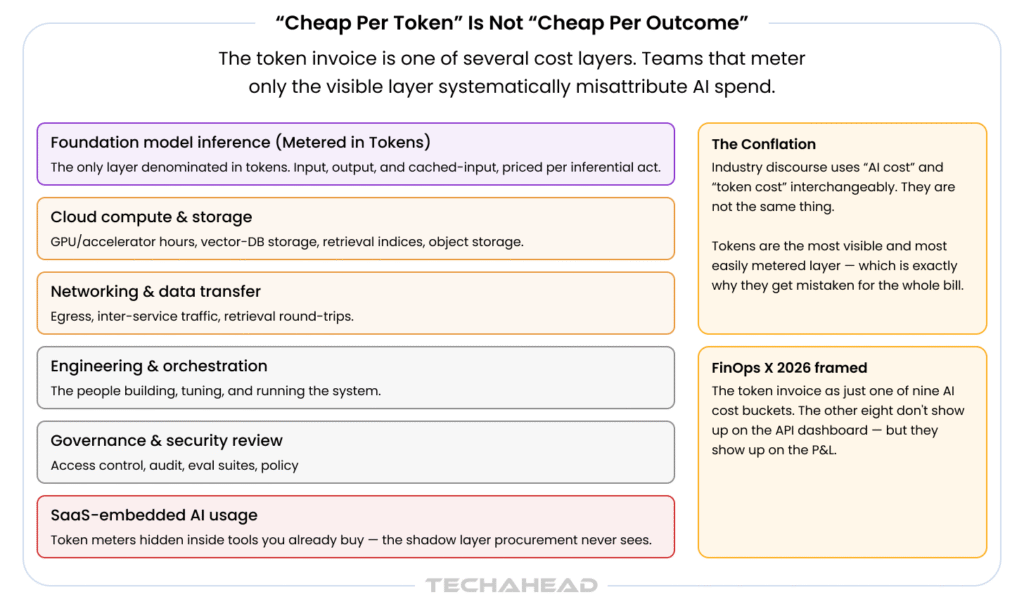
Token price is one layer of the bill, not the bill. The FinOps Foundation is blunt about the conflation: “AI cost” and “token cost” get used interchangeably in industry discourse, and they are not the same thing.
Source: TechAhead AI Team
A complete accounting spans several layers, only one of which is denominated in tokens: foundation model inference (metered in tokens, billed per API call or derived from self-hosting); cloud compute and storage (GPU hours, vector databases, retrieval indices); networking; the engineering and orchestration labour; governance and security review; and, the sneakiest one, SaaS-embedded AI usage, where a token meter is hidden inside a tool you already bought and procurement never sees it.
FinOps X 2026 framed the token invoice as just one of nine AI cost buckets.
Even within the token layer, price isn’t a single number.
Input, output, and cached-input tokens are billed at different rates. Output typically costs several times more than input.
Claude Opus 4.8, for example, is priced at $5 per million input tokens and $25 per million output tokens. Rates vary across model families and modalities.
And the economic value of a token depends entirely on task complexity and system design: the same thousand tokens can resolve a customer ticket or generate filler nobody reads.
Source: TechAhead AI Team
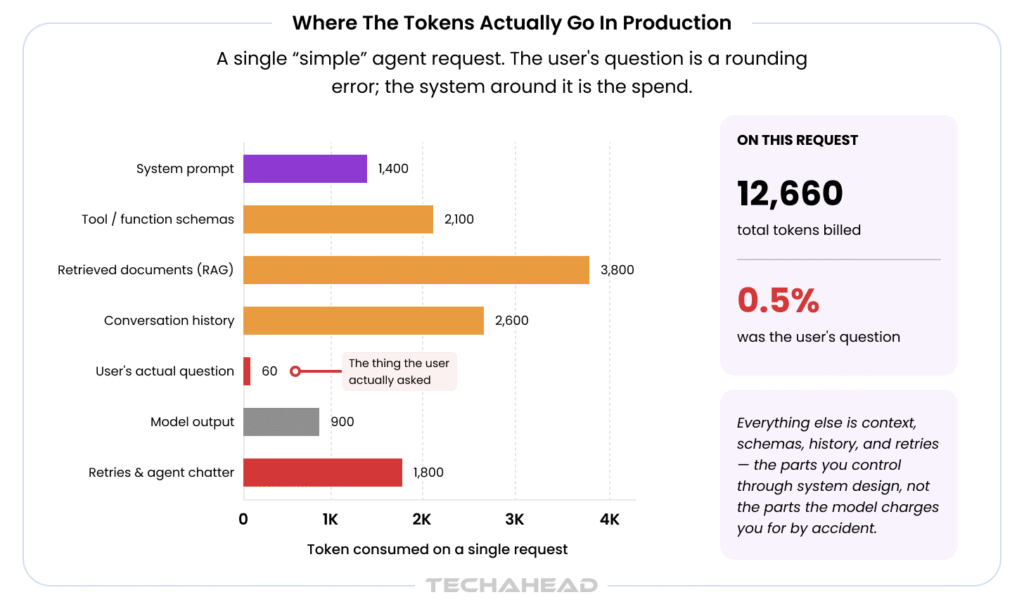
Here’s the uncomfortable part: In a real deployment, the user’s actual question is often a rounding error in the token bill. The system wrapped around it is the spend.
The major cost drivers are structural: system prompts sent on every call, tool and function schemas loaded whether or not they’re used, retrieved documents from RAG, conversation history that grows without bound, model output, and the retry loops and agent-to-agent chatter that multi-step workflows generate.
Token consumption climbs sharply the moment an application adds memory, agents, and orchestration.
Four patterns account for most of the waste.
Context bloat from long histories and oversized retrieved documents. Output inflation from vague instructions that let the model ramble. Retry loops and agent chatter, where systems burn tokens re-attempting failed steps.
And hidden overhead from tool schemas and function definitions that ride along on every request. None of these are the model’s fault, they’re system-design choices, which is precisely why they’re fixable.
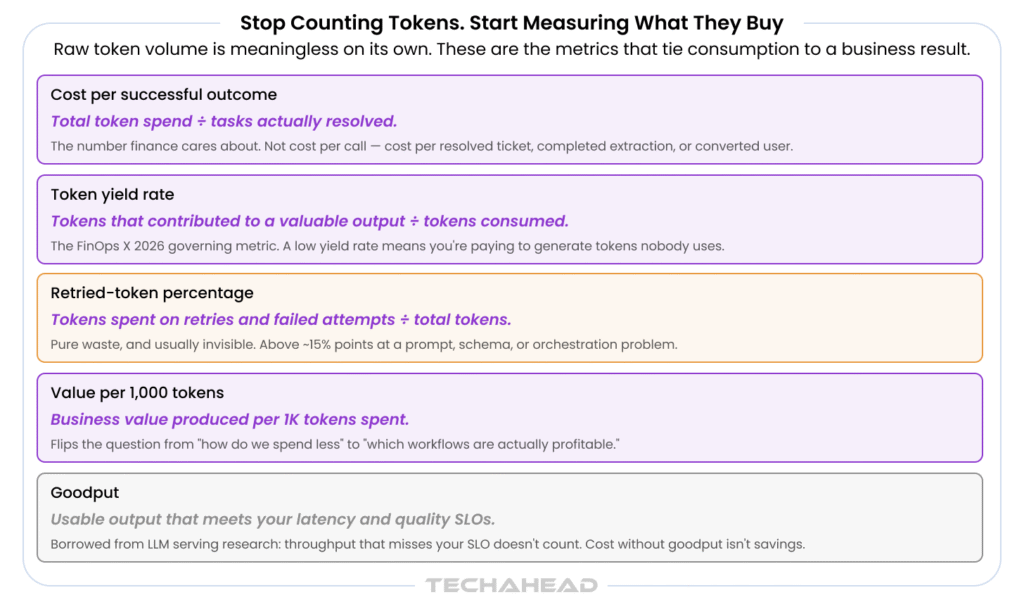
This is the core of the discipline, and the part most teams skip. Raw token count is meaningless until it’s tied to a business result, a resolved ticket, a conversion, reduced handle time, a completed extraction.
Tokenomics is about useful output, not minimal output. A system that cuts tokens by starving the model of context and tanks answer quality hasn’t optimized anything; it’s moved the cost from the API bill to the support queue.
Source: TechAhead AI Team
Five metrics turn token spend into something you can manage. Cost per successful outcome, total spend divided by tasks actually resolved, not calls made.
Token yield rate, the share of consumed tokens that contributed to a valuable output; the FinOps community treats this as the governing metric.
Retried-token percentage, pure waste, usually invisible until you look. Value per 1,000 tokens, which flips the question from “how do we spend less” to “which workflows are actually profitable.”
And goodput, borrowed from LLM-serving research: the count of outputs that meet your latency and quality targets. As one plain definition puts it, goodput is completed requests per second that also meet your latency SLOs, a request that finishes but blows past the target counts toward throughput but not toward goodput.
Cost without goodput isn’t a saving; it’s a downgrade you haven’t measured yet.
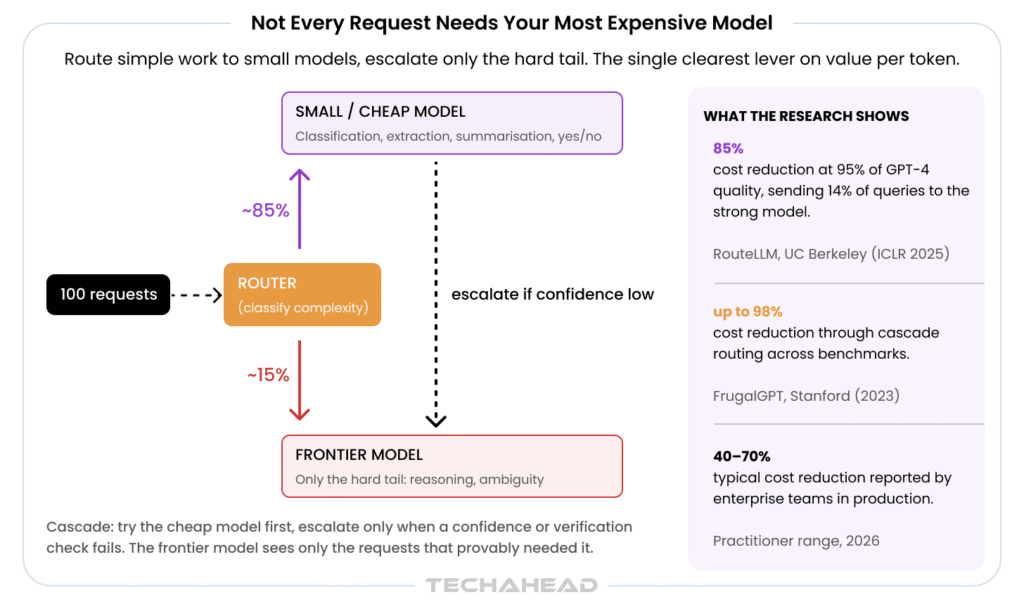
The single clearest lever on value per token: stop sending every request to your most expensive model.
Source: TechAhead AI Team
Most production traffic never needed a frontier model in the first place. Route simple requests, classification, extraction, summarisation, yes/no questions, to smaller, cheaper models, and escalate only the hard tail. The research here is unusually strong.
RouteLLM, the UC Berkeley work published at ICLR 2025, achieved over 85% cost reduction on MT-Bench while maintaining 95% of GPT-4 quality, sending only 14% of queries to the strong model.
Stanford’s earlier FrugalGPT demonstrated up to 98% cost reduction through cascade routing. In production, enterprise teams typically report cost reductions in the 40-70% range depending on how skewed their traffic is toward simple tasks.
Three architectures do the work. Classifier-based routing decides before any model call, using a lightweight classifier to predict complexity.
Cascade routing sends the query to the cheap model first and escalates only if the response fails a confidence check. Semantic routing embeds the query and routes by similarity. A common production design layers them into a tiered cascade, cheapest routing method first, escalating only when it can’t decide confidently.
One caution worth stating plainly: model tiering is a governance decision, not just an engineering trick. “Good enough” for each task type has to be defined on your own production data, and a starting escalation rate above 50% usually means the threshold is too conservative, below 5% too permissive.
Since context is billed on every call, trimming it is one of the most direct savings available, and, counterintuitively, it often improves reliability, because a smaller, cleaner context gives the model less room to get distracted.
The practical moves: choose RAG over long context where you can, retrieving only the relevant passages rather than stuffing an entire corpus into the window.
Apply prompt compression to strip redundancy from prefixes. Use semantic filtering or relevance ranking to prune retrieved documents before they hit the model. And prefer structured output formats over verbose free-form text, a JSON object costs fewer tokens than three paragraphs saying the same thing, and it’s easier to validate downstream. The goal isn’t the smallest possible context; it’s the smallest context that preserves the answer.
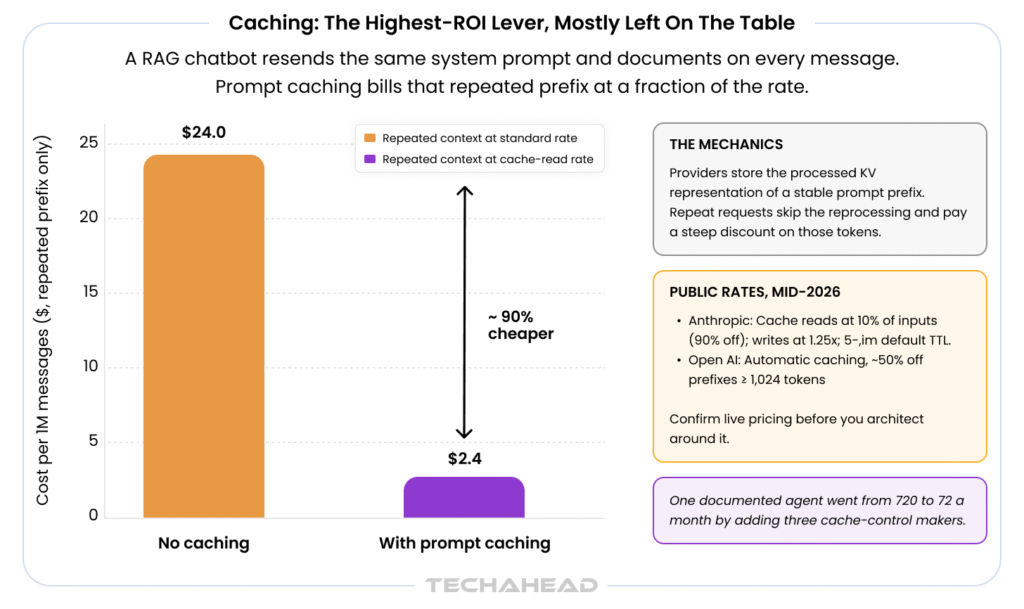
If a prompt prefix repeats across requests, and in production it almost always does, you should not be paying full price for it twice.
Source: TechAhead AI Team
Prompt caching stores the processed representation of a stable prefix: System prompt, tool definitions, retrieved documents, conversation history, so the provider skips reprocessing on the next request and charges a steep discount.
The savings are real and, in mid-2026, well documented. Anthropic bills cache reads at 10% of the standard input rate, a 90% discount, with writes at 1.25× and a five-minute default TTL; OpenAI’s caching is automatic and discounts qualifying prefixes (1,024 tokens or longer) by roughly 50%.
One widely cited example: an agent that went from $720 a month to $72 by adding three cache-control markers. Another team, ProjectDiscovery, raised its cache-hit rate from 7% to 84% and cut total LLM spend by 59-70%.
Three caching layers stack. Cached-input pricing from the provider for stable prefixes.
Response and semantic caches for repeated or near-duplicate queries, so you return a stored answer instead of paying to regenerate it. And memoization for repeated workflow steps. The catch is that caching done poorly silently does nothing, the discipline is putting stable content first and variable content last, then logging cache-read tokens and watching the hit rate. It’s one of the rare optimisations where the code change is small and the bill change is large.
Agentic systems waste tokens in places that don’t show up as “tokens” in anyone’s mental model: tool selection, schema loading, and the overhead of multi-step orchestration. Every tool definition is tokens on every call. Every unnecessary intermediate step is a full round-trip.
Treat tool design as an economic lever. Minimise tool schemas and load only what a given flow needs. Use structured tool routing rather than dumping every available function into the context and hoping the model picks well. Avoid unnecessary intermediate steps, cap retries and validation loops, and design agent flows around the shortest path to a correct outcome.
The cascade principle applies inside the agent too: spend expensive steps only where cheaper ones provably fall short.
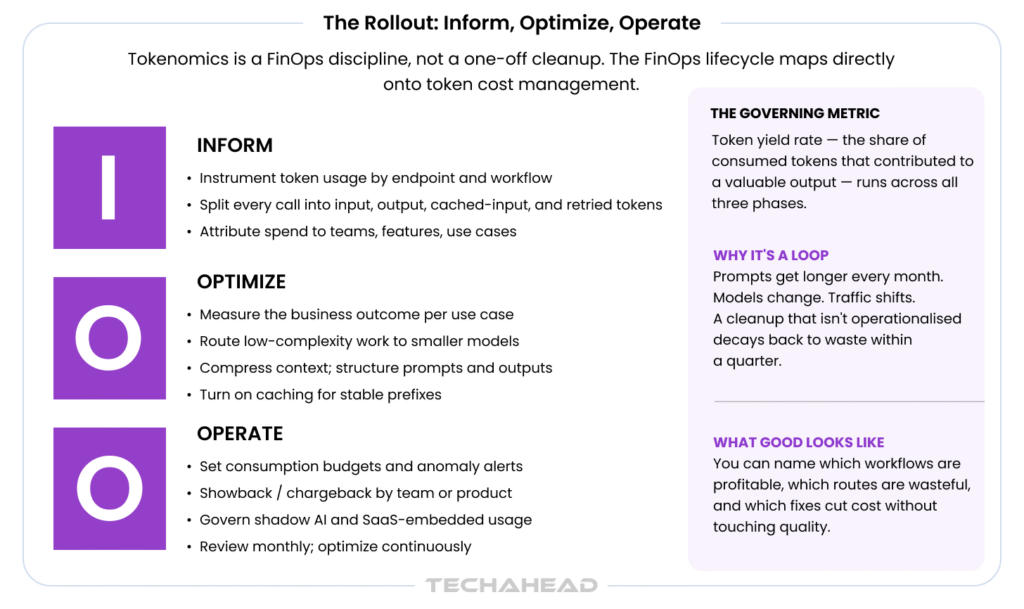
Everything above is engineering. Making it stick is a finance-and-operations discipline, which is exactly the case the FinOps Foundation has been making.
Its guidance frames token economics as the way to connect AI consumption to business outcomes, and it maps the established FinOps lifecycle, Inform, Optimize, Operate , directly onto token cost management.
Source: TechAhead AI Team
In practice that means chargeback and showback by team or product, so AI spend has an owner. Consumption budgets and policy thresholds with anomaly alerts.
Unit economics by workflow, so you know which use cases pay for themselves. Normalized metrics for vendor comparison, the FOCUS specification, ratified at version 1.4 on June 4, 2026, already includes token-economics columns for AI billing.
And governance for the two blind spots: shadow AI (developers spinning up API access on a credit card before procurement notices) and SaaS-embedded AI usage where the token meter is buried inside a vendor’s product.
This is not a niche concern anymore. The State of FinOps 2026 survey ranked FinOps for AI as the top forward-looking priority, and the Foundation has updated its own mission from managing the value of cloud to managing the value of technology, a deliberate broadening to make AI a first-class scope.
A mature tokenomics program can answer three questions without a meeting: which workflows are profitable, which routes are wasteful, and which optimizations lower cost without harming the user experience.
Concretely, that shows up as lower cost per ticket resolved, faster responses at the same quality, fewer average tokens per successful task, and, the one finance cares about most, predictable AI spend instead of a bill that lurches every month. It also gives you clear thresholds for the big structural decisions: when to self-host, when to route, and when to keep buying via API.
A practical rollout sequence, in order:
Maximizing value per token is not about minimizing tokens at all costs. It’s about using the fewest necessary tokens to produce the highest reliable business value, with measurable governance shared across product, engineering, and finance. The teams winning at this in 2026 aren’t the ones with the smallest token bill, they’re the ones who can tell you, per workflow, exactly what each token bought.
We help engineering and product teams instrument token spend, design routing and caching architectures, and stand up the governance that keeps AI costs predictable as you scale: Without trading away model quality. If your LLM bill is growing faster than your usage can explain, that gap is usually diagnosable in weeks, not quarters.
Tokenomics (token economics) is the discipline of metering token consumption, attributing it to teams and workflows, and connecting it to business outcomes. The FinOps Foundation frames it as extending established cloud cost-management practice to the variable cost of AI inference. In June 2026 the Linux Foundation announced intent to form a dedicated Tokenomics Foundation to set open standards.
Because token price is one layer of the AI cost stack, and a token’s value depends on whether it produced a useful outcome. A low per-token rate spent on bloated context, retries, and unused output can cost more per resolved task than a higher rate used efficiently.
Two levers, in order: prompt caching for repeated prefixes (up to ~90% off that portion on some providers, small code change) and model routing that sends simple requests to cheaper models. Both preserve output quality when implemented with measurement in place.
Goodput is the rate of outputs that meet your latency and quality SLOs, throughput that misses the target doesn’t count. It matters because cutting cost while quietly breaching latency or quality targets isn’t a saving; goodput keeps the optimization honest.
Both, which is the point. The engineering levers (routing, caching, context reduction) lower cost; the FinOps practices (instrumentation, showback, budgets, governance) make the savings durable and tie them to business value across product, engineering, and finance.
We use cookies to ensure our website functions properly, improve performance, and provide a personalized experience. You can choose which types of cookies to allow below.
Required for core functionality such as security, network management, and accessibility. These cannot be disabled.
Help us understand site traffic and user interactions so we can improve performance and usability.
Enable enhanced functionality and personalization such as language or region preferences.
Used to deliver relevant ads, track campaign performance, and measure advertising effectiveness.