


 Copy Link
 Share on X
 Share on Facebook
 Share on LinkedIn
Always Active
Required for core functionality such as security, network management, and accessibility. These cannot be disabled.

Uncover the transformative potential of digital and mobile solutions for your industry.





 Last Updated: Sep 22, 2026
Jul 23, 2026
Last Updated: Sep 22, 2026
Jul 23, 2026  360
360  22 min. Read


Key Takeaways
The pilot worked. The demo landed. Your coding assistants are rolled out across the team, commit volume is climbing, and the pull request queue has never been longer. And yet nothing is actually shipping faster.
If that sounds like your engineering organization right now, you are not looking at a model problem. You are looking at a delivery problem. For enterprise engineering teams, technology leaders, and organizations scaling AI in production, the move from AI pilot to production usually fails not because the code cannot be generated, but because the pipeline lacks delivery controls that can absorb the volume AI now produces. Generation moved to warp speed while everything downstream, the testing, the security review, the deployment discipline, stayed exactly where it was.
This is the real reason so many teams stall on the way from AI pilot to production. It is rarely the code that blocks them. It is the absence of controls that can keep pace with how fast that code now arrives. The adoption numbers make the pressure concrete: in Stack Overflow’s 2025 developer survey, 84% of developers now use or plan to use AI tools, up from 76% a year earlier.
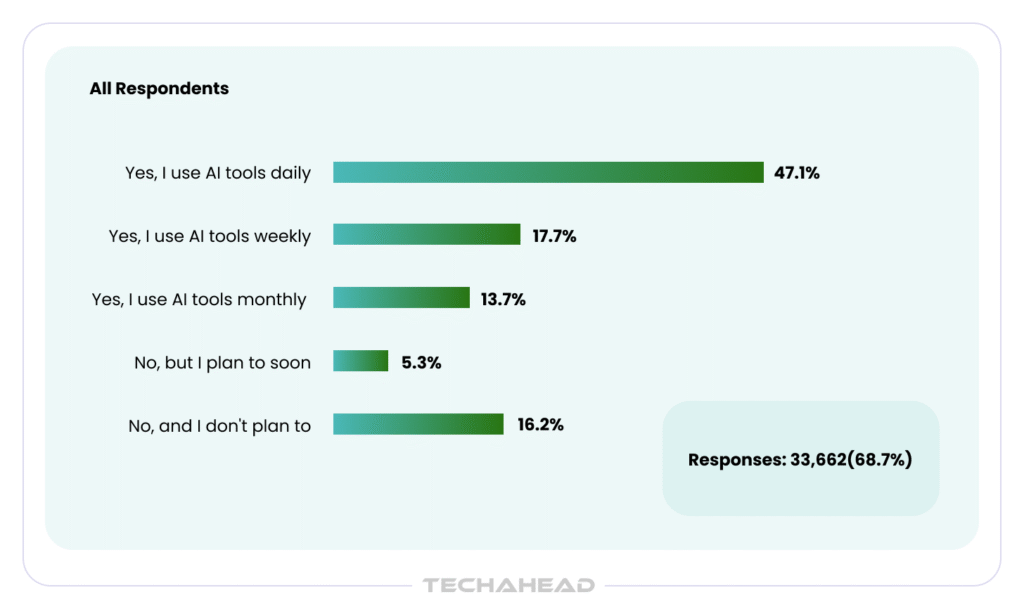
Yet in the same survey, 66% said they spend more time fixing AI-generated code that is almost right but not quite. More code is arriving, and more of it needs work before it can ship.
This pattern repeats across enterprise engineering teams, from Fortune 500 software groups to high-growth startups and regulated teams in healthcare and finance: the bottleneck has moved, and most delivery pipelines have not moved with it. A pilot proves the idea works. Then the code hits a delivery process built for a slower era, and it stalls there, reviewed but not merged, merged but not shipped.
This blueprint shows how to get AI pilots into production by adding six controls to your existing delivery pipeline: testing and quality gates, security and AppSec, deployment and rollback, observability, cost and FinOps, and delivery measurement through DORA metrics. If you are responsible for scaling AI delivery with reliability, security, and compliance intact, these are the operational controls that turn faster code generation into production throughput instead of instability, review friction, and slower releases.
Also Read: Why Enterprise AI Development Pilots Fail to Reach Production
Traditional delivery pipelines were tuned for human output. A developer writes a feature over days, a reviewer reads it, tests run, it ships. The whole rhythm assumes a certain cadence of change. AI breaks that assumption not by writing worse code, but by writing far more of it, far faster than the controls around it were designed to handle; most organizations still treat early AI work as isolated experiments or pilot programs, which is why many ai projects never follow a clear production path.
The failure is rarely dramatic. It is a slow accumulation of pressure at every gate that was already running close to capacity:
An ai initiative can clear the demo stage yet still fail in operational reality because the pipeline was designed for a controlled environment rather than production scale.
This is not a hunch. Google Cloud’s DORA research, one of the longest-running studies of software delivery performance, found that AI adoption without matching delivery discipline measurably degrades outcomes. Its 2024 report, drawn from a survey of more than 39,000 professionals, associated a 25% increase in AI adoption with roughly a 1.5% drop in delivery throughput and a 7.2% drop in delivery stability. Only 30% of ai projects move beyond the pilot stage, a pattern that shows how often ai projects fail when delivery controls lag behind adoption.
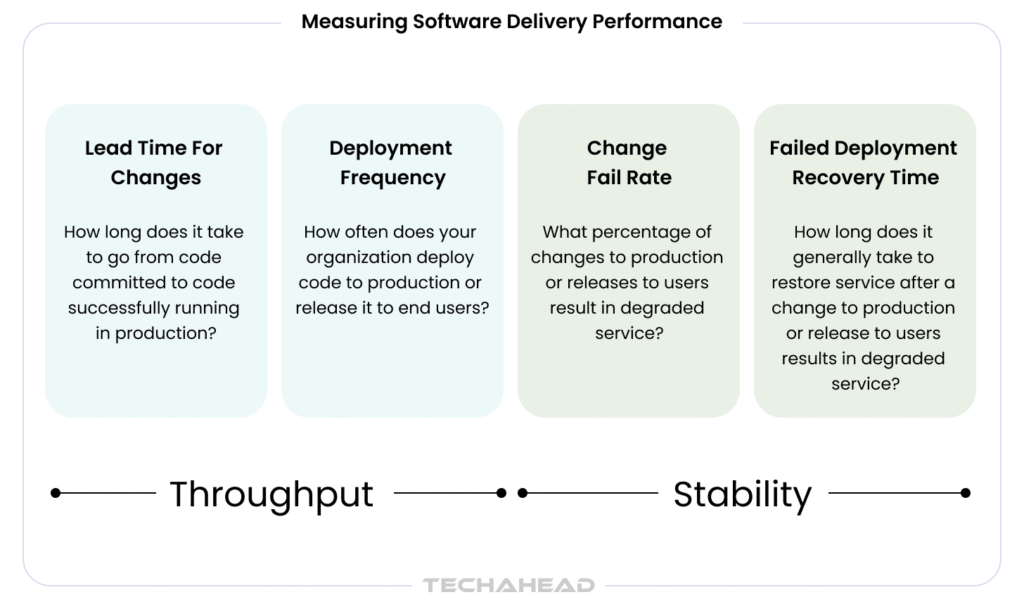
In other words, faster generation without stronger controls does not just fail to help, it actively drags delivery backward.
None of these problems are exotic. They are the ordinary controls of software delivery, each one now carrying a load it was never sized for. The fix is not another model, a point we argued in the real AI implementation challenges, where model intelligence has stopped being the constraint. It is a set of delivery controls built for devops for AI generated code, where the pipeline itself does the work that human attention no longer can at this volume.
The rest of this blueprint works through six control domains. Here is the map before we walk it.
Table 1. The six delivery controls and the failure each one prevents
| Control Domain | What It Governs | Failure Mode It Prevents |
| Testing and Quality Gates | Whether code is verified before it advances | Untested generated code reaching main |
| Security and AppSec | Vulnerabilities, secrets, dependency risk | Silent security debt shipping to production |
| Deployment | How change reaches users | An uncontrolled release hitting everyone at once |
| Rollback | How a bad release retreats | A failure with no fast way back |
| Observability | Visibility into running code | Blind spots you cannot govern or debug |
| Cost and FinOps | The spend signature of AI-in-the-loop delivery | Runaway cost nobody notices until the invoice |
Testing and security carry the most weight in an AI-heavy pipeline, so that is where the detail is deepest. We start there.
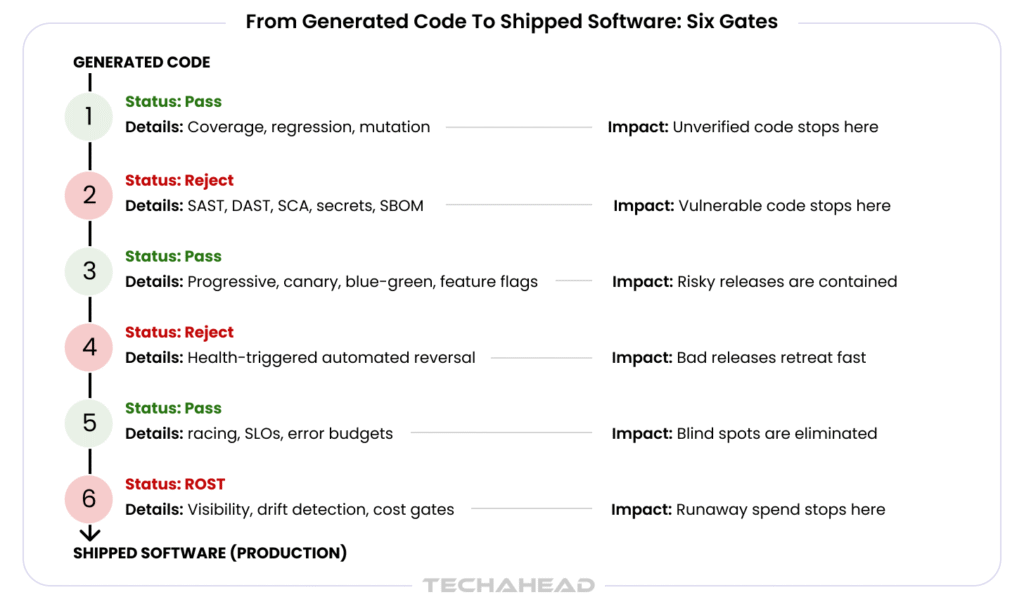
The single most useful principle a team can adopt when AI enters the pipeline is short: AI writes code, but AI does not ship code. The gap between those two is where quality gates live, and AI readiness depends on data readiness as much as model output. This is a shift we examined in what changes when agents join the SDLC, and the data backs the caution: developer trust in AI output accuracy fell to around 33% in 2025, down from 43% the year before.
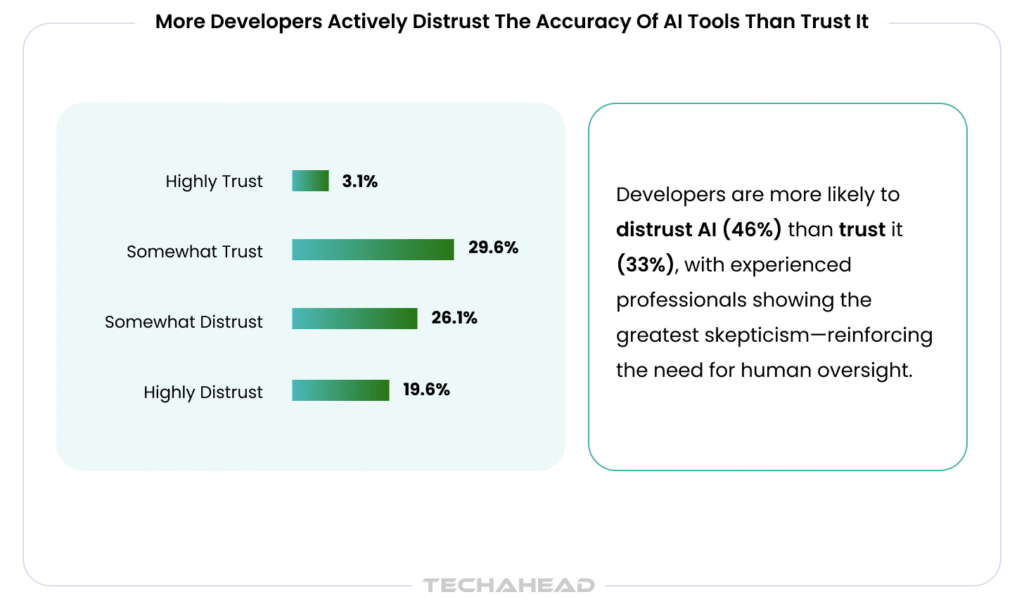
The gate is what lets a team ship confidently despite that trust gap, because the pipeline verifies what the developer no longer takes on faith.
An AI code deployment pipeline built for generated code treats the quality gate as an automated checkpoint that code must pass before it advances, not as a suggestion. In practice, a well-formed gate checks several things in sequence:
Poor data quality costs organizations an estimated $3.1 trillion annually, which is why a strong data foundation matters before teams reach production.
The difference from a traditional CI setup is one of emphasis. Conventional pipelines assume the human wrote and understood the code, so the gate is a safety net. In an AI-heavy pipeline, the human may not have written a line of it, so the gate becomes the primary line of defense rather than the backup..
| In one engagement, a US enterprise engineering team running roughly 200 developers had rolled out coding assistants and watched their merge rate climb while their escaped-defect rate climbed with it. The fix was not to slow down generation. It was to make the quality gate strict enough that unverified code simply could not advance, which pushed the verification burden onto the pipeline instead of onto exhausted reviewers. Building that kind of automated gate discipline is core to our DevOps consulting services. |
Security is the control domain where AI-generated code is most quietly dangerous, because insecure code often looks completely reasonable. It compiles, it runs, it passes a glance. The vulnerability sits underneath.
That is why AI-heavy pipelines need security shifted left and automated by default, running on every change rather than as a pre-release audit. A mature security gate layers several scans:
The principle underneath all of these is simple: security requirements should never depend on who, or what, wrote the code. A vulnerability introduced by an assistant is exactly as dangerous as one introduced by a person, and the gate should not care about the difference. Model choice shifts the shape of the risk rather than removing it, but the security gate stays constant regardless of which model wrote the change.
Bonus Read: Claude vs OpenAI: How to Choose the Right Model
This is also where delivery discipline meets governance. In practice, AI governance, a clear governance model, and embedded risk management have to be pipeline requirements, not after-the-fact policy work. Controls like these are what let an organization stand behind certifications such as SOC 2 Type II and ISO 42001, both of which TechAhead holds, because the pipeline itself enforces regulatory compliance and data governance from the start, especially in regulated industries handling sensitive data, rather than relying on a policy document nobody reads. Designing data access controls and proactive risk management early is usually what helps governance-mature teams move faster in production. For teams whose obligations run deeper, we treat this as a bridge into the broader cloud and platform security work rather than a compliance checklist bolted on at the end.
“The teams that ship AI-generated code safely are not the ones with the best model. They are the ones who decided early that a security gate does not get to know or care whether a human or an assistant wrote the change. The standard is the standard. Once that is enforced in the pipeline rather than in a meeting, velocity stops being the enemy of safety.”
Deepak Sinha, CTO, TechAhead
Getting code through testing and security earns it the right to be deployed. A reliable [ai solution] must also integrate with [existing systems] and [enterprise systems] before deployment is trustworthy. How it reaches users, and how fast it can retreat, is the next control.
Deploying AI-generated code at volume rewards teams who release in a way that limits blast radius. The established techniques are not new, but they matter more when change arrives faster. Production readiness also requires high availability and redundancy, so rollback is not the only safeguard when releases go wrong:
Production readiness depends on [production data] moving through stable [data pipelines], not just curated pilot inputs.
The payoff for getting deployment right is measurable. Stack Overflow’s 2025 data found that teams adopting AI coding tools cut pull request turnaround from 9.6 days to 2.4 days, a roughly 75% reduction, but that speed is only safe when the controls around deployment can contain a bad release. Speed without a fast retreat path is just a faster way to reach an outage, and production success still depends on weekly health signals showing the system meets its operating targets before wider release.
This is also the point where it helps to look at how the market has productized these controls, because it tells you how mature the category has become. Harness, the AI software delivery platform company (harness.io), has packaged much of this into purpose-built agents spanning DevOps, testing, security, and cost. According to the company, it was named a Leader in the 2026 Gartner Magic Quadrant for its category. The harness AI devops platform is a useful reference point precisely because it shows these controls are no longer bespoke engineering, they are a defined product category with several serious players.
Must Read: Best AI Models for Developers: H2 2026 Edition
That last part matters more than any single vendor. Harness is one option among several, and the right choice depends entirely on your existing stack, including the [ai platforms] and [data platforms] that must fit your deployment model. The table below sets the leading reference platforms side by side so you can see the shape of the field rather than a sales pitch for one row of it.
Table 2. Reference platforms across delivery control domains
| Control Area | Harness | GitLab | Argo CD | Spinnaker |
| CI / build | Yes | Yes | Via integration | Via integration |
| Progressive / canary delivery | Yes | Yes | Yes (with Rollouts) | Yes |
| GitOps model | Supported | Supported | Native | Partial |
| Automated rollback | Yes | Yes | Yes | Yes |
| Built-in cost / FinOps | Yes | Limited | No | No |
| Best fit | Teams wanting an integrated platform | Teams already on GitLab | Kubernetes-native GitOps | Large multi-cloud deployers |
The takeaway is not “buy Harness.” It is that these controls exist, they are proven, and the work is fitting them to your environment rather than picking the loudest brand. Effective AI development services focus on integrating the right delivery controls into the tools, infrastructure, and operating model your team already uses. The same discipline applies whether you are shipping traditional services or agentic AI in production, where narrow, well-controlled deployments consistently outperform broad ones.
You cannot govern what you cannot see. Once generated code is running in production, observability is what turns it from a black box into something you can reason about.
Observability rests on three pillars working together:
For AI-generated code specifically, observability closes a loop the earlier controls open. Testing and security catch problems before deployment. Observability catches the ones that only appear under real traffic, real data, real scale, and user behavior changes, which is exactly where generated code tends to surprise you and where operational reality diverges from a pilot. It also feeds the automated rollback from the previous control: rollback is only as good as the health signals that trigger it, and those signals come from your observability layer. It should also track business value and business impact signals, so teams can tell whether the ai solution is delivering real business value, measurable business outcomes, and post-launch business value. Wiring these signals into a pipeline that acts on them is a core part of our DevOps consulting work.
This control is the one that gets the upper management’s attention, and it is the natural close because it translates everything above into money.
AI-in-the-loop delivery has a distinct cost signature. Generation itself consumes tokens and compute. The extra pipeline activity, more builds, more scans, more test runs against more code, consumes cloud spend. And generated code is not always efficient code, so what ships can quietly cost more to run than what a careful human would have written. Left unwatched, all of this shows up as an invoice nobody predicted, and too much ai investment disappoints when teams optimize token spend but ignore broader business value.
The controls that keep it in check are the same discipline applied to spend:
Cost reduction is only one success metric; teams should judge spend controls by measurable business outcomes, operational efficiency, and whether they create real business value and clear business impact that deliver sustained gains.
Managing the token and inference side of this is a discipline in its own right, read more of that in our blog on LLM cost optimization.
On the infrastructure side, cost control is tightly bound to how modern your cloud footprint is. Legacy architecture quietly inflates the cost of everything running on it, which is why we treat spend efficiency as part of cloud modernization rather than a separate exercise. For teams rebuilding the applications themselves rather than just the pipeline around them, that work extends into enterprise app development.
Six controls are useful. What turns them from a checklist into something you can take to your executive team is a way to measure them, and here the industry already has a shared language: the four DORA metrics. Business leaders should define metrics early and tie them to measurable business outcomes, not only delivery speed, because organizations that define success metrics reach production more often.
DORA, the DevOps Research and Assessment program behind Google Cloud’s annual State of DevOps research, identifies four measures that together describe delivery performance:
Examples include customer satisfaction, employee satisfaction, and cost reduction.
The reason these matter for an AI-heavy pipeline is that they cut through the noise. Generated code volume can make a team feel busy without being effective. DORA metrics tell you whether all that generation is actually producing faster, safer delivery, or just more work in progress. They are vendor-neutral, they are widely understood, and they are exactly the kind of scorecard a VP of Engineering can put in front of a leadership team to justify investment in delivery controls and tie measurable outcomes to strategic goals. Most organizations do not struggle for lack of dashboards; ai projects fail when AI strategy is disconnected from business value and stakeholder ownership.
Use them to locate yourself honestly. The table below maps maturity stages to the symptoms you can observe day to day, so you can self-diagnose where your pipeline actually sits.
Table 3. Delivery maturity, and how to recognize your stage
| Stage | What you observe | DORA signature |
| Stalled | Pilots demo well, little reaches production | Low deployment frequency, long lead time |
| Fragile | Code ships, but releases break often | High change failure rate, slow recovery |
| Controlled | Gates enforce quality and security automatically | Rising frequency, falling failure rate |
| Optimized | Fast, safe, measured delivery is routine | Strong across all four metrics |
Most teams that have rolled out AI coding tools without upgrading their delivery path find themselves at Stalled or Fragile, generating plenty of code but unable to ship it reliably. Involving end-users early improves user adoption, which helps pilots move beyond the stalled stage toward clearer business outcomes. That stall pattern, and the orchestration work that breaks it, is something we unpack further in moving stalled pilots to production. The blueprint here is the route from Stalled to Controlled and beyond.
Everything above points to one conclusion: the work is not choosing a tool, it is building these six controls into the pipeline you already have.
That is deliberately where we position ourselves. We are the delivery partner who assesses your current path from AI pilot to production by looking at ai readiness across people, process, data readiness, and a governance model, not just tools; this typically involves cross functional teams, business leaders, and a clearly assigned project team to carry ownership after go-live. We identify which of the six controls is your binding constraint, strengthen data governance, risk management, and integration with existing systems and enterprise systems, and build the gates, deployment discipline, observability, and cost controls into your existing stack, whether that runs on Harness, GitLab, Argo CD, or a pipeline stitched together over years. In practice, scaling an ai solution usually also requires change management, and 61% of companies cite rebuilding processes as key to making it work, while 80% of AI projects fail due to lack of stakeholder buy-in.
Our footing for that work is concrete: AWS Advanced Tier Partner, SOC 2 Type II, ISO 42001, and ISO 27001, backed by delivery teams who build these controls for enterprise engineering organizations rather than talk about them. In the engagement mentioned earlier, the outcome was not a new platform purchase. It was a pipeline where generated code met a strict, automated gate before it could advance, which moved that team from a rising defect rate to controlled, measurable delivery. User training is also part of turning a successful pilot into production success.
If you want to see where your own pipeline sits against this blueprint, our DevOps consulting team can help you find the binding constraint and fix it.
Most AI pilots stall because a demo and a production system are different animals. The pilot proves the idea works, but the path from AI pilot to production needs testing, security, and deployment controls the demo simply skipped.
Treat every AI output as unverified until it clears the gates. A solid AI code deployment pipeline runs coverage checks, SAST, DAST, dependency scanning, and a human-review trigger before anything ships. The pipeline does the verifying, not tired reviewers.
Six, really: testing gates, security scanning, controlled deployment, automated rollback, observability, and cost control. Together they form the delivery discipline behind devops for AI generated code, and skipping any one of them is usually where teams get burned in production.
Not on its own. DORA’s research found AI adoption without matching controls can drag delivery throughput and stability down. AI writes code faster, but only strong delivery gates turn that speed into software that actually ships.
Yes, and arguably stricter. A vulnerability does not care who wrote it. Insecure AI code often looks perfectly reasonable, so AI in devops pipelines should run the same SAST, DAST, and SCA scans on every change, regardless of origin.
Enough to catch what automation can’t. The workable model is tiered: let the pipeline handle coverage and consistency at machine speed, then pull a human in where the gate flags risk or where architecture and release decisions need real judgment.
Enforce the standard in the pipeline, not in a policy doc nobody reads. Automated gates plus traceability give you audit trails that satisfy SOC 2, ISO 42001, and similar frameworks. TechAhead builds these controls in so compliance is a byproduct of delivery, not a scramble before an audit.
A demo convinces a room. Production has to survive real traffic, real data, real users, and real auditors. That means authentication, monitoring, rollback, and governance, the unglamorous engineering the pilot quietly left out.
Use the four DORA metrics: deployment frequency, lead time, change failure rate, and recovery time. They cut through the noise of raw code volume and tell you whether all that generation is producing faster, safer delivery or just more work in progress.
No. Platforms like the harness AI devops platform prove the control category is mature, but the real work is fitting those controls to your stack. TechAhead builds them into whatever you already run, from Harness to GitLab to a homegrown pipeline.
We use cookies to ensure our website functions properly, improve performance, and provide a personalized experience. You can choose which types of cookies to allow below.
Required for core functionality such as security, network management, and accessibility. These cannot be disabled.
Help us understand site traffic and user interactions so we can improve performance and usability.
Enable enhanced functionality and personalization such as language or region preferences.
Used to deliver relevant ads, track campaign performance, and measure advertising effectiveness.