Tool Poisoning
Identify high-value workflows, define AI agent responsibilities, and map where automation can create measurable impact.

Uncover the transformative potential of digital and mobile solutions for your industry.




TechAhead has 16+ years of experience as an AI development company and is an OpenAI Services Partner as well as a member of the Claude Partner Network. We engineer secure Model Context Protocol (MCP) integrations that enable enterprises to connect AI agents with critical systems and data.





THE THREAT LANDSCAPE
Identify high-value workflows, define AI agent responsibilities, and map where automation can create measurable impact.
Design agents with the right models, tools, memory, orchestration, and enterprise integrations.
Define approval and escalation paths while enforcing scoped identities and least-privilege access to data, systems, and tools.
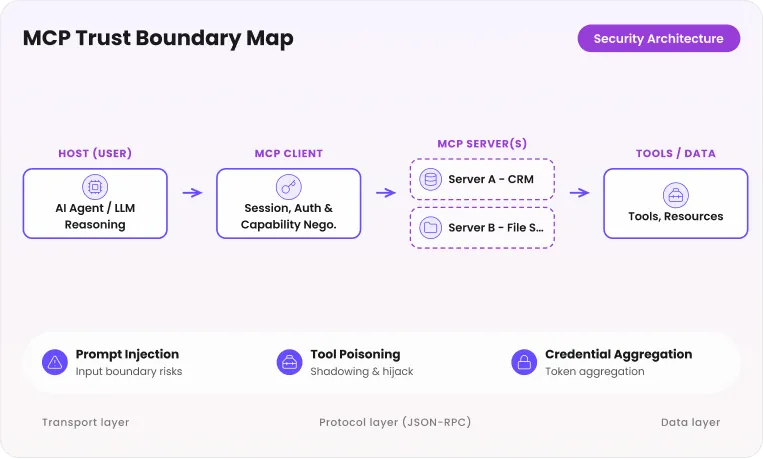
Rogue servers using names similar to legitimate ones can capture credentials and queries during name-based discovery.
When one MCP server holds tokens for multiple services, a single breach can cascade across connected systems.
A malicious server can misuse sampling to trigger custom LLM completions, increasing costs or extracting responses outside the user's visibility.
Obfuscated instructions can push agents to execute actions users never intended, including unauthorized commands on local servers.
Unvetted or unsigned MCP packages can introduce risk at installation, including hidden behavior and potential data exfiltration.
Broad, standing permissions—such as full database, admin, or file access—can turn a minor compromise into a major breach.
OUR APPROACH
We build security onto MCP architecture from discovery through go-live, the same way we engineer production AI platforms.
WHY IT MATTERS
MCP has become the default way enterprises wire AI agents into CRMs, file systems, ticketing tools, and internal APIs. That convenience is exactly what makes it a target: an MCP server typically holds live credentials for several downstream systems at once.
A single point of failure if it's compromised. Only one server can hold OAuth tokens for every connected CRM, file store, and internal tool.
The MCP specification explicitly leaves authentication, scoping, and session security to the implementing team, not the protocol.
The first industry-standard risk framework for MCP, covering injection, over-privileged tokens, and supply-chain risk.
Digital Products & AI-Powered
Solutions Delivered
Days Average
Pilot-to-Production Timeline
Enterprise Clients Trust Our
AI Strategy & Delivery
Years of Proven Success
in the Industry
In-House AI Engineers &
Data Scientists










WHY TECHAHEAD
We map every MCP server, credential, and scope in use today.
Every agent connects through one allowlisted, monitored gateway.
Short-lived, task-specific tokens replace broad standing credentials.
Every tool is validated at connect time and rechecked on updates.
HOW IT STARTS
We deliver tailored solutions that address your unique business challenges for measurable operational efficiency. With our structured software development process, we take your custom software project from discovery to post‑launch support, built for efficient project management at every stage.
We review how AI agents are connected to your systems, which teams are involved, and accessible data and tools. You walk away with a clear picture of your current exposure.

We inventory every MCP server in use, sanctioned or not, and rank the risks by what they could expose, and you get a prioritized list.

Our engineers implement the controls that matter most first, routing every connection through a single secure gateway, limiting access, and testing before production.

We connect MCP activity to your existing security monitoring with a clear governance process for approving tools, with our team support as AI usage grows.
UNDER THE HOOD
Every server we deploy is locked to a reviewed version, so any unexpected change in its behavior triggers a fresh review before it's trusted again. Every tool action runs inside a contained boundary, limiting exactly what a server can touch or execute, even if something upstream gets missed.

Every MCP server is approved and routed through one gateway, so only trusted connections reach your systems.

Each connection receives a narrow, time-limited token instead of standing access to an entire service.

Every tool description is scanned for hidden or malicious instructions before an agent is trusted to use it.

Servers stay locked to a reviewed version, and any change to their behavior triggers a fresh review.

Local tool actions run inside contained boundaries, limiting exactly what a server can touch or run.

Only cryptographically verified, signed MCP servers are ever allowed to connect to your environment.

Every tool call, login, and permission event is logged clearly in one place your security team can see.

Any server requesting an LLM completion on your behalf needs visible, user-approved permission first.
TECH STACK


















As requirements change or expand, engagement often extends into complementary technology capabilities. Our work reflects this by supporting multiple initiatives across several technology areas‑helping organizations modernize, scale, and accelerate delivery with confidence.


Recognized Across AI, Product Engineering & Digital Innovation

Award by Clutch for The
Award by Clutch for
Award by Google for The
Award by Clutch for The
Award by Clutch for The
Award by Clutch for The
Award by Clutch for The
Award by The Webby Awards for
Certified by Great Place To Work as
Award by The Manifest for The
Award by Clutch for The
Award by The Manifest for The

Award by Conejo Valley for The
August 6, 2026 | 311 Views

Chief Commercial & Customer Success Officer
March 16, 2026 | 1276 Views

Sr. VP Programme Management
The architectural, identity, and monitoring controls that protect Model Context Protocol deployments from credential theft, tool poisoning, and unauthorized data access. MCP itself doesn’t enforce these controls — the implementing organization has to build them in.
Credential aggregation. A single MCP server often holds live tokens for several downstream services at once, so one compromised server can expose everything it connects to — not just one system.
An attack where malicious instructions are hidden inside a tool’s metadata or description rather than its visible output, so an AI agent acts on them as if they were a legitimate part of the tool.
Through a centralized gateway that allowlists approved servers, OAuth 2.1 with capability-level scopes instead of broad tokens, signed and version-pinned servers, sandboxed execution, and audit logging tied into your SIEM — the five-layer framework above.
TechAhead is an AI-native application, software, and platform development company with 16+ years of engineering experience, an OpenAI Services Partner, and a member of the Claude Partner Network — building MCP integrations with enterprise security controls engineered in from the start.
MCP defines an authorization model on top of OAuth, but the specification explicitly leaves enforcement to the implementing team. Enterprises need to layer OAuth 2.1 with PKCE, capability scopes, and short-lived tokens on top of MCP themselves.
We'll map every MCP server in your environment, score it against the OWASP MCP Top 10, and hand you a prioritized plan to close the gaps.
We use cookies to ensure our website functions properly, improve performance, and provide a personalized experience. You can choose which types of cookies to allow below.
Required for core functionality such as security, network management, and accessibility. These cannot be disabled.
Help us understand site traffic and user interactions so we can improve performance and usability.
Enable enhanced functionality and personalization such as language or region preferences.
Used to deliver relevant ads, track campaign performance, and measure advertising effectiveness.