


 Copy Link
 Share on X
 Share on Facebook
 Share on LinkedIn
Always Active
Required for core functionality such as security, network management, and accessibility. These cannot be disabled.

Uncover the transformative potential of digital and mobile solutions for your industry.





 Last Updated: Sep 22, 2026
Jul 30, 2026
Last Updated: Sep 22, 2026
Jul 30, 2026  303
303  21 min. Read


Key Takeaways
Most AI apps do not fail because the model is weak. They fail because no one owned the distance between a working demo and a system that runs every day under real load. That distance is where budgets disappear.
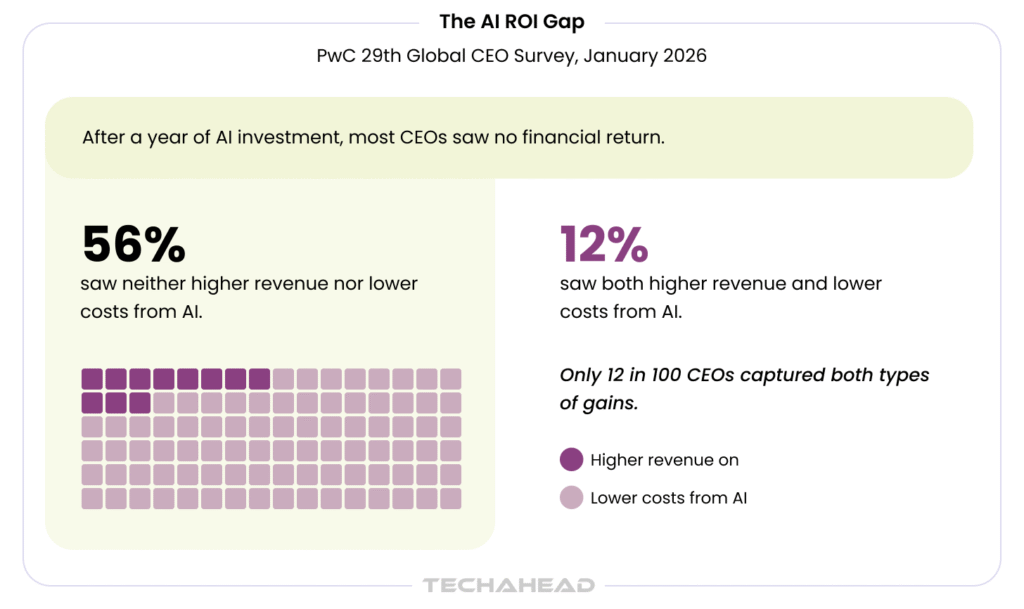
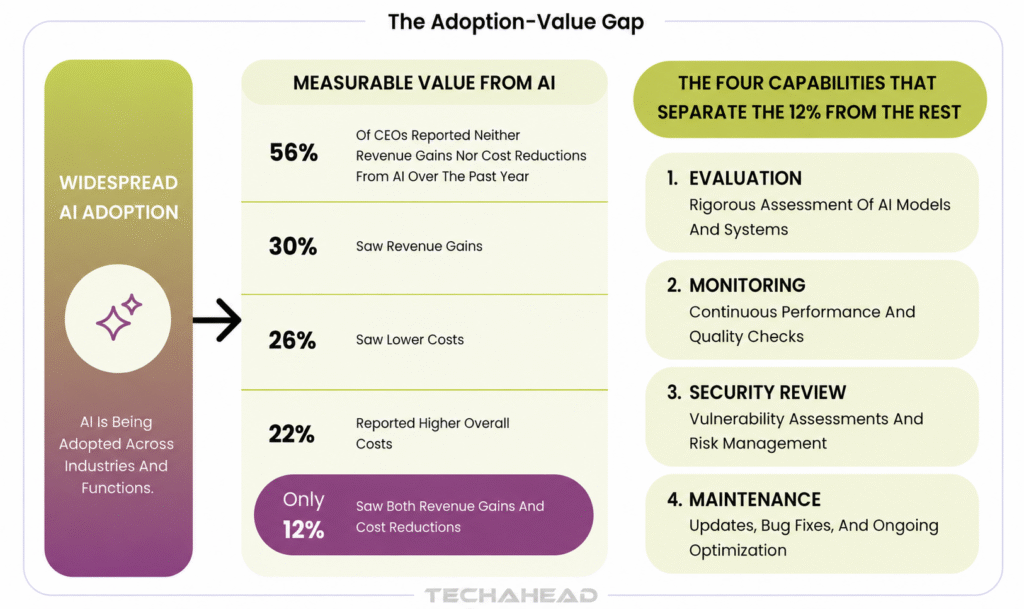
In PwC’s 29th Global CEO Survey, released in January 2026, 56% of chief executives reported that a year of AI investment had delivered neither higher revenue nor lower costs, and only 12% saw both. Adoption is scaling; measurable value is not.
The technology is not the constraint. Ownership of the full lifecycle is.
That single fact should reshape how a buyer evaluates an AI app development company. The question is not who can build an impressive prototype. Almost anyone can now. The question is who can design, build, deploy, and maintain an AI app that survives contact with production, real users, and a compliance review. This guide lays out how to evaluate a partner against that standard, what the architecture underneath a production AI app actually requires, where compliance becomes a buying filter, and what genuine proof looks like.
The spending signal is loud. IDC forecasts that global AI infrastructure spending will reach $758 billion by 2029, after growing 166% year over year in a single quarter of 2025, with the United States accounting for roughly three-quarters of it. Yet the same market is quietly abandoning most of what it starts.
The gap between money spent and value shipped is the defining problem of enterprise AI right now, and it maps almost entirely to the pilot-to-production boundary.
The reasons are consistent. Pilots are scoped to impress, not to run, so they skip the parts that make software durable:
The gap shows up the moment the app goes live. A demo answers one question well in a controlled setting. A production AI app answers thousands of questions per hour, handles the ones it was not designed for, stays inside a cost envelope, and does not leak data. Those are different engineering problems, and most vendors are only equipped for the first.
This is why the buyer’s real risk is not picking a partner who cannot build. It is picking one who cannot finish.
Must Read: Why Enterprise AI Pilots Fail to Reach Production
The pattern rarely changes: the model works, the wrapper works, and then the project stalls at the last mile where deployment, governance, and maintenance live.
The buyer’s own words describe the requirement better than anyone else: they want a partner to design, build, deploy, and maintain an AI app. Turned into an evaluation lens, those four words become a standard. TechAhead refers to this internally as the DBDM Production Standard, and it exists because most of the service providers are strong at one or two of the four gates and quietly weak at the rest.
Each gate has a question a buyer should ask and a failure mode that shows up when the vendor cannot clear it.
| Gate | The question to ask | Failure mode if they cannot clear it |
| Design | Can they architect for production on day one: data strategy, model selection, system design? | Prototype-grade design that looks good in a pitch and never scales. |
| Build | Do they engineer for reliability with evaluations, testing, MLOps, and security built in? | Works in the notebook, breaks under real traffic. |
| Deploy | Can they ship into the real environment: integration, infrastructure, compliance gates? | The last-mile stall where pilots quietly die. |
| Maintain | Do they own it after launch: monitoring, drift, retraining, cost control, support? | The vendor leaves, the model rots, no one notices until it fails. |
An AI application development company worth hiring can speak credibly to all four. Weak vendors change the subject back to the model or the demo, because that is the only gate they can win. The value of the standard is that it forces the conversation onto the three gates where projects actually break.
This framing also maps to the fears a senior buyer carries into the decision. Cost uncertainty lives in Build and Maintain. Vendor disappearance lives in Maintain. Compliance risk lives in Deploy. A partner who can only build is a partner who leaves the buyer exposed on all three.
For a fuller view of where these breakdowns originate, TechAhead’s analysis of the real AI implementation challenges is a useful companion read, and it reinforces why AI development has to be scoped as a production program, not a build engagement.
Below is a sharper scorecard, organized around the DBDM Production Standard, for evaluating how to choose an AI development company that can carry an app all the way to production.
| Evaluation Criterion | What Good Looks Like | Weak Signal to Watch For |
| Production portfolio | Deployed apps handling real traffic, with named outcomes | Demos, prototypes, and hackathon projects presented as delivery |
| MLOps and LLMOps maturity | CI/CD for models, monitoring, retraining, rollback | “We fine-tune models” with no mention of operating them |
| Data and security posture | Data governance, access control, encryption, audit trails | Security treated as a later phase |
| Lifecycle ownership | One accountable partner across design to maintenance | Handoff to the client’s team at launch, then silence |
| Cost engineering | Token and inference cost modeled before build | No answer on unit economics at scale |
| Exit and handoff terms | Documented, transferable, no lock-in | Knowledge trapped in the vendor’s heads |
A few criteria deserve emphasis. First, what to look for in an AI development partner is evidence of operating AI, not just building it. Ask directly how they monitor a live model, how they detect drift, and how they roll back a bad deployment. The answers separate an engineering partner from a prototyping shop.
Second, cost. A production AI app has unit economics, and a serious partner models them before writing code. TechAhead’s guide to tokenomics and LLM cost optimization shows why this is not a detail: at scale, an unoptimized architecture can make an otherwise successful app financially unviable. If a vendor cannot discuss cost per token or per inference, they have not run anything at scale.
Third, whether the requirement is a custom AI app development company for a bespoke build or an enterprise AI app development company for a regulated, high-scale deployment, the evaluation does not change. The scorecard holds.
What changes is the weight: enterprise buyers should push hardest on Deploy and Maintain, because those are the gates where enterprise complexity concentrates.
A senior buyer fluent in this space does not need AI explained. They need to know whether a partner can build the architecture that keeps an AI app reliable after launch. This is where the Design and Build gates are won or lost.
A production AI app is not a model with an API in front of it. Done well, architecture choices and AI-driven automation help control spend, and AI integration can reduce development costs by up to 20%. It is a system built across technologies such as machine learning and natural language processing, using artificial intelligence technologies where they fit, and the model is only one component inside an architecture that has to handle several layers at once:
Retrieval-augmented generation, or RAG, grounds model outputs in the enterprise’s own data so answers are accurate and current rather than plausible and wrong. That retrieval layer, its indexing, chunking, and freshness, often determines whether the app is trustworthy more than the choice of model does, especially when advanced AI technologies are layered onto enterprise data.
Model selection itself is an engineering decision, not a brand preference. Different tasks reward different models on accuracy, latency, and cost, and a good partner chooses per task rather than defaulting to one provider; in strong production setups, AI systems can achieve up to 95% accuracy in real-world conditions when the task, data, and monitoring are aligned. TechAhead’s breakdown of choosing the right AI model by task reflects how this decision should be made in practice.
Generative AI models are often chosen to automate complex knowledge tasks and support decision-making inside production apps. In more complex workflows, an AI agent can take on a bounded role inside orchestration without turning the system into an unmanageable black box.
Then there is the operational layer, which is what actually keeps the app alive. MLOps and LLMOps cover the pipelines that deploy, monitor, and retrain models, often on AI platforms designed for enterprise governance and scale:
None of this is visible in a demo, and all of it is the difference between an app that works in week one and an app that still works in month eighteen. TechAhead’s field notes on agentic AI in production make the same point about scope: narrow, well-instrumented systems reach production, sprawling ones stall.
Every architectural choice ties back to a business risk the buyer cares about. Latency affects user adoption. Drift affects accuracy and trust. Inference cost affects margin. Scalable AI solutions depend on infrastructure that can grow without rework, and cutting edge AI tools only matter when they improve delivery discipline and reliability. A partner who can connect architecture to those outcomes is thinking about the business, not just the stack. This is why the underlying AI infrastructure and disciplined machine learning application development matter as much as the model layer sitting on top of them.
“In production, the model is maybe twenty percent of the problem. The other eighty percent is the pipeline around it: how you deploy safely, how you catch drift before a user does, how you keep inference cost flat while traffic grows. That is the work that decides whether an AI app lives or dies, and it is the work most vendors never scope.”
Mukul Mayank, COO, TechAhead
For you, compliance is not a formality at the end of the project. It is a filter to apply at the start, because a partner who cannot deploy inside a regulated environment cannot deploy at all. The Deploy gate includes compliance gates, and failing them stops a launch cold.
The relevant standards depend on the buyer’s context, but the ones that recur are worth naming. SOC 2 Type II governs how a vendor handles data security and availability over time. ISO 42001:2023 is the management-system standard specifically for AI governance, covering risk controls and responsible AI practices. HIPAA applies to any AI app touching protected health information. The EU AI Act reaches US firms that serve European users or markets, and its risk-tiered obligations are now a live consideration for American companies with any EU exposure. From the start, enterprise grade security should include encryption, audit trails, and access controls.
Also Read: Enterprise AI Compliance & Governance
| Standard | What it governs | When it becomes a buying filter |
| SOC 2 Type II | Data security, availability, processing integrity over time | Any app handling sensitive customer or business data |
| ISO 42001:2023 | AI management system, risk controls, governance | AI systems making or informing consequential decisions |
| HIPAA | Protected health information | Healthcare, payer, provider, or health-data apps |
| EU AI Act | Risk-tiered obligations for AI systems | US firms serving EU users or markets |
The important distinction for a buyer is between a partner who builds to these standards and a partner who audits against them. TechAhead is a development and engineering partner, not an auditor or certifier. The value is in building an app that is architected to pass a SOC 2 review or align with ISO 42001 from the first design decision, rather than retrofitting compliance after the fact, which is slower, costlier, and often impossible. A SOC 2 compliant AI development company is one whose engineering practices already assume the audit, not one that promises to think about it later. This matters most in regulated verticals, where the stakes are highest; TechAhead’s work on AI risk modeling in financial services shows how governance and model design have to be built together rather than bolted on.
TechAhead’s own credentials sit here as a reference point for what to look for: ISO 42001:2023 for AI governance, SOC 2 Type II for security, Claude & OpenAI Services Partner status, and AWS Advanced Tier standing for cloud infrastructure. The point is not the badges themselves. It is that a buyer should expect a production partner to hold verifiable standards, because those standards are what make deployment into a regulated environment possible.
The Maintain gate is where the vendor-disappearance fear is either confirmed or put to rest. It is also the half of the lifecycle that most vendors treat as someone else’s problem. An AI app is not a deliverable that is finished at launch. It is a system that degrades without active ownership:
A partner who hands over the code at launch and moves on has left the buyer with a depreciating asset and no one to maintain it.
Maintenance for AI apps is more demanding than for conventional software because the software’s behavior changes even when the code does not. A model that was accurate at launch can quietly become inaccurate as real-world data diverges from training data. Catching that requires monitoring and retraining, which are ongoing commitments, not one-time tasks. This is the operational reality behind the Maintain gate, and it is why lifecycle ownership is an important criterion.
Modernization is the other side of maintenance. Targeted AI integration can often add AI powered solutions and custom AI applications to existing apps or systems in as little as 6 to 10 weeks, depending on scope, systems, and existing data. Many enterprises are not building a greenfield AI app; they are integrating AI into existing systems, including generative AI powered mobile experiences, or replacing aging, high-cost software with custom builds. That work carries its own risk, because it has to preserve business continuity while changing the system underneath. TechAhead’s CTO’s guide to replacing high-cost SaaS with custom AI software covers this path in detail, and it reflects a broader truth: the partner who designed and built the app is best positioned to modernize and maintain it, because the context does not have to be rebuilt each time.
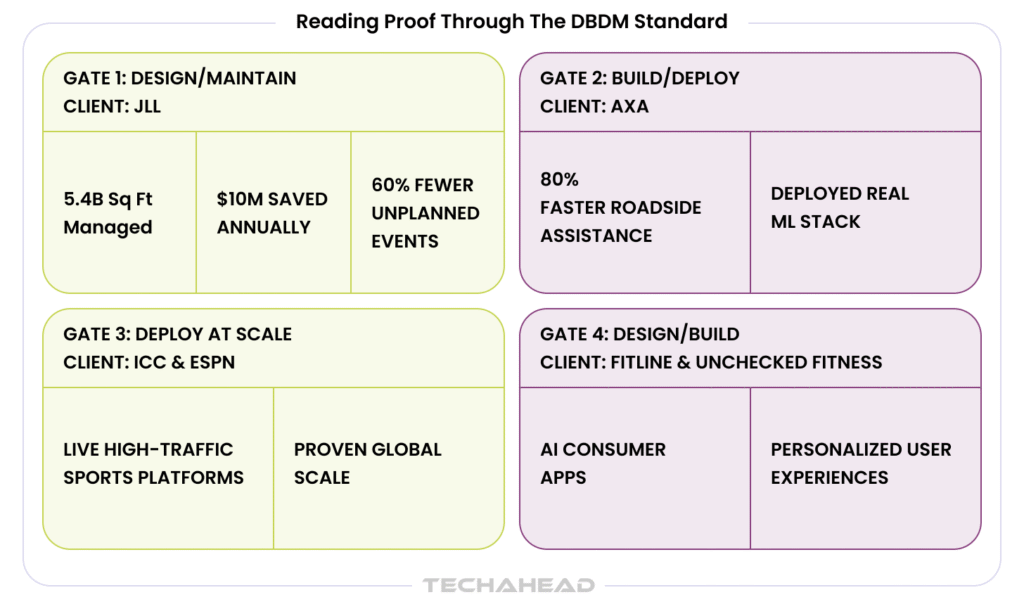
Proof is the part a buyer can verify, and it is where the DBDM Production Standard becomes a way to read a portfolio. A useful case study does not just say what was built. It shows a partner clearing all four gates on a real system, at scale, with a named outcome. Read through that lens, TechAhead’s portfolio makes the case across very different production contexts.
For Jones Lang LaSalle, a Fortune 500 commercial real estate leader, TechAhead built Intellicommand, an artificial intelligence and IoT commissioning platform that monitors 5.4 billion square feet of property in real time using predictive machine learning, similar to how retail uses AI for demand forecasting and personalized recommendations. The outcomes are the kind that only a maintained, production-grade system produces: a 30% reduction in equipment downtime, a 30% increase in equipment lifespan, roughly $10 million saved annually in maintenance and operational expense, and a 60% reduction in unplanned maintenance events. It also delivers predictive analytics that support ongoing operational insights at enterprise scale. Predictive models that hold up across billions of square feet are not a demo. They are the Design and Maintain gates, proven.
For AXA Assistance, part of one of the world’s largest insurers, TechAhead built a roadside assistance platform on a genuine machine learning stack, including TensorFlow, XGBoost, and routing optimization powered by machine learning algorithms, to locate stranded customers and dispatch the nearest help in real time, the same class of AI used in logistics for route optimization and fleet tracking. The result was roadside assistance delivered up to 80% faster. In finance, similar AI techniques also improve decision-making through fraud detection.
Sports platforms are an unforgiving test of the Deploy and Maintain gates, because traffic spikes are enormous and failure is public. TechAhead built the International Cricket Council’s fan platform and ESPN’s motorsport experience for exactly those conditions, where the app has to stay up when millions arrive at once.
For American Express, TechAhead built a mobile and cloud sales platform giving more than 64,000 employees real-time access to customer data. It is not an AI app, and it should not be sold as one, but it is proof of delivering reliable software at enterprise scale for one of the most demanding institutions in finance, which is exactly the reliability bar a production AI app has to clear.
Across these, the common thread is not a single technology. It is a partner clearing all four gates on systems that had to work in the real world.
The way to use this is simple. Whether you are comparing vendors for the best AI app or starting with a specific app idea, take the shortlist and run each vendor, including experienced AI development companies, through the four gates:
The vendor who can answer all four with specifics, and back the answers with production proof, is the one who can carry an app to production and show AI expertise, clear AI capabilities, and tailored AI solutions aligned to the project. The vendor who keeps returning to the demo cannot.
That is the real test of an AI app development company and a practical way to find a custom AI development company or broader AI companies that can help businesses build intelligent applications. Not whether they can build something impressive in a controlled setting, but whether they can design, build, deploy, and maintain a system that holds up when it is live, real, and accountable.
TechAhead is one example of what full-lifecycle ownership looks like in practice, with the credentials, architecture discipline, and production track record to clear all four gates. The standard, though, belongs to the buyer. Apply it to everyone, including TechAhead, and the shortlist gets a lot shorter.
Ready to put a shortlist to the test? Contact TechAhead to talk through how the DBDM Production Standard applies to your project, and where a full-lifecycle partner can help you clear all four gates.
Look past the demo. The right AI app development company proves it can design, build, deploy, and maintain apps in production, not just prototype them, and strong AI app developers and app developers should show production deployment experience. Ask about MLOps maturity, real deployments, and who owns the system after launch.
You need a partner who treats production as the goal, not an afterthought: hardening the architecture, with AI consulting and AI strategy, adding evals, monitoring, and security, then deploying into your real environment. TechAhead built its delivery approach around closing exactly this pilot-to-production gap.
The good ones own the full lifecycle. A serious AI application development company handles deployment plus post-launch monitoring, retraining, and drift management, and the best AI development services and custom AI development services include post-launch ownership. Strong artificial intelligence development services also cover integration, automation, deployment, and quality assurance for enterprise-scale systems. If a vendor hands over code at launch and walks away, treat that as a red flag.
For US enterprise work, look for SOC 2 Type II, ISO 42001 for AI governance, HIPAA for healthcare data, and EU AI Act readiness if you serve Europe. A SOC 2 compliant AI development company builds to these standards from day one.
Yes. TechAhead holds SOC 2 Type II and ISO 42001:2023 certifications, and is an OpenAI Services Partner and AWS Advanced Tier partner. That means AI apps are architected to meet enterprise security and governance standards from the first design decision.
It runs in stages: discovery and data strategy, architecture and model selection across existing APIs, custom AI models, and large language models where appropriate, build with testing and evals, deployment, then ongoing monitoring and retraining. Some teams may use an AI app builder for simple cases, but a custom AI app is usually the better fit for complex production work. An AI powered app also needs testing, optimization, and performance tracking from concept through launch. Teams using generative AI technologies should plan governance early so personalization and automation can scale safely. Disciplined AI app development can reduce costs by up to 20% when architecture, automation, and deployment are planned early. When weighing how to choose an AI development company, look for one that owns all five stages.
You should. Before signing, confirm you keep full ownership of your data, models, and IP, and that your data won’t train the vendor’s other clients’ models. Clear handoff and exit terms protect you if the relationship ends.
Because MLOps is what keeps an AI app alive after launch. It covers the pipelines that deploy, monitor, and retrain models so accuracy doesn’t decay, and even generated code still needs testing, evals, and oversight in production. A vendor without MLOps and LLMOps practice can build a demo, rarely a durable product.
Most serious players focus on regulated, high-scale verticals like finance, insurance, healthcare, real estate, and media, including use cases like virtual assistants, computer vision, and AI powered applications across mobile and web apps. TechAhead, for example, has shipped production apps for enterprises including JLL, AXA, and ESPN, where reliability under real traffic isn’t optional.
Yes, and often that’s the smarter move. A capable custom AI app development company can integrate AI into a mobile app, web apps, and mobile and web apps through custom software development or custom software solutions, or retrofit AI into your existing systems or modernize legacy software, as long as it preserves business continuity while re-architecting what’s underneath. The right team should also be able to extend advanced AI solutions into core workflows without disrupting operations.
We use cookies to ensure our website functions properly, improve performance, and provide a personalized experience. You can choose which types of cookies to allow below.
Required for core functionality such as security, network management, and accessibility. These cannot be disabled.
Help us understand site traffic and user interactions so we can improve performance and usability.
Enable enhanced functionality and personalization such as language or region preferences.
Used to deliver relevant ads, track campaign performance, and measure advertising effectiveness.