


 Copy Link
 Share on X
 Share on Facebook
 Share on LinkedIn
Always Active
Required for core functionality such as security, network management, and accessibility. These cannot be disabled.

Uncover the transformative potential of digital and mobile solutions for your industry.





 Last Updated: Sep 18, 2026
Aug 21, 2026
Last Updated: Sep 18, 2026
Aug 21, 2026  263
263  21 min. Read


Key Takeaways
Today, the majority of the organizations are past the question of whether to deploy a chatbot. They are more concerned on who do you trust to build one that still works in month twelve, when it is fielding real customers, wired into real systems, and carrying real compliance risk. The demo you sit through will not answer that.
That gap, between a demo that dazzles and a system that survives, is where budgets go to die. RAND reports that more than 80% of AI projects fail, roughly double the failure rate of ordinary IT work.
S&P Global Market Intelligence explains it further through numbers:
42% of companies abandoned most of their AI initiatives in 2025, up sharply from 17% a year earlier. Chatbots ride the same curve. The ones that make it usually share a single trait, and it is not the model. It is a team that has actually shipped this before.
So the decision that settles your outcome is not the feature list. It is which AI chatbot development company you hire, and vetting one deserves the same rigor you would bring to any production AI build. What follows is the checklist to run each vendor against, built around the eight things that quietly decide whether an enterprise chatbot lasts or dies after launch.
Also Read: Choosing An AI App Development Company
There is a stubborn myth that chatbot success comes down to the model. Pick the best large language model, so the story goes, and the rest falls into place. In reality, model intelligence is rarely the bottleneck. Projects break somewhere less glamorous: on messy data, on integrations that snap under load, on governance nobody scoped, on the plain absence of anyone who has done this at scale.
And every enterprise is being pushed toward deployment at the same moment. The global conversational AI market sat at roughly USD 14.30 billion in 2025 and is on track for USD 78.9 billion by 2033, a 23.8% annual growth rate.
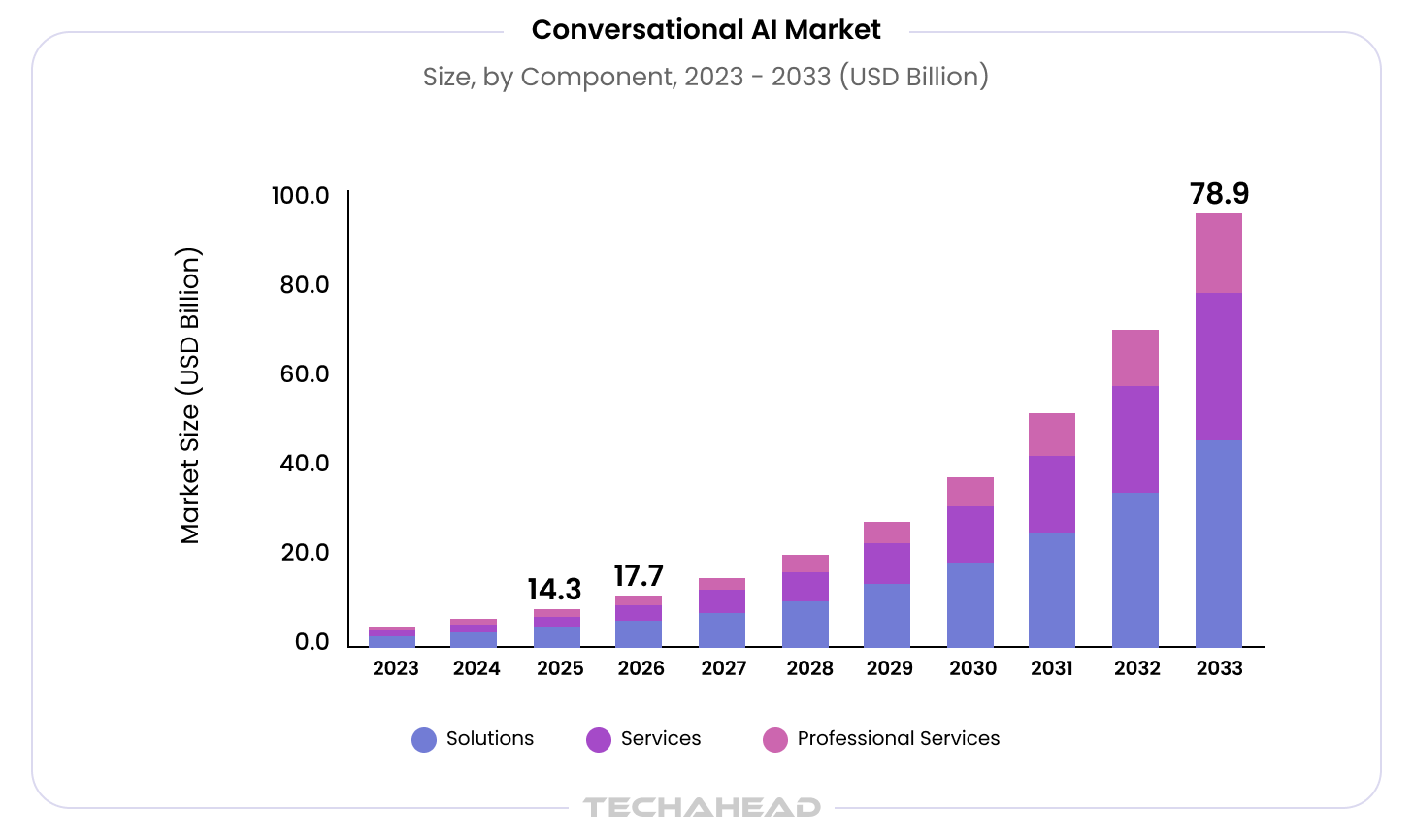
Adoption is also climbing fast based on what statistics are saying:
Salesforce reports that use of AI agents in customer service jumped from 39% to 66% in a single year. Demand like that breeds a crowded field of vendors, plenty of whom demo brilliantly and deliver poorly. Enterprise chatbot solutions are only ever as strong as the engineering beneath them, and none of that engineering shows up in a small walkthrough.
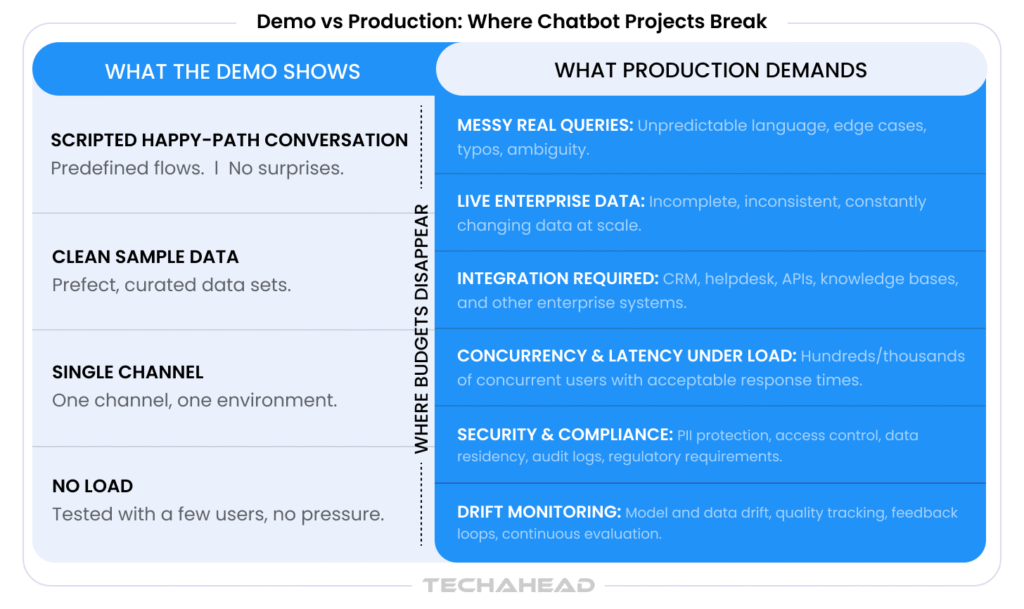
A capable AI chatbot development company closes that gap on purpose. You spot one by pressing every vendor against the categories below, and by treating whatever they cannot answer plainly as a warning, not a footnote.
Before you score anyone, get clear on what you are actually buying. An enterprise AI chatbot is not a scripted FAQ box with a nicer skin. It reads intent across a dozen phrasings, grounds its answers in your own knowledge instead of improvising, plugs into the systems where work really happens, and holds up under security, compliance, and traffic that a consumer bot never meets.
Also Read: AI Ready Data: The Missing Layer
That lifts the bar for enterprise chatbot development sharply. The system has to parse language reliably, pull accurate answers from your documents and records, pass a conversation to a human without fumbling the context, and log all of it for audit and improvement. That is the line between a bot that swats away a few easy questions and a conversational AI layer that carries real support, sales, and back-office load across customer interactions.
It is also where the money is: Grand View Research notes that customer service was the dominant chatbot application in 2025, and customer service is exactly where accuracy and integration depth earn their keep.
The best custom chatbot development works backward from your use case to the architecture, the way any serious custom AI software build should; enterprise AI chatbot design depends on the chatbot’s primary goal, whether that is customer support or lead generation, and strong RAG setups can reduce hallucination rates below 2%. That is how teams move from custom ai chatbots to tailored solutions and custom chatbot solutions, not the other way round. A vendor who name-drops a favorite platform before understanding your problem is solving for their convenience, not your outcome.
Treat these eight categories as your scorecard. For each one, make the vendor answer in specifics, decide what a strong answer sounds like, and read vagueness as a red flag. Weight the categories that matter most for your use case, score every provider, and compare like against like.
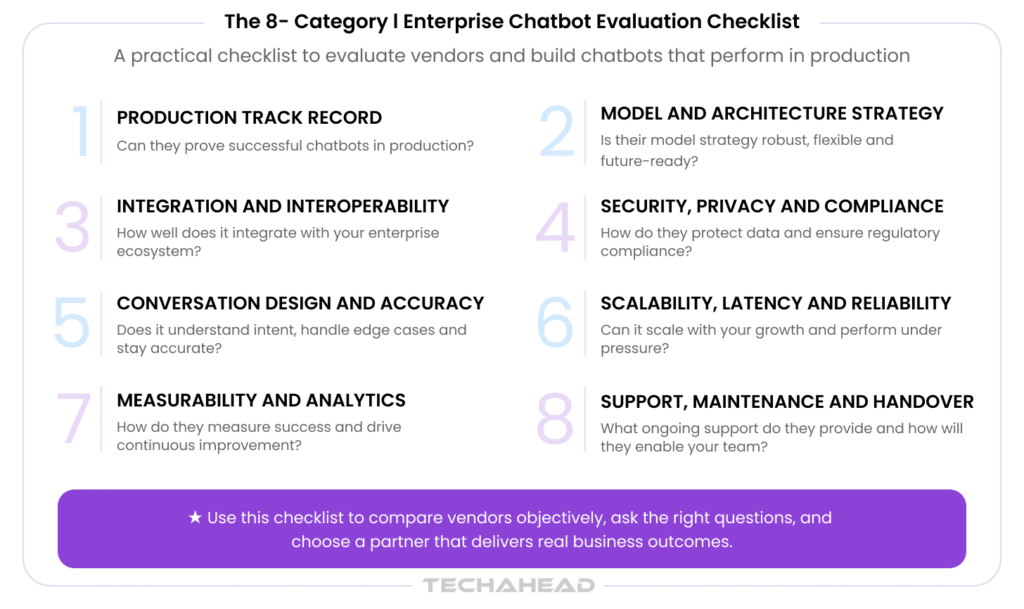
Ask for systems running in production right now, not pilots that looked good in a controlled setting. A good vendor can tell you what they shipped, what broke, and how they fixed it once real users showed up, because they have made the journey from pilot to production before. Get references you can actually call, and ask them one question in particular: what happened between months three and twelve, when most bots start to drift.
A portfolio that is all demos and proofs of concept, with nothing shown to survive real traffic, has already answered the question for you.
Architecture should follow the job, and a serious partner will say so rather than reaching for the same tool every time. Off-the-shelf model APIs stand up fast but know nothing about your business. Retrieval-augmented generation anchors answers in your own knowledge base and cuts hallucination without the expense of training a model from scratch, with well-implemented systems reducing hallucination rates below 2%. Fine-tuned or small domain models earn their place in specialized or tightly regulated work, and a good partner can explain which architecture fits your use case and why.
Whatever a generative AI developer proposes, ask exactly how they keep it from hallucinating. Guardrails should reflect modern AI technologies, including natural language processing (NLP), and the advanced AI technologies behind grounding, citations, and output filtering. That is especially important for generative AI chatbots, where conversational systems depend on the right AI technologies and AI capabilities rather than a shrug.
| Approach | How it works | Strengths | Trade-offs | Best fit |
| Off-the-shelf LLM API | Calls a hosted foundation model directly | Fast to deploy, low upfront cost, strong general language | No knowledge of your data, weaker control, ongoing usage cost | Early pilots, general Q&A, speed to market |
| Retrieval-augmented generation (RAG) | Retrieves your documents, then grounds the model’s answer in them | Accurate on your content, reduces hallucination, no retraining needed | Requires clean data pipelines and retrieval engineering | Enterprise knowledge, support, policy and product answers |
| Fine-tuned / small domain model | Trains a model on your proprietary or domain data | High precision in narrow domains, predictable tone and format | Higher effort, needs quality training data and upkeep | Regulated, specialized, or high-volume domain tasks |
Advanced AI models and large language models (LLMs) should be matched to the use case, not treated as the default choice.
The table is not here to crown a winner. It is here to test one thing: can this vendor reason across the options and fit one to your problem.
A chatbot that cannot reach your systems is an expensive novelty. Real ai chatbot integration with existing systems and enterprise systems is the core requirement, spanning the CRM (Salesforce, HubSpot), the support and ITSM stack (Zendesk, ServiceNow), the channels people actually use across messaging platforms and mobile apps, identity and single sign-on (Okta, Azure AD), and the data a retrieval system leans on.
Push on the hard part: how do they build custom connectors for older or in-house systems, because that is where enterprise integration usually turns painful. Strong ai chatbot solutions can automate workflows and trigger backend processes while still handling millions of customer interactions daily. A vendor who only bolts onto a few prebuilt platforms, with no answer for your legacy stack, has just shown you their ceiling.
Customer support bots also need to fit cleanly into broader customer interactions, not just answer isolated prompts.
Also Read: Enterprise Application AI-Native Modernization Guide
Regulated enterprises should give the least ground here. Ask about certifications, and then ask the more important question of how they hold up in practice rather than on a slide. SOC 2 Type II, ISO 27001, and ISO 42001 for AI governance are the floor for any mature AI chatbot development company, not the ceiling. On the regulatory side you want genuine coverage of GDPR for EU data, the EU AI Act for anything touching European users, and a straight answer on a HIPAA-compliant chatbot the moment healthcare data enters the picture.
Dig into how they treat personally identifiable information, data residency, access controls, and audit logging. Compliance handled as an afterthought becomes your problem the day something goes wrong.
Must Read: Enterprise AI Compliance & Governance
Accuracy is as much design as it is model quality, and strong conversation design improves customer engagement and user engagement, not just intent accuracy. Ask how the vendor measures intent accuracy, what the bot does when it is unsure, and how it hands a conversation to a person without losing the thread. A well-built system knows the edge of its own competence and escalates cleanly instead of inventing an answer. Well-designed custom chatbot solutions often deflect over 60% of Tier-1 customer support queries when escalation logic is set up correctly. Skip that, leave no fallback and no human in the loop, and the bot quietly erodes trust in the very channel it was meant to strengthen. The best intelligent chatbots also function like an ai assistant, handling complex queries 3–5 times faster than humans and improving customer retention through personalized interactions.
A bot that feels quick in a demo can buckle under real concurrency, so scalable chatbot solutions and chatbot development solutions should be built to handle millions of user interactions daily. Ask for hard commitments on uptime, response latency, and behavior at peak, written into service level agreements you can actually enforce. Ask what happens when traffic spikes and how the architecture absorbs it. Mature deployments often use Kubernetes-based autoscaling to maintain sub-two-second response times. Also ask how teams deploy AI chatbots as a distinct production phase with reliability planning, testing, and rollback safeguards.
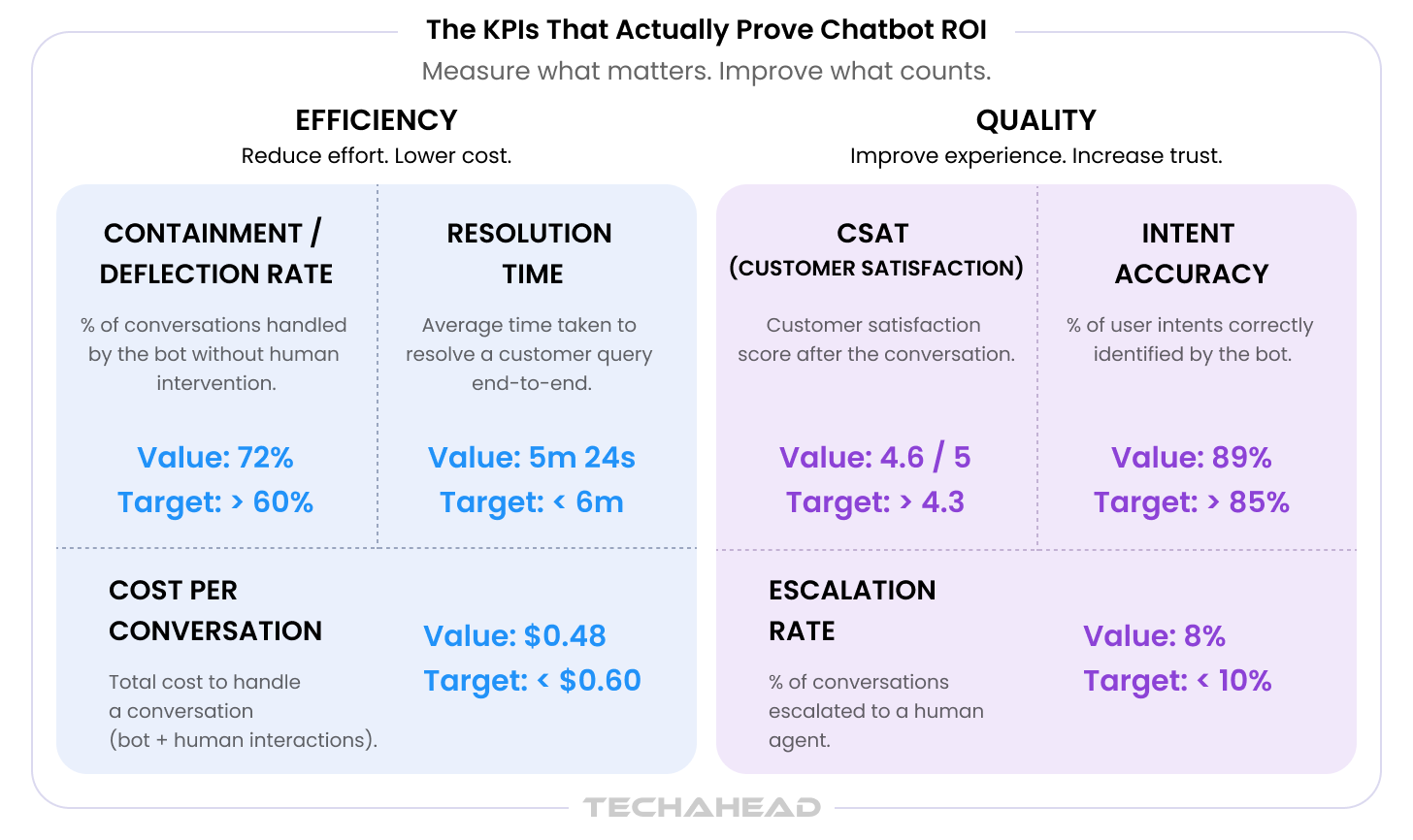
If you cannot measure it, you cannot defend it. A strong vendor wires in instrumentation from day one and reports the numbers that map to value: containment and deflection rate, resolution and response time, customer satisfaction, cost per conversation, intent accuracy, and model drift over time. Those are the figures that prove an effective chatbot ROI, and the same ones that indicate that your system needs a check.
Custom chatbot development services are not a one-and-done build. They are an operational responsibility you keep running. Ask what life looks like after launch: how the model gets retrained, how performance is watched, and whether an ai chatbot project may launch in about eight weeks but still requires ongoing iteration afterward. Clarify ownership and exit terms in the chatbot project contract, including who owns conversation data and source code, and require continuous monitoring for performance issues and security incidents. A good partner brings exceptional project management, documents properly, and hands over enough that you are never cornered. Strong chatbot development services also depend on disciplined project management over time. A vendor whose business model quietly depends on you being unable to leave has just shown you their hand.
The right build looks different in a bank than it does in a hospital. TechAhead works across more than 16 industries, and the checklist above gets weighted differently depending on which constraints dominate. In global deployments, AI-powered customer support bots may offer multilingual support across 100+ languages, including real-time translation.
Here is how enterprise chatbots earn their place in a few of them, and which evaluation criteria matter most in each.
The chatbot handles account servicing, card and payment queries, and customer onboarding, which means it touches regulated data on almost every turn. Security, compliance, and clean integration with core systems carry the most weight in evaluation. This is the territory of AI agents for KYC and customer onboarding, where a wrong answer is a compliance event, apart from also being a poor experience. In banking, many firms hire AI chatbot developers for tailored solutions aligned to strict security and compliance requirements.
Claims status, first notice of loss, policy questions, and renewals are high in volume and tied to backend systems of record, which is why TechAhead approaches them through custom AI chatbot development for insurance claims and policy workflows with tailored solutions rather than generic bots. Integration depth and measurability decide the outcome, because the goal is to deflect routine contacts and prove it with containment and resolution numbers. TechAhead’s enterprise track record in the sector includes carriers such as AXA.
Patient engagement, appointment scheduling, and symptom triage carry a safety burden no retail bot faces. Compliance and conversation design dominate: the system has to handle protected health data correctly and, just as importantly, know when to stop and route to a human rather than guess. In practice, healthcare teams often deploy custom AI chatbots as an AI assistant embedded in broader conversational systems.
Teams build AI chatbots for product discovery, order tracking, and returns, often alongside web development and custom software development work. In ecommerce, that work often converges with mobile app development when the assistant must operate consistently across sites and apps. Integration and scalability are the deciding criteria, as TechAhead’s AI-powered chatbot for a home-improvement ecommerce platform shows in production.
Plan changes, billing questions, and outage status arrive in enormous volume, so the chatbot lives or dies on deflection at scale. In telecom, well-designed ai chatbot solutions and customer support bots can cut support costs by about 30% and reduce Tier-1 workload by roughly 60% at scale. Scalability, latency, and measurability are the criteria to press hardest, since the business case is tier-one support cost that only holds up when the system performs under load.
Booking changes, itinerary support, and around-the-clock multilingual guest service put conversation design and reliability first, especially when teams need custom software for travel and hospitality workflows with voice interaction across mobile apps. The evaluation question is less about raw capability and more about whether the system stays coherent across languages, channels, and time zones without losing context.
Cost is the first thing every buyer asks and the last thing most vendors answer honestly. On its own the headline number means little, because price tracks the scope of AI chatbot development services and custom software development, not just the chat window. Costs should also tie back to business goals and the broader custom software being integrated around the bot. What actually moves it is model choice, integration depth, data preparation, compliance, and the maintenance that never really stops. The way to read a quote is to break it into the work that actually happens.
Must Read: AI Chatbots in Healthcare (ROI, Costs, and Use Cases 2026)
The figures below are TechAhead’s indicative planning bands, not fixed quotes. They reflect the engineering effort behind an enterprise-grade build rather than an off-the-shelf widget, and your actual numbers will move with scope, data readiness, integration count, and compliance load.
One-time build costs
| Development component | What it covers | Indicative range (USD) |
| Discovery and use-case scoping | Requirements, success metrics, solution design | 2,000 to 8,000 |
| Conversation design and flow architecture | Intent mapping, dialog flows, fallback and escalation logic | 3,000 to 12,000 |
| Chat UI and UX design | Interface across web, mobile, and messaging channels | 2,000 to 10,000 |
| Core LLM integration and orchestration | Model wiring, prompt and orchestration layer, response handling | 8,000 to 30,000 |
| RAG and data preparation | Ingestion pipelines, embeddings, vector store, knowledge grounding | 6,000 to 35,000 |
| System integrations (per system) | CRM, helpdesk or ITSM, channels, SSO, telephony, each | 3,000 to 12,000 |
| Guardrails and hallucination controls | Grounding, citations, output filtering, safety rails | 4,000 to 15,000 |
| Security and compliance build | PII handling, data residency, access controls, audit logging | 5,000 to 25,000 |
| Evaluation, QA and testing | Eval suite, accuracy testing, load and red-team testing | 4,000 to 18,000 |
| Deployment and infrastructure setup | Environments, CI/CD, observability, go-live | 3,000 to 12,000 |
| Optional fine-tuning or custom model work | Domain data preparation, training, tuning | 10,000 to 50,000+ |
Model inference and API usage, driven by token volume: from a few hundred dollars a month at low volume to USD 8,000 or more at high volume
Vector database and retrieval infrastructure: USD 50 to 2,000 per month
Application hosting, logging, and monitoring: USD 300 to 2,500 per month
Maintenance, retraining, and support: typically 15 to 20 percent of the build cost per year
Add it up and the tiers fall out. A focused single-use chatbot draws on a subset of these lines and lands around USD 30,000 to 60,000+.
A mid-complexity assistant with custom LLM integration, RAG grounding, and several system connections runs USD 60,000 to 120,000+.
An enterprise conversational AI build, with deep integrations, omnichannel deployment, compliance, and often fine-tuning, reaches USD 120,000 to 350,000 or more.
A suspiciously low fixed quote almost always means something above was left out, usually data preparation, evaluation, compliance, or the recurring costs. When you compare an AI chatbot development company on price, compare the full scope and the assumptions behind each line.
“The cheapest chatbot quote is almost always the most expensive one to run. What you save at the build stage, you pay back in rework the first time it meets real users, real data, and real compliance.”
Deepak Sinha, CTO, TechAhead
Turn the eight categories into a simple scorecard. Weight the ones that count most for your use case (a regulated enterprise leans hard on compliance and integration, a high-volume support team on measurability and scalability), score each vendor one to five, and add it up. The scoring does two useful things at once: it forces vendors to answer in specifics, and it makes you notice the exact moment a confident demo goes quiet. It is the same lens you would bring to choosing any AI-native partner. Treat the checklist like a benchmark for custom chatbot solutions against business goals, not just a feature tally.
A mature partner welcomes that scrutiny rather than dodging it. Some teams also want ai consulting support early to clarify scope and avoid mismatched chatbot development solutions. TechAhead treats enterprise chatbot solutions as a dev-plus-consulting job: pin down the use case, ground the system in your data, wire it into the platforms where work happens, and instrument it so the results hold up to questioning. You can see that in production work like the AI-powered chatbot built into a home-improvement ecommerce platform, where the payoff came from integration and reliability rather than a slick demo. With ISO 42001, SOC 2 Type II, ISO 27001, Claude & OpenAI Services Partner status, and AWS Advanced Tier credentials behind it, the aim is the one this whole checklist points at: a system that still earns its place long after launch.
Whatever partner you land on, run the checklist first. The cheapest time to learn what a vendor cannot do is before you sign, not in month three.
Run every contender through these eight criteria, weigh the true cost of ownership, and insist on production evidence over promises. When you are ready to work with a team that clears all eight, talk to TechAhead and put your use case in front of people who have built these systems at scale.
Ask for live production references you can speak to, not demos, and ask them what actually happened in months three through twelve. Ask how the vendor keeps the model from hallucinating, how it handles your integrations and your legacy systems, which compliance standards it holds and genuinely applies, what it will commit to on uptime and latency, and how it measures and reports results. What an AI chatbot development company answers in specifics, and what it cannot, tells you more than any pitch.
Score every vendor against production track record, model and architecture strategy, integration depth, security and compliance, conversation design, scalability, measurability, and post-launch support. Choosing the right AI chatbot development company really comes down to asking for live production references instead of demos, and treating any category a vendor cannot answer concretely as a risk you would be taking on. The same discipline applies when evaluating a generative AI development company: specific production artifacts beat capability claims.
As an indicative planning range, a focused build or proof of concept usually runs 10,000 to 30,000 USD, a mid-complexity assistant with integrations runs 30,000 to 100,000 USD, and an enterprise conversational AI system with deep integrations and compliance can reach 100,000 to 350,000 USD or more. Where you land depends on scope, integrations, data readiness, and how heavy your compliance requirements are.
Model choice, integration depth, data preparation, security and compliance, and ongoing maintenance do most of the work. The conversational interface itself is a small slice of the total. A low upfront quote tends to leave out data preparation, production infrastructure, evaluation, or post-launch tuning, so compare scope, not the sticker price.
Watch for a portfolio that is all demos and proofs of concept with no live production references. Watch for a vendor who reaches for one architecture before understanding your use case, has no clear story on hallucination control or human handoff, integrates only with a handful of prebuilt platforms, treats compliance as a slide rather than a practice, commits to nothing on uptime or latency, or leaves you locked in with no exit. Any one of those is worth harder questions before you sign.
It depends on complexity. A focused build can take a few weeks. An enterprise system with multiple integrations, compliance controls, and custom model work usually runs several months from discovery to production, and it keeps needing tuning after that.
Building in-house gives you the most control, but it demands LLM engineering, data, MLOps, and integration skills that most teams do not have and that cost a lot to hire. A specialized partner brings production experience and speed. Plenty of enterprises split the difference: partner for the build, then take on enough knowledge to run the system themselves over time
By building it in, not bolting it on. That means data minimization and residency controls for GDPR, proper safeguards and access controls for a HIPAA-compliant chatbot touching health data, and risk classification, transparency, and human oversight for the EU AI Act, all backed by audit logging and certifications like SOC 2 Type II and ISO 27001.
A capable enterprise chatbot platform connects to CRMs like Salesforce and HubSpot, support and ITSM tools like Zendesk and ServiceNow, channels including web, mobile, WhatsApp, Microsoft Teams, and Slack, identity providers like Okta and Azure AD, and the internal data a retrieval system draws on. Custom connectors cover the legacy and proprietary systems.
Track containment and deflection rate, resolution and response time, customer satisfaction, cost per conversation, intent accuracy, and escalation rate, and keep an eye on model drift over time. Together they tell you whether the system is delivering chatbot ROI and when it is due for retraining or a closer look.
We use cookies to ensure our website functions properly, improve performance, and provide a personalized experience. You can choose which types of cookies to allow below.
Required for core functionality such as security, network management, and accessibility. These cannot be disabled.
Help us understand site traffic and user interactions so we can improve performance and usability.
Enable enhanced functionality and personalization such as language or region preferences.
Used to deliver relevant ads, track campaign performance, and measure advertising effectiveness.