


 Copy Link
 Share on X
 Share on Facebook
 Share on LinkedIn

Always Active
Required for core functionality such as security, network management, and accessibility. These cannot be disabled.

Uncover the transformative potential of digital and mobile solutions for your industry.





 Last Updated: Sep 22, 2026
Aug 3, 2026
Last Updated: Sep 22, 2026
Aug 3, 2026  340
340  14 min. Read


Key Takeaways
Why production AI fails on data, not models; And how to build the layer that turns impressive pilots into repeatable business value.
The demo goes beautifully.
The copilot answers every question, the retrieval feels magical, the room nods. Six weeks later the same system is in production, returning inconsistent answers, citing a policy that was retired in 2022, and taking nine seconds to respond. Nobody changed the model. So what broke?
The data broke, or more precisely, it was never built for this in the first place.
This is the pattern behind one of the most uncomfortable statistics in enterprise technology, and it is worth sitting with before reaching for a better model.
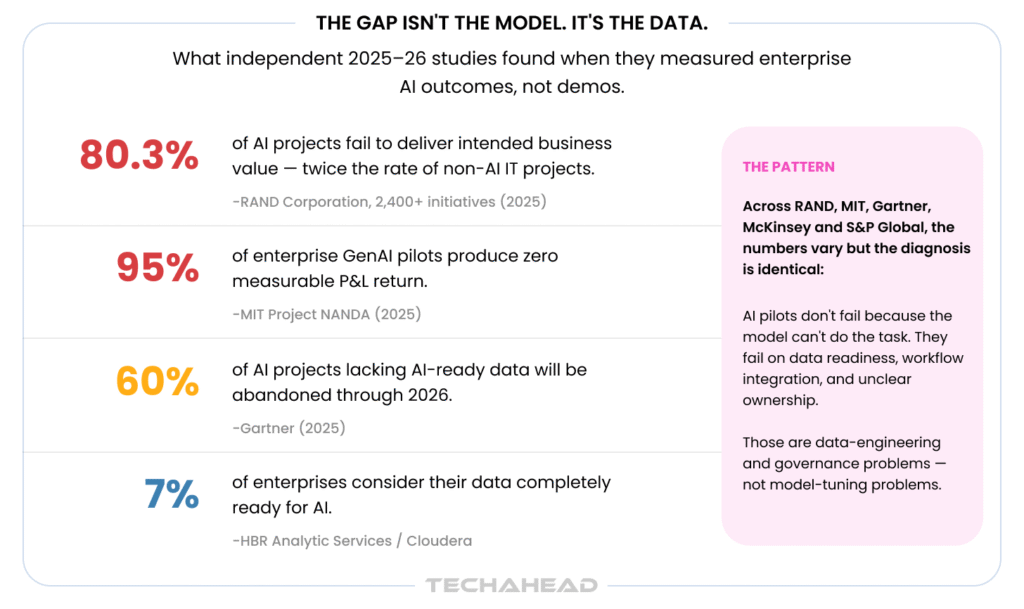
RAND Corporation, analyzing more than 2,400 initiatives, found that over 80% of AI projects fail to deliver their intended business value, roughly twice the failure rate of non-AI IT projects. MIT’s Project NANDA put the figure for generative AI even more starkly: about 95% of enterprise GenAI pilots produce zero measurable return on the P&L.
Source: TechAhead AI Team
And when researchers ask why, the answer is remarkably consistent across RAND, MIT, McKinsey, and S&P Global. Pilots don’t fail because the model can’t do the task. They fail on data readiness, workflow integration, and unclear ownership.
Those are data-engineering and governance problems, not model-tuning problems. Which is the whole thesis of this piece: AI-ready data is the missing layer between demos and ROI.
Most pilots are built on idealized data: Small, clean, manually curated, and assembled by the one person on the team who understands the domain. Production systems face the opposite: messy, distributed, evolving data spread across systems that were never designed to talk to each other.
Source: TechAhead AI Team
The gap between those two worlds is where projects die. Data quality issues, missing fields, inconsistent formats, outdated records, that a curator quietly fixed by hand now arrive at scale with no one to fix them. Access and permission complexity that didn’t exist in a sandbox becomes a security review that stalls for months.
Schema drift and unstructured content that a hand-picked demo corpus avoided now break prompts and retrieval in ways that are hard to trace. And underneath all of it sits the ownership question: when the AI gives a wrong answer because a source record was stale, whose job is it to fix that record?
Gartner’s research makes the scale of the readiness gap concrete: it predicts organizations will abandon 60% of AI projects unsupported by AI-ready data through 2026, and separately attributes a large share of AI project failure to poor data quality.
A joint HBR Analytic Services and Cloudera study found that only 7% of enterprises consider their data completely ready for AI.
Seven percent.
The demos work because they run on the other 93%’s best-curated slice, and that slice does not exist at production scale.
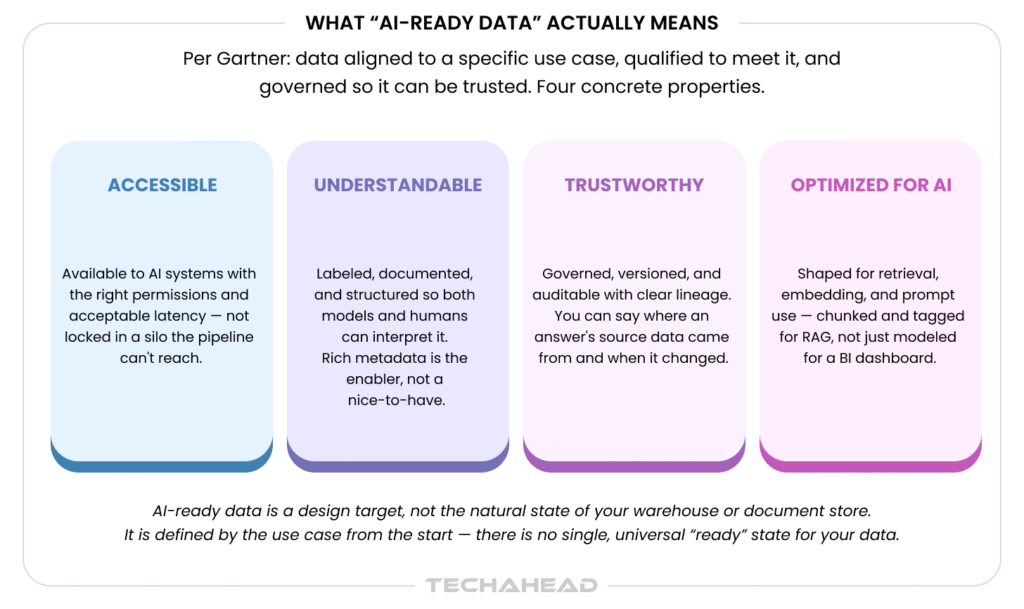
The term gets thrown around as a synonym for “clean data,” which badly undersells it. Clean data is a BI concept: deduplicated, correctly typed, nulls handled. AI-ready data is something more specific.
Gartner’s definition is the one worth anchoring to: AI-ready data is data that has been aligned with a specific use case, qualified to meet that use case’s requirements, and governed so it can be trusted, making it representative of the real conditions the model or agent will face.
Crucially, Gartner stresses that readiness “can only be determined contextually to the use case,” which means there is no single, universal AI-ready state for your data. A churn model and a contract-analysis agent need different data prepared in different ways.
In concrete terms:
AI-ready data is accessible (available to AI systems with the right permissions and acceptable latency), understandable (labeled, documented, and structured so both models and humans can interpret it), trustworthy (governed, versioned, and auditable with clear lineage), and optimized for AI (shaped for retrieval, embedding, and prompt use, not just modeled for a dashboard).
One point that trips up teams from a traditional analytics background: Gartner emphasizes that AI-ready data must be representative, including the valid outliers and edge cases the use case depends on. Conventional BI strips anomalies out to clean up a report; AI-ready data often needs to keep them in.
The takeaway is that AI-ready data is a design target, not the natural state of an existing warehouse or document store, and it’s an ongoing practice, not a one-time cleanup.
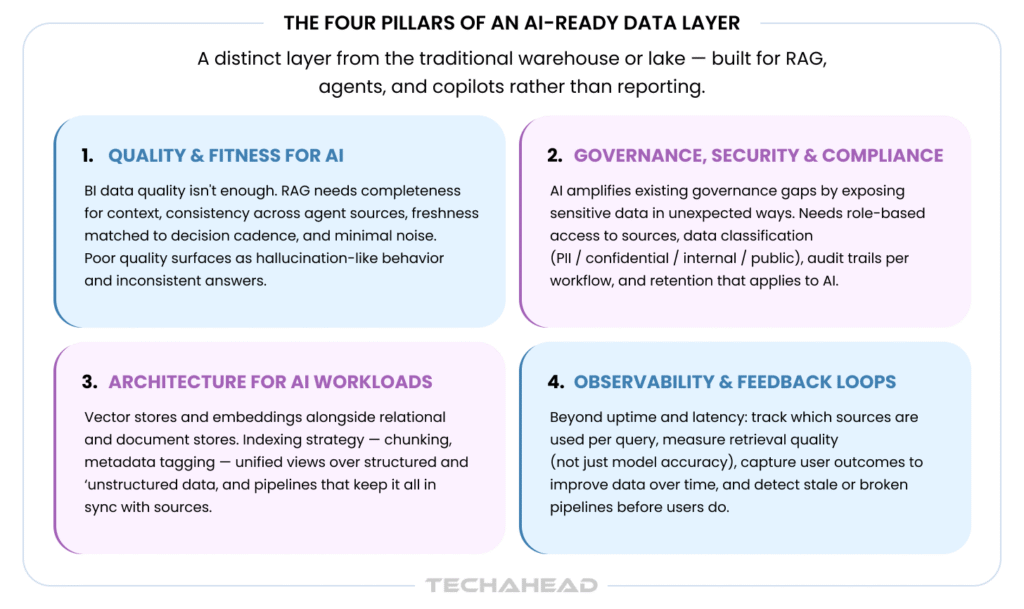
If AI-ready data is the goal, these four pillars are how you build toward it. Together they describe a layer that is distinct from the traditional warehouse or lake, one built for RAG, agents, and copilots rather than reporting.
Source: TechAhead AI Team
Quality and fitness for AI. Traditional data quality optimizes for BI and reporting. AI needs additional dimensions: completeness for context-building in RAG, consistency across the sources an agent draws on, freshness aligned to the decision cadence (a support copilot and a quarterly planning assistant have very different freshness needs), and minimal noise that could mislead a generative model. When this pillar is weak, it doesn’t show up as an error message; it shows up as hallucination-like behavior, inconsistent answers, and eroding user trust.
Governance, security, and compliance. AI systems amplify existing governance gaps because they can surface sensitive data in unexpected ways, a well-phrased prompt can pull a record no one intended to expose. This pillar means role-based access control for AI data sources, data classification (PII, confidential, internal, public), audit trails for what data feeds which AI workflow, and retention and deletion policies that actually apply to AI-accessible copies of your data. It is the prerequisite for scaling beyond a pilot, not a box to check afterward.
Architecture for AI workloads. AI changes the data-architecture conversation. Vector stores and embeddings now sit alongside relational and document stores; indexing strategy; Chunking and metadata tagging, becomes a first-class design decision; and you need unified views that combine structured and unstructured data, plus pipelines that keep the AI layer in sync with source systems. This is a genuinely distinct layer, and treating it as a bolt-on to the existing warehouse is a common and expensive mistake.
Observability and feedback loops. AI systems need observability that goes beyond uptime and latency. That means tracking which data sources are used per query or workflow, measuring retrieval quality rather than only model accuracy, capturing user feedback and outcomes to improve the data over time, and using telemetry to detect stale or broken pipelines before they degrade answers. Most teams instrument the model and ignore the data flowing into it; which is exactly backwards, given where failures originate.
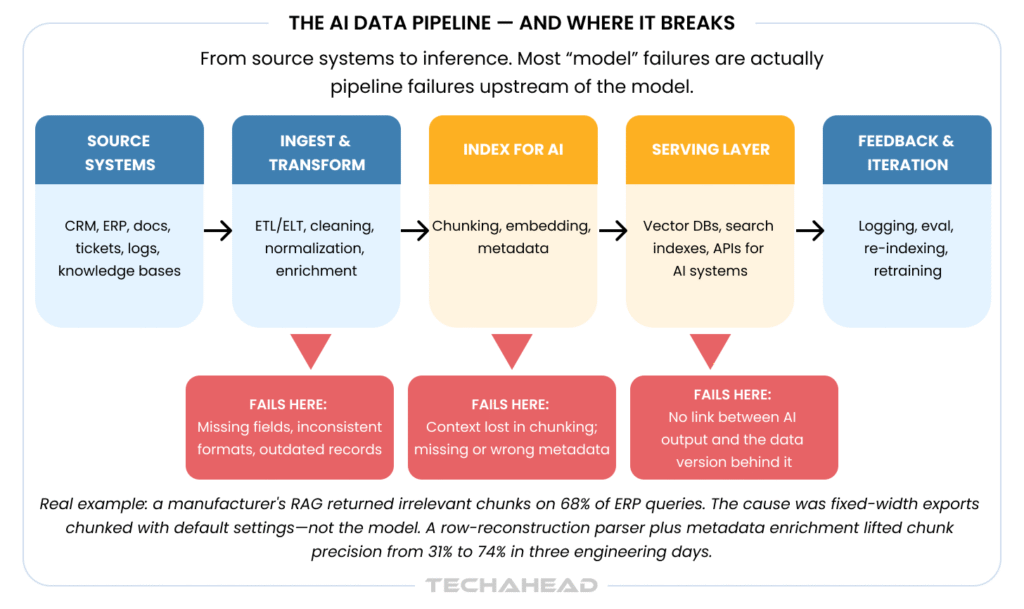
Walk a request through a production system and you can see precisely where things break.
Source: TechAhead AI Team
Data starts in source systems: CRM, ERP, documents, tickets, logs, knowledge bases. It moves through ingestion and transformation (ETL/ELT, cleaning, normalization, enrichment), then indexing for AI (chunking, embedding, metadata creation), into a serving layer (vector databases, search indexes, APIs), and finally through feedback and iteration (logging, evaluation, re-indexing).
Every arrow is a potential point of failure, and naive pipelines hide those failures because the system returns a confident answer regardless of whether the retrieval was any good.
The failure modes are specific. Context gets lost during chunking. Metadata for retrieval is missing or wrong. There’s no link between an AI output and the version of the data that produced it, so you can’t reproduce or debug a bad answer. None of these are model problems, and the fix rarely involves the model at all.
A concrete example makes the point. A 150-person manufacturer running SAP found its internal RAG pipeline returning irrelevant chunks on 68% of production queries against ERP data.
The root cause was fixed-width export files chunked with default settings.
After a custom row-reconstruction parser with metadata enrichment (report type, fiscal period, cost centre, plant), chunk precision on structured financial queries rose from 31% to 74%, with the embedding model and the LLM prompt left completely unchanged. Total implementation time: three engineering days. The model was never the problem.
The abstract failure modes tend to cluster into three recognizable patterns.
The “golden dataset” trap. The pilot runs on a small, perfect, hand-curated dataset and dazzles. Expanded to production, it breaks: data quality varies across teams and regions, edge cases dominate real usage, and the pipeline can’t handle the volume or variety. RAND’s analysis names this directly: the most common reason pilots fail to replicate at scale is that they ran on curated data that could not be automated.
The “copy-paste RAG” trap. Raw documents get dumped into a vector store with minimal preprocessing. Poor chunking retrieves irrelevant fragments, sensitive content leaks because access rules never made it into the index, and outdated or duplicate documents drive confidently wrong answers. The failure mode here is subtle and dangerous: one enterprise legal team’s RAG system cited a contract clause but missed the amendment that superseded it, because the amendment’s chunk scored 0.89 on similarity and fell just outside the top-k retrieval window while the original scored 0.94. The answer was coherent, well-formatted, and legally wrong; the kind of error only a domain expert catches.
The “black-box pipeline” trap. No one knows exactly what data the AI is using or how it updates. That makes wrong answers impossible to debug, leaves no owner for data fixes, and makes ROI unmeasurable because outcomes can’t be tied to data changes.
This one is widespread: a 2026 practitioner survey found that 70% of teams running RAG in production have no systematic retrieval-level evaluation at all. They measure end-to-end answer quality, assume the model is responsible for errors, and never look at whether retrieval surfaced the right context in the first place.
Moving from pilot to production is a cross-functional effort spanning data, security, product, and engineering. A practical design checklist:
Inventory, map every data source the AI will use and identify its owner. Classify, tag data by sensitivity and business criticality before it ever reaches an index. Set quality gates, define minimum thresholds (completeness, freshness, accuracy) that data must meet to be eligible for AI use. Enforce schema and metadata, consistent structures for AI-relevant fields, because metadata is what makes retrieval filterable and lineage traceable. Implement least-privilege access for AI systems, so a copilot can only reach what its users are permitted to see. Version everything, track which data and index versions each AI release used, so answers are reproducible. And monitor data freshness, completeness, and usage from day one.
The through-line: most of this is governance and engineering discipline, applied before the model rather than patched around it afterward. Effective AI development services bring together data engineering, security, governance, and product delivery so this foundation is designed for production from the start.
ROI from AI is impossible to measure if the data layer is invisible; You can’t attribute a business outcome to a data change you didn’t track.
Once the layer is instrumented, the metrics become concrete: time saved per task from better retrieval and context; reduction in escalations or rework caused by wrong answers; increased conversion or resolution rates for AI-assisted workflows; lower support or operational cost per transaction; and fewer incidents traced to bad or stale data.
Each of these requires the same thing, linking AI outcomes back to specific data sources and pipeline versions. That link is not a reporting nicety; it’s the mechanism by which you prove the AI is working and diagnose it when it isn’t.
It’s also, notably the thing the 61% of projects that S&P and Beam.ai found were approved on never-measured ROI projections were missing.
A sequence that improves data and AI performance together, one use case at a time:
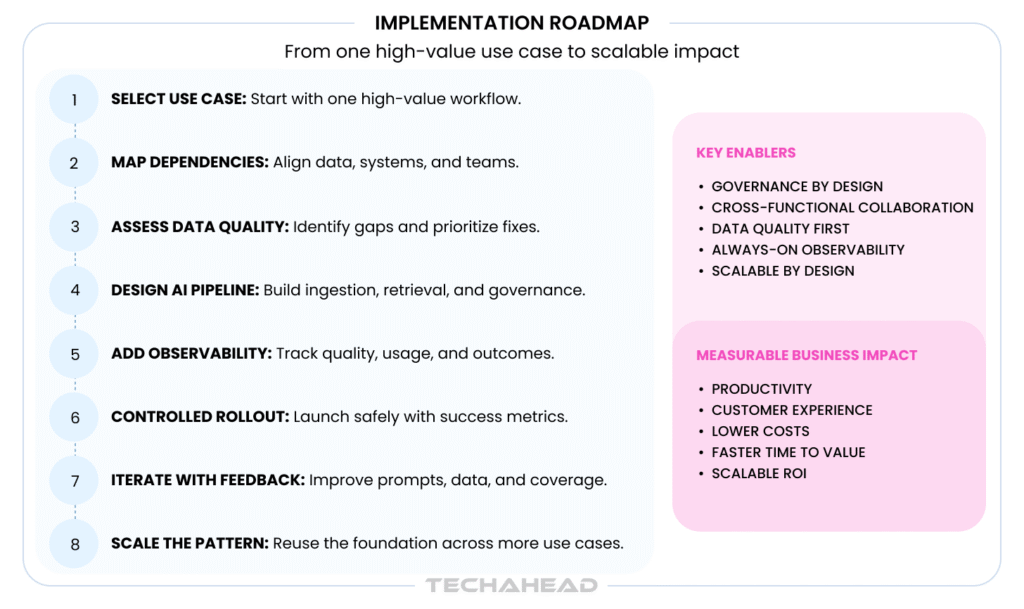
Image Source: TechAhead AI Team, on OpenA
Each iteration should measurably improve both the data and the AI on top of it. That compounding is the point, the second use case is cheaper than the first because the foundation already exists.
The organizations that win with AI won’t be the ones with the best model, model quality is converging and largely rented. They’ll be the ones that industrialized their data layer, so that every new AI use case starts from governed, representative, observable data instead of a heroic curation effort that can’t be repeated.
Demos prove what’s possible. AI-ready data proves what’s repeatable. Without it, AI stays a collection of impressive but isolated experiments, and joins the 80% that never turned a demo into a durable business result.
We help enterprise teams close the gap between a promising pilot and production ROI, assessing data readiness for a specific use case, designing the pipeline and governance end to end, and instrumenting the observability that keeps AI reliable as you scale. If your demos work but production doesn’t, the problem is almost always upstream of the model, and it’s usually diagnosable in weeks.
Data that has been aligned to a specific AI use case, qualified to meet that use case’s requirements, and governed so it can be trusted, making it representative of the real conditions the model or agent will face, including valid outliers. Per Gartner, readiness is contextual to the use case, so there’s no single universal “ready” state.
Because pilots run on small, curated, idealized data while production faces messy, distributed, evolving data. RAND, MIT, and Gartner independently converge on the same causes: data readiness, workflow integration, and unclear ownership, not model capability.
No. Clean data is a BI target (deduplicated, correctly typed). AI-ready data adds accessibility, rich metadata, governance and lineage, and optimization for retrieval and embedding, and it deliberately keeps representative outliers that BI would strip out.
Usually in the pipeline, not the model: bad chunking that fragments context, missing or wrong metadata that wrecks retrieval, and no versioning link between answers and source data. Most hallucinations trace to retrieval failures, and a majority of teams run RAG with no retrieval-level evaluation.
Instrument the data layer so outcomes can be tied to specific sources and versions, then track time saved per task, reduced escalations and rework, higher resolution or conversion rates, lower cost per transaction, and fewer incidents from stale data.
We use cookies to ensure our website functions properly, improve performance, and provide a personalized experience. You can choose which types of cookies to allow below.
Required for core functionality such as security, network management, and accessibility. These cannot be disabled.
Help us understand site traffic and user interactions so we can improve performance and usability.
Enable enhanced functionality and personalization such as language or region preferences.
Used to deliver relevant ads, track campaign performance, and measure advertising effectiveness.