


 Copy Link
 Share on X
 Share on Facebook
 Share on LinkedIn

Always Active
Required for core functionality such as security, network management, and accessibility. These cannot be disabled.

Uncover the transformative potential of digital and mobile solutions for your industry.





 Last Updated: Sep 18, 2026
Aug 4, 2026
Last Updated: Sep 18, 2026
Aug 4, 2026  320
320  21 min. Read


Key Takeaways
Most modernization programs do not fail because the technology is too old. They fail because the replacement is built the same way the original was, and two years later you are managing a new system that is just as rigid, just as hard to integrate, and just as expensive to maintain as the one you retired. That is the risk every technical leader like you is enterprise application development company quietly weighing before signing off on a rebuild.
Enterprise application development services cover the design, build, integration, modernization, and ongoing support of the software systems that run core business operations, from ERP and CRM platforms to custom internal tools and customer-facing applications.
In 2026, the center of gravity has shifted. The U.S. Government Accountability Office reported in 2025 that the federal government spends more than $100 billion a year on IT, with roughly 80 percent going to operate and maintain existing systems rather than build new ones.
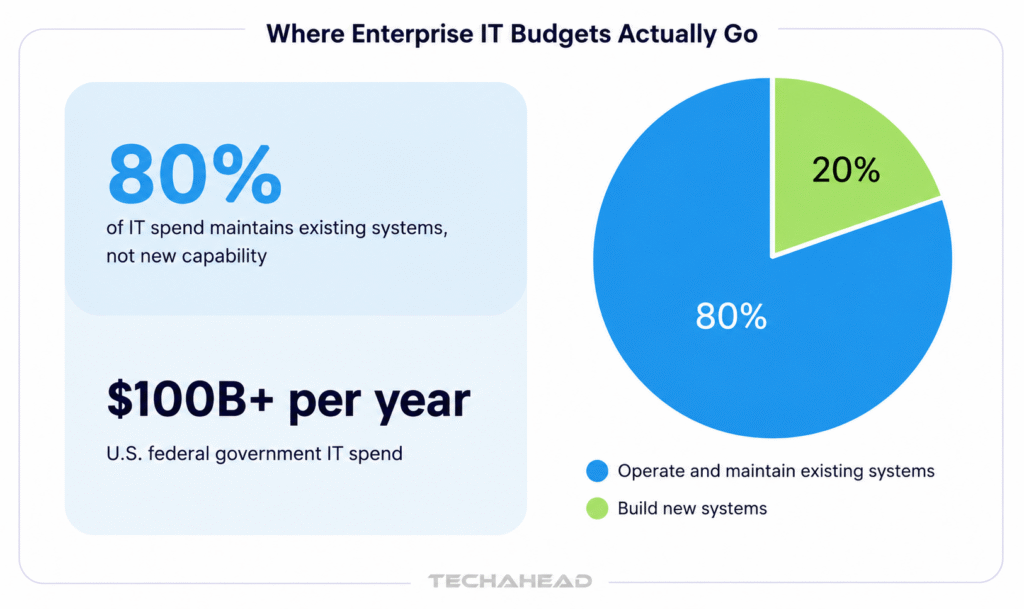
That ratio, maintenance crowding out new capability, is the pressure behind the shift: the demand is now less about building net-new applications and more about modernizing what already exists without introducing a fresh generation of technical debt. This guide is written for that decision: how to modernize enterprise applications so the result is resilient, not brittle, and how to evaluate the partner who will do the work.
The category has widened. A decade ago, enterprise application development services meant writing bespoke software from a requirements document. Today the scope spans the full application lifecycle, and most engagements start with systems that are already in production.
A modern services scope typically includes:
The distinction that matters for buyers is between vendors who treat these as separate line items and vendors who treat modernization as an architectural discipline. The first group ports your old logic to a new stack and calls it done. The second designs the target state first, then decides what to keep, refactor, or replace against it. That difference is why two modernization projects with identical budgets can end in opposite outcomes.
This is also where custom software development and modernization overlap. The engineering practices that produce a maintainable new application, clean domain boundaries, testable code, and documented interfaces, are the same practices that determine whether a modernized system stays flexible or calcifies.
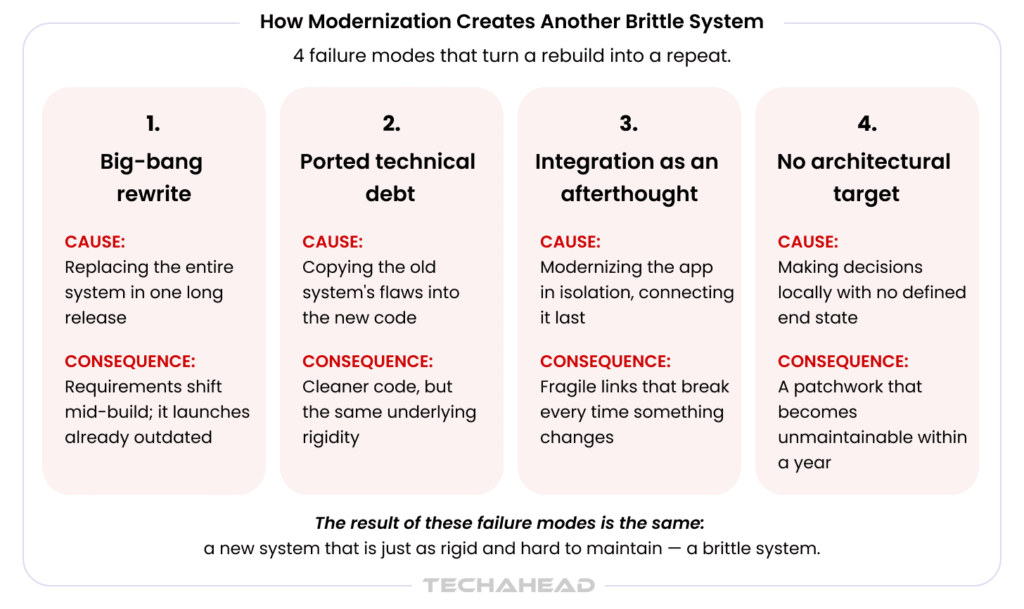
The brittle-system outcome is common in enterprise software development, and the reasons are predictable. Understanding them is the first step to avoiding them.
The Rewrite:
Teams decide to replace an entire system in one release. The rewrite takes 18 months, business processes move underneath it, and the new system launches already out of date. During those 18 months, no new value ships. This is the highest-risk path in modernizing legacy systems and the one most likely to be cancelled midway.
Ported Technical Debt:
The old system’s flawed assumptions get copied into the new one because nobody documented why the original worked the way they did. The new code is cleaner, but the architecture inherits the same rigidity from legacy systems.
Integration as an Afterthought:
The application is modernized in isolation, then connected to other enterprise systems through brittle point-to-point links. Every downstream system becomes a dependency that breaks when the new application changes.
No Architectural Target:
Without a defined target state, each decision is made locally. The result is a patchwork that works on launch day and becomes unmaintainable within a year.
The data backs this up. In McKinsey’s research, companies in the bottom fifth for technical-debt severity were 40 percent more likely to have incomplete or cancelled IT modernizations than companies in the top fifth. The condition of what you start with, and the discipline you bring to the development process, largely determine whether the modernization finishes at all. This is the exact trap a good modernization is meant to break, and a bad one reproduces: maintenance and rework crowding out the new capability the project was supposed to deliver.
AI-native modernization does not mean pointing a model at your codebase and hoping, especially when modernizing legacy systems that strain operations. It means using AI at specific, high-leverage points in the modernization lifecycle where it compresses time or reduces risk, while keeping human engineers accountable for architecture and correctness.
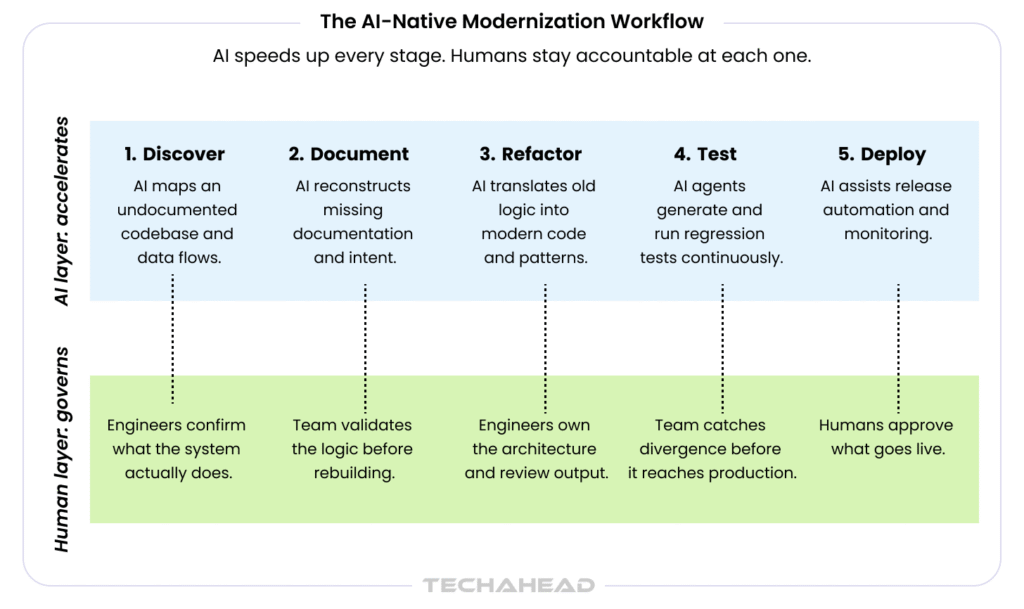
The enablers that matter in practice:
Adoption of these development tools is now mainstream. Stack Overflow’s 2025 Developer Survey found that 84 percent of developers use or plan to use AI tools in their workflow, up from 76 percent the year before. That is the accelerant behind the improving economics of modernization.
Also Read: What Happens When Agents Join the SDLC
The same survey carries the warning that defines responsible AI-native work. Only 29 percent of developers said they trust the accuracy of AI output, and 45 percent said fixing AI-generated code took longer than writing it themselves. The lesson is not that AI is unreliable. It is that AI-native modernization without human governance produces exactly the brittle, subtly-wrong system you were trying to avoid. A weak development process also breaks downstream business processes. Speed without verification is how you ship defects at scale.
This is why the AI-native approach and enterprise AI development discipline are inseparable from the modernization itself. Used well, application modernization services built on AI compress discovery and translation while engineers choose the right technology stack and own the outcome.
Resilience is an architectural property, not a feature you add later. In modern enterprise application development process, AI should be applied across the development lifecycle, not just at isolated modernization steps. The systems that stay flexible are the ones designed so that any single component can change without forcing changes everywhere else across enterprise systems, enterprise platforms, and cloud platforms. A handful of proven patterns produce that property, and a competent partner will assess the current technology landscape, choose the right technology stack instead of relying on AI output alone, and use AI-assisted development tools to accelerate discovery, refactoring, testing, or documentation while designing for seamless integration.
The same survey carries the warning that enterprise AI governance has to be built into the development process, because compliance reviews at the end of a build delay project launches.
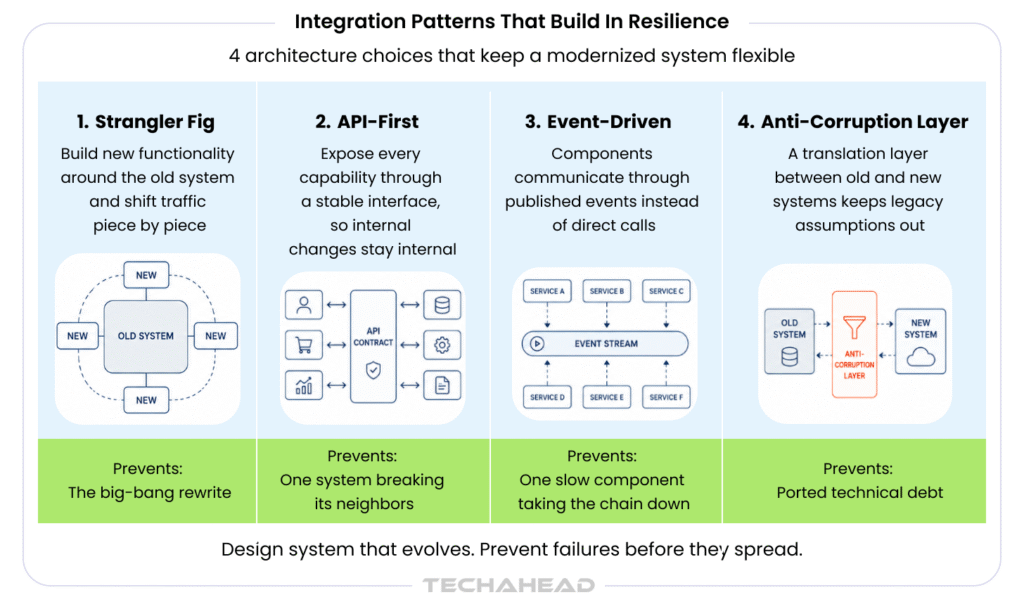
Instead of rewriting the whole system at once, you build new functionality around the edges of the old one and route traffic to it incrementally, creating resilient architecture for enterprise platforms rather than just a single application. The legacy systems keep running while they are gradually replaced, piece by piece, enabling seamless integration across enterprise systems until nothing depends on them. This is the direct antidote to the rewrite, and it is the safest path for modernizing legacy systems because value ships continuously, rollback is always possible, and teams can better rationalize a changing technology landscape.
Every capability is exposed through a well-defined interface before it is built, making API-first design a practical way to modernize legacy systems incrementally and support seamless integration. Systems integrate through stable contracts rather than direct dependencies across legacy systems and other enterprise systems, so internal changes stay internal. This is what stops one modernized application from becoming a fragile hub that breaks its neighbors.
Components communicate by publishing and subscribing to events rather than calling each other directly. This decouples systems in time and in dependency, so stable contracts support seamless integration and a slow or failing component degrades gracefully instead of taking the chain down with it. Teams can automate tasks through event-triggered workflows to improve operational efficiency, which matters most when the app must connect with other enterprise systems.
When new and old systems must coexist, a translation layer between them prevents the legacy model’s assumptions from leaking into the new architecture, while event-driven patterns help automate tasks across connected services and keep business data consistent. It is the specific mechanism that stops ported technical debt, helps protect sensitive customer and company data, and lets enterprise applications automate workflows to enhance operational efficiency.
Breaking a monolith into services can improve scalability and independent deployment while translating and safeguarding business data as it moves between old and new models, but only when the boundaries follow real business domains and the right technology stack. Decomposed carelessly, microservices trade one kind of rigidity for a harder one: a distributed system that is brittle across the network, even if a coexistence layer reduces risk to company data during transition. The discipline is in the boundaries, not the count, and in building scalable infrastructure.
These patterns are also what make cross-system connectivity durable as the estate grows, an area where emerging interoperability standards for connected systems are quickly becoming part of the architectural conversation. Integration and modernization are the same problem viewed from two angles, which is why cloud migration and delivery automation through DevOps consulting belong in the architecture from the start, not after the application is built.
“The mistake we see most often is teams treating integration as the last step. By then the architecture is already set, and every connection becomes a workaround. If you design the interfaces and the boundaries first, resilience is the default state, not something you engineer back in under pressure.”
Deepak Sinha, CTO, TechAhead
There is no single correct way to modernize. There are several, and the right one depends on the state of the application, its business value, your tolerance for risk, and whether decomposition supports scalable infrastructure through sound service boundaries. The established framework is often called the six Rs, and the right path also depends on choosing a technology stack that matches real domain boundaries, operational load, and business goals. A capable enterprise app development company will recommend a path per application, not one approach for the whole portfolio.
| Approach | What it means | Best when | Main tradeoff |
| Rehost | Move the application to new infrastructure as-is (“lift and shift”) | You need out of a data center fast and the app is stable | No modernization gain; debt moves with it |
| Replatform | Move to new infrastructure with minor optimizations | You want quick cloud benefits without re-architecting | Limited flexibility improvement |
| Refactor | Restructure the code without changing external behavior | The logic is sound but the code is hard to maintain | Effort with no visible feature change |
| Rearchitect | Redesign the architecture, often to microservices or event-driven | The current architecture blocks scale or change | Higher cost and delivery time |
| Rebuild | Rewrite the application from scratch on modern foundations | The system is beyond economical repair | Highest risk; classic big-bang exposure |
| Replace | Retire the application for a commercial or SaaS product | A standard product meets the need better than custom | Loss of custom fit; vendor dependency |
The framework’s value is that it forces an honest, per-application decision. Most failed modernizations come from applying one approach, usually rebuild, across an entire portfolio because it felt decisive. A portfolio assessment that assigns the right R to each application is the difference between a controlled program and a gamble, especially when business objectives include upgrading enterprise resource planning, customer relationship management, or supply chain management platforms that support various business processes.
For a step-by-step view of sequencing that assessment, see our application modernization roadmap.
Modernization is the moment your security and compliance posture is most exposed and most improvable, and the path should reflect business objectives and risk tolerance. You are moving data, changing access paths, and often introducing AI into the stack. Getting this wrong during a rebuild is how a modernization project becomes a breach headline.
The 2025 IBM Cost of a Data Breach Report makes the current risk concrete. The average breach in the United States reached a record $10.22 million, and among organizations that suffered an AI-related breach, 97 percent lacked proper AI access controls. AI adoption is outpacing AI governance, and the gap is where attackers are moving. An AI-native modernization that ignores governance does not just risk a brittle system. It risks an insecure one.
Security-by-design during modernization means several things in practice:
This is where the standards a partner actually holds matter more than the ones they mention. TechAhead operates to SOC 2 Type II for security controls, ISO 27001 for information security management, and ISO 42001 for AI governance, the specific frameworks that govern data handling, cloud services, and responsible AI in exactly the situations a modernization creates. Certification is not marketing here. It is the evidence that the controls exist before your data moves and that safeguards extend to customer and company data. |
Cost is the question every executive asks first and the one most vendors answer worst, usually with a range so wide it is useless. A more honest answer names the drivers, because the drivers are what you control. As modernization moves sensitive data and company data during migration, governance matters even more; over 90% of enterprises use cloud services for scalability, which raises the bar for secure execution.
| Cost driver | Why it moves the number | What to watch |
| Application complexity | More integrations, more business logic, more edge cases mean more engineering | Undocumented systems cost more to discover before any code is written |
| Modernization approach | A rehost is a fraction of a rebuild; the R you choose sets the baseline | Defaulting to rebuild inflates cost and risk together |
| Data migration | Volume, quality, and structure of legacy data drive a large share of effort | Dirty or poorly modeled data is the most common budget surprise |
| Integration scope | Each connected system adds interface work and testing | Point-to-point integration is cheaper upfront, costlier over the system’s life |
| Compliance and security | Regulated workloads require controls, audits, and evidence | Retrofitting compliance after build is far more expensive than designing it in |
| AI enablement | AI tooling can lower discovery and translation cost and support process optimization | Governance and validation are real line items, not free additions |
Two points reframe the cost conversation. First, technical debt is already a cost you are paying: McKinsey estimates it at 20 to 40 percent of an organization’s entire technology estate value, with a meaningful share of new-build budgets diverted to servicing it. Modernization is not net-new spend so much as a decision to stop paying interest on old shortcuts, and the shape of that spend depends heavily on cloud infrastructure choices and long-term operational costs.
Second, AI-native methods are compressing the discovery and translation phases that historically dominated modernization timelines, which is bending the cost curve for the first time in years.
The build-versus-buy question sits underneath all of this. Sometimes the right answer is to replace a custom system with a product; sometimes the economics run the other way, as we cover in the economics of replacing high-cost SaaS with custom software.
Where AI workloads are involved, the ongoing operating cost deserves its own scrutiny, which we break down in our guide to controlling the cost of AI workloads. A serious enterprise application development services partner will model total cost of ownership with you, not just the build quote, across compliance, security, and backend decisions tied to cloud services. A decade without a single data breach reflects real commitment to security, and a 95% client retention rate is a strong signal of compliance discipline and trust.
The stack matters less for its brand names and more for what it enables: independent deployment, clean integration, and the ability to change one part without disturbing the rest. A good modernization stack is chosen to serve the target architecture, not to chase whatever is newest. The same discipline that governs the six Rs decision governs tooling, where every choice answers to the target state rather than personal preference.
A typical legacy application modernization stack spans six layers, each doing a specific job:
| Layer | Representative Technologies | What it Delivers |
| Discovery and Assessment | AI-assisted code analysis, dependency mapping | Reconstructs how an undocumented system behaves before anything is touched |
| Languages and Frameworks | Java/Spring Boot, .NET Core, Node.js, Python, React, Angular | Modern, supported runtimes to replace aging stacks |
| Cloud and Infrastructure | AWS, Azure, Google Cloud, Docker, Kubernetes | Portability, scale, and isolation between components |
| Integration | API gateways, Kafka event streaming, service mesh | Stable connections that hold as the estate grows |
| Data | PostgreSQL and managed databases, migration pipelines | Moving legacy data without losing structure or integrity |
| DevOps and Delivery | CI/CD pipelines, Terraform, observability tooling | Faster releases and issues caught before production |
The stack you actually need follows the modernization approach you choose, and so does the budget. Lighter approaches touch fewer layers; a full rearchitect or rebuild engages all six. The indicative ranges below reflect that, and they move within tiers as scope, integration depth, and data condition change:
| Modernization Approach | Typical Scope | Indicative investment |
| Rehost / Replatform | Lift-and-shift with minor optimization, few layers touched | $50,000 to $90,000 |
| Refactor (Single Application) | Restructure code and cloud-enable one app | $70,000 to $130,000 |
| Rearchitect (Connected Applications) | Microservices, integration layer, data migration | $150,000 to $250,000 |
| Rebuild / Enterprise Program | Multiple systems, compliance, phased delivery | $250,000 to $500,000 |
These are starting ranges, not quotes. A rehost of a stable application sits at the low end; the moment integration scope, regulated data, or multiple connected systems enter the picture, you move up the table.
Everything above resolves into one decision: who does the work. The vendor determines whether you get a resilient system or a new brittle one, and the evaluation criteria follow directly from the risks this guide has laid out.
Evaluate an enterprise application development company against these:
The market is crowded and the marketing is uniform, which is why the evaluation has to go past the pitch.
TechAhead was built for this specific decision. The enterprise application development services practice pairs AI-native delivery with integration-first architecture to create solutions that improve user adoption, and it holds the SOC 2 Type II, ISO 27001, and ISO 42001 certifications that a modernization program actually requires, backed by AWS Advanced Tier engineering depth. As an app development company and enterprise development company, TechAhead delivers enterprise software solutions for complex environments where cloud services shape total cost of ownership and scalability.
Modernization is not risky because software is hard. It is risky because the default way of doing it, rewrite everything, port the debt, integrate last, reproduces the exact rigidity you set out to escape. The way through is not more caution. It is a different method: AI-native where it compresses risk, integration-first so resilience is designed in, governed so speed does not become exposure, and matched to the right approach for each application rather than one bet across the portfolio.
That is what separates a modernization that lasts from one you will be replacing again in three years. And it is why the choice of partner is not a procurement detail. It is the decision that determines the outcome.
When you are ready to make that choice deliberately, talk to TechAhead.
Look past cloud badges. A strong enterprise application development company assesses before proposing, applies the right approach per application, can name its integration patterns, and shows verifiable security proof. Ask for comparable case studies, not just a polished pitch.
The big-bang rewrite. Replacing everything at once, without validating current production behavior, is how most legacy application modernization efforts stall or ship a new brittle system. Phased, incremental replacement is the safer and far more predictable path.
Any capable partner using the strangler fig pattern or blue-green deployment can replace a system incrementally while it stays live, with clean rollback at each step. TechAhead structures its application modernization services this way so business continuity holds throughout.
AI reads undocumented code, reconstructs the missing documentation, and drafts the first pass of refactoring, compressing the discovery phase that used to eat months. Engineers still own architecture and correctness, so speed doesn’t quietly turn into a broken system.
Security has to be designed into the migration, not bolted on after cutover. That means rebuilding access controls, governing any AI component, and mapping compliance to the target architecture upfront. TechAhead runs this to SOC 2 Type II, ISO 27001, and ISO 42001.
Not quite. Cloud migration moves your workload; modernization improves how the app is built. You can migrate without modernizing, but the real resilience gains come when application modernization services re-architect the application to actually use the cloud, not just sit on it.
It depends on the app’s condition and business value, which is exactly why the six Rs framework exists. Refactor when the logic is sound but the code is messy; rebuild only when a system is beyond economical repair. Decide per application, never portfolio-wide.
Design the target architecture first, then decide what to keep or replace against it. Integration-first patterns and an anti-corruption layer stop old assumptions and technical debt from leaking into the new build. Brittleness is an architecture problem, not bad luck.
AI-native delivery balanced with real governance, integration-first architecture, and certifications you can actually verify. TechAhead’s enterprise application development services pair those with AWS Advanced Tier depth, which is the combination a modernization program genuinely needs, not generic full-stack claims.
It starts with assessing the system and its technical debt, then choosing a strategy per app, migrating in phases with validation at each step, and optimizing after go-live. Modernization isn’t a project that ends at launch, it’s ongoing.
We use cookies to ensure our website functions properly, improve performance, and provide a personalized experience. You can choose which types of cookies to allow below.
Required for core functionality such as security, network management, and accessibility. These cannot be disabled.
Help us understand site traffic and user interactions so we can improve performance and usability.
Enable enhanced functionality and personalization such as language or region preferences.
Used to deliver relevant ads, track campaign performance, and measure advertising effectiveness.