


 Copy Link
 Share on X
 Share on Facebook
 Share on LinkedIn
Always Active
Required for core functionality such as security, network management, and accessibility. These cannot be disabled.

Uncover the transformative potential of digital and mobile solutions for your industry.





 Last Updated: Sep 18, 2026
Aug 11, 2026
Last Updated: Sep 18, 2026
Aug 11, 2026  304
304  22 min. Read


Key Takeaways
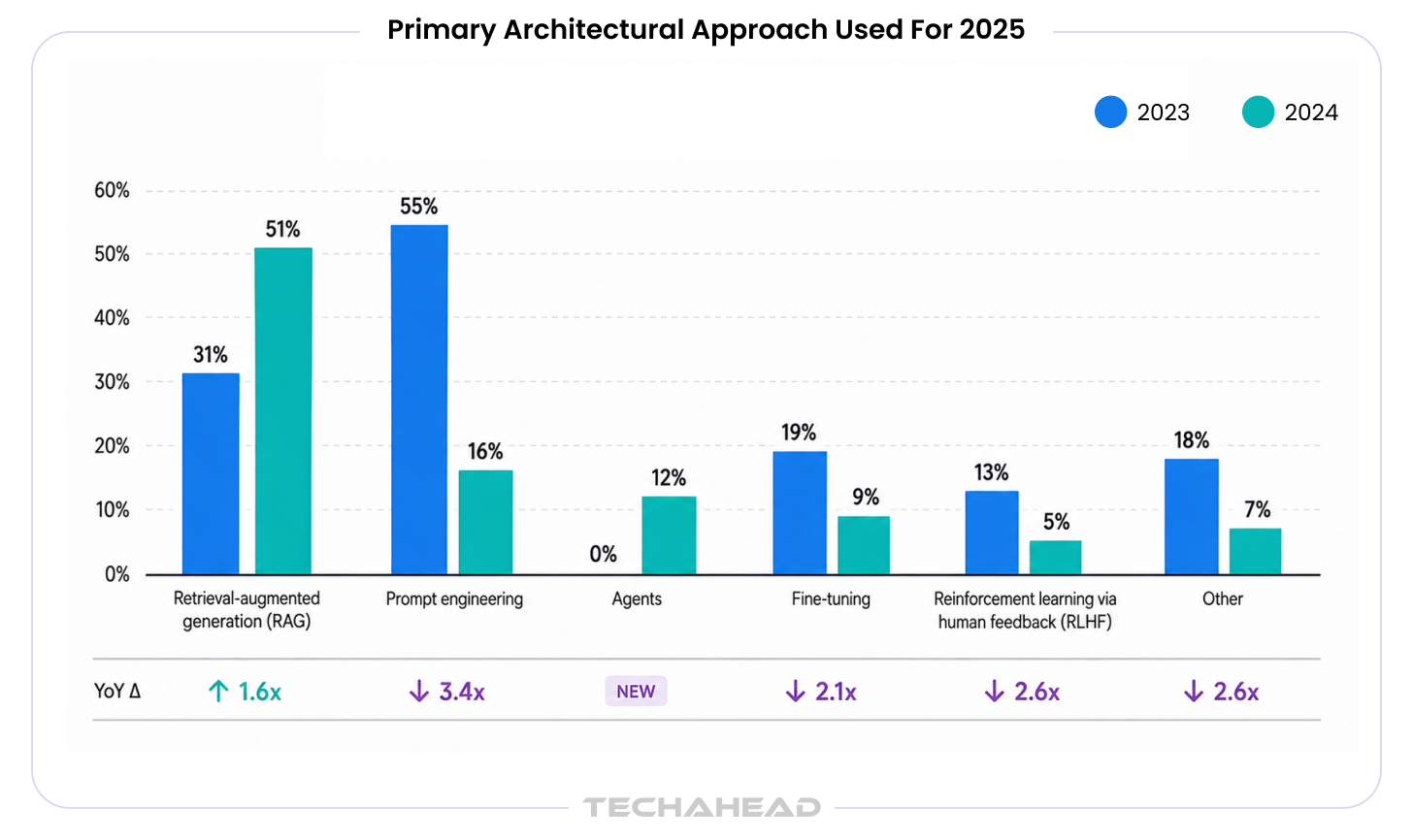
By the end of 2024, retrieval-augmented generation had reached 51% adoption across enterprise AI deployments. Fine-tuning sat at 9%. Autonomous agents, the newest arrival, at 12%. Those figures, from Menlo Ventures’ State of Generative AI in the Enterprise, describe more than a popularity contest. They map where enterprises have learned, often expensively, which architecture fits which job.
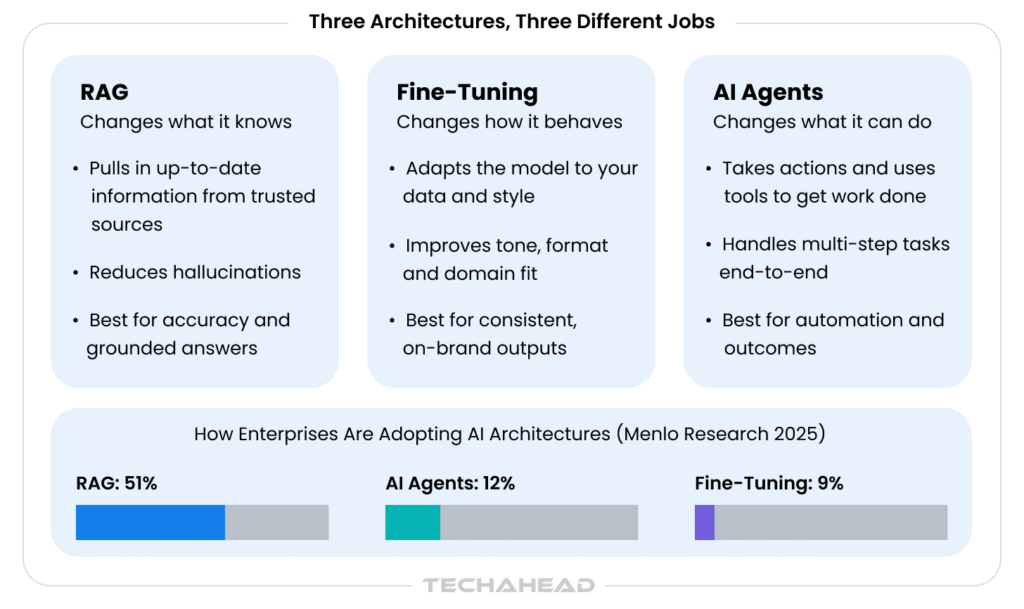
The RAG vs fine-tuning question, and the third option most comparisons leave out, comes down to a distinction that is easy to state and costly to get wrong. RAG changes what a model knows. Fine-tuning changes how it behaves. Agents change what it can do. Choose the wrong one for your use case and the cost surfaces later, in a pilot that will not scale and a system you rebuild.
This blog gives you a scored decision matrix across the five axes senior teams actually weigh, a clear verdict on when each architecture fits, and an honest read on when combining them is smart and when it is just expensive.
The three architectures solve different problems. RAG changes what your model knows. Fine-tuning changes how your model behaves. Agents change what your model can do. Getting this distinction right is most of the battle, because the majority of costly architecture mistakes come from applying one approach to a problem that belonged to another.
Here is the plain-language version:
Large language models start with general knowledge, then enterprises adapt them with RAG or fine-tuning to fit business needs.
The table below is the fastest way to hold all three in your head before we go deeper.
| Architecture | What it changes | Best-fit job | Main risk |
| RAG | What the model knows | Answering from current, private, or frequently changing knowledge | Answer quality collapses if underlying data is poor or ungoverned |
| Fine-tuning | How the model behaves | Enforcing consistent tone, format, or narrow domain behavior | Stale the moment your knowledge changes; costly to update |
| AI agents | What the model can do | Multi-step workflows that require decisions and tool use | Cost and reliability failures when scope is too broad |
That adoption spread, RAG well ahead of both fine-tuning and agents, is not an accident. It reflects the real cost and complexity of each approach, which is exactly what the rest of this guide unpacks. The lesson underneath the numbers is that most enterprises reach for the heavier architecture before the lighter one has been ruled out, and pay for it in maintenance and rebuilds.
Use RAG when your knowledge changes often, must stay current, or has to be traceable back to a source. This is the default starting point for most enterprise use cases, and for good reason. It ships faster than fine-tuning, keeps your data in your control, and grounds answers in documents you can audit.
RAG fits when you see these signals:
The reason RAG dominates is that it separates the knowledge from the model. When a policy changes, you update the document, not the training pipeline, so RAG avoids the computational demands of retraining models. That single property is why it became the most adopted pattern in the enterprise, and why it usually answers the when to use RAG vs fine-tuning question in RAG’s favor for knowledge-heavy work.
The honest caveat is that RAG lives or dies on data quality. How does RAG work in practice? It typically follows a four-stage flow: retrieve, augment, generate, and return the answer with citations. A retrieval system pointed at outdated, duplicated, or poorly structured content will confidently return wrong answers. Well-designed RAG systems still carry operational complexity because the RAG architecture depends on retrieval infrastructure, data pipelines, and ongoing maintenance. The architecture is only as trustworthy as the knowledge base underneath it, which is why serious RAG work is as much a data engineering effort as an AI one.
Enterprises that treat retrieval as a search problem alone tend to underestimate the grounding, chunking, and governance work that makes it reliable. If your organization is weighing how much of this to build in-house, our enterprise search and RAG development service exists precisely to close that gap between a promising demo and a dependable production system.
Verdict: RAG is the right first move when the model needs current, private, or auditable knowledge, and when speed to production matters.
Fine-tune when you need to change how the model behaves, not what it knows. If every response must follow a strict format, adopt a specific tone, or use specialized domain language consistently, fine-tuning teaches the model those behaviors in a way that prompting alone cannot reliably enforce, helping a model absorb domain knowledge, specialized knowledge, and domain expertise needed for domain specific tasks. This is the core of the fine-tuning vs RAG distinction: one shapes behavior, the other supplies knowledge.
Fine-tuning earns its place when:
The reason fine-tuning stays rare in production, at that 9% figure, is that it carries real friction. It requires high quality data, sometimes even limited training data when that is all a team has, plus labeled datasets for supervised training, retraining cycles when things change, and governance around the training process itself. Fine-tune a model on knowledge that shifts monthly and you have built something that goes stale on a schedule. That is the classic overbuild: teams reach for fine-tuning to solve a knowledge problem that RAG would have handled without the retraining tax.
The fine tuning process uses domain specific data and input-output examples as additional training data to improve consistency on specialized tasks, including proprietary code generation. Modern methods have lowered the cost. Parameter-efficient techniques like LoRA and QLoRA, along with capable small language models, have compressed what used to be six-figure training runs into something far more accessible. That has widened the set of cases where fine-tuning makes sense, particularly for behavior and format control on well-defined tasks. It can also excel at specific domain jargon and code generation for proprietary languages. It has not, however, changed the fundamental rule: fine-tuning is for behavior, not for knowledge that moves.
Choosing between models and approaches at this layer is its own decision, and our breakdown of how to choose between Claude and OpenAI by task is a useful companion when you get there.
Verdict: Fine-tuning is the right call for consistent behavior, strict formatting, or low-latency narrow tasks, and the wrong call for knowledge that changes.
Use AI agents when the work requires multiple steps, decisions, and actions, not just an answer. An agent plans, calls tools, and executes toward a goal. That is a genuine leap in capability, moving from passive retrieval to active task execution, and it is also where the most expensive mistakes happen. This is the heart of the AI agents vs RAG question: agents are not a better RAG, they are a different tool for a different job.
Agents fit when:
The risk is real, and senior teams should weigh it before committing. When agents operate without tight boundaries, they can enter costly logic loops, make unintended tool calls, or drift from the intended task, a failure pattern practitioners now call agent drift. The defenses are guardrails, human-in-the-loop checkpoints for high-stakes decisions, and narrow, well-defined scope. An agent needs a sandbox and a clear escalation path, or it moves from a productivity asset to an operational liability.
The market data makes the caution concrete. Gartner predicts that over 40% of agentic AI projects will be canceled by the end of 2027, citing escalating costs, unclear business value, and inadequate risk controls. That is not a reason to avoid agents. It is a reason to apply them only where they deliver clear value, and to build them with discipline. The pattern that consistently scales is the narrow agent with a bounded job, not the broad autonomous system that tries to do everything. Our field view on why narrow agents scale and broad ones do not goes deeper on exactly where that line sits, and building this well is the core of our agentic AI systems practice.
A brief note on agentic AI architecture as a term: it covers the orchestration patterns, memory, and tool-integration design that make agents reliable, and it deserves a treatment of its own. For this decision guide, the point to hold is narrower. Agents are the right architecture when the job is action across steps, not answer in one shot.
Verdict: AI agents fit multi-step workflows that need decisions and tool use, and they demand guardrails and narrow scope to survive contact with production.
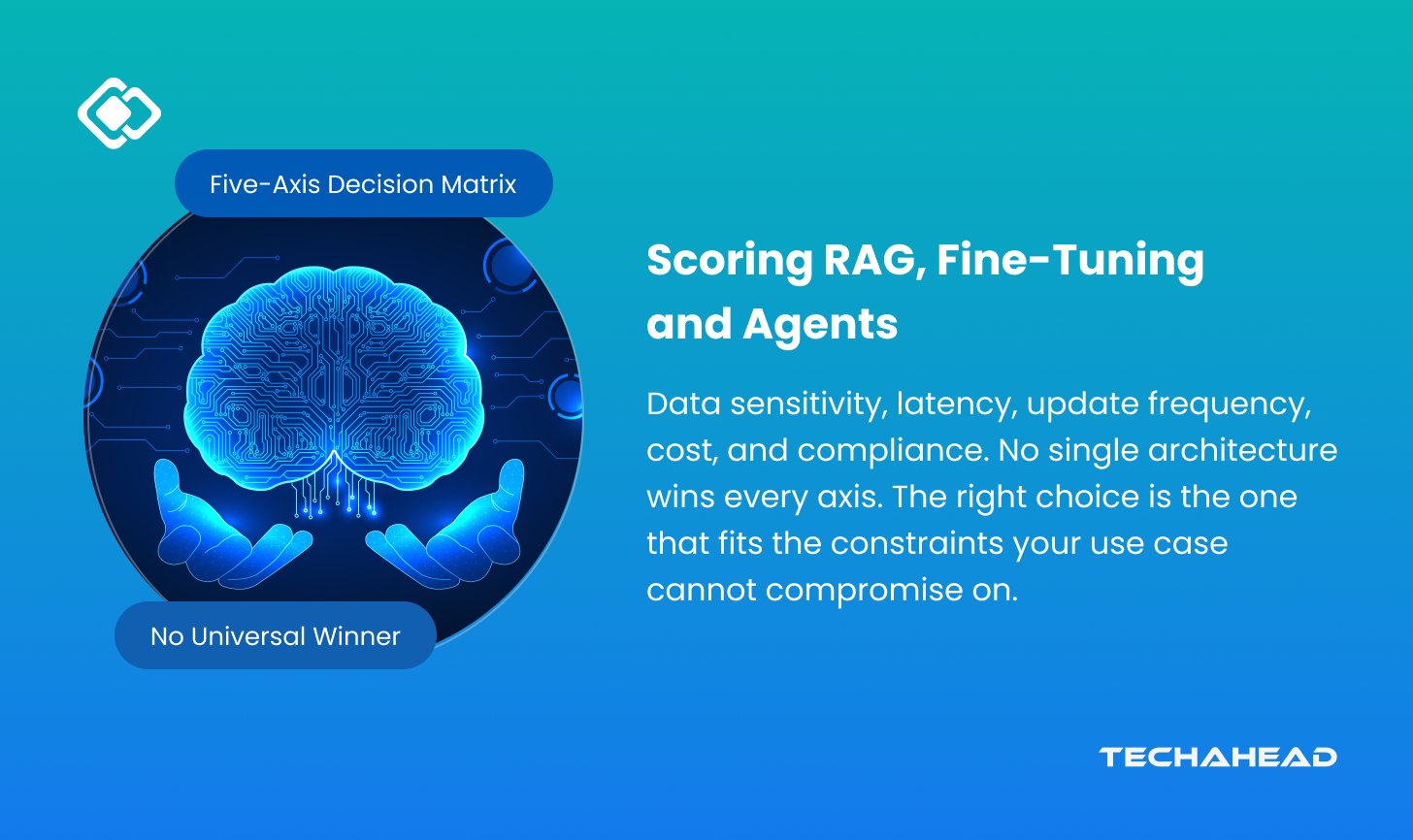
The clean way to decide is to score your use case against the five axes that actually drive cost and risk in production: data sensitivity, latency, update frequency, cost, and compliance. This is where the RAG vs fine tuning vs agents decision stops being abstract and becomes a set of concrete trade-offs you can evaluate against your own requirements, with the goal to deliver AI systems that balance accuracy, currency, and behavior.
Read the matrix by finding the axes that matter most for your use case, then following them to the architecture that scores strongest.
| Decision axis | RAG | Fine-tuning | AI agents |
| Data sensitivity | Strong. Data stays in your controlled sources and is fetched at query time, never baked into weights | Weaker. Training data becomes embedded in the model, requiring trust in the training and hosting process | Depends. Sensitivity risk scales with how many tools and data sources the agent can reach |
| Latency | Moderate. Retrieval adds a step, though it can be optimized | Strong. A tuned smaller model can deliver fast, consistent responses | Weaker. Multi-step planning and tool calls add cumulative latency |
| Update frequency | Strong. Update a document, not the model. Ideal for fast-changing knowledge | Weak. Every knowledge change means a retraining cycle | Moderate. Depends on whether the underlying knowledge sits in RAG or in weights |
| Cost | Lower upfront, recurring retrieval and context costs at scale | Higher upfront training cost, lower and more predictable per-query cost at high volume | Highest and least predictable, driven by multi-step calls and tool use |
| Compliance | Strong. Source attribution supports audit trails and traceability | Weaker. Fine-tuned models alone struggle to show where an answer came from | Requires deliberate design. Every action needs logging and accountability |
Two things are worth calling out from the matrix. First, RAG scores strongly on the axes most regulated US enterprises weight highest: data sensitivity, update frequency, and compliance traceability. That is a large part of why it became the default. Second, no single column wins every row, which is the entire point, and both RAG and fine-tuning can be the right choice depending on constraints. The which AI architecture for enterprise question has no universal answer. It has a right answer for your specific use case, defined by which axes you cannot compromise on, and in some cases a fine tuning RAG hybrid is the best fit.
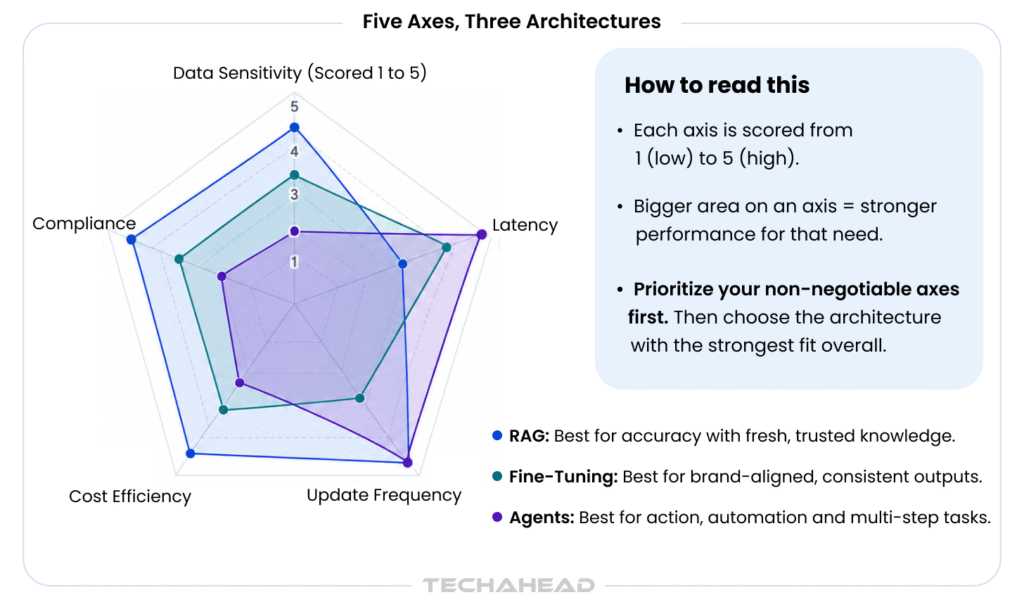
Cost deserves particular attention because it is the axis most often underestimated. RAG shifts cost into recurring retrieval and context, while cost efficiency may favor fine-tuned systems at scale because they trade higher training cost for lower inference cost. Agents multiply it across steps. Modeling this honestly against your real query volume and traffic shape is what separates a sustainable system from one that surprises the finance team, and it is worth reading our guide to LLM cost optimization before you commit to any single path.
Prompt engineering is the cheapest layer, and often the right first thing to try before building anything heavier. Before you invest in retrieval infrastructure or a training pipeline, a well-constructed prompt against a capable model can resolve a surprising number of use cases on its own. In the RAG vs fine tuning vs prompt engineering framing, prompting is the low-cost outer loop that you reach for first and keep even after you add other layers.
The practical sequence for most teams looks like this:
The mistake to avoid is skipping the cheap layer and jumping straight to the expensive one. Prompt engineering will not give you the knowledge currency of RAG or the behavioral consistency of fine-tuning, but it costs almost nothing to test and frequently narrows the problem before you spend on architecture.
Combining architectures often outperforms any single approach, which is why hybrid systems have become the production default. But hybrid is also where overbuilding hides. The honest position is that hybrid is powerful and frequently correct, and that reaching for it too early is one of the most common and expensive mistakes enterprises make.
The case for hybrid is straightforward. A fine-tuned model plus RAG combines domain-specific behavior with current external knowledge, and fine-tuning RAG is most useful when one method alone cannot cover both needs. An agent orchestrates multi-step work when needed. Each layer covers the others’ weaknesses. For a mature, high-volume, mission-critical workflow, that combination genuinely delivers better results than any single architecture in isolation.
The case against reaching for it prematurely is just as important. Hybrid systems require multiple engineering disciplines at once, including data engineering, model training, machine learning work, and orchestration, a combination few organizations have on hand. Every layer you add is a layer you must maintain, monitor, and govern. Hybrid systems are justified when one layer alone cannot provide both domain specific knowledge and up-to-date retrieval. If a single RAG implementation would meet your requirements, building a fine-tuned, agent-orchestrated hybrid on top of it is not sophistication. It is cost and fragility you chose to take on.
This is the discipline the “don’t overbuild” principle demands. The table below gives you the signals that separate a rightsized architecture from an overbuilt one.
| Signal | Rightsized | Overbuilt |
| Layers in the system | The minimum needed to meet the requirement | Layers added for capability you do not yet use |
| Reason for each component | Tied to a specific, current use-case need | Added because it is advanced or expected |
| Maintenance burden | Matches the team’s actual capacity | Requires disciplines the team does not have |
| Update path | Changing knowledge or behavior is straightforward | Simple changes require touching multiple layers |
| Cost behavior | Predictable and tied to value delivered | Escalating and hard to trace to outcomes |
The reason overbuilding is so common connects directly to what actually predicts success. According to Gartner, organizations with successful AI initiatives invest up to four times more, as a percentage of revenue, in foundational areas like AI-ready data quality, governance, people, and change management, compared to those with poor outcomes. The winners are not the ones with the most elaborate architecture. They are the ones who invested in the foundations that make any architecture work.
The cost of ignoring this shows up in the aggregate numbers. MIT’s State of AI in Business 2025 report, covered by Fortune, found that 95% of enterprise generative AI pilots delivered no measurable P&L impact, with only about 5% creating significant value. When teams overbuild the architecture while underinvesting in the data and compliance & governance beneath it, they land in that 95%.
Moving a stalled pilot forward is far more often a foundations problem than an architecture problem, which is why our work on moving stalled pilots to production starts there rather than with more layers.
No architecture survives poor data. RAG returns wrong answers when its knowledge base is messy, and hallucination risk rises when a system lacks relevant knowledge or pulls from external data sources that do not provide accurate data. Fine-tuning bakes in whatever quality your training data had. Agents act on flawed inputs at machine speed. The single highest-leverage investment in enterprise AI is not the architecture. It is the data quality and governance underneath it, which is exactly what the Gartner foundational-investment finding quantifies.
This is where the difference between RAG and fine-tuning matters less than what they share. Both, and agents alongside them, depend on:
Data engineers are often responsible for the pipelines that keep RAG content fresh and reliable.
For US enterprises operating under real compliance obligations, this foundation is also where trust is won or lost. Governed data, source attribution, and auditable outputs are what let an AI system stand up to scrutiny. Building that foundation deliberately, rather than bolting it on after a pilot stalls, is the difference between the 5% that reach measurable value and the 95% that do not. The groundwork here is covered in depth in our look at AI-ready data as the missing layer between demos and ROI, and standing up this capability as a repeatable discipline is what an AI Center of Excellence is built to do.
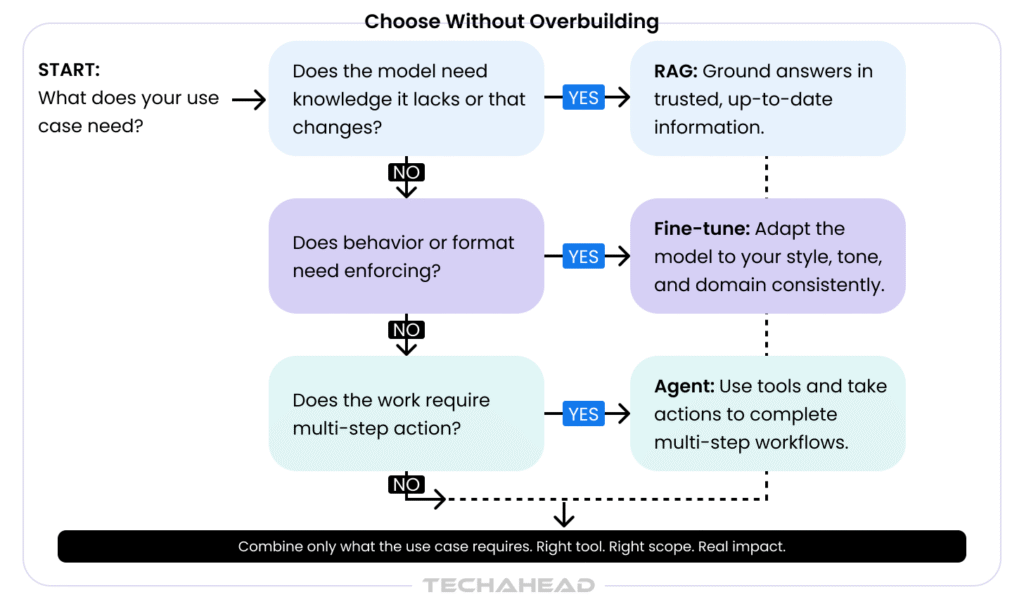
Pulling it together, here is the decision logic in the order that keeps you from overbuilding:
This is the answer to how to choose AI architecture without wasting a budget cycle: match the architecture to the use case, resist the pull toward complexity you do not yet need, and put the foundational work first.
The reason this matters for senior decision-makers is that architecture choices made early, on too little information, are the ones that quietly drain budgets for years. The teams that get it right are rarely the ones with the most advanced stack. They are the ones who chose deliberately and built on solid foundations. That is also why AI implementation challenges in production tend to trace back to speed, accuracy, and cost trade-offs set at the architecture stage, not to model capability.
Choosing the right architecture is the first decision. Building it to production standard is the harder one, and it is where TechAhead operates. As an enterprise AI development company, we help US enterprises make the RAG vs fine-tuning decision on evidence rather than hype, then engineer the system that follows, whether that is retrieval, selective fine-tuning, a bounded agent, or a disciplined combination of the three.
That work is grounded in production discipline rather than experimentation. Our teams build on governed foundations backed by SOC 2 Type II, ISO 27001, and ISO 42001 AI governance certification, the controls that matter when data sensitivity and compliance sit at the top of your decision axes. As a Claude & OpenAI Services Partner, and an AWS Advanced Tier Partner, we architect across the model and infrastructure choices that shape cost and latency, so the system you ship is one you can afford to run and trust to scale. When the constraint is the environment your models run in, our AI infrastructure management and generative AI development capabilities close the gap between a chosen architecture and a dependable production system.
The enterprises that win with AI are not the ones that build the most. They are the ones that build the right thing on the right foundation. If you are weighing the RAG vs fine-tuning vs agents decision for a real use case, that is precisely the conversation our enterprise AI team is built to have.
Simplest way to hold it: RAG changes what your model knows, fine-tuning changes how it behaves. RAG pulls fresh knowledge in at query time; fine-tuning bakes behavior into the weights. Most enterprise mistakes come from confusing the two.
Use RAG when your knowledge changes often or needs to be traceable to a source, which covers most enterprise cases. Fine-tune when behavior, tone, or output format has to stay consistent. The when to use RAG vs fine-tuning call really comes down to that split.
Reach for AI agents when the work needs multiple steps, decisions, and tool calls, not just an answer. RAG retrieves and responds; agents plan and act. If a single retrieval answers the question, you don’t need an agent. That’s the honest AI agents vs RAG line.
Often yes, but not always. Combining them handles knowledge and behavior together, which is why hybrid is the 2026 production default. The trap is reaching for it early. If one clean RAG layer meets your need, a hybrid stack is just complexity you’ll maintain forever.
For regulated US enterprises, RAG usually leads because source attribution gives you the audit trail compliance teams need. Fine-tuning alone struggles to show where an answer came from. With the EU AI Act enforcing from August 2026, that traceability stopped being optional.
Score your use case against five axes: data sensitivity, latency, update frequency, cost, and compliance. Start with the lightest option that works, then add layers only when a real requirement demands it. That discipline is the whole answer to how to choose AI architecture sensibly.
RAG generally does, because it grounds answers in retrieved source documents rather than the model’s memory, so responses stay tied to real data. Fine-tuning shapes behavior but won’t reliably stop a model from inventing facts. For factual accuracy, grounding beats tuning.
Prompt engineering is your cheapest first move. Test it before building anything heavier, since a strong prompt resolves more cases than people expect. In the RAG vs fine tuning vs prompt engineering stack, it’s the low-cost outer loop you keep even after adding other layers.
Honestly, it’s rarely the architecture. It’s the data quality and governance underneath it. Gartner found successful AI initiatives invest up to four times more in those foundations. At TechAhead, we start there, because clean, governed data is what any RAG or fine-tuned system stands on.
Yes, that’s the core of what we do. As an enterprise AI development company, TechAhead helps you make the RAG vs fine-tuning vs agents call on evidence, then engineers the system, whether that’s retrieval, selective fine-tuning, a bounded agent, or a disciplined mix.
We use cookies to ensure our website functions properly, improve performance, and provide a personalized experience. You can choose which types of cookies to allow below.
Required for core functionality such as security, network management, and accessibility. These cannot be disabled.
Help us understand site traffic and user interactions so we can improve performance and usability.
Enable enhanced functionality and personalization such as language or region preferences.
Used to deliver relevant ads, track campaign performance, and measure advertising effectiveness.