


 Copy Link
 Share on X
 Share on Facebook
 Share on LinkedIn
Always Active
Required for core functionality such as security, network management, and accessibility. These cannot be disabled.

Uncover the transformative potential of digital and mobile solutions for your industry.





 Last Updated: Sep 18, 2026
Jul 22, 2026
Last Updated: Sep 18, 2026
Jul 22, 2026  361
361  20 min. Read


Key Takeaways
In a single week of March 2026, twelve major AI models shipped. That is not a spike. It is the tempo the enterprise now runs on, and it has quietly broken an assumption most AI strategies were built on: that you pick one model and standardize around it.
You cannot, not anymore. The model you chose last quarter may already be slower, pricier, or weaker on your workload than three alternatives that launched since. That pressure is what turned the LLM gateway from a developer convenience into enterprise infrastructure. It is also why a company most executives had not heard of eighteen months ago is now worth more than a billion dollars.
OpenRouter raised a $113 million Series B led by CapitalG, Alphabet’s growth fund, at a reported $1.3 billion valuation in May 2026. A year earlier it was valued at roughly $500 million. The interesting part is not the number. It is what the number is evidence of.
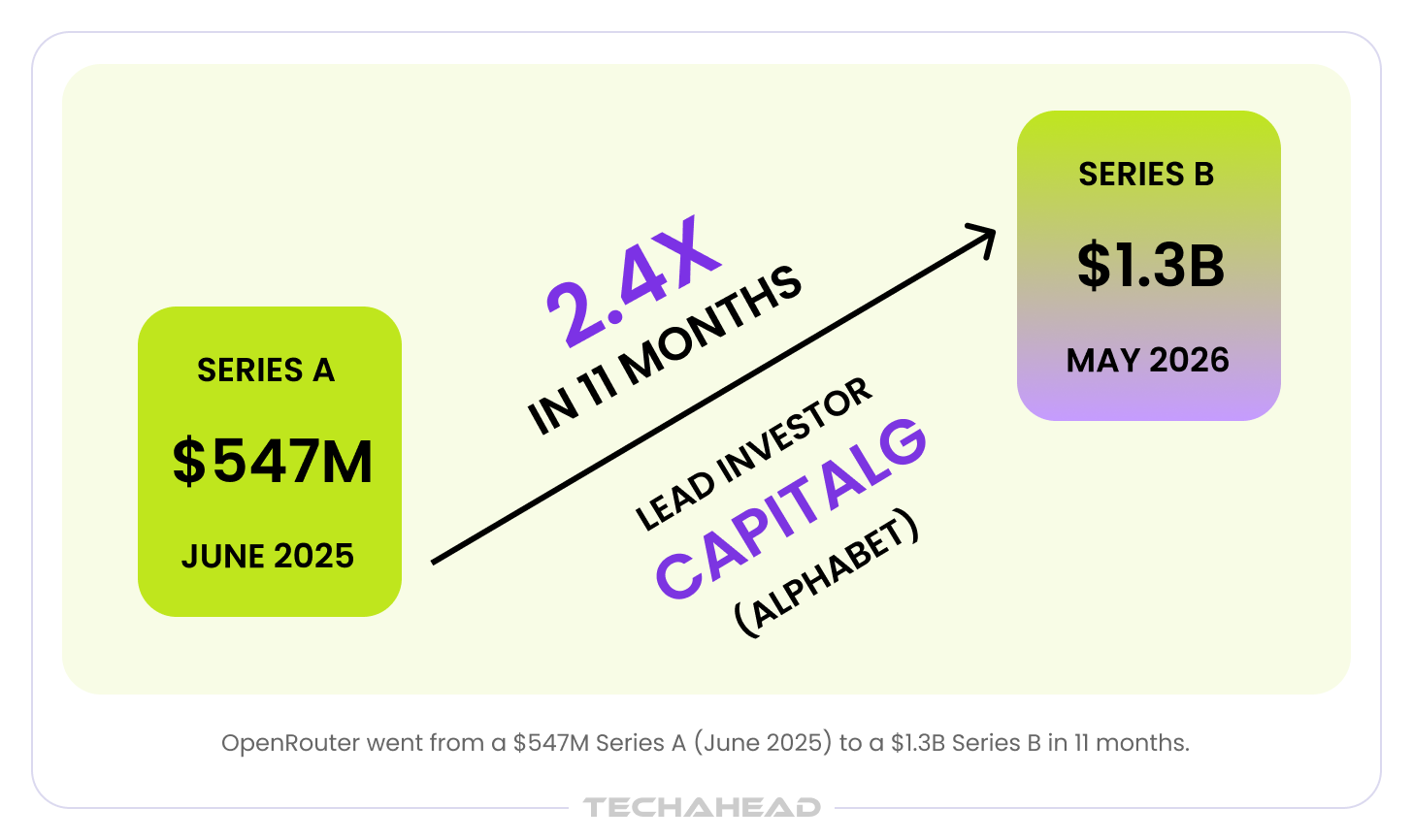
OpenRouter is a lens, and what it lets you see is a structural shift: the model layer is commoditizing, and orchestration is where durable engineering value is moving.
This piece uses that lens to get to a decision every serious AI team now faces. Once you accept that model choice is a runtime problem rather than a one-time purchase, you have to decide whether to build your own routing layer, buy a gateway, or govern one. First, it helps to see why routing became the center of gravity in the first place, because the word hides three very different ideas.
Must Read: LLM Deployment Optimization
If your product already touches more than one model, you know the friction. One model for reasoning, another for long-context document work, a cheaper open-weight model for high-volume classification. Run three models and you inherit:
There is a subtler cost underneath the obvious one. The same model is not the same across providers. On OpenRouter, one popular model is served by sixteen different providers at prices that vary by roughly four times, with throughput ranging from about 4 to 57 tokens per second. Latency, uptime, context limits, and even output quality drift between vendors hosting what is nominally identical weights. So “which model is best” quietly became “which model, from which provider, for this specific request, right now,” and even keeping track of which models lead on which tasks is now a moving target. That is not a procurement question. It is an architecture question, and it repeats on every call.
Must Read: Best AI Models for Developers (H2 2026 Edition)
Fragmentation is not a fringe problem for a handful of AI-native startups either. Gartner forecasts worldwide AI spending will reach $2.59 trillion in 2026, a 47% year-over-year jump, and it raised its outlook on AI-model spending specifically to roughly double this year.
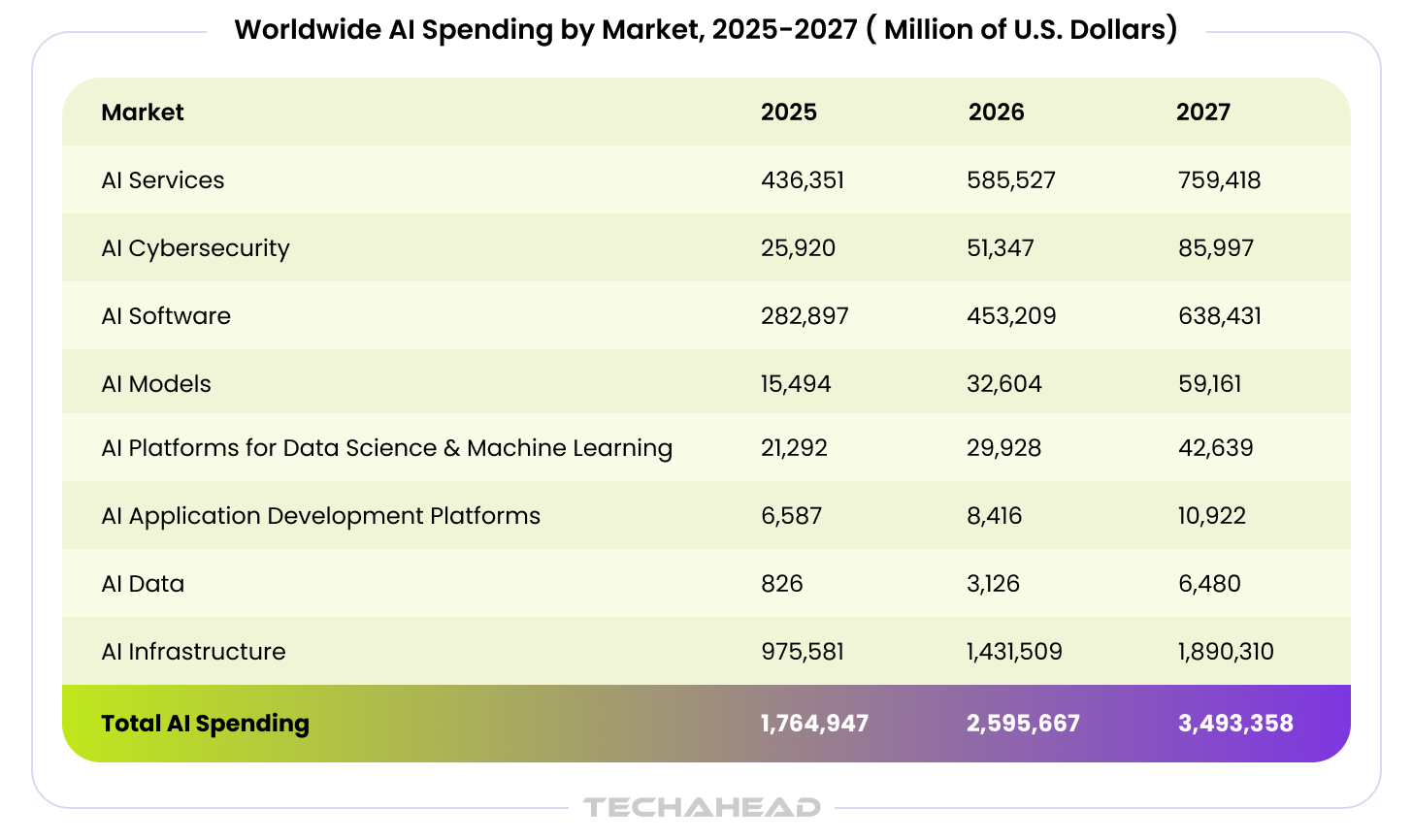
Adoption is broad and messy: in one Deloitte survey cited alongside that forecast, nearly half of respondents said they had more than 30 AI pilots underway. Thirty pilots means many models, many providers, and many small integration decisions that no one is coordinating. This is the environment an LLM gateway exists to tame, and it is why more enterprises are treating model intelligence as a solved problem and the surrounding engineering as the real bottleneck.
Worth clearing up one thing before going further, because the terminology confuses people up. An LLM gateway is not an API gateway. An API gateway manages traffic, auth, and rate limits for your own services at the network layer. An LLM gateway sits one level up and specializes in a different job: it presents many models behind one interface, then decides which model and which provider should handle each request. That centralized layer also gives teams centralized security management. Same instinct, different layer. Confusing the two leads teams to assume their existing infrastructure already covers this. It does not.
Here is the idea that ties OpenRouter’s whole story together, and the part most write-ups blur. “Routing” is not a single feature. It is a principle that appears at three different altitudes of the AI stack, and each one solves a different problem.
Before routing happens between models, it happens inside them. A Mixture of Experts model is built from many specialized subnetworks, called experts, plus a small gating network that decides which experts handle each token. Instead of firing the entire network for every word, the gating network sends each token to only a few relevant experts.
The effect is concrete. One recent 295-billion-parameter Mixture of Experts model in OpenRouter’s catalog activates only about 21 billion parameters per token, drawing on 192 experts with a top-8 routing scheme. You get the knowledge capacity of a very large model at close to the inference cost of a much smaller one.
This is the most common confusion in the topic: Mixture of Experts is not the same thing as model routing across providers. MoE routing is internal, automatic, and invisible to you. It is an architecture choice the lab made when it trained the model. You do not configure it, and it will not fail your request over to a different provider when one has an outage. What MoE proves is the underlying logic. Even inside a single model, the efficient move is to route each unit of work to the part of the system best suited to handle it. Scale that idea up one level and you get the gateway.
This is OpenRouter’s core product and the reason for the name. At its simplest, the platform is a single, OThis is OpenRouter’s core product and the reason for the name. At its simplest, the platform is a single, OpenAI-compatible endpoint: a unified api and single api that acts as a single integration point across multiple providers, reaching more than 400 models across 70-plus providers. Existing code that calls one provider becomes a drop-in switch to hundreds of models by changing the base URL and the model string, so teams can switch providers without rewriting application code.
The intelligence sits on top of that access, abstracting provider specific quirks behind one api. Llm routing can use custom rules to route requests by latency, cost, or model fit. The layer can pick an endpoint by price, latency, uptime, or throughput, and it fails over automatically when a provider is rate-limited or down. Sacra’s analysis suggests an llm gateway works with just 3–10ms of added overhead while still lifting effective uptime well past what any single provider offers, because there are usually several providers serving the same model to fall back to. Teams also get explicit control through routing variants:
Commercially it is pay-as-you-go with pass-through provider pricing, and OpenRouter takes roughly a 5% cut on the inference spend that flows through it. Treat that percentage as approximate and confirm it against current pricing, since fees in this category move. Transparent billing also follows underlying provider rates.
This is also the layer where cost discipline lives or dies. Routing lets you send a cheap task to a cheap model without rewriting anything, which is the foundation of any serious approach to LLM cost optimization. Semantic caching can cut costs and latency by over 80%.
The third layer is the newest. OpenRouter’s Fusion feature turns one prompt into a small multi-model deliberation. Instead of sending your question to a single model, a panel of models works on it in parallel, then a separate judge model synthesizes their outputs: where they agree, where they contradict each other, what only one caught, what all of them missed.
The tradeoff is honest and worth stating for anyone who owns a budget. Because Fusion runs every panel member plus a judge, the request costs the sum of those calls rather than one completion. So it is not an everyday default. It earns its place in research, expert critique, and high-stakes decisions where being wrong costs far more than a few extra calls. Cross-checking answers across models is also one of the more reliable ways to catch hallucinations, which is a large part of why multi-model patterns keep spreading into production, particularly in agentic systems that chain many model calls together.
Three layers, one principle. Experts inside a model, providers behind a model, models behind an answer. Routing is fractal, and OpenRouter has planted itself across two of those three layers. Now the evidence that it is actually winning.
Also Read: Claude vs OpenAI: How to Choose the Right Model
“Winning” is a strong word, so here is what supports it. The fast-moving figures below come from investor and analyst reporting and are point-in-time, so treat them as directional rather than audited.
Scale is the headline:
These are estimates, so hold them loosely. The growth curve is steep by any reading.
The market-structure signal is more useful than the valuation. In late 2025, OpenRouter and a16z published an empirical study of platform usage, “State of AI: An Empirical 100 Trillion Token Study with OpenRouter.”
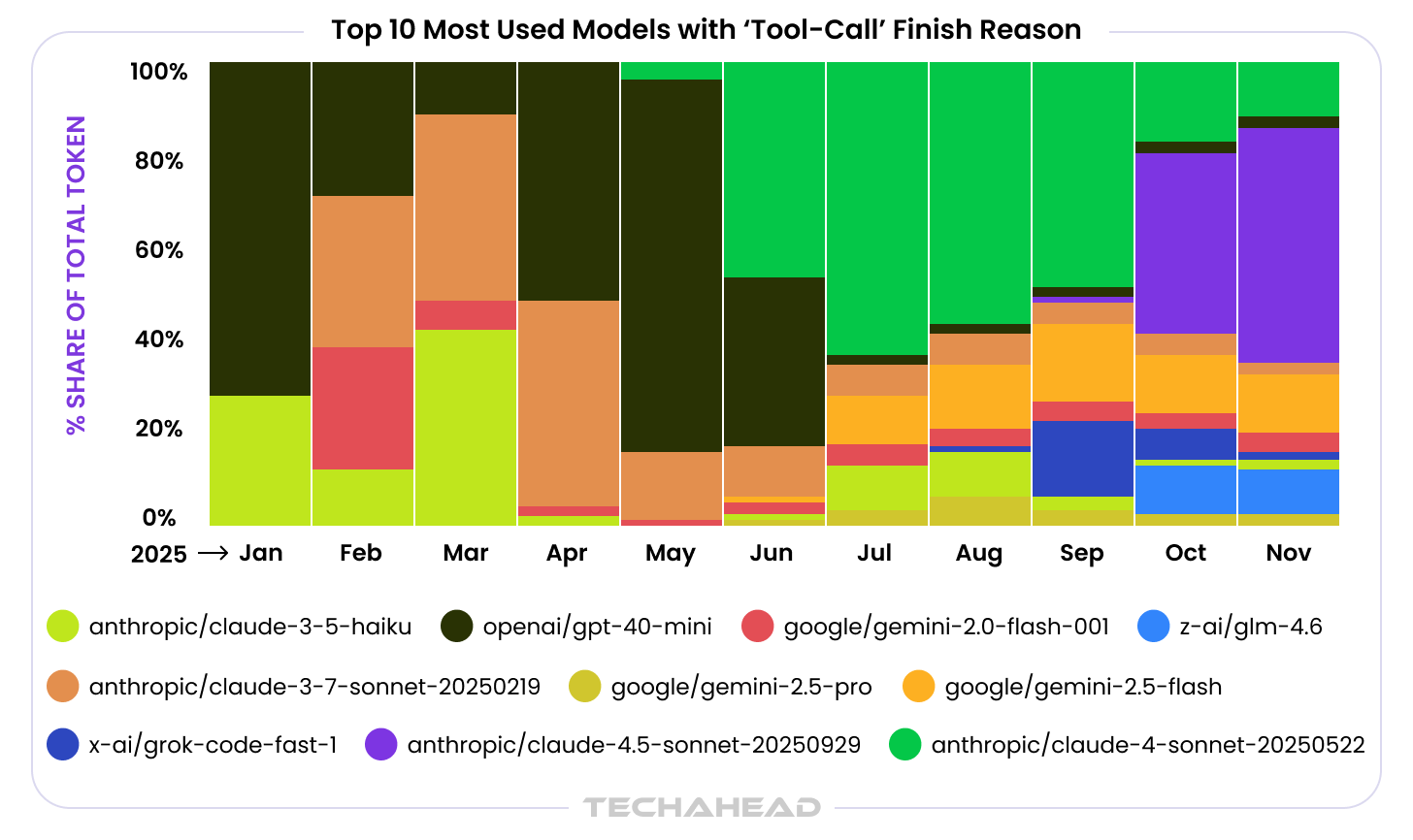
Note the provenance honestly: this is the platform analyzing its own traffic, co-authored with an investor, not independent academic work. With that caveat, the findings are consistent with what the rest of the market shows. The study observed substantial adoption of open-weight models, heavy use for coding assistance, and a clear rise in agentic inference. Independent coverage of the same study reported that Chinese-developed open-weight models climbed from roughly 1.2% of weekly token share in late 2024 to peaks near 30% during 2025.
One honest wrinkle on that study, since it matters for enterprise readers. The same data showed creative roleplay made up more than half of open-weight model usage, which means raw platform tokens are heavily consumer, not enterprise. So the enterprise case does not rest on total volume. It rests on the direction of travel: open-weight options are getting good enough to route real work to, coding is a dominant serious use case, and agentic workloads are multiplying model calls. Those are the signals that make a gateway matter for a business, and they hold regardless of how much of the platform is people roleplaying.
The investor thesis reads the same shift. As one account of the funding put it, OpenRouter’s rise suggests the model is becoming an invisible, swappable engine rather than a vendor you marry. Its backers have compared the company to Cloudflare and Stripe, the argument being that every platform shift opens an infrastructure gap, and whoever fills it captures a durable utility layer. Enterprises, on this view, have no intention of locking into a model vendor the way they once locked into a database. The multi-model future is already here, and orchestration is how you live in it.
The sharpest critique is that OpenRouter may be eroding its own reason to exist. If models keep The sharpest critique is that OpenRouter may be eroding its own reason to exist. If models keep converging in quality and inference prices keep falling, the value of cleverly routing among them shrinks. When every capable model is cheap and roughly comparable, the router becomes a thinner slice of the stack. The counterargument is that fragmentation is backed by real demand rather than hype, since different models genuinely lead on different tasks, but the tension is real and worth watching over the next few product cycles.
The governance gaps are more immediate, and they are where regulated enterprises should slow down. On a shared gateway, data retention is typically set per model, not across the platform. Some models run with zero data retention, while others carry an explicit warning that prompts and completions may be logged by the upstream provider. The gateway in front of them is identical. The policy behind each one is not.
That means compliance cannot be a single switch. Your team has to track and enforce data policy model by model, which is exactly the kind of detail that becomes an incident when it is assumed rather than verified. Regulated prompts that land on a logging provider do not announce themselves.
There are operational edges too. A gateway on its own does not give you:
Mature gateways also centralize token usage and cost visibility for engineering teams.
Routing solves the input-side problem of model access. It does not, on its own, solve the output-side problems of cost control, auditability, and compliance. And sometimes going direct still wins: if you run one model at high volume on a negotiated contract with strict data terms, an extra abstraction can add cost and policy surface you do not need. This is the same reason so many enterprise AI pilots stall on the way to production.
Strip away the funding news and the enterprise question is simple to state and hard to answer. Model choice has moved from a procurement decision to a runtime architecture decision. So do you build your own routing layer, buy a gateway like OpenRouter, or impose governance over whatever you use? An LLM Gateway can be consumed as a managed service or self host on your own infrastructure, whether you are routing third-party APIs, self hosted models, or even providers like vertex ai. For most enterprises it is not either-or. It is a sequence, and knowing which posture fits which workload is the actual work.
| Model | Control | Time to Value | Cost Model | Compliance Fit | Maintenance Burden | Best Fit |
| Build your own | Full | Slowest. Months to first value. | High fixed cost, low marginal at scale. | Strong, if built for it. Nothing leaves your boundary. | Yours forever, every new model included. | High-volume or regulated workloads where routing is core IP. |
| Buy a gateway | Lowest | Fastest. Live in an afternoon. | Pass-through pricing plus a platform fee. | Conditional. Per-model retention, enforced by you. | Low. Provider absorbs churn. | Experimentation and teams needing model breadth now. |
| Govern on top | Shared | Medium. Faster than build, slower than raw gateway. | Adds a governance layer over your base. | Strongest. Policy enforced in the request path. | Ongoing, but controls not plumbing. | Regulated teams past pilot, moving real workloads. |
The three are not rivals. Most enterprises buy first to move fast, then add governance as workloads get serious, and build selectively where routing itself is a competitive advantage. The mistake is skipping the middle column and pushing a raw gateway straight into regulated production, especially in regulated industries where self-hosted deployment allows tighter compliance controls. That is where the per-model policy gaps turn into audit findings.
There is a narrower comparison worth making inside the “buy” path, because plenty of teams over-adopt a gateway when direct access would serve them better.
| Dimension | LLM Gateway (e.g., OpenRouter) | Direct to a single provider |
| Integration effort | One endpoint, one key, hundreds of models. | One integration per provider added. |
| Reliability and fallback | Automatic failover across providers serving the same model. | You build retries and failover yourself. |
| Cost transparency | Pass-through pricing plus a platform fee. | Provider’s published rate, no middle fee. |
| Data-policy control | Per-model, so tracked and enforced by you. | One contract, one negotiated data term. |
| Vendor lock-in | Low. Switching models is a config change. | High. Switching means re-integration. |
| When it wins | Many models, changing needs, uneven load. | One model, high volume, strict data terms. |
Read those two tables together and the pattern is clear. A gateway buys breadth, speed, and freedom from lock-in. Direct access buys simplicity and clean contracts. Governance is what makes either one safe at enterprise scale. None of it is a product you can purchase in finished form, which is the whole point.
The govern posture is where the real engineering judgment concentrates, and it is more than a compliance checkbox. Done well, it means:
This is the same discipline that separates a working demo from a system, and it is why moving stalled pilots into production usually comes down to an orchestration and governance harness rather than a better model.
Notably, OpenRouter’s own roadmap points here too, toward helping enterprises find call sites where a cheaper model would have produced the same quality. That is a quiet admission that the routing decision is ultimately about your workloads, not the router’s defaults. Which is exactly where a build partner earns its keep. Designing that layer well is a core part of any serious generative AI engagement, and for organizations standing this capability up internally it is the connective tissue between an AI Center of Excellence that sets policy and the AI infrastructure that has to enforce it in production. As workloads shift from single calls to chained, tool-using pipelines, the same routing and governance decisions extend directly into agentic AI systems, where a single task can fan out across many models and every hop is a policy and cost decision.
The pace of model releases is not slowing. Twelve in a week will look quaint soon enough. So the question is no longer whether you will use more than one model. You already do, or you will. The question is whether your architecture can choose between them intelligently, on every request, without a rewrite each time the frontier moves.
OpenRouter is winning because it read that shift early and built for it. The AI model gateway it popularized is now a category, and the category exists because model choice became continuous. But the lesson for an enterprise is not “adopt OpenRouter.” It is that the durable advantage sits in how you route, fall back, and govern, not in which model you happened to pick this quarter.
This is the part where most teams want a hand, and not because the concept is hard. The concept is clear by now. The hard part is the honest build-buy-govern call for your specific workloads, then the engineering to make it real: routing logic that reflects your tasks, fallback and cost controls that hold under load, and governance wired into the request path rather than bolted on after an audit, with one platform able to unify routing, governance, and observability for production ai applications. Gateway vendors will not give you a neutral read on that, because they sell the gateway. That is where a generative AI partner like TechAhead fits: a team with no stake in a particular gateway, that can weigh the decision against your workloads, build the routing and governance layer, and move it from pilot to production without the usual stall.
The model is becoming a swappable engine. The orchestration around it is the part you actually own, and the part worth engineering with intent.
An LLM gateway sits between your app and multiple model providers, handling routing, failover, and policy through one interface. An API gateway manages network traffic. Same instinct, different layer: one governs model calls, the other governs services.
Not quite. Mixture of Experts routes tokens between experts inside a single model, automatically. Model routing sends your request across different providers and models. One is architecture you can’t configure; the other is an orchestration decision you own.
Honestly, about the moment you run more than one model. Once you’re juggling multiple providers, failover logic, and scattered keys, you’re already building gateway infrastructure. An LLM gateway just makes that multi-model orchestration deliberate instead of accidental.
Depends on the workload. Buy a gateway for speed and breadth when you’re experimenting. Build when routing is core IP or compliance demands full control. Most enterprises buy first, then govern, then build selectively where it matters.
Governance has to live in the request path, not a policy doc: per-provider data rules, audit trails, and access control enforced on every call. TechAhead builds that AI model gateway and governance layer around your multi-model stack, so compliance isn’t an afterthought.
It can be, with caveats. On a shared gateway, data retention is set per model, not platform-wide. For HIPAA, SOC 2, or GDPR work, you’ll need to enforce data residency and audit controls yourself before routing production traffic.
You wire per-model data policy into the routing layer, so a regulated prompt can only reach approved, zero-retention endpoints. TechAhead sets up exactly this kind of enforced model routing, so nothing sensitive slips through by default.
Usually an orchestration and governance harness, not a better model. Think evaluation-based routing, failover design, and observability. TechAhead specializes in taking stalled multi-model orchestration pilots and hardening them into governed, production-grade systems.
A good LLM gateway detects the outage and fails over automatically to another provider serving the same model, usually within milliseconds. Your users never see the 503. That automatic failover is model routing’s most underrated benefit.
Fusion runs your prompt through a panel of models in parallel, then a judge model synthesizes their answers. It’s not an everyday tool, but for high-stakes calls where being wrong is expensive, that cross-check earns its place.
We use cookies to ensure our website functions properly, improve performance, and provide a personalized experience. You can choose which types of cookies to allow below.
Required for core functionality such as security, network management, and accessibility. These cannot be disabled.
Help us understand site traffic and user interactions so we can improve performance and usability.
Enable enhanced functionality and personalization such as language or region preferences.
Used to deliver relevant ads, track campaign performance, and measure advertising effectiveness.