


 Copy Link
 Share on X
 Share on Facebook
 Share on LinkedIn
Always Active
Required for core functionality such as security, network management, and accessibility. These cannot be disabled.

Uncover the transformative potential of digital and mobile solutions for your industry.





 Last Updated: Sep 21, 2026
Mar 3, 2026
Last Updated: Sep 21, 2026
Mar 3, 2026  2405
2405  23 min. Read


Key Takeaways



The global AI agents market size is expected to reach $182.97 billion by 2033, growing at a CAGR of 49.6% from 2026 to 2033. Furthermore, 92% of leaders believe that agentic AI will deliver measurable ROI within two years.
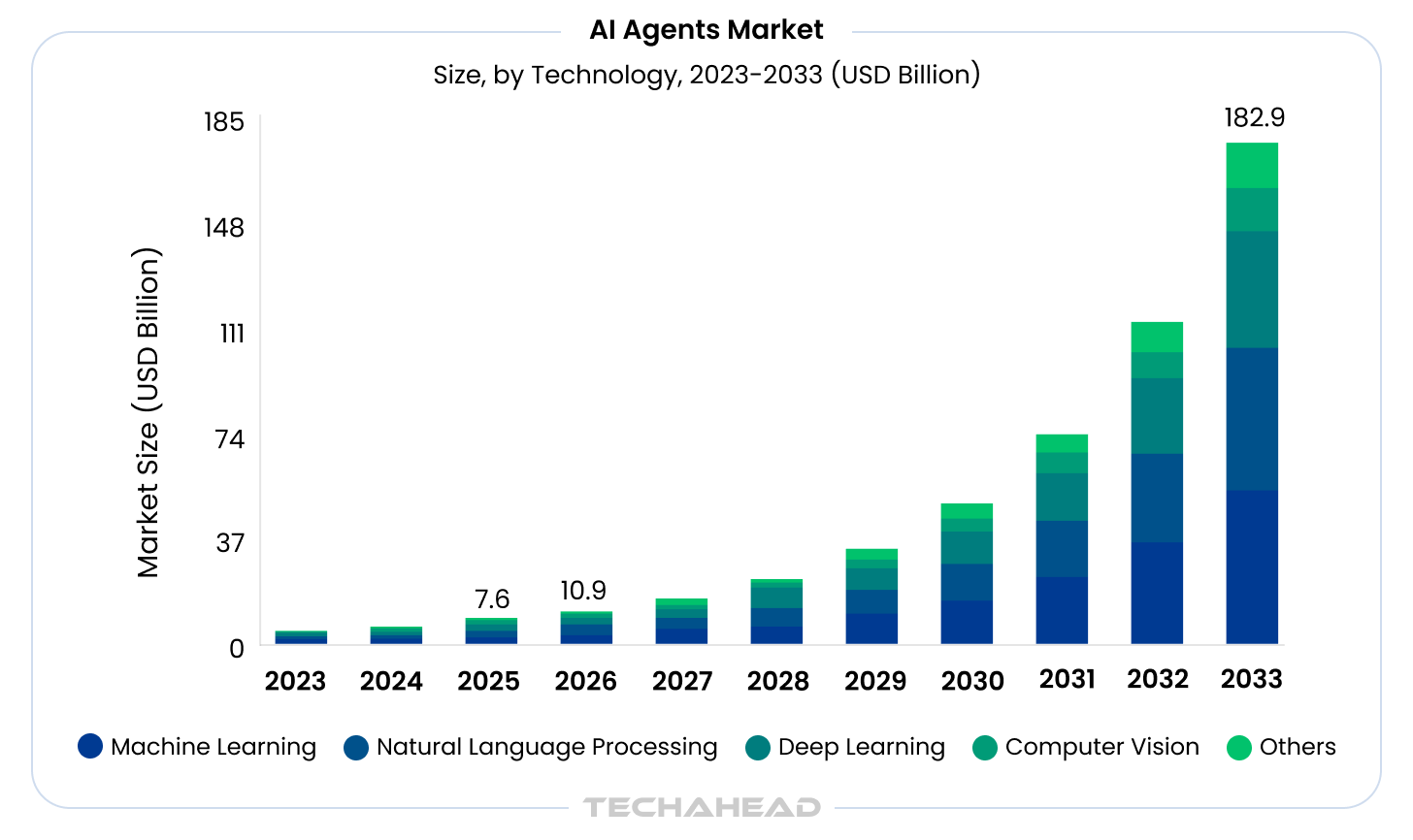
Source: Grand View Research
That’s not a projection to bookmark for later, but a shift that is already in motion. The organizations pulling ahead in 2026 are not the ones that understood agentic AI first. They are the ones that committed to it while everyone else was still forming a committee.
With technology moving at such a fast pace, where new solutions are coming up every now and then, waiting for the right time for agentic AI solutions is long gone. 62% of organizations are now widely implementing Agentic AI technology, and 23% of them are scaling their autonomous AI agent solutions.
So, what does that actually look like, industry by industry? Recognizing the latest agentic AI use cases at your organization will give you a clear idea of how you can benefit from this lucrative technology.
And that’s what this blog breaks down. A clear look at the use cases of agentic AI that are delivering real value across enterprises right now, and what you need to think about before deploying.
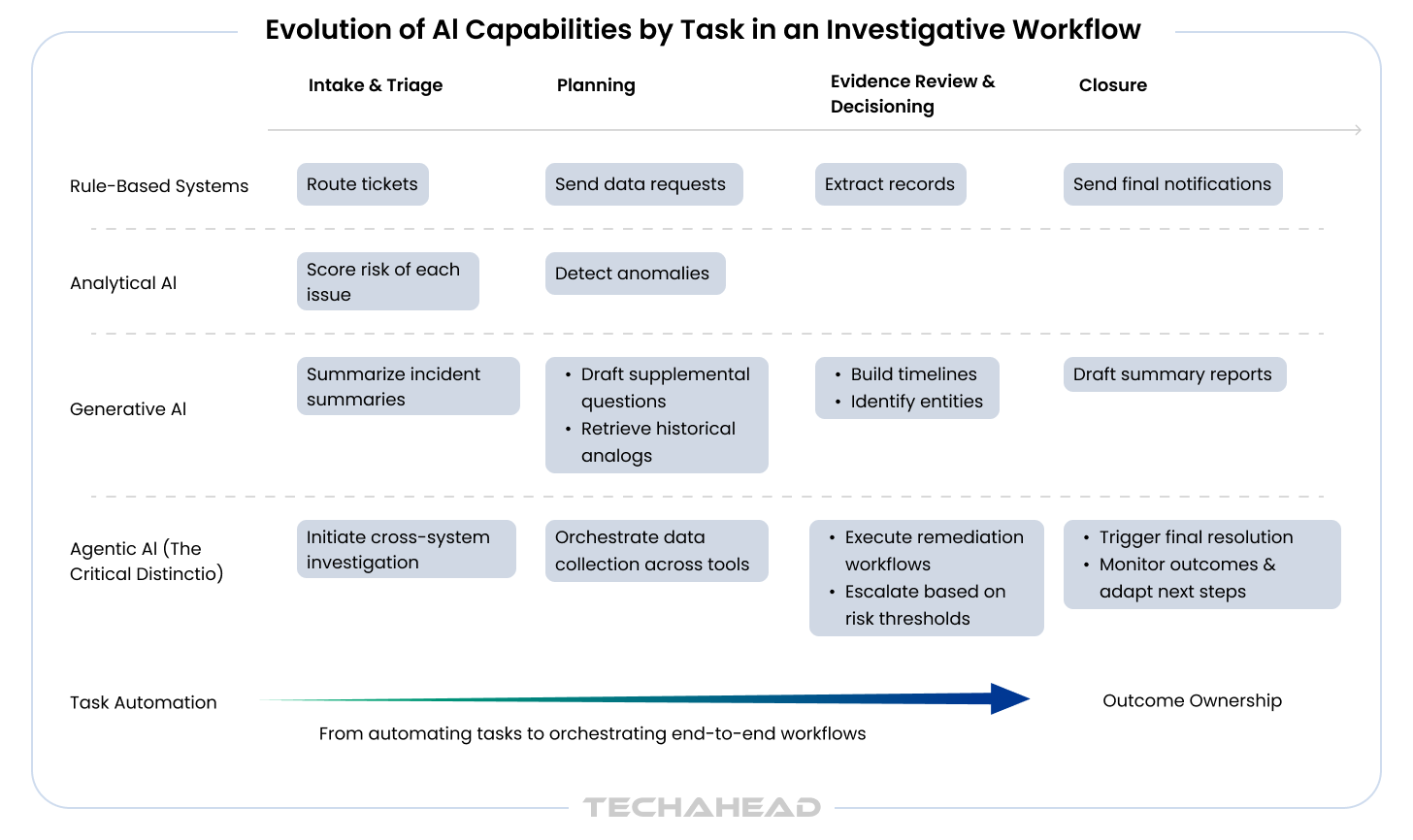
Most enterprise AI today still waits for you. You ask a question; it answers. You initiate a task; it assists. That’s useful, but it’s not agentic.
Agentic AI refers to autonomous systems that act on their own. It takes a goal, breaks it into steps, uses tools, makes decisions, and executes — without someone holding its hand at every stage. A traditional automation AI model helps your analyst pull data. An AI agent monitors the pipeline, spots the anomaly, investigates the root cause, drafts the summary, and routes it to the right person. The analyst reviews instead of producing.
Across sectors, leadership teams are reassessing disconnected systems where execution breaks down—where processes stall, where decisions wait in queues, and where human coordination becomes the bottleneck. The renewed focus on the use cases of agentic AI is a direct response to that pressure.
Enterprises are expected to deliver faster service, shorter release cycles, and higher customer satisfaction—often with the same or smaller teams. Agentic AI systems change that equation. Instead of assisting a user, they own a defined outcome.
Insurance claims that need manual review. Fraud alerts require contextual judgment. Supply chain disruptions that break predefined rules. AI agents can reason across intelligent systems, pull contextual data, evaluate risk thresholds, implement a risk management framework, and decide the next action. In regulated industries, this means faster adjudication. In operations, it means fewer stalled processes.
Manual orchestration is expensive—not only in salary cost, but in delay cost. Consider the key use cases of AI agents in customer support. A typical case may move through routing, summarization, response drafting, compliance checks, and documentation. Each handoff creates latency.
Enterprise platforms now expose robust APIs. ERP, CRM, ITSM, and data platforms are increasingly interoperable. Cloud-native architectures allow real-time data exchange. This integration maturity makes it feasible for agents to operate across multiple systems rather than within isolated tools.
In 2026, enterprises are not prioritizing agentic AI solutions because they are experimental. They are prioritizing it because the technical foundation now supports execution at scale. That’s the shift. And below are the agentic AI enterprise use cases latest building up across industries that show exactly what this looks like in practice.
Agentic AI can enhance customer experience by providing hyper-personalized interactions, autonomously managing customer interactions, and anticipating future needs based on historical data. Highest ROI velocity of any function — deployable fast, measurable faster.
Heavy admin burden, highly structured workflows, and compliance complexity are the exact environment where AI agents add the most leverage. Let’s explore some of the key use cases of agentic AI in healthcare transforming patient care.
In the financial sector, agentic AI is used for fraud detection by autonomously monitoring transactions in real time, detecting behavioral anomalies, and updating detection patterns based on new fraud signals. This is a highly process-driven and rule-heavy industry. Hence, it is ideal for agentic automation at scale.
The global AI agents in the financial services market size is expected to reach $6,708.0 million by 2033, growing at a CAGR of 31.5% from 2026 to 2033.
Agentic AI can autonomously optimize the transportation and logistics process by managing vehicle fleets, delivery routes, and logistics on a large scale, increasing cost savings and helping organizations meet their sustainability goals. Operational ROI per use case of Agentic in the supply chain is among the highest.
Cross-functional orchestration is the retail opportunity — agents span merchandising, pricing, marketing strategy, and ops simultaneously.
In education, agentic AI tools can provide personalized learning experiences by adapting content in real-time based on individual student performance and learning styles, significantly improving engagement and outcomes. Strong personalization opportunity with low compliance-heavy backend workflows, but high learner-facing impact.
As adoption scales with IoT infrastructure and connectivity penetration, it creates high potential for agentic AI use cases.
Real-time responsiveness and personalization are the core value drivers in this sector.
Operational continuity and quality are the primary value drivers — downtime and defects are expensive at scale.
Approximately 70% of enterprise marketing leaders believe agentic AI will be a transformative technology for marketing. Agentic AI enhances marketing efficiency by automating multi-step workflows, allowing teams to focus on strategic insights rather than repetitive tasks. By integrating real-time performance data, agentic AI can autonomously adjust marketing workflows, improving campaign velocity and personalization.
Different industries. Different pressures. But one consistent pattern: the organizations moving the fastest are the ones deploying agentic AI against their highest-volume, most structured workflows to execute tasks and transform creative direction.
Here is what AI-driven outcomes look like, by sector, with real world Agentic AI work examples already in production.
The use cases above are real, and the data behind them is solid. But Gartner also projects that more than 40% of agentic AI projects will be canceled by 2027 — not because the technology doesn’t work, but because organizations skip the fundamentals.
Here’s what separates AI agent deployments that scale from ones that stall:
Decide what the agent can do autonomously, what requires human approval, and what triggers an escalation — before you deploy. Governance isn’t what slows you down. It’s what lets you scale without losing control.
Only 45% of companies are actively rethinking their operating models in light of AI agents (PwC). The ones that are tend to be the ones seeing consistent ROI.
Agentic AI is going through evolution and no longer lives in a demo environment. It connects to your CRM, ERP, data warehouse, and communication layer. The organizations that underestimate this complexity are the ones with pilots that work beautifully in presentations and break in production. Budget for the integration work upfront.
Every function touched by agentic AI will see roles redefined. Less than 10% of organizations have scaled AI agents in any individual function (McKinsey). The gap isn’t technology — it’s organizational readiness. Running the workforce redesign conversation in parallel with the deployment, not six months after it, is what separates implementation from transformation.
Leading organizations work with TechAhead because enterprise AI implementation is not only about deploying models. It requires strong system architecture, connected workflows, governed data pipelines, and reliable execution across production environments. TechAhead focuses on building AI-native systems that operate within real business processes instead of isolated proof-of-concept experiments.
The company brings deep experience in building agentic AI systems, enterprise platforms, and workflow automation solutions across industries. Its work on the ERIN employee referral platform shows how intelligent systems can automate hiring workflows, improve employee engagement, and support HR operations through AI-driven recommendations and automation.
TechAhead also helps organizations solve one of the biggest challenges in AI adoption: fragmented systems and disconnected data. The company integrates platforms, aligns operational workflows, and builds scalable infrastructure that allows AI agents to function reliably across enterprise environments. This creates stronger operational visibility, better governance, and long-term scalability for AI initiatives.
With more than 16 years of experience, TechAhead works with startups, scaleups, and enterprises that need production-grade AI systems built for long-term growth. Their focus on architecture, governance, scalability, and continuous system improvement makes them a strategic technology partner for organizations adopting agentic AI at scale. Businesses can connect directly with the team through the TechAhead Contact Page to discuss AI implementation requirements and enterprise transformation goals.
Agentic AI in 2026 is operating infrastructure, not a future roadmap item. The use cases of agentic AI documented across these industries are running in production, and the performance data is in.
93% of business leaders believe those who successfully scale AI agents in the next 12 months will gain a durable competitive edge (Capgemini). That window is open right now.
The organizations building that edge are the ones that partner with an AI development company to move from evaluation to execution while the window of opportunity is still open. picked a high-value use case, set up governance early, invested in integration, and moved — while others were still evaluating.
The question isn’t whether agentic AI belongs to your enterprise. The question is which use case you’re starting with, and whether you’re moving fast enough to matter.
Agentic AI is moving fast, and it’s moving across almost every major business function. In 2026, the use cases of agentic AI are no longer experimental. They’re in production, and the ROI data is coming in. Some of the primary use cases of agentic AI are autonomous customer service resolution, customer support routing & escalation, insurance claims & underwriting automation, predictive maintenance in manufacturing, and clinical documentation & healthcare workflow automation.
The best use case of agentic AI in customer service is autonomous support resolution, which is measured by speed of deployment and clarity of ROI.
Here’s what that actually looks like: an AI agent receives an incoming support request, verifies account data, diagnoses the issue, executes the fix, and closes the ticket. No human touchpoint. No escalation. The customer gets a resolution, often in minutes.
This is the most common point of confusion, and it matters because choosing the wrong option for the wrong job is expensive.
The short version: chatbots respond. AI agents act.
A bit more precisely:
Chatbots are reactive and rule-bound. They wait for a user to initiate, match the input to a predefined response or decision tree, and reply. Even NLP-powered chatbots are fundamentally scripted — they’re better at understanding the question, but still limited in what they can do with the answer.
AI agents are proactive and goal-oriented. They receive a goal, break it into steps, use tools and APIs, make decisions, and execute — without needing a human prompt at each stage. They can initiate, not just respond.
The industry enterprise leaders seeing the sharpest ROI from agentic AI extend two traits: high transaction volume and structured, repeatable workflows. The more standardized the process and routine tasks, the more leverage an agent creates.
BFSI: The process-heavy, rule-driven nature of financial operations is exactly where agents compound value fast.
Healthcare: The admin burden in healthcare is acute — clinicians spending more time on documentation than on care is well-documented. Agents tackling clinical notes, care coordination, and patient engagement are solving a problem the sector has tried to solve manually for years.
Customer Service: The key use cases of AI agents in customer support — resolution, retention, escalation assist — are among the fastest to deploy and the easiest to measure. That makes it the most common starting point for enterprises new to agentic AI.
Supply chain, HR, legal, retail, and manufacturing all follow with strong but more targeted use cases. The common thread: any function where a human is currently spending significant time on process execution, not judgment, is a candidate.
Yes — with the right governance architecture. The concern is understandable. Autonomous AI systems making decisions in environments governed by HIPAA, GDPR, FINRA, Basel IV, or RBI legal and compliance processes carry a real risk of evolving attack patterns and emerging threats if deployed without coordinated workflows. But the answer to that risk isn’t to avoid agentic AI — it’s to build governance into the deployment from the start, not as an afterthought.
Yes. Agentic AI solutions can continuously monitor systems, analyze data from multiple external tools and data sources, and detect unusual activity in real time. These agents help organizations improve compliance monitoring by tracking policy violations, identifying security risks, and generating audit-ready reports automatically. They can also integrate with service management and version control platforms to monitor operational changes, user access, and deployment activity across environments.
Traditional automation follows fixed rules and handles repetitive tasks with limited adaptability. Robotic process automation works well for structured workflows but struggles with fragmented data and changing conditions. Agentic AI automation systems go beyond task execution. They can analyze context, make decisions, adapt workflows, and act autonomously across systems. This makes agentic AI implementation more effective for dynamic business environments that require continuous decision-making and real-time responses. Unlike generative AI, which focuses on content creation, agentic AI drives action and decision-making, allowing it to execute complex workflows without requiring constant human input.
AI agent lifecycle management is the process of monitoring, updating, governing, and optimizing AI agents throughout their operational lifecycle. It includes deployment, performance tracking, version control, security oversight, compliance checks, and continuous improvement. Proper lifecycle management ensures agentic AI systems remain accurate, reliable, and aligned with business goals as data, workflows, and operational requirements evolve.
Agentic AI helps HR teams automate repetitive processes and improve workforce management. AI agents can screen resumes, schedule interviews, manage onboarding workflows, answer employee queries, and monitor compliance requirements across HR systems. They can also analyze employee data to identify retention risks, skill gaps, and hiring trends, helping organizations make faster and more informed workforce decisions.
To successfully implement agentic AI, organizations should start with workflows where teams are losing time, ensuring that the workflow can be controlled and that the first version of the AI agent is a guided workflow requiring human approval for high-impact actions. Successful deployment of agentic AI requires careful customization and integration into existing business infrastructure, aligning AI systems with organizational objectives and optimizing data pipelines. To integrate agent-based systems into existing workflows, organizations should start with a small AI pilot, integrate step by step, and keep human fallback options in place.
Agentic AI can enhance customer experience by providing hyper-personalized interactions, autonomously managing customer inquiries, and anticipating future needs based on historical data. Initial agentic AI deployments can deliver 3–5% annual productivity gains, while scaled multi-agent systems can increase enterprise growth by 10% or more, according to McKinsey. For AI to deliver real, lasting value, trust must be built first, requiring employees to understand how AI works, how data is used, and what control they have over it.
We use cookies to ensure our website functions properly, improve performance, and provide a personalized experience. You can choose which types of cookies to allow below.
Required for core functionality such as security, network management, and accessibility. These cannot be disabled.
Help us understand site traffic and user interactions so we can improve performance and usability.
Enable enhanced functionality and personalization such as language or region preferences.
Used to deliver relevant ads, track campaign performance, and measure advertising effectiveness.