


 Copy Link
 Share on X
 Share on Facebook
 Share on LinkedIn

Always Active
Required for core functionality such as security, network management, and accessibility. These cannot be disabled.

Uncover the transformative potential of digital and mobile solutions for your industry.





 Last Updated: Oct 16, 2026
Aug 25, 2026
Last Updated: Oct 16, 2026
Aug 25, 2026  289
289  18 min. Read


Key Takeaways
Ask any room full of executives whether they can produce a number for what their AI investment will return, and most will hand you one within minutes. Ask them to defend that number in front of a finance committee three months later, and the room gets quiet.
That gap, between a number and a number you can defend, is the real story behind enterprise AI development spending today. Plenty of tools online will generate a return figure in two minutes flat. That was never the hard part. The hard part is arriving at that meeting with inputs solid enough to survive scrutiny: real cost baselines, honest adoption assumptions, and a clear view of what happens when a use case moves from a promising pilot to a live production workload.
Industry research puts a number on how often that survival happens. Among 782 infrastructure and operations leaders surveyed in late 2025, only 28% said their AI use cases fully met ROI expectations, while 20% failed outright, according to Gartner. The remaining majority sat somewhere in between: technically live, technically funded, and still unable to show a return anyone would call a win.
This blog is built for the executives standing in that gap. It walks through a complete enterprise AI ROI calculator framework: the questions worth answering before you calculate anything, a fully worked example you can adapt for your own organization, and the checkpoints that keep a business case honest as a use case moves toward production.
A search for an enterprise AI ROI calculator turns up two broad categories of tools today. The first type benchmarks your inputs against a large dataset of real-world AI use cases, showing you what similar organizations in your industry and size bracket typically achieve. The second type is built by a specific AI vendor and scoped tightly to their own product, showing detailed math for a handful of preset scenarios.
Both categories earn their place. A benchmark-driven calculator gives business leaders a useful reference point for what good looks like in their sector. A vendor-built calculator with transparent math is a genuine improvement over the black-box tools that dominated this category a few years ago.
Here is where both fall short for an executive building a real business case. Every one of these tools assumes clean inputs are already sitting ready to enter: accurate headcount-to-task mapping, a real wage and overhead figure, a documented error rate, an honest read on how fast teams will adopt a new workflow. Gartner’s own research points to exactly this gap. Among I&O leaders who reported an AI initiative failure, 38% cited persistent skills gaps and the same share cited poor data quality as direct causes. The calculator was rarely the constraint. The inputs were.
This is the piece that most tools skip, and it is the piece an enterprise AI ROI calculator has to get right before any formula matters. Jumping on the AI bandwagon without this groundwork tends to land an organization squarely in the middle category: technically live, still short of expectations.
Most conversations about AI ROI collapse into a single question: how much time or cost will this save? That question captures only half the picture, and McKinsey’s research suggests the half left out is where the largest business value tends to concentrate.
McKinsey’s State of AI research splits organizations into two groups. Eighty percent of all respondents name efficiency as an objective for their AI initiatives. High performers, the small group of organizations that report AI contributing five percent or more to EBIT, are far more likely to name growth and innovation as explicit objectives alongside efficiency, according to McKinsey. They are also 3.6 times more likely to describe their AI ambitions as genuinely transformative rather than incremental.
That distinction matters when you calculate AI ROI for a new use case. Efficiency ROI shows up as cost savings, time savings, and productivity gains, the numbers that are easiest to defend because they map cleanly to hours and headcount. Growth ROI shows up as revenue growth, new markets entered, conversion rates lifted, annual revenue expanded, and customer satisfaction improved, numbers that take longer to materialize and are harder to isolate from other business activity.
An enterprise AI ROI calculator that only has fields for cost savings has already excluded the category of AI use case most associated with the highest business impact. When business objectives include revenue growth alongside operational efficiency, the calculator needs to as well.
Also Read: AI Readiness Assessment for Enterprises
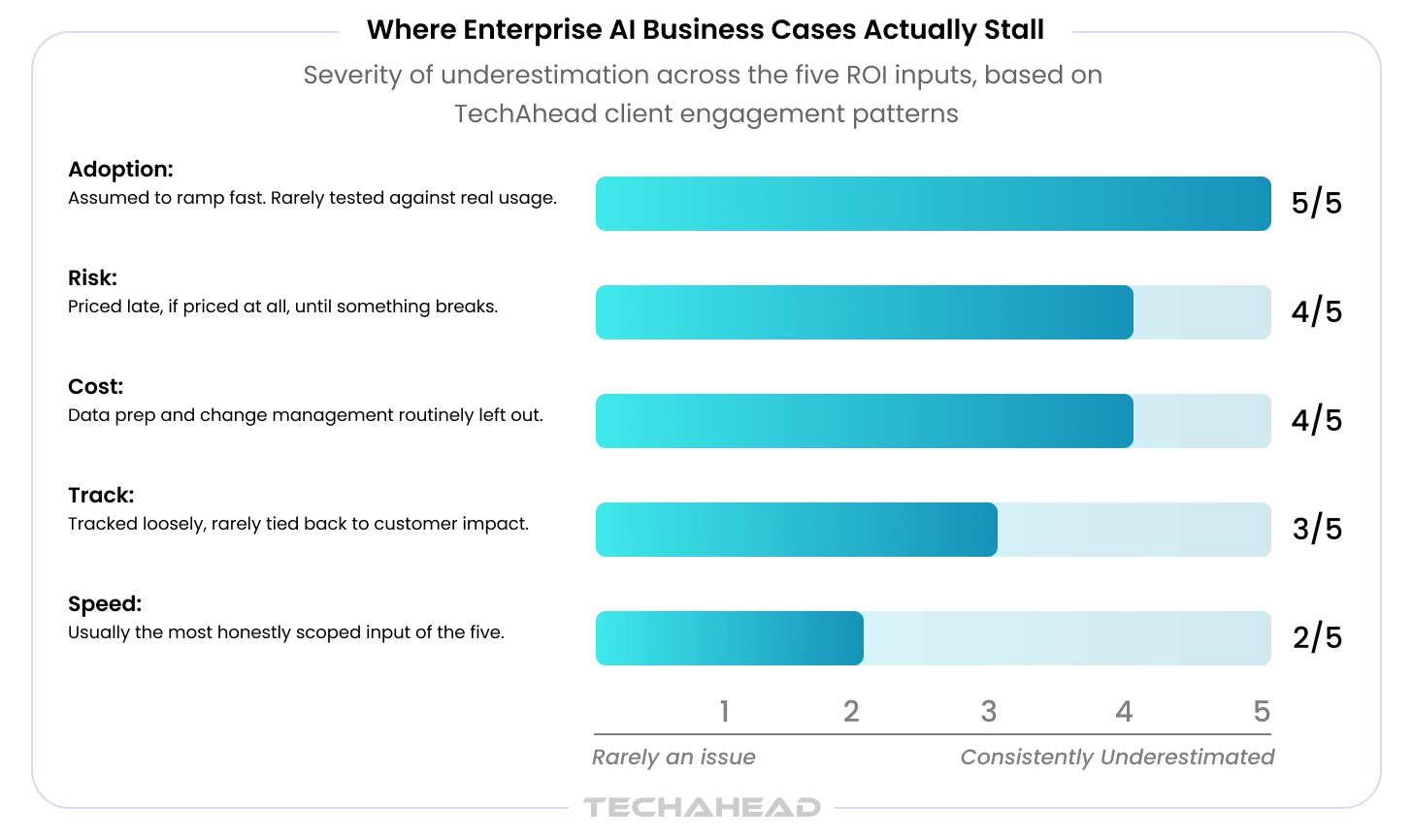
Here is where most AI ROI conversations skip a step. Before a single formula runs, five categories of inputs deserve honest answers. Treat this as the discovery phase every serious AI initiative goes through, whether that discovery happens with a spreadsheet, a consulting partner, or a working session with your own team.
Answer these five blocks honestly, and the arithmetic that follows becomes the easy part. Most business cases that stall in production stall because one of these blocks was assumed instead of answered. Involving human resources and finance early, alongside the technical team, tends to surface the gaps faster.
Numbers persuade more than frameworks. Here is a complete enterprise AI ROI calculator walked through by hand, using a realistic composite example: an AI-assisted customer support workflow for a mid-size company with 40 support agents.
Fully loaded cost per agent: $75,000 annually, including benefits and overhead. Total team cost: $3,000,000 annually. Average handling time per ticket: 12 minutes. Ticket volume: 250,000 per year.
Based on ticket categorization, 55 percent of tickets are repetitive and high frequency enough to qualify for AI-assisted resolution. This is a deliberately conservative figure. Tickets requiring judgment, escalation, or emotional handling stay with human agents.
250,000 tickets multiplied by 55 percent equals 137,500 tickets assisted by AI annually. At 12 minutes per ticket, that is 27,500 hours reclaimed across the team each year, roughly 14.6 full-time equivalents worth of capacity.
Only a portion of reclaimed hours converts directly to cost savings. A share goes toward faster resolution and improved quality rather than headcount reduction. Assume 60 percent of reclaimed hours convert to measurable productivity gains, either through reduced overtime and contractor spend or redeployment to higher-value work that previously had no capacity. 27,500 hours multiplied by 60 percent equals 16,500 hours of measurable value. 16,500 hours multiplied by an average loaded hourly rate of $42 equals $693,000 in annual value.
Platform and licensing cost: $180,000 annually. Data preparation and integration, year one only: $220,000. Training and change management: $90,000 in year one. Year one total cost: $490,000. Year two and beyond, once the one-time data preparation cost rolls off: $270,000 annually.
Year one net value: $693,000 minus $490,000 equals $203,000, roughly 41 percent ROI. Year two net value, with quality gains lifting measurable value to $780,000: $780,000 minus $270,000 equals $510,000, close to 189 percent ROI. Payback period, based on monthly value accrual: approximately 8.5 months.
This is the shape of a defensible enterprise AI ROI calculator. Every input traces back to a real number the team can locate, every assumption is stated instead of hidden, and the same six steps apply whether the use case sits in customer support, finance operations, or software engineering. Swap the baseline numbers for your own, and the formula holds. Financial returns tend to compound in year two, once one-time setup costs stop recurring.
Also Read: How to Align AI Capabilities with Business Outcomes
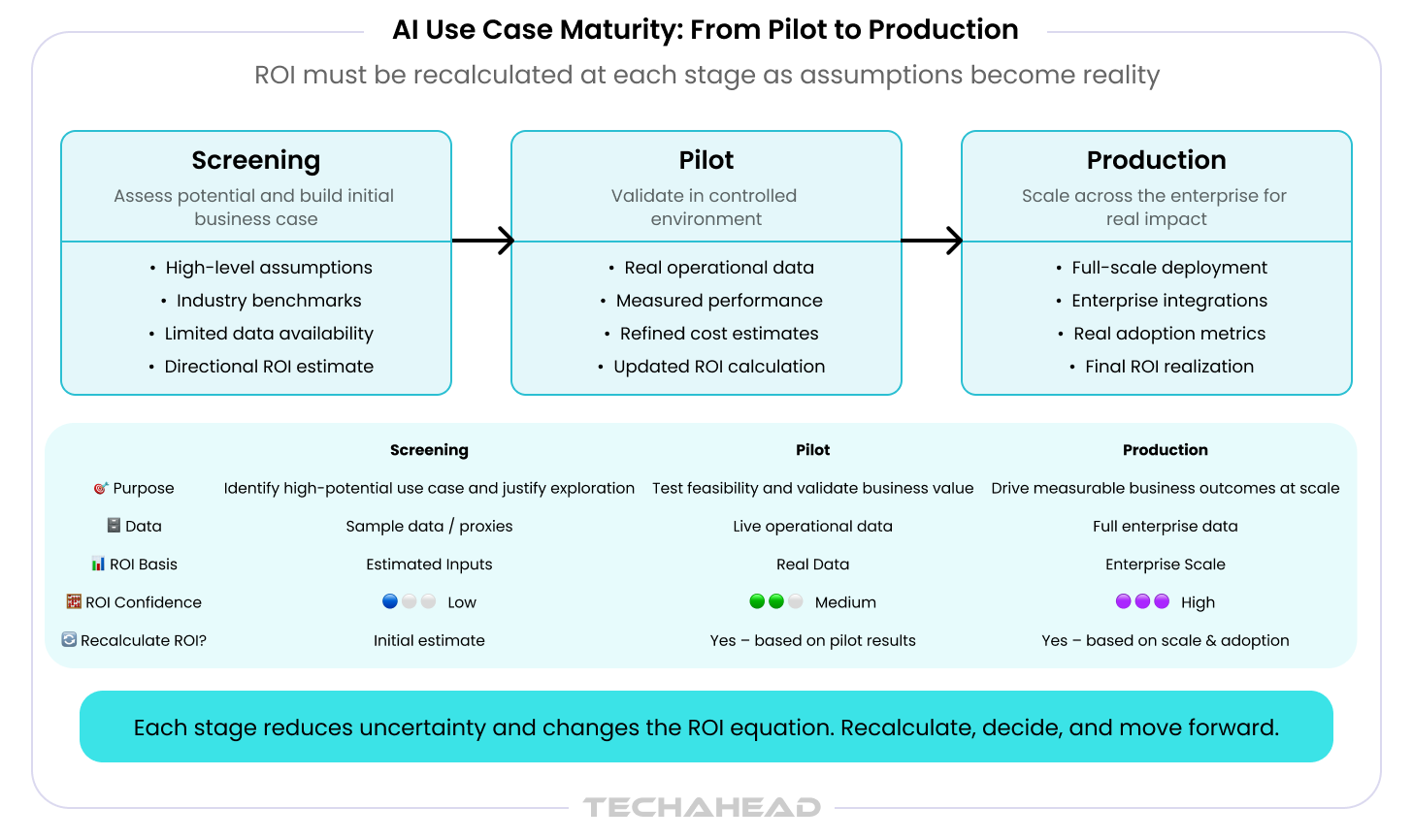
A business case built once and never revisited is the most common way a strong pilot turns into a disappointing production rollout. Among the 77% who reported at least one successful AI use case, success was attributed primarily to integrating AI into existing workflows and systems, and to securing full support from business executives throughout execution, extending well past the initial approval. Both factors require the business case to stay current.
Three checkpoints deserve a fresh look at all five variables from the requirements questionnaire above.
Before funding, run the numbers with conservative assumptions and flag which inputs are estimates versus confirmed data. This is where most calculators start and stop.
Once real usage data exists, replace every estimate with an observed number. Adoption almost always looks different in practice than in the plan, and cost frequently shifts once data preparation work is actually underway. This checkpoint is where an honest business case earns credibility with finance.
As the use case moves from a single team to the wider organization, cost per unit typically improves, though the complexity of change management and risk exposure grows alongside it. Re-score all five variables here, because the assumptions that justified a 50-person pilot rarely hold unchanged at 2,000 users.
Enterprise AI ROI calculator work continues well past the funding meeting. It carries through each of these gates, which is exactly why a documented formula outlasts a one-time number from any tool.
Most calculators, including the basic one, stop at Efficiency Value. That’s fine for a task-automation use case. It understates anything customer-facing or agentic, where growth and risk carry more weight than time saved. Your AI transformation journey should consider the following ways to estimate the return and ensure better decision-making.
1. Separate value into three streams
Total Value = Efficiency Value + Growth Value + Risk-Mitigated Value
2. Apply a risk-adjustment multiplier before you total anything
Adjusted Value = Total Value × Confidence Factor
Confidence Factor reflects how mature the use case is:
| Maturity | Confidence Factor |
| Proven pattern, your data, your industry | 0.85–1.0 |
| Proven pattern, new domain for you | 0.6–0.8 |
| Novel or agentic, limited precedent | 0.35–0.55 |
This single step is what separates a defensible number from an optimistic one. Skipping it is why pilot-stage projections routinely miss in production.
3. Run it across three years, not one
Year-one numbers almost always look worse than they are, because build and data prep costs front-load into year one while value ramps with adoption. A single-year ROI kills good use cases on paper and inflates bad ones with heavy year-one deployment tricks.
Net Present Value = Σ (Adjusted Value − Cost) ÷ (1 + discount rate)^year, for years 1 through 3
You don’t need a finance degree to run this. A simple 8–10% discount rate and three rows in a spreadsheet gets you there.
4. Model three scenarios, not one number
Conservative, base, and optimistic, driven by varying just two inputs: adoption rate and automation share. Present all three. A single point estimate is the fastest way to lose credibility with a CFO who has seen AI projections miss before.
5. Match the formula weighting to the use case type
This is the piece that makes the formula “cover all the scenarios.” A support-ticket deflection use case and a regulated-industry agentic workflow should never be scored with the same weighting, and most public calculators score them identically.
| Use case type | Dominant value stream | Weight risk adjustment |
| Back-office automation (support tickets, data entry) | Efficiency | Low |
| Customer-facing agent or copilot | Growth + Risk-Mitigated | Medium-High |
| Regulated workflow (finance, healthcare, compliance) | Risk-Mitigated | High |
| Net-new agentic workflow | All three, low confidence factor | High |
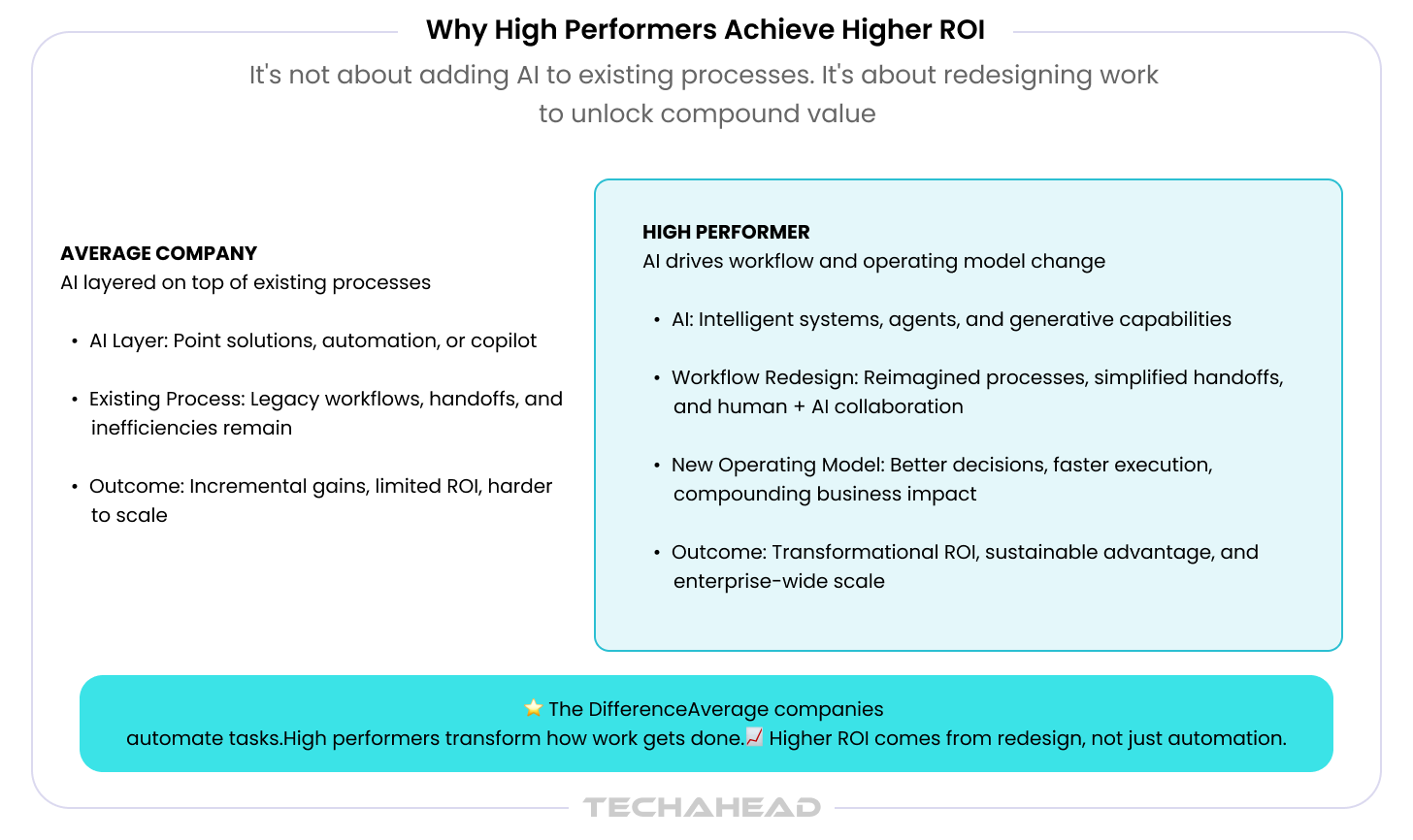
McKinsey’s research identifies a small group, about six percent of surveyed organizations, that report significant business value and attribute measurable EBIT impact to their AI initiatives, per McKinsey’s State of AI report. What separates this group is instructive for any executive building a case for AI investments.
High performers redesign core workflows rather than layering AI on top of existing ones. Fifty-five percent report fundamentally redesigning workflows when deploying AI, compared with roughly 20 percent among other organizations. They invest meaningfully, with more than a third allocating over 20 percent of their digital budgets to AI. And they extend AI ambitions past efficiency, pursuing business growth and new markets as explicit objectives from the outset, rather than afterthoughts added to satisfy a board presentation.
Agentic AI plays a growing role in this pattern. Where traditional automation handles a single task, AI agents can plan and execute multi-step workflows, which changes both the adoption curve and the risk profile in the requirements questionnaire above. An enterprise AI ROI calculator built for agentic AI use cases needs adoption and risk assumptions that account for a system operating with greater autonomy across the underlying workflow.
The throughline across this research stays consistent. Business performance from AI use is fundamentally an execution outcome, built on workflow redesign, sustained executive support, and a business case revisited as often as the workflow itself. Organizations that stay ahead of this curve treat the calculator as a living model, rather than a one-time slide filed away after the meeting that funded it.
Building a defensible enterprise AI ROI calculator is a strategic exercise. Building the AI systems that make the calculator’s projections real is an engineering exercise, and the two need to stay connected for either to hold up.
TechAhead is an AI development company that help organizations move from an approved use case to a production system that holds up against the numbers in the business case. That connection between financial modeling and production engineering is where many AI initiatives lose momentum, and it is where TechAhead’s teams focus most of their effort, across AI solutions, custom AI software, and the web and mobile platforms these systems ultimately run on.
An enterprise AI ROI calculator is a structured framework that estimates the financial and operational return of an AI initiative using five core inputs: cost, speed, quality, adoption, and risk. Rather than producing a single instant number, a reliable calculator documents every assumption so the projection can be defended in front of finance and revisited as the use case moves toward production.
79% of executives see productivity gains but struggle to measure ROI. Start with a fully loaded cost baseline for the current process, apply a conservative automation share to estimate reclaimed capacity, convert that capacity into financial value using a loaded hourly rate, then subtract the full cost of the AI system, including platform fees, data preparation, and change management. The result is a net value figure expressed as a percentage ROI and a payback period. Governance and compliance costs include legal reviews and data privacy safeguards. The time horizon for AI ROI is often measured over 1 to 5 years. Time-to-value measures how long it takes before an AI system generates returns.
According to Gartner’s 2026 survey of 782 infrastructure and operations leaders, only 28 percent of AI use cases fully meet ROI expectations, while 20 percent fail outright. The remaining majority deliver partial or mixed results, often because business cases get built once and never revisited as the use case scales. Organizations expect to increase AI spending by 46% in two years to ensure AI investments align with business goals.
Most calculators assume all reclaimed time converts directly into measurable output, when in practice a meaningful share flows into quality improvement, training, and strategic work that takes longer to show up on a balance sheet. Vendor lock-in can impact the validity of initial integration investments. Calculators that skip adoption assumptions and risk costs tend to produce optimistic numbers that are difficult to defend once a project moves into production. AI ROI calculations should include full costs beyond just model and API licensing. Generative AI typically delivers lower ROI than agentic AI.
Efficiency ROI covers cost savings, time savings, and productivity gains from automating existing work. Growth ROI covers new revenue streams, new markets, and improved customer satisfaction that AI initiatives can unlock. McKinsey’s research shows high-performing organizations pursue both, while most organizations focus almost entirely on efficiency.
Payback period varies by use case, but a well-scoped initiative with a clear automation share and honest adoption assumptions typically shows measurable value within 8 to 14 months, with ROI improving significantly in year two once one-time data preparation and setup costs stop recurring.
A significant one. Gartner’s research found poor data quality was cited by 38 percent of I&O leaders who experienced an AI initiative failure, tied with skills gaps as the leading cause. High quality data is a precondition for reliable AI ROI calculations, essential from day one rather than a detail to resolve after launch.
Companies using AI report $9.9 million in ROI this year.20% of companies capture 74% of AI-driven returns, per PwC. 30% of tasks are completed with AI assistance as of 2026. AI leaders report 7.2 times higher financial performance than others. Moreover, AI-driven systems can reduce compliance errors by 90%. Companies with specialized AI applications see a 67% success rate. For example, Organizations using WRITER achieved 333% ROI over three years, and CirrusMD achieved a 234% increase in physician benefits recommendations.
We use cookies to ensure our website functions properly, improve performance, and provide a personalized experience. You can choose which types of cookies to allow below.
Required for core functionality such as security, network management, and accessibility. These cannot be disabled.
Help us understand site traffic and user interactions so we can improve performance and usability.
Enable enhanced functionality and personalization such as language or region preferences.
Used to deliver relevant ads, track campaign performance, and measure advertising effectiveness.