


 Copy Link
 Share on X
 Share on Facebook
 Share on LinkedIn
Always Active
Required for core functionality such as security, network management, and accessibility. These cannot be disabled.

Uncover the transformative potential of digital and mobile solutions for your industry.





 Last Updated: Sep 18, 2026
Aug 20, 2026
Last Updated: Sep 18, 2026
Aug 20, 2026  278
278  15 min. Read


Key Takeaways
Two numbers tell you everything about how fast this market moved in 2026.
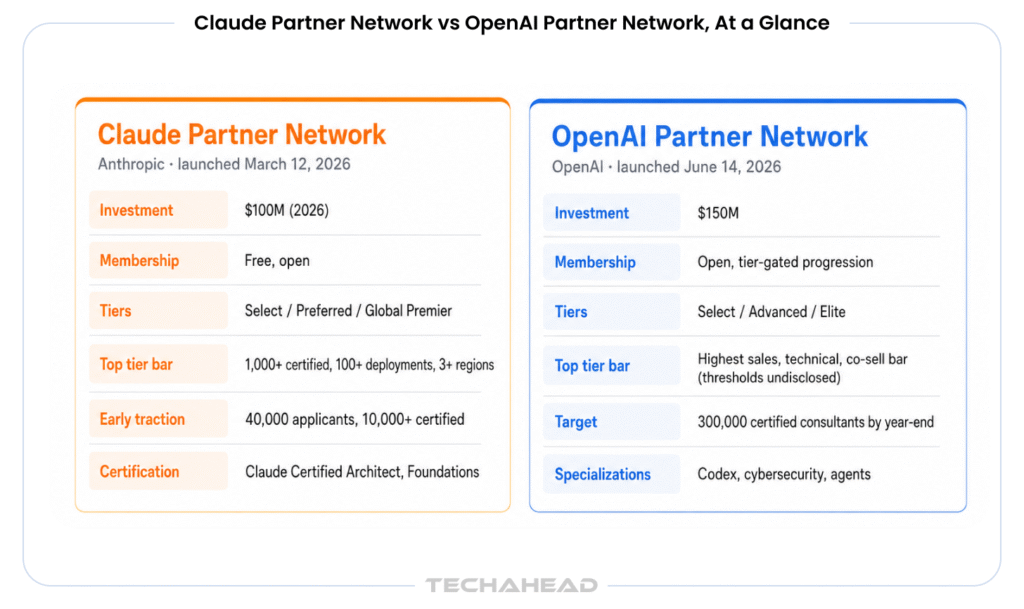
Anthropic committed $100 million to the Claude Partner Network on March 12, and within three months the program had drawn 40,000 applicants and certified more than 10,000 consultants.
OpenAI answered on June 14 with its own $150 million commitment and a target of 300,000 certified consultants by the end of the year.
Two frontier AI labs, roughly $250 million combined, and a shared bet that the real bottleneck to enterprise AI adoption is no longer the model. It is the implementation partner standing between the model and your production environment.
If you are a CIO, CTO, or procurement lead evaluating vendors right now, you have almost certainly seen the badges: “Claude Global Premier Partner,” “OpenAI Elite Partner,” “Certified in Codex,” “Anthropic Certified Architect.”
These labels are showing up in pitch decks, RFP responses, and LinkedIn banners at a pace that outstrips most buyers’ ability to interpret what any of it actually guarantees.
This article does three things.
Note: Neither program exists in a vacuum.
Enterprise software has run this playbook before: AWS, Microsoft, and Salesforce all professionalized sprawling, informal partner ecosystems into tiered, certification-gated programs once their platforms reached enough enterprise scale that buyers needed a faster way to sort serious delivery partners from firms that had simply added a logo to a website.
Claude and OpenAI are now running the same playbook, on a compressed three-month timeline, which is exactly why the badges are multiplying faster than most procurement teams can interpret them.
Anthropic launched the Claude Partner Network on March 12, 2026, describing it as a program for organizations helping enterprises adopt Claude, backed by an initial $100 million commitment for the year. Membership itself is free and open to any organization bringing Claude to market.
That single fact matters more than it sounds: a “Claude Partner” badge on a website, on its own, can simply mean a firm filled out an application form.
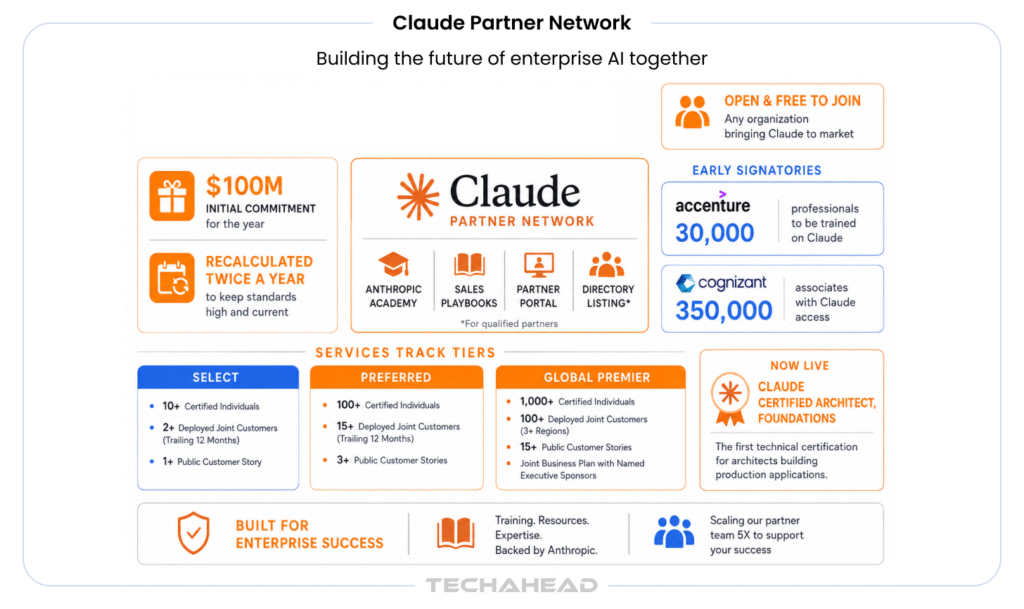
Image Source: TechAhead AI Team
The more meaningful structure sits inside the Services Track, introduced on June 3, 2026, which sorts partners into three tiers with hard, publicly disclosed thresholds:
Anthropic recalculates tier standing twice a year, and partners who join get access to Anthropic Academy training, sales playbooks, a Partner Portal, and (for qualified firms) a listing in the Services Partner Directory that enterprise buyers can search directly.
The network also introduced the first Claude technical certification, Claude Certified Architect, Foundations, aimed at solution architects building production applications.
Anthropic says it is scaling its own partner-facing team fivefold to support live deals with dedicated engineers and technical architects.
Early signatories give a sense of scale: Accenture has committed to training 30,000 professionals on Claude, and Cognizant has opened Claude access across roughly 350,000 associates.
OpenAI launched its own program on June 14, 2026, three months after Anthropic, with a $150 million investment and a public target of certifying 300,000 consultants by the end of the year.
OpenAI framed the launch around a specific claim: model capability is no longer the main barrier to enterprise AI value.
The bottleneck has moved to identifying the right use cases, redesigning workflows, and managing the change-management burden inside large organizations.
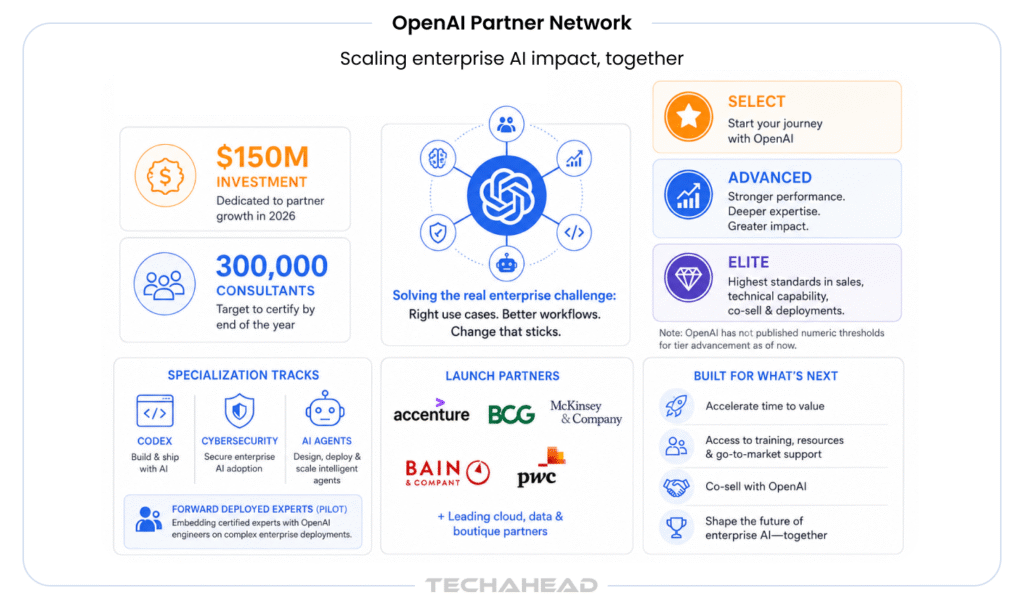
The OpenAI Partner Network uses a three-tier structure as well:
Unlike Anthropic, OpenAI has not published exact numeric thresholds (certified headcount, deployment counts) for each tier as of this writing, so treat “Elite” as a qualitative, not a quantitative, signal until OpenAI discloses the underlying bar.
The program also introduces specialization tracks in Codex, cybersecurity, and AI agents, plus a pilot Forward Deployed Experts program that embeds certified partner staff alongside OpenAI’s own engineering teams on complex deployments.
Launch partners named publicly include Accenture, BCG, McKinsey, Bain, PwC, and a mix of cloud, data, and boutique firms.
Source: TechAhead AI Team
Four structural reasons explain why a badge should be a starting question, not a closing argument.
The entry bar is low by design. Anthropic states plainly that any organization bringing Claude to market can join for free. OpenAI’s Select tier is explicitly described as an entry-level starting point.
Base membership in either network tells you a firm has registered and begun the relationship. It does not tell you whether that firm has shipped anything you would recognize as production-grade.
Tiers measure scale and activity, not fit for your context.
Anthropic’s own published thresholds are built entirely around three counts: certified headcount, deployment volume, and public references.
Those are genuinely useful proxies for how much Claude work a firm has done overall.
They say nothing about whether that firm has done Claude work in your industry, under your regulatory regime, or against your specific stack of legacy systems and data residency constraints.
A firm can hit Global Premier’s 1,000-certified-consultant bar with deployments concentrated entirely outside your sector.
Partner incentives are aligned with the model vendor first.
Both programs are explicitly co-sell and market-development engines.
Anthropic is scaling a partner-facing team to support live deals; OpenAI’s stated goal is accelerating enterprise adoption at scale.
That alignment is not inherently bad, but it does mean a partner’s default posture will often be to recommend more AI, delivered through standardized playbooks, rather than to tell you a use case is not ready or not worth pursuing.
Certifications measure training completion, not production maturity.
A Claude Certified Architect credential or an OpenAI technical certification demonstrates that an individual passed an exam.
It does not demonstrate that the firm around that individual has mature incident response processes, governance frameworks, or change-management discipline for when something goes wrong in production.
Broader AI vendor due diligence frameworks, including the OECD’s due diligence guidance for responsible AI, consistently treat certifications as one input among several, not a standalone quality gate.
Partner status is useful context. It is a starting point for questions, not a substitute for evidence.
Three scenarios show how this plays out in an actual shortlisting process.
Scenario A: the Global Premier partner with no relevant references. A systems integrator’s deck leads with “Anthropic Global Premier Partner, 1,000+ certified consultants.” On paper this clears the highest bar Anthropic publishes.
But when you ask for case studies in your specific industry, none exist; most of the firm’s 100-plus deployments sit in different geographies and regulatory regimes than yours. The playbook may not translate, and compliance gaps can surface late in the engagement.
Scenario B: the Select partner with deep niche expertise. A smaller firm shows up as “OpenAI Select Partner, 15 certified consultants,” a fraction of the headcount of Scenario A.
But it can point to multiple public references in your exact vertical, working under similar data constraints, with documented governance patterns. Smaller tier, more relevant capability, and potentially a better outcome for your specific project.
Scenario C: the AI-native boutique that barely mentions partner status. A firm describes itself simply as building production agentic AI on Claude and OpenAI, without leading with badges at all.
Digging in, you find a rigorous internal evaluation framework, a strong engineering culture, and real production deployments, even though the firm has not yet crossed the headcount thresholds for a top public tier.
The lesson across all three: badges are easy to put on a homepage.
Production outcomes are hard to fake over time, especially once you ask for names you can call. The job of a good vendor evaluation process is to move the conversation from “what tier are you” to “show me proof you can do this for us.”
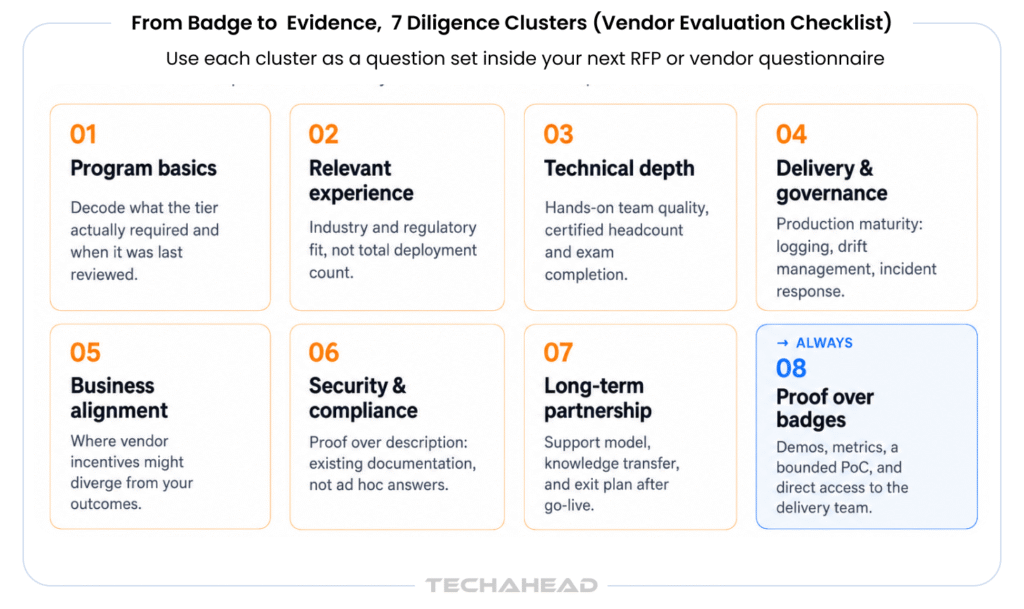
This is the core deliverable. Each cluster below pairs a short set of buyer questions with a note on what strong evidence actually looks like, so you can use this directly inside an RFP or vendor questionnaire.
Decode the badge before you evaluate anything else.
Strong evidence: a clear mapping to the vendor’s published tier criteria, and willingness to share redacted partner portal summaries as proof.
Shift the conversation from total volume to relevant volume.
Strong evidence: specific, recent references you can actually call, and case studies that state a baseline, a solution, and a measured outcome.
Strong evidence: concrete architecture walkthroughs and public technical content that goes beyond marketing copy.
Strong evidence: documented runbooks and a willingness to share anonymized post-mortems.
Strong evidence: transparent discussion of incentives, and at least one real example of scoping a project down.
Strong evidence: existing, specific security documentation rather than answers written on the spot.
Strong evidence: a defined support package and references who can speak to a relationship that lasted past the first release.
Table: Condensed vendor diligence checklist
| Category | Core question | Weight in evaluation |
| Program basics | What does your tier actually mean, and when was it last reviewed? | Low |
| Relevant experience | Have you delivered in our industry under our constraints? | High |
| Technical depth | Can you show, not just certify, real capability? | High |
| Delivery and governance | How mature is your production operating model? | High |
| Business alignment | Where might your incentives diverge from ours? | Medium |
| Security and compliance | Can you prove it, not just describe it? | High |
| Long-term support | What happens after go-live? | Medium |
A checklist only works if it is built into the actual shortlisting workflow, not bolted on as an afterthought.
Step 1, build the longlist. Include partners from both the Claude Partner Network and the OpenAI Partner Network alongside strong non-partner specialists. Do not filter out smaller firms simply because they have not reached Global Premier or Elite status; Scenario B above exists precisely because tier and fit are different axes.
Step 2, send a pre-RFP questionnaire. Condense the checklist to 10 to 15 questions and require written answers plus supporting artifacts such as case studies or security summaries.
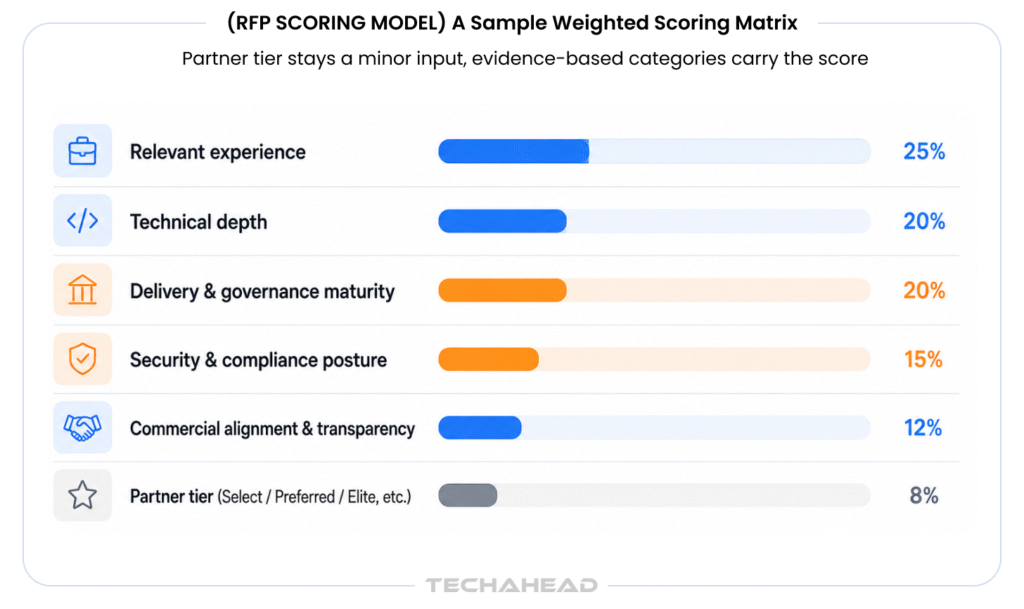
Step 3, score on evidence, not badges. Build a simple weighted scoring matrix across relevant experience, technical depth, delivery maturity, security posture, and commercial alignment. Treat partner tier itself as a minor input, roughly 5 to 10 percent of the total score, rather than a gate.
Step 4, run deep-dive sessions and reference calls. Shortlist two to four vendors for live architecture walkthroughs, and call references with targeted questions about responsiveness and delivery quality, not just satisfaction.
Step 5, run a bounded proof of concept. Use a scoped PoC with clear, pre-agreed success criteria to validate performance and integration effort claims, and pay close attention to how the vendor handles problems that come up during it, not just the demo itself.
A handful of patterns should trigger deeper scrutiny rather than automatic disqualification:
None of these alone disqualifies a vendor. Together, or unaddressed under direct questioning, they are a signal to slow down.
It is worth remembering that the underlying market these badges are chasing is real and growing fast. Enterprise AI services spending tied to implementation and deployment, not just model API consumption, is estimated at well over $5 billion in 2026 alone, which is precisely why 300,000 consultants are being certified in a single calendar year.
The badges are a symptom of genuine demand. That does not make any individual badge a reliable substitute for your own diligence.
The Claude Partner Network and OpenAI Partner Network are genuinely useful ecosystem signals, backed by real investment, real certification bars, and in Anthropic’s case, publicly disclosed thresholds you can hold a vendor to.
But neither program was built to certify your specific risk or your specific outcome. The question worth asking a vendor is not “what tier are you.” It is “what have you delivered for clients like us, and how exactly will you do it here.”
Keep this checklist next to your next AI vendor shortlist, and share it with your procurement and security teams before the RFP goes out, not after the badges start showing up in the responses.
If your team is building out an AI vendor evaluation process and wants a second set of eyes on the shortlist, TechAhead’s engineering team is glad to compare notes.
Anthropic’s $100 million program launched March 2026, offering free membership, training, and certification across Select, Preferred, and Global Premier tiers.
OpenAI’s $150 million program launched June 2026, targeting 300,000 certified consultants across Select, Advanced, and Elite tiers by year-end.
No. Tiers measure headcount and deployment volume, not fit for your industry, regulatory environment, or specific technical stack.
Ask for relevant industry references, technical depth beyond certifications, governance maturity, incentive transparency, and proof through a bounded proof of concept.
Heavy badge emphasis without case studies, vague “AI-powered” language, no governance discussion, and reluctance to provide references or run a PoC.
We use cookies to ensure our website functions properly, improve performance, and provide a personalized experience. You can choose which types of cookies to allow below.
Required for core functionality such as security, network management, and accessibility. These cannot be disabled.
Help us understand site traffic and user interactions so we can improve performance and usability.
Enable enhanced functionality and personalization such as language or region preferences.
Used to deliver relevant ads, track campaign performance, and measure advertising effectiveness.