


 Copy Link
 Share on X
 Share on Facebook
 Share on LinkedIn
Always Active
Required for core functionality such as security, network management, and accessibility. These cannot be disabled.

Uncover the transformative potential of digital and mobile solutions for your industry.





 Last Updated: Sep 22, 2026
Jul 7, 2026
Last Updated: Sep 22, 2026
Jul 7, 2026  790
790  22 min. Read


Key Takeaways
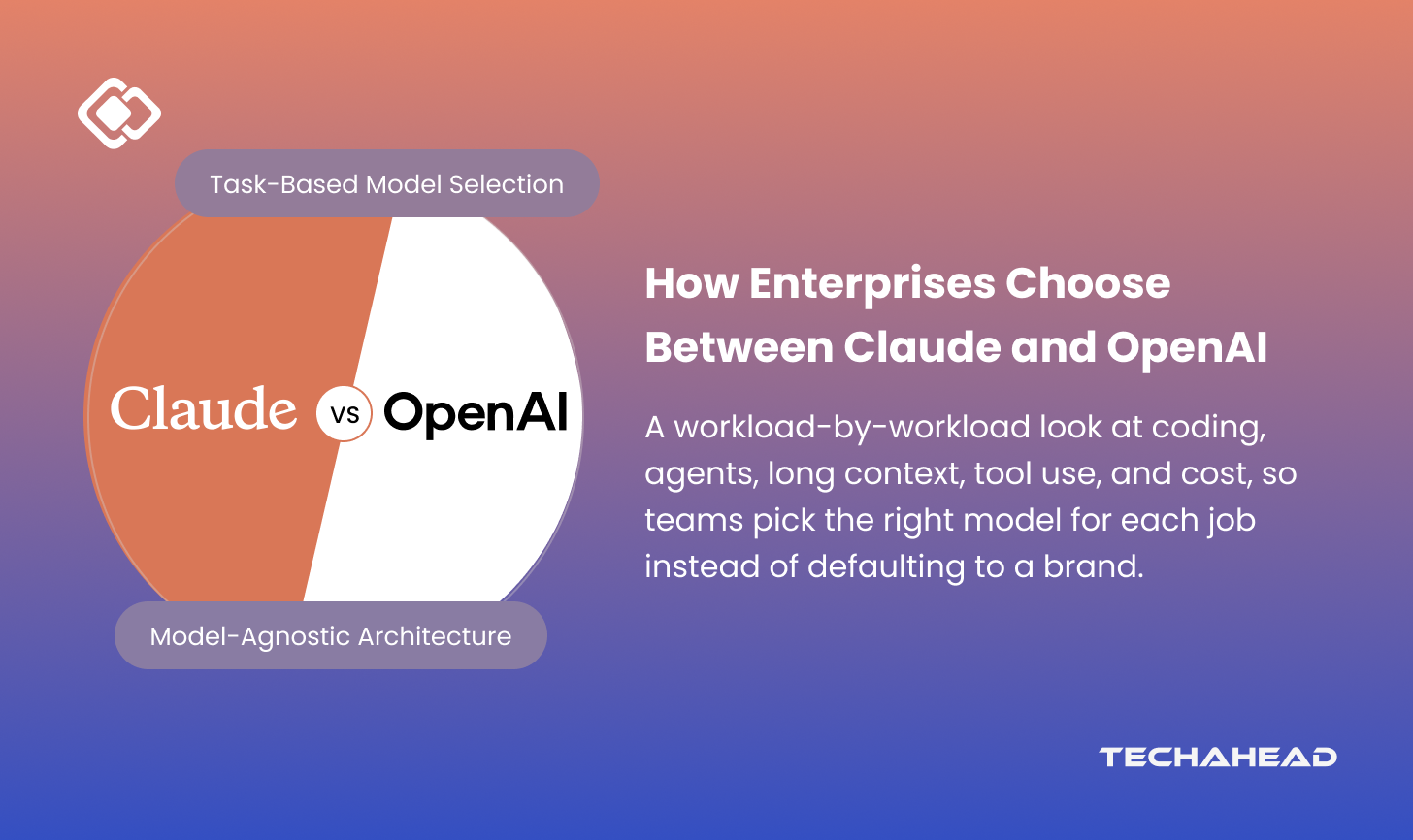
The Claude vs OpenAI debate has quietly changed shape. For two years, enterprise teams asked one question about foundation models: which one is smarter? In 2026, that question no longer earns its keep. Both Anthropic’s Claude and OpenAI’s flagship models clear the bar for the overwhelming majority of enterprise workloads, and the raw-intelligence gap at the top has narrowed to the point where it rarely decides anything on its own.
The question that actually pays off is narrower. For a given job, coding, autonomous agents, long-context reasoning, tool use, or cost at scale, which model fits best? That is a task-by-task evaluation, and it is where teams either save a great deal of money or quietly waste it. This guide runs the Claude vs OpenAI comparison the way an engineering leader should run it: by workload, with numbers, and without brand loyalty.
The stakes behind this choice are rising fast, because enterprise spending on foundation model APIs is surging. Enterprise LLM spend more than doubled in roughly six months, from $3.5 billion in late 2024 to $8.4 billion by mid-2025, according to Menlo Ventures, as workloads moved out of pilots and into production.
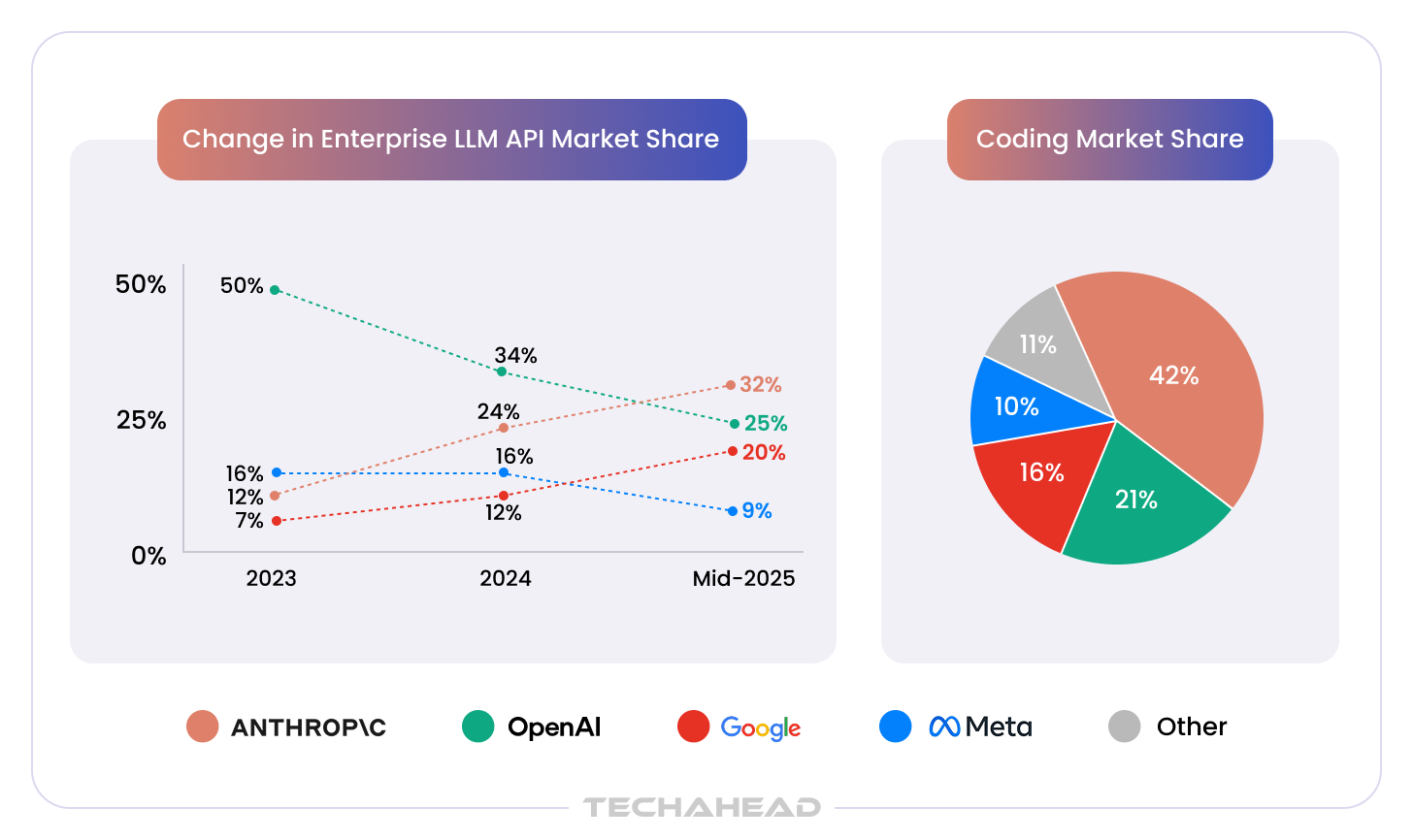
Just as telling for anyone weighing Claude vs OpenAI, the market is no longer a one-vendor story: where a single provider held roughly half of enterprise usage in 2023, that share is now split across several leading labs. When the real budget rides on the outcome and no single model owns the category, choosing the right model for each task matters more than defaulting to a familiar name.
You are no longer choosing a single model. You are choosing a tiered portfolio and deciding which tier does which job. Anthropic keeps its lineup compact and opinionated, while OpenAI spreads across more price bands, but both follow the same logic of small, mid, and flagship tiers.
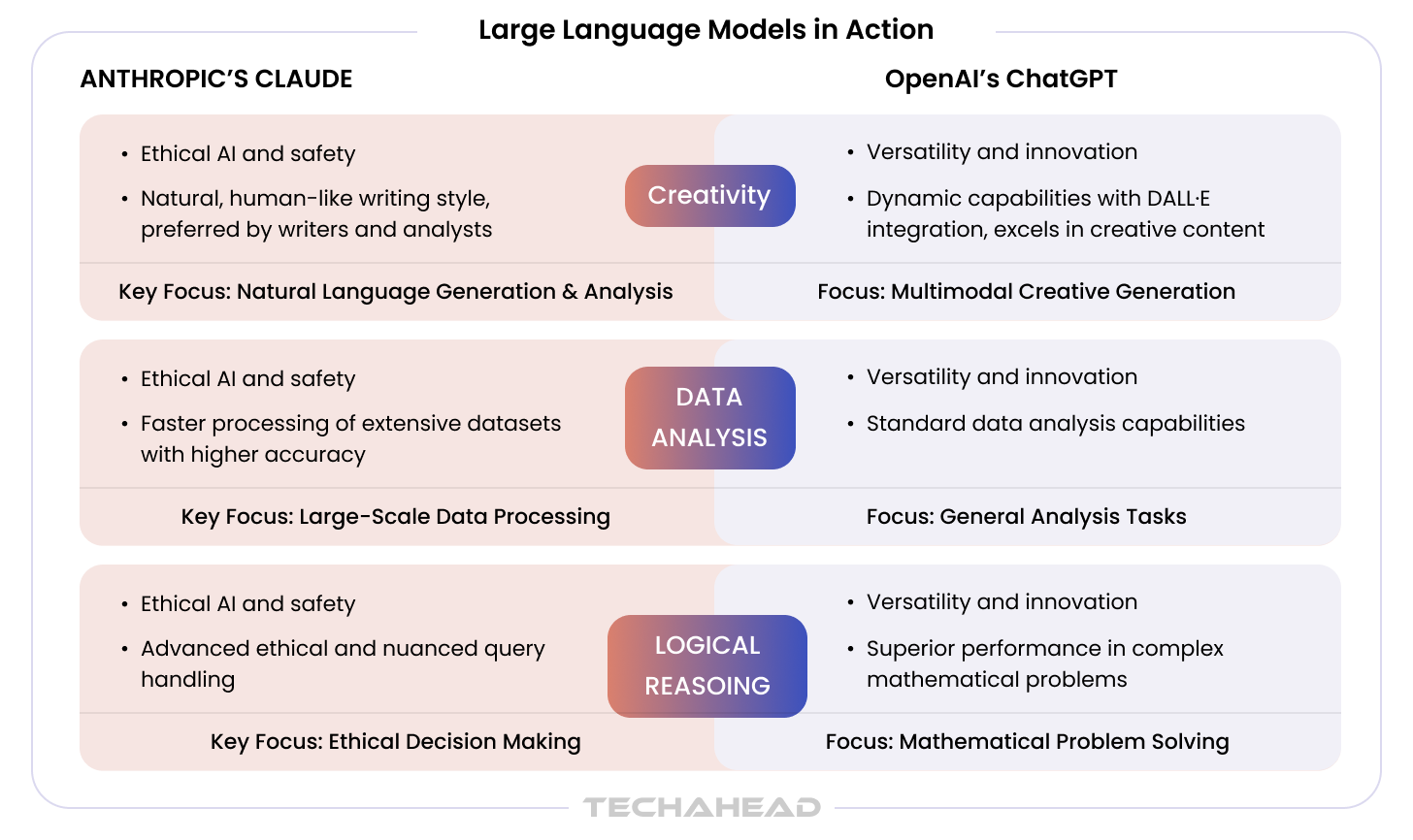
Per the Claude models overview, Anthropic’s current generally available lineup runs across four tiers:
Per the OpenAI models documentation, the OpenAI lineup centers on three practical choices for most builders:
The strategic contrast is worth holding in mind as you read the task sections below. Anthropic gives you a short, role-based ladder that is easy to reason about. OpenAI gives you a wider menu of price points and specialized models inside a single vendor stack. Neither shape is better in the abstract, and the right one depends on how many distinct jobs you are trying to serve.
For a deeper primer on how model families map to agent architectures more broadly, our overview of the 8 types of LLMs powering modern AI agents is a useful companion read.
Software engineering is now the center of gravity for both families, and both are credible for serious work. This is the axis where your own evaluation should outweigh any leaderboard, because performance varies sharply by codebase, language, and how you structure the agent loop.
Related: Agent Loop Explained
What holds true regardless of your stack is structural: both flagships give you room to generate substantial code in a single pass.
For most single-file or single-feature work, these ceilings are effectively equivalent. The difference tends to surface on very large, cross-file refactors, where context retention and instruction-following under load separate a clean run from a frustrating one. That is precisely the scenario worth reproducing in your own tests rather than inferring from a spec sheet.
Both vendors have also built dedicated coding-agent tooling around their models, but the operating model is different.
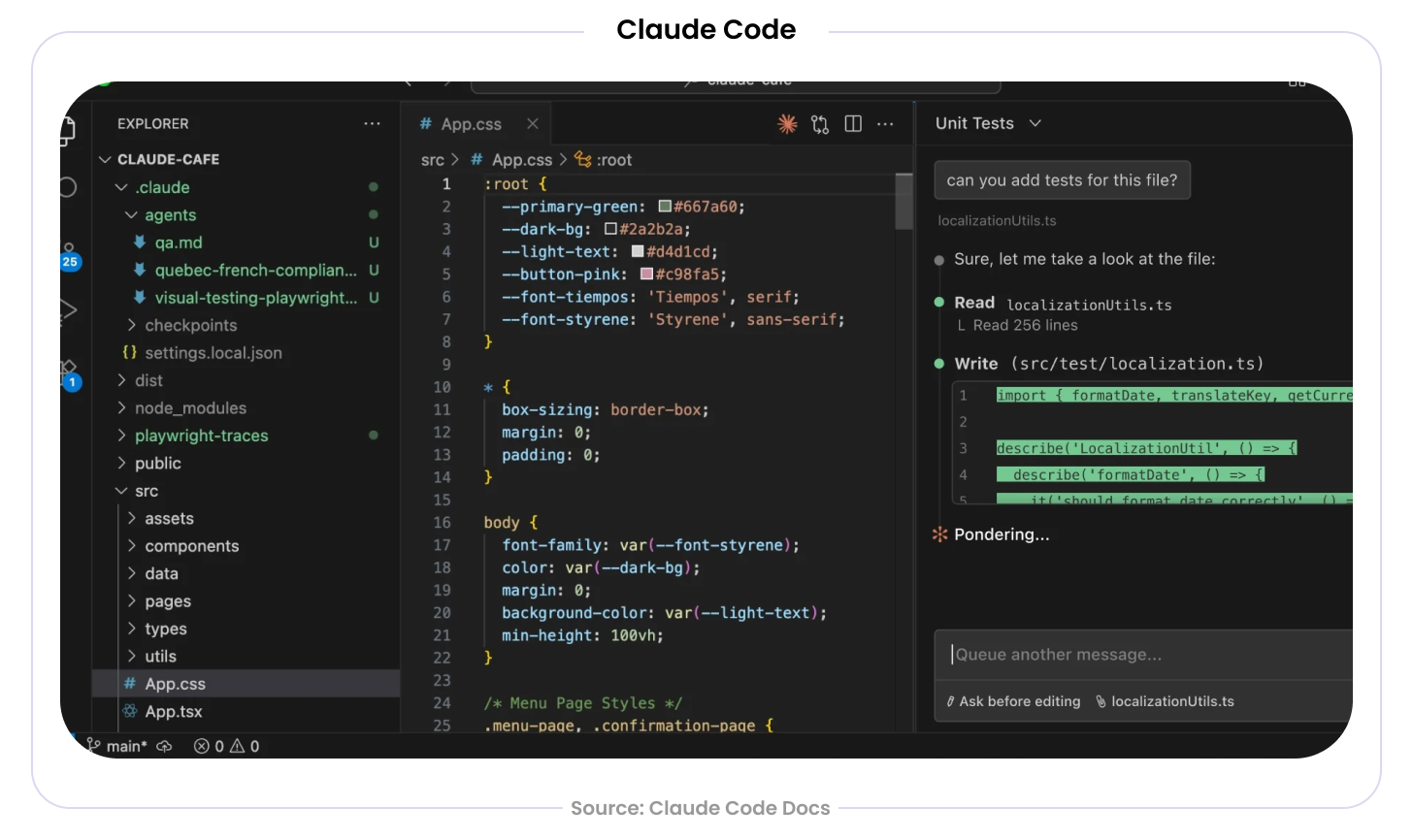
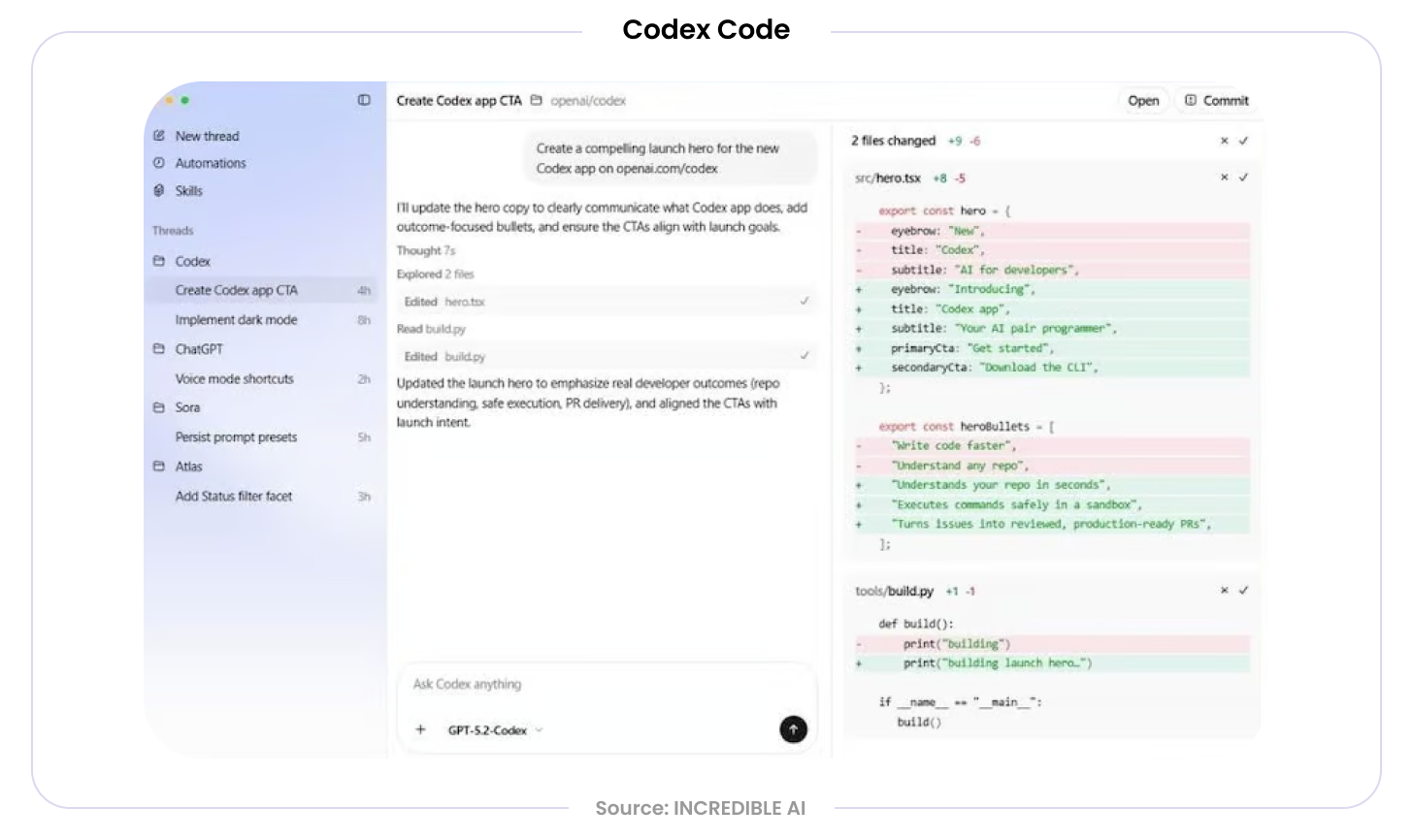
Both also expose tunable reasoning so you can spend more compute on hard problems and less on trivial ones. GPT-5.5 offers a reasoning effort control spanning none, low, medium, high, and xhigh, and Claude Opus 4.8 exposes an effort parameter that defaults to high. That control is one of the more consequential recent developments, because it lets you tune cost and latency inside a single model instead of switching models mid-pipeline, with Claude Code using Claude Sonnet 4 and Opus 4 while OpenAI Codex is powered by a fine tuning variant of the o3 model.
Coding is also where the workflow changes, not just the tool. Bringing an AI agent into your pipeline reshapes code review, testing, and how work is scoped, and that shift is worth understanding before you pick a model, since it affects which capabilities actually matter. Our breakdown of what changes when agents join the SDLC covers those workflow implications in depth.
On model strengths, Claude 4 often delivers more production-ready output and Claude Code is especially strong in interactive coding sessions.
Claude Code also posted a 67% win rate over Codex CLI in blind quality tests, and roughly 70% of developers prefer Claude for coding tasks.
The honest recommendation for coding is simple. Shortlist both families, because the best choice depends on the specific task even if Claude often leads on coding benchmarks, assemble a representative slice of your real engineering tasks, and run each through the tier you would actually deploy, measuring quality, latency, and cost together. Structured evaluation on your own repositories is the only reliable signal here, and it is the kind of hands-on comparison our AI development services team runs on client codebases before a single line of production code depends on the choice.
If your roadmap involves autonomous or semi-autonomous workflows, the model matters, but the agent infrastructure around it matters just as much. This is where the Claude vs OpenAI choice becomes as much about ecosystem as about weights. Agent platforms are also shaped by memory behavior: OpenAI implements stateful memory for long-running agent workflows, while Claude is often preferred for project-specific instructions across chats.
Related: Why AI Agent Costs Explode and How to Cap Them
Both providers have leaned hard into this space. Anthropic positions Opus 4.8 specifically for long-horizon agentic coding and complex enterprise tasks, and has invested in computer use and multi-step autonomous workflows. OpenAI pairs GPT-5.5 with a dedicated Agents SDK, the Responses API, and its own coding-agent product, and notes that GPT-5.4 introduced native computer-use capabilities aimed at agents that operate software across long horizons.
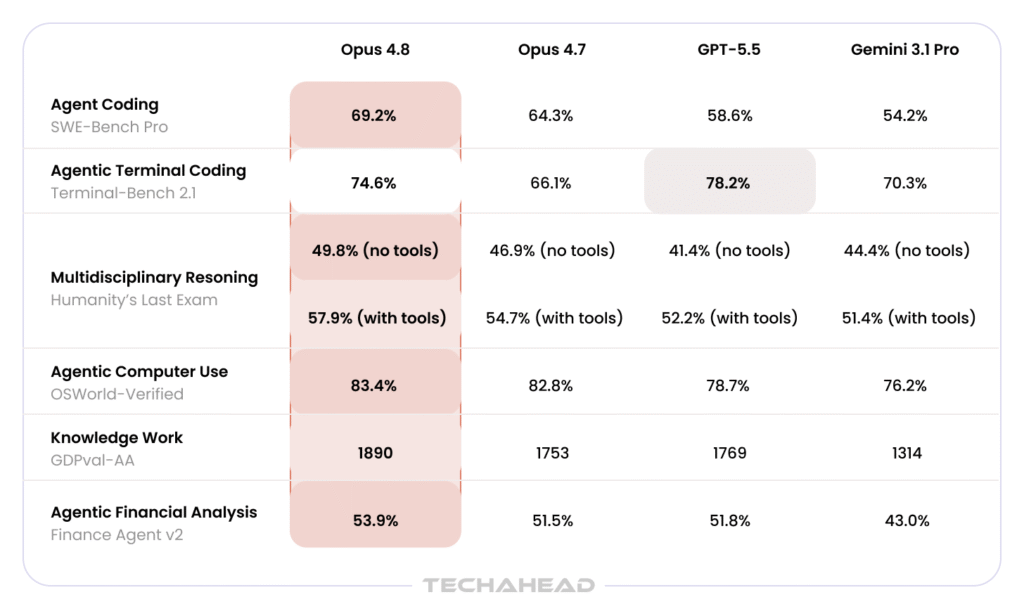
For agents specifically, three practical factors usually decide the matter more than headline capability:
Those factors play out very differently by domain, and that difference is easy to underestimate when you are comparing models on generic benchmarks. A customer-support agent can tolerate an occasional wrong answer; a financial-operations agent working under audit and regulatory constraints often cannot, which raises the bar for reliability, traceability, and how much autonomy you can safely hand the model. Regulated verticals are where these demands bite hardest, and if that is your world, our guide to vertical AI agents in fintech shows how far domain requirements can pull a build beyond raw model choice.
When agent orchestration is the core of the build rather than a feature bolted onto a chatbot, the engineering effort shifts toward planning, tool routing, memory, and guardrails. That orchestration layer is a discipline in its own right, and it is the focus of our agentic AI services.
Recommended: 12 AI Agent Frameworks Compared
Long-context work, feeding a model an entire repository, a large document set, or a long conversation history, has become a routine enterprise requirement. It is also one of the areas where the specifications are clear enough to compare directly.
The context windows are close to identical at the top:
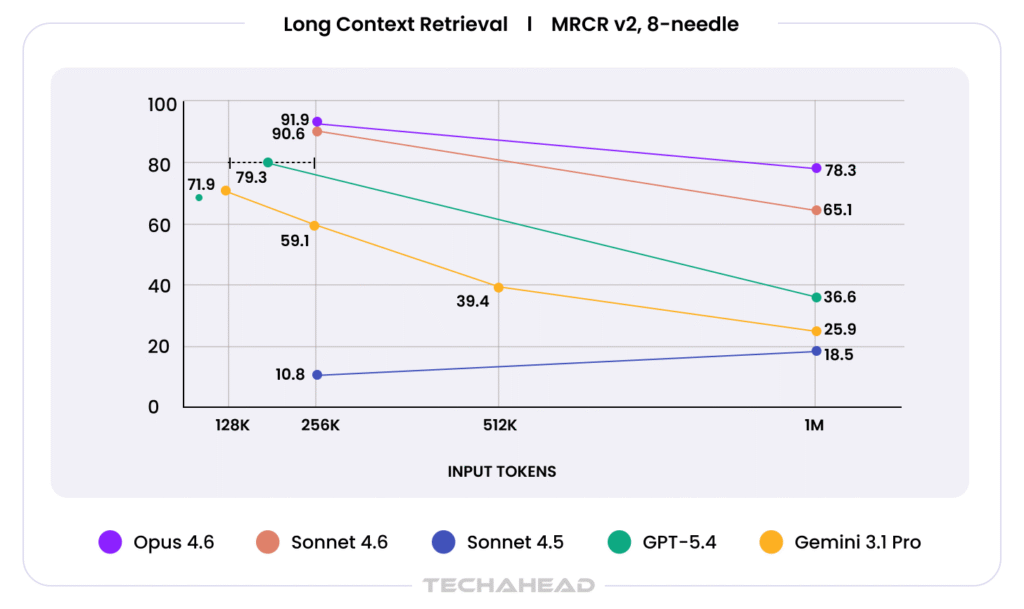
There is one pricing nuance on the OpenAI side that long-context users must model carefully. For GPT-5.5 and GPT-5.4, OpenAI notes that prompts above 272K input tokens are priced at 2x input and 1.5x output for the full session. If your workload routinely pushes very large contexts, budget against that long-context rate rather than the standard rate, or the bill will outrun your estimate. Long-context pricing structures differ across providers, so this is a place to price your realistic prompt sizes rather than assume parity.
Raw window size is not the whole story: Claude is widely favored for deep writing and analyzing complex documents, and it often shows stronger long-document comprehension when full context matters.
Two closing points on long context are easy to overlook. A larger window does not automatically mean better retrieval across the full context, so if your use case depends on the model reliably using information buried deep in a long input, test that behavior specifically; response speed also matters in long-context workflows, and Claude is often chosen for near-zero-latency reasoning on document analysis despite similar headline window sizes. And a very large context window changes your cost profile more than your capability profile, because you pay for every input token you send on every call.
The models have converged on capability while diverging on ecosystem, and tool use is where that divergence is most visible. For teams already committed to a particular way of building, this is often the deciding axis.
The two ecosystems differ in shape more than in quality.
The practical question is not which ecosystem is larger. It is which one matches how your team already builds and which connection standards you are betting on. The Model Context Protocol has gained broad traction as an open way to link models to tools and data, and it increasingly pairs with agent-to-agent standards to form the connective layer of multi-agent systems. That layer is a separate architectural decision from model choice, with its own long-term consequences.
If you want to go deeper on it, our breakdown of MCP vs A2A vs ACP interoperability standards maps how those protocols fit together and where the standards are consolidating.
A short way to frame the ecosystem decision:
Cost is where most Claude vs OpenAI decisions are actually won or lost, and where the biggest mistakes get made, especially once you separate subscription plans from API pricing. The single largest lever on your bill is not which vendor you pick. It is whether you match each task to the cheapest model that can do it well.
Start with the flagship-to-flagship view, using each vendor’s published rates.
| Model | Input (per 1M tokens) | Output (per 1M tokens) | Context window | Max output |
| Claude Opus 4.8 | $5 | $25 | 1M | 128K |
| GPT-5.5 | $5 | $30 | 1.05M | 128K |
| Claude Sonnet 5 | $3 (intro $2 through Aug 31, 2026) | $15 (intro $10) | 1M | 128K |
| GPT-5.4 | $2.50 | $15 | 1.05M | 128K |
| Claude Haiku 4.5 | $1 | $5 | 200K | 64K |
Sources: Anthropic models overview and pricing page; OpenAI GPT-5.5 and GPT-5.4 model pages.
A few things stand out from the table, including that Anthropic is generally cheaper than OpenAI for similar tasks, especially on output-heavy workloads. The two flagships share identical input pricing at $5 per million input tokens, and the most visible gap is on output, where Opus 4.8 lists at $25 per million output tokens against GPT-5.5 at $30. For generation-heavy workloads, where output dominates the bill, that difference compounds. For read-heavy workloads such as document analysis, it matters far less, because you are paying mostly for input.
Bonus Read: Custom GPTs Vs. APIs, Agents, and Chatbots (What to Choose)
Claude Pro costs $20/month and includes Claude Code, while OpenAI Codex is included in the $200/month ChatGPT Pro plan. Claude Max costs $100/month for higher usage limits.
The flagship comparison is a trap if you stop there, and for heavy users the Max plan can offer better value than paying per-token depending on usage limits and workload mix. The real savings come from tiered routing rather than from picking a winner:
Running every request on a flagship, when most of them are classifications a small model handles perfectly well, is the most common and most expensive mistake enterprises make.
This is an operational discipline, not a procurement choice. As Mukul Mayank, Chief Operating Officer at TechAhead, puts it: “The biggest AI savings rarely come from the model you pick. They come from disciplined routing, sending each task to the cheapest tier that clears the bar, then measuring everything.”
Most tasks do not need frontier-tier capability, so routing lower-complexity work to cheaper tiers reduces extra cost. Prompt caching and batch processing on both platforms cut costs further for repeated context and asynchronous jobs.
The takeaway is that the Claude vs OpenAI cost comparison should be run at the workload level, not the vendor level. Map your actual traffic to task types, estimate the token profile of each, and price the realistic tiered deployment on each platform. Building the routing, caching, and monitoring to do this well is its own engineering effort, distinct from choosing a model, and it is the focus of our AI infrastructure management services. For many enterprises, this layer is where the theoretical savings become real, and where our generative AI development services most often start a client engagement.
For regulated enterprises, security and compliance frequently decide the outcome before capability enters the conversation. Both vendors meet the baseline expectations of enterprise procurement, with details that differ enough to warrant checking against your exact requirements.
On the Anthropic side, per its certifications documentation and Trust Center, the commercial posture includes:
Anthropic’s stronger safety posture can make Claude more cautious in some conversations, which may matter depending on the use case.
On the OpenAI side, per its business and enterprise documentation, the enterprise posture includes:
Anthropic’s stronger safety posture can make Claude more cautious in some conversations, which may matter depending on the use case.
Deployment often maps to a customer’s existing cloud commitment. Anthropic’s models are available through the Claude API and major clouds including Amazon Bedrock, Google Cloud, and Microsoft Foundry, per its models overview. OpenAI’s models are available directly and through Microsoft’s Azure platform. For many enterprises, keeping model traffic inside a private network on the cloud they already use is a decisive factor in its own right.
One point deserves stating plainly to any executive sponsor. Vendor certifications are the floor, not the ceiling. A SOC 2 report or a signed BAA covers the provider’s side of the boundary. It does not manage who on your team can access the model, what data they paste into it, or how prompts and responses are logged and stored. Most failures in regulated AI deployments happen in that layer, which is yours to build and govern, including data processing choices and provider safety defaults.
Related: Enterprise AI Compliance & Governance
There is no universal winner in the Claude vs OpenAI decision, and any comparison that declares one is usually selling something. There is only the right fit for a given organization and workload. The honest answer is that the better model depends on the specific task: Claude is often stronger for nuanced creative writing and more human like prose, while OpenAI may fit other needs better. A practical way to run it, in order:
Public benchmarks are a reasonable starting point for a shortlist, but they are not a substitute for testing on your data. The models are close enough at the top that your specific use case will usually give a clearer signal than any leaderboard.
The distance between choosing a model and shipping a governed, cost-controlled, production-grade system is wide, and it is where most enterprise AI initiatives stall. The model is the easy part. The hard part is the architecture around it:
That is the work TechAhead does as a model-agnostic partner, building on both Claude and OpenAI because the right answer for a given client is a matter of evidence rather than allegiance. In practice, the choice of provider is rarely the hard conversation. The hard conversations are about how to route workloads across tiers, how to prove compliance to a CISO, and how to keep unit economics sane as usage scales.
Some teams want that expertise embedded directly in the build rather than delivered as a report. For those, our overview of how to hire OpenAI and Claude forward-deployed engineers explains how senior engineers work alongside your team through evaluation, integration, and production hardening. When the frontier shifts, as it reliably does, a well-architected foundation lets you move without rebuilding, which is the outcome our generative AI development services are designed to protect.
In 2026, the Claude vs OpenAI decision is no longer a contest of raw intelligence. Both families are strong enough that capability rarely decides it alone.
Run the comparison by task, not by brand. Filter on your non-negotiables, test on your own data, price the realistic tiered deployment, and keep your architecture flexible enough to use both. That is how you make a model decision that still looks sound as the models keep changing underneath it.
That is a lot to hold together, and you do not have to do it alone. TechAhead helps you choose, integrate, and scale the models that fit your business, on any cloud and model-agnostic by design. Have a project in mind? Contact us today and let’s build it right.
Neither wins outright. Claude often shines on complex, agentic coding, while OpenAI’s tooling suits async, GitHub-centric workflows. The honest move in any Claude vs OpenAI call is testing both on your codebase, which TechAhead runs on real client repos before a build starts.
Both are strong, so it comes down to reliability on your multi-step workflows and how cleanly the agent fits your systems. The smarter approach is staying flexible and routing each AI agent workload to whichever model performs best in production.
Yes. Both flagship models now offer roughly 1M-token context windows, so they can process large document sets or full repositories in a single pass. The real work is designing long-context workflows that stay accurate and efficient at scale.
Both offer enterprise-grade controls, so the real answer depends on your regulatory context and cloud. TechAhead evaluates Claude vs OpenAI against your specific compliance needs across healthcare, finance, or government before anything touches production data.
Yes, both provide SOC 2 and HIPAA-ready options, with Business Associate Agreements on eligible enterprise plans. But certifications are only the floor. TechAhead builds the access controls and governance layer that real compliance sign-off actually requires.
By default, neither trains on your data through their enterprise and API tiers. That said, retention and data-handling terms differ between providers, so read them closely and confirm the specifics before you deploy anything sensitive.
Absolutely, and plenty do. A model-agnostic setup lets you route each task to whichever model wins, avoiding lock-in as the frontier keeps shifting. TechAhead designs exactly this kind of multi-model architecture for enterprise clients.
Start with your non-negotiables (compliance, cloud, ecosystem), then test both on your real workloads instead of public benchmarks. That task-by-task approach beats defaulting to whichever brand your team happens to know best.
OpenAI offers broader out-of-the-box modalities, while Claude leans into open standards like MCP for connecting tools and data. The right pick depends on matching tool use to how your team already builds rather than chasing the longer feature list.
We assemble a representative test set from your real workflows, run both model families at the tiers you would deploy, and measure quality, latency, and fit together. That is the evaluation process TechAhead runs before any enterprise build.
We use cookies to ensure our website functions properly, improve performance, and provide a personalized experience. You can choose which types of cookies to allow below.
Required for core functionality such as security, network management, and accessibility. These cannot be disabled.
Help us understand site traffic and user interactions so we can improve performance and usability.
Enable enhanced functionality and personalization such as language or region preferences.
Used to deliver relevant ads, track campaign performance, and measure advertising effectiveness.