


 Copy Link
 Share on X
 Share on Facebook
 Share on LinkedIn
Always Active
Required for core functionality such as security, network management, and accessibility. These cannot be disabled.

Uncover the transformative potential of digital and mobile solutions for your industry.





 Last Updated: Sep 18, 2026
Aug 14, 2026
Last Updated: Sep 18, 2026
Aug 14, 2026  301
301  20 min. Read


Key Takeaways
The last decade of SaaS application development optimized for one thing: getting a human to the right screen, quickly. In the agentic AI era, that changes from building interfaces that help users complete tasks to designing AI-native systems where agents can plan work, call the right tools, and complete a unit of work on their own. The product is no longer just selling access to an interface. It is selling an outcome.
That single shift, from selling seats-on-a-screen to selling completed work, cascades through everything that follows: how you design workflows, how you price the product, how the user experience changes when AI does the work instead of guiding a person through it, and how you architect the system underneath. Most teams feel the change first as a pricing headache or a UX debate, without recognizing that all three are downstream of the same root cause.
This blog is for business owners, product teams, and enterprise leaders who are past the “should we use agents” question and into the harder one: what actually changes in how we build, prioritize, and scale an AI-native SaaS product, and where is the line between a genuine AI-native SaaS application and an expensive feature that got called one?
If you have been weighing whether to buy, extend, or replace high-cost SaaS tools with custom AI software, the answer starts with understanding this cascade. What follows breaks down how agentic AI is reshaping SaaS development, including workflow design, pricing models, AI-native UX, architectural patterns, and practical build priorities that now determine whether a product can compete in enterprise software at all.
Agentic AI changes SaaS application development by moving the product’s core value from the interface to the outcome. SaaS stands for software as a service, a software delivery model built on cloud computing, and now that delivery layer is being redefined by agents. Instead of building screens that help a user complete a task, teams increasingly build agents that complete the task and report back. Everything else, the UX, the pricing, the architecture, reorganizes around that new center of gravity.
The market is moving faster than most roadmaps. SaaS applications have long been delivered through web applications over an internet connection, making them globally accessible from any internet-connected device before agentic workflows changed the value-unit. By the end of 2026, Gartner projects that 40% of enterprise applications will include task-specific AI agents, up from under 5% in 2025. In the same analysis, Gartner’s best-case projection sees agentic AI driving roughly 30% of enterprise application software revenue by 2035, up from about 2% in 2025.
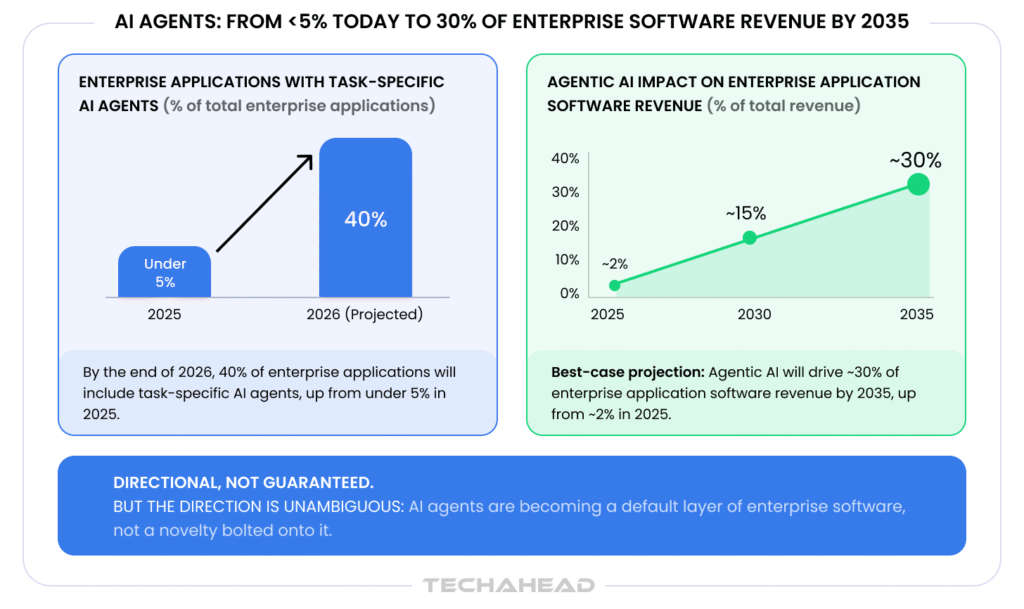
Those are directional numbers, not guarantees, but the direction is unambiguous: agents are becoming a default layer of enterprise software.
The trap is treating “add an agentic AI SaaS capability” as a feature ticket. A copilot pinned to the corner of an existing dashboard is not an AI-native product. It is the old product with a chat box. Real change happens when you let the value-unit shift reshape the three layers below.
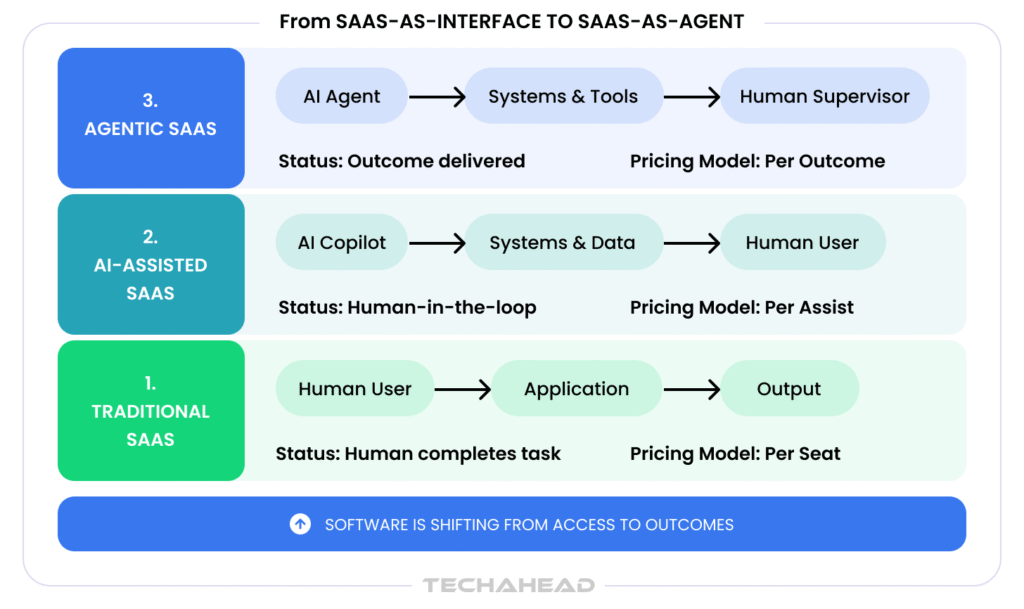
For teams offering SaaS application development services, this reframing is the whole job now. The deliverable is not a set of features. It is a system that reliably turns intent into completed work, which is a meaningfully harder engineering and design problem than the CRUD-and-dashboard era that preceded it.
Verdict: If agents don’t change what your product charges for, you have added a feature, not built an AI-native product.
Agent workflows change SaaS design by replacing linear, click-driven flows with goal-driven loops. A traditional workflow is a fixed path: the user clicks through steps A, B, and C. An agentic workflow is a loop: the agent perceives context, plans an approach, acts by calling tools, and verifies the result, repeating until the goal is met or a human is asked to step in. Designing that loop and not the screens around it, becomes the core work, because the SaaS app development process becomes more iterative once agent workflows are involved, and so does the SaaS development process.
This is where a real AI agent SaaS product diverges hardest from its predecessors. Four design concerns move from optional to essential, especially as user management matters more when agents, admins, and end users each need distinct roles in the workflow:
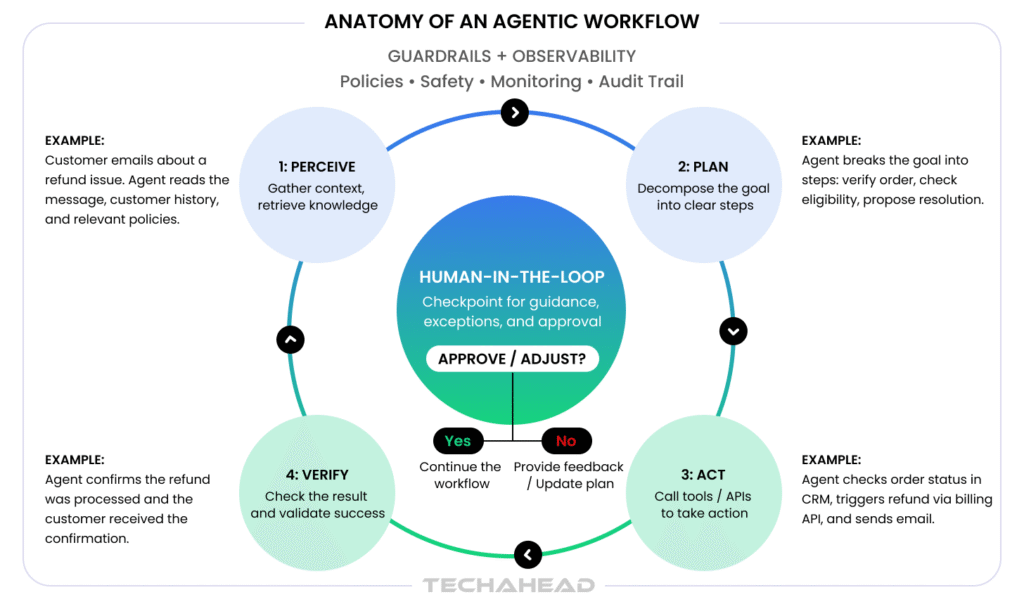
The teams that get this right treat the workflow as the product. When we engineered ERIN, an award-winning agentic AI referral platform, the hard problem was never the interface. It was designing agent-driven workflows that could handle referral management reliably at scale, with the right handoffs to humans, across a real enterprise environment. Getting the orchestration and the guardrails right is what separated a product people trusted from a demo that impressed once.
For enterprises trying to move these systems from pilot to production, the same discipline shows up as agent orchestration tooling that keeps autonomous workflows controllable under real load.
There is a rightsizing decision hiding here too. Not every workflow deserves an agent. High-volume, ambiguous, multi-system tasks are where SaaS AI agents earn their cost. Simple, deterministic actions are usually better left as plain code, and dressing them up as “agentic” adds latency, cost, and failure modes for no benefit in the broader development process.
Verdict: Design the loop and the handoffs first; the screens are what’s left over after the agent does its job.
Agentic AI reshapes pricing because the value-unit changes, and pricing has to follow it. In the traditional SaaS model, a subscription model with per-seat access made sense because more users usually meant more value. When a product completes discrete units of work, seats stop describing value, and pricing shifts toward what was actually done. This is the core reason usage based pricing SaaS models moved from niche to mainstream in the last two years.
The economics are already visible in the data. In the 2025 SaaS pricing research from Benchmarkit and Maxio, 44% of SaaS companies reported charging for AI-powered features, and companies using hybrid models that combine a subscription base with usage posted the highest median growth rate at 21%.
On the enterprise side, Deloitte’s 2026 technology predictions expect subscriptions and seat-based licensing to give way to hybrid models that blend usage- and outcome-based pricing, citing a Gartner forecast that at least 40% of enterprise SaaS spend will shift toward usage-, agent-, or outcome-based pricing by 2030. Among AI-native companies the move is already well underway, with 83% of them offering usage-based pricing today.
The pricing conversation now spans three models, and most products end up blending them. That makes setting a pricing strategy early important, because it shapes feature scope, customer segmentation, and go-to-market choices.
SaaS pricing models in the Agentic Era
| Pricing model | What you charge for | When it fits | Main risk |
| Subscription (per seat) | Access per user | Predictable human-driven usage; collaboration tools | Breaks when agents, not people, do the work |
| Usage-based | Measured consumption (tokens, calls, tasks) | Variable workloads; infrastructure-heavy products | Revenue and customer bills become volatile |
| Outcome-based | Verified business results (tickets resolved, deals closed) | Clear, measurable outcomes both sides trust | Hard to define and meter; requires agreement on what “counts” |
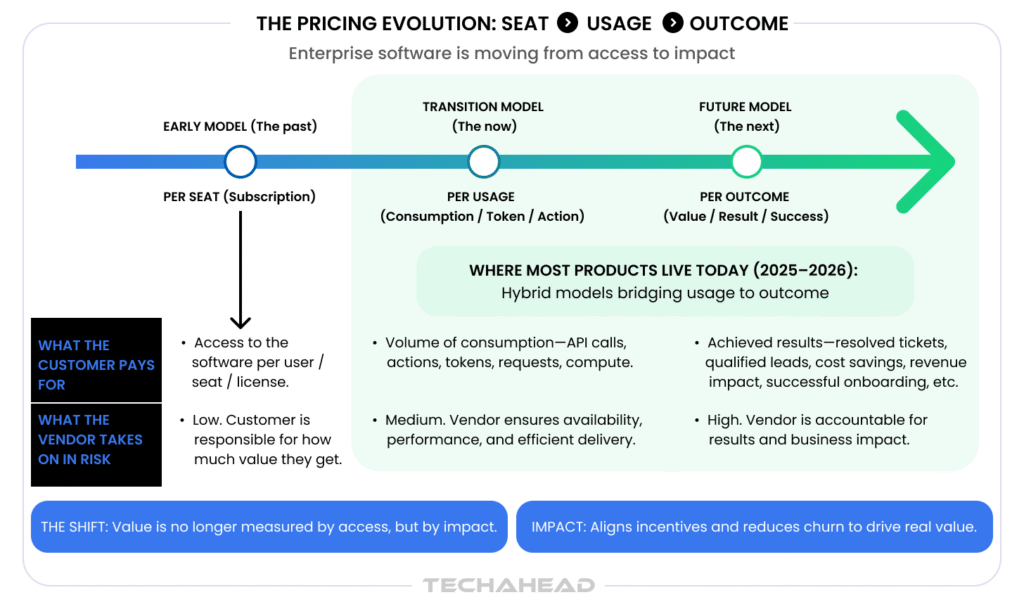
The practical warning for anyone building agentic SaaS is that usage-based and outcome-based models push cost volatility onto the customer’s budget, and enterprise buyers dislike surprises. This is why cost visibility, spend alerts, and predictable hybrid structures matter as much as the pricing model itself, because an unpredictable bill is one of the fastest routes to churn. In subscription businesses, that predictability also supports stronger customer relationships, and customer retention strategies are essential in subscription-based SaaS models. Teams usually test sustainability by watching monthly recurring revenue and customer acquisition cost first, since monthly recurring revenue remains a critical SaaS success metric.
Pricing also reshapes go-to-market: in a product-led growth motion, where teams adopt the product before they ever speak to sales, the model has to be transparent enough that a buyer can reason about their own spend without a quote. Pricing an agent that costs you real money per task also forces a discipline most SaaS teams never needed: understanding the true cost of production AI at the unit level, so your monetization strategies don’t quietly sell work at a loss.
Verdict: Pick the value-unit first, then the pricing model; if you can’t name what you’re charging for, the model won’t save you.
AI-native UX shifts the interface from doing to delegating and supervising. In a traditional SaaS product, the UX helps a user perform each step. In an AI native SaaS product, the UX helps a user express intent, watch an agent work, and intervene when needed. The screens stop being the workspace and start being a cockpit.
That reframing changes what good design means. Three surfaces become central:
The products that feel effortless here have usually done unglamorous groundwork underneath. When we built the Waresport sports club management platform, the goal was to consolidate fragmented operations into a single, coherent operating system, which is exactly the foundation of intelligent, agent-assisted workflows. Agents are only as good as the context they can see, and a fragmented product gives them a fragmented view. Strong AI-native UX rests on an AI-ready data foundation; without clean, connected, well-governed data underneath, the most elegant agent interface still hands users confident nonsense.
Verdict: In AI-native UX, the interface’s job is trust and control, not task execution.
The difference between traditional and AI-native SaaS is not a longer feature list. Unlike traditional software built around licensed software and customer-managed upkeep, it is a different center of gravity that changes decisions across the entire build. The table below maps where those decisions diverge, so you can see at a glance what a genuine move to agentic AI SaaS actually demands.
[TABLE 2 — Traditional SaaS vs AI-native (agentic) SaaS]
| Dimension | Traditional SaaS | AI-native / agentic SaaS |
| Core value unit | Access to features | Completed outcomes |
| UX model | Screens, forms, navigation | Intent, supervision, control surfaces |
| Pricing model | Per-seat subscription | Usage, outcome, or hybrid |
| Architecture | Request-response, CRUD | Event-driven, tool-calling, orchestration |
| Data needs | Transactional records | Connected, retrievable, governed context |
| Team and skills | Full-stack product engineers | Plus AI engineering, evals, and orchestration |
Examples of SaaS solutions across modern SaaS platforms include customer relationship management tools that organize customer interactions, enterprise resource planning systems, human resources tools for onboarding and payroll, billing and invoicing apps that automate payments, and analytics products for performance tracking with business intelligence dashboards that provide data visualization.
The row that catches most teams off guard is the last one. Building AI SaaS development capability in-house means adding skills that traditional product teams often lack: designing evaluations, tuning retrieval, managing model behavior, and instrumenting agents for observability. That skills gap, more than the model choice, is what stalls otherwise strong teams.
Verdict: If only your feature list changed and none of these six rows did, you modernized a traditional product; you didn’t build an AI-native one.
An AI-native SaaS application is architected around asynchronous, tool-using agents rather than synchronous request-and-response. Where traditional SaaS assumes a user clicks and the server responds, agentic systems assume a goal arrives, work happens over time across multiple tools and systems, and results flow back when ready. That assumption reshapes the stack and should inform the tech stack choices early.
A few architectural patterns do most of the heavy lifting:
Across these patterns, cloud infrastructure on modern cloud platforms from major cloud providers such as Google Cloud Platform is the hosting layer that supports scalability and high uptime.
Model choice belongs in this layer too, and it is not a one-model decision. Different tasks inside the same product often warrant different models balancing capability, latency, and cost, and that mix will change over time. Making that a routing decision rather than a hardwired dependency keeps you flexible; a practical starting point is understanding the current landscape of selecting the right model for each job rather than committing your whole product to one. The deeper architectural question of whether a given capability needs RAG, fine-tuning, an agent, or a simple prompt is worth resolving early, and our guide to choosing the right AI architecture walks through that decision without overbuilding.
At this layer, data security and data protection also depend on tenant-aware data storage isolation, data encryption, regular backups, role-based access control for sensitive information, regular security and compliance audits, and ongoing work to reduce security vulnerabilities through steady security improvements.
The most important architectural discipline is knowing where not to add agents. The table below is a rightsizing check.
[TABLE 3 — Build-decision signals: agent, or not?]
| Signal | Lean toward an agent | Lean toward plain code |
| Task ambiguity | High, context-dependent | Low, deterministic |
| Systems involved | Spans multiple tools/APIs | Single system |
| Volume and repetition | High volume, tedious for humans | Rare or trivial |
| Cost of an error | Manageable with human review | Catastrophic and unrecoverable |
| Value of autonomy | Saves real time or money | Negligible |
Teams delivering serious enterprise app development work increasingly live or die by this judgment. Over-adding agents inflates cost and latency and multiplies failure modes; under-adding them ships a product that looks modern and behaves like 2019.
Verdict: Architect for asynchronous, grounded, tool-using agents, and reserve agents for tasks that are genuinely ambiguous, multi-system, and high-volume.
You should prioritize the value-unit decision, the data foundation, and disciplined rightsizing, in that order, before touching model selection. These are the key considerations before starting any SaaS project, beginning with market research and early validation of the SaaS concept. Most failed AI-native builds trace back to skipping those and starting with the model, which is the least durable choice in the entire stack.
A practical sequence looks like this:
Throughout, invest early in evaluations and observability, because you cannot improve or trust behavior you cannot measure. A strong development team should also plan for further development after launch, because continuous iteration is part of the SaaS lifecycle.
The failure mode to avoid has a name worth remembering: agent-washing, shipping ordinary automation with an “AI agent” label. It wins a demo and loses a renewal, because enterprise buyers now test whether the autonomy is real. The teams that clear that bar are the ones that treated the hard parts, orchestration, guardrails, evals, and AI automation that actually holds up in production, as the product. Many of the real implementation challenges that decide success are no longer about model intelligence at all; they are about speed, accuracy, and cost under production conditions.
That is also where development cost planning sharpens architecture choices: initial development costs often range from $25,000 to $250,000, with SaaS development costs typically landing around $25,000-$100,000 for an MVP and $100,000-$500,000+ for broader scope, while software maintenance costs usually add 15-30% annually.
Scale raises the stakes further. When we delivered agentic AI enterprise transformation for AXA, a Fortune 500 global insurer, the differentiator was not a clever prompt. It was engineering discipline: security, governance, and reliability applied to autonomous workflows at global scale. That is the standard production building AI SaaS products now has to meet, and it is why custom software development for agentic systems looks less like assembling features and more like engineering a dependable system of record that happens to act on its own.
Verdict: Decide the outcome and fix the data before you fall in love with a model.
The through-line across every section above is a single shift: agentic AI moves the value your SaaS product sells from access to outcomes, and that one move rewrites your workflows, your pricing, your UX, and your architecture together. Treating any one of those as an isolated upgrade is how teams end up with an expensive copilot instead of an AI-native product. Treating them as one connected system is how the strongest agentic AI SaaS products get built, especially on cloud based SaaS platforms that can deploy about 50% faster than traditional software while reducing IT costs by 20–30%.
That connected view is exactly where a build partner earns its place. TechAhead works as a development and consulting partner that ships production-grade agentic and AI-native SaaS, covering SaaS app development from value-unit and data decisions through launch, post-launch maintenance, orchestration, guardrails, and scale.
If you are moving from a traditional product toward an AI-native one, our SaaS application development services support the full lifecycle of a SaaS app. Connect with our team today.
The cost depends far more on scope than on the AI itself. As a rough guide, an MVP often runs about $75,000-$150,000, a full-featured build can range from $200,000-$500,000+, and annual maintenance is commonly 15-25% of the initial cost. A focused agentic feature inside an existing product is a very different investment from a ground-up AI-native platform with orchestration, evals, and a governed data layer. The larger, often underestimated costs are the data foundation, evaluation and observability tooling, and the per-task inference cost of running agents at scale, which becomes an ongoing operating expense rather than a one-time build cost. The most reliable way to get a real number is to fix the value-unit and scope first, then estimate.
Start with one high-value, well-bounded workflow rather than agent-ifying the whole product. Confirm the task is genuinely ambiguous, spans multiple systems, and is high-volume, then design the perceive-plan-act-verify loop with clear human-in-the-loop checkpoints and guardrails. This is also where third party integrations and strong integration capabilities matter, because the workflow has to move reliably across tools and APIs. Ground the agent in your own data through retrieval, instrument it for observability from day one, and expand only once that first workflow is trusted in production. Bolting a chat box onto the UI is not the same as adding an agent.
Match the pricing model to your value-unit. If people drive the value through steady, predictable use, a subscription still fits. If agents complete variable, consumption-heavy work, pure subscription pricing will erode your margins as usage climbs. Most 2025-2026 products land on a hybrid: a predictable subscription base plus usage or outcome-based components, which gives customers budget predictability while letting revenue scale with the work performed and supports retention as well as acquisition.
An AI-assisted product helps a human do a task faster; an AI-native product completes the task and reports back, with the human supervising. The clearest test is the value-unit: if your product still sells access to features and charges per seat, it is AI-assisted. If it sells completed outcomes and the UX, pricing, and architecture are organized around agents doing work, it is AI-native, and successful SaaS products depend on strong technical foundations and the right stack.
No, and assuming they do is a common and expensive mistake. Simple, deterministic, single-system tasks are usually better as plain code, which is faster, cheaper, and more predictable than an agent. Not every SaaS app needs agents, and many teams still get the best results from deterministic workflows. Agents earn their added cost and complexity on tasks that are ambiguous, span multiple systems, and run at high volume. Rightsizing, deciding deliberately where agents belong, is one of the highest-leverage decisions in the entire build.
Look for a partner with production experience in agent orchestration, evaluations, and observability, not just model integration, along with the security and governance discipline enterprise systems demand. The build spans product engineering, AI engineering, and data engineering, so a partner who covers cloud infrastructure and post-launch maintenance as well as engineering, and who can prove it with shipped agentic products at scale, will save you the costliest mistakes.
We use cookies to ensure our website functions properly, improve performance, and provide a personalized experience. You can choose which types of cookies to allow below.
Required for core functionality such as security, network management, and accessibility. These cannot be disabled.
Help us understand site traffic and user interactions so we can improve performance and usability.
Enable enhanced functionality and personalization such as language or region preferences.
Used to deliver relevant ads, track campaign performance, and measure advertising effectiveness.