


 Copy Link
 Share on X
 Share on Facebook
 Share on LinkedIn
Always Active
Required for core functionality such as security, network management, and accessibility. These cannot be disabled.

Uncover the transformative potential of digital and mobile solutions for your industry.





 Last Updated: Sep 22, 2026
May 6, 2026
Last Updated: Sep 22, 2026
May 6, 2026  854
854  16 min. Read


Key Takeaways
Enterprise AI is booming, but most deployments remain fragmented and brittle. This is where Model Context Protocol (MCP) changes the game, enabling AI agents to securely access enterprise tools, data, and workflows through a single standardized interface.
Enterprise AI adoption has exploded: 97 million monthly SDK downloads in March 2026, with 78% of enterprise teams now running AI agents in production.
Yet 86% of AI pilot projects still fail before reaching production, blocked by a single critical problem: fragmented integrations.
The bottleneck isn’t model capability.
Modern LLMs are remarkably powerful at understanding language.
The real problem is context: AI models remain blind to enterprise business data. They cannot reliably access live customer records from your CRM, pull inventory levels from ERP systems, or securely execute workflows across enterprise tools.
This is where Model Context Protocol (MCP) changes the game enabling AI agents to securely access CRM, ERP, APIs, and enterprise workflows through a standardized, vendor-agnostic interface that eliminates custom integrations and reduces implementation time by up to 60%.
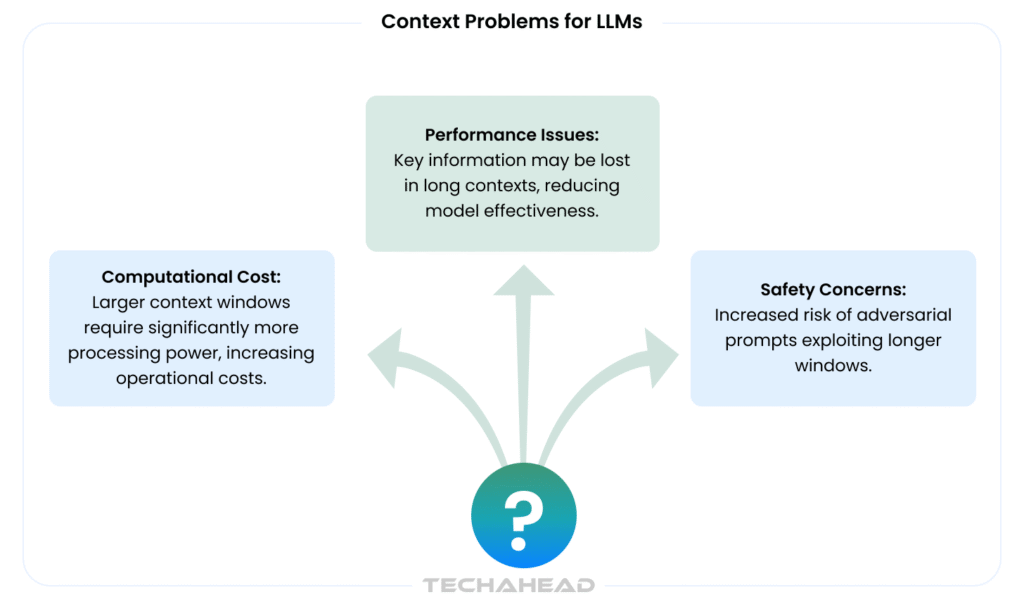
Context Problem for LLMs (Source)
In a typical business environment, a new AI use case requires engineering teams to build custom point-to-point integrations.
A sales copilot needs a CRM connector. A customer support bot needs a ticketing system connector. An internal assistant needs connectors to SharePoint, Jira, Salesforce, and whatever else an organization uses.
Scale this across even a mid-size enterprise, multiple teams, dozens of data sources, competing LLM vendors, and you have an integration debt crisis.
This is where Model Context Protocol (MCP) offers a solid solution, which is scalable, precise, and ROI-focussed.
Introduced by Anthropic in November 2024, MCP is an open-source, vendor-neutral standard that has achieved industry-wide adoption, backed by OpenAI, Google, Microsoft, AWS, and the Linux Foundation. Think of it as the “USB-C for AI applications”, a universal connector that allows any AI model to communicate with any tool, data source, or system through a single, standardized interface.
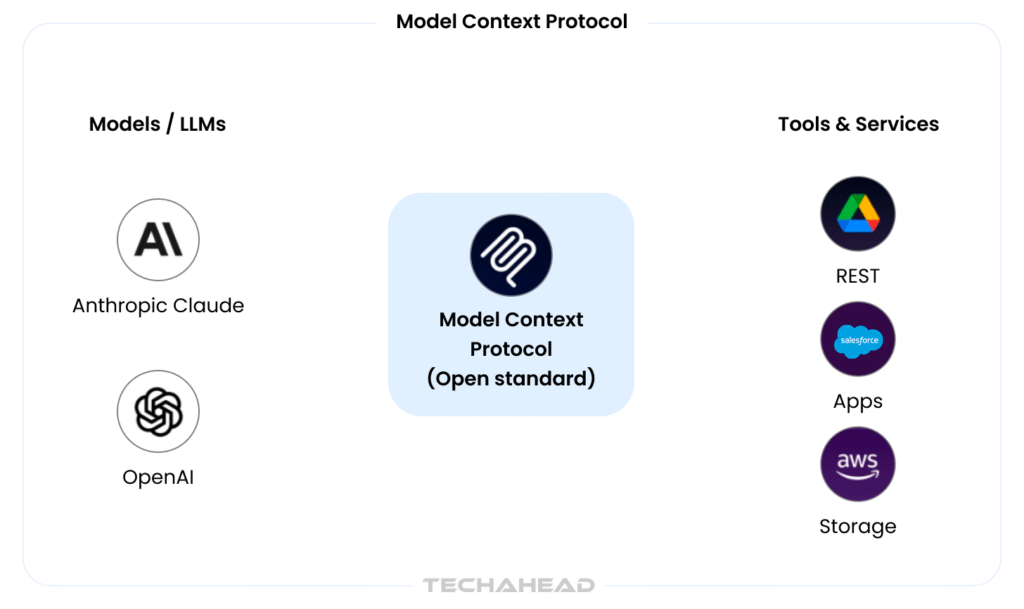
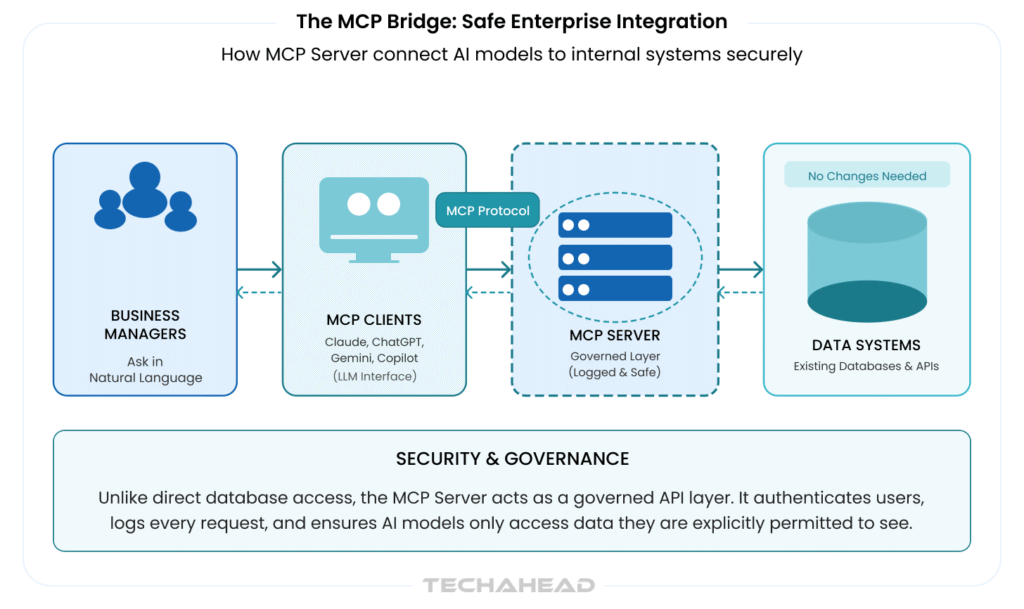
In plain business terms: MCP standardizes how AI agents discover, authenticate to, and safely invoke external tools and data sources. Before MCP, every AI application needed custom integrations for every tool. After MCP, one standard interface replaces thousands of point-to-point connections.
The adoption curve tells the story better than any explanation. In November 2024, when MCP launched, the SDK had roughly 100,000 downloads. By March 2026, just 18 months later, that number reached 97 million monthly downloads, representing a 970x increase.
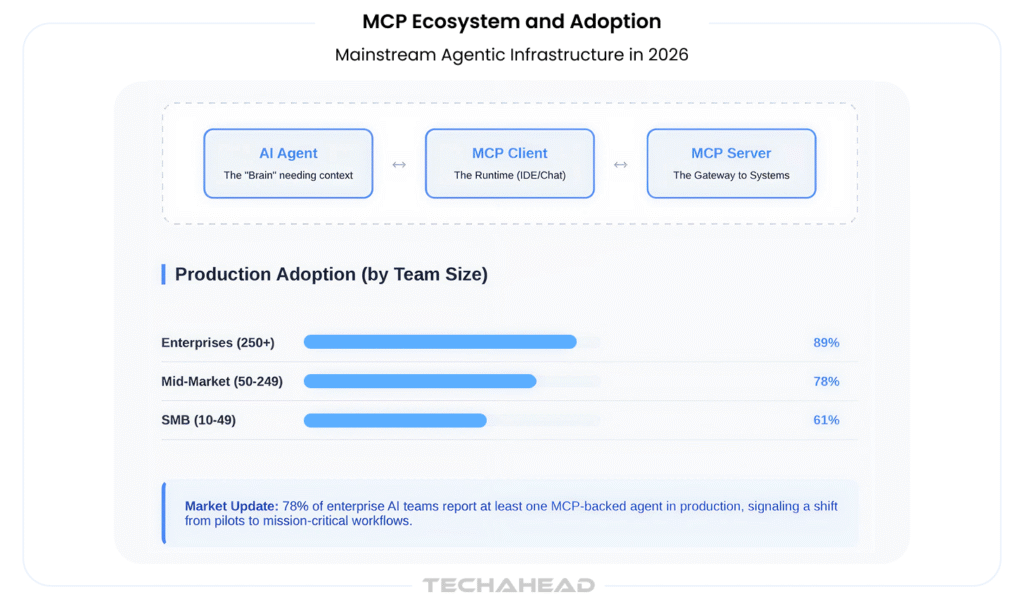
As of Q1 2026, 78% of enterprise AI teams (defined as organizations with 50+ AI/ML practitioners) reported at least one MCP-backed agent in production, up from 31% a year earlier. This is not a niche adoption curve. This is mainstream enterprise infrastructure.
The public MCP server registry grew 7.8x year-over-year, expanding from 1,200 servers in Q1 2025 to 9,400+ in April 2026, with month-over-month growth still tracking at +18%. By April 2026, MCP was implemented on more than 10,000 enterprise servers with over 97 million SDK downloads.
Traditional REST API integrations are ad hoc and fragile. Each system gets its own custom connector. There’s no standard for how tools expose capabilities, no shared way to express permissions, no built-in discovery mechanism.
MCP changes this by introducing:
The elegance of MCP lies in its simplicity. Three actors interact:
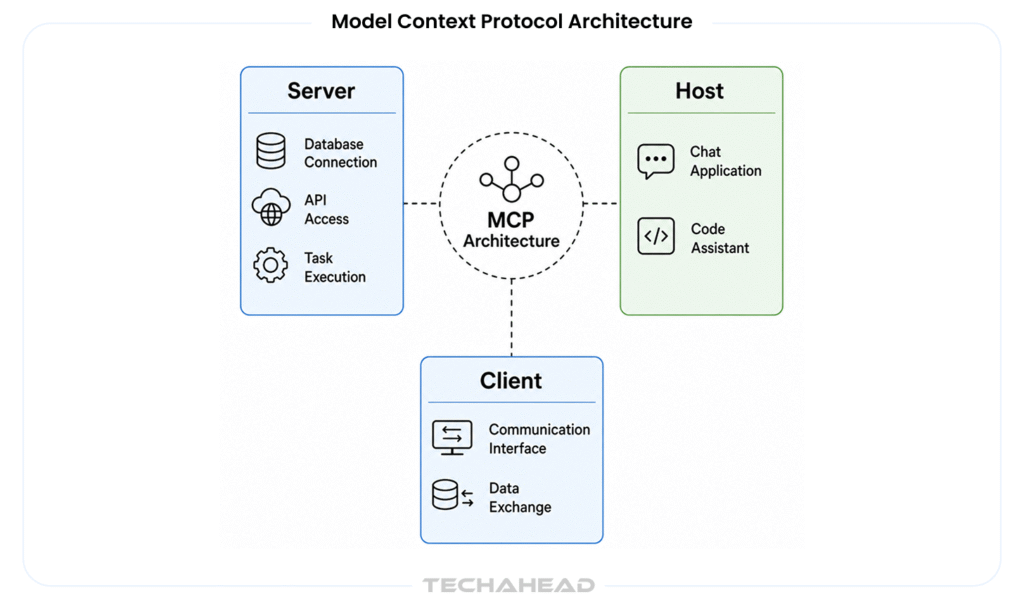
Communication happens via structured JSON-RPC-style messages with well-defined schemas, enabling deterministic tool calling and standard error handling. This is deliberate: MCP was designed to make AI behavior predictable and auditable in production environments.
The strategic case for MCP comes down to five factors.
According to CData’s 2026 State of AI Data Connectivity Report, 71% of AI teams spend more than a quarter of their implementation time on data integration alone, time not spent building value. This integration tax is unsustainable. Every team rebuilds the same connectors. Every new tool requires fresh engineering effort. The result is fragmentation, inconsistent security postures, and slow time-to-market.
For years, enterprise technology lacked a unified standard. Within eighteen months, MCP achieved what few technology standards accomplish: adoption by OpenAI (March 2025), Google DeepMind (April 2025), and Microsoft, with Anthropic donating MCP to the Linux Foundation in December 2025 for vendor-neutral governance.
This is significant. When OpenAI, Google, and Microsoft all ship support for the same protocol, it stops being a curiosity and becomes infrastructure.
EY, Salesforce, and JPMorgan are orchestrating trillions of data points across thousands of workflows, signaling the mainstreaming of agentic infrastructure for regulated, mission-critical workflows.
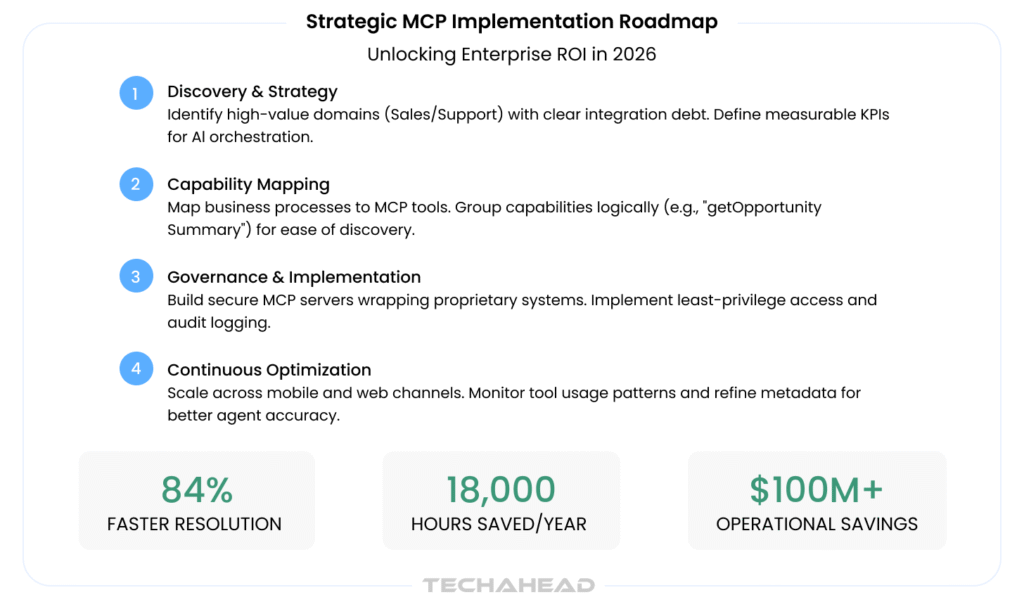
At Reddit, Salesforce’s Agentforce deployment (utilizing MCP) achieved 84% reductions in case resolution times and exceeded $100 million in annual operational savings according to vendor reports.
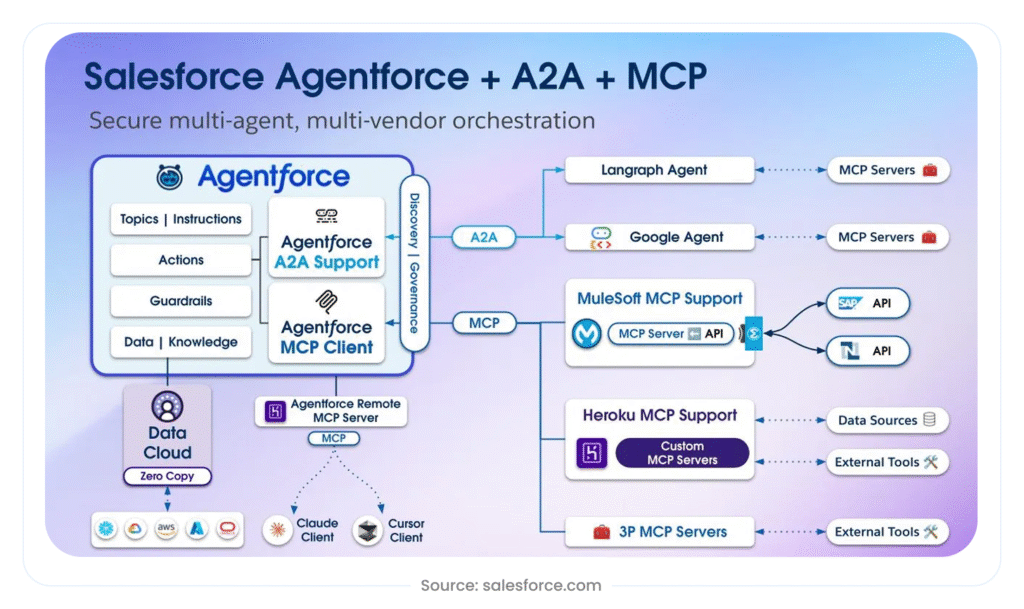
These aren’t isolated experiments. They’re production AI systems handling mission-critical workflows at scale, exactly the environments where MCP’s governance, security, and auditability matter most.
Security researchers, particularly at RSA Conference 2026, are focusing heavily on MCP security risks, with submissions warning that the combination of ease of integration and expansive permissions creates a risk profile that organizations have not previously managed at scale.
Source: TechAhead AI Team
This is actually a sign of maturity. Early technologies are security afterthoughts. MCP is being evaluated for its security properties precisely because it’s being deployed in real enterprises. The solution is not to avoid MCP, it’s to understand its governance gaps and design systems that close them.
Forbes saved 18,000 hours annually and doubled landing page conversion rates by removing developer dependency from content creation workflows through MCP-backed AI. This is not theoretical ROI. This is measurable operational impact from day one.
Gartner predicts that 40% of enterprise applications will embed AI agents by the end of 2026, with MCP at the core of this expansion.
MCP isn’t a technology looking for a problem. The use cases are clear and immediately valuable.
A sales copilot connected via MCP can simultaneously access CRM data (customer history, deal stage, contact info), marketing automation platforms (campaign engagement, content preferences), and internal systems (pricing, inventory, capacity) to generate real-time account briefs, personalized outreach, and next-best-action recommendations.
Before MCP, this required custom integrations. With MCP, a sales team can have a working copilot in weeks.
MCP enables support AI to access ticketing systems, knowledge bases, product databases, order management systems, and customer communication history to summarize cases, propose resolutions, and even execute actions (escalate to human, create follow-up task) safely and auditably.
AI agents can safely trigger actions across multiple systems: create Jira tickets, update CRM records, send Slack notifications, generate reports in business intelligence tools. 76% of software providers are already exploring or implementing MCP as their connectivity standard for AI models.
A unified “front door” to enterprise knowledge, connecting intranets, SharePoint, document repositories, APIs, data warehouses, with proper access controls, role-based context, and audit trails.
The case for MCP moves beyond theory when you examine actual deployments.
Among enterprise AI teams, adoption varies by scale: 89% of enterprise teams (250+ AI engineers) have at least one MCP-backed agent in production, 78% of mid-market teams (50-249 engineers), and 61% of SMBs (10-49 engineers).
More telling: 41% of enterprise AI teams have built custom internal MCP servers, typically wrapping proprietary systems of record like data warehouses, internal CRMs, or custom workflow engines. This indicates deep adoption, not casual experimentation.
Source: TechAhead AI Team
According to independent census data, there are at least 17,468 MCP servers across registries as of Q1 2026, with the official MCP Registry listing roughly 2,000 first-party vendor servers and MCPMarket.com cataloging additional community implementations.
The distribution is instructive: 80% of public MCP servers implement tools-only capabilities (the practical default), 11% combine tools with data resources, and 4% add prompts for workflow orchestration.
The 2026 MCP roadmap explicitly makes enterprise readiness a top priority, acknowledging gaps in audit trails, SSO-integrated authentication, gateway behavior, and configuration portability, exactly the areas that block production deployment at scale.
This signals healthy protocol maturity: the community recognizes what production deployments require and is systematically closing gaps.
Building production MCP systems requires a disciplined approach.
Look for:
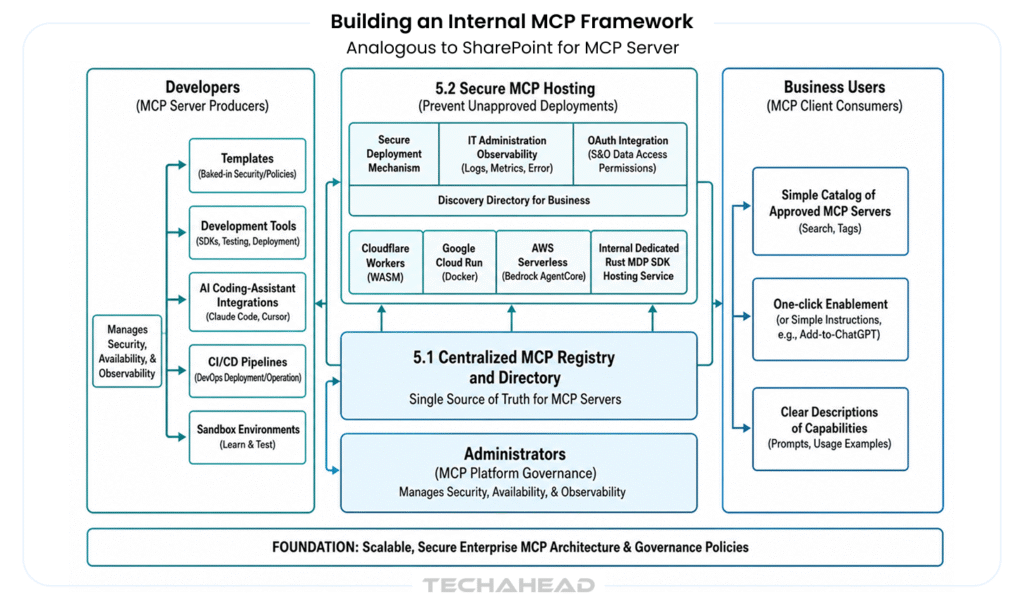
Translate business operations into MCP capabilities:
Well-scoped, clearly named capabilities are maintainable capabilities. Avoid the trap of exposing entire systems as single overly broad tools.
This is non-negotiable:
MCP adoption is not risk-free. Understanding the challenges is crucial for success.
Semantic Modeling Maturity: Teams must learn to think in terms of business capabilities, not low-level APIs. This requires a shift in how organizations approach integration design.
Granularity Decisions: Overly broad capabilities are risky (an agent could do too much). Overly granular capabilities become unmaintainable. Finding the right balance takes discipline and iteration.
Context Window Limitations: MCP servers expose capabilities, but agents still need to fit them within a finite context window. Thoughtful capability design prevents overwhelming agents with too many options.
Staggeringly, 86-89% of AI agent pilots fail before production, overwhelmingly due to gaps in governance, inability to inventory and trace agent actions, insufficient monitoring, and friction across organizational boundaries.
This is not an MCP-specific problem. It’s a general AI deployment problem that MCP can help solve (through governance-by-design) but doesn’t eliminate. Success requires alignment between product, engineering, security, and compliance teams.
At TechAhead, we’ve spent 16+ years building production-grade mobile and web applications that integrate complex backends, third-party APIs, and enterprise systems. We’ve learned what it takes to ship secure, scalable systems that last.
MCP is a natural extension of this expertise into the AI layer. Rather than treating AI as a black box that needs custom connections to every system, MCP lets us architect AI-powered applications the same way we architect enterprise systems: with clear contracts, standardized interfaces, and governance built in.
We work with enterprise teams across four phases:
If MCP is new to your strategy, here’s how to move forward systematically.
Evaluate your current AI initiatives, data landscape, and system inventory. Select a pilot domain with these properties:
Bring together business stakeholders (the users who will benefit) and technical teams. List the key actions and data needs. Group them into 5-15 MCP capabilities. Prioritize based on value and implementation complexity.
Build an initial MCP server (using FastMCP, the TypeScript MCP SDK, or similar). Wire it to your chosen LLM. Test with real users. Conduct security and performance reviews. Iterate on tool definitions and metadata.
Reuse MCP capabilities across multiple AI surfaces: mobile apps, web interfaces, internal tools, Slack bots. Build an internal capability catalog so teams can discover and consume tools.
MCP isn’t operating in isolation. It’s converging with other critical patterns.
API Management: MCP works alongside API gateways and service meshes, not instead of them. Smart organizations treat MCP as an AI-facing layer above existing API management infrastructure.
Event-Driven Architectures: MCP integrates naturally with event-driven systems, enabling AI agents to respond to real-time system events.
Compliance and Observability Platforms: Enterprise identity management, audit logging, and security information and event management (SIEM) systems are evolving to support MCP-specific controls and logging.
Gartner research indicates that 87% of IT leaders now prioritize interoperability for agentic orchestration, with 51% of enterprises preferring hybrid stacks that layer open protocols like MCP on top of extensible, vendor-managed orchestration.
The strategic reality is clear: enterprises that adopt MCP early, not today, but within the next 12-18 months, will have significant competitive advantages.
They will innovate faster (building AI-powered features in weeks, not months). They will integrate more securely (governance built into the architecture). They will reduce vendor lock-in (MCP-based applications can switch between LLM providers more easily). They will scale more confidently (because they understand and can audit every AI action).
The inverse is equally true. Organizations that delay adoption will accumulate integration debt, struggle with vendor lock-in, and find it increasingly difficult to compete on AI-driven innovation.
The future of enterprise AI isn’t in better models. We’re past the point where model performance is the constraint. The future belongs to organizations that figure out how to connect AI to real business context reliably, securely, and at scale.
MCP is the infrastructure that makes that possible.
MCP is an open standard enabling AI systems to securely access and share contextual information across enterprise applications seamlessly.
MCP provides standardized tool discovery, semantic metadata, secure context propagation, and built-in governance instead of ad hoc custom connections.
Faster innovation cycles, reduced integration costs, improved security, better governance, reduced vendor lock-in, and measurable operational impact across teams.
Four phases spanning sixteen weeks: assess (four weeks), design (four weeks), build (eight weeks), launch and scale thereafter.
EY, JPMorgan, Salesforce, Reddit, Amazon, Block, and Bloomberg are all orchestrating production MCP deployments at scale.
We use cookies to ensure our website functions properly, improve performance, and provide a personalized experience. You can choose which types of cookies to allow below.
Required for core functionality such as security, network management, and accessibility. These cannot be disabled.
Help us understand site traffic and user interactions so we can improve performance and usability.
Enable enhanced functionality and personalization such as language or region preferences.
Used to deliver relevant ads, track campaign performance, and measure advertising effectiveness.