


 Copy Link
 Share on X
 Share on Facebook
 Share on LinkedIn
Always Active
Required for core functionality such as security, network management, and accessibility. These cannot be disabled.

Uncover the transformative potential of digital and mobile solutions for your industry.





 Last Updated: Sep 22, 2026
May 20, 2026
Last Updated: Sep 22, 2026
May 20, 2026  645
645  39 min. Read


Key Takeaways
Most enterprises have an AI strategy. Very few have an AI system actually running in production. That gap between the roadmap and the reality is where millions in the enterprise budget quietly disappear. On pilots that never scale. On vendors who delivered impressive demos and underwhelming production systems. On AI features that worked perfectly in a test environment and failed the moment real users, real data, and real compliance requirements entered the picture.
The enterprise AI market is heading toward $558 billion by 2035. That growth isn’t being driven by experimentation. It’s being driven by the enterprises who figured out how to move from pilot to production — and are now operating with cost structures, decision-making speed, and operational intelligence that their competitors simply can’t match.
We have been on the production side of that equation for 16+ years. AI systems for Disney, American Express, AXA, JLL, and ESPN F1. SOC 2 Type II certified. ISO 42001 governed. Claude, OpenAI, and AWS partner. This guide exists because most AI resources tell you what’s possible. This one tells you what’s practical — what it costs, what breaks, and what separates the AI systems that show up on a P&L from the ones that just fill dashboards.
AI development is the process of building intelligent systems that learn from data, make decisions, and execute tasks that previously required human judgment. Artificial intelligence development services provide comprehensive offerings to help enterprises build, integrate, and manage AI solutions, emphasizing end-to-end services, security, and expertise for seamless AI transformation and operational improvement.
However, that definition undersells what it actually means for enterprise operations in 2026. It means a claims processing system that reviews documentation in seconds instead of days. A predictive maintenance platform that catches equipment failures before they become production incidents.
A customer intelligence layer that personalizes every interaction that no human team could replicate. An AI software development company specializes in designing and training deep learning models for complex data analysis tasks such as image recognition, speech processing, and autonomous decision-making.
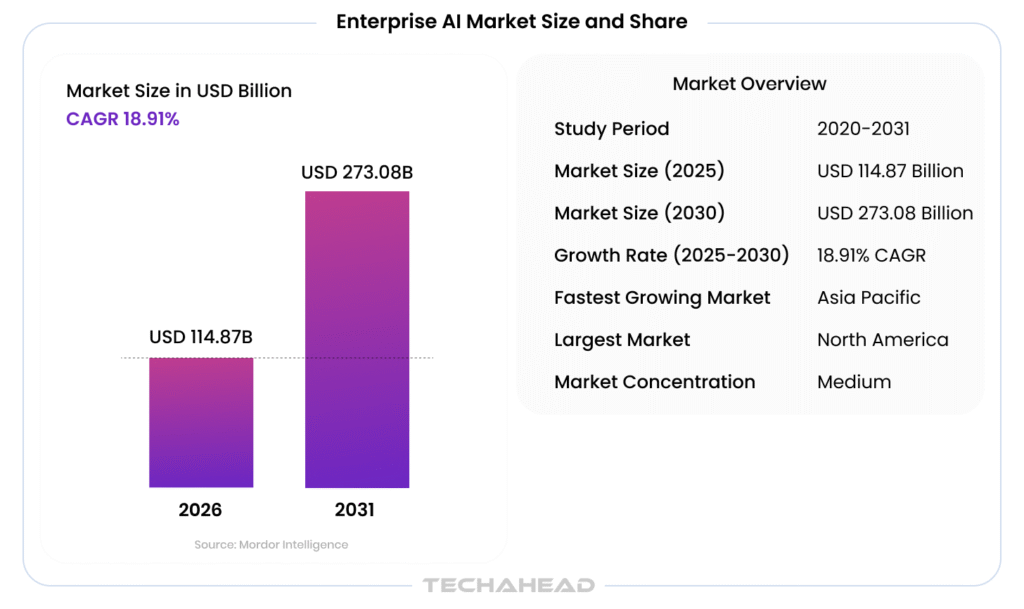
The enterprise AI market stands at $114.87 billion in 2026 and is projected to reach $273.08 billion by 2031, growing at an 18.91% CAGR. That capital is not going toward experiments. It’s going toward production AI systems that deliver measurable operational outcomes.
The gap between experimentation and execution is where most enterprises are stuck, and it is widening every quarter. AI-as-a-Service solutions are enabling businesses to access advanced AI models and automate workflows without the need for extensive in-house development, streamlining processes and accelerating adoption.
We have sat across that gap more times than we can count. As Claude & OpenAI Services partner with ISO 42001 certification and a dedicated AI Studio, we have delivered production AI systems for American Express, AXA, Disney, JLL, and ESPN F1; clients who did not need another pilot. They needed AI that worked under real enterprise pressure, met compliance requirements their legal teams could verify, and delivered outcomes their finance teams could measure.
AI development services are essential for both startups and enterprises, but their focus differs: startups prioritize speed and disruption, while enterprises emphasize optimization and risk management. When evaluating AI development services, companies should prioritize vendor domain expertise, data security protocols, and integration capabilities.
Not all AI development is the same, and treating it as one category is how enterprises end up with solutions that do not match their actual problems. Strategic AI consulting also helps enterprises define, develop, and scale AI initiatives, supporting everything from feasibility assessments to deployment to ensure alignment with business and regulatory goals.
The ten service types below are not theoretical categories, they are the investment areas enterprise leadership teams are actively funding in 2026. Our experts have delivered production systems across all ten. Here is what each one actually involves.
Machine learning is the foundation of most enterprise AI investment — and the service type with the clearest ROI story. Machine learning models are essential for enabling business intelligence and supporting data driven decisions, as they learn patterns from historical data and use those patterns to predict future outcomes — equipment failures, customer churn, demand fluctuations, fraud probability, credit risk.
For JLL’s Intellicommand platform, our AI experts deployed predictive ML pipelines, leveraging data engineering to prepare and manage the data pipelines that analyzed equipment health data across 5.4 billion square feet of global real estate, identifying fault patterns before failures occurred. The outcome was $10M in annual operational savings and a 60% reduction in unplanned equipment failures. That’s not an AI demo. That’s predictive analytics delivering a P&L impact that justified the investment within the first operational year.
Machine learning and foundation models captured 49.77% of enterprise AI adoption in 2025, making it the single largest AI investment category across industries.
Generative AI has moved from consumer novelty to enterprise infrastructure faster than almost any technology in recent memory. Generative AI development leverages large language models to automate content creation, enhance personalization, and optimize workflows using advanced AI architectures. LLM integration, connecting models like GPT-4, Claude, or domain-specific fine-tuned models to enterprise workflows is now one of the most requested AI development services we handle at TechAhead.
The valuable implementations are not just chatbots. However, AI chatbot development is a key service involving the design and implementation of AI-powered chatbots that utilize generative AI, natural language processing (NLP), and machine learning. These AI chatbots can enhance customer engagement by automating interactions and providing real-time assistance, delivering personalized responses to users. In customer service, AI chatbots significantly reduce operational costs while improving service delivery and customer satisfaction.
By leveraging Natural Language Processing and machine learning, AI chatbots understand user intent and context, enabling them to provide relevant and accurate responses. Beyond chatbots, we build intelligent document processing systems that review 40-page insurance claims in seconds, natural language search layers that let field engineers query equipment manuals without knowing the right terminology, and automated report generation that turns raw operational data into structured executive summaries without manual input.
As Claude & OpenAI partner, we build LLM integrations with infrastructure-level access; early visibility into model updates, deprecation timelines, and capability roadmaps that most vendors only read about after the fact. Generative AI & LLM Integration connects proprietary company knowledge bases to language models to automate content creation. For AXA’s insurance platform, LLM-powered document processing reduced manual claim review time dramatically, not by replacing adjusters, but by handling the routine documentation work so adjusters could focus on decisions that actually required human judgment.
Agentic AI is the fastest-growing enterprise AI service category in 2026 — and the most complex to build correctly. According to Grand View Research, the global AI agents market size was estimated at USD 7.63 billion in 2025 and is projected to reach USD 182.97 billion by 2033, growing at a CAGR of 49.6% from 2026 to 2033.
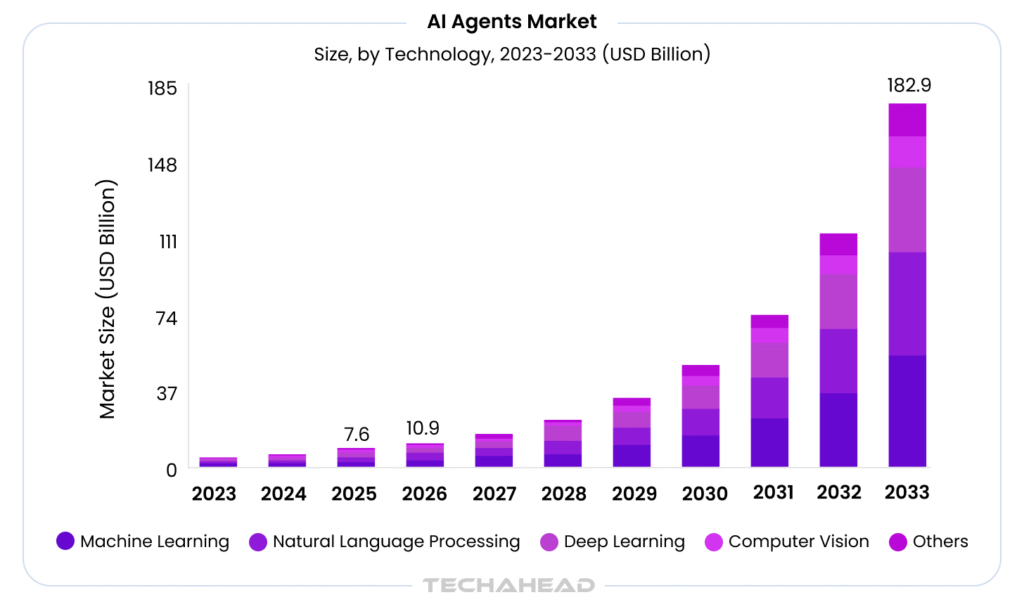
AI agent development, led by expert AI engineers, focuses on building autonomous, decision-making systems that automate complex workflows and improve operational efficiency. Autonomous agents that plan, decide, and execute multi-step tasks independently are moving from enterprise backends into operational workflows across every industry.
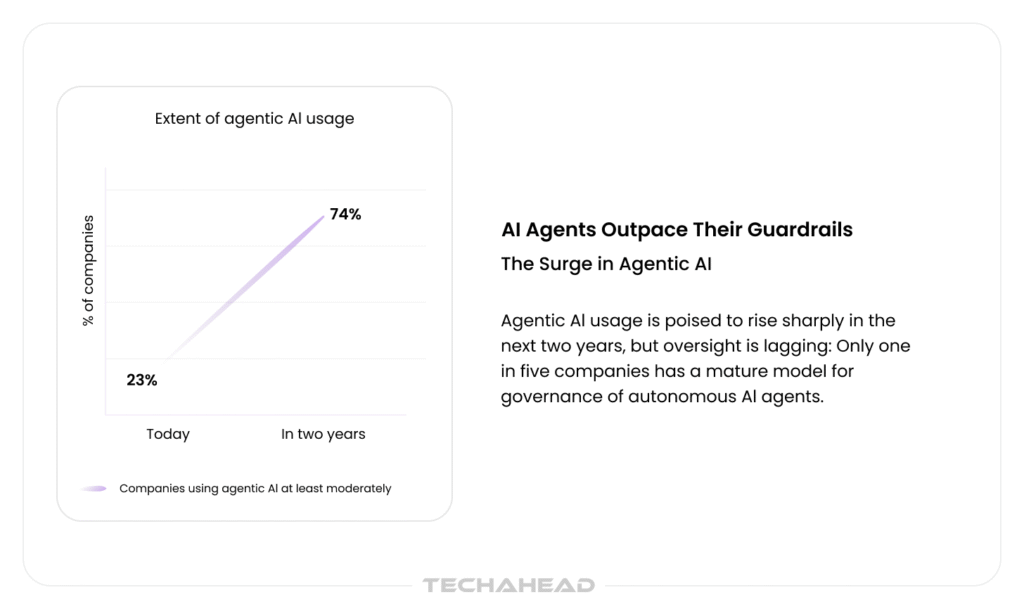
Source: Deloitte
The engineering challenge is that agentic systems do not fail the way traditional software fails. They make compounding decisions, and a poorly architected agent does not just return an error. It takes the wrong action, repeatedly, before anyone notices. A robust AI integration process is essential to ensure seamless deployment and operational efficiency, incorporating strategic planning and system compatibility.
In our organization, every agentic AI engagement starts with documented workflow mapping, failure mode analysis, and human-in-the-loop escalation design before a single agent is built. Our ISO 42001 certification ensures every autonomous system we deploy operates within an audited AI governance framework.
Key AI development services include AI product engineering, AI agent development, and AI integration, helping organizations automate processes, enhance decision-making, and improve operational efficiency.
NLP is the AI capability that lets enterprise systems understand, classify, and act on human language. Contract analysis that reviews 200-page documents in seconds. Customer feedback categorization across thousands of simultaneous inputs. Multilingual content processing for global enterprise operations.
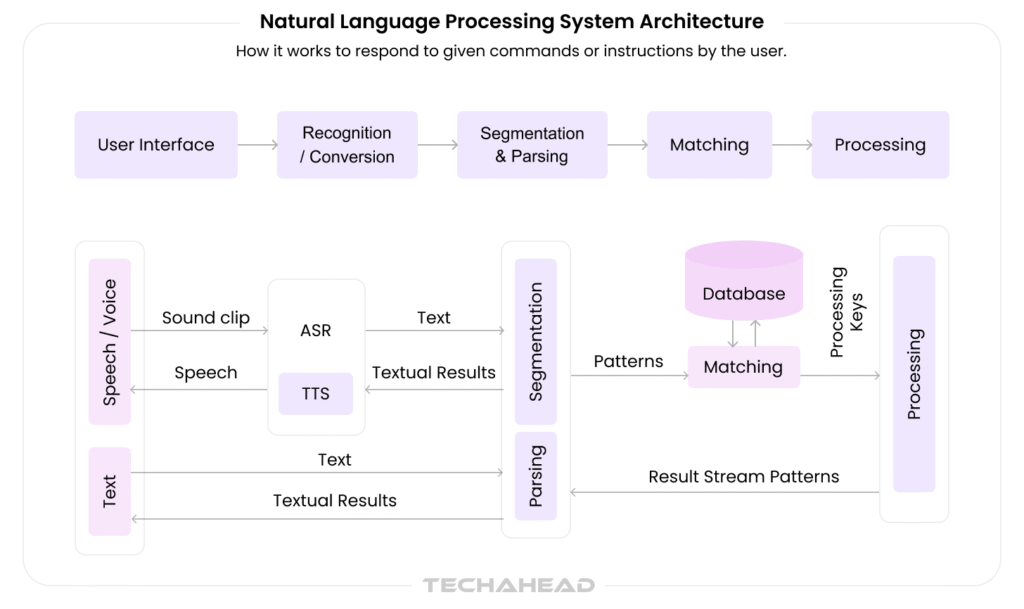
For us, NLP powers the intelligence layer inside enterprise workflows that previously required dedicated human teams to operate, which delivers accuracy and speed no manual process can match.
Computer vision gives enterprise systems the ability to interpret and act on visual data; quality inspection on manufacturing lines, medical imaging analysis, document processing, retail shelf monitoring, and security surveillance automation. For healthcare clients, our team builds computer vision systems under HIPAA-compliant data handling frameworks where patient imaging data requires the same audit trail and access control architecture as any other protected health information.
Intelligent automation combines AI with robotic process automation, moving beyond rule-based workflows into systems that handle exceptions, learn from outcomes, and improve without manual reprogramming. Invoice processing that handles non-standard formats. Claims routing that adapts to new document types. Procurement workflows that flag anomalies in real time. For many of our clients, intelligent automation deployments for insurance and financial services have reduced manual processing overhead by 40-60% within the first operational year.
Recommendation engines are the AI capability that delivers personalized experiences. For example, product recommendations, content personalization, dynamic pricing, next-best-action workflows, all powered by models that learn continuously from real user behavior rather than demographic assumptions.
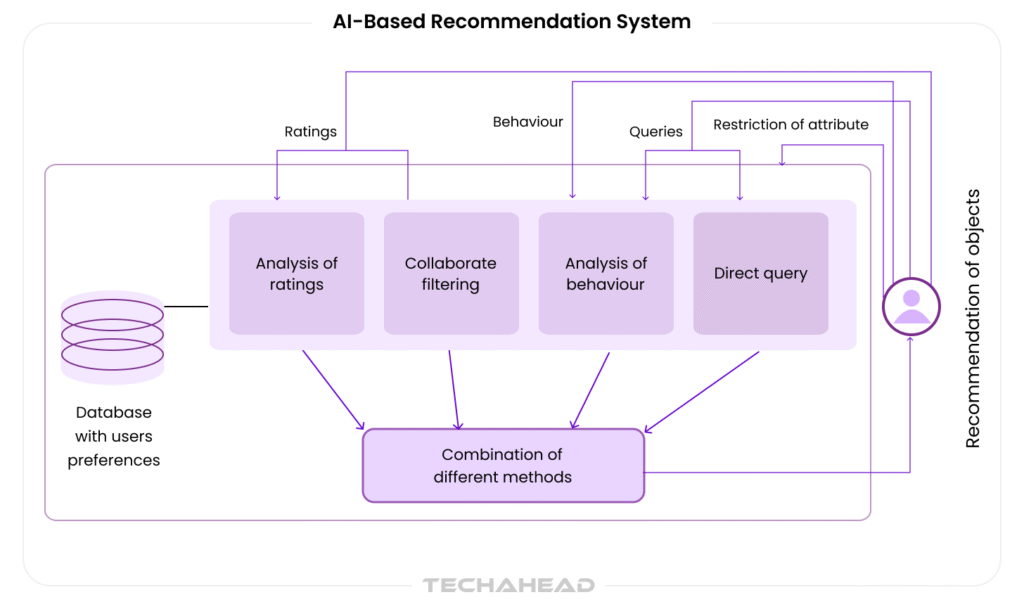
For the AI-driven news platform Headline.ai, we built personalization models trained on actual engagement data that delivered content relevance improvements that static editorial curation could not approach.
Predictive maintenance AI monitors equipment health continuously; identifying fault patterns before failures occur, estimating remaining useful life, and triggering maintenance workflows at exactly the right moment. For JLL’s Intellicommand platform, AI teams deployed predictive ML pipelines across 5.4 billion square feet of global real estate which delivers annual operational savings and reduction in unplanned equipment failures.
Fraud detection AI identifies anomalous patterns in real-time transaction data, flagging suspicious activity before financial losses occur rather than after. Unlike rule-based fraud systems that only catch known patterns, ML-powered fraud detection learns continuously from new attack vectors. That distinction matters enormously in 2026, when fraud patterns evolve faster than any static rule set can track.
For many of our clients, fraud detection architecture required a tiered ML model operating under PCI-DSS compliance standards, where real-time anomaly scoring had to run at transaction speed, maintain explainability for regulatory examination, and continuously retrain on emerging fraud patterns without manual intervention. Balancing those three requirements simultaneously is where most fraud AI systems fall short, and where production experience makes the difference.
As regulatory scrutiny of enterprise AI intensifies globally — EU AI Act, sector-specific healthcare and financial services frameworks, ISO 42001 — AI governance has become a dedicated service category, not just a compliance checkbox. TechAhead holds ISO 42001 certification, the AI management system standard covering risk governance, transparency requirements, and human oversight protocols. For enterprise clients pursuing their own AI governance maturity, our certified framework provides a proven blueprint. It reduces preparation, audit, and implementation costs compared to building governance infrastructure from scratch.
Most enterprises use these three terms interchangeably. They should not. Each represents a fundamentally different engineering approach with different data requirements, infrastructure costs, and use case fits.
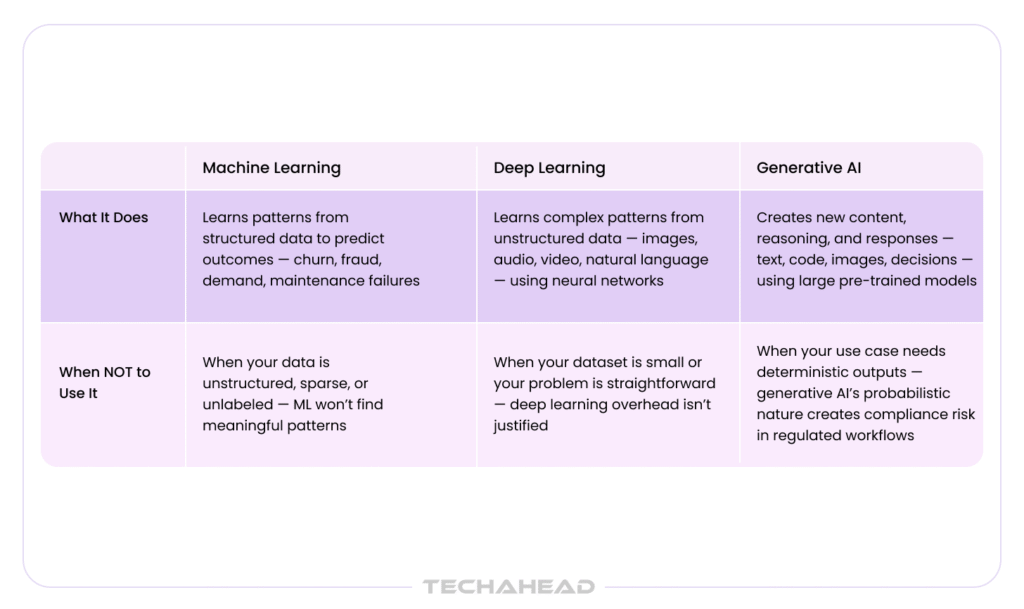
Choosing the wrong one does not just affect your build budget. It determines whether your AI system solves the actual business problem or just creates an expensive, technically impressive one.
AI software development companies can help enterprises select and design the right approach, including building custom AI models and delivering custom AI solutions tailored to specific business needs.
| Factor | Machine Learning | Deep Learning | Generative AI |
| Data Requirements | Structured, labeled datasets — smaller volumes work well with right features | Large volumes of unstructured data — quality and quantity both critical | Pre-trained on massive datasets — your enterprise data used for fine-tuning or RAG, not base training |
| Infrastructure Cost | Lower — runs on standard cloud compute | Higher — requires GPU clusters for training, significant compute overhead | Variable — pre-trained API access is low cost; custom fine-tuning and inference at scale is high cost |
| Build Complexity | Moderate — well-established frameworks, large talent pool | High — specialized ML engineers, longer development cycles | Moderate to High — LLM integration is accessible; production governance and RAG architecture adds complexity |
| Best Enterprise Use Cases | Predictive maintenance, fraud detection, demand forecasting, customer churn, credit scoring | Computer vision quality inspection, medical imaging, speech recognition, document processing at scale | Document summarization, intelligent search, code generation, conversational workflows, report automation |
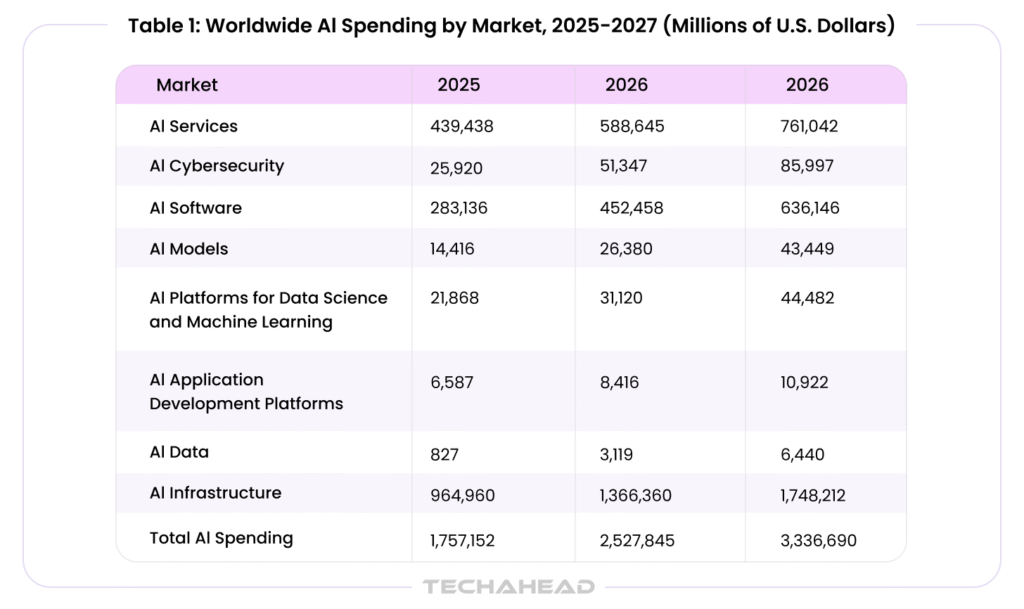
Gartner forecasts worldwide AI spending at $2.52 trillion in 2026 up 44% year over year. The enterprises capturing that value are not the ones with the most ambitious AI roadmaps. They are the ones who moved from roadmap to production with the right architecture, the right governance, and the right partner.
Every enterprise AI system being built today—including every system we have ever delivered—is Narrow AI. General AI doesn’t exist in production yet. Understanding this distinction matters because vendors who sell “general AI” capabilities are either describing narrow AI with broad applications or overpromising something that isn’t real.
What Narrow AI Actually Covers?
Every one of these capabilities, deployed by TechAhead for clients including American Express, JLL, AXA, Heatmiser and Disney—falls under Narrow AI. By utilizing AI technologies, these systems deliver measurable enterprise outcomes. However, they each do one defined category of task exceptionally well, not everything.
| Factor | Narrow AI | General AI (AGI) |
| Current Status | Production-ready — deployed in enterprise environments today | Theoretical — does not exist in deployable form in 2026 |
| Capability Scope | Excels at one specific task or category of tasks | Theoretically capable of any intellectual task humans can perform |
| Enterprise Use Cases | Fraud detection, predictive maintenance, document processing, personalization, agentic workflows | No current enterprise use cases — AGI is not commercially available |
| Build Complexity | Well-understood engineering discipline — frameworks, talent, and governance standards exist | Undefined — no established development methodology or production framework |
| Compliance & Governance | ISO 42001, SOC 2, HIPAA, GDPR frameworks apply; we are ISO 42001 certified | Regulatory frameworks don’t yet exist; significant ethical and legal uncertainty |
| Investment Risk | Quantifiable — proven ROI across healthcare, fintech, insurance, real estate | Unquantifiable — no production deployments to benchmark against |
| What Enterprises Should Do | Invest in Narrow AI use cases with clear ROI — predictive, generative, and agentic systems | Ignore AGI claims from vendors — focus budget on what’s deployable and measurable today |
The vendors selling “General AI” in enterprise proposals deserve exactly one response, show me a production deployment. The answer will tell you everything you need to know about whether that proposal deserves a second meeting. In our AICoE, every AI engagement starts with a specific problem, a defined dataset, and a measurable outcome, not a capability claim.
This is the first decision most enterprises get wrong, not because the answer is complicated, but because the framing is wrong. The question is not which option is better. It is which one fits your specific use case, data environment, and long-term business requirements.
A custom AI development company specializes in building custom AI solutions that offer seamless integration into existing systems, ensuring compatibility and scalability for enterprise needs. We have recommended both, and the recommendation is always driven by the problem, not the preference.
When considering the benefits of custom AI, it’s crucial to focus on a robust AI integration process. This ensures that AI-powered applications are effectively incorporated into your existing systems, maximizing efficiency and minimizing disruption.
Off-the-shelf AI solutions are pre-built products: Salesforce Einstein, Microsoft Copilot, Google’s AI APIs, IBM Watson, designed to solve common enterprise problems without custom development. They are faster to deploy, require less engineering investment upfront, and come with vendor support, established security certifications, and pre-built integrations for common enterprise platforms.
What off-the-shelf AI does well:
Custom AI development builds custom AI models, pipelines, and systems designed specifically for your enterprise’s data, workflows, and business outcomes as part of comprehensive AI software development services. These custom AI solutions are tailored to your unique requirements, ensuring the model learns from your operational history, not generic training data. The architecture integrates with your specific systems, and the governance framework meets your exact compliance requirements.
What custom AI does well:
Custom AI is what we build for clients like JLL, where predicting equipment failures across 5.4 billion square feet of global real estate requires custom AI models trained on JLL’s specific equipment data, integrated with JLL’s specific building management infrastructure. No off-the-shelf tool solves that problem.
For AXA’s insurance platform, custom AI solutions handled claims documentation processing under GDPR and regional compliance requirements that a generic vendor product couldn’t satisfy. For the AI-driven news platform, custom recommendation models trained on actual user behavior delivered personalization accuracy that pre-built recommendation APIs simply couldn’t match.
| Factor | Off-the-Shelf AI | Custom AI Development |
| Speed to Deploy | Weeks — faster time to initial value | Months — longer build cycle, higher long-term ROI |
| Cost Structure | Lower upfront — ongoing subscription or usage fees | Higher upfront — lower ongoing cost, no vendor dependency |
| Data & Accuracy | Trained on general data — adequate for standard use cases | Trained on your data — significantly higher accuracy for specific enterprise problems |
| Compliance & Control | Vendor-controlled — may not meet regulated industry requirements | Fully controlled — built to your exact compliance, security, and governance standards |
| Competitive Advantage | None — competitors access identical capabilities | Significant — proprietary system your competitors cannot replicate by purchasing a product |
The decision framework is straightforward. If your use case is standard, your compliance requirements are basic, and speed matters more than precision — off-the-shelf delivers adequate value faster. If your problem is specific, your data is proprietary, your compliance requirements are non-negotiable, or your AI system needs to be a competitive differentiator rather than an operational utility — custom development is the only answer worth considering.
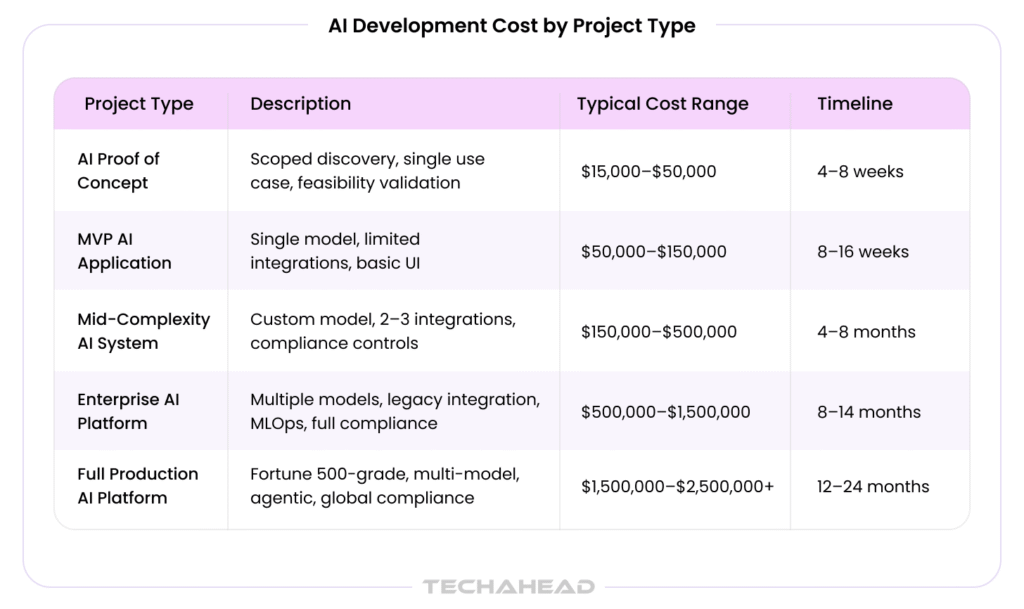
Enterprise AI development costs range from $25,000 for a focused proof of concept to well over $2,000,000 for a full production platform with compliance controls, custom model development, legacy integration, and MLOps infrastructure.
This cost spectrum covers a wide range of ai development services, including ai app development services—such as building custom data query bots and proof-of-concept prototypes—and comprehensive AI application development services that deploy generative AI solutions, integrate with business processes, and ensure security and scalability.
That range isn’t arbitrary — and it isn’t vendors making up numbers. It reflects genuine differences in data complexity, model architecture, integration depth, compliance requirements, and the operational overhead that keeps an AI system performing after launch. AI models also require continuous monitoring and retraining, so vendors must provide post-launch support and scalability to ensure ongoing performance.
We have delivered AI systems across every point in that range; from focused MVPs for mid-market enterprises to multi-year AI platform builds for Fortune 500 clients including American Express, AXA, Disney, and JLL. The most expensive AI projects we’ve ever seen weren’t the most complex ones. They were the ones that skipped discovery, underscoped data preparation, and found out what the real costs were through change orders after the contract was signed.
Here’s what actually drives enterprise AI development cost — broken down honestly.
Bad data doesn’t slow your AI down. It breaks it entirely. Data collection and data engineering are foundational for successful AI projects. In most enterprise environments, data arrives inconsistent — mismatched schemas, duplicate records, missing values, siloed sources that have never been joined. For one logistics client, our data remediation work cut model error rates by 34% before training even began. That work took months and added significant cost that the original proposal hadn’t accounted for.
Data preparation and quality remediation represents 15–25% of total AI project cost. For data-heavy deployments — predictive maintenance, fraud detection, demand forecasting — that can reach 30–40%. And it’s not a one-time cost. Ongoing data validation and pipeline maintenance adds $40,000–$90,000 annually for mid-scale deployments.
A fine-tuned LLM integration using existing pre-trained models costs a fraction of what a custom deep learning model trained from scratch on proprietary enterprise data costs. Computer vision systems for medical imaging require different architecture — and different compliance controls — than a recommendation engine for a retail loyalty platform. Model development is scoped based on the specific problem, the data available, and the accuracy requirements — not based on a template.
Connecting AI to a live enterprise environment is never a clean API call. The AI integration process must ensure seamless integration with existing systems, including ERP systems, CRM platforms, proprietary data warehouses, and legacy infrastructure that was never designed to feed a modern AI system.
Integration and customization adds 20–30% to total project cost — and in legacy-heavy environments, that figure climbs higher. For many of our clients, data consolidation across systems that had never been designed to communicate required months of normalization work before a single model saw the data. And for JLL, building management system APIs varied across property types and regions; none of which was visible until engineers were inside the actual infrastructure.
For enterprises in healthcare, insurance, fintech, or any regulated environment — compliance isn’t a layer added at the end. It’s an architectural requirement that reshapes the entire system. Data security is paramount throughout the AI development and deployment process, making it essential to partner with an AI software development company experienced in compliance and advanced protection measures.
HIPAA audit trails, GDPR data residency controls, PCI-DSS transaction security, and ISO 42001 AI governance frameworks all carry real engineering costs. Besides that, compliance implementation adds 15–25% to total project cost for regulated industries — and our SOC 2 Type II, ISO 42001, and ISO 27001 certifications mean those controls are built to independently audited standards. The alternative — retrofitting compliance after architecture decisions are locked — consistently costs three times more than building it correctly from day one.
Building the model is the cost vendors quote. Keeping it performing is the cost that shows up after you’ve signed.
Ongoing support is essential for both AI software development services that remain reliable, secure, and optimized throughout their lifecycle. Model drift, prompt degradation, data pipeline failures, infrastructure scaling, security patches, and retraining cycles all carry ongoing engineering costs.
For mid-scale AI deployments, ongoing MLOps and maintenance runs $40,000-$120,000 annually. For enterprise-scale platforms with multiple models, real-time inference, and compliance monitoring — that number climbs significantly higher.
| Cost Component | Description | Typical Cost Range |
| Discovery & Architecture | Use case mapping, data readiness, compliance assessment | $15,000–$50,000 |
| Data Preparation & Pipeline | Cleaning, normalization, validation, pipeline build | $20,000–$150,000 |
| Model Development & Training | Custom model build, fine-tuning, or LLM integration | $30,000–$300,000 |
| LLM & API Integration | OpenAI, Claude, or open-source model integration with RAG | $20,000–$80,000 |
| Enterprise System Integration | ERP, CRM, data warehouse, legacy API connections | $25,000–$200,000 |
| Compliance & Governance | Audit trails, explainability, ISO 42001, HIPAA, SOC 2 | $20,000–$100,000 |
| UI & Application Development | Dashboards, mobile interfaces, workflow tools | $25,000–$150,000 |
| MLOps Infrastructure | Monitoring, drift detection, retraining pipelines | $20,000–$80,000 |
| Security & Penetration Testing | Adversarial testing, access controls, encryption | $15,000–$60,000 |
| Post-Launch Maintenance | Annual monitoring, updates, model governance | $40,000–$120,000/year |
The most important cost insight we share with every enterprise AI client is this: the discovery phase that maps every one of these variables before the build starts costs $15,000–$50,000. The change orders generated by skipping it routinely cost ten times that. As Claude & OpenAI partner with SOC 2 Type II, ISO 42001, and ISO 27001 certifications, our delivery framework builds compliance, governance, and integration costs into every proposal from day one, so they do not surface as surprises in month six of a build that was already over budget before the first model was trained.
Most AI proposals look clean. A project total, a timeline, a team structure. What they do not show is the list of line items sitting just below the surface; the ones that appear in change orders after you have signed. Engaging in AI consulting with a partner that brings proven AI expertise and experienced AI engineers is essential for identifying and managing these hidden costs from the outset.
We surface every one of these in discovery. Because a client who knows what they are paying for makes better decisions than one who finds out in month three.
Data remediation: Enterprise data is never as clean as vendors assume. Schema inconsistencies, duplicate records, and siloed sources add $20,000–$150,000 before model training begins
LLM inference costs: Token consumption at enterprise scale runs $2,000–$25,000 monthly; a recurring cost most proposals quote conservatively and revisit quietly later.
Legacy system integration discovery: Undocumented APIs and infrastructure constraints invisible during scoping routinely add $20,000–$100,000. JLL’s building management systems taught us this.
Compliance re-engineering mid-build: Regulatory requirements surfacing after architecture is locked cost three times more to implement. AXA’s regional compliance requirements reshaped an entire data residency architecture mid-project
Model drift and retraining cycles: AI systems degrade over time. Retraining adds $15,000–$50,000 per cycle; ongoing, indefinitely, and almost never in the opening proposal
Explainability and audit trail development: regulators in healthcare, insurance, and fintech require documented AI decision trails. Building this in after launch costs more than architecting it from day one.
Prompt degradation remediation: LLM providers update their models. Agent behavior drifts by month four. Re-engineering and regression testing add ongoing costs nobody quotes upfront.
The vendors who cannot walk you through this list are not being modest. They are either inexperienced with production enterprise AI or protecting their margin.
Every enterprise AI conversation eventually lands on the same question; what is the return? And it is the right question. Deploying AI without a defined ROI model isn’t innovation. It is expensive experimentation on your operational budget.
We utilize business intelligence to ensure AI investments are strategically aligned with your business goals and business objectives, maximizing measurable value. We run an ROI framework in discovery — before architecture decisions are made and before a budget number is committed to. Here’s how that calculation actually works.
ROI starts with an honest number on the left side of the equation. What is the problem actually costing you right now?
For JLL, quantifying unplanned equipment failures across 5.4 billion square feet produced a number that made the AI investment decision simple. The cost of the problem exceeded the cost of solving it.
Vague AI benefits do not build board-approved business cases. Specific, measurable outcomes do.
| Current Problem | AI Solution | Measurable Outcome |
| Manual claims review | LLM document processing | 60% reduction in review time |
| Unplanned equipment failures | Predictive ML maintenance | $10M annual savings — JLL |
| Fraud detection lag | Real-time anomaly detection | 65% faster response time |
| Manual report generation | Automated AI summarization | 70% reduction in reporting hours |
| Customer churn | Predictive retention modeling | 25% improvement in retention rate |
AI ROI is not just build cost versus savings. It is the total cost of ownership: development, integration, compliance, MLOps, and ongoing maintenance versus the quantified operational improvements your system delivers over three years.
Most of our enterprise AI clients with well-defined problem statements reach positive ROI within 18–24 months. JLL reached it faster within the first operational year.
The most important ROI calculation is not the one done after the system is built. It is the one done in discovery.
Responsible AI gets discussed at conferences and forgotten in proposals. Most vendors add a “responsible AI” section to their pitch deck and move on. We have an architectural commitment, backed by ISO 42001 certification, independently audited, and built into every production AI system we have delivered for clients in healthcare, insurance, fintech, and commercial real estate.
Responsible AI development requires a strong focus on data security, leveraging advanced AI technologies, and relying on proven AI expertise to ensure safe, compliant, and effective solutions.
Here is what responsible AI actually looks like when an enterprise AI system is running in production:
The EU AI Act classifies high-risk AI systems; including those used in hiring, credit scoring, healthcare, and law enforcement as requiring mandatory explainability and human oversight by 2026. Regulators do not accept “the model decided” as an answer. Neither should your enterprise.
Explainability in production means:
For AXA’s insurance platform, we built explainability layers into the claims AI architecture from day one because regional regulators across multiple markets required documented decision rationale before automated recommendations could influence claim outcomes.
According to Deloitte’s 2026 research, only 34% of enterprises have implemented formal AI bias monitoring frameworks, which means the majority are running production AI systems without knowing whether their models are making systematically unfair decisions.
Bias in enterprise AI isn’t always obvious during development. It emerges when:
Our bias monitoring is a continuous MLOps workstream not a pre-launch checkbox. Our ISO 42001 certification requires documented bias assessment protocols as an audited governance standard.
Not every AI decision should be fully autonomous. Defining exactly where human judgment must enter the workflow and building that boundary into the architecture is one of the most important responsible AI decisions an enterprise makes.
Human-in-the-loop requirements by risk level:
For American Express, payment fraud detection required a tiered human oversight model where AI flagged anomalies autonomously at low risk thresholds but escalated to human review above defined transaction values. That boundary was not a technical decision. It was a compliance and risk management decision that shaped the entire system architecture.
Regulatory scrutiny of enterprise AI systems is intensifying globally with the EU AI Act, emerging US state-level AI regulations, and sector-specific frameworks in healthcare and finance all requiring documented governance artifacts by 2026. (Statista)
Production responsible AI governance covers:
TechAhead’s ISO 42001 certification means these governance artifacts are not optional additions; they are audited delivery standards on every production AI engagement. For clients in regulated industries, that certification eliminates significant compliance preparation costs that non-certified vendors pass back to the enterprise.
AI is not a single use case. It is a capability that reshapes operations differently in every industry it enters. The industries moving fastest are not the ones with the biggest technology budgets; they are the ones that identified a specific operational problem, matched the right AI architecture to it, and built the data infrastructure to act on what the models tell them. We have built production AI systems across six major industry verticals. Here is where AI is actually delivering measurable enterprise outcomes in 2026.
Financial services was one of the first enterprise industries to recognize that AI-powered decision-making is a structural competitive advantage.
Fraud detection, credit risk modeling, algorithmic trading, regulatory compliance automation, and customer intelligence platforms are all active AI investment areas for banks, payment processors, and fintech companies in 2026. The common thread is data volume. For instance, financial services generates more structured, labeled, decision-relevant data than almost any other industry, which makes it one of the best environments for ML model performance.
At TechAhead, our American Express engagement required AI and data architecture built to PCI-DSS compliance standards from day one, where customer data consolidation across systems that had never been designed to communicate required months of normalization work before a single model saw the data. The outcome was a direct, measurable increase in sales and customer engagement that legacy infrastructure had been quietly suppressing for years.
High-value AI use cases in financial services:
These AI use cases not only drive innovation but also enhance business intelligence, improve operational efficiency, and support data driven decisions by leveraging advanced analytics and real-time insights across financial operations.
Healthcare AI carries a different weight than any other industry. When an AI system makes a wrong recommendation in a retail context, a user sees the wrong product. When it makes a wrong recommendation in a clinical context, the consequences are fundamentally different.
That is why healthcare AI development requires HIPAA compliance architecture, explainability layers that clinical teams can interrogate, and human-in-the-loop oversight frameworks that define exactly where autonomous AI decisions stop and physician judgment begins.
TechAhead digital healthcare transformation engagement required every one of these controls built from day one; patient data handling, audit trails, role-based access controls, and AI decision documentation all architected to HIPAA standards before a single feature was developed.
We leverage advanced AI technologies and emerging technologies, including IoT and generative AI to deliver secure and innovative healthcare AI development services that drive better patient outcomes.
High-value AI use cases in healthcare:
Insurance is one of the most data-rich and process-heavy industries in the enterprise world, which makes it one of the highest-ROI environments for AI deployment. Working with Insurance AI app development company that delivers services focused on client success in insurance ensures that claims processing, underwriting risk assessment, fraud detection, and customer service automation are all optimized by integrating scalable, secure AI solutions into existing workflows.
At TechAhead, our AXA engagement required AI architecture that operated across multiple regional markets with different regulatory environments, different data residency requirements, and different compliance frameworks.
LLM-powered document processing reduced claims review time dramatically, not by replacing adjusters, but by handling routine documentation analysis so adjusters could focus on decisions that genuinely required human judgment.
High-value AI use cases in insurance:
Personalization at scale is the AI use case that sports and media enterprises cannot achieve any other way. An editorial team of 50 people cannot curate individualized content experiences for 50 million users.
For social media app development services, organizations can drive operational efficiency by automating content personalization, streamlining data access, and optimizing user engagement. An AI recommendation engine can and the engagement difference between personalized and non-personalized content experiences is measurable within weeks of deployment.
The AI-driven news platform we built required a real-time content personalization engine. For ESPN F1, real-time data delivery during live race events required AI-powered content routing that handled millions of concurrent users without performance degradation. For ICC’s cricket platform, multilingual AI content processing served a global audience across multiple languages and regional preferences.
High-value AI use cases in media and sports:
Commercial real estate was an early enterprise adopter of AI because the operational cost of managing large property portfolios without intelligent automation is immediately quantifiable. Deploying scalable real estate AI solutions enables property managers to address complex business challenges and optimize business operations, such as equipment failures, energy inefficiency, unplanned maintenance, and manual inspection cycles—all of which have dollar values that AI directly reduces.
JLL’s Intellicommand platform, our most complex enterprise IoT and AI deployment demonstrates what AI-powered property operations actually delivers. Predictive ML pipelines monitoring equipment health across 5.4 billion square feet of global real estate. Fault pattern diagnosis before failures occur. Maintenance workflow automation that dispatches the right technician with the right parts before the equipment actually breaks.
That’s not a technology case study. That is AI delivering outcomes that show up on JLL’s P&L every quarter.
High-value AI use cases in commercial real estate:
As a leading AI development company, TechAhead leverages deep AI expertise to deliver tailored solutions that drive measurable results for clients across industries. Our commitment to client success is at the core of every project, ensuring strong partnerships and long-term growth through end-to-end AI development services.
Founded in 2009, we bring over 16 years of experience engineering innovative, scalable applications for some of the world’s most demanding clients. Our team of experienced AI engineers leverages advanced AI technologies and emerging technologies—including IoT, blockchain, and generative AI—to deliver tailored solutions across industries. Leading brands like Audi, Disney, JLL, American Express, and AXA trust TechAhead, a level of enterprise credibility that takes decades to earn, not months.
Enterprise teams need proof, not promises. Since 2009, we have shipped 2,500+ apps and digital platforms for 1,200+ companies from Fortune 500 global brands to venture-backed startups. As a leading AI app development company, we deliver services that empower enterprises to enhance business intelligence, streamline data access, and drive data-driven decision-making.
Compliance is not optional at the enterprise level. As a certified AI software development company, we are committed to data security, ensuring that our AI software development services adhere to the highest industry standards. We hold certifications across the full modern technology stack, including ISO 42001 (AI Governance), SOC 2 Type II, ISO 27001, and partnerships as Claude & OpenAI Services Partner, AWS Advanced Tier Partner, Microsoft AI Solution Partner, and Google Developer Partner.
With over 250 experienced consultants and a dedicated team of skilled AI engineers, TechAhead has earned a reputation as a leading AI development company. We are well-equipped to manage large-scale, complex projects, delivering scalable solutions for high-profile clients, while providing ongoing support to ensure sustained performance and compliance. Enterprise teams get a proven partner, not an experiment.
TechAhead’s AI Center of Excellence (AICoE) is where high-level corporate strategy meets production-grade software execution. Anchored by our over 16 years engineering legacy and a track record of 2,500+ delivered platforms, this dedicated unit unifies our elite AI architects, data scientists, and ML engineers under a single mission: taking your automation initiatives out of sandbox pilots and scaling them into live, profitable deployments.
Rather than relying on generic, off-the-shelf API wrappers, our Center of Excellence engineers custom, highly secure intelligence platforms designed to integrate seamlessly into complex, legacy enterprise workflows without disrupting your daily operations.
From custom LLM development and agentic workflows to high-performance RAG architectures, MLOps frameworks, and deep infrastructure consolidation, every solution we deploy is built to move a specific line item on your P&L. Backed by our active ISO 42001 governance certification and Claude & OpenAI Services Partner status, TechAhead’s AICoE represents the most structured, secure, and predictable path to enterprise AI scaling on the market today.
Enterprise AI development in 2026 is not an experiment worth running twice. The architectural decisions made in the first four weeks: model selection, data pipeline design, compliance framework, integration approach shape everything that follows for the next five years.
TechAhead has delivered production AI systems for Disney, American Express, AXA, JLL, and ESPN F1. 250+ engineers. 2,500+ products. SOC 2 Type II, ISO 42001, and ISO 27001 certified. AWS Advanced Tier and Claude & OpenAI partner. Recognized by Clutch as a Top Generative AI Company for 2026.
Not AI pilots. Not proof-of-concept experiments. Production-grade AI systems that reduce operational costs, prevent failures, and deliver outcomes that show up on a P&L, built to the standard Fortune 500 compliance teams actually verify.
Look for three signals: high data volume, repetitive decision patterns, and measurable outcomes. Processes where humans make the same judgment repeatedly using the same inputs are almost always AI-ready. Our discovery framework maps operational workflows against data availability and outcome clarity before any AI architecture is recommended. The processes that fail this test need better data infrastructure first; not an AI model.
Prompt engineering is the discipline of designing, testing, and optimizing the instructions that guide LLM behavior, and it affects enterprise AI performance more than most teams expect. A poorly engineered prompt produces inconsistent, inaccurate, or non-compliant outputs regardless of model quality. Prompt engineering is a dedicated workstream, not something handled informally during development. We’ve improved output accuracy by 40% through systematic prompt optimization alone, without changing the underlying model.
Four factors determine the answer — compliance requirements, customization depth, inference cost at scale, and data privacy constraints. Proprietary models like GPT-4 deliver superior performance with less engineering overhead. Open-source models like Llama give you full control over data handling — critical for healthcare and fintech deployments where data leaving your infrastructure creates compliance risk. As an OpenAI & Claude partner, our AI experts build with both — the recommendation is always driven by your specific requirements, not vendor preference.
Synthetic data is artificially generated data that mirrors the statistical properties of real data — used when real data is scarce, sensitive, or imbalanced. Healthcare enterprises use it to train diagnostic AI without exposing patient records. Fintech enterprises use it to simulate fraud patterns that rarely appear in historical transaction data. Synthetic data is a scoped solution — not a default shortcut. It works when generated carefully and validated against real-world distribution. Used carelessly, it trains models that perform well in testing and fail in production.
Adversarial attacks manipulate AI inputs — images, text, or data — to produce deliberately wrong outputs. A fraud detection model fooled into approving fraudulent transactions. A document classifier manipulated into misrouting sensitive files. Protection requires adversarial input testing, input validation layers, model robustness training, and continuous anomaly monitoring in production. Adversarial testing is a mandatory security workstream on every enterprise AI engagement — covered under our SOC 2 Type II certified delivery framework and ISO 42001 AI governance standard.
AI hallucination occurs when a language model generates confident, plausible-sounding outputs that are factually incorrect — a risk that becomes a liability in healthcare, legal, and financial services contexts. The most effective mitigation is RAG — Retrieval Augmented Generation — which grounds model responses in your verified enterprise knowledge base rather than general training data. As an OpenAI partner, we build RAG architectures that constrain model outputs to documented, auditable sources — reducing hallucination risk significantly while maintaining the explainability that regulated industry clients require.
It means infrastructure-level access, not just API access. Claude & OpenAI partners receive early visibility into model updates and deprecation timelines, direct technical support for production edge cases, and access to capability roadmaps before public announcement. For enterprise clients, this translates to AI systems built with current architectural insight rather than six-month-old documentation.
We use cookies to ensure our website functions properly, improve performance, and provide a personalized experience. You can choose which types of cookies to allow below.
Required for core functionality such as security, network management, and accessibility. These cannot be disabled.
Help us understand site traffic and user interactions so we can improve performance and usability.
Enable enhanced functionality and personalization such as language or region preferences.
Used to deliver relevant ads, track campaign performance, and measure advertising effectiveness.