

HIPAA-Compliant AI Agents for Clinical & Administrative Workflows

TechAhead designs and builds HIPAA-aligned agentic AI systems for hospital systems, payers, and health-tech platforms, from PHI classification at the source to audit-ready logging.

Compliance Framework

Controls built into every HIPAA-compliant AI agent we deploy

Every agent we ship is engineered against how HHS treats AI acting on your workforce's behalf, i.e., held to the same access and audit standards as your employees. Your compliance and security teams get a system built to pass review on the first pass.
Data Mapping

PHI Classification

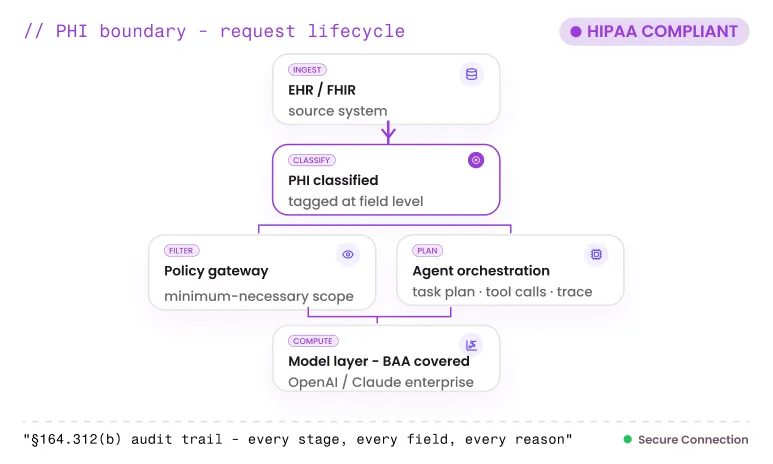
Every field in every connected system is tagged and mapped before an agent ever runs its first query. Your team gets a governed, defensible data map from the start, not a forensic reconstruction after something's already gone wrong.

Task-Based Access

Minimum-Necessary Enforcement

Agents retrieve only what a task requires — a summarization agent gets the current encounter, never the full longitudinal record. Scoping is built into the query layer itself, so that compliance standards are satisfied.

Vendor Chain Checks

Full BAA Coverage

We map and verify a signed BAA across every party that touches PHI, including model provider, orchestration layer, cloud host, and vector store. One fewer procurement and legal risk sitting unresolved in your vendor chain.

Full Traceability

Audit-Ready Logging

Every access is logged — who or what, which fields, when, under which policy, satisfying the audit controls standard at 45 CFR §164.312(b). We capture the agent's full reasoning trace, so your privacy officer has a complete record on review day.

Incident Readiness

Breach-Ready Response

Agent-caused exposure is built into your incident-response runbook from day one, on the same notification clock as any other breach. No separate playbook to draft later, no gap between "the system did it" and your existing process.

Safe Data Reuse

Governed De-Identification

Data flowing into analytics or model evaluation passes through a Safe Harbor or Expert Determination gate first, with periodic re-verification as new fields get added. A defensible, one-time-built pathway to keep improving the system.

How we deliver it

HIPAA-compliant AI agent deployment, built for governance

From data inventory to launch, every stage produces something your compliance team can review.

Data inventory & risk mapping

  • Catalog every source system the agent will touch
  • Map how PHI moves across each connected system
  • Flag high-risk fields before any build begins
  • Deliver a data-flow diagram compliance can review

Architecture & threat model

  • Define the PHI classification schema up front
  • Set minimum-necessary scoping rules per task type
  • Confirm BAA requirements for every vendor in scope
  • Agree the full architecture before writing code

Build the guardrails first

  • Build the policy gateway before agent logic
  • Scope tool access to each task's needs
  • Wire in audit logging from the first commit
  • Test guardrails independently of orchestration behavior

Clinical & compliance pilot

  • Run a scoped pilot with real users
  • Review every access against the audit trail
  • Validate outputs with clinical and compliance stakeholders
  • Confirm readiness before any production PHI volume

Audit-ready launch

  • Hand over a documented, reviewable control set
  • Brief your privacy and security officers directly
  • Confirm sign-off from your compliance stakeholders
  • Launch with evidence ready, not verbal assurances

Managed evolution

  • Track model updates against your compliance baseline
  • Fold in new source systems as you scale
  • Monitor regulatory changes like HHS's proposed AI inventory rule
  • Review the architecture on a fixed cadence

What You Get

What every HIPAA-compliant AI agent deployment delivers

We build a HIPAA-compliance agentic AI system your compliance team can defend on day one and re-verify on every review after that.

  • Production-Ready Agent

    Configured against your real systems and validated on live workflows, matching exactly what runs in production.

  • Documented Control Set

    Every control is documented and packaged for your privacy and security officers to present straight to auditors.

  • Governance Playbook

    A living reference for model updates and new systems, keeping the deployment audit-ready well beyond launch day.

What every HIPAA-compliant AI agent deployment delivers

Proven results. Delivered at scale

0+

Digital Products & AI-Powered
Solutions Delivered

0+

Days Average
Pilot-to-Production Timeline

0+

Enterprise Clients Trust Our
AI Strategy & Delivery

0+

Years of Proven Success
in the Industry

0+

In-House AI Engineers &
Data Scientists

TRUSTED TECHNOLOGY PARTNERS

Adobe Solutions
Microsoft
Open AI
Claude
IBM
Adobe Solution
Shopify
Google Developers
Fastly
Klaviyo
Mixpanel

Why TechAhead

Why healthcare AI teams choose TechAhead for HIPAA‑compliant AI agents

TechAhead has spent 16+ years building healthcare software, giving us the depth to design HIPAA-compliant AI agents that hold up under real compliance review. Beyond meeting that bar, we build agents that improve clinical and operational decisions, not just pass an audit.

Scoping

We map minimum-necessary access per task before selecting a model.

Simulation

We simulate breach scenarios before launch, so your team has answers ready.

Portability

Compliance sits above the model, so switching providers needs no rebuild.

Documentation

We document deployments against the exact categories auditors review.

Where this architecture applies

Agent categories we build in healthcare

Every HIPAA-compliant AI agent deployment starts with a use case like one of these four. The same classification, scoping, and audit controls apply no matter which workflow it's built for.

Clinical Documentation

Clinical Documentation

Draft notes, summaries, and discharge instructions with controlled PHI access.

  • Scoped to current encounter only
  • Drafts routed for clinician review
  • Every field read or written logged
  • Historical records out of scope
Claims & Prior-auth

Claims & Prior-auth

Support claims processing and prior authorizations with compliant data handoffs.

  • Cross-checks payer requirements automatically
  • Shares only claim-specific data
  • Flags gaps instead of guessing
  • Logs every payer handoff
Outreach & Triage

Outreach & Triage

Automate intake, follow-ups, and triage while keeping humans involved when needed.

  • Collects only task-required data
  • Urgent cases routed to humans
  • Follow-ups sent without full history
  • Every escalation logged with trigger
Research Agents

Research Agents

Generate population-level insights through de-identified and governed data access.

  • Operates behind de-identification gate
  • Aggregated to prevent re-identification
  • Re-verified as fields are added
  • Dataset access logged separately
Clinical Decision Support

Clinical Decision Support

Surface evidence-based recommendations to clinicians without replacing their judgment.

  • Flags interactions and contraindications
  • Guidelines scoped to diagnosis
  • Recommendations routed to physicians
  • Every output logged with source
Revenue Cycle & Billing

Revenue Cycle & Billing

Automate coding and claims scrubbing with governed access to financial and clinical data.

  • Codes cross-checked pre-submission
  • Discrepancies flagged, not auto-fixed
  • Access limited to the claim
  • Denials cut, exposure limited
Care Coordination

Care Coordination

Manage referrals and care plans across providers with only the data each handoff requires.

  • Shares only referral-relevant data
  • Tracks care plans across settings
  • Flags follow-up gaps early
  • One audit trail per handoff
Medication Management

Medication Management

Track prescriptions and interactions with access scoped to a patient's active regimen.

  • Monitors refills and adherence
  • Checks new scripts against history
  • Escalations routed to pharmacists
  • Access limited to active regimen
Scheduling & Resource Optimization

Scheduling & Resource Optimization

Coordinate appointments and resource allocation using scheduling metadata, not clinical records.

  • Matches requests to availability
  • Optimizes beds and resources
  • Clinical records stay out of scope
  • Reminders reduce no-shows
Compliance Monitoring

Compliance Monitoring

Continuously audit other agents and systems for HIPAA policy violations before they become incidents.

  • Flags out-of-scope access
  • Monitors integrations for BAA gaps
  • Anomalies routed for review
  • Feeds incident-response process

Explore our full range of capabilities

As requirements change or expand, engagement often extends into complementary technology capabilities. Our work reflects this by supporting multiple initiatives across several technology areas‑helping organizations modernize, scale, and accelerate delivery with confidence.

Guides & insights

Explore our original research, field-tested guides, frameworks, and lessons from building enterprise AI, custom platforms, and production systems at scale.

FAQs

General

A qualified partner needs three things at once: production experience building regulated software, direct engineering access to frontier model providers, and a delivery process that classifies PHI and scopes agent access before any orchestration code is written. TechAhead builds HIPAA-aligned agentic AI architectures for hospital systems, payers, and health-tech platforms, combining 16+ years of regulated software delivery with OpenAI Services Partner and Claude Partner Network status.

HHS treats an AI agent acting on a workforce member’s behalf as bound by the same rules as that employee: minimum-necessary access, a signed BAA with any vendor in the data path, audit controls under 45 CFR §164.312(b), and HIPAA breach notification clock. There is no separate “AI exception” written into the Privacy or Security Rule.

Yes. Any AI vendor, model provider, or subprocessor that creates, receives, maintains, or transmits PHI on a covered entity’s behalf meets the definition of a business associate and needs a signed BAA before any PHI reaches it — a requirement that extends down the chain to cloud infrastructure and inference APIs, not just the primary vendor.

An agent may only access the specific PHI fields its current task requires, not a full patient record. Most agent frameworks violate this by default through broad FHIR API scopes and persistent conversation memory. Compliant agentOps framework & architectures enforce scoping at query time, not by filtering the output afterward.

A typical engagement runs 10 to 16 weeks from data inventory to an audit-ready production launch, depending on the number of source systems, existing BAA coverage, and whether a compliance or security review board needs to sign off before go-live.

A chatbot responds to a single prompt and stops. An agent takes autonomous action across multiple systems, often retrieving, reasoning over, and writing back PHI without a human reviewing each step. That autonomy is exactly what HIPAA’s minimum-necessary and audit-control requirements were built to constrain, so an ungoverned agent creates more exposure per task than a standard AI tool.

The organization carries direct liability for any PHI exposure, regardless of whether the agent or a vendor caused it. Penalties scale with the level of negligence, and a missing BAA or undocumented data flow is treated as a violation on its own, independent of whether the data was ever misused.

Cost depends on the number of source systems, the complexity of the compliance review process, and whether existing infrastructure already has BAA coverage in place. We scope cost after the data inventory stage, once the real integration surface is known, rather than quoting a flat number upfront.

It adds cost in specific places: classification work, scoping design, and audit logging. It doesn’t add cost across the entire build. Teams that treat compliance as a parallel workstream from day one spend less than teams that build first and retrofit compliance after a review flags gaps.
A typical engagement runs 10 to 16 weeks from data inventory to an audit-ready production launch. Timeline depends on the number of source systems, existing BAA coverage, and whether a compliance or security review board needs to sign off before go-live.

It changes when work happens, not how much time the whole project takes. Compliance work runs in Stage 2 of our process, alongside architecture design, so the review isn’t a separate phase tacked onto the end. Projects that build compliance in from the start typically launch faster than ones that build the agent first and start compliance work afterward.

Start Your Deployment

Get a HIPAA-compliant AI agent architecture built around your systems

We'll map your source systems, flag where minimum-necessary is likely to break, and scope a pilot your privacy officer can review before anything touches production PHI.

    check

    Your idea is 100% protected by our Non-Disclosure Agreement.

    Response guaranteed within 24 hours

    4.9 106

      Build AI-Powered, Secure, and Scalable Apps

      Find out why 1200+ businesses rely on TechAhead to power their success.

      TRUSTED BY GLOBAL BRANDS AND INDUSTRY LEADERS

      • AXA

      • Audi

      • American Express

      • Lafarge

      • Great American Insurance Group

      • ESPN-F1

      • Disney

      • DLF

      • JLL

      • ICC

      Start Your Project Discussion

      Non-Disclosure Agreement

      Your idea is 100% protected by our Non-Disclosure Agreement.

      • Response guaranteed within 24 hours.

      • icon

      • icon

      • icon

      • icon

      • icon

      • icon

      • icon

      • icon

      • icon

      • icon