


 Copy Link
 Share on X
 Share on Facebook
 Share on LinkedIn
Always Active
Required for core functionality such as security, network management, and accessibility. These cannot be disabled.

Uncover the transformative potential of digital and mobile solutions for your industry.





 Last Updated: Sep 16, 2026
Sep 6, 2026
Last Updated: Sep 16, 2026
Sep 6, 2026  156
156  21 min. Read


Key Takeaways


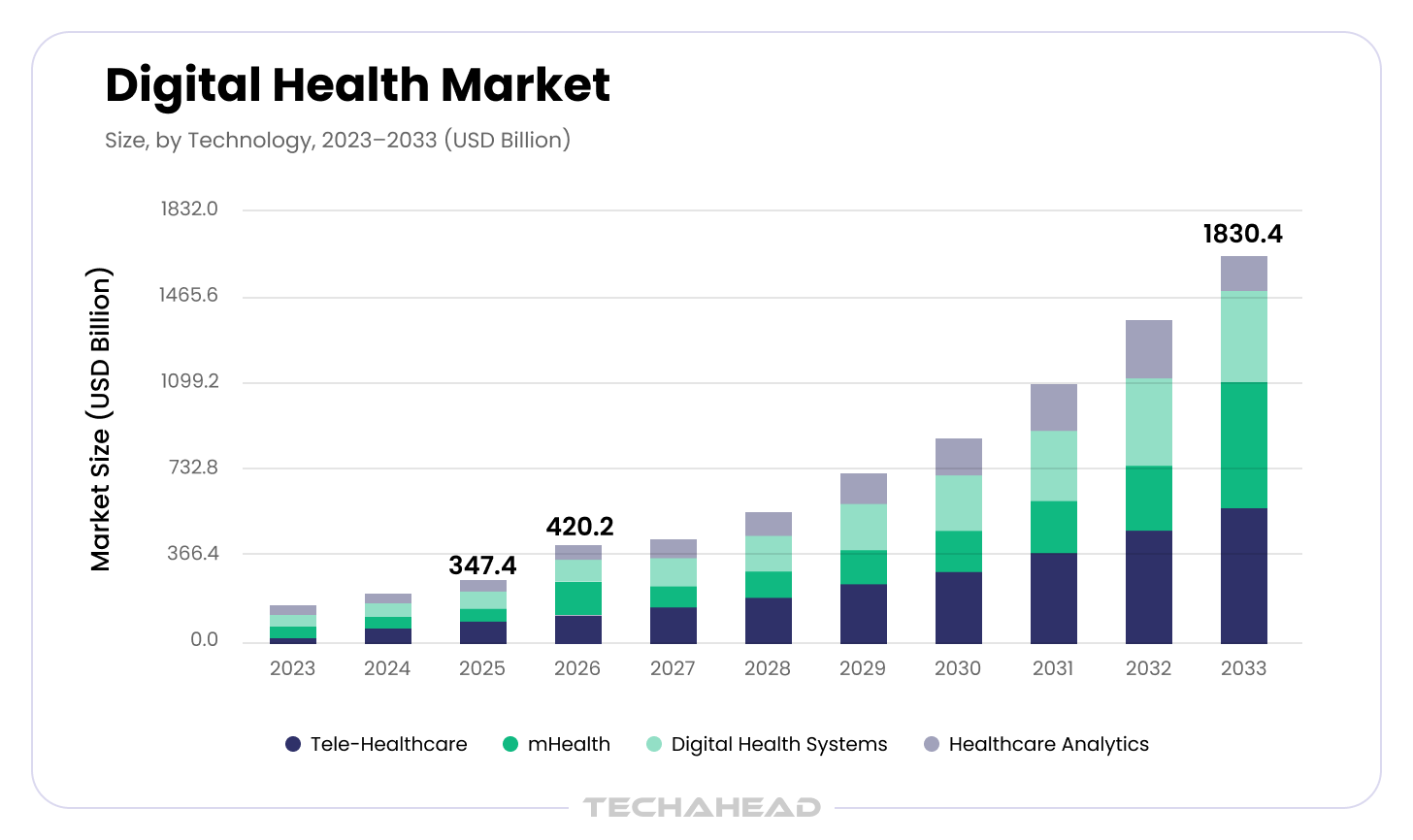
Global digital health spending is expected to exceed $500 billion this year. That amount should be enough to halt hospital CIOs and health-tech startups in their tracks. Since 2023, remote patient monitoring adoption has more than doubled, telehealth visit volume has stabilized as a permanent fixture of care delivery rather than a pandemic-era workaround, and enterprise health systems are finally admitting what frontline clinicians have known for years: the software they’re using is holding them back.
Legacy platforms were not designed to handle constant biometric data streams, AI-assisted diagnoses, or patients who want an app experience as seamless as their banking app. Most were designed a decade or more ago with batch data outputs and static dashboards. Bolting contemporary features onto that base is costly, slow, and often introduce the compliance gaps a medical system cannot afford. That is why custom mobile and web development has become the default option for every healthcare institution serious about modernization, rather than a nice-to-have.
This article explores the healthcare app development companies and trends that will shape the industry in 2026, the solution categories you should understand before writing an RFP, and the best healthcare app development businesses worth speaking with.
Also Read: Top 10 Healthcare Software Development Companies in 2026
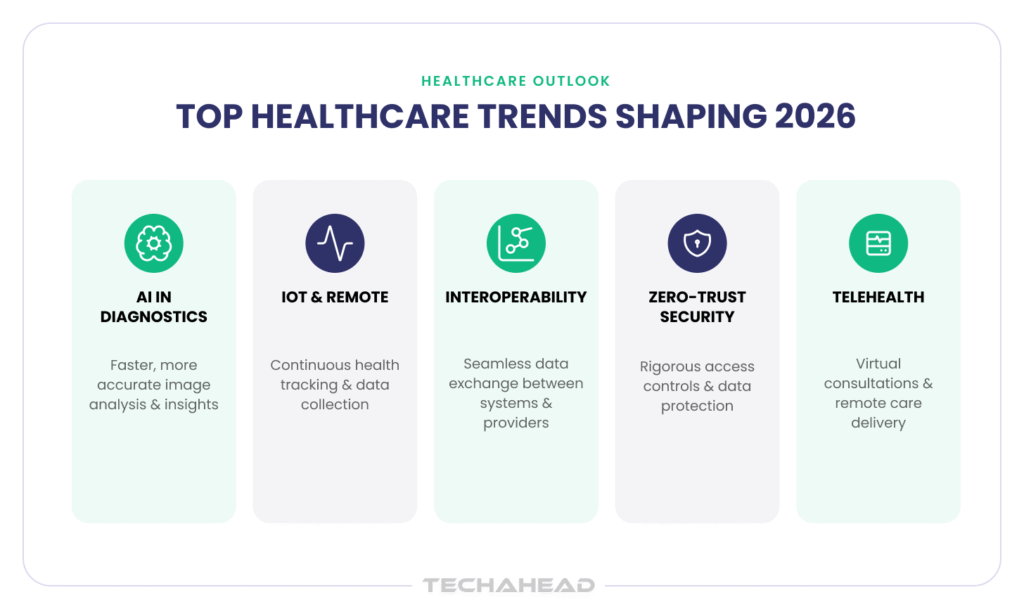
Computer vision models built on annotated DICOM datasets are no longer considered experimental add-ons. They now sit inside radiology workflows, flagging worrisome nodules before a person opens the study. Clinical decision engines are shifting from retrospective analytics to point-of-care recommendations that combine structured and unstructured data in real time. The technical bar has risen quickly. A vendor that can’t communicate effectively about model validation, false-positive tolerance, and FDA approval processes for SaMD (software as a medical device) shouldn’t be building your diagnostic tools.
Wearables and linked home devices send continuous biometric streams into healthcare systems around the clock. Smart insoles can track heart rate variability, glucose trends, SpO2, and even gait analysis. Edge computing has become critical in this scenario: no one wants a hypoglycemia alarm delayed by a round trip to the cloud. A good IoMT (Internet of Medical Things) architecture analyzes abnormalities at the edge while saving cloud analytics for trend modeling and longitudinal insight.
FHIR and HL7 are no longer buzzwords. They are the standard expectation for every app that has to communicate with an EHR. The difficult thing isn’t developing an FHIR-compliant API. It’s getting that API to work properly with fifteen-year-old Epic or Cerner instances that have been modified into something hardly recognizable. In 2026, interoperability efforts will focus on untangling legacy data pipelines without disrupting clinical operations throughout the conversion process.
HIPAA and HITECH compliance used to require encrypted data at rest and a certified BAA. That is no longer the ceiling; it is the floor. Zero-trust architecture, in which every request is validated and allowed regardless of network origin, has become the industry standard for any program that handles PHI at scale. SOC 2 Type II certification distinguishes between suppliers that discuss security and those audited over time.
Must Read: Healthcare Cybersecurity: Software Security, HIPAA Compliance & Best Practices
Telehealth has progressed beyond “video call plus scheduling.” The most effective platforms now incorporate CBT courses, mood tracking, crisis response procedures, and physician dashboards that detect risk signs before a patient says anything frightening out loud. Mental health applications, in particular, carry more weight than general consumer software. If the escalation logic is wrong, the penalties go beyond a negative App Store review.
Must Read: Generative AI in Medical Technology: Mapping High-Value Opportunities Across the Operating Model
TechAhead is Clutch top-ranked in mobile and healthcare app development, holds AWS Advanced Partner status with the Security Services Competency, and is certified across HIPAA, HITECH, and SOC 2 Type II. It’s also a certified Great Place to Work, which matters more than it sounds when you’re trusting a vendor with a multi-year roadmap and want the same engineers around for the maintenance phase.
Service description: TechAhead manages the whole healthcare software lifecycle in-house. This includes strategy and discovery, HIPAA-compliant mobile and web app development, EHR/HMS integration (Epic, Cerner, Allscripts, and bespoke legacy systems), remote patient monitoring and IoMT platforms, cloud migration and DevOps, legacy application modernization, and 24/7 post-launch support. The team creates unique API connections, manages AWS cloud infrastructure with a 99.9% uptime SLA, and incorporates AI-driven diagnostics, encrypted communications, and automated patient reminders as needed for each project. Rather than delivering a build and departing, TechAhead stays involved throughout the maintenance and iteration period, which is typically where healthcare software discreetly fails and most vendor relationships are tested.
Key features:
Best for: Healthcare enterprises, payers, and digital health companies that need one accountable partner across the entire lifecycle, from architecture strategy through post-launch support, instead of stitching together multiple vendors.
Cognizant is a Fortune 500 digital engineering and IT services company generating over $21 billion in annual revenue, with healthcare as one of its largest industry verticals. Its healthcare provider practice supports more than 875,000 providers, and its Neuro AI platforms modernize claims processing, care coordination, and legacy mainframe systems at a scale few other vendors can match.
Service description: Cognizant’s healthcare solution focuses on large-scale digital transformation for providers and payers, including legacy system modernization, AI-powered claims and administration platforms, and multi-cloud migration. Its Flowsource platform is a unified, AI-driven engineering solution designed to speed up the software development lifecycle, whereas Skygrade focuses on de-risking cloud transition and extracting business rules from decades-old mainframe code. On the data side, Cognizant’s healthcare data and insights marketplace combines AI, machine learning, analytics, and business intelligence reporting into a single managed solution for enterprises moving from fragmented dashboards to a true data-to-decision pipeline spanning dozens of facilities at once.
Key features:
Best for: Large-scale enterprise legacy transformation. Health systems and payers with sprawling, multi-facility IT estates that need a vendor with the operational muscle to run parallel modernization workstreams.
Founded in 1989 and active in healthcare IT since 2005, ScienceSoft is an IT consulting and software development company with ISO 13485, ISO 9001, and ISO 27001 certifications. It has delivered 150+ healthcare software projects and brings deep medical device development expertise, including an MD on staff as a healthcare IT consultant.
Service description: ScienceSoft specializes in specialized healthcare software development, medical device and SaMD (software as a medical device) engineering, medical imaging analysis tools, telemedicine platforms, and life sciences software for contract research organizations and pharmaceutical R&D teams. Its S-SDLC (secure software development lifecycle) strategy follows OWASP guidelines, with continuous testing, software validation and verification, and frequent code review embedded in each release cycle. On the imaging side, the team has decades of expertise developing image-processing algorithms in C++ and R, according to ISO 13485 and IEC 62304 standards for CT, ultrasound, and other DICOM modalities. Its consultancy arm also helps healthcare firms develop a compliance strategy and select an architecture before committing to full development.
Key features:
Best for: Long-standing medical device software and IT consulting. Medical device manufacturers and life sciences companies that need regulatory-grade software built by a team fluent in FDA, MDR, and ISO requirements.
With more than 25 years in healthcare IT, Itransition specializes in the unglamorous but essential work of connecting disparate healthcare systems. Its EHR and EMR development practice has delivered solutions integrated via HL7 and FHIR across labs, insurance providers, and multiple EMR platforms simultaneously.
Service description: Itransition creates new EHR/EMR systems from the ground up or enhances off-the-shelf platforms such as Microsoft Cloud for Healthcare with specialized modules. Its interoperability practice manages EHR integration projects that connect a single platform to speech recognition technologies, handwriting recognition, clinical text analysis, NLP-based documentation, and telehealth visit modules, all communicating via HL7 or FHIR standards. Beyond EHR work, the company builds telemedicine platforms, healthcare ERP systems, and RPA-driven administrative automation. It also has a dedicated Healthcare Center of Excellence that builds connected RPM and care management platforms that combine EHR functionality with a lower total cost of ownership than replacing a full legacy system.
Key features:
Best for: Complex enterprise systems and multi-EHR integrations. Organizations juggling Epic, Cerner, and specialty EHRs that need one team to make everything talk to everything else.
Founded in 2008 and now part of TELUS International, WillowTree built its reputation on Fortune 500 consumer app design before deepening into healthcare. Its portfolio includes the FDA-approved Dexcom G7 companion app for continuous glucose monitoring and Vocable, an award-winning communication app for non-verbal and paralyzed patients.
Service description: WillowTree, now TELUS Digital, provides mobile app strategy, UX design, and full-stack engineering for healthcare applications for patients and clinicians. Its work on the Dexcom G7 companion app combined continuous monitoring with real-time warnings, expediting FDA-approval testing processes through automation and reducing testing time by 77%. Vocable, an AAC communication tool for nonverbal individuals with illnesses such as ALS or MS, was customized for Apple Vision Pro and was one of the first apps accessible on the platform’s App Store. The team’s larger healthcare expertise includes digital therapies, connected-device companion applications, and healthcare portals, with quick prototyping and iterative user testing embedded into every project.
Key features:
Best for: Consumer-grade patient UI/UX design. Organizations that want a healthcare app with the design polish of a top consumer product, not just clinical functionality.
MindSea is a Halifax, Canada-based healthcare app development company founded in 2007, working exclusively in the health and wellness space. It has delivered 250+ projects impacting more than 10 million lives and holds a 5.0-star average across 40+ verified Clutch reviews.
Service description: MindSea specializes in patient-facing and clinician-facing mobile apps for healthcare providers, research teams, and health-tech companies and operates solely in the healthcare industry rather than as one of several verticals. Its Blueprint exploration sprint produces a clickable prototype, technical brief, and product roadmap before full development begins, letting teams test direction before allocating funds. The company incorporates HIPAA, PHIPA, GDPR, and SOC 2 compliance into its architecture from the start, and its service lines include nutrition and habit-tracking apps, Bluetooth or BLE-connected RPM tools, AI-powered clinical decision support, and a Digital Health Check service that assesses an existing app’s UX, code quality, and compliance status.
Key features:
Best for: Boutique health and wellness mobile apps. Startups and mid-size wellness or behavioral health brands that want a small, senior, North America-based team rather than an enterprise-scale vendor relationship.
Operating since 2012 out of Los Angeles, Sidebench is a product strategy, design, and engineering studio built specifically around regulated industries. Its healthcare client list includes the American Heart Association, Children’s Hospital Los Angeles, UCSF Innovation, and Cedars-Sinai.
Service description: Sidebench combines technology and product strategy, UX-first product design, systems and data architecture, and HIPAA-compliant engineering into a single team to reduce handoffs between discovery and delivery. Its method is divided into three phases: strategy, discovery, and development, with user research and testing completed before writing a single line of production code. Previous healthcare projects include a unique scheduling system that coordinates complex appointments across numerous doctors, insurance, and billing, as well as a follow-up-care platform for Children’s Hospital Los Angeles to determine what discouraged parents from returning after NICU discharge. The business also operates an internal Enterprise Innovation Lab and a startup venture studio arm for customers that are still developing their long-term product roadmap.
Key features:
Best for: US-focused product strategy and digital health studios. Health systems and funded startups that want one accountable team to handle strategy, design, and engineering rather than fragmented vendors.
Founded in 2011 and based in San Diego, Dogtown Media has built a name in mHealth and connected-device software, with client work spanning Google, Citibank, the Minneapolis Heart Institute, and Harvard Medical School.
Service description: Dogtown Media creates mobile applications that interact directly with medical devices and wearables, from Class I wellness apps to Class II devices such as ECG readers and glucose monitors that require FDA 510(k) certification. Its wearable app development work includes the Apple Watch, Fitbit, Whoop, Garmin, Oura, smart textiles, and FDA-cleared hardware such as the Omron HeartGuide, with functionality tailored to each device’s form factor, whether screen-based, sensor-only, or haptic-driven. The team walks clients through the full regulatory readiness lifecycle, aligning software functionality with FDA device classification and supporting 510(k) submissions, while also developing the underlying IoT and Bluetooth connectivity layer that lets implantable devices, surgical tools, and diagnostic sensors sync with cloud-based EHR systems in real time.
Key features:
Best for: mHealth IoT-connected devices. Teams building RPM or wearable-integrated products with unusual or regulated hardware that needs FDA pathway expertise baked in.
A Los Angeles-based digital product agency founded roughly a decade ago, Goji Labs has shipped 500+ digital products and helped clients collectively raise more than $1 billion in venture funding, backed by an Inc. 5000 ranking and a Forbes Business Award.
Service description: Goji Labs is a strategy-driven product firm that invests substantially in research and MVP validation before creating production code. For healthcare and wellness customers, it provides product strategy advice, HIPAA-compliant app development, and UI/UX design to prove an idea before a team overbuilds it. Its MVP approach starts with a targeted strategy to identify critical features, then builds a working prototype for user testing before full investment, reducing risk and surfacing real feedback early. The firm also provides product launch strategy services, including aligning positioning, messaging, and go-to-market planning, so that a healthcare business may enter the market with a proven product and a clear route to its next financing round.
Key features:
Best for: Health tech scale-ups and early-stage MVP strategy. Founders who haven’t fully locked down product scope and need a partner to pressure-test the idea before committing engineering budget.
Quytech is an India-based mobile app development company with 14+ years in the market and more than 1,000 delivered mobile applications across healthcare, fitness, finance, and travel.
Service description: Quytech develops healthcare and wellness apps that include telemedicine, remote patient monitoring, prescription reminders, mental health management, and appointment scheduling, all in accordance with HIPAA, GDPR, HL7, and FDA standards. Its engagement methodology begins with strategic mobile advising to help startups and corporations select the right platform and technology mix, followed by native or cross-platform development for iOS, Android, and the web. The team incorporates upcoming technologies such as AI, ML, IoT, blockchain, Gen AI, and AR/VR as needed for a client’s use case, and concludes the engagement with post-deployment support and maintenance rather than ending the connection at app store submission.
Key features:
Best for: Mid-market custom mobile health app development. Smaller health organizations and clinics that need a capable, compliant build without an enterprise consultancy price tag.
Complete End-to-End Development Services and Capabilities
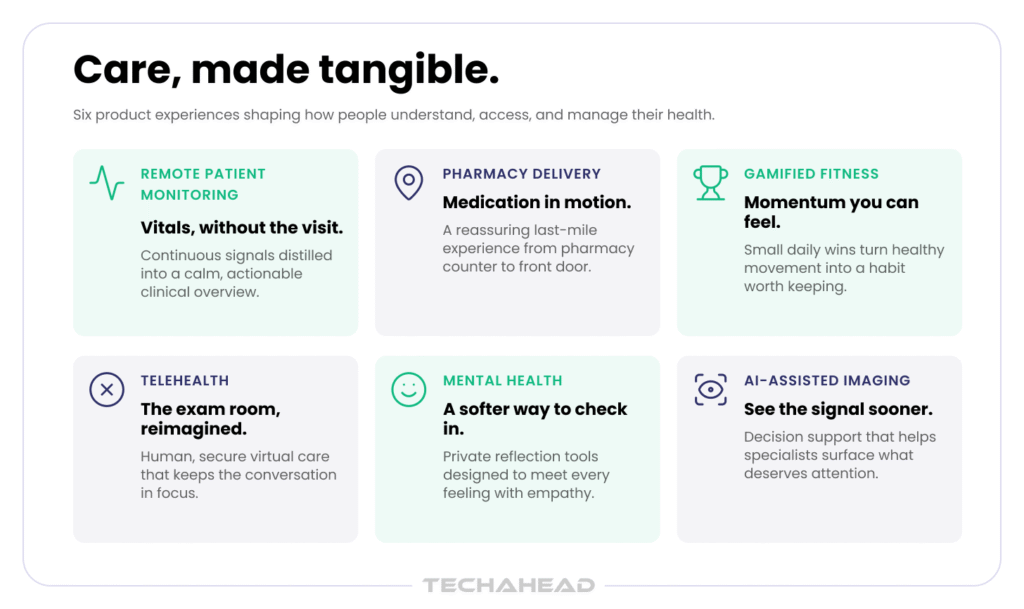
Building clinical-grade software takes more than a development sprint and a launch date. The full lifecycle, and what TechAhead delivers under one roof, usually includes:
Skip any one of these, and the gaps tend to surface at the worst possible moment, usually during an audit or an outage.
Sixteen-plus years of enterprise healthcare technology experience. Engineering teams fluent in HIPAA and HITECH compliance requirements. AWS Advanced Partner status with the Security Services Competency specifically, not just general cloud hosting credentials. SOC 2 Type II certified data architecture, independently audited rather than self-reported. Over 1,200 global clients and 200+ healthcare solutions deployed and running in production today, backed by a 240+ person engineering team and a Great Place to Work certification that speaks to team retention on long engagements.
None of that matters in isolation. What matters is what it adds up to: a partner who has already made the expensive mistakes on someone else’s project and built the guardrails so your project doesn’t repeat them.
Picking a development partner for clinical software isn’t a decision to make off a feature checklist. Start by auditing what’s actually failing in your current architecture: is it the EHR integration layer, the patient-facing UX, the compliance posture, or all three at once? That answer should shape the shortlist far more than a vendor’s logo wall.
If your current platform is struggling to keep pace with FHIR requirements, RPM data volume, or a growing compliance burden, the right move is a straightforward architecture review before signing anything. Request a consultation with TechAhead’s healthcare team, bring your current pain points to the table, and let a technical audit tell you what a sales deck won’t.
Healthcare app development involves building mobile or web applications for patients, healthcare providers, hospitals, payers, and digital health companies. Common solutions include telehealth, remote patient monitoring, patient portals, fitness apps, and medical software.
The major healthcare app development trends in 2026 include AI-powered diagnostics, IoT-enabled remote patient monitoring, FHIR and HL7 interoperability, zero-trust security, telehealth platforms, and mental health applications.
Healthcare app development costs vary based on app complexity, integrations, security requirements, platforms, regulatory needs, and advanced features such as AI, IoT, and remote patient monitoring.
A healthcare app development company can build telehealth platforms, remote patient monitoring apps, patient portals, online pharmacy platforms, mental health apps, fitness and wellness applications, and AI-powered medical image analysis solutions.
Healthcare apps typically use interoperability standards such as FHIR and HL7 to exchange patient and clinical data with EHR and EMR systems, including legacy healthcare platforms.
HIPAA compliance requires appropriate safeguards for protected health information, including secure architecture, encryption, access controls, audit trails, and compliant infrastructure. A healthcare application should address security and compliance throughout development rather than treating them as a final-stage requirement.
Key remote patient monitoring features include wearable and medical-device integration, continuous biometric tracking, real-time alerts, cloud analytics, patient profiles, and healthcare provider dashboards.
Evaluate healthcare experience, regulatory and security expertise, EHR/EMR integration capabilities, AI and IoT experience, development methodology, post-launch support, and the company’s ability to manage the complete software lifecycle.
We use cookies to ensure our website functions properly, improve performance, and provide a personalized experience. You can choose which types of cookies to allow below.
Required for core functionality such as security, network management, and accessibility. These cannot be disabled.
Help us understand site traffic and user interactions so we can improve performance and usability.
Enable enhanced functionality and personalization such as language or region preferences.
Used to deliver relevant ads, track campaign performance, and measure advertising effectiveness.