


 Copy Link
 Share on X
 Share on Facebook
 Share on LinkedIn
Always Active
Required for core functionality such as security, network management, and accessibility. These cannot be disabled.

Uncover the transformative potential of digital and mobile solutions for your industry.





 Last Updated: Sep 18, 2026
Aug 24, 2026
Last Updated: Sep 18, 2026
Aug 24, 2026  293
293  14 min. Read


Key Takeaways
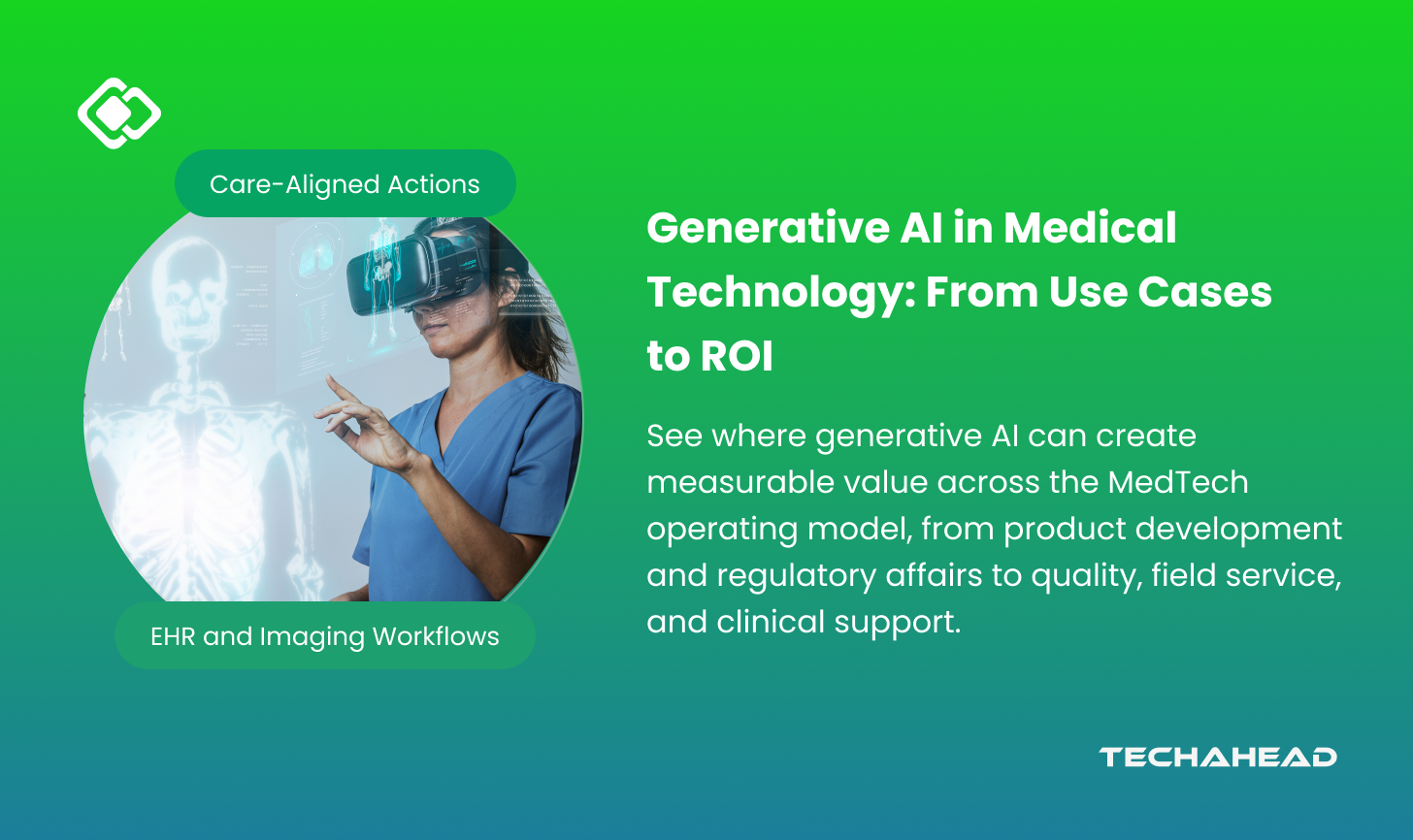
Most discussions of generative AI in healthcare focus on physicians and hospitals. The firms that create, manufacture, certify, and support the software and devices those doctors use are known as MedTech companies. Their AI potential extends beyond the classroom. This includes product development, quality, clinical evidence, field service, supply chain, and regulatory affairs.
Right now, that distinction is important. A discussion paper on considerations for regulating generative AI-enabled medical devices was published by the FDA’s Digital Health Center of Excellence on August 18, 2026. It covered risk assessment, premarket evaluation, postmarket monitoring, and how the agency should approach foundation models and agentic AI. The agency is accepting public comments under docket FDA-2026-N-7874 through October 19, 2026. MedTech executives have a compelling incentive to organize their GenAI strategy now rather than waiting for regulations to be finalized, even if this is the clearest indication yet of where supervision is heading.
This is designed for you if you work for a medical device or health software firm as a VP of Product, Head of Regulatory Affairs, or CTO and are attempting to determine where GenAI truly benefits your company and where it poses risks you are not prepared to take. It shows where generative AI services add quantifiable value throughout the operational model of a MedTech firm, which use cases are low-risk wins vs. those with real regulatory weight, how much a GenAI deployment actually costs, and how to choose where to begin.
| Operating model area | What GenAI does here |
| Product development & engineering | Drafts technical documentation, design specs, and risk files |
| Regulatory affairs | Speeds up submission drafting, literature review, and change-impact analysis |
| Clinical & diagnostic support | Assists with imaging reports, decision support, and clinical documentation |
| Quality & post-market | Analyzes complaints, adverse events, and CAPA documentation |
| Field service & customer support | Powers technician copilots and troubleshooting assistants |
| Research & evidence generation | Summarizes literature, extracts trial data, supports biomarker analysis |
| Supply chain & operations | Supports demand forecasting and procurement documentation |
Each of these topics is covered in further detail in the remainder of this article, which concludes with a framework for determining where your company should really begin.
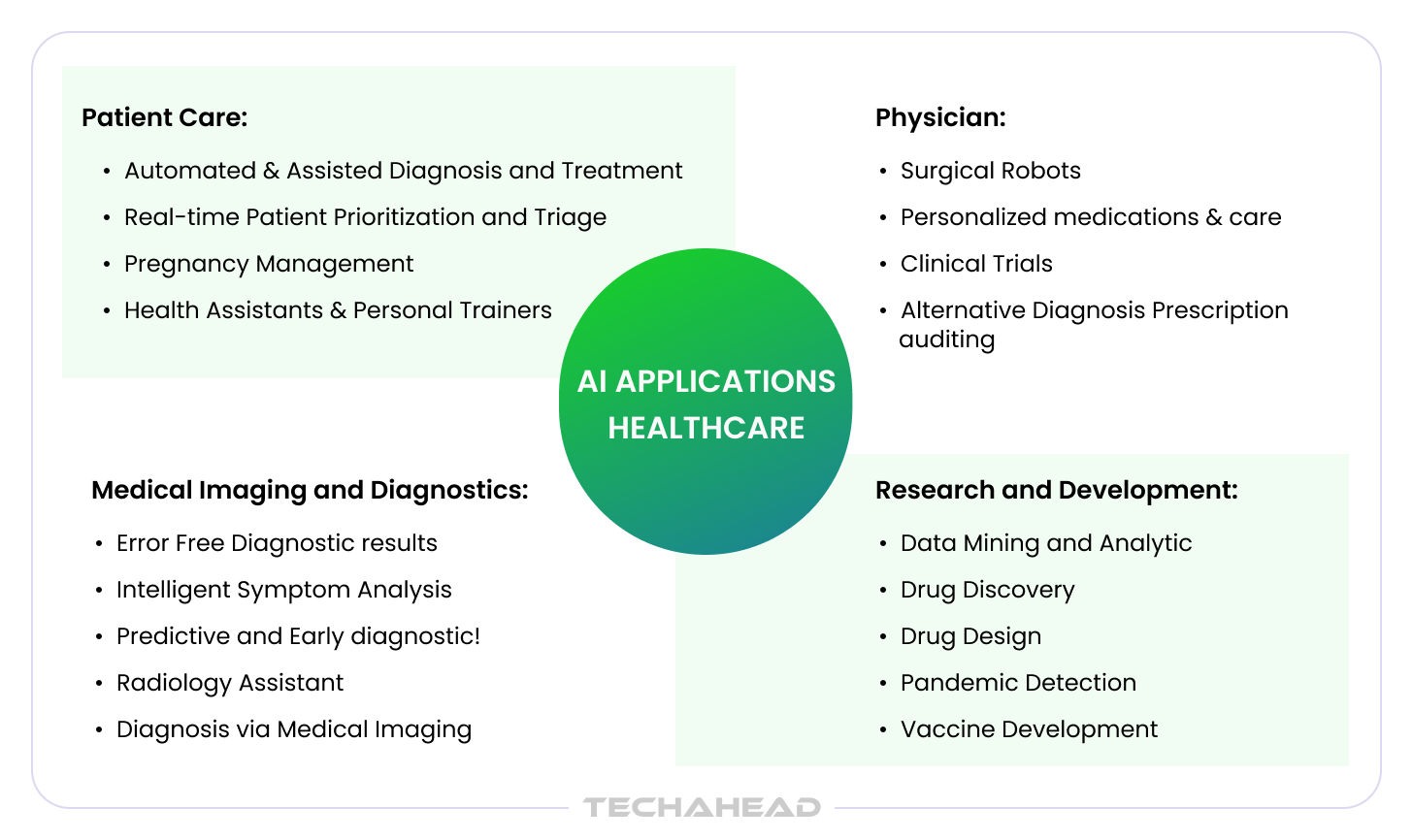
AI in healthcare and AI in medical technology are sometimes used interchangeably; however, they are two different topics. AI in healthcare often refers to technologies designed for healthcare systems and professionals, such as clinical processes, patient engagement, and hospital operations. The layer underneath is called medical technology, or MedTech, and it consists of the businesses that create, certify, and maintain the hardware and software those providers use. This implies that MedTech businesses have more than clinical AI potential. Just as much as they live in the exam room, they also live in product development, regulatory affairs, quality, and field service.
Unlike typical predictive AI, which just classifies or scores existing data, generative AI creates new material (text, structured data, graphics, or code). That distinction is crucial in a MedTech setting. Conventional AI may identify a scan abnormality. Generative AI can write a piece of a regulatory submission, summarize a clinical remark, or provide a field technician with a clear explanation of a service manual.
Furthermore, GenAI does not inherently imply autonomous clinical decision-making. A model whose output directly influences a diagnosis without human assessment falls into a whole separate risk category from one that creates a discharge report for physician evaluation. In early discussions with a MedTech leadership team, maintaining that boundary is typically the first thing that comes up. It is the difference between a defensible AI strategy and a regulatory problem.
Engineering and Product Development
Instead of focusing on engineering, device and software development companies devote disproportionate effort to paperwork, including risk documentation, design specifications, requirements traceability, and design history files. When generative AI is linked to an organization’s technical repositories via retrieval-augmented generation, it may create first drafts of this documentation and retrieve previous engineering knowledge that would normally be stored on a shared drive or in someone’s mind. Because a human engineer still vets every output before it reaches a design file, engineering leads usually see time savings within the first sprint or two. For a MedTech company, this is one of the lowest-risk, highest-return entry points into GenAI.
Clinical and Diagnostic Assistance
The FDA’s recent discussion paper is particularly important here. GenAI can help create radiology or pathology reports for doctor approval, synthesize imaging results, and summarize patient history alongside clinical recommendations. It should never be positioned as a substitute for a radiologist’s or physician’s expertise. The earlier article on AI in medical diagnostics discusses the operational aspect of accelerating radiology workflows, while TechAhead’s own work on AI-powered diagnostics using DICOM imaging, computer vision, and multimodal fusion architectures demonstrates what a responsibly scoped diagnostic-support system looks like in practice.
Quality, Grievances, and Post-Market Monitoring
Every MedTech business produces a constant flow of nonconformance records, adverse event reports, and complaints. Summarizing that unstructured input, identifying early signals in thousands of records that a quality team could never manually evaluate at scale, and creating CAPA documentation for a quality engineer to finish are all tasks that generative AI excels at. Human sign-off on each output remains non-negotiable since this data directly feeds regulatory reporting duties; nevertheless, the time saved on first-draft synthesis is significant and immediately defensible to auditors when the process is fully recorded.
Customer support and field service
In general, this is one of the most missed possibilities in MedTech content. When troubleshooting equipment at a hospital or clinic, field personnel want quick access to maintenance protocols, service manuals, and previous case histories. It is a truly MedTech-specific use case that most generic “AI in healthcare” content never touches, making it a powerful differentiator if your competitors haven’t built it yet. A generative AI assistant trained on a company’s technical documentation can significantly cut resolution time and reduce escalations to senior engineers.
Research and the Production of Evidence
Evidence extraction, trial data synthesis, and literature evaluation take significant time for clinical and research teams. To free up researchers to focus on interpretation rather than manual searching, GenAI can summarize existing research, extract pertinent findings, and help identify trends across vast amounts of literature. Evidence packages, competitive information, and keeping up with the rapidly evolving regulatory and clinical landscape all depend on this.
Operations & Supply Chain
Although demand forecasting, procurement paperwork, and supplier communication are not as glamorous as diagnostic AI, they provide a meaningful operational return on investment and almost no clinical risk, making them a good place to build internal AI trust before taking on higher-stakes use cases.
Not every use case deserves the same amount of caution or investment. This framework is the single most useful thing a MedTech leader can walk away with, because it turns a long list of possibilities into an actual decision.
| Category | Examples | ROI potential | Regulatory risk |
| Low risk, high ROI | Low risk, high ROI | High | Low |
| Medium risk, high ROI | Regulatory drafting, post-market surveillance, quality documentation | High | Medium |
| High risk, high potential ROI | Clinical decision support, patient-facing clinical AI, GenAI embedded in the device itself | Very High | High to very high |
The practical takeaway: start in the first category to build internal capability and prove value, use the second category to demonstrate measurable operational impact, and approach the third category only with a clear regulatory strategy and a genuine clinical validation plan.
If two or more of those are true, you are past the point where general research helps and closer to the point where a scoped technical assessment does.
A medical device that utilizes a generative model to generate output that directly affects patient care differs significantly from a regulatory team that uses an internal LLM to summarize papers. An internal productivity tool is the first. The second is a regulated medical device and must be treated as such from the start of design discussions, not added after the fact. It is subject to the FDA’s developing framework for GenAI-enabled devices.
The FDA’s August 2026 discussion paper outlines a proposed two-axis risk assessment framework, a competency-based approach to premarket evaluation (including non-clinical benchmarking and clinical confirmation), and risk-proportionate postmarket monitoring, with specific attention to foundation models and agentic AI systems. It builds on the agency’s existing Good Machine Learning Practice guiding principles for the total product lifecycle. Importantly, this is a discussion paper, not final guidance. The FDA has said explicitly that it does not represent the agency’s final regulatory expectations. But it is the clearest early signal of what premarket and postmarket obligations for GenAI-enabled devices are likely to look like, and companies that start building toward it now will be ahead when formal guidance lands, rather than scrambling to retrofit compliance into a product that was not designed with it in mind.
A practical, non-theoretical roadmap looks like this:
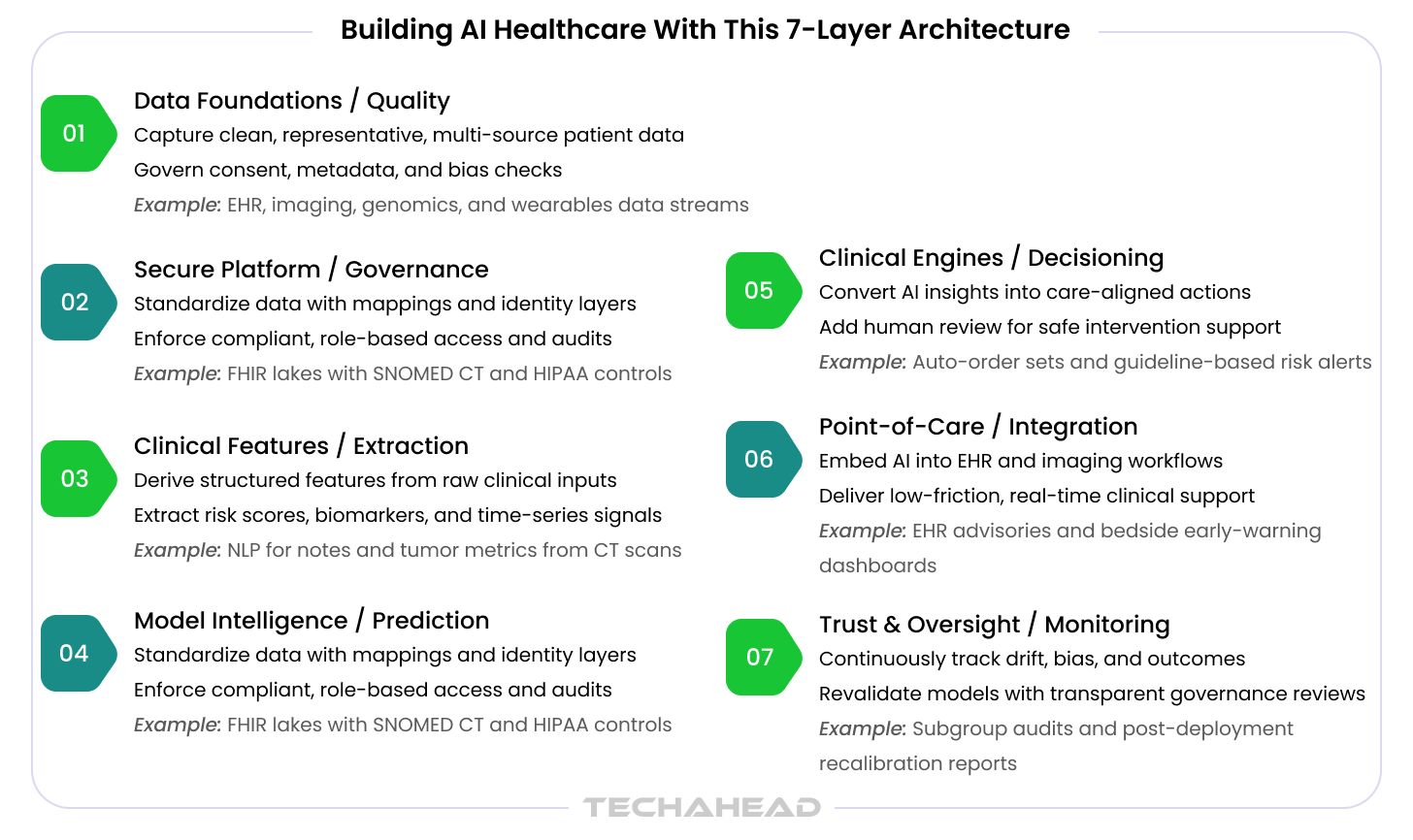
“It saves time” is not a metric a board or a CFO will accept on its own. These are the numbers worth tracking from day one of a pilot, broken out by what they actually prove:
| Category | Metrics worth tracking |
| Operational | Hours saved per week, documentation turnaround time, workflow completion time |
| Clinical | Reviewer time per output, false-positive and false-negative rates, escalation rate |
| Business | Cost per workflow, adoption rate across teams, revenue or margin impact |
| Model health | Hallucination rate, retrieval accuracy, response latency, drift over time |
Building a measurement plan before launch, not after, is what separates a pilot that gets funded for a second phase from one that quietly disappears after six months.
Costs vary widely depending on scope and clinical risk. As a general range:
| Solution type | Typical investment range |
| Internal knowledge assistant (documentation, field service) | Lower five to low six figures |
| Healthcare or regulatory copilot with RAG | Mid six figures |
| Clinical documentation or imaging-support platform | High six to low seven figures |
| GenAI-enabled diagnostic or embedded device feature | Seven figures and up, plus ongoing clinical validation cost |
Data engineering, system interfaces, security and regulatory effort, and clinical validation are the main cost drivers outside of the model itself, which is precisely why MedTech AI often costs more than a comparable consumer AI product. Instead of relying on a general range, the quickest way to get a realistic figure for your use case is through a discovery discussion.
Build, Buy, or Partner?
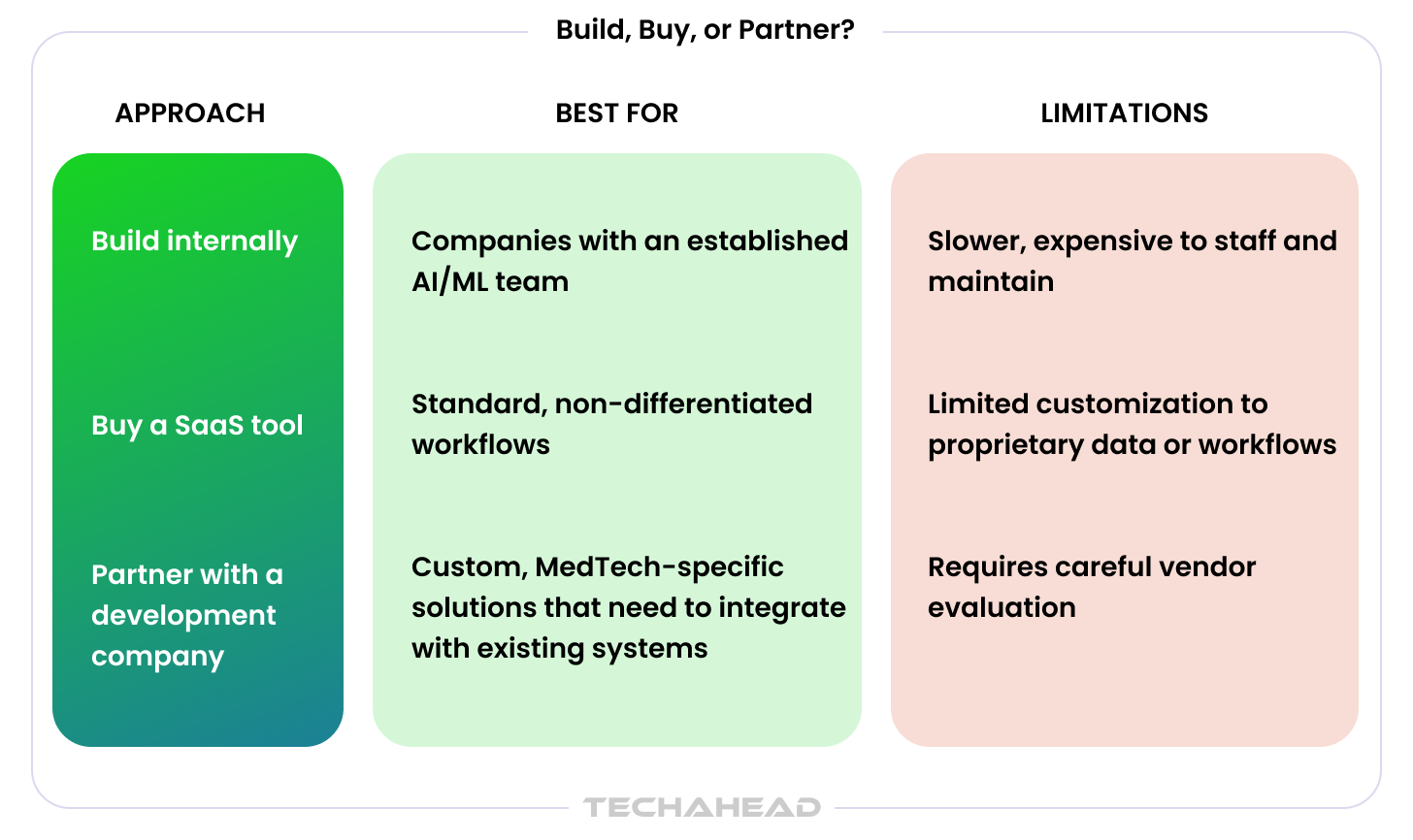
Custom development tends to make sense once a use case touches proprietary technical documentation, regulated data, or existing enterprise systems that an off-the-shelf tool cannot reach, which describes most of the higher-value use cases mapped earlier in this blog.
Typical Errors to Avoid
TechAhead is a healthcare development company with more than fifteen years of experience building HIPAA-compliant healthcare technology, and its AI work spans AI-powered diagnostics, clinical decision support, and multimodal healthcare AI, FHIR and HL7 interoperability, and custom healthcare software development. For MedTech companies weighing agentic workflows for regulatory or operational automation, the team’s agentic AI development services and broader enterprise AI development experience provide the engineering discipline to move from pilot to production without the project stalling at the compliance stage.
That combination, healthcare domain depth plus AI engineering discipline, is what separates a GenAI pilot that ships from one that stays a slide deck.
Generative AI in medical technology uses AI models to generate, summarize, or transform information across MedTech workflows such as product development, regulatory documentation, quality management, clinical support, and field service.
High-value use cases include regulatory document drafting, technical documentation, quality and complaint analysis, field-service copilots, clinical evidence research, supply chain automation, and knowledge assistants.
Generative AI can help medical device teams draft design specifications, technical documentation, requirements, risk files, and other engineering records, reducing repetitive documentation work while keeping human engineers in the review loop.
Generative AI can be used safely in MedTech when the application is appropriately risk-classified and includes human oversight, data governance, validation, security controls, and regulatory review. Clinical or device-embedded applications require significantly more scrutiny than internal productivity tools.
The cost of developing a generative AI solution for MedTech can range from the lower five figures to seven figures or more, depending on the use case, data engineering, integrations, security requirements, clinical validation, and regulatory complexity.
A practical approach is to identify the workflow, assess data readiness, classify risk, select the right AI architecture, build a secure data layer, develop and validate an MVP, and deploy gradually with continuous monitoring.
Key risks include AI hallucinations, poor data quality, privacy and security issues, inadequate human oversight, regulatory non-compliance, model drift, and unreliable clinical outputs. Higher-risk applications require stronger validation and monitoring.
MedTech companies can measure AI ROI through hours saved, documentation turnaround time, workflow completion time, reviewer effort, adoption rates, cost per workflow, hallucination rates, retrieval accuracy, and business impact.
We use cookies to ensure our website functions properly, improve performance, and provide a personalized experience. You can choose which types of cookies to allow below.
Required for core functionality such as security, network management, and accessibility. These cannot be disabled.
Help us understand site traffic and user interactions so we can improve performance and usability.
Enable enhanced functionality and personalization such as language or region preferences.
Used to deliver relevant ads, track campaign performance, and measure advertising effectiveness.