


 Copy Link
 Share on X
 Share on Facebook
 Share on LinkedIn
Always Active
Required for core functionality such as security, network management, and accessibility. These cannot be disabled.

Uncover the transformative potential of digital and mobile solutions for your industry.





 Last Updated: Sep 18, 2026
Aug 26, 2026
Last Updated: Sep 18, 2026
Aug 26, 2026  235
235  15 min. Read


Key Takeaways
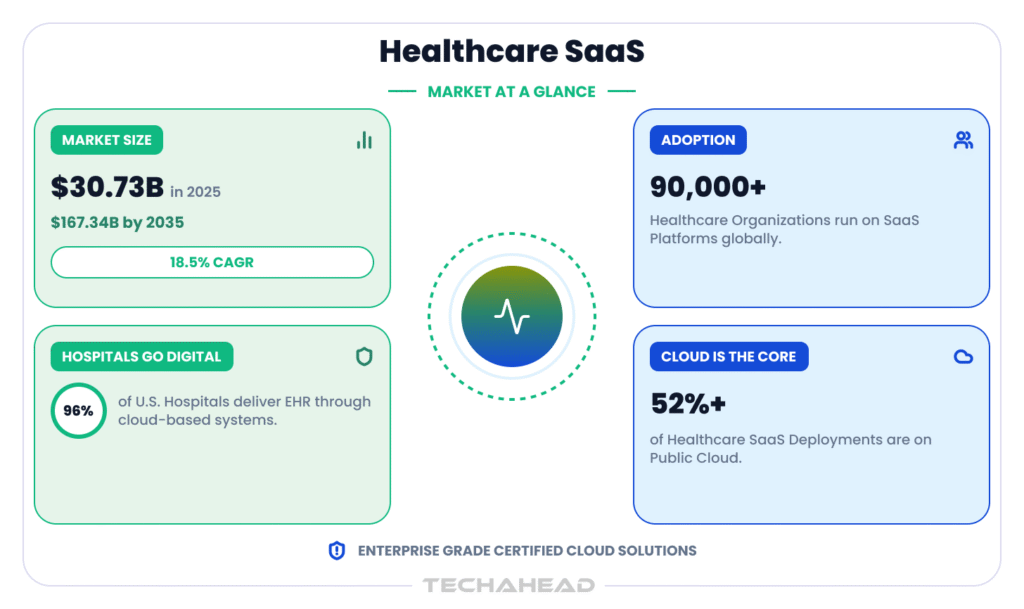
The healthcare SaaS market is valued at $30.73 billion in 2025 and is projected to reach $167.34 billion by 2035, growing at a compound annual rate of roughly 18.5%.
More than 90,000 healthcare organizations now run on SaaS platforms, and 96% of U.S. hospitals deliver electronic health records through certified, largely cloud-based systems.
Public cloud alone accounts for over 52% of healthcare SaaS deployments today.
Those numbers tell a growth story.
But they do not tell you what actually happens when you try to build one of these platforms.
Source: TechAhead AI Team
Cloud adoption is not the same thing as compliance, and compliance is not the same thing as clinical safety. That gap is where most healthcare SaaS projects lose months and budget.
The core difference in healthcare software development compared with generic SaaS development is simple to state and hard to engineer around: you are handling protected health information (PHI and ePHI) and, often, live clinical workflows.
A bug in a retail app costs you a refund.
A bug in a medication ordering workflow, an access control gap in a patient portal, or a missed audit log can trigger a breach notification, a regulatory investigation, or worse, a patient safety incident.
The regulatory backdrop is tightening, not loosening.
Healthcare remains one of the most heavily targeted sectors for cyberattacks, and HHS’s own proposed overhaul of the HIPAA Security Rule, discussed in detail below, exists specifically because voluntary, “addressable” safeguards were not holding up against modern threats.
Buyers, especially hospital security review committees, have absorbed that lesson faster than many vendors have.
Most guides to this space stop at a high level: “get HIPAA compliant,” “use FHIR,” “hire good engineers.”
Few connect architecture, security, features, and cost into a single practical view.
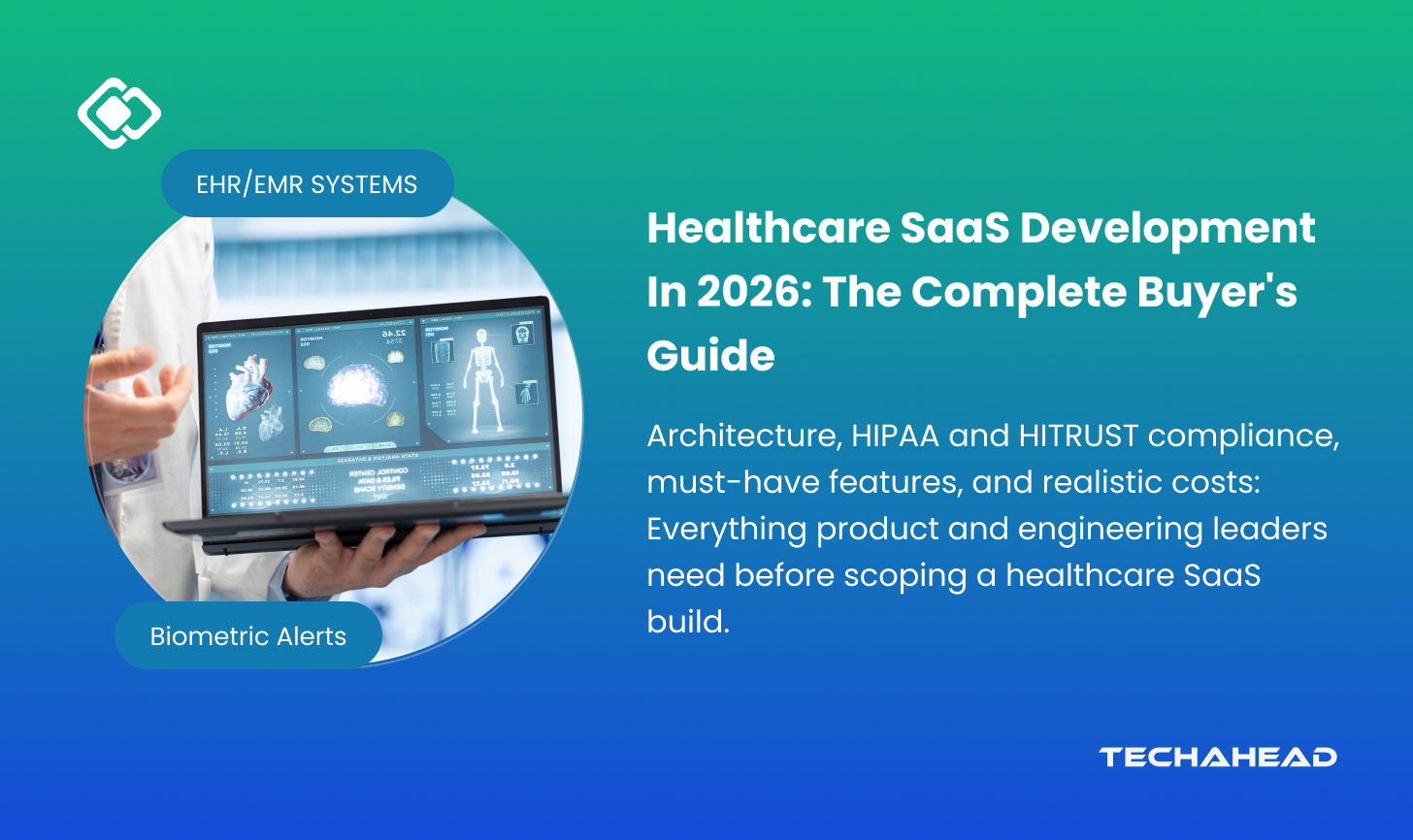
Teams either over-engineer, burning cash on controls they do not need yet, or under-engineer and fail an audit or a hospital security review right before launch. This guide is built to close that gap: a reference architecture, a real compliance stack (HIPAA, GDPR, HITRUST, SOC 2), must-have features by product type, and realistic 2026 cost ranges from MVP to enterprise.
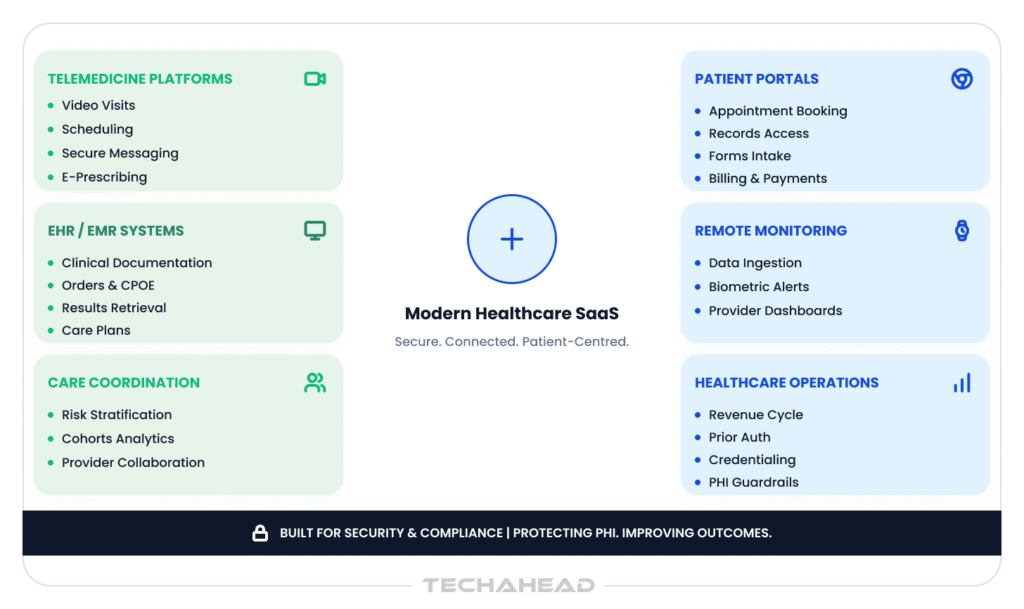
Healthcare SaaS development covers any multi-tenant or single-tenant platform that stores, processes, or transmits PHI or ePHI, or that directly supports clinical or clinical-adjacent workflows. In practice, that spans six recognizable categories:
One distinction shapes almost everything downstream: are you a covered entity or a business associate under HIPAA?
Source: TechAhead AI Team
Most healthcare SaaS vendors are business associates, meaning they handle PHI on behalf of a covered entity such as a hospital or clinic, and they are required to sign a Business Associate Agreement (BAA) before touching that data.
Whatever category your product falls into, the same four pillars apply: architecture, security and compliance, feature scope, and realistic budgeting.
Three principles should be non-negotiable before a single line of code is written for a scalable SaaS platform.
Compliance by design, not bolted on. In January 2025, the Department of Health and Human Services (HHS) published a Notice of Proposed Rulemaking (NPRM) to overhaul the HIPAA Security Rule for the first time in over a decade.
The proposal would require multi-factor authentication and encryption of ePHI at rest and in transit as express, non-negotiable requirements rather than the older “addressable” standard that allowed entities to document a workaround instead.
As of this writing the rule remains proposed, not final, but the direction of travel is unambiguous, and most hospital security reviews already expect MFA and full encryption as a baseline. Build for the final rule now rather than retrofitting later.
Multi-tenancy with real data isolation. A shared database with separate schemas is workable for standard customers, but enterprise and high-risk customers, particularly hospital systems, often require dedicated database instances or fully isolated environments.
A zero-trust network model. Every service-to-service call should be identity-based rather than network-based, IAM should follow least privilege, and secrets belong in a managed vault (AWS Secrets Manager, Azure Key Vault, or GCP Secret Manager) rather than in configuration files or environment variables checked into source control.
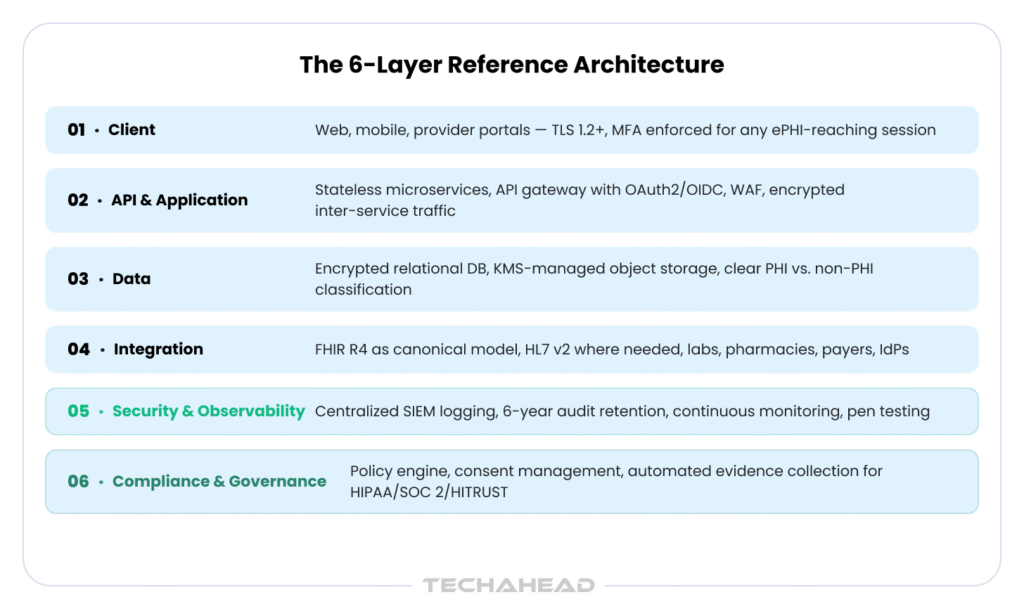
Client layer. Web apps (React, Angular, or Vue), mobile apps, and provider portals, all traffic over TLS 1.2 or higher, with MFA enforced for any session that can reach ePHI.
API and application layer. Stateless microservices or a modular monolith, an API gateway handling OAuth2/OIDC authentication, rate limiting, and a web application firewall, and encryption on inter-service traffic even inside the VPC.
Data layer. A primary relational database (PostgreSQL, MySQL, or SQL Server) with encryption at rest, object storage (S3, Blob, or GCS) for documents, images, and DICOM files with KMS-managed keys, and a clear data classification that separates PHI from non-PHI wherever the workflow allows it.
Integration layer. FHIR R4 as the canonical data model for EHR and health-system integrations, HL7 v2 interfaces through an integration engine where legacy systems require it, and connections out to labs, pharmacies, payers, identity providers, and payment gateways.
Security and observability layer. Centralized logging into a SIEM, with audit logs retained for at least six years to satisfy HIPAA documentation requirements, continuous monitoring and anomaly detection on access patterns, and a standing program of vulnerability scanning and penetration testing.
Compliance and governance layer. A policy engine for access control, consent management, and data retention, with automated evidence collection feeding your HIPAA, SOC 2, and HITRUST audit trail continuously rather than in an annual scramble.
On AWS, a typical pattern places ePHI workloads in private subnets behind an application load balancer and WAF, uses VPC flow logs and KMS for encryption, and leans on CloudTrail and CloudWatch for the audit trail, with AWS HealthLake or HealthImaging where FHIR or DICOMweb support is needed natively.
Azure and Google Cloud offer close analogues: Azure’s VNet, Private Endpoints, Key Vault, and FHIR service, or GCP’s VPC, customer-managed encryption keys, Secret Manager, and Cloud Healthcare API covering FHIR, DICOM, and HL7.
None of the three hyperscalers make you compliant by default; each gives you the primitives to build a compliant architecture if you configure them correctly.
This is the section most healthcare SaaS teams underinvest in early, and it is the one that determines whether your product ever reaches a hospital’s approved vendor list.
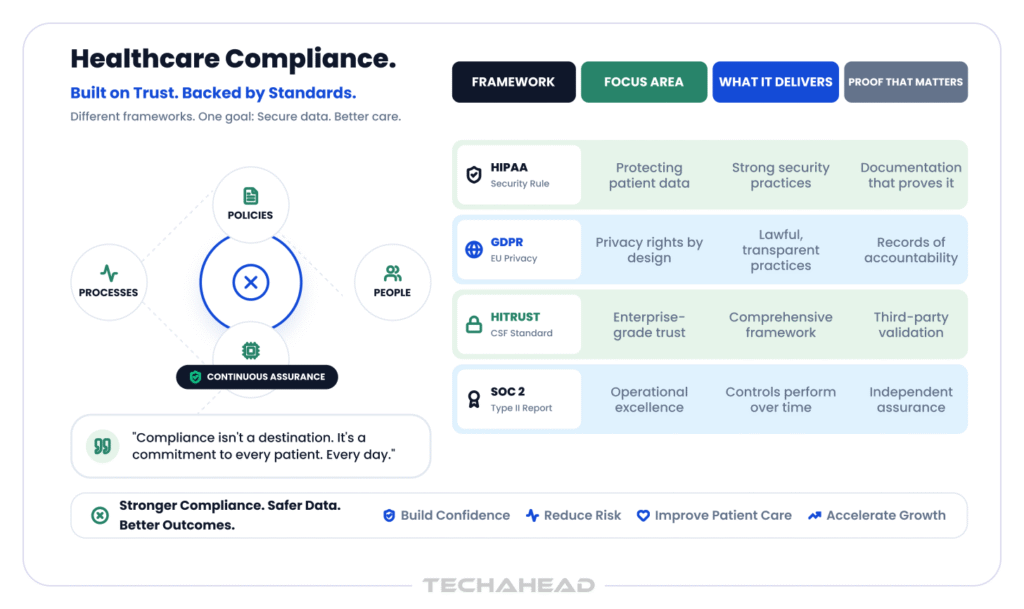
HIPAA applies to covered entities and their business associates, which is most SaaS vendors handling ePHI. The Security Rule requires administrative, physical, and technical safeguards; the Privacy Rule governs use and disclosure of PHI along with patient rights; and the Breach Notification Rule sets strict timelines for disclosing a breach once discovered.
A defensible 2026 baseline, informed by the pending Security Rule update, includes multi-factor authentication for all ePHI access, AES-256 encryption at rest and TLS 1.2 or higher in transit, comprehensive audit logging of access and changes to ePHI retained for at least six years, role-based access control with session timeouts, and a documented risk analysis with a tested incident response and contingency plan.
Any subcontractor that touches PHI, including your cloud provider and any AI vendor in your stack, needs a signed BAA.
If you serve patients or providers in the EU or UK, health data is classified as “special category data” under GDPR, which requires both a lawful basis for processing (consent, contract, or legal obligation) and a specific condition for processing special category data, such as healthcare provision or explicit consent.
Beyond that dual requirement, GDPR demands data minimization, purpose limitation, full data subject rights including access, correction, deletion, and portability, a Data Protection Impact Assessment for high-risk processing, and appropriate safeguards, such as Standard Contractual Clauses, for any data that leaves the EU or UK.
HITRUST is a certifiable framework that layers on top of HIPAA, NIST, and ISO standards, purpose-built for healthcare.
Many hospitals and payers now request or outright require HITRUST certification from vendors as a condition of doing business, because it provides a structured, independently assessed control model that maps cleanly back to HIPAA. Expect HITRUST to demand a materially broader and more rigorous control set, and a longer evidence trail, than HIPAA compliance alone.
SOC 2 is an independent audit covering security, availability, processing integrity, confidentiality, and privacy, scoped to your specific service boundary.
It has become table stakes for enterprise SaaS generally, and healthcare buyers frequently request it alongside HIPAA or HITRUST. The control overlap with HIPAA is substantial, particularly around access control, logging, and incident response, so a well-built HIPAA program materially reduces the lift to reach SOC 2. A Type II report, unlike Type I, requires you to operate the controls over a review period, typically three to twelve months, before the audit can be completed.
Table 1: The 2026 healthcare SaaS compliance stack
| Framework | Applies when | Core requirement | Typical evidence |
| HIPAA Security Rule | Any US ePHI handling | MFA, encryption, audit logs, risk analysis, BAAs | Risk assessments, access logs, incident response plan |
| GDPR | EU/UK patients or providers | Lawful basis + special category condition, DPIA | Consent records, DPIA reports, data maps |
| HITRUST CSF | Hospital/payer vendor requirement | Broader, certifiable control set mapped to HIPAA/NIST | HITRUST assessment report |
| SOC 2 Type II | Enterprise buyer requirement | Operated controls over a review period | Independent auditor’s report |
Operationalizing this stack means automated evidence collection, access reviews, change logs, incident tickets, feeding continuously into your compliance program, rather than a once-a-year audit panic. Compliance in healthcare SaaS is an architectural and operational discipline, not a checkbox exercise you complete after the product is built.
Source: TechAhead AI Team
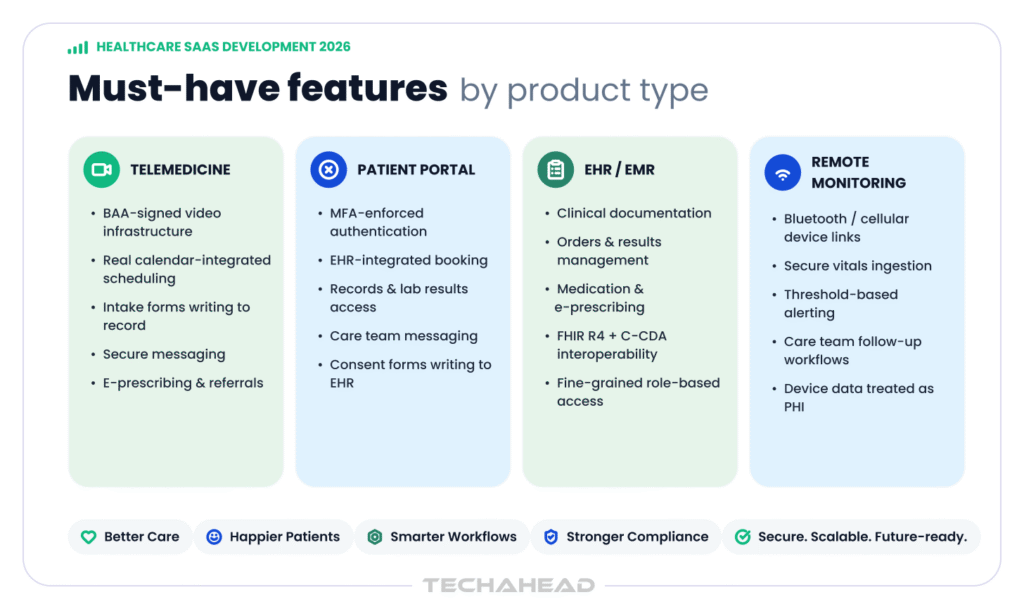
Core requirements: HIPAA-compliant video infrastructure from a vendor willing to sign a BAA, scheduling that integrates with real provider calendars rather than a shadow calendar, pre-visit intake forms that write directly into the clinical record, secure patient-provider messaging, e-prescribing and referral generation, and payment or eligibility verification at booking.
Stronger platforms add multi-language support with interpreter integration, asynchronous store-and-forward care, and AI-assisted visit summarization with clear human-review guardrails.
Core requirements: authentication with mandatory MFA for any ePHI access, appointment booking integrated with the EHR calendar, access to records, lab results, and visit summaries, secure messaging with the care team, and online intake and consent forms that write back into the EHR rather than living as disconnected PDFs.
Every access to a record or message needs to be audited, and consent flows need to be explicit, particularly for GDPR-covered patients.
Core modules: clinical documentation with templated and free-text input, orders and results management for labs and imaging, medication management with e-prescribing, problem lists, allergies, and care plans, and scheduling with resource management.
Interoperability is non-negotiable: HL7 FHIR R4 APIs for data exchange and C-CDA document support for legacy health information exchange. Access control needs to be fine-grained by clinical role, with a comprehensive audit trail on every chart access and change.
Core requirements: device connectivity across Bluetooth, cellular hubs, and vendor APIs, secure ingestion and storage of vitals and metrics, clinical dashboards with configurable alert thresholds, and care team workflows to act on those alerts.
Device-generated data is PHI the moment it is tied to a patient identity, so it inherits the full encryption, access control, and consent requirements of any other clinical record.
Source: TechAhead AI Team
Risk stratification and care gap identification, care plan management across multiple providers, analytics dashboards covering utilization, outcomes, and cost, and integration with EHRs, claims data, and social determinants of health sources round out this category.
Regardless of which product type you are building, start with one or two core workflows and prove clinical and compliance value before expanding, rather than attempting a full platform in version one.
These are planning anchors based on typical 2026 delivery patterns, not fixed quotes. Actual cost swings heavily on compliance depth, integration count, and team composition and location.
Table 2: Healthcare SaaS cost ranges, 2026
| Stage | Scope example | Typical cost | Typical timeline |
| Lean MVP | HIPAA-compliant patient portal, basic scheduling, secure messaging | 80,000–180,000 | 4–6 months |
| Telemedicine MVP | Video, scheduling, messaging, basic portal | 80,000–150,000 | 10–18 weeks |
| AI-enabled MVP | Triage, scribe, or chatbot layered on a HIPAA-ready base | 120,000–250,000+ | 4–7 months |
| Validated mid-market | Multi-role access, one read-only FHIR integration | 180,000–300,000 | 6–9 months |
| Enterprise platform | Multi-tenant, EHR integration, advanced compliance, analytics | 150,000–500,000+ | 6–12+ months |
| Full EHR/EMR or complex RPM | Deep interoperability, clinical documentation, device fleets | 250,000–500,000+ | 8–14+ months |
Table 3: What actually moves the number
| Cost driver | Why it matters |
| Compliance depth | HIPAA alone vs. HIPAA + SOC 2 + HITRUST + GDPR can double the security and audit workstream |
| Integration count | Each EHR, lab, payer, or device integration adds mapping, testing, and edge-case work |
| Security posture | Penetration testing, third-party audits, and DLP tooling are recurring, not one-time, costs |
| Team composition | Onshore vs. nearshore, and in-house vs. outsourced, shift both cost and delivery speed |
| AI/ML features | Data labeling, evaluation, guardrails, and ongoing model monitoring add a distinct workstream |
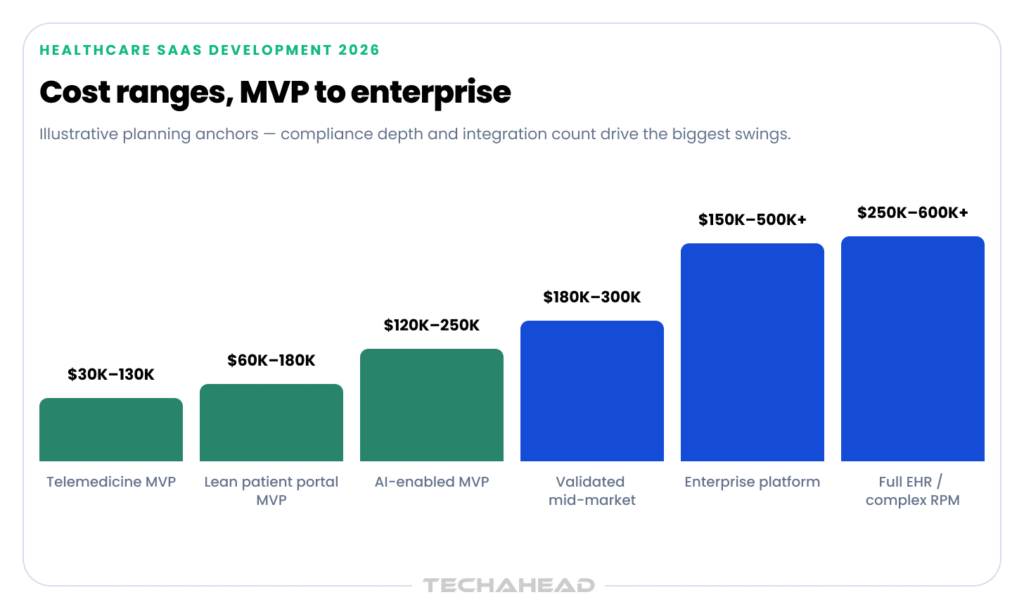
Treat every figure above as a planning anchor. Scope and compliance requirements, not team size alone, drive the largest swings between a $150,000 build and a $500,000 one.
Treating compliance as a post-build activity. This produces architectural rework, delayed audits, and failed hospital security reviews. Bake HIPAA and GDPR controls into the architecture and CI/CD pipeline from day one.
Underestimating EHR integration complexity. FHIR APIs exist across most major EHR vendors, but quality and field-level coverage vary widely. Start with read-only use cases and budget real time for mapping, testing, and the inevitable edge cases.
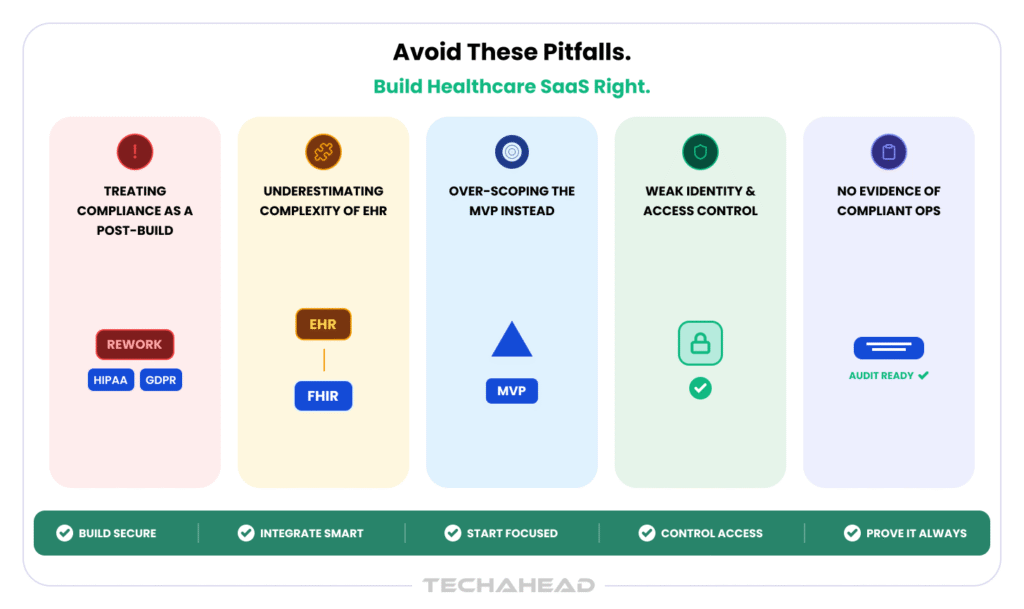
Over-scoping the MVP. Attempting a full EHR or a multi-specialty platform in version one is the single most common reason healthcare SaaS projects stall. Focus on one high-value workflow, such as tele-visits for a specific specialty, and iterate from evidence.
Weak identity and access management. Shared credentials, missing MFA, and overly broad roles are still common findings in vendor security reviews. Enforce MFA, least privilege, and proper session management through a managed identity provider from the start.
Ignoring the need for operational evidence. Written policies without logs, tickets, or records to prove the controls actually operate will not survive a HITRUST or SOC 2 audit. Design logging, access reviews, and incident workflows to generate audit-ready evidence continuously, not retroactively.
Healthcare SaaS success rests on five pillars built together, not in sequence: sound architecture, rigorous security and compliance, a focused feature set, responsible AI implementation where it creates measurable value, and realistic budgeting.
Skipping any one of them does not save time; it moves the cost downstream into rework, failed audits, or a stalled hospital procurement process.
As AI becomes part of healthcare software development, teams should prioritize practical, lower-risk use cases first and maintain clear human oversight in clinical workflows. A secure AI healthcare development strategy helps organizations move from proof of concept to a production-ready platform without treating compliance, safety, or model governance as afterthoughts.
Use this guide as a baseline to align product, engineering, compliance, and AI development services teams, and to frame the first real conversation with vendors, investors, or hospital stakeholders.
Map your idea to one of the product types above, scope a focused MVP around a single workflow, and run a lightweight architecture and compliance review before committing to a full build.
None of the four pillars in this guide substitutes for the others. A beautifully architected platform that never earns a signed BAA cannot go live in a hospital environment.
A fully HITRUST-certified program built around the wrong MVP scope burns budget before it proves clinical value.
The teams that ship healthcare SaaS successfully in 2026 are the ones that plan architecture, compliance, features, and cost together, from the very first roadmap conversation.
Scoping a healthcare SaaS build and want a second set of eyes on your architecture or compliance plan? TechAhead’s healthtech engineering team is glad to compare notes.
Healthcare SaaS handles protected health information and clinical workflows, where bugs can trigger breach notifications, regulatory action, or patient safety incidents.
HHS proposed mandatory MFA and encryption in January 2025; the rule is not yet final, but hospital security reviews already expect it.
Not always. HIPAA is baseline for any ePHI handling; SOC 2 and HITRUST are typically driven by specific enterprise or hospital buyer requirements.
A lean, HIPAA-compliant MVP typically runs $80,000 to $180,000 over four to six months, depending on scope and integrations.
Treating compliance as a post-build activity. This causes architectural rework, delayed audits, and failed hospital security reviews late in the process.
We use cookies to ensure our website functions properly, improve performance, and provide a personalized experience. You can choose which types of cookies to allow below.
Required for core functionality such as security, network management, and accessibility. These cannot be disabled.
Help us understand site traffic and user interactions so we can improve performance and usability.
Enable enhanced functionality and personalization such as language or region preferences.
Used to deliver relevant ads, track campaign performance, and measure advertising effectiveness.