


 Copy Link
 Share on X
 Share on Facebook
 Share on LinkedIn
Always Active
Required for core functionality such as security, network management, and accessibility. These cannot be disabled.

Uncover the transformative potential of digital and mobile solutions for your industry.





 Last Updated: Sep 22, 2026
Mar 30, 2026
Last Updated: Sep 22, 2026
Mar 30, 2026  1418
1418  25 min. Read


Key Takeaways
Global enterprises poured between $30 and $40 billion into AI initiatives in 2024. According to MIT’s GenAI Divide: State of AI in Business 2025 report, only 5% of those investments produced measurable revenue acceleration. The remaining 95% stalled somewhere between a promising pilot and a forgotten proof-of-concept.
5% of enterprise AI investments produce measurable revenue acceleration — MIT, 2025
That gap is about to get significantly more expensive. The global AI market is projected to grow from $371 billion in 2025 to over $2.4 trillion by 2032, a 30.6% CAGR that makes AI the single largest technology investment category in enterprise history. (MIT Sloan) More capital chasing the same strategic mistakes means the cost of getting this wrong scales proportionally.
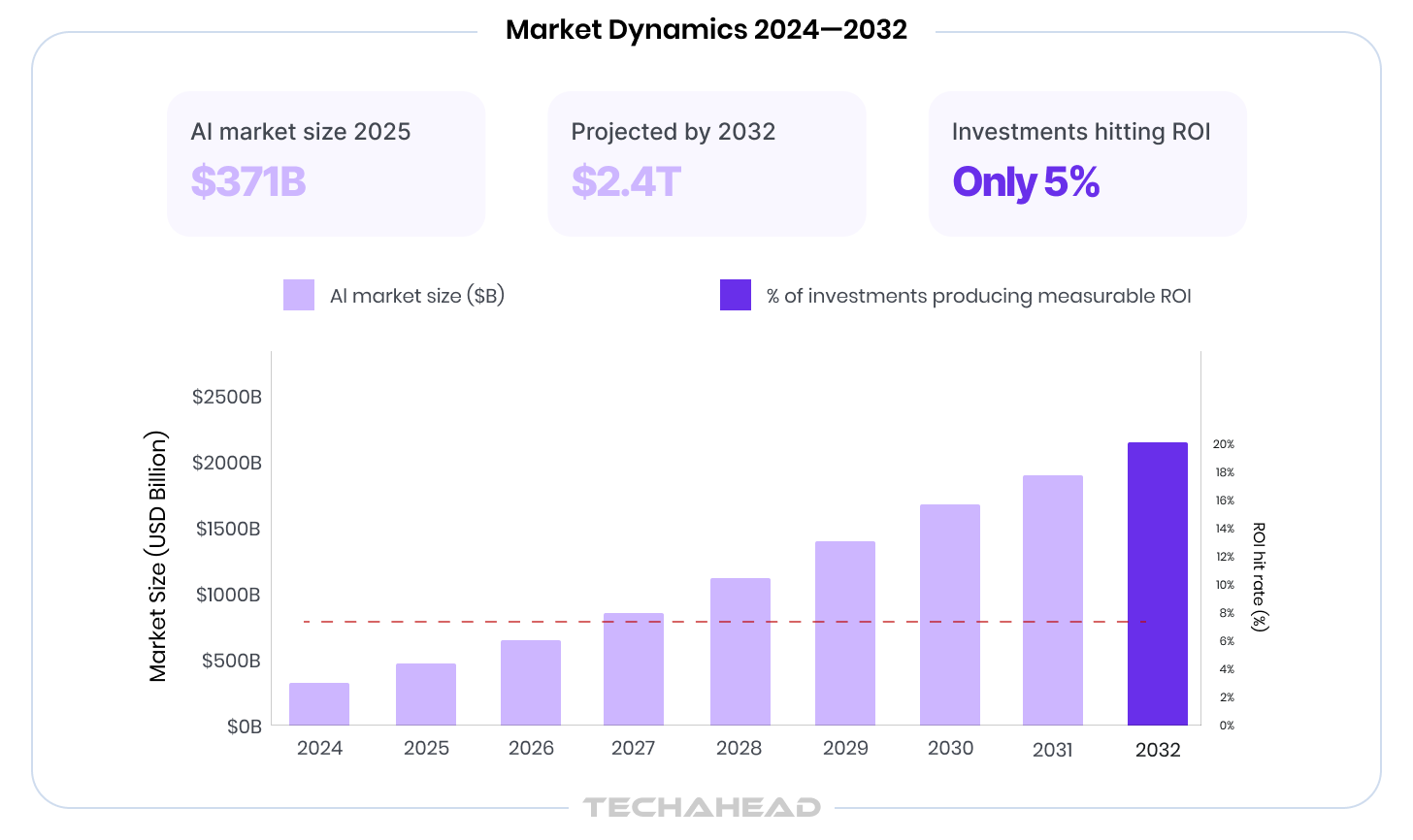
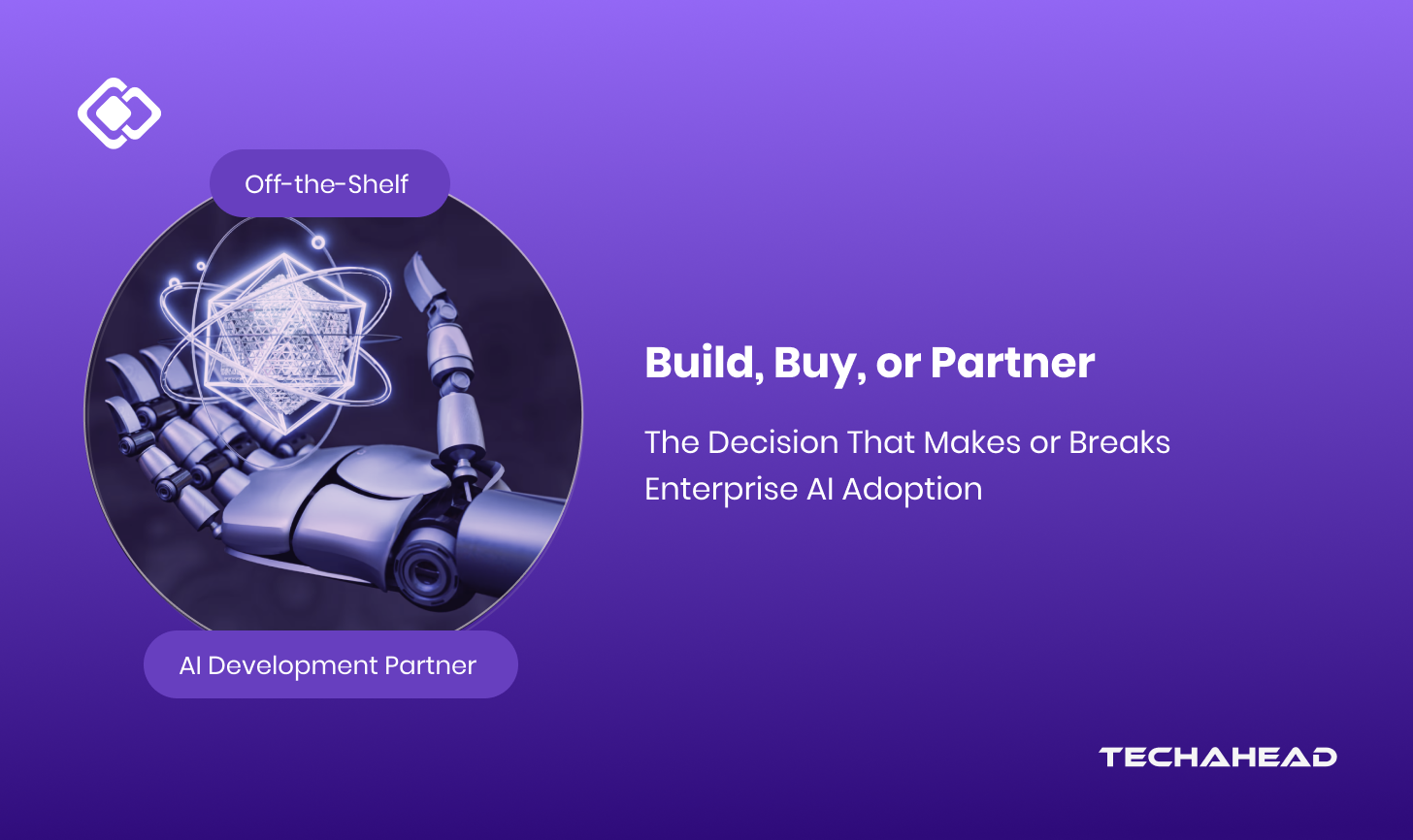
The gap between investment and impact is not a technology problem. There are plenty of proven AI use cases widely adopted across industries. So, the gap is almost always strategic, and it begins with a single decision that most enterprises make badly: the build vs buy vs partner AI decision.
This is the question that determines timelines, budgets, team structures, and ultimately whether your AI initiative ever reaches production. Get it wrong, and you spend 18 months building something a vendor already offers. Or you license a platform that locks you into constraints you did not anticipate. Or you hand the project to an internal team that does not yet have the depth to execute it.
This blog gives you a clear, data-backed framework for making that call with confidence, before you commit a dollar or a headcount.
The AI market has never been noisier. Large language models, agentic AI, computer vision, predictive analytics, and generative design tools multiply faster than most enterprise procurement cycles can evaluate them. Every vendor claims their platform is enterprise-ready. Every consultant has a framework. Every analyst firm has a quadrant.
The data tells a different story. S&P Global found that 42% of companies scrapped the majority of their AI initiatives in 2025, up sharply from 17% the year prior. That is not a technology failure rate. That is a strategy failure rate.
Enterprise AI adoption challenges are rarely technical at their core. They are organizational, strategic, and definitional. The most common AI mistakes in business start not in the model, but in the boardroom, before any solution is scoped.
Three forces are making the decision harder than ever in 2026. The AI talent market remains brutally expensive and competitive: senior ML engineers and AI architects command salaries that most enterprise budgets weren’t built to absorb. The vendor landscape is overcrowded with tools that look differentiated in a demo and feel indistinguishable in production. And regulatory pressure, the EU AI Act, emerging US state-level frameworks, and sector-specific mandates in finance and healthcare are adding layers of compliance complexity that most off-the-shelf vendors have not fully addressed.
The result: enterprises default to a path based on budget comfort or internal political pressure, not actual analysis. That default is expensive. Understanding what each path truly demands and costs is where the decision has to start.
Most enterprise AI decisions get made in boardrooms before anyone has sat down with the actual trade-offs side by side. This comparison does not replace the framework, but it gives you the lay of the land before we break each path apart.
| Dimension | Build | Buy | Partner |
| Initial investment | High | Low to medium | Medium |
| Time to first value | Longest | Fastest | Moderate |
| Customization | Full | Limited | High |
| IP ownership | You own it | Vendor owns it | You own it |
| Talent dependency | Very high | Low | Low to medium |
| Vendor lock-in risk | None | High | Low |
| Compliance control | Full control | Vendor-dependent | Partner-managed |
| Success rate | Lower | Varies | Higher |
| Knowledge retained | Depends on team stability | Minimal | Structured transfer |
| Best for | Proprietary use case, strong internal AI maturity | Standard use case, speed priority | Custom need, limited internal capability |
Building in-house means assembling a full internal AI capability: data scientists, ML engineers, MLOps practitioners, AI architects, and the data infrastructure to support them. You own the models, the pipelines, and the roadmap. This is in-house AI vs outsourcing AI at its most complete form, and it demands more than most enterprise leaders anticipate.
If your AI use case is proprietary by nature, a pricing algorithm that encodes a decade of competitive intelligence, or a risk model that reflects underwriting logic no vendor could replicate, building may be the only path that protects your differentiation. Similarly, if you operate in a sector with hard data sovereignty requirements, keeping model training and inference entirely on your own infrastructure may be non-negotiable.
Build also makes sense when AI is not a support function but a core product. A healthcare SaaS company building a diagnostic model that becomes the product has a different calculus than a logistics firm automating invoice processing.
Here is where most internal business cases underestimate reality. A small-to-mid-sized in-house agentic AI team costs between $500,000 and $1.5 million annually, factoring in experience levels, infrastructure, and ongoing training requirements. Maintaining a production-grade generative AI model alone can run approximately $200,000 per month, with senior AI engineer salaries exceeding $300,000 per year in competitive markets.
| Cost Dimension | Typical Range |
| Annual team cost (small in-house AI team) | $500K – $1.5M |
| Senior AI engineer salary | $250K – $350K+ |
| Monthly model maintenance (GenAI) | $150K – $250K |
| Data engineering (annual) | $100K – $150K per engineer |
| Annual maintenance (% of build cost) | 17% – 30% |
| Time to first production value | 12 – 24+ months |
Data preparation alone can consume 60 to 80% of a project’s time and resources before a single model is trained. These are not edge cases; they are the norm across enterprise AI projects. The cost of building vs buying AI solutions is not just financial. It is measured in months of organizational focus that cannot be redirected.
The risks of in-house AI development are structural, not circumstantial. Talent attrition is the most acute: the average tenure for AI roles at non-technology companies is under two years, and the skills gap between your best AI hire today and the team you need to scale tomorrow is significant.
Beyond talent, internal builds face scope creep, model drift in production, and a consistent pattern of underestimating data quality requirements. Internal builds are the most exposed to this failure mode because there is no external accountability to force the project toward deployment.
Build only when you have the talent, the timeline, and a use case that is genuinely irreplaceable by any external path.
Buying means licensing an off-the-shelf AI solution: a SaaS platform, a pre-built model accessed via API, or an enterprise AI product from a major cloud provider. OpenAI, AWS, Microsoft, Salesforce, the ecosystem is mature, and the deployment timelines are fast. For the right use case, this is the most rational path.
If your use case is well-established, like customer service automation, HR document processing, and basic predictive analytics. If the requirement is standard rather than proprietary, a proven platform will outperform an internal build on every dimension that matters: time-to-value, reliability, and ongoing vendor-managed improvement.
The AI solution build or buy decision tilts toward buying when speed matters more than differentiation and when your internal team lacks the depth to build and maintain a production-grade system. For enterprises that are still early in their AI maturity, buying a platform is also the lowest-risk way to build organizational understanding before committing to a larger program.
The monthly subscription that looks affordable in a procurement conversation rarely survives contact with enterprise reality. Off-the-shelf AI platforms often start at $200 to $400 per month at the tier shown in a demo, but Gartner’s research puts average enterprise AI software licensing at $30,000 to $50,000 annually per user at production scale.
In regulated industries, compliance requirements add $10,000 to $100,000 annually as vendor policies evolve and audit requirements shift. And vendor lock-in, the accumulation of integration dependencies, data pipelines, and workflow automations built around a single platform, is rarely visible until the switching cost becomes prohibitive.
The build vs buy vs partner AI decision is most often mishandled on the buy side, because buying feels low-risk until it isn’t. These are the failure patterns that repeat across enterprise AI vendor evaluations.
The AI vendor vs internal team comparison often favors vendors on initial cost but reverses over a 36-month horizon, particularly when customization, integration, and compliance overhead are fully loaded into the calculation.
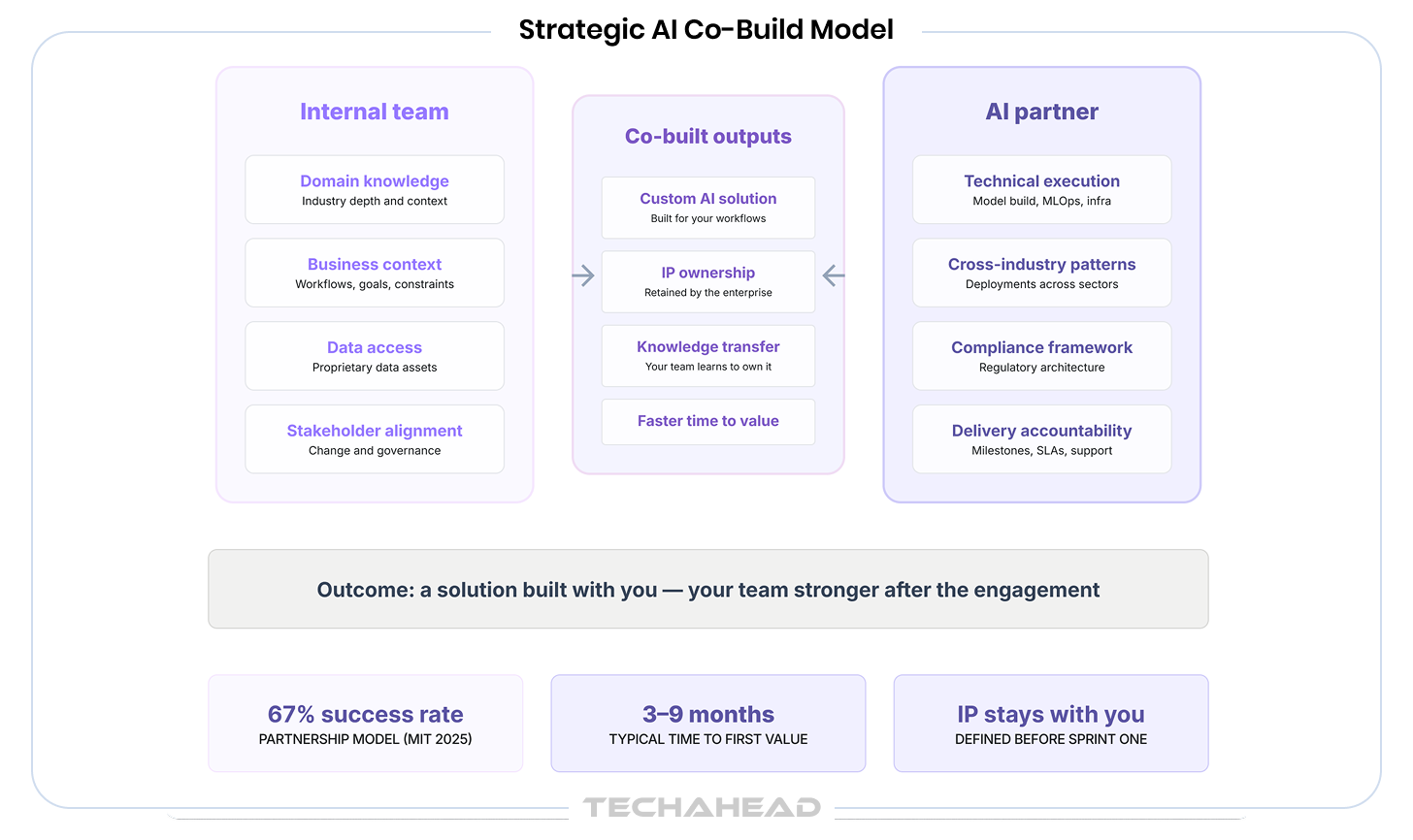
Partnering is not outsourcing in the traditional sense, and it is not vendor procurement either. It is engaging a specialized AI development firm to co-build a solution alongside your team, bringing technical depth, cross-industry pattern recognition, and delivery accountability that internal teams often cannot replicate, while preserving IP ownership and strategic control on your side.
This is the path most underrepresented in enterprise AI frameworks, and it is also the path with the strongest performance data behind it.
MIT’s 2025 enterprise AI research found that purchasing AI tools from specialized vendors and building through strategic partnerships succeeds roughly 67% of the time. Fully internal builds succeed at approximately half that rate. The reason is structural: specialized partners have solved the deployment problem dozens of times across multiple industries. They know where projects stall, which data quality issues typically surface at month four, and how to design for adoption rather than just for functionality.
Internal teams frequently underestimate integration costs and stall in the pilot phase, not because the technology fails, but because the path to production requires workflow redesign, change management, and compliance validation that internal builds rarely budget for adequately.
When to partner for AI development is a cleaner question than it appears. If you have a custom AI need that no off-the-shelf platform addresses, but your internal team lacks the depth to build and maintain a production-grade solution, partnering is the only path that gives you both customization and delivery confidence. It is also the right choice when speed and quality both matter — when you cannot sacrifice one for the other, which describes the majority of enterprise AI initiatives with a real business case behind them.
In regulated industries, a partner’s established compliance track record and existing security frameworks often eliminate months of audit preparation that an internal build would require from scratch.
The outsourcing AI development benefits are most visible in the time-to-value comparison. External AI consultants typically deliver solutions five to seven months faster than in-house teams building equivalent projects, which require nine to eighteen months for initial production deployment. For an enterprise initiative with a measurable ROI tied to a business deadline, that gap is the difference between a project that pays back and a project that is still in development when the budget cycle resets.
Beyond speed, the right partner delivers cross-industry pattern recognition that internal teams by definition cannot have. A firm that has built AI solutions across financial services, healthcare, and logistics has seen failure modes your team has not yet encountered. That institutional knowledge is not transferable through hiring or training, but it accrues through delivery.
The framing of AI consulting vs internal development as a binary choice misses the most valuable version of the partner model. The best engagements are not outsourced projects, but they are collaborative builds where the partner brings execution capability and the internal team provides domain depth. The knowledge transfer built into the engagement means your team does not just receive a solution; they receive the understanding of how it was built.
IP ownership, data governance, and post-deployment support should be non-negotiable terms in any partnership agreement. A partner who is not prepared to discuss these upfront is not operating as a strategic partner.
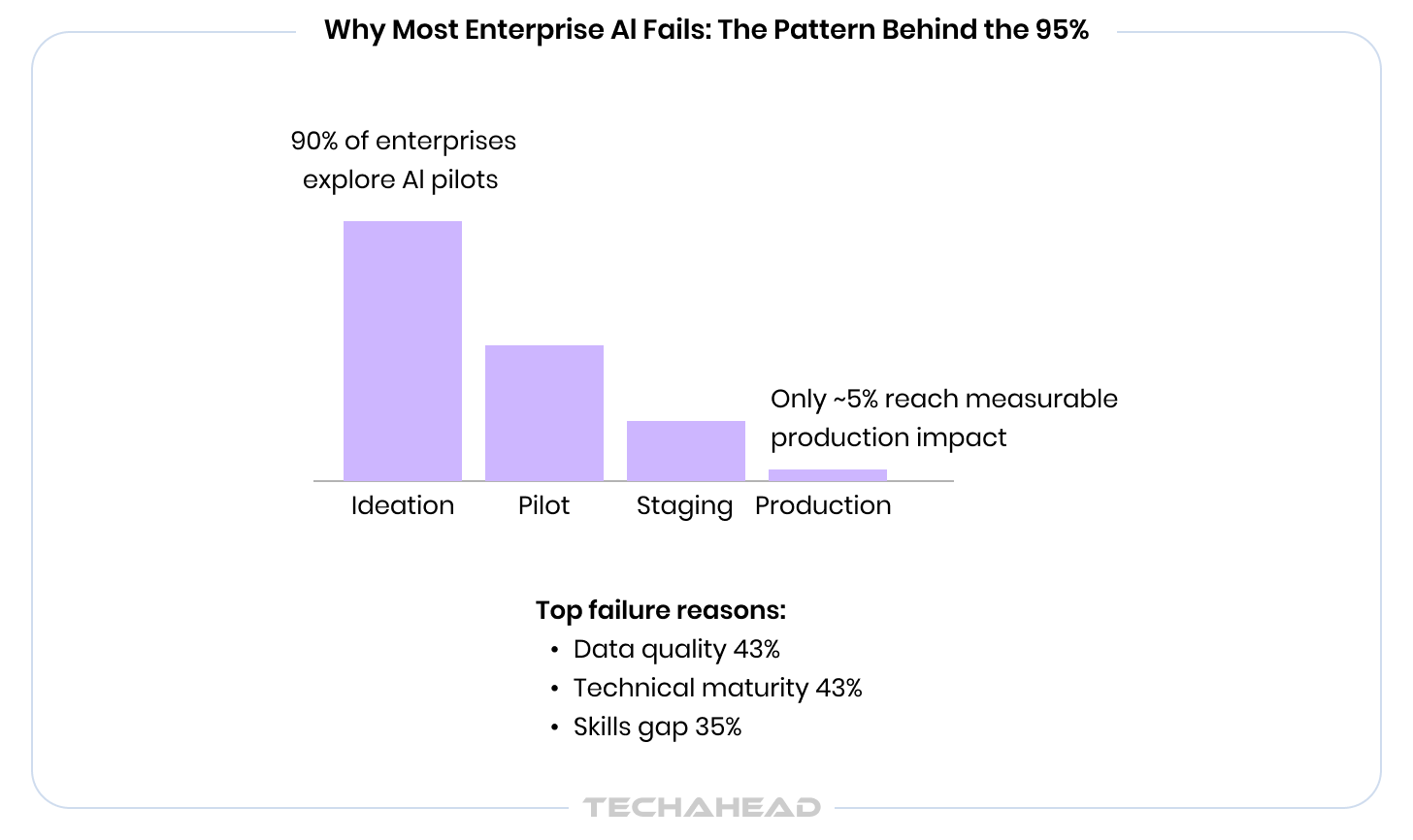
The 95% of AI investments that do not produce measurable impact share a recognizable set of failure patterns. Understanding them is not an academic exercise, but it is how you select the path that minimizes your specific exposure.
MIT’s research describes a Pilot-to-Production Chasm: 90% of enterprises have explored AI solutions and many launch pilots, yet enterprise-grade conversion remains rare. The top obstacles are data quality and readiness (cited by 43% of respondents), lack of technical maturity (43%), and shortage of skills (35%). These are not random. They are structural weaknesses that each path handles differently.
| Failure Pattern | Most Risky Path | Why |
| No clear business outcome defined | Build | No external pressure to sharpen the use case |
| Poor data quality and readiness | Build | Internal teams often inherit data problems without the mandate to fix them |
| Talent attrition mid-project | Build | 100% dependent on a team that may not stay |
| Integration underestimation | Buy | Surfaces after contract, not before |
| No post-deployment support model | Buy | Vendor SLAs rarely match enterprise operational needs |
| Compliance gaps discovered late | Buy | Vendor roadmaps do not align to your regulatory schedule |
| Knowledge gap after delivery | Partner (poorly executed) | When knowledge transfer is not a structured deliverable |
The most expensive common AI mistakes in business are not technical miscalculations. They are governance failures: nobody owned the definition of success, or the data readiness review was deferred, or the change management budget was cut in the second planning cycle. The build vs buy vs partner AI decision shapes which of these failures you are most exposed to, but it does not eliminate the need to address them.
Read our blog on AI Readiness Assessment to get to know whether or not your organization is ready for AI adoption.
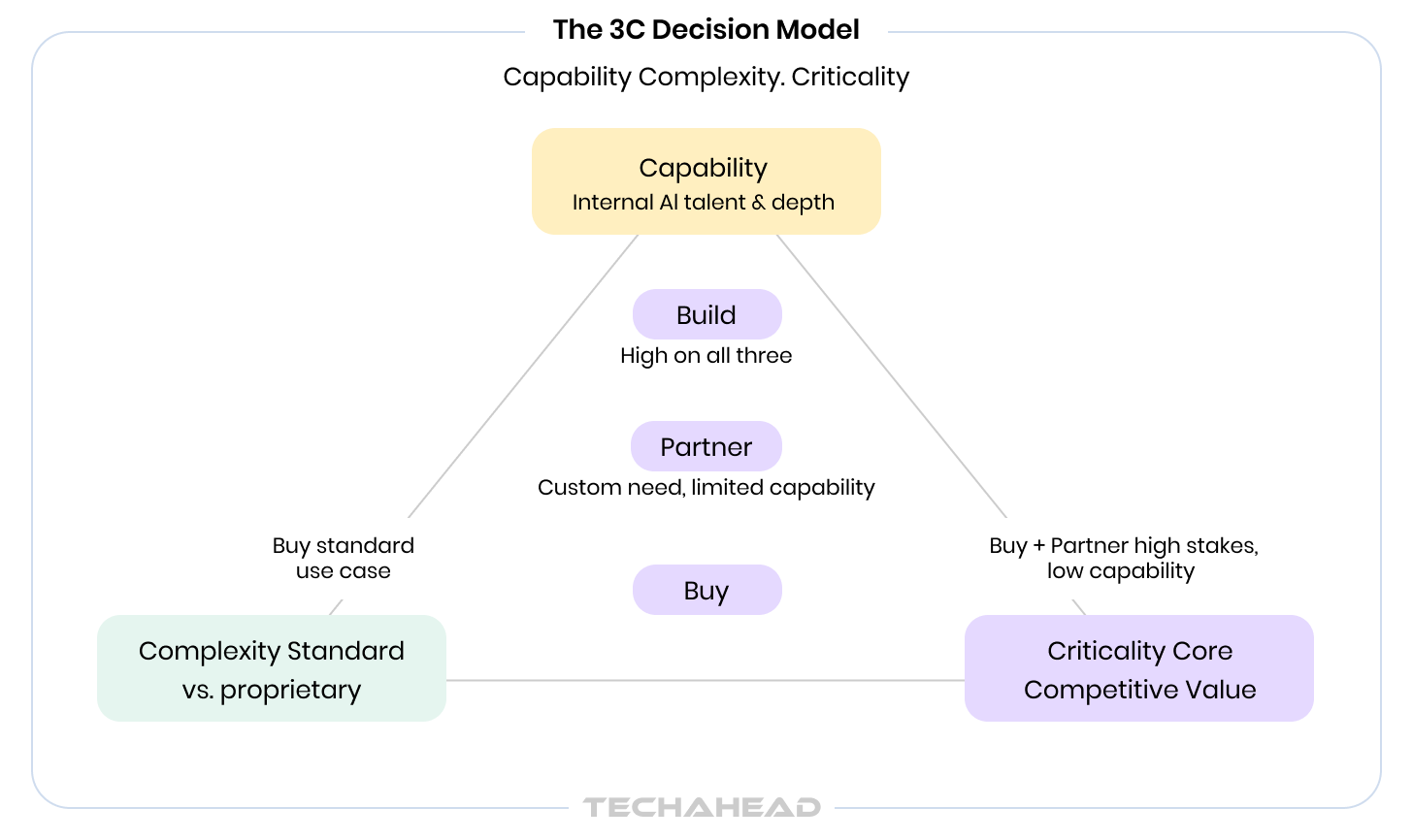
Every enterprise AI initiative can be evaluated on three axes. These three dimensions, taken together, point toward the path with the highest probability of success for your specific context.
| Axis | The Core Question |
| Capability | Do we have — or can we realistically acquire — the talent to build and maintain this internally? |
| Complexity | Is this a standard, well-established use case, or a genuinely differentiated and proprietary need? |
| Criticality | How central is this AI capability to our long-term competitive advantage? |
These are not abstract questions. They produce a decision with clear implications.
| Capability | Complexity | Criticality | Recommended Path |
| Low | Low | Low | Buy |
| Low | High | High | Partner |
| High | High | High | Build |
| Medium | Medium | High | Partner, then transition to Build |
| Low | Low | High | Buy + Partner for customization |
| Any | Any | Low | Buy |
The best approach for implementing AI in enterprises is rarely a single path held constant across all initiatives. Mature enterprise AI programs operate as hybrid portfolios: Buy for commodity and standardized use cases, Partner for differentiated and time-sensitive initiatives, and Build selectively when long-term IP ownership justifies the investment.
The question of whether enterprises should build or buy AI solutions is, in practice, the wrong question. The right question is: which combination of paths creates the most value, at the lowest execution risk, given where we are today?
Enterprise AI decisions are financial decisions. The framework above tells you which path is strategically correct; this table tells you what it actually costs.
| Cost Dimension | Build (In-House) | Buy (Off-the-Shelf) | Partner (Co-build) |
| Initial investment | $500K – $1.5M+ | $30K – $50K/user/yr | $150K – $500K (project) |
| Time to first value | 12 – 24 months | 1 – 3 months | 3 – 9 months |
| Annual maintenance | 17 – 30% of build cost | Licensing + integration | Included or low % |
| Talent dependency | Extremely high | Low | Low to medium |
| Customization flexibility | Full | Limited | High |
| Vendor lock-in risk | None | High | Low (IP stays with you) |
| Compliance flexibility | Full control | Vendor-dependent | Partner-managed |
| Knowledge retained | Full (if team stays) | Minimal | High (with transfer plan) |
Cost is one dimension. Time-to-value and risk exposure are equally important for C-level decisions, and they rarely appear together in vendor proposals or internal business cases. The comparison above reflects the full picture, and it shows why partnering occupies a position that neither building nor buying can replicate for the majority of complex enterprise AI initiatives.
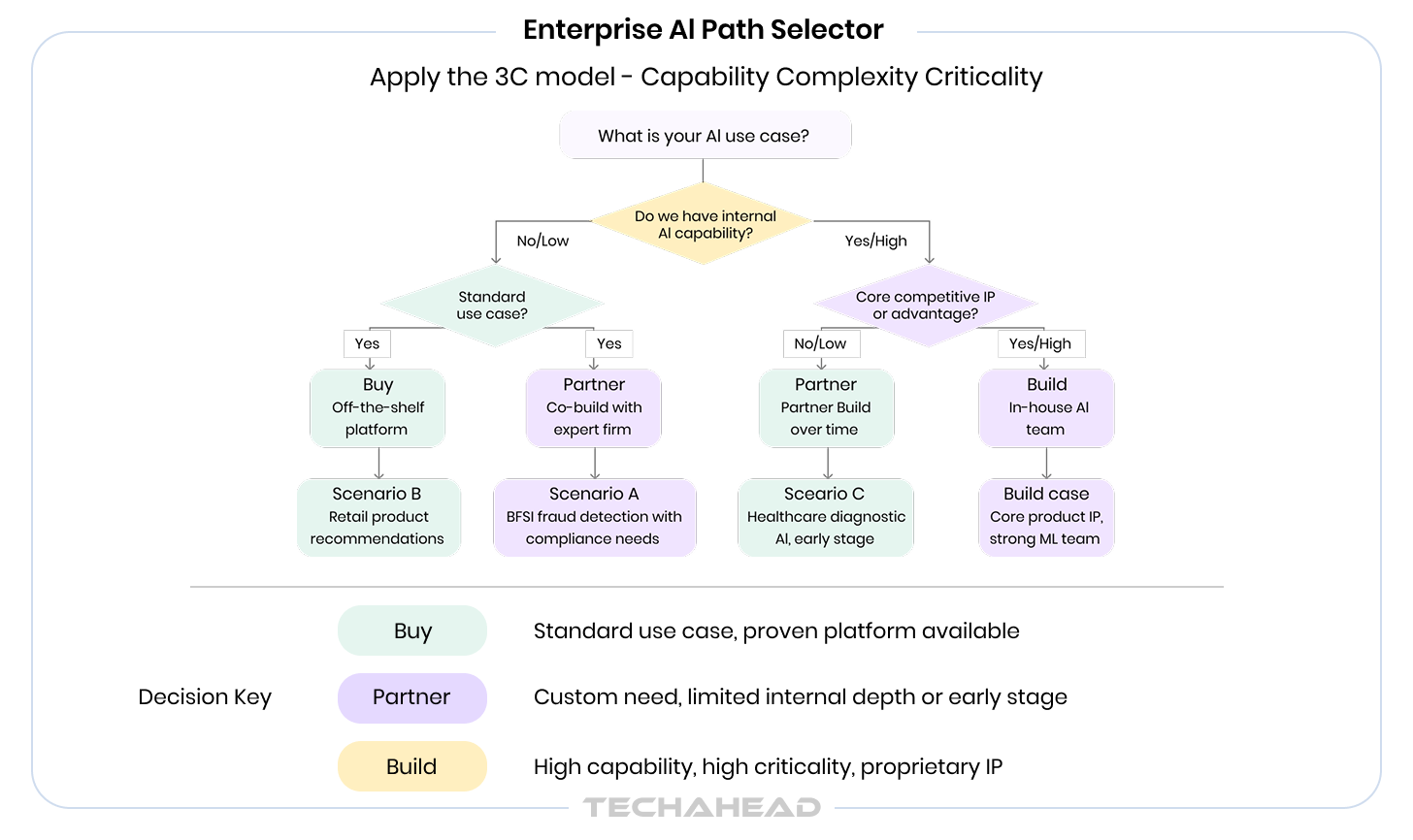
If the 3C Model points toward partnering, the next decision, enterprise AI partner selection, is where execution risk is won or lost. The market is full of firms that pitch AI expertise. The discipline is in knowing what to look for and what to walk away from.
How to choose an AI app development partner comes down to a single test: is this firm building with you, or for you? The distinction matters more than any technical capability. A partner building with you leaves your organization stronger after the engagement. A partner building for you leaves a system and a dependency.
Our blog How to Align AI Capabilities with Business Outcomes dives deep into the right ways to measure AI impact.
Abstract frameworks earn their credibility when applied to real contexts. Here is how the 3C Decision Model maps to three common enterprise situations.
Suppose a regional bank wants to replace its rules-based fraud detection with an ML model that adapts to emerging transaction patterns. The data is sensitive, the regulatory environment is strict, and the competitive stakes are high.
3C Recommendation
Partner with a BFSI-specialized AI development firm. Co-build with defined IP ownership, compliance-first architecture, and a knowledge transfer plan that leaves the internal risk team capable of model monitoring and retraining.
Another example: A national retailer wants to deploy AI-powered product recommendations across its e-commerce platform. Proven platforms exist, the use case is well-established, and deployment speed matters.
3C Recommendation
Buy a proven personalization engine and customize via API. The internal data science team manages ongoing tuning. Partner engagement was scoped narrowly for integration support only.
If a healthcare SaaS company is building a diagnostic AI model, it is supposed to become a core product differentiator, embedded in clinical workflows and subject to FDA oversight.
3C Recommendation
Partner to accelerate early development and navigate regulatory architecture, with a structured transition plan to internal ownership as ML capability matures. IP ownership is retained by the enterprise from day one.
The partner path delivers full value only when the AI development company you choose has already solved the problems you are about to face. Here is TechAhead’s track record.
Founded in 2009, TechAhead is ranked number one globally in Clutch’s Spring 2025 App Development Awards. With over 2,500 successful projects delivered and 1,200-plus global brands served, we have served many high-growth startups to Fortune 500 enterprises.
What sets them apart for enterprise AI:
SOC 2 Type II certified, ISO 42001:2023 certified, ISO 27001 certified, and an AWS Advanced Tier Partner with Security Services Competency compliance is built into the architecture before development begins, not retrofitted after.
Their team of 250+ AI consultants holds recognition as a Top Generative AI Company, and Most Reviewed AI/ML firm on Clutch, alongside 35+ industry awards, including Webby, Google Best App 2024, and Red Herring Top 100.
Trusted by global brands including Audi, Disney, American Express, JLL, and AXA with a delivery model built around IP ownership, knowledge transfer, and production-grade outcomes.
The build vs buy vs partner AI question is not a one-time call. It is a strategic posture that evolves as your AI capability matures, as your use cases multiply, and as the regulatory and competitive environment shifts around you.
The most successful enterprise AI programs in 2026 are not the ones that chose the right technology. They are the ones who chose the right path for each initiative and kept that choice under review. They treat the build vs buy vs partner AI framework as a living model, not a settled answer.
The most expensive mistake is not choosing the wrong path. It is choosing without a framework, and discovering the consequences twelve months into a program that was committed before the question was fully asked.
The 3C Model gives every AI initiative a structured starting point. Apply it, weigh it against your specific organizational context, and revisit it as each initiative moves from pilot to production.
AI strategy insight
AI does not fail because the technology is flawed. It fails when it is misapplied. The right path is the one that matches your organizational reality.
Building means assembling an internal AI team to develop models and infrastructure from scratch with full control, full cost, and full timeline. Buying means licensing an off-the-shelf AI platform or SaaS tool, focusing on fast deployment and limited customization. Partnering means co-building a custom solution with a specialized AI development firm, combining your domain knowledge with external technical execution, while retaining IP ownership. Most mature enterprises use all three simultaneously, depending on the use case.
Apply the 3C Decision Model. Rate your initiative on three axes: Capability (do you have internal AI talent?), Complexity (is this a standard or proprietary use case?), and Criticality (how central is this to your competitive advantage?). Low capability plus high complexity plus high criticality almost always points to partnering. High capability plus high criticality plus a genuinely proprietary use case point to building. Standard use cases with proven vendor solutions point to buying.
The top failure patterns are data quality and readiness issues, lack of technical maturity, and skills shortages. The deeper issue is governance with no defined business outcome, no post-deployment support plan, and no structured knowledge transfer. The path you choose determines which of these failure modes you are most exposed to.
Buying appears cheaper upfront as enterprise AI software licensing typically runs $30,000 to $50,000 per user annually at production scale. Building in-house costs $500,000 to $1.5 million annually for a small-to-mid-sized AI team, before infrastructure. But the total cost of buying compounds quickly through customization gaps, integration overhead, and vendor lock-in. Partnering typically lands at $150,000 to $500,000 for a project engagement, faster than building, more flexible than buying, with IP retained by your enterprise.
Partner when you have a custom AI need but lack the internal depth to build and maintain a production-grade system. Partner when speed and quality both matter, and you cannot sacrifice one for the other. Partner when you are in a regulated industry where compliance architecture needs to be validated from day one. The right AI partner delivers the solution and leaves your team capable of owning it.
Look for production-grade delivery experience, actual deployments at enterprise scale. Look for industry vertical expertise, particularly in your sector. Demand transparent IP ownership terms defined before development begins. Confirm they have a structured knowledge transfer plan and a post-deployment support model. A red flag: any partner who leads with tools and technology before understanding your business outcome.
We use cookies to ensure our website functions properly, improve performance, and provide a personalized experience. You can choose which types of cookies to allow below.
Required for core functionality such as security, network management, and accessibility. These cannot be disabled.
Help us understand site traffic and user interactions so we can improve performance and usability.
Enable enhanced functionality and personalization such as language or region preferences.
Used to deliver relevant ads, track campaign performance, and measure advertising effectiveness.