


 Copy Link
 Share on X
 Share on Facebook
 Share on LinkedIn
Always Active
Required for core functionality such as security, network management, and accessibility. These cannot be disabled.

Uncover the transformative potential of digital and mobile solutions for your industry.





 Last Updated: Sep 22, 2026
May 20, 2026
Last Updated: Sep 22, 2026
May 20, 2026  570
570  28 min. Read


Key Takeaways
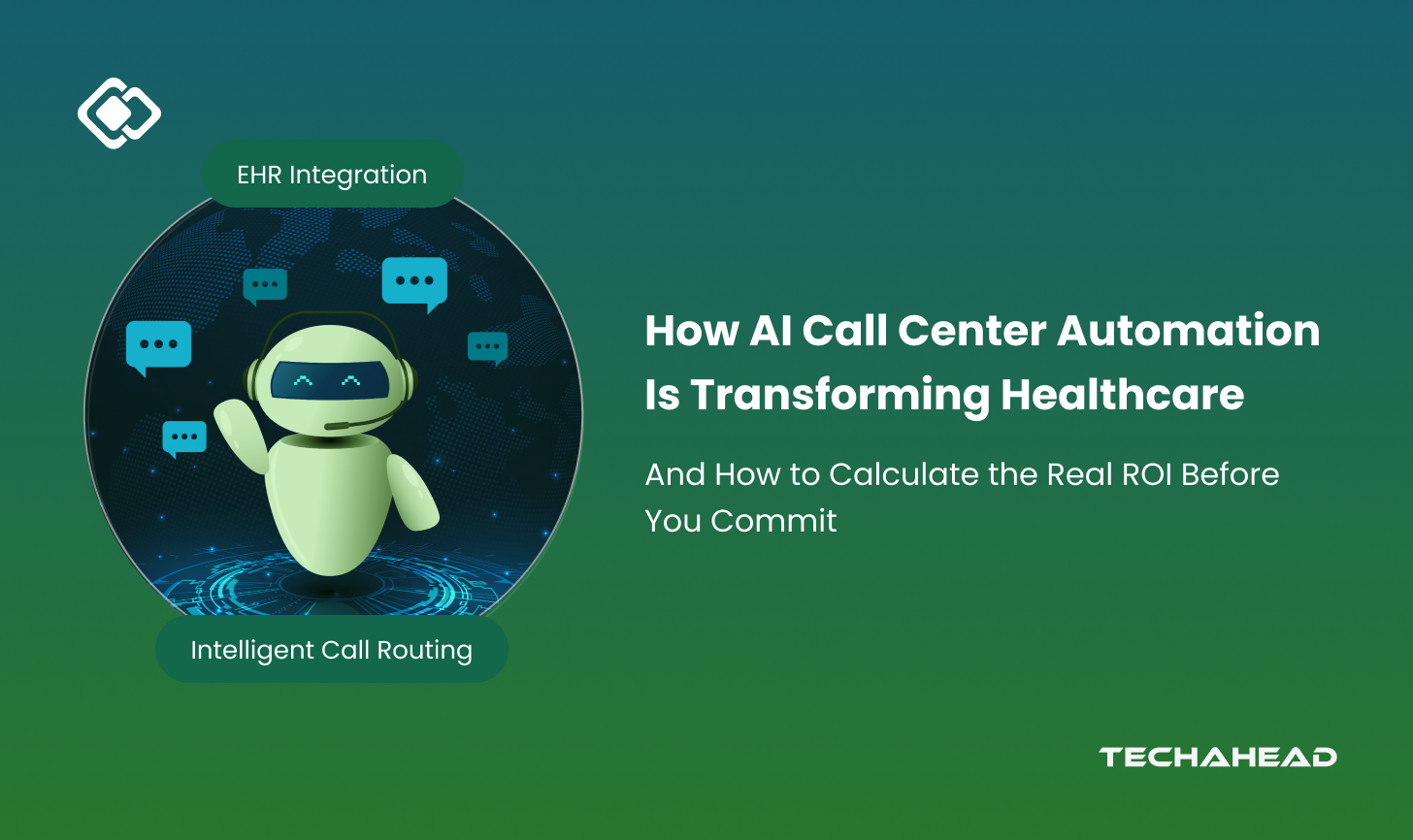
If your organization has already run an AI pilot in the contact center and walked away with inconclusive results, you are not alone. A meaningful share of healthcare technology leaders have been through exactly that cycle: a compelling vendor demo, a scoped proof of concept, a few months of testing, and then a quiet shelving of the project as results failed to match the promise.
In fact, it is estimated that 95% of AI pilots fail, costing organizations millions and damaging their reputation. Reasons could be anything from a lack of business value to poor quality data.
This is evidence that most AI call center automation implementations are designed without the operational rigor and integration depth needed to deliver measurable outcomes. The technology has matured significantly, but the implementation methodology in most organizations has not caught up. This leads to the increased importance of collaborating with an AI development company with the right type of expertise in this domain, be it OpenAI, Agentic AI, or Gen AI.
The numbers frame the stakes clearly. Administrative tasks account for 15 to 30 percent of total U.S. healthcare costs. A significant share of that burden sits inside the healthcare contact center: appointment scheduling, prescription refills, prior authorization, billing questions, referral management, and routine patient follow-ups. These are the interactions that consume the majority of call center staff capacity every single day, and they are precisely the interactions most amenable to AI automation.
This article is a strategic assessment for evaluating AI call center automation with a healthy level of skepticism. It covers what actually changes in healthcare call center operations when AI is deployed correctly, why most pilots fail, how to calculate a real ROI before committing, and what the next 24 months look like for organizations that move now versus those that wait.
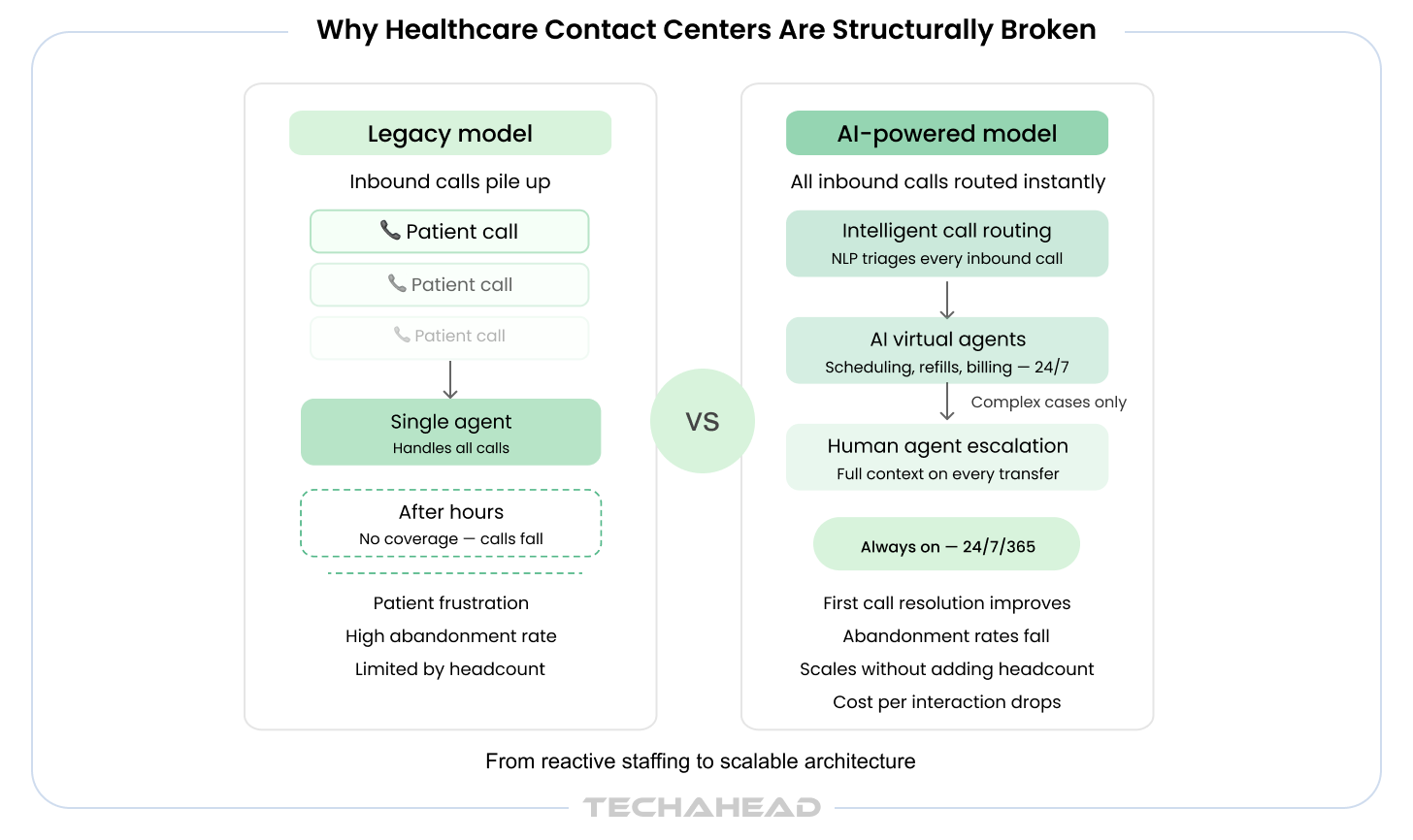
The challenges facing healthcare call centers are not new. What has changed is the degree to which incremental fixes have stopped working.
Call volumes are rising as patient access demands grow. Staffing costs are climbing. After-hours coverage remains a persistent gap that drives abandonment rates and patient frustration. And the nature of inbound calls has not changed: a large majority of them are routine requests that require no clinical judgment, yet they consume the same agent bandwidth as the complex cases that genuinely need human attention.
In the U.S, the average call center wait time is around 4.4 minutes. This is even above the Healthcare Financial Management Association benchmark of 50 seconds. Moreover, the first call resolution rate in healthcare is 52%. This means that almost half of the patient inquiries are not resolved immediately in a single interaction and require follow-up.
Healthcare administrative support roles carry fully loaded costs well above base salary when benefits, training, and turnover are factored in. Healthcare organizations that have modeled the cost of scaling a contact center through headcount alone consistently find that the expense outpaces any reasonable projection of revenue growth tied to improved patient access.
The structural problem is this: the healthcare contact center is built on a model that requires human agents to handle every inbound call, including the ones that are entirely routine. Scheduling appointments, confirming prescription refills, answering billing questions, sending appointment reminders, managing referral management workflows, these interactions follow predictable patterns. They do not need a trained agent. They need a reliable system.
Staffing shortages in the broader healthcare sector compound this further. According to the WHO, healthcare will face a shortage of 11 million health workers by 2030, and the number is high in the low- and lower-middle-income countries. When skilled clinical and administrative staff spend their time on repetitive tasks that AI can handle, the cost is not just financial. It is operational capacity that cannot be redirected to higher-value patient engagement.
Before making the case for where AI call center automation succeeds, it is worth naming the failure patterns clearly. We as, an AI healthcare solution provider, can trace the root causes of an unsuccessful AI pilot.
Complexity: An AI agent that cannot access live patient data, provider schedules, and EHR records in real time can hold a conversation. It cannot take action. This distinction is everything in healthcare call center operations. Epic integration and similar EHR connectivity are table stakes.
Voice automation AI and conversational AI deployed without that integration layer produce a more sophisticated phone tree, not a transformed contact center. The AI can gather information from the patient. It cannot do anything useful with it.
Solution: Organizations that treat EHR integration as a phase-two consideration consistently find that phase two never closes the gap created in phase one. Every pilot that launches without live data access is structurally capped on what it can automate.
Complexity: The second most common failure pattern is attempting to automate too many call center workflows simultaneously. A healthcare contact center handles scheduling appointments, prescription refills, billing questions, referral management, prior authorization, appointment reminders, and general patient inquiries. The impulse to automate all of them at once in the name of a comprehensive rollout produces complexity that collapses timelines and dilutes results.
Solution: The organizations that achieve durable contact center ROI from AI call center automation consistently start with one well-defined use case, typically inbound scheduling or prescription refills, demonstrate clear and measurable outcomes, and expand sequentially. That discipline is not timidity. It is what makes the second and third phases of deployment possible.
Complexity: The moment a patient has to repeat their name, date of birth, and reason for calling after being transferred from an AI agent to a human agent, the patient experience value of the automation has been erased. Escalation design, the architecture that determines how an AI agent hands off to a human representative with complete context, full conversation history, and a clear summary of what the patient needs, is where a significant number of healthcare AI deployments fall short.
Solution: Intelligent routing and clean handoffs between AI and human agents are not afterthoughts. They are core to the system design. Call center staff who receive complete context on every transfer resolve calls faster, make fewer errors, and deliver more personalized service. The absence of that design produces the repeat contacts and customer frustration that undermine the entire business case.
Complexity: A pilot without a pre-deployment baseline produces anecdotes, not evidence. Many healthcare organizations deploy AI in the contact center and then attempt to construct a financial case after the fact, comparing results to a period that may not be representative, or measuring metrics that were not tracked before the deployment began.
Solution: Calculating ROI of AI in healthcare call centers requires knowing your cost-per-interaction, first call resolution rate, abandonment rates, and agent productivity before go-live. Without that baseline, the ROI conversation is always subjective, and subjective conversations rarely produce the executive confidence needed to scale.
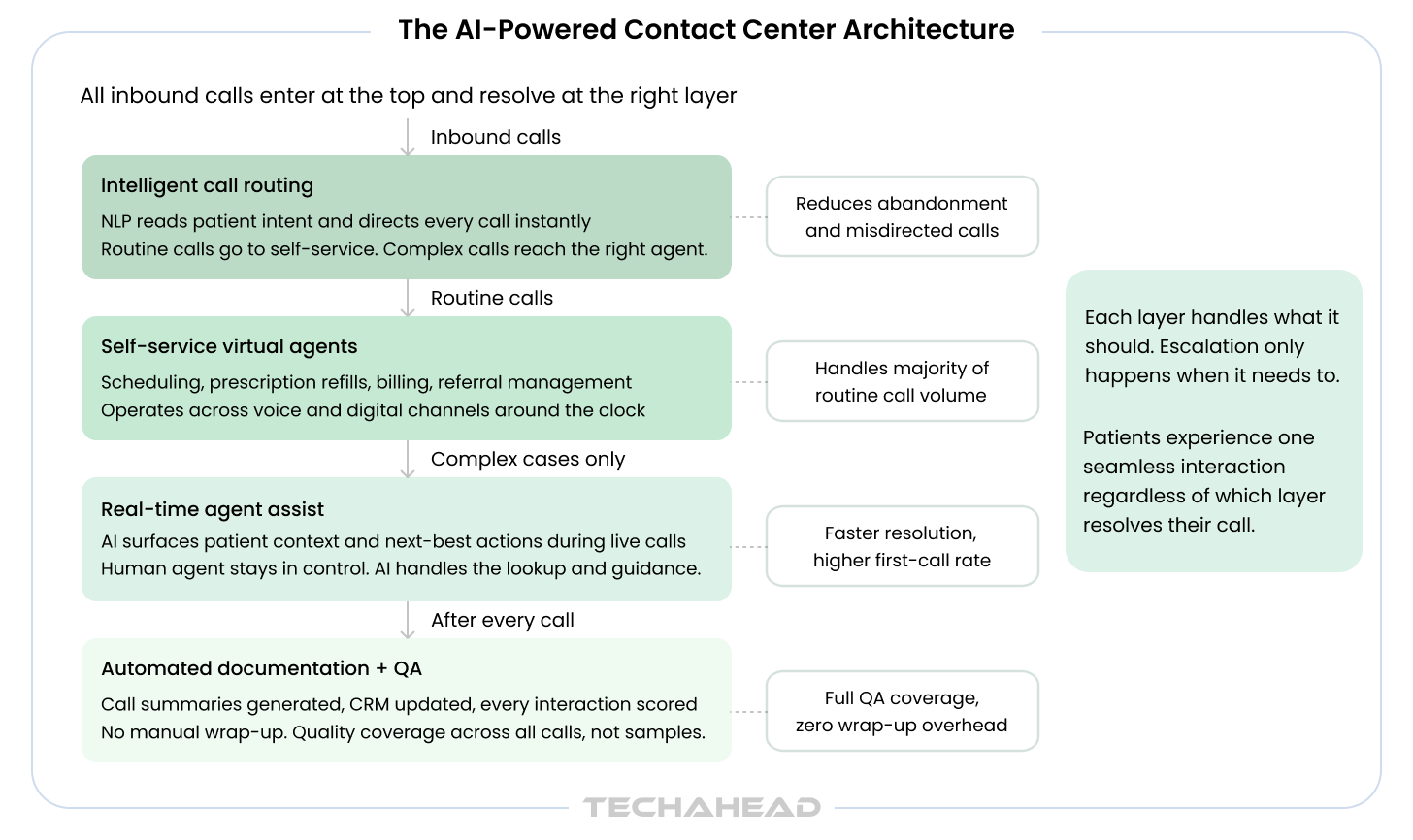
The implementations that deliver measurable outcomes share a consistent architecture. They are not built around a single AI feature. They are built as a layered system across four operational areas, each reinforcing the others.
Before any AI agent handles a call, intelligent call routing ensures the right call reaches the right destination. AI-powered routing analyzes the reason for the call in real time using natural language processing, identifies the patient context from customer data already in the system, and directs the interaction accordingly.
Routine requests go to self-service flows. Complex cases go to the appropriate human agent with the relevant context already populated. Calls no longer fall through the gaps between departments, and abandonment rates drop because patients reach resolution faster.
This layer alone produces measurable efficiency gains. It also makes every downstream element of the contact center more effective, because the right type of interaction is reaching the right resource.
This is where the volume impact is highest in healthcare call centers. AI voice agents and chat agents operating across voice and digital channels can handle the full end-to-end workflow for scheduling appointments, prescription refills, billing questions, appointment reminders, and referral management, without human involvement, at any hour, across inbound calls and outbound calls alike.
Agentic AI in healthcare is what makes this level of automation possible at scale. It is predicted that Agentic AI will autonomously resolve 80% of common customer service problems without human intervention by 2029.
Unlike rule-based chatbots or basic voice AI, agentic AI systems can reason across multiple steps, access live patient data, apply scheduling logic specific to each provider, manage exceptions, and escalate to human agents when a situation moves outside the parameters of what the AI should handle. The patient engages through a single platform. The system resolves the call, updates the record, sends confirmations, and closes the loop.
Self-service options of this quality also address the patient access problem that call center expansion has never fully solved: after-hours availability. An AI-powered contact center handling inbound calls around the clock does not require shift premium or overtime. It extends patient access through digital channels and voice channels simultaneously, without adding headcount.
Read our blog, “Top Use Cases of Agentic AI,” to learn about other advanced uses of this intelligent technology in healthcare.
For the calls that reach human agents, AI does not step aside. Real-time agent assist delivers contextual guidance to call center staff during live conversations, surfacing relevant patient history, suggested next steps, and compliance checkpoints in the moment.
The AI agent stays in control of the conversation and ensures they have everything they need to resolve calls faster and more accurately. At scale, across hundreds of agents handling thousands of inbound calls daily, that difference represents significant call center cost reduction.
The impact on call resolution is measurable. Unity, a leading game engine, saved $1.3 million with Zendesk automations and self-service.
After every interaction, AI-powered QA and automated documentation handle the administrative tasks that currently consume call center staff time. Conversation summaries are generated automatically, CRM records are updated, and Quality scores are produced for every call. AI powered QA at full call volume gives healthcare organizations compliance coverage and resolution quality data that manual processes can never match.
The aggregate effect of eliminating post-call wrap-up time across a large healthcare contact center is substantial. It is also one of the fastest-returning investments in the automation stack, because it does not require patient-facing deployment to deliver value.
The difference between an AI deployment that works and one that does not is rarely the AI itself. It is the architecture around it, the integration depth, the escalation design, and the discipline of the use case sequencing.
There are many limitations regarding workforce management tools. For example, it often lacks advanced forecasting and scheduling capabilities. And this leads to inaccurate demands for staffing requirements. Moreover, call center tools are not adequate to tag detailed reasons for call needs by AI to deliver customer insights, with almost 60% calls being untagged.
Therefore, it is crucial to enhance technology infrastructure to address these limitations, improving overall efficiency, responsiveness, and service quality.
According to Deloitte’s 2026 US Health Care Outlook Survey, more than 80% of health care executives agree that gen AI and agentic AI are expected to deliver moderate-to-significant value across a range of functions in 2026. This goes from clinical and business operations to back-office functions.
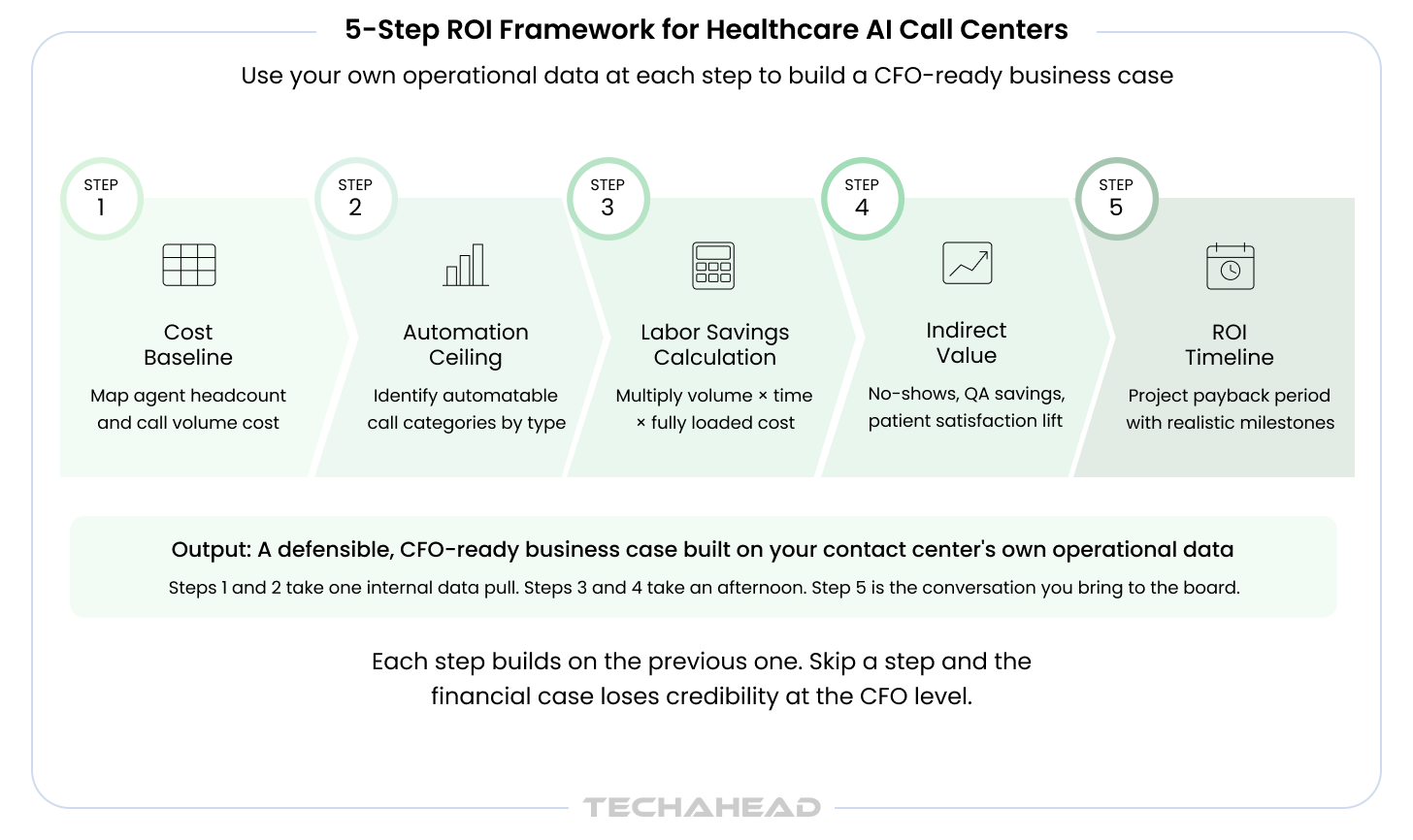
How AI call center automation reduces costs in healthcare is a question best answered with your own operational data, not industry benchmarks alone. The methodology below is the same framework we use with healthcare organizations before scoping any deployment. It produces a defensible financial case before a single line of code is written.
Pull five numbers from your current contact center operations:
These five inputs give you the cost structure of your current healthcare call center operations in enough detail to model what changes under automation.
Map each call category against a realistic automation rate. Scheduling appointments and prescription refills typically automate at 60 to 80 percent in well-deployed healthcare contact centers. Billing questions and general inquiries typically land at 50 to 65 percent. Prior authorization and referral management, which often involve clinical data exchange, automate at lower initial rates but improve significantly as EHR integration matures.
Most healthcare contact centers find that 55 to 70 percent of total call volume is automatable within the first 12 months of a well-sequenced deployment. AI automation could unlock a $150 billion opportunity for operational improvement, with a reduction in administrative costs being one of the categories.
For each automatable call category: multiply the monthly call volume by the automation rate, multiply by the average handle time in hours, and multiply by your fully loaded agent cost per hour. That figure is your monthly labor cost recovery for that single category. Sum across all categories for your aggregate labor savings. This is the primary driver of contact center ROI and the number most relevant to a CFO.
Let’s assume an example:
A healthcare contact center receives 30,000 inbound calls per month. 35 percent are scheduling calls averaging 7 minutes each. At a fully loaded agent cost of $28 per hour, those calls cost approximately $122,500 per month in labor. Automating 65 percent of them through AI call center automation recovers roughly $79,625 per month, or $955,500 annually from one call category alone.
Labor savings are the most quantifiable component of healthcare AI call center ROI, but they are not the only one. Factor in:
Well-scoped AI call center automation deployments in healthcare typically show positive ROI within 8 to 14 months. However, the range depends on the complexity of the initial use case, the depth of EHR integration required, and whether the organization starts narrow or broad. Organizations that sequence their deployment well, starting with high-volume routine call categories, consistently hit the lower end of that range.
Three-Scenario Model
| Healthcare AI Call Center ROI: Three-Scenario Model Based on well-sequenced deployments with EHR integration. Use your own operational data to refine these ranges. | |||
| Metric | Conservative Scenario | Average Scenario | Best-Case Scenario |
| Automation Rate (of routine call volume) | ~50% (Scheduling + high-volume only) | ~65% (Most routine categories covered) | 75%+ (All automatable workflows active) |
| Cost Reduction (vs. current operations) | 15–22% (Labor + wrap-up savings) | 25–32% (Labor + QA + documentation) | 35–45% (Full stack savings realized) |
| Annual Savings (mid-size health org) | $400K–$700K (Single use case driving return) | $800K–$1.4M (Multiple categories automated) | $1.5M–$3M+ (Full deployment, QA included) |
| ROI Timeline (to positive return) | 12–14 months (Longer ramp, lower risk) | 9–11 months (Steady, proven trajectory) | 6–8 months (Fast payback, high readiness) |
The financial model given above is achievable. It is also not the default outcome of any AI deployment. The difference between realizing those numbers and writing off another pilot comes down to six specific variables.
This is the single most consequential implementation decision. An AI call center automation deployment that launches without live EHR integration is constrained from the start. Epic integration and equivalent connectivity to other major EHR platforms is what enables an AI agent to take action, not just conduct a conversation. It should be a launch requirement, not a roadmap item.
Start with the highest-volume, lowest-complexity call category in your contact center. For most healthcare organizations that is appointment scheduling. Demonstrate measurable outcomes. Build organizational confidence. Then expand to prescription refills, billing questions, and referral management in sequence. Organizations that respect this discipline reduce their implementation risk significantly and produce the early results that sustain executive support through the full deployment.
Design the handoff between AI and human agents before deployment, not during. Every escalation from an intelligent virtual agent to a human representative should carry complete conversation history, identified patient context, and a clear summary of what the patient needs. Call center staff who receive complete context on each transfer deliver higher first call resolution rates and more personalized service. Patients do not repeat themselves. Customer satisfaction improves as a direct result.
Establish your key metrics before the deployment begins. Cost per interaction by call category. First call resolution rate. Abandonment rates. Average handle time. Agent productivity measures. Patient satisfaction scores. These are the numbers that make your post-deployment ROI case concrete and the numbers that sustain investment in subsequent phases.
When evaluating an AI call center automation partner for a healthcare deployment, four questions separate serious vendors from those who will deliver another failed pilot:
| The Healthcare Contact Center Roadmap: Next 24 Months | |||
| Timeline | Phase | Key Development | What It Means |
| 0 – 12 months | Agentic AI at Scale | Multi-step scheduling and refill workflows handled end-to-end without human involvement | Routine processes become fully automated, reducing dependency on human agents for repetitive tasks |
| 12 – 18 months | Voice AI Parity | Voice AI accuracy on routine calls reaches the level where it is indistinguishable from skilled agents | AI can handle calls as effectively as human agents for standard queries |
| 18 – 24 months | Clinical Intelligence | Contact center data becomes a strategic clinical asset (patient sentiment, care gaps, demand signals) | Data from interactions starts driving clinical and operational decision-making |
The organizations investing in AI call center automation now are building a capability advantage that compounds over the next two years. Three shifts are already underway that will define competitive positioning in healthcare patient access.
The current generation of agentic AI in healthcare is largely focused on discrete, high-volume interactions: scheduling, refills, billing. The next 24 months will see agentic AI systems managing multi-step workflows that cross traditional department boundaries.
Prior authorization initiated in the contact center completing autonomously through payor integration. Referral management that tracks the full referral lifecycle from initial call to confirmed appointment. Care gap outreach across outbound calls and digital channels driven by AI analysis of patient data. Health systems investing in the integration architecture now will be positioned to extend these capabilities at a fraction of the cost of organizations starting from scratch in two years.
Voice AI in healthcare contact centers has historically struggled with the combination of medical terminology, patient emotional context, and the accuracy requirements of clinical data capture. That is changing materially.
The combination of large language model advances and domain-specific training on healthcare call center data is pushing voice AI accuracy into ranges that make it indistinguishable from skilled human agents on routine calls. In fact, the global conversational AI in healthcare market size is expected to reach $106.67 billion by 2033, projecting a CAGR of 25.71% from 2025 to 2033.
AI voice agents handling inbound calls for scheduling appointments and prescription refills will reach that threshold for the majority of healthcare contact center use cases within 18 to 24 months. Organizations building voice and digital channels capability now are setting the infrastructure for that transition.
This is the shift that most healthcare leaders have not fully priced into their AI call center investment cases. The data generated by AI call center automation at scale, patient sentiment patterns, call outcomes by category, emerging patient demand signals, and care gap indicators surfacing through call routing patterns, is clinically and operationally valuable beyond the contact center itself.
Patient-facing data capture as one of the highest-value inputs for proactive care management. Health systems that build this capability inside their healthcare call center operations will have a data asset that competitors cannot replicate from a standing start.
Skepticism about AI call center automation in healthcare is real and justified. The pilots that failed were real. The vendor promises that outpaced the technology were real. The organizational frustration of cycling through proof-of-concept phases without reaching production scale is a pattern that too many healthcare leaders have experienced firsthand.
The answer to that is a better methodology for AI adoption: a financial case built on your own operational data before the deployment begins, and a use case sequencing strategy that produces early measurable results. Moreover, the EHR integration must be designed as a day-one requirement with an escalation architecture that makes the AI-to-human handoff invisible to the patient. And a reliable tech partner is what makes this adoption easy and also ensures all the compliances like HIPAA and GDPR are met adequately.
TechAhead, a 16+ years experienced AI development company, builds end-to-end AI call center automation for healthcare organizations, from the financial scoping and use case strategy through to production deployment and post-launch optimization. As Claude & OpenAI Services Partner, we bring enterprise-grade AI infrastructure to healthcare-specific implementation challenges:
We also ensure EHR integration, HIPAA-compliant data architecture, intelligent virtual agents trained on healthcare contact center workflows, and the escalation design that makes patient experience a measurable outcome.
If you are evaluating AI call center automation for your healthcare organization, the right starting point is a financial model built on your own contact center data. We can help you build it.
AI call center automation in healthcare refers to a layered system of intelligent technologies, including conversational AI, agentic AI, voice AI, and automated documentation tools, that handle inbound and outbound patient interactions across voice and digital channels. The distinction from a basic chatbot is architectural. A chatbot follows a fixed script and cannot take action. A production-grade AI call center system accesses live EHR data, applies provider-specific logic, completes multi-step workflows like scheduling appointments and prescription refill processing, and escalates to human agents with full context when a situation requires human judgment. The patient experiences a seamless interaction regardless of which layer handles their call.
The four most consistent failure patterns are: deploying AI without live EHR integration, which limits the system to conversation rather than action; scoping too many call center workflows at once, which creates complexity that collapses timelines and dilutes measurable results; neglecting escalation design, which causes patients to repeat themselves after AI-to-human handoffs and undermines patient satisfaction; and failing to establish a pre-deployment baseline, which makes the ROI case subjective and difficult to defend. None of these failures are technology failures. They are implementation and methodology failures.
The calculation starts with five operational inputs: total call center staff with fully loaded cost per hour, monthly inbound call volume broken down by category, average handle time per call type, post-call wrap-up time per agent, and QA analyst cost and evaluation hours. From those inputs you can model your automation ceiling by call category, calculate labor savings per automated workflow, layer in indirect value from reduced no-show rates and lower abandonment rates, and project a realistic payback timeline.
Agentic AI refers to AI systems capable of reasoning across multiple steps, accessing external data sources in real time, and completing end-to-end workflows autonomously rather than responding to a single prompt. In the context of healthcare contact center automation, agentic AI is what makes it possible for an AI agent to receive a scheduling call, check provider availability in the EHR, apply scheduling rules specific to that provider, confirm the appointment, update the patient record, and send a confirmation — all within a single interaction and without human involvement. Earlier generations of AI could handle one step at a time. Agentic AI handles the full workflow. That difference is what separates meaningful call center cost reduction from marginal efficiency gains.
Timeline depends on the complexity of the initial use case, the depth of EHR integration required, and the organization’s internal readiness. A well-scoped first deployment, typically automating appointment scheduling or prescription refill calls, can go from financial assessment to live deployment in 10 to 16 weeks for a mid-sized healthcare contact center. Full multi-layer deployments covering intelligent routing, self-service virtual agents, real-time agent assist, and automated QA typically take 6 to 9 months to reach production scale. Organizations that invest in the integration architecture early move significantly faster on each subsequent phase.
No, and the framing of replacement is one of the reasons healthcare organizations underestimate the operational value of what they are actually building. AI call center automation handles the high-volume, repeatable interactions, including scheduling appointments, answering billing questions, processing prescription refills, and sending appointment reminders that consume the majority of agent time but require no clinical judgment. Human agents are freed to focus on complex cases, sensitive patient conversations, and interactions where empathy and clinical context are genuinely necessary. In well-deployed healthcare contact centers, the result is higher job satisfaction among call center staff, improved patient satisfaction scores, and a contact center that performs better across every measurable metric.
AI automates call centers by combining Natural Language Processing (NLP), Machine Learning, and voice recognition. Voice Recognition converts spoken language into actionable data for real-time call transcriptions. Natural Language Processing (NLP) enables AI to understand, interpret, and generate human language. RPA bots ensure data is entered into CRMs flawlessly, reducing human error.
Automated call scoring allows managers to offer better, data-driven coaching to their teams. AI can offload 30% to 50% of routine inquiries to virtual agents, scaling support without a proportional increase in headcount.
We use cookies to ensure our website functions properly, improve performance, and provide a personalized experience. You can choose which types of cookies to allow below.
Required for core functionality such as security, network management, and accessibility. These cannot be disabled.
Help us understand site traffic and user interactions so we can improve performance and usability.
Enable enhanced functionality and personalization such as language or region preferences.
Used to deliver relevant ads, track campaign performance, and measure advertising effectiveness.