


 Copy Link
 Share on X
 Share on Facebook
 Share on LinkedIn


Always Active
Required for core functionality such as security, network management, and accessibility. These cannot be disabled.

Uncover the transformative potential of digital and mobile solutions for your industry.



 Last Updated: Nov 12, 2026
Nov 12, 2026
 17
 17 min. Read


Key Takeaways
Black Friday lands on November 27, and a growing share of shoppers will open an AI assistant before they open a retailer’s website. They will type one detailed request that includes budget, deadline, and preferences, then let an AI shopping agent do the comparing. Retailers whose products are easy for AI to read, verify and recommend collect that visit.
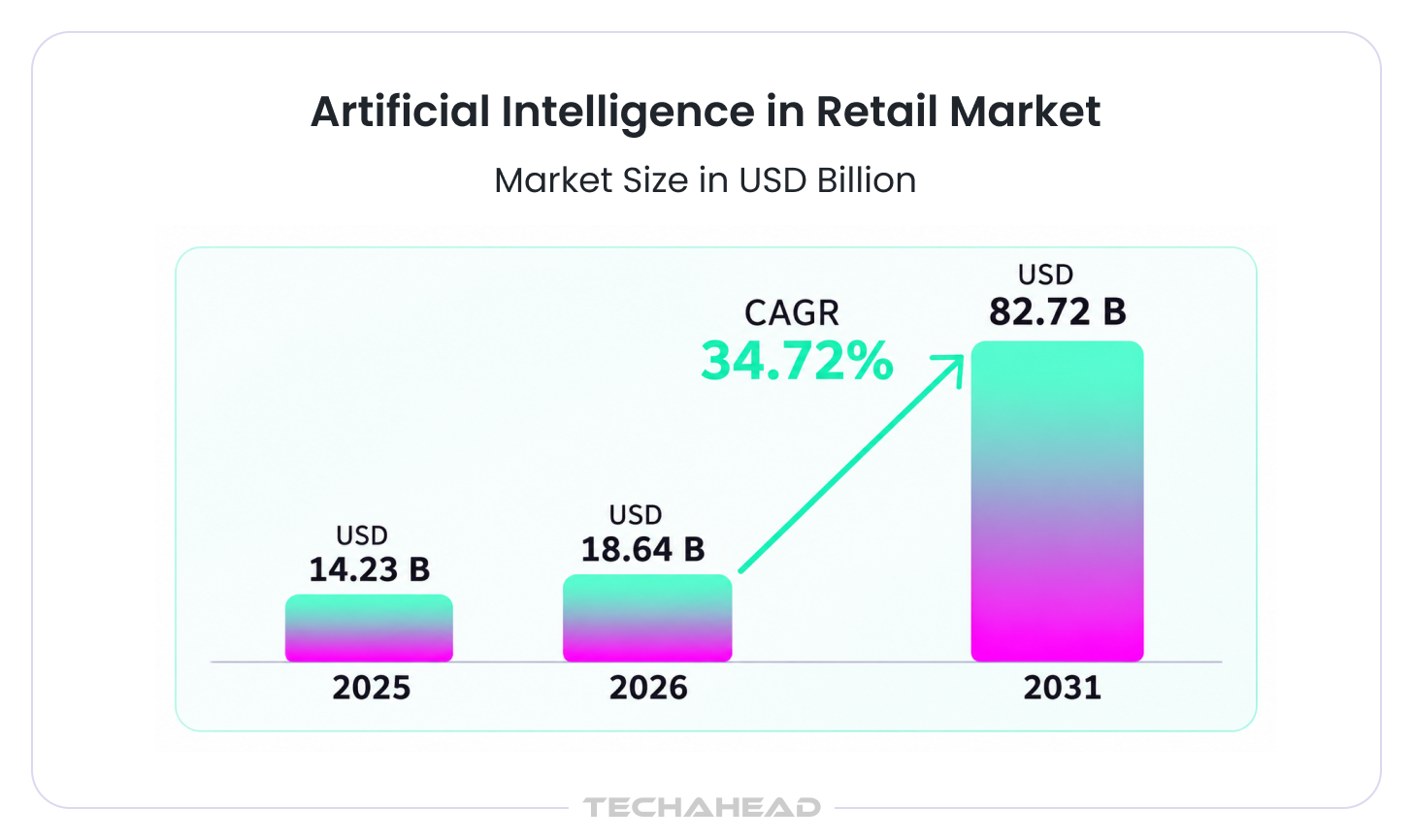
The AI in Retail market size is anticipated to reach $82.72 billion by 2031, up from $18.64 billion in 2026, showing a 34.7% CAGR over 2026-2031. Artificial Intelligence’s role in the retail industry has moved beyond POCs into production environments. Be it layering LLMs on top of existing data pipes for personalizing content or computer-vision checkout for reducing waste & saving waste, such attributes collectively drive AI in the retail market.
McKinsey estimates that agentic commerce could orchestrate up to $1 trillion of US B2C retail revenue by 2030 and $3 trillion to $5 trillion globally, and it describes AI agents as the new gatekeepers of commerce. Adobe Analytics shows how quickly that future is arriving: visits to US retail sites from AI sources grew 71% in September 2026 and converted 90% better than other traffic.
This POV blog through the fifteen prompts we expect to see most often this season and what each one asks of your product data, your systems and your brand.
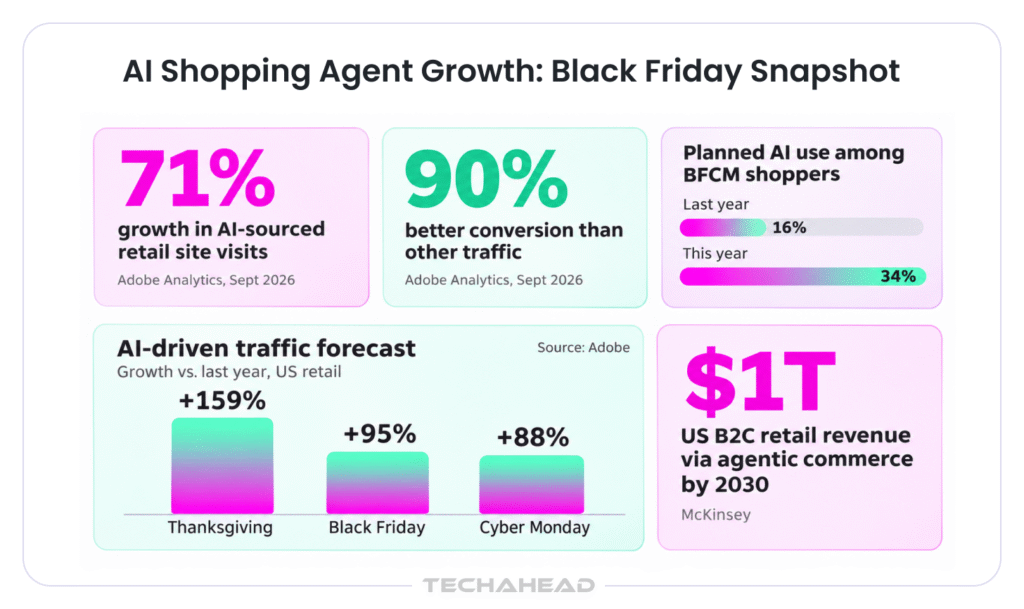
Last holiday season set the baseline. Salesforce estimates that AI and agents influenced 20% of retail sales, equal to $262 billion in global online revenue, and retailers running their own agents grew sales 59% faster than their peers. Adobe reports that generative AI traffic to US retail sites rose 693% over the same period, with AI referrals converting 31% better than other sources.
This season points higher. Adobe forecasts AI-driven traffic growth of 159% on Thanksgiving, 95% on Black Friday, and 88% on Cyber Monday. Shopper intent supports the forecast. YouGov finds that planned AI use among likely US Black Friday and Cyber Monday shoppers has more than doubled in a year, from 16% to 34%, and a Statista Consumer Insights survey found that about 70% of American respondents could imagine using AI tools when buying Christmas gifts.
The US market shows the scale. Salesforce data puts US online holiday sales at $294 billion in 2025, and McKinsey’s ConsumerWise survey found that 68% of US consumers used at least one AI tool in the past three months.
Two patterns shape the planning that follows. First, AI currently shapes discovery and comparison, with checkout adoption building gradually, and the same McKinsey survey places discovering and deciding on brands, products or services third among AI tasks, at 19% of AI users. Second, visitors who arrive from AI assistants bring strong intent, which makes visibility inside AI answers one of the most valuable positions in retail. Gartner describes agentic commerce as a move from human-centric business models to dynamic flows powered by agents, and its consumer research shows that readiness varies by generation, income level, and community type.
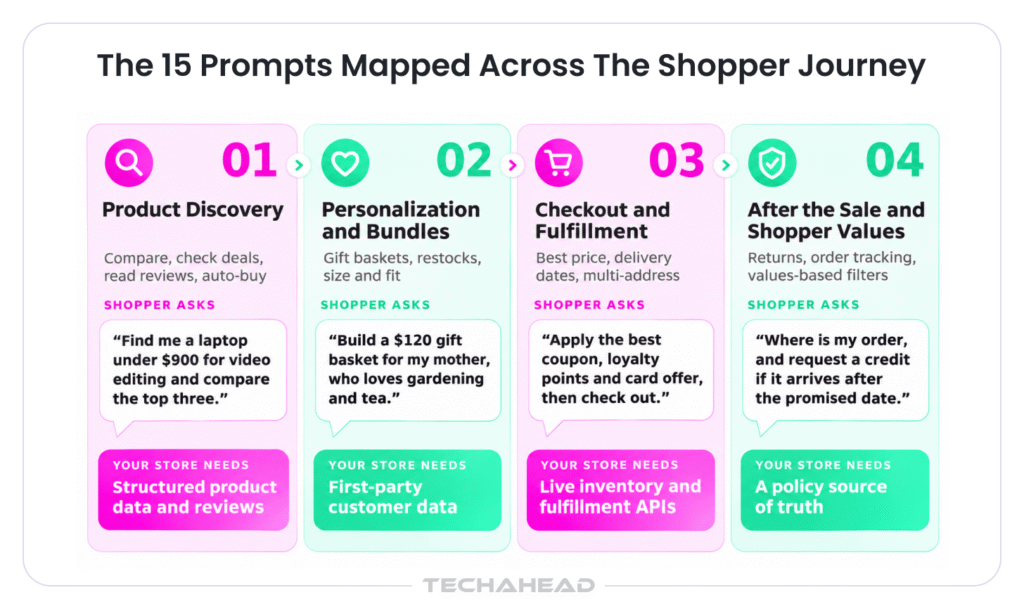
Each prompt below reflects a shopping intent that AI agents handle well today, paired with the business capability it rewards. The prompts are grouped by stage of the journey so your teams can assign ownership.
“Find me a laptop under $900 for video editing with 16GB RAM and compare the top three.”
This request turns a product category into a ranked shortlist, which makes it a core example of AI product discovery. The agent reads specifications, prices and reviews across stores, so structured attributes decide who appears. Processor, memory, display and warranty details should sit in clean fields that match your product feed. Brands that publish complete specifications become easy to compare, and agents reward that clarity with a place on the shortlist.
“What is a good gift for a 10-year-old who loves robots, under $50, delivered before December 5?”
Gift prompts blend interest, age, budget and deadline into one request. Agents answer best when catalogs carry use-case tags, age ranges and live delivery estimates. Retailers who tag products by occasion and recipient interest give the agent the vocabulary it needs. A delivery promise attached to each product page builds shopper confidence and gives the agent a strong reason to recommend you.
“Is this a good price for this noise-cancelling headphone? Show me what it cost over the last 90 days.”
Shoppers now verify deals in seconds. AI agents compare current prices against price history and against other retailers, so pricing integrity becomes a brand asset. Consistent was-and-now pricing, transparent promotion dates and stable list prices in the weeks before Black Friday help your offer read as genuine. Structured price data lets an agent confirm your discount with confidence.
“Find the lowest total price for this blender across stores, including shipping and return terms.”
Total cost is the new headline price. Agents add shipping, duties and return terms to the sticker price before ranking options. Machine-readable shipping tables and return policies help your offer rank on the full picture. For US retailers, clear shipping fees by region and transparent sales tax details strengthen the comparison.
Also Read: AI agent development cost
“Watch this camera and buy it for me when the price drops to $600 or lower.”
This is the clearest preview of agentic commerce in action. The shopper delegates authority within a price limit, and the agent acts once the condition is met. Businesses prepare with product APIs, secure payment authorization, spending caps and audit trails. McKinsey places trust and responsible AI at the center of agent-led transactions, so governance deserves attention early in the build.
“Summarize what verified buyers praise and what they flag about this vacuum cleaner.”
Agents condense thousands of reviews into a single paragraph, and that paragraph becomes your reputation at the moment of decision. Verified-buyer labels, timely replies to feedback and accurate product descriptions strengthen the summary. Treat review quality as a conversion lever, and use recurring review themes to refine product copy before the sale begins.
“Build a $120 gift basket for my mother, who loves gardening and tea.”
Bundle prompts reward catalogs that connect categories. The agent selects complementary items across your range, then checks the total against the budget. Relationship data between products, such as pairings, sets and accessories, gives agents a ready framework. Retailers with curated bundles and gift-ready packaging options gain a natural advantage in conversational commerce.
“Based on what I bought last year, what should I restock this Black Friday?”
Here the shopper shares history and expects personal relevance. An AI shopping assistant connected to loyalty and CRM data, with the customer’s consent, can propose replenishment lists and bundle offers. First-party data becomes a strategic asset, and consent management becomes a design priority. Retailers with unified customer profiles can deliver this experience inside their own branded assistant.
Also Read: How to Build an AI Voice Assistant App Like Alexa
“I am 5 feet 9 inches tall and usually wear a medium. Which of these jackets will fit best?”
Fit questions sit close to the point of purchase, and the answer shapes both conversion and returns. Agents rely on size charts, reviewer fit notes and garment measurements. Detailed measurements per product, consistent size labeling and a feedback loop from past orders give the agent reliable material. Accurate fit guidance supports higher confidence at checkout and healthier return rates.
“Apply the best combination of coupon, loyalty points and card offer, then check out.”
Shoppers want the best price assembled for them. Agents read promotion terms and test combinations, so clear and consistent rules matter. Define stacking logic in structured form, keep expiry dates visible and align loyalty and payment-partner offers in a single source of truth. Retailers who make the best price easy to calculate become the easiest recommendation.
“Confirm this arrives in Chicago before December 20, and show an in-stock alternative that ships faster if one exists.”
Real-time inventory and delivery data turn this request into a quick win. Agents query stock by location and compare promised delivery windows. Live inventory feeds, accurate cutoff dates and store-pickup options place your products on the shortlist. Accurate availability builds the trust that repeat AI recommendations depend on.
“Send one gift each to three addresses, gift-wrapped, with a message card.”
Gifting season multiplies addresses. A checkout that handles several recipients, wrapping options and personal messages in one flow works well for agents and for people alike. Clear APIs for address handling and gift options let an agent complete the task smoothly. Retailers who streamline this flow capture the high-value baskets that gift shoppers build.
We have built a Flutter-powered mobile commerce platform enabling self-checkout, real-time inventory tracking, AI chatbot assistance, and seamless online-offline shopping experiences for our client Leroy Merlin. Read our case study to know about how we developed this platform.
“Summarize the return policy for this order and remind me a week before the window closes.”
Agents quote policy language directly, so consistency across product pages, checkout and help content matters. Clear return windows, conditions and refund timelines written in plain language let the agent answer correctly and build shopper confidence. A shared policy source that feeds every channel keeps the answer uniform, whichever assistant the shopper uses.
“Where is my order, and request a delivery credit if it arrives after the promised date.”
Post-purchase service becomes a conversation between agents. Salesforce reports that agents handled a 142% surge in tasks such as returns and shipping updates during the 2025 holiday season. Order-status APIs, clear service commitments and a smooth route to a human specialist prepare your support operation for this volume. Strong after-sale service turns a seasonal buyer into a repeat customer.
“Show me brands with recyclable packaging that offer free two-day shipping to my ZIP code.”
Values-based filters reward detailed attributes. Packaging materials, sourcing claims, shipping coverage by ZIP code and delivery speed work as searchable fields for an agent. English and Spanish product data side by side widens your reach across the US market. Verified sustainability information, backed by certifications, makes your claims easy for agents to confirm.
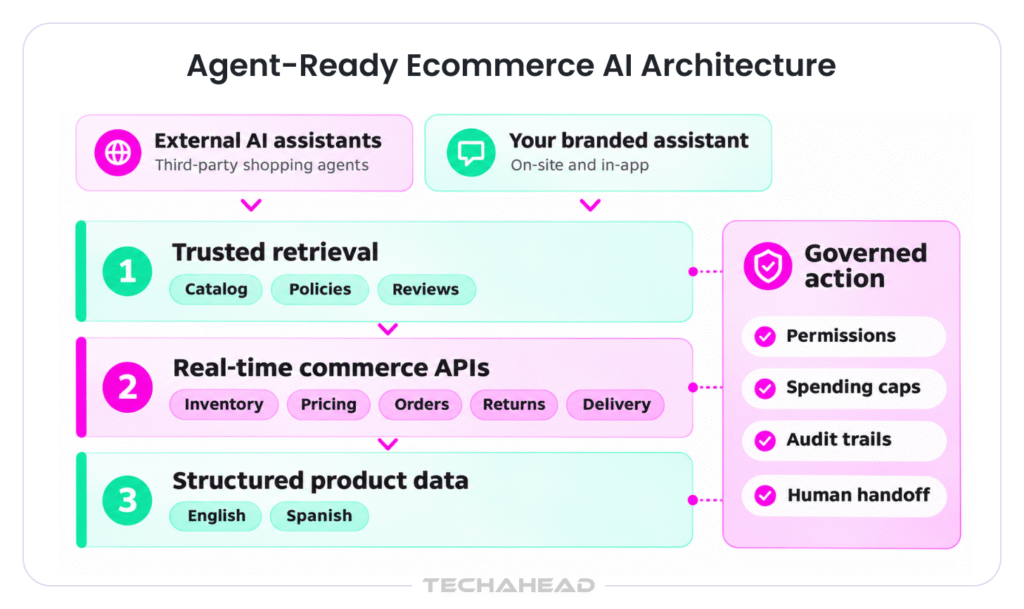
These prompts and capabilities form the foundation for AI agents for ecommerce, whether the agent belongs to a shopper, a marketplace, or your own brand.
Retailers generally choose among three paths: appear well inside the assistants shoppers already use, build a branded assistant on their own channels, or combine both. The combined path secures visibility in external assistants and ownership of the customer relationship at home.
Black Friday is around the corner, and it’s time for your current stack.
The 2027 roadmap builds on that foundation: a branded AI shopping assistant, agent-ready APIs, personalization on first-party data, support for emerging agentic checkout protocols and analytics that track AI-referred traffic. Adobe’s September data shows why that investment deserves priority, with AI traffic producing 83% higher revenue per visit than other sources.
TechAhead is an AI-native app and enterprise software development company, an OpenAI Services Partner and a Claude partner, with ISO/IEC 42001 certified AI governance, SOC 2 Type II and ISO 27001 certifications. More than 1,200 businesses rely on our US-headquartered team and our engineering talent across the globe. We deliver ecommerce AI development services that connect product data, commerce APIs and governance in a single architecture, so every answer an AI agent gives matches your live inventory, pricing and policies.
Our work includes custom AI agent development, conversational commerce experiences and the web and mobile applications that carry them. Explore our AI development services to see how we approach each stage, from strategy and design to deployment and ongoing optimization.
Proven in production: Heady, the conversational assistant inside Headlyne.ai
Headlyne.ai is an AI news app we built with Flutter, Node.js, and OpenAI language models. Its chatbot, Heady, lets readers ask questions about any story, request deeper context or background, and receive answers personalized by the app’s summarization and sentiment systems.
Heady runs alongside AI summaries, instant translation into 8+ Indian languages, audio briefs and an age-appropriate Junior Mode. The app earned Google’s Best App Award for 2024 in the Personal Growth category.
Read the full case study of the AI-driven new platform we developed.
News and retail share the same core pattern: a person asks a question in plain language, and an assistant answers from trusted content in real time. In retail, that becomes a shopper asking an assistant to compare products, confirm a delivery date, or explain a return policy, which covers the prompts in this guide.
What retailers gain from building with TechAhead
Shoppers are already telling AI assistants what they want, and the retailers whose products are ready for those requests collect the visits. All fifteen prompts in this guide rest on the same four foundations: structured product data, real-time commerce APIs, trusted retrieval and governed action. Retailers with those in place give AI agents accurate answers about price, availability, delivery and returns, and agents recommend the stores they can verify.
Talk to the TechAhead AI team to turn this readiness plan into a working AI shopping assistant for your business.
An AI shopping agent is an assistant that takes one detailed request, with budget, deadline and preferences, and then compares products, prices, reviews and delivery options across stores for the shopper. Agentic commerce is the shift to these agents handling the buying journey. McKinsey estimates it could orchestrate up to $1 trillion of US B2C retail revenue by 2030.
Adobe forecasts AI-driven traffic growth of 159% on Thanksgiving, 95% on Black Friday and 88% on Cyber Monday. YouGov finds planned AI use among likely US Black Friday and Cyber Monday shoppers has more than doubled in a year, from 16% to 34%.
Yes. Adobe reports AI-sourced visits to US retail sites grew 71% in September 2026 and converted 90% better than other traffic, with 83% higher revenue per visit. Salesforce estimates AI and agents influenced 20% of retail sales last holiday season, about $262 billion in global online revenue.
Shoppers will use 15 common prompts across four stages: product discovery (compare products, set a price target, summarize reviews), personalization and bundles (gift baskets, restocks, size and fit), checkout and fulfillment (stack coupons, confirm delivery dates, ship to several addresses), and after the sale (return policies, order tracking, values-based filters).
Make your products easy for AI to read and verify. Keep titles, attributes, images, and specifications complete and structured. Keep inventory and pricing accurate, and match shipping and return policies across product pages, checkout, and help content. Verified-buyer reviews help too, because agents summarize them at the moment of decision.
It needs four things: structured product data (in English and Spanish where your customers need both), real-time commerce APIs for inventory, pricing, orders, returns and delivery, trusted retrieval from a single source of truth, and governed action with permissions, spending limits, audit trails and human handoff.
Retailers have three paths: appear well inside the assistants shoppers already use, build a branded assistant on their own channels, or combine both. The combined path secures visibility in external assistants and keeps ownership of the customer relationship at home.
Five steps:
– Audit your top 100 products.
– Align shipping, delivery cutoff and return policies across channels.
– Validate inventory and price feeds, and publish promotion dates in structured data.
– Test the 15 prompts in the major AI assistants and record how your products and policies are described.
– Brief support teams on AI-referred shoppers.
Use governed action: permissions, spending caps, audit trails and a smooth route to a human specialist. For shoppers who let an agent buy at a set price, also add product APIs and secure payment authorization. McKinsey places trust and responsible AI at the center of agent-led commerce.
We use cookies to ensure our website functions properly, improve performance, and provide a personalized experience. You can choose which types of cookies to allow below.
Required for core functionality such as security, network management, and accessibility. These cannot be disabled.
Help us understand site traffic and user interactions so we can improve performance and usability.
Enable enhanced functionality and personalization such as language or region preferences.
Used to deliver relevant ads, track campaign performance, and measure advertising effectiveness.