


 Copy Link
 Share on X
 Share on Facebook
 Share on LinkedIn
Always Active
Required for core functionality such as security, network management, and accessibility. These cannot be disabled.

Uncover the transformative potential of digital and mobile solutions for your industry.





 Last Updated: Sep 18, 2026
Aug 12, 2026
Last Updated: Sep 18, 2026
Aug 12, 2026  271
271  20 min. Read


Key Takeaways
Somewhere inside most enterprise engineering organizations right now, a familiar scene is playing out. Developers are shipping code faster than they ever have, aided by AI coding assistants that draft functions, suggest fixes, and generate entire modules on demand. Pull requests pile up. Deployment frequency climbs.
On paper, the delivery metrics look healthy, but underneath, something quieter is breaking. The review, security, and release governance that used to keep pace with human-authored code cannot keep pace with machine-generated code, and the gap is widening by the sprint.
AI in devops is not just using AI to write more code inside a traditional pipeline. It means treating AI as a first-class participant in the software delivery lifecycle, with explicit controls for AI-generated output, validation before release, and governance that stays active from commit through deployment. This is the central tension of AI in devops in 2026. Google Cloud’s 2025 DORA report found that AI adoption among software professionals reached 90 percent, and while AI now correlates positively with delivery throughput, it continues to correlate negatively with delivery stability.
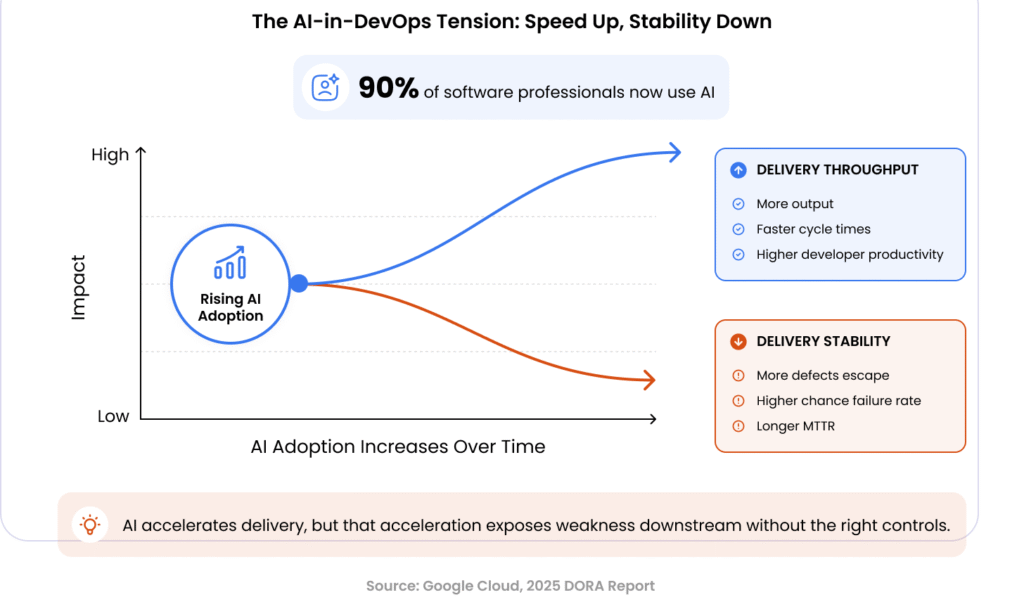
Acceleration is real. So is the instability that follows when change volume outruns the controls around it. For enterprise software teams, platform owners, and IT leaders, especially in regulated or integration-heavy environments such as healthcare, finance, and logistics, the issue is not whether to adopt AI-assisted delivery but how to do it without weakening security, compliance, or production reliability. The organizations pulling ahead are not the ones with the most AI tooling, but are the ones that redesigned the system of work AI operates inside.
That redesign has a name: an AI-native devops operating model. The rest of this piece breaks down that model, the tradeoff between velocity and governance, the five control layers that make it workable at scale, and how TechAhead helps enterprises implement them through consulting and delivery.
For most of the last decade, the phrase described a productivity story. AI in DevOps meant using machine learning to automate testing, predict incidents, optimize resource allocation, and shorten the path from commit to production. That story is still true, but it is no longer the whole picture, and treating it as the whole picture is precisely what leaves teams exposed.
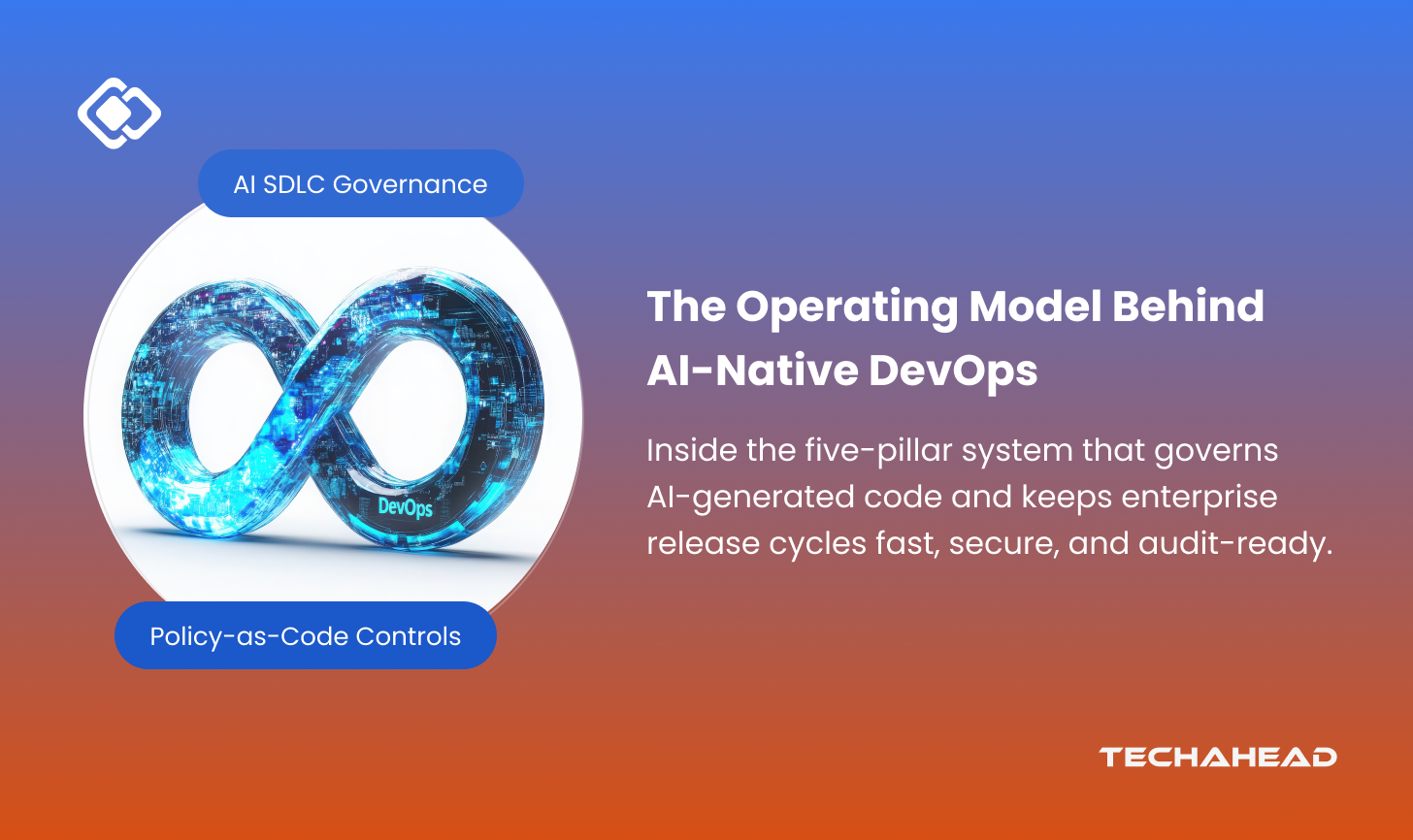
An AI-native DevOps operating model is a delivery framework in which AI is treated as a first-class participant in the software lifecycle, with explicit controls governing what it generates, how that output is validated, and how it reaches production. The distinction matters. The older model bolts AI onto a pipeline built for humans.
The AI-native model assumes machine-generated code is now a permanent input and engineers governance around that reality from the first commit. Continuous integration, continuous delivery, and AIOps still form the backbone. What changes is the layer of oversight wrapped around them.
Traditional DevOps pipelines were built on a quiet assumption that no longer holds: that an engineer understands every line of code they deploy, why it exists, what it connects to, and what risk it carries, even as artificial intelligence and AI tools spread across software development and DevOps practices. That assumption weakens the moment a meaningful share of the codebase is generated, modified, and merged with limited human scrutiny.
The share is no longer small. JFrog’s 2026 Software Supply Chain State of the Union reports that 35 percent of new enterprise code is already AI-generated or AI-assisted. That volume is arriving through pipelines whose review gates, automated testing, code quality checks, and security scanning were sized for a slower, human-paced flow of change, not to automate tasks across the development workflow and software delivery process. Speed alone would be manageable. Speed combined with unverified output is where the risk concentrates.
| Dimension | Traditional DevOps | AI-Native DevOps |
| Primary Code Origin | Human-authored | Human plus AI-generated |
| Review Assumption | Author understands every line | Output treated as untrusted until validated |
| Security Timing | Scanned late, often pre-release | Enforced at point of generation, shift-left |
| Governance Model | Periodic, point-in-time review | Continuous, encoded in the pipeline with human oversight for high-impact decisions in DevOps workflows and DevOps processes; generative AI can generate code from high-level requirements, which raises the need for stronger governance |
| Dominant Failure Mode | Human error, slow release | Unverified volume, silent vulnerability |
The comparison makes the shift concrete. This is not traditional DevOps running faster. It is a different operating posture, and the difference between the two columns is where most of today’s production risk lives, especially where oversight around CI/CD and AIOps must also support continuous improvement and alignment with business goals. Implementing AI often runs into integration complexity, and teams must keep up with rapid changes in AI technology.
TechAhead’s breakdown of how DevSecOps and DevOps differ offers useful grounding for teams still mapping security into their delivery flow.
The productivity gains from AI-assisted development are easy to measure and easy to celebrate. In the DevOps pipeline, development and operations teams traditionally relied on manual reviews, fixed approval gates, and stable release patterns to keep changes aligned with business goals. The downstream costs are harder to see until they surface in production, and by then they are expensive. The governance gap is not hypothetical. It is measured, and the measurements are sobering.
A 2026 industry survey reported by DevOps.com found that 75 percent of organizations have already encountered production issues linked to AI, yet only 43 percent mandate human review of AI-generated code, and just 18 percent have standardized or mastered AI agent governance.
As artificial intelligence pushes more volume through delivery workflows, it also puts more pressure on CI/CD pipelines when deploying code into production environments. The distance between adoption and control is the exposure.
AI also enables scalability by handling more change volume without increasing headcount, but only if controls mature at the same pace.
The Governance-Maturity Gap
| Signal | Share of organizations | What it indicates |
| Hit production issues linked to AI | 75% | The risk is already realized, not theoretical |
| Mandate human review of AI-generated code | 43% | Majority ship AI output without a required review gate |
| Standardized or mastered AI agent governance | 18% | Governance maturity badly trails adoption |
Read together, these numbers describe an industry that has adopted the capability far ahead of the controls. That is the definition of accumulated risk, and it compounds every time change volume increases.
Governance at this scale is not a documentation exercise. It is an engineering discipline, and it borrows directly from the cloud governance practices enterprises already know. TechAhead’s guide to cloud governance strategies shows how policy and automation combine to keep operations both compliant and fast.
If the problem is that governance fell behind velocity, the solution is not to slow velocity. It is to rebuild the operating model so that governance moves at the same speed as generation. An AI-native devops operating model does this through five connected pillars. None works well in isolation. Together they form a system where artificial intelligence can accelerate the software delivery process without eroding control, which is one of the key benefits of this approach.
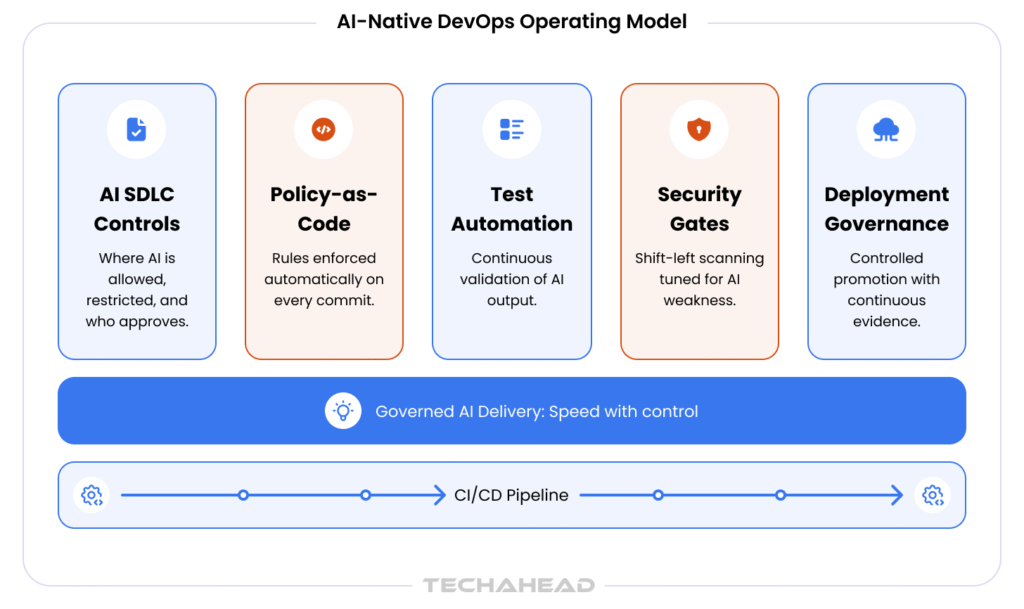
The model can be stated in one line: it is an operating framework that governs where AI generates code, how that code is validated, and how it is promoted to production, enforced continuously rather than reviewed after the fact. The five pillars below give that framework its structure.
The first pillar defines the boundaries so teams can move through the software delivery process faster without losing control across DevOps workflows. Teams need explicit rules for where AI-generated code is acceptable, where it is restricted, and who owns approval for high-risk changes across the software development lifecycle. Sensitive areas such as authentication, financial workflows, and infrastructure provisioning warrant stricter controls than low-risk automation because they affect code quality, software development outcomes, and broader business goals. Without these boundaries, development and operations teams end up applying the same risk profile everywhere instead of using human oversight where it matters most.
Clear ownership across the lifecycle turns AI from an ungoverned contributor into a bounded one, and the framework also governs how artificial intelligence and AI tools participate in DevOps processes while giving stakeholders valuable insights. This is foundational to how TechAhead approaches enterprise application development services, where AI acceleration is scoped against the sensitivity of each system it touches.
The second pillar makes governance enforceable across the software development lifecycle. Policy-as-code means expressing organizational rules, such as required approvals, dependency restrictions, and compliance checks, as machine-readable code that runs automatically inside the pipeline rather than living in a document reviewed in a meeting. When policy is code, it enforces itself on every commit, consistently, without waiting for a human gatekeeper. These boundaries protect code quality while keeping the software delivery process aligned to business goals.
This is the mechanism that lets devops governance and AI code governance operate at machine speed instead of becoming the bottleneck that AI was supposed to remove. It gives development and operations teams clear human oversight for high-risk changes, from access controls and deployment permissions to configuration management and infrastructure management, while AI helps automate tasks inside the development workflow.
In practice, the same controls can govern cloud infrastructure and support ai applications without slowing releases. TechAhead’s enterprise application development guide details how encoded governance keeps compliance from delaying launches.
The third pillar validates output continuously. Traditional CI/CD pipelines confirm that code executes correctly. AI-assisted pipelines have to go further, adding permission analysis, dependency tracing, configuration management, and governance across the broader development workflow to the definition of “tested.” Increasingly this work is handled by devops AI agents that generate regression tests, run them continuously, and flag divergence the moment it appears rather than in production.
AI can assist in generating Terraform configurations from natural-language requirements, but Natural Language Infrastructure as Code still needs policy enforcement before use.
The goal is not more tests for their own sake. It is validation coverage that matches the volume and unpredictability of machine-generated change, while encoded rules help automate tasks in infrastructure management and the software delivery process. TechAhead’s QA automation and testing capabilities are structured around exactly these automated quality gates.
The fourth pillar is where the operating model directly addresses the vulnerability data. To secure AI generated code, security scanning has to shift left to the point of generation, using SAST and SCA engines, which are static and software-composition analysis tools, tuned for the specific weaknesses AI tends to introduce.
Test automation should also validate output produced by generative AI, because tools such as GitHub Copilot in Visual Studio Code can speed software development and make stronger validation essential. Standard scanners were built for human logic and human pace; they often miss the subtle, repeatable flaws that appear in machine-generated code, and they cannot run at the speed AI produces output.
Catching a flaw the moment code is suggested helps detect anomalies early, and looping that finding back for regeneration is far cheaper than remediating it after release. It also improves anomaly detection in code, logs, and runtime behavior, supporting continuous monitoring with real time vulnerability alerts. Teams can use these signals to monitor systems in cloud environments, surface security issues sooner, and drive enhanced security while enhancing monitoring through feedback loops based on performance metrics. Code repositories also need automated checks for generated code quality, especially when vibe coding reduces routine tasks and context switching for developers.
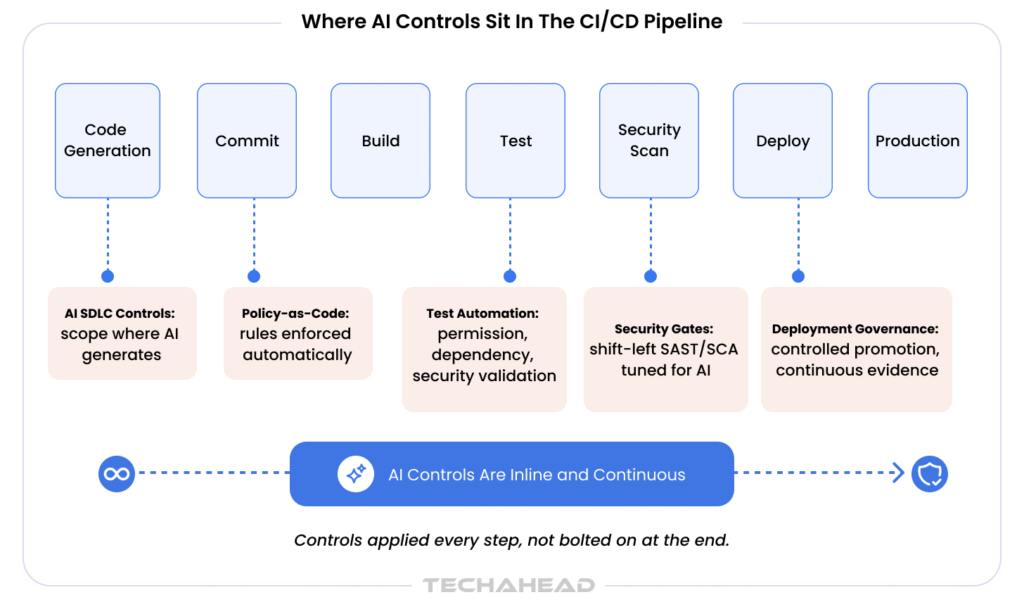
The flow diagram shows how these gates sit inline rather than at the end, spanning generation, testing, and promotion. For teams formalizing this layer, TechAhead’s DevSecOps services embed security controls directly into the delivery pipeline instead of appending them to it.
The fifth pillar governs the last mile. Deployment governance covers controlled promotion, reliable rollback, audit trails, and continuous evidence that controls operated as intended, rather than a point-in-time approval captured once and assumed to hold. As AI coding agents commit, build, and promote artifacts at a pace far beyond sprint-based development, inline scanners support continuous monitoring and can detect anomalies in log data before they become security issues while teams are deploying code across production environments.
AI can correlate logs and application metrics, generate alerts when specific conditions are met, and correlate alerts to reduce alert noise for system engineers across the software delivery process.
Stronger inline analysis also improves root cause analysis, can trigger self-healing workflows, and reduces mean time to resolution to strengthen security in cloud environments.
Governance embedded in the promotion path, producing evidence as it runs, is the only version that scales to that velocity. TechAhead’s blueprint for delivery controls from pilot to production walks through how these controls hold up under real deployment pressure.
The five pillars are not a menu to pick from. They are a system, and their value comes from the connections between them. AI SDLC controls define where the risk is; policy-as-code enforces the rules automatically; test automation and security gates validate the output; deployment governance proves it all held as code moves through the DevOps pipeline into production environments. Remove any one and the others lose leverage. Boundaries without enforcement are suggestions. Enforcement without validation is theater. Validation without deployment governance leaves no evidence that any of it worked, and that evidence has to persist across the full software delivery process, not just at a single approval point. That shared evidence also supports continuous improvement by tying performance metrics and user feedback back to the key benefits each control is meant to protect.
Pillar-to-Control Mapping
| Pillar | Concrete control | Risk it closes | Maturity signal |
| AI SDLC controls | Defined zones for AI use and approval ownership | Uniform risk across unequal systems | Sensitive paths carry stricter gates |
| Policy-as-code | Rules enforced automatically on every commit | Inconsistent, manual governance | Policy runs without a human gatekeeper |
| Test automation | Permission, dependency, and security validation | Untested machine-generated change | Coverage scales with change volume |
| Security gates | Shift-left SAST/SCA tuned for AI weaknesses | Vulnerabilities reaching production | Flaws caught at point of generation |
| Deployment governance | Controlled promotion with continuous evidence | Undocumented, unauditable releases | Evidence produced as the pipeline runs |
Mapped this way, the operating model reads as a set of interlocking controls rather than a checklist, which is exactly how it should function in practice. Teams selecting supporting tooling can reference TechAhead’s overview of DevOps platforms and tools to see how these controls map onto the wider ecosystem.
Standing up this operating model is a delivery capability, not a purchase. The pillars only work as a system when DevOps processes and practices are applied across the full software delivery lifecycle, which is a different competency from selecting a scanning product. It is where a delivery-focused partner earns its place. In practice, that means engineers who can:
The stakes justify the investment. In a 2025 Checkmarx survey of more than 2,300 security leaders and developers reported by CIO, 70 percent of developers said AI code generation had introduced vulnerabilities, and nearly all organizations surveyed had experienced at least one security breach traced to in-house developed applications. That reframes governance from a quality concern into a security imperative. Building the controls now is materially cheaper than absorbing the breach later.
TechAhead approaches this as a DevOps delivery and consulting partner rather than a point-tool vendor. That positioning is backed by credentials earned in exactly the domains this model spans:
That foundation extends across cloud infrastructure, configuration management, and data management in regulated environments, and supports the monitoring of systems and machine learning models running in production. Because TechAhead works across major cloud providers, this systems view helps teams evaluate AI tools by control coverage rather than features alone. The relevance is direct: an operating model built on governance, security gates, and deployment controls is best delivered by a partner independently assessed on those same capabilities.
“Enterprises do not need another tool that flags problems. They need the operating model that prevents them, delivered by people who have wired governance into real pipelines under real deadlines.”
— Mukul Mayank: COO
This work rarely stands alone. It connects to broader modernization, which is why TechAhead pairs it with cloud modernization so that the pipeline and the infrastructure it deploys to evolve together. When the operating model and the platform advance in step, governed AI delivery becomes the default rather than the exception, and that is the outcome TechAhead’s DevOps consulting services are built to produce.
The path forward is not a wholesale rebuild. It is a sequence. Most teams already run continuous integration and delivery; the AI-native model layers governance onto that foundation pillar by pillar, starting with the boundaries and building toward continuous evidence. The reason to move deliberately rather than rush is captured in the same DORA research: roughly 30 percent of developers report little to no trust in AI-generated code even as they rely on it daily. That gap between reliance and trust is not a reason to slow adoption. It is the argument for governing it well, so that speed and confidence rise together instead of trading off.
A practical first step is an honest assessment of where an organization sits against the five pillars, which boundaries exist, which policies are encoded, where security gates actually run, what evidence the deployment path produces, and what engineering capability exists across cloud infrastructure and infrastructure management in different cloud environments.
That assessment turns an abstract model into a specific roadmap. It is the same starting point TechAhead uses when helping development and operations teams move toward governed, AI-native delivery through its DevOps consulting services, and engagement models scale to fit an existing delivery structure rather than replacing it, with AWS services supporting monitoring, observability, compliance, and automation for DevOps teams.
An AI-native DevOps operating model is a delivery framework that treats AI-generated code as a permanent input and governs it accordingly. It defines where AI may generate code, enforces rules automatically through policy-as-code, validates output with automated testing and security gates, and controls promotion to production with continuous evidence. Unlike traditional DevOps, it assumes machine-generated code from the first commit rather than bolting AI onto a human-paced pipeline.
AI in DevOps automates and augments the software delivery lifecycle. It generates and reviews code, predicts and detects incidents through AIOps, automates testing and deployment, and optimizes resource allocation. As of 2025, roughly 90 percent of software professionals report using AI in their work. The newer and more consequential use is governance: applying AI and automated controls to validate and secure the very code that AI helps produce.
Governing AI-generated code requires controls embedded in the pipeline rather than reviews conducted around it. In practice this means defining where AI-generated code is permitted, encoding approval and compliance rules as policy-as-code, validating output with permission and dependency analysis alongside security scanning, and enforcing controlled promotion with audit trails. TechAhead’s DevOps consulting services build these controls into existing delivery pipelines.
AI SDLC controls are the rules and boundaries that define how AI participates across the software development lifecycle. They specify where AI-generated code is acceptable, where it is restricted, who approves high-risk changes, and how sensitive areas such as authentication and infrastructure receive stricter oversight than low-risk automation. They are the foundation on which the other governance layers depend.
Security gates for AI-generated code work best when they shift left to the point of generation. This means integrating SAST and SCA engines, tuned for the specific weaknesses AI tends to introduce, directly into the coding and CI/CD workflow so flaws are caught the moment code is suggested rather than after release. Findings can then be looped back for regeneration, reducing the volume of vulnerable code that reaches production.
Policy-as-code is the practice of expressing organizational rules, such as required approvals, dependency restrictions, and compliance checks, as machine-readable code that runs automatically inside the pipeline. Instead of relying on documented policies and manual gatekeeping, the rules enforce themselves on every commit. This lets governance operate at the same speed as AI-assisted code generation rather than becoming a bottleneck.
AI-generated code is not automatically production-ready. A 2025 Veracode analysis found that 45 percent of AI-generated samples failed security tests aligned to the OWASP Top 10. AI-generated code is not inherently less secure than human-written code, but the speed and volume it enables can push unverified vulnerabilities into production. It becomes enterprise-ready when validated through the security gates and governance controls of an AI-native operating model.
Traditional DevOps assumes engineers understand every line they deploy and reviews code through periodic, point-in-time gates. An AI-native model assumes a significant share of code is machine-generated, treats that output as untrusted until validated, enforces governance continuously through policy-as-code, and shifts security to the point of generation. The difference is a change in operating posture, not simply a faster version of the same pipeline.
Enterprises should look for a partner that delivers governance as an engineering capability, not just a tool recommendation. Relevant signals include demonstrated expertise in cloud governance, security, and compliance, independent validation such as AWS competencies and recognized security certifications, and the ability to encode policy, tune security gates, and wire governance into deployment without slowing delivery. Related guidance is available in TechAhead’s analysis of agentic AI in production.
Teams sustain speed and control together by making governance move at the same pace as generation. That means enforcing rules automatically through policy-as-code rather than manual review, validating output with automated testing and inline security gates, and producing deployment evidence continuously rather than assembling it retroactively. When governance is encoded into the pipeline instead of layered on top, faster release cycles and reliable control stop being a trade-off.
We use cookies to ensure our website functions properly, improve performance, and provide a personalized experience. You can choose which types of cookies to allow below.
Required for core functionality such as security, network management, and accessibility. These cannot be disabled.
Help us understand site traffic and user interactions so we can improve performance and usability.
Enable enhanced functionality and personalization such as language or region preferences.
Used to deliver relevant ads, track campaign performance, and measure advertising effectiveness.