


 Copy Link
 Share on X
 Share on Facebook
 Share on LinkedIn
Always Active
Required for core functionality such as security, network management, and accessibility. These cannot be disabled.

Uncover the transformative potential of digital and mobile solutions for your industry.





 Last Updated: Aug 5, 2026
May 15, 2026
Last Updated: Aug 5, 2026
May 15, 2026  569
569  10 min. Read


Key Takeaways
You don’t need anyone to convince you that AI matters. You’ve already experimented with plenty of tools, and you know what they can do.
Now, you’re ready to add AI to your own product, but which one?
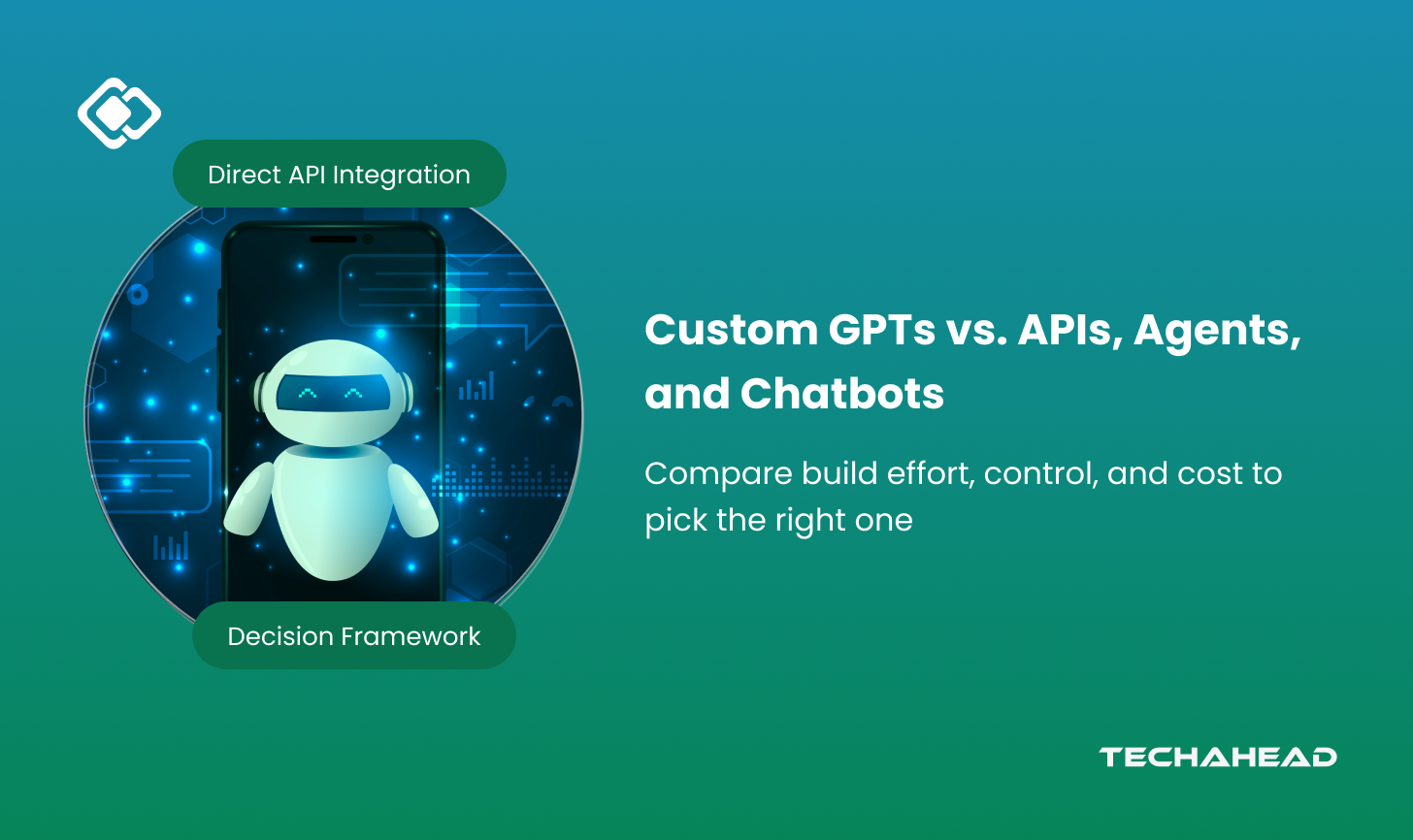
Your customers are probably already familiar with traditional chatbots, but custom GPTs offer more flexibility. Or direct API integration or AI agents would fit the bill perfectly. Each has different trade-offs, and some require a lot more commitment.
A recent Clutch survey of 558 AI users found that 74% are on ChatGPT. Custom GPTs work similarly, which is why they often come up early in build-vs.-buy conversations. But just because they’re easy to use doesn’t automatically mean they’re the right fit.
This guide breaks down the four options, so you can make an educated decision.
Custom GPTs may seem like the obvious choice, especially if you’re trying to reach as many people as possible, but that reach isn’t automatic. Around half (55%) of users trust Custom GPTs more when they’re built by brands they already know.
Ultimately, it all comes down to three factors: where your users are, the level of control you need, and your engineering capacity.
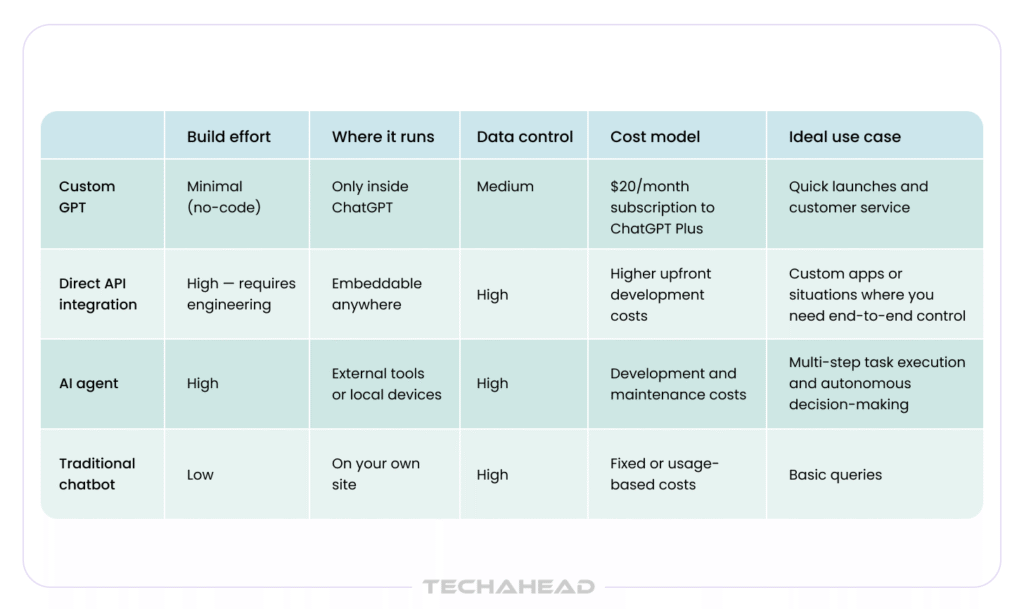
What are custom GPTs? They’re specialized versions of ChatGPT built for specific purposes or audiences. You create them directly inside OpenAI’s platform, so you don’t need any programming knowledge.
Companies often build custom GPTs to share niche knowledge or complete tasks. For example, Expedia’s custom GPT helps users plan their vacation itineraries using the latest hotel and flight options. Regular ChatGPT doesn’t have access to that sort of live data.
Custom GPTs are also useful for customer support. If your audience tends to ask the same basic questions, a Custom GPT can handle those instead of your team.
Custom GPTs aren’t the most high-tech AI tools, but that’s not the point. Brands choose this option because they’re built on top of ChatGPT. This gives you access to OpenAI’s vast audience, so you don’t need to start from scratch.
There’s a reason why you hear people mention ChatGPT more than any other AI tool: it’s the most popular. According to the Clutch survey, 74% of AI users rely on ChatGPT, while 56% use Gemini and 40% prefer Meta AI. Choosing custom GPTs gives you instant access to the largest share of users.
There’s a caveat, though. Slightly over half (55%) of users trust Custom GPTs from familiar brands. If you don’t already have brand equity, you’ll need to put in more legwork to build trust.
Custom GPTs are also still relatively unknown, with 27% not aware that they exist. For people who do find them, though, 45% consider them “very helpful.”
While custom GPTs can help you build an audience quickly, they have a few drawbacks.
For one, you’re tied to OpenAI’s platform, so you can’t embed your custom GPT in your own product’s UX. You also have to pay a monthly subscription, which could increase over time.
OpenAI also gives you limited access to the backend, and the custom GPT won’t retain anything between uses. That makes it difficult to track how people are actually using your tool.
You’ll also need to surrender control of your data to OpenAI. That’s a huge compliance issue for regulated industries. For instance, you shouldn’t create a custom GPT that asks people for their health information or draws on sensitive financial data.
You don’t need to send your data to another platform to add AI features. Direct API integration lets you embed AI into your own product.
This option lets you connect your product to Claude, GPT, Gemini, or an open-source model. If one tool doesn’t fit your needs, you can switch to another provider.
Once you link the platforms, you control data storage and how your product uses AI. You also design the entire user experience and decide who gets access.
You’re not building an AI model from scratch, but direct API integration still requires significant resources. Your engineering team has to handle design, evaluation, monitoring, and prompt management. You’re also responsible for maintaining everything, including setting up safety measures and rate limits. Partnering with an experienced AI development company can help product teams manage these technical responsibilities while maintaining control over their AI experience, data, and deployment architecture.
Unlike custom GPTs, API integration doesn’t have built-in distribution. Anyone who uses your API integration must get there through your product.
Direct API integration is a solid option if AI is a core part of your product, not just an extra perk. It’s also the best choice for SaaS products and regulated industries like healthcare and finance.
AI agents are autonomous software capable of handling more complex tasks.
A custom GPT mostly responds to user queries, so it’s useful for situations where you only need AI to give a good answer. For example, a retailer might use a custom GPT to answer simple questions about its shipping and return policies.
AI agents are more sophisticated. They plan, call tools, perform tasks, and loop through processes. If you need a tool that can complete a workflow across three systems, it’s time to bring in an agent.
Agents are useful for automating internal operations, such as lead qualification and email sorting. They also excel at resolving customer support tickets, not just routing them to a human.
Multi-system data tasks are another area where agents are useful. The next time you need to order supplies or summarize research from five sources, you can hand it off to an agent.
Agents are more complex to build than other AI tools. They also take longer to test and debug because there are many places where things can break.
Cost is another factor, especially for small teams. You’ll pay more per interaction, which can quickly add up.
Don’t write off traditional chatbots just yet. After all, not every problem needs a high-tech LLM.
Simple chatbots are often the best solution for high-volume queries that don’t require much context. For instance, you don’t need an expensive AI agent to help someone reset their password or check their order status. Chatbots are also a smart choice if you’re on a tight budget or can only give fixed answers for compliance reasons.
You don’t necessarily need to settle for one tool. Many production systems send easy queries to traditional chatbots, while more complex ones get routed to an LLM.
If you haven’t made up your mind yet, these questions will help you narrow your options.
If your audience already uses ChatGPT, custom GPTs are familiar and accessible. If your users engage with your own product, consider an API.
For the most control over the experience, go with an API or self-hosted AI tool. If you’re more flexible, a custom GPT works fine.
Custom GPTs and chatbots give simple responses, while agents take action.
If you have limited time or talent, a custom GPT or off-the-shelf chatbot is the easiest solution. APIs and agents require the most effort and maintenance.
Most mature products end up with multiple AI tools, so don’t feel like you need to stick with just one. For example, you might use a custom GPT for top-of-funnel discovery, and an API integration inside your product. You may even round out the toolkit with an agent for internal ops.
As you weigh your options, avoid these common mistakes:
Custom GPTs aren’t a competitor to APIs or agents. Each tool addresses different problems, so they can easily work together inside the same tech stack. Instead of focusing on whether you should build a custom GPT, consider where you can fit all four tools in your AI strategy.
Connect with an AI developer to scope the right build path.
Yes, via Actions, but you’re still routing everything through ChatGPT.
No, that’s the central trade-off.
Building a custom GPT requires a ChatGPT Plus subscription, which starts at $20/month. By contrast, the OpenAI API is usage-based, so it could be cheaper or much more expensive.
Limited. Real agentic workflows usually need direct API + orchestration.
Custom GPTs are OpenAI-only. Other providers have their own assistant/project features with different trade-offs.
Track engagement for GPTs, in-product activation for API integrations, and task completion for agents.
We use cookies to ensure our website functions properly, improve performance, and provide a personalized experience. You can choose which types of cookies to allow below.
Required for core functionality such as security, network management, and accessibility. These cannot be disabled.
Help us understand site traffic and user interactions so we can improve performance and usability.
Enable enhanced functionality and personalization such as language or region preferences.
Used to deliver relevant ads, track campaign performance, and measure advertising effectiveness.