


 Copy Link
 Share on X
 Share on Facebook
 Share on LinkedIn
Always Active
Required for core functionality such as security, network management, and accessibility. These cannot be disabled.

Uncover the transformative potential of digital and mobile solutions for your industry.





 Last Updated: Oct 6, 2026
Sep 1, 2026
Last Updated: Oct 6, 2026
Sep 1, 2026  214
214  18 min. Read


Key Takeaways
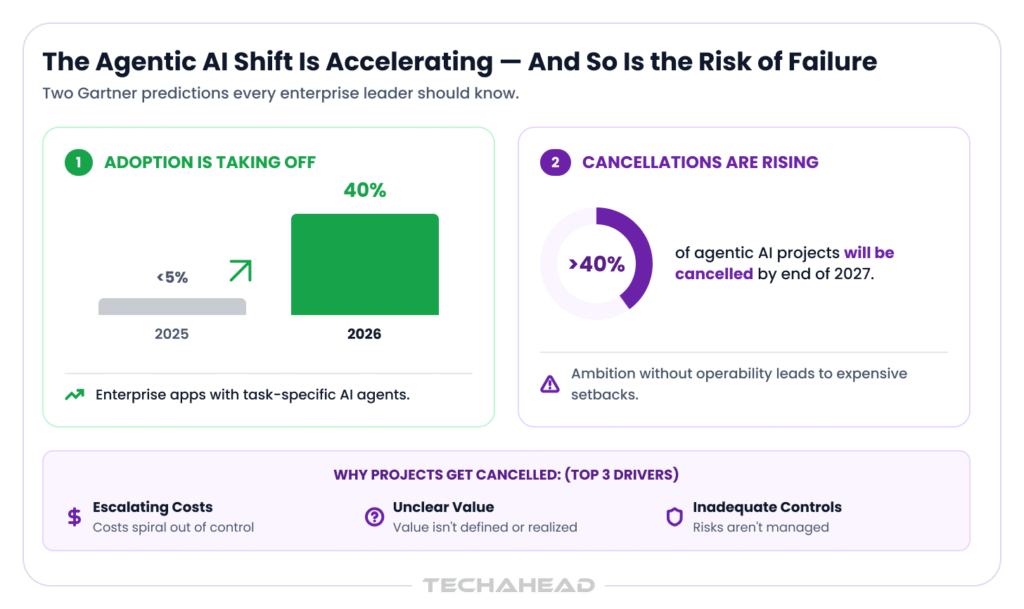
Enterprise interest in autonomous agents has moved from curiosity to budget line. Gartner projects that 40% of enterprise applications will include task-specific AI agents by the end of 2026, up from less than 5% in 2025. The same firm expects that more than 40% of agentic AI projects will be canceled by the end of 2027, citing escalating costs, unclear business value, and inadequate risk controls. Those failure modes are not model problems.
They are operational ones, and together they describe the distance between an agent that performs under controlled conditions and one that holds up in production.
That distance is what AgentOps addresses for technical leaders, enterprise architects, and organizations building AI agents for complex, regulated, or large-scale production environments. An agent that reasons well in isolation still has to run inside live systems, against live data, under real cost and reliability constraints. It has to be observable when it acts, bounded when it errs, measurable against a definition of correct, and affordable at scale. These are engineered properties. They are not acquired by placing a capable model behind an API, and they cannot be added once behavior is already in front of users.
The distance between capability and operability is where most current work stalls.
This article sets out an AgentOps framework for closing that distance: the Agent Operability Lifecycle, with five phases – Design for Operability, Instrumented Build, Pre-Production Validation, Controlled Deployment, and Operations at Scale, plus the practices needed to monitor, evaluate, govern, and improve AI agents in production.
The premise is that production-ready AI agents are shaped across the entire build, not certified at the end of it.
Must Read: Agentic AI Development Guide
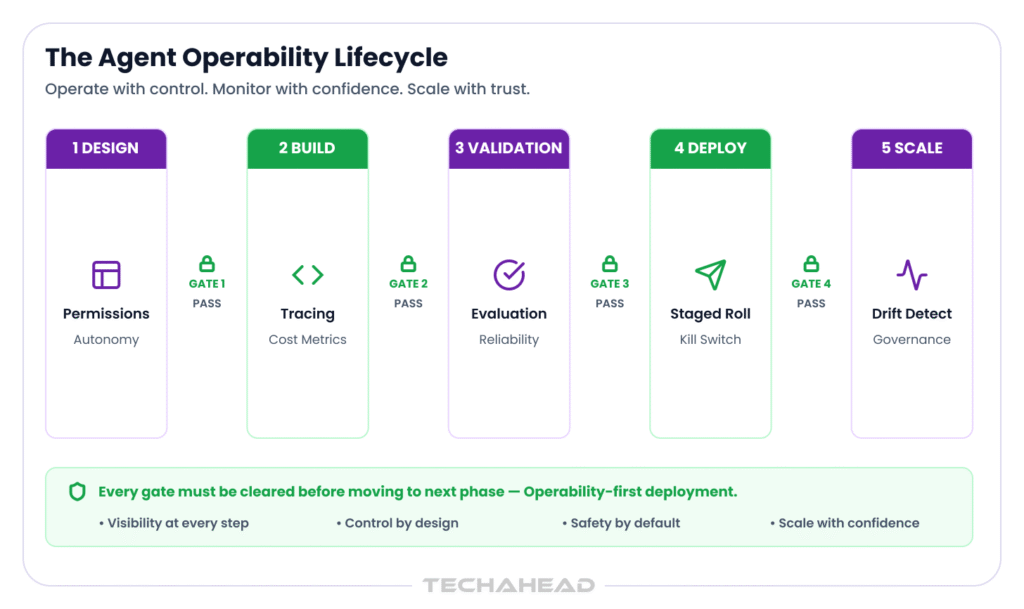
The lifecycle organizes agent development around a single question asked at five points: is this agent ready to advance? Each phase introduces the operational properties that become expensive or impossible to add later, and each closes on a gate, a set of checkable criteria that must be met before the next phase begins.
The gates are what separate this from a general build sequence. A phase model on its own describes order; gates enforce it. They convert operationalizing AI agents from an aspiration into a set of pass conditions, and they give a technical leader a defensible answer to the only question that matters at each stage, which is whether the agent has earned the right to take on more exposure. The five phases are:
Guardrails, observability, evaluation, reliability, cost control, and scale each enter at the phase where they are first required, not where they first cause an incident. Each property depends on decisions made in the phase before it, and inverting that order is what produces agents that work in a review and fail in the field.
Deepak Sinha, CTO at TechAhead, frames the discipline this way:
“Operability is a design-time decision. By the time an agent reaches production, the properties that let you run it safely have either been built into its architecture or they are absent, and retrofitting them costs more than building them in.”
Operational behavior is decided before code exists. The design phase fixes the boundaries within which the agent will act and the points at which it can be controlled, and those choices constrain everything downstream. Four decisions dominate:
Bonus Read: Understanding Context Rot: Why AI Agents Fail
This is also where AI agent guardrails are located in the control flow, with policy enforcement making them actionable at each control point rather than described in principle. Input validation, output constraints, and action checks are positioned at the points where the agent transitions from reasoning to acting. Designing those placements early is what makes later enforcement possible; guardrails introduced after behavior is live tend to sit around the agent instead of inside its decision path, where they can be reasoned around. For each external action, the design specifies what a failure means and what the agent does next, so a downstream error becomes a defined path rather than an open question at runtime.
Gate 1, exit criteria:
Instrumentation is part of the agent, emitted from the first commit rather than introduced when something goes wrong. Basic AgentOps instrumentation typically takes 2-3 lines of code. An agent built without it is unobservable precisely when observability matters most: in production, under load, on the request that failed. Adding telemetry afterwards means reconstructing intent from incomplete signals, which is slower and less reliable than capturing it as the agent runs.
Also Read: LLM Observability into Enterprise AI Systems
AI agent observability begins with end-to-end tracing, with agent monitoring as part of the same production observability layer. Every reasoning step, tool call, and LLM calls carries a correlation ID, so a single task can be reconstructed from entry to outcome as one connected trace that also reveals execution paths rather than a scatter of unlinked log lines. Because an agent’s control flow is dynamic, the trace has to capture the path actually taken, including which tools were considered and which were called.
Alongside tracing, the build emits structured, queryable logs of decisions, steps, and errors, recording the basis on which each action was selected, not only that it occurred. That distinction is what turns a later incident review from speculation into inspection, since the question in production is rarely what the agent did and almost always why it did it.
AgentOps also provides native integrations with agent frameworks such as CrewAI and LangChain, and leading platforms support over 400 LLMs and frameworks.
The same phase establishes the foundation for AI agent cost management. Token, cost, latency, and performance metrics are emitted per step and made attributable per task and per session through session wide metrics. Cost visible only as a monthly aggregate cannot be governed; cost attributed at the task level can be traced to the loop, the tool, or the prompt that drives it.
With signals in place, the nondeterministic core of the agent is wrapped in deterministic scaffolding:
The guardrails placed in Phase 1 are implemented here and verified as firing against test inputs, not assumed to work because they exist in the code.
Gate 2, exit criteria:
Validation proves behavior against defined criteria before the agent reaches live traffic. The central task, and the one most often skipped, is deciding what “correct” means for this agent and encoding it as measurable success metrics used in validation. Without that, later phases have no reference to test against and no basis for deciding whether a change improved or degraded behavior.
AI agent evaluation operates on two levels. Offline evaluation runs the agent against curated datasets with known-good outcomes, giving a repeatable measure that can run on every change. Scenario-based evaluation tests multi-step task completion across realistic sequences, where failure modes compound: a small error in an early step propagates through the ones that follow. Session replays can capture every decision point for later analysis of failures or regressions.
Scoring is done by rules where outcomes are deterministic and by judge models where they are not, always against thresholds set in advance, including the final output. Where judge models are used, their own reliability is checked, since an unvalidated judge simply moves the measurement problem one layer back. User feedback can supplement those technical signals when assessing quality. Defining the pass thresholds is part of the work, not a preface to it; an evaluation suite without an explicit pass line measures activity rather than readiness.
AI agent reliability is tested for failure detection by inducing the failures production will eventually deliver rather than waiting for it to deliver them, which reduces mean time to resolution:
The phase closes by capturing baseline metrics across accuracy, latency, cost, error rates, and other agent performance indicators, the reference against which later drift and regression will be measured once the agent is live.
Gate 3, exit criteria:
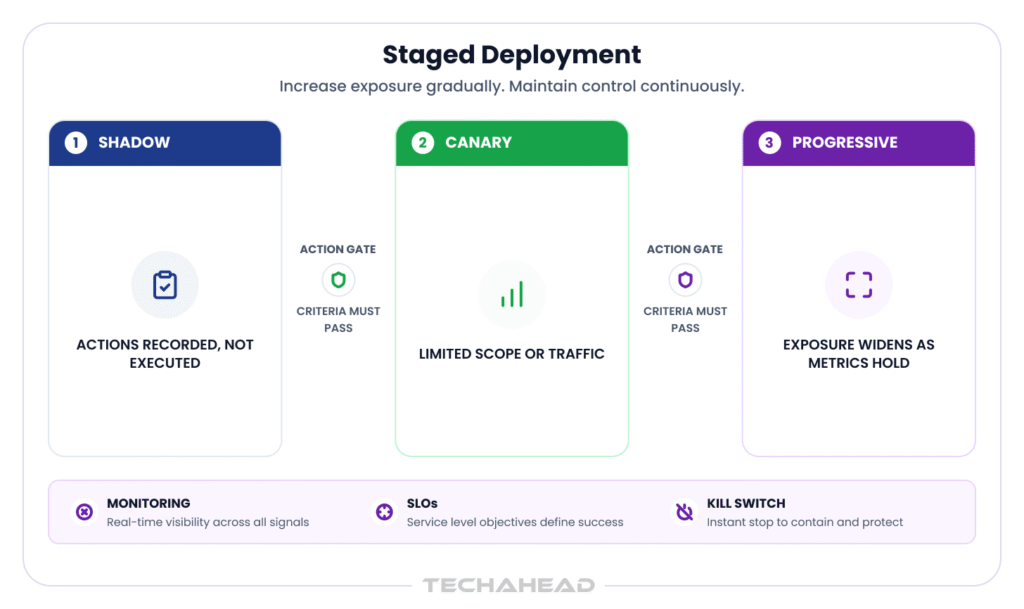
Deploying AI agents in production environments is a matter of bounding blast radius, not flipping a switch. The agent reaches live traffic through stages, each expanding exposure only after the previous one holds, so the cost of an undetected problem stays proportional to the exposure allowed at that point.
The rollout begins in shadow mode, where the agent runs against real inputs but its actions are recorded rather than executed. This surfaces the discrepancies that controlled testing misses, the ones that come from real input distributions, with zero live consequence. It then moves to a canary stage, limited to a narrow slice of scope or traffic and watched against the Phase 3 baselines, before progressive expansion widens exposure only as the canary metrics hold. AgentOps also supports deployment integrations with Kubernetes and Docker. Throughout, high-impact actions are gated: they require human confirmation initially, and the gate relaxes for a given action class only as confidence in it accumulates.
The tracing and metrics built in Phase 2 now drive real-time monitoring through a platform dashboard and alerts against defined service-level objectives, success rate, latency, and cost per task, so regression is caught by monitoring of system behavior and user interactions rather than by a user report.
The same deployment stage often includes integration with enterprise systems such as Salesforce and GitHub. A kill switch and rollback path complete the phase, and both are tested rather than merely present, because an untested recovery path is an assumption rather than a control, and the moment it is needed is the wrong moment to discover it does not work.
Gate 4, exit criteria:
The final phase is about managing AI agents at scale and keeping AI systems correct under real load as their environment shifts. This is where scaling AI agents stops being a throughput question and becomes an operability one, because the conditions that change an agent’s behavior at scale are rarely the ones tested in isolation.
Also Read: Scaling AI (Expanding Digital Natives to Transform Industries)
This phase often extends from a single agent to multi agent systems, where agents can collaborate and delegate tasks.
Continuous observability carries forward from deployment, now paired with anomaly detection on the live signal so departures in agent behavior and tool usage are flagged without waiting for an SLO breach. This operational model is especially relevant in regulated industries such as healthcare and finance. Drift and regression detection run on a defined cadence, catching degradation introduced by model or version changes and by shifts in the input distribution the agent sees, as well as by changes in external services used for data retrieval, all of which move behavior even when the agent’s own code is unchanged.
Behavior is also verified under production concurrency: concurrent runs, contention over shared state, complex workflows, and multi-agent coordination are load conditions that can alter how an agent behaves independently of the model, and they appear only once real volume arrives.
Cost governance matures into the ongoing discipline it has to be at volume. Cost per task is tracked against budget, per-agent unit economics are maintained so an expensive agent can be identified rather than absorbed into a total, and runaway consumption triggers alerts before it becomes a month-end surprise.
Must Read: Enterprise AI Compliance & Governance
The optimization levers are exercised deliberately, against the cost attribution built in Phase 2, rather than reached for once a bill has already landed. Enterprises can safely deploy multiple specialized agents across departments under the same operating discipline:
Sustained AI agent cost management is what keeps an operable agent an affordable one, and it is the property most likely to erode quietly if it is not watched.
Gate 5, sustained-operation criteria:
An agent is ready for AgentOps when it has cleared all five gates, unlike traditional software, where readiness is often judged by stable behavior in a controlled setting or a convincing result. The lifecycle makes readiness explicit and sequential: operability designed in Phase 1, instrumented in Phase 2, proven in Phase 3, contained in Phase 4, and sustained in Phase 5. Each gate is a point where an agent that is not yet ready is held back cheaply, before the cost of its shortfall is paid in front of users.
The three drivers behind the projected wave of canceled agentic projects each map to a phase in this model, extending ideas familiar from machine learning operations and software engineering for agentic systems:
Also Read: Agentic AI Development Cost in 2026
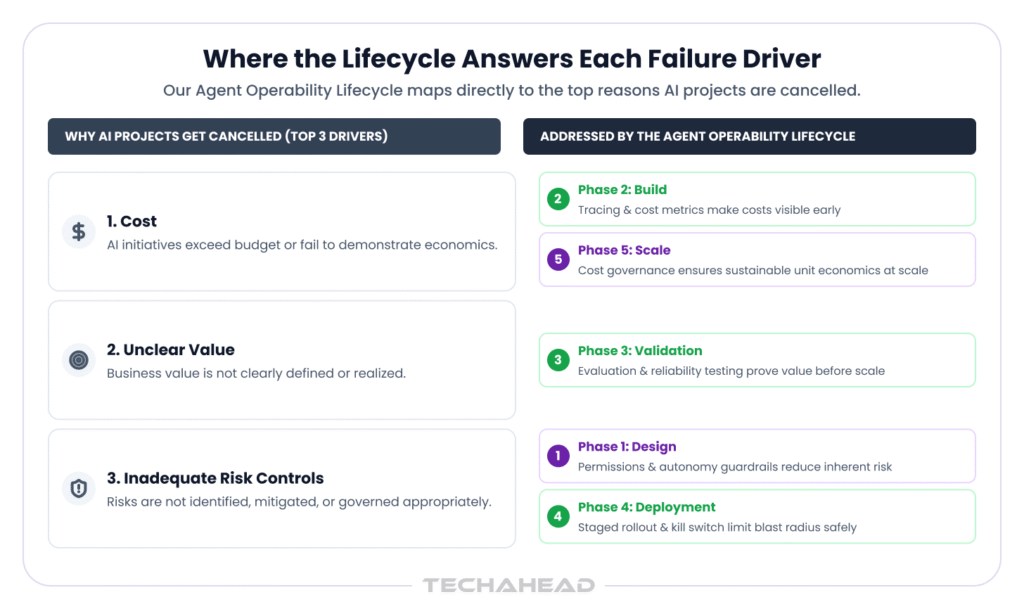
Treated as an operating model rather than a launch checklist, the Agent Operability Lifecycle is how an organization builds agents that are ready to run and keeps them ready as the systems and models beneath them change.
That is the discipline TechAhead, a reputed AgentOps service provider, brings to agent engineering. As a software and agentic AI development company, TechAhead builds enterprise agents with operability designed in from the first phase rather than added under pressure later, which is the difference between an agent that performs in a review and one that survives production.
The same engineering rigor the lifecycle demands, controlled access, instrumentation, evaluation, and cost governance, is reflected in how the practice is run: TechAhead holds ISO 42001:2023 for AI management systems, SOC 2 Type II, and ISO 27001, and works as Claude & OpenAI Services Partner and an AWS Advanced Tier partner.
For technical leaders weighing the move from capable agents to production-ready AI agents, that combination, a build discipline organized around operability and the certifications that hold it to a standard, is what turns an AgentOps framework from a document into a system that runs.
AgentOps is the operating model for running AI agents in production. It defines what an agent is allowed to do, how its quality and cost are measured, and how it is monitored, evaluated, and controlled across the agent’s lifecycle once live.
Most fail on operations, not the model. Gartner expects over 40% of agentic AI projects to be canceled by 2027, citing escalating cost, unclear value, and inadequate risk controls.
A production-ready AI agent has operability engineered in: scoped permissions, guardrails, tracing, evaluation, and bounded cost. TechAhead builds these properties in from the design phase, so agents behave predictably under real load rather than only in testing.
Through staged rollout: shadow runs first, then a limited canary, then progressive expansion, with monitoring, guardrails, a human in the loop approval path, and a tested kill switch at each step, so exposure grows only as reliability holds.
AI agent observability relies on end-to-end tracing with correlation IDs, structured decision logs, and per-task cost and latency metrics, with the agentops dashboard serving as the place teams review traces and analytics, so any run can be reconstructed and any failure traced to the exact step that caused it. Monitoring can also include agent actions, such as file access, command execution, or prompt submissions, when applicable to the deployment.
AI agent cost management starts by attributing token, cost, and latency to each task, then applying levers like model routing, caching, and context trimming. Cost seen only as a monthly total cannot be governed.
AI agent evaluation combines offline testing on curated datasets with scenario-based scoring against set thresholds, plus reliability and adversarial testing. Defining what “correct” means is the step teams most often skip.
AgentOps extends DevOps and MLOps beyond traditional software to autonomous systems that behave non-deterministically, use tools, and make context-dependent decisions. It adds guardrails, agent evaluation, per-task cost control, and model deployment concerns that conventional monitoring was never designed to handle.
Ask how they define production readiness, scope permissions for autonomous actions, and handle legacy integration. A capable partner like TechAhead builds operability in from design rather than adding it after problems surface in production.
Scaling AI agents means sustaining reliability and cost as load grows: drift detection, concurrency testing, and cost governance. TechAhead applies a gated AgentOps framework from design to deployment to keep agents dependable at scale.
We use cookies to ensure our website functions properly, improve performance, and provide a personalized experience. You can choose which types of cookies to allow below.
Required for core functionality such as security, network management, and accessibility. These cannot be disabled.
Help us understand site traffic and user interactions so we can improve performance and usability.
Enable enhanced functionality and personalization such as language or region preferences.
Used to deliver relevant ads, track campaign performance, and measure advertising effectiveness.