


 Copy Link
 Share on X
 Share on Facebook
 Share on LinkedIn
Always Active
Required for core functionality such as security, network management, and accessibility. These cannot be disabled.

Uncover the transformative potential of digital and mobile solutions for your industry.





 Last Updated: Sep 23, 2026
Sep 23, 2026
Last Updated: Sep 23, 2026
Sep 23, 2026  115
115  18 min. Read


Key Takeaways
A vibe-coded application can prove demand, win early users, and give investors something tangible to evaluate. None of that proves the application is ready for enterprise customers. In practice, the cost to make a vibe-coded app production ready usually falls around $60,000–$95,000 for focused enterprise hardening, $125,000–$190,000 for broader remediation or partial rebuilds, and $250,000–$450,000 for major enterprise rebuilds, with complex programs exceeding $500,000.
For founders, product owners, and technology leaders preparing a vibe-coded application for enterprise buyers, moving a prototype to production introduces a different class of work. Vibe-coded app enterprise readiness introduces a different standard: buyers may ask how access is controlled, where data travels, who approves releases, whether the architecture can scale, how code quality is assessed, and whether your team can produce security-review and compliance evidence. If the application cannot answer, its visible features are only part of the product.
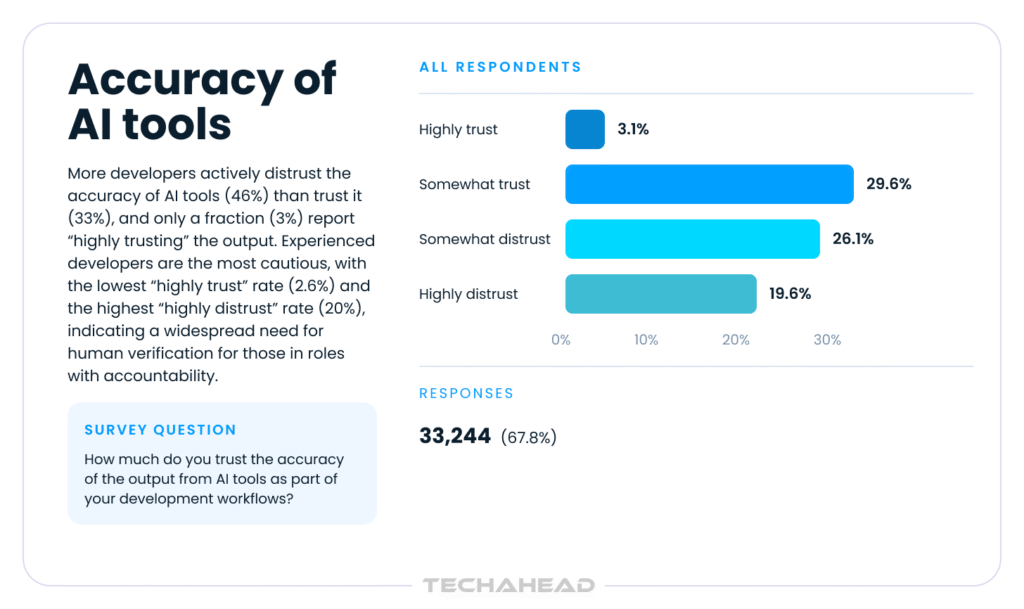
That is why the cost cannot be calculated from screen count or lines of code alone. The meaningful cost is the work required to close the gap between what the application demonstrates and what an enterprise buyer needs it to prove, especially when AI-generated or low-code prototypes must meet enterprise expectations for security, reliability, and operational readiness. Google’s 2025 DORA research found that 90% of surveyed software professionals used AI. Yet the 2025 Stack Overflow Developer Survey found that 46% distrusted AI-tool accuracy, compared with 33% who trusted it. Speed still requires verification.
Vibe coding may describe a prompt-built application, AI-generated code later modified by developers, or a low-code product containing generated workflows. Each creates a different ownership profile; none is automatically secure or insecure. This article breaks down production-readiness cost drivers, enterprise security and compliance requirements, architecture and code-quality issues, assessment methods, technical debt prevention, and the decision between remediation and a partial or full rebuild.
Related: What is Vibe Coding (An Enterprise Guide)
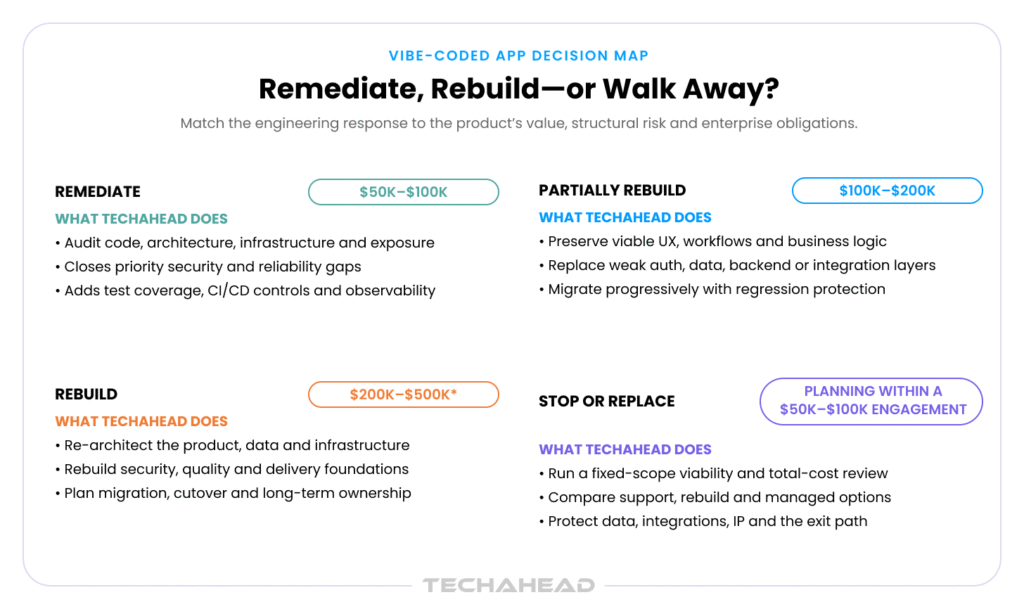
A focused enterprise-hardening engagement may fall around $60,000–$95,000. A broader remediation program or partial architectural rebuild may require approximately $125,000–$190,000. A substantial rebuild involving core workflows, data architecture, security controls and enterprise operations may reach $250,000–$450,000.
Complex platforms can exceed $500,000 when scope includes multiple applications, regulated data, legacy integrations, high availability, multi-tenant isolation or cloud migration.
| Engagement path | Indicative planning range | What the scope may include | When it is more likely to fit |
| Focused enterprise hardening | $60,000–$95,000 | Code and architecture assessment, critical security fixes, authentication hardening, targeted tests, deployment controls and remediation roadmap | The core architecture is usable and the highest risks are contained |
| Broader remediation or partial rebuild | $125,000–$190,000 | Rebuilding selected services, data or identity controls, integration hardening, test automation, observability and compliance evidence | The product has value, but critical subsystems cannot be patched safely |
| Major enterprise rebuild | $250,000–$450,000 | Reworking core architecture, data boundaries, security model, infrastructure, delivery pipelines and operational controls | Risk is distributed across the codebase or enterprise requirements have materially changed |
| Complex enterprise program | Above $500,000 | Multi-product modernization, regulated workloads, complex migrations, high availability or extensive enterprise integrations | The work extends beyond one application and requires a custom program |
Price follows how much of the product can be trusted, retained and operated with evidence, not how much code AI wrote.
Also Read: Enterprise AI Development Cost 2026
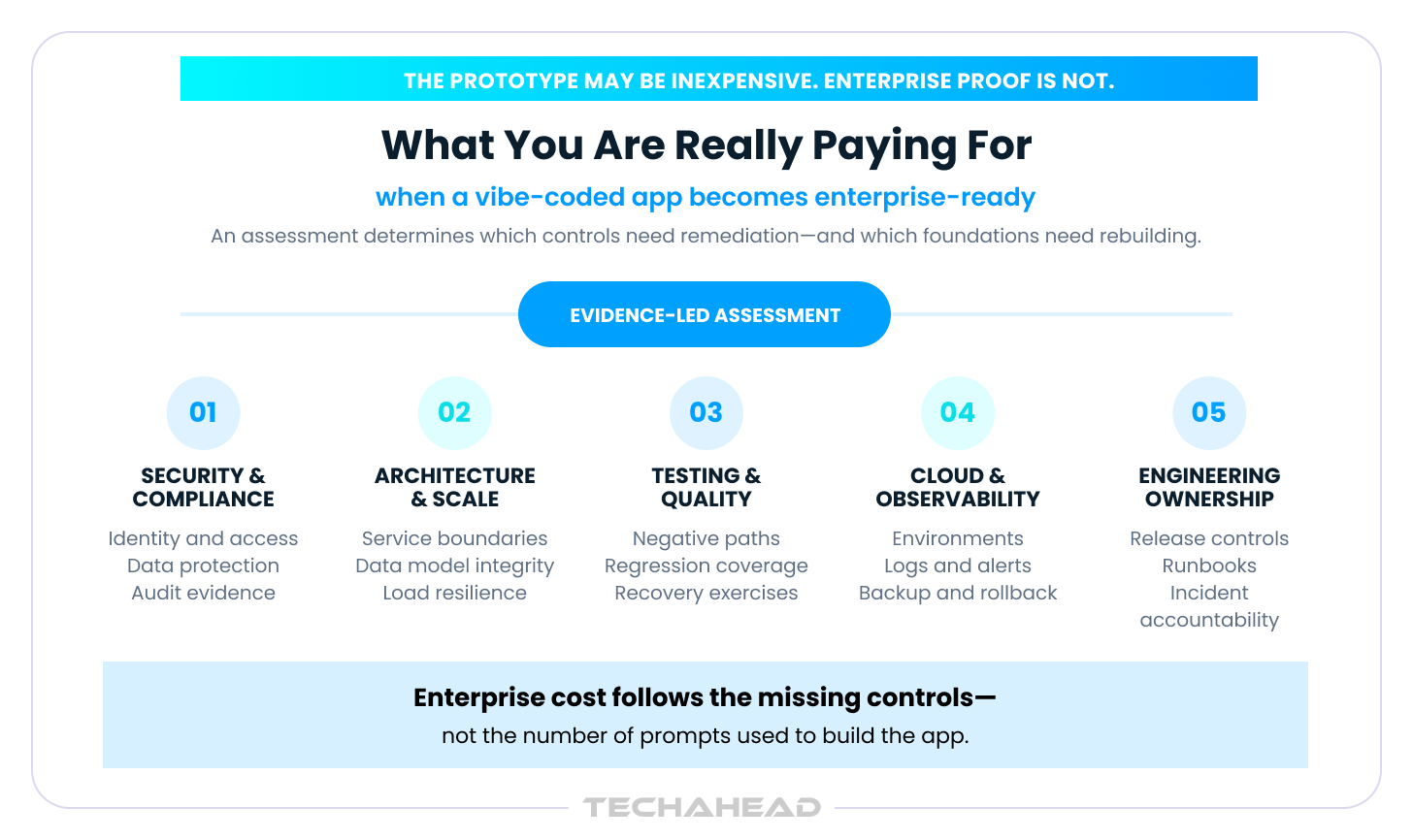
A vibe-coded application may work reliably for early users and still fail an enterprise evaluation. Larger customers assess more than features and interface quality. Their security, legal, procurement and IT teams want evidence that the application can protect sensitive data, withstand operational disruption and remain supportable after deployment.
The requirements vary by customer and industry, but enterprise reviews commonly examine:
Enterprise customers may also request security questionnaires, penetration-testing results, architecture diagrams, privacy documentation or evidence aligned with standards such as SOC 2 and ISO 27001. The evidence required depends on the application’s data exposure, integrations and intended operating environment.
Recommended: A Practical Test Strategy for Vibe-Coded Applications
Founders should therefore define the buyer’s acceptance criteria before selecting a remediation scope. The objective is not to add every possible enterprise control. It is to build and document the controls that prospective customers will expect based on the product’s actual risk profile.
Similar-looking applications can require very different investments. One may have clear service boundaries and a few fixable gaps. Another may contain exposed secrets, inconsistent authorization and no reliable way to test changes.
Before assigning a cost range, evaluate four contexts.
Start with what the application must support next. A founder preparing for one enterprise pilot has a different risk profile from a platform processing transactions across multiple customers, especially when the app handles payments, since revenue-impacting workflows increase contractual and operational exposure.
Also Read: Enterprise AI Scaling (What to Avoid)
Important questions include:
The most important vibe coding security risks are rarely visible in a demonstration. AI-generated code can be syntactically correct and still be unsafe. Veracode’s 2025 GenAI Code Security Report tested more than 100 models and found that 45% of samples introduced OWASP Top 10 vulnerabilities. In relevant samples, 86% failed cross-site scripting defenses, so stabilization work is meant to address those OWASP Top 10 risks before they become enterprise blockers. These AI-generated code vulnerabilities require human verification.
A vibe-coded app security assessment should therefore examine authentication, authorization, input validation, secrets management including API keys, session handling, encryption, dependency exposure, tenant isolation and administrative paths. AI-generated code often embeds credentials directly in source files, and hardcoded API keys are the most common security failure in vibe-coded apps.
Architecture determines whether technical debt remediation can proceed safely. Warning signs include duplicated business rules, client-side database access, circular dependencies, weak APIs, uncontrolled jobs, irreconcilable state changes, unindexed database schemas, and missing indexes that only fail under concurrent usage. Prototypes often survive demos but break on production data and concurrency when data-access patterns were never designed for scale.
Generated-code provenance also matters. vibe coded applications often accumulate technical debt three times faster than traditional software, so small shortcuts can force rebuilds. Teams should identify major dependencies, licenses, generated components and critical design decisions. The NIST Secure Software Development Framework includes protecting software, producing well-secured releases, responding to vulnerabilities and collecting provenance information. Enterprise readiness turns those practices into operational evidence, especially when testing with real data shows safe remediation is impractical and professional rebuilds can cost $5,000 to $30,000.
Must Read: NIST AI RMF
A corrected codebase can degrade again without accountable ownership. Ownership therefore changes the recommendation. A capable internal team may need an external assessment, a prioritized backlog, and senior engineers to support high-risk components and transfer reliable ownership practices. A founder without an engineering organization may need TechAhead to assume broader responsibility for remediation, product engineering and production operations, as teams that build software for production operations rather than just prototype delivery.
Preserving the most code is not always cheapest. When comparing the cost to fix a vibe-coded app with the cost to rebuild a vibe-coded app, include repeat failures, delayed enterprise sales and continued operating effort, not only the first engineering estimate. The hidden cost of technical debt can also push rebuild work into the $5,000 to $30,000 range even before broader enterprise hardening is priced.
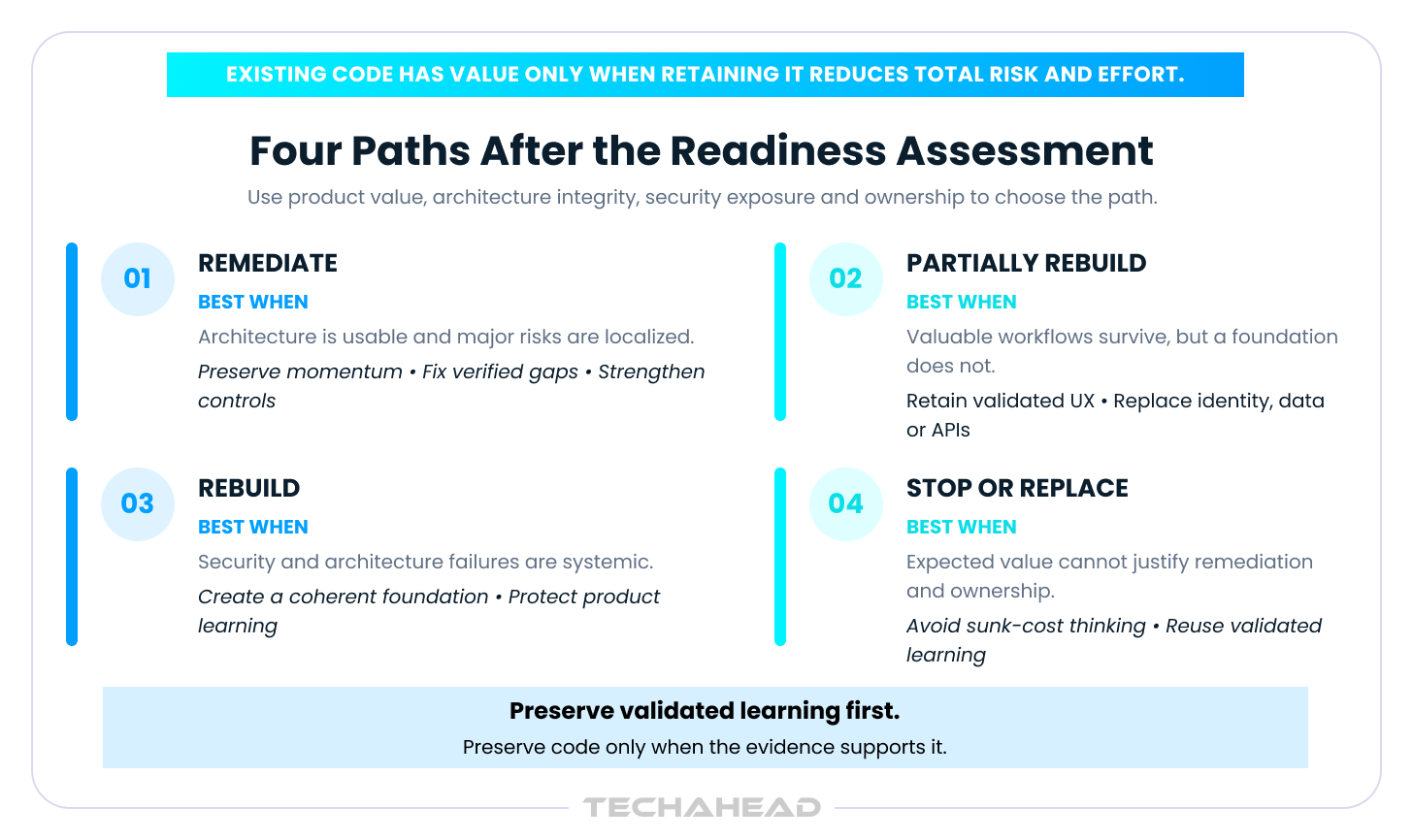
| Decision path | Choose it when | Main advantage | Main tradeoff |
| Remediate the existing application | Architecture is understandable, core data flows are sound and risks are localized | Preserves product momentum and validated user experience | Hidden coupling can expand scope after work begins |
| Partially rebuild critical components | Valuable workflows can remain, but identity, payments, data or integrations need replacement | Directs investment toward the highest-risk systems | Old and new components must coexist during transition |
| Rebuild the application | Security, data and architecture failures are systemic or requirements have fundamentally changed | Creates a coherent enterprise foundation | Requires careful migration and protection of validated product knowledge |
| Stop or replace | The business case is weak, differentiation is limited or remediation exceeds expected value | Prevents sunk-cost thinking from driving further investment | The team must accept that validated learning—not the code—is the reusable asset |
Consider a hypothetical B2B workflow platform with paying pilots but front-end authorization, weak customer-data boundaries and uncontrolled releases. A partial rebuild could retain validated journeys while replacing identity, tenant isolation, APIs, deployment controls and observability – a mid-range engagement rather than superficial cleanup or a complete rewrite. |
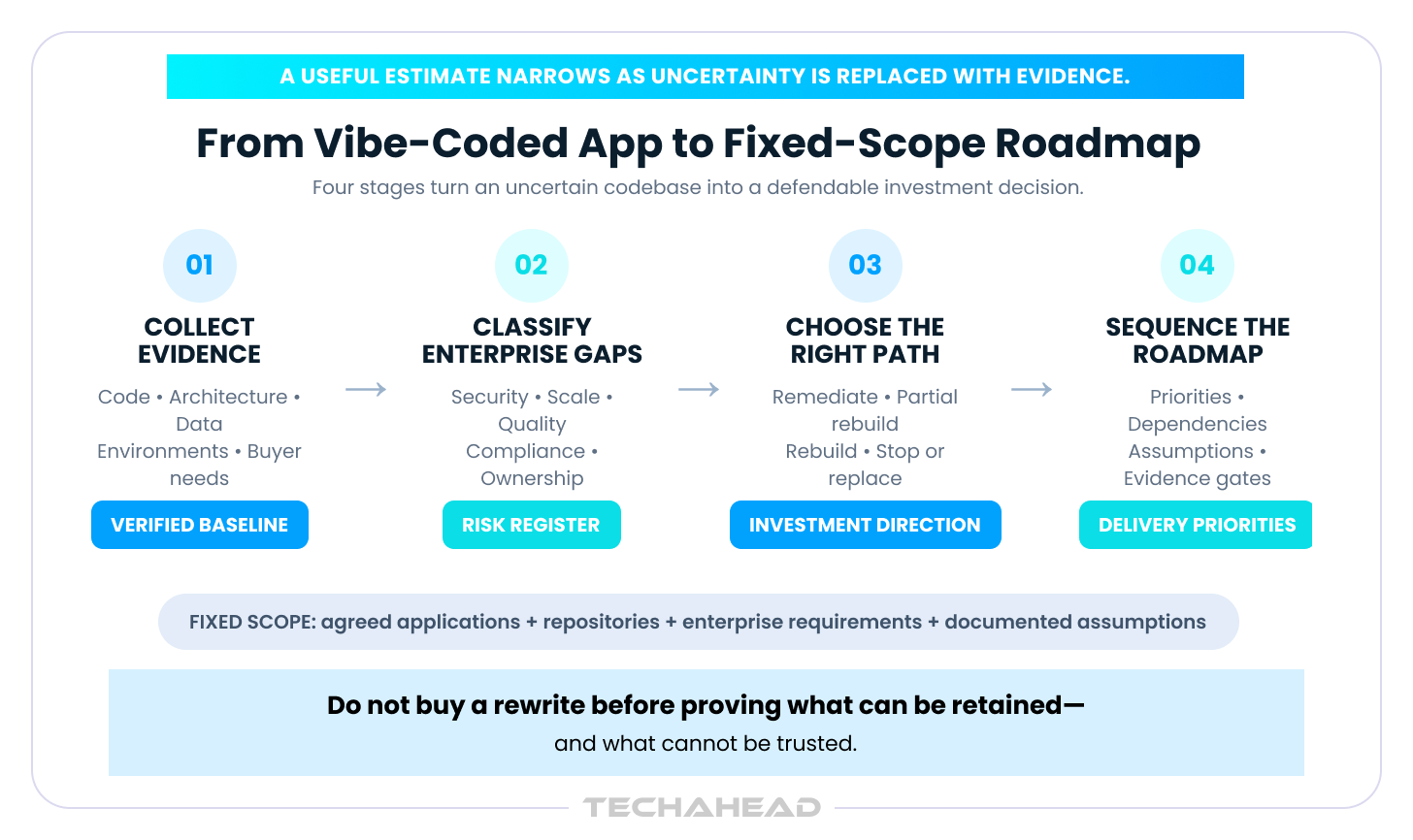
Founders often ask for a price before anyone has reviewed the repository, environments or data model. A responsible estimate narrows as evidence improves.
The largest cost drivers usually include:
Timeline remains a planning variable until assessment. Focused hardening is generally measured in weeks; partial rebuilds and enterprise programs may span months when migrations, external approvals or parallel operation are required. Adding E2E test coverage for three to five critical user paths typically takes 2 to 4 hours manually.
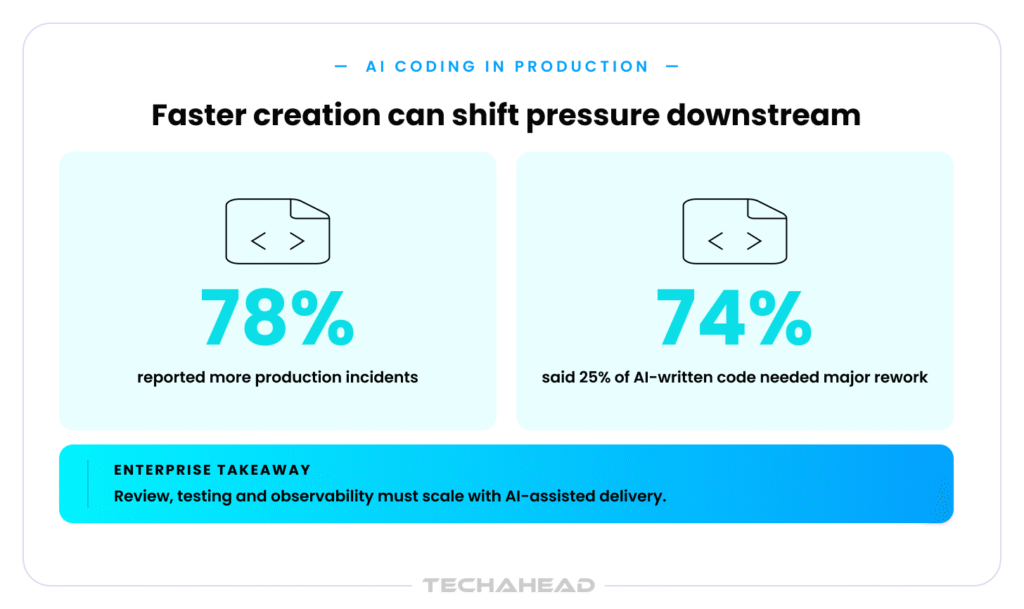
New Relic’s 2026 State of AI Coding research, based on 200 U.S. technology decision-makers at upper mid-market and enterprise organizations, found that 78% reported more incidents after AI-generated code shipped. It also found that 74% said at least a quarter of AI-generated code required significant rework.
Total cost of ownership also includes security updates, cloud usage, monitoring, dependency maintenance, incident response and testing. Without funded ownership, one-time remediation will not create durable readiness.
Remediation should leave the business with more than a cleaner codebase. It should establish an engineering system that prevents rushed prompts, unreviewed dependencies and inconsistent implementation patterns from recreating the same problems, because vibe coding skips governance steps that later have to be restored before release.
That requires controls around how AI-assisted code is produced, reviewed and released. The appropriate model depends on team size and application risk, but an enterprise-ready operating approach should include:
Most founders complete all six steps in 8 to 12 hours when the app is small and the workflow is disciplined.
These controls matter because fixing the current defects does not automatically improve the team’s future development practices. Without an agreed definition of done, new AI-generated features can gradually reintroduce duplicated logic, security gaps and maintenance complexity.
A fixed remediation roadmap should therefore identify both immediate technical corrections and the controls needed to preserve them. TechAhead can use the assessment findings to define coding standards, quality gates, ownership requirements and post-release safeguards alongside the remediation scope. |
The result is not a promise that technical debt will disappear. It is a more controlled product-engineering environment in which risks are detected earlier, changes are traceable and the application can evolve without repeatedly requiring emergency repair.
The assessment should convert technical findings into a defendable investment decision.
Score the application across five dimensions: product value, security exposure, architecture integrity, operational readiness and team ownership. For each dimension, identify whether the current state is evidenced, partially evidenced or unknown.
Unknown is not low risk; it is an assessment requirement, and decision matrices should surface blind spots explicitly rather than treating missing evidence as acceptable.
A credible production-readiness assessment and AI-generated code audit should request more than repository access. Inputs should include:
The deliverable should be fixed in scope even when the eventual engineering program is not. TechAhead can structure the assessment around agreed systems and evidence, then provide a prioritized remediation roadmap, recommended disposition for each major component, indicative investment range and the assumptions that could change it; for a small app, the first three assessment and stabilization steps often take 2 to 4 hours combined, depending on evidence quality.
The first question should not be, “How much of the existing code can we keep?” A better question is, “What will this product need to prove to its next customer?” That shifts the discussion from protecting sunk effort to making sound decisions about revenue, procurement and operational risk.
TechAhead combines AI development, enterprise AI development and end-to-end product engineering expertise to examine the product as a working business system and a production app. The review covers more than code quality. It considers architecture, infrastructure, security, data handling, deployment practices and the team’s ability to support the application after launch, with the goal of helping ai built apps survive real users and real traffic, not just demos.
A fixed-scope assessment can help you establish:
TechAhead has delivered digital products and enterprise platforms for organizations such as AXA, the International Cricket Council and American Express. That experience includes customer-facing products, operational platforms, complex integrations and systems built to perform under real-world business demands.
Its delivery practices are supported by SOC 2 Type II, ISO 27001 and ISO 42001 certifications. TechAhead is also a Claude & OpenAI Services Partner and an AWS Advanced Tier Partner with Security Services and Cloud Operations competencies.
A polished interface or successful demonstration does not make an application ready for enterprise use. Your team must be able to show how the product is secured, tested, released, monitored, recovered and maintained.
If your vibe-coded product has moved beyond a working prototype, contact TechAhead for a focused technical assessment. Get a clearer view of what to retain, what to remediate and where rebuilding would protect the product’s future after launch so it can survive real users.
Yes, but only when the application can demonstrate effective access control, role based access control, data protection, dependency governance, secure deployment, testing, monitoring, and incident response. A successful demo or automated scan alone does not establish vibe-coded app enterprise readiness.
An AI-generated code audit should combine automated scanning with human review of authentication, authorization, input validation, business logic, dependencies, data flows, infrastructure, test coverage, operational controls, and error handling for external integrations and database interactions, with a deeper look at failure modes outside the happy path. Because AI coding tools and AI agents often optimize for the success case, human auditors must inspect how developers write code around failures. It should connect every material finding to business impact, since even a single line of insecure generated logic can expose a larger workflow.
Compliance cannot be added through documentation alone. The team must map applicable obligations to technical controls, operating procedures, and retained evidence. A production-readiness assessment should confirm access records, change controls, data handling, testing, and vulnerability management.
Remediate when the architecture is understandable and risks are localized. Partially rebuild when valuable workflows can remain but identity, data, or integration foundations are unsafe. Rebuild when security, architecture, and ownership failures are systemic. In practice, vibe coding costs can look low at first, but professional rebuilds of unstable sections often run $5,000 to $30,000 once remediation is no longer safe.
Before production, especially for a saas app with critical user journeys, establish server-side authorization, secure secrets, input validation, dependency controls, environment separation, automated tests, logging, alerting, backups, rollback, and incident ownership. End-to-End (E2E) tests are crucial for flows such as signup and checkout because those are the paths enterprise buyers and real users notice first. Secure AI-generated code requires these controls to be verified against real workflows and failure conditions.
Ownership should sit with named engineering, security, product, and operations roles—not with the AI tool, tools like Claude Code, or the original prompt author. Teams need accountable reviewers, release authority, incident responsibilities, architecture decisions, and maintained documentation for every critical subsystem.
Look for load and concurrency results, service-level objectives, monitoring coverage, dependency-failure tests, backup restoration evidence, rollback exercises, and incident runbooks, and confirm the app was tested against production data or realistic real data patterns, not just clean sample inputs. Application observability should show how the team detects degradation, traces failures, and verifies recovery. On a smaller app, monitoring vendors’ free tiers can be enough to start observability.
The decision should take only as long as necessary to examine the codebase, environments, data flows, enterprise requirements, and operating model. A focused application may require weeks; complex platforms need longer when integrations, regulated data, or migrations expand the assessment.
A vendor should provide traceable findings, business impact, architecture recommendations, retain-or-rebuild decisions, remediation priorities, delivery assumptions, verification criteria, and custom domain readiness when hosting control or migration is part of the recommendation. TechAhead also documents the evidence enterprise buyers should expect rather than offering scanner output without an accountable engineering interpretation.
Yes. TechAhead can define a fixed-scope remediation roadmap that shows how to move a vibe-coded app production plan from initial hardening to durable operations, including money decisions about what to retain versus rebuild, covering agreed applications, repositories, environments, and enterprise requirements. The deliverable prioritizes remediation, partial rebuilding, and operational controls while documenting assumptions that could change the subsequent engineering program.
We use cookies to ensure our website functions properly, improve performance, and provide a personalized experience. You can choose which types of cookies to allow below.
Required for core functionality such as security, network management, and accessibility. These cannot be disabled.
Help us understand site traffic and user interactions so we can improve performance and usability.
Enable enhanced functionality and personalization such as language or region preferences.
Used to deliver relevant ads, track campaign performance, and measure advertising effectiveness.