


 Copy Link
 Share on X
 Share on Facebook
 Share on LinkedIn
Always Active
Required for core functionality such as security, network management, and accessibility. These cannot be disabled.

Uncover the transformative potential of digital and mobile solutions for your industry.





 Last Updated: Sep 22, 2026
Sep 22, 2026
Last Updated: Sep 22, 2026
Sep 22, 2026  112
112  15 min. Read


Key Takeaways
Not long ago, building software meant manual coding, linear process, and compiling, and debugging line-by-line. However, enterprises spent the last two years learning to build with AI. The next phase is learning to trust what got built.
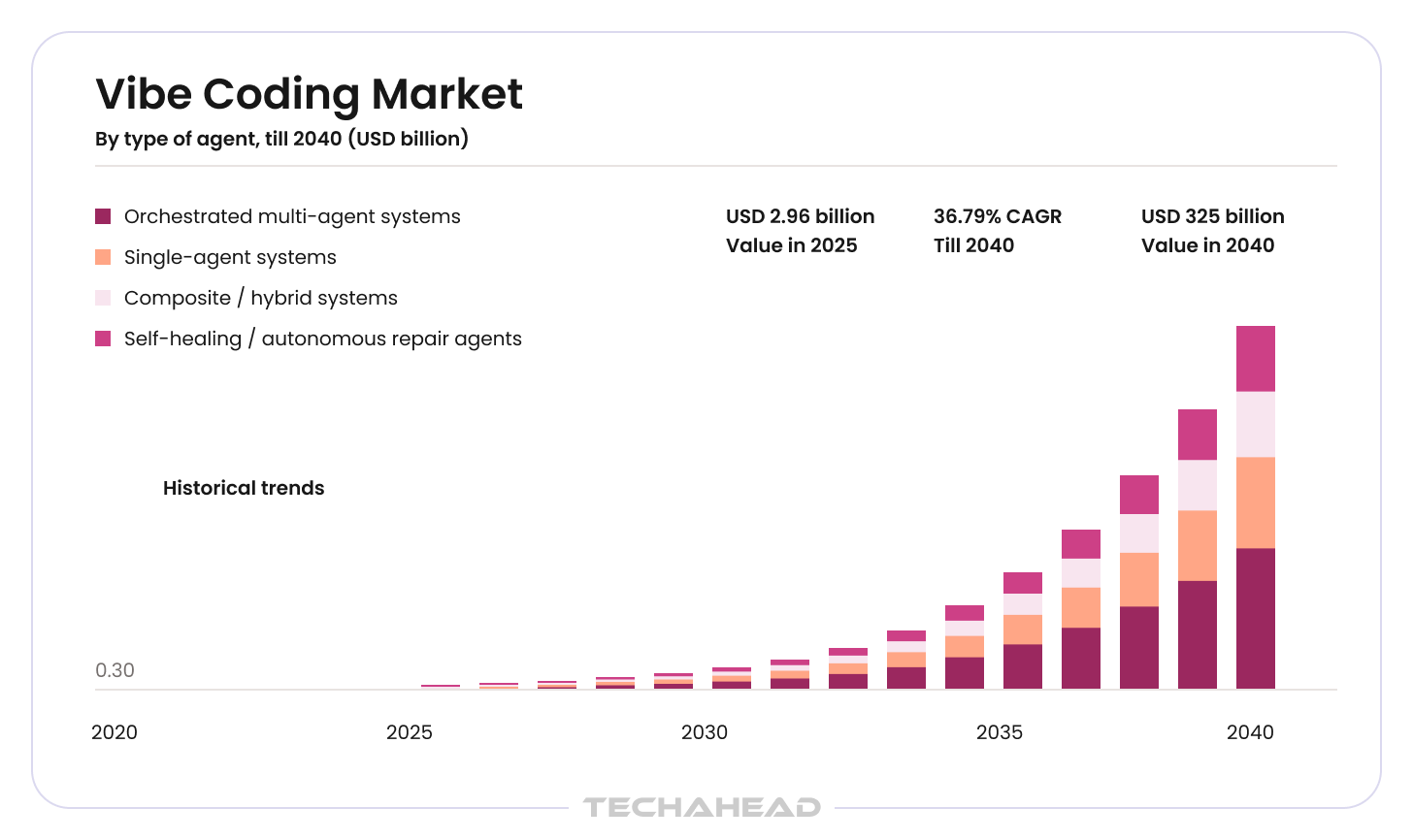
Enterprises are building software with new methods today: fast, AI-assisted, and increasingly “vibe coded.” The global vibe-coding market size is expected to reach $325 billion by 2040, projecting a CAGR of 36.79% (2025-2040). This growth makes it clear how fast vibe coding is evolving. Moreover, it has the potential to redefine human-AI interaction and emotional computing in the coming decades.
Building fast with AI is now a solved problem for most organizations. Testing AI built applications, at the standard an enterprise actually needs, is the problem still being solved. In this blog, we will discuss a practical vibe coded app testing strategy, and why every enterprise shipping AI-assisted software needs one.
Vibe coding as the name suggests is “vibe-based” interaction with the AI tool. Developers accept copilot suggestions here, run a full feature through Cursor there, hand a prompt to an agent and merge what comes back. The result rarely follows a decision, rather arrives as accumulation. Hence, only a few people on the team can explain the reasoning behind the codebase.
Want to know more about vibe coding? Read our blog “What Is Vibe Coding, and What Changes When the App Becomes a Business?”
Gartner projects that 75% of enterprise software engineers will use AI code assistants by 2028, up from under 10% in early 2023. That is a workforce-level shift in how software gets made, and it changes what QA engineering is for.
Traditional QA tested human decisions. A developer made a choice, wrote it into code, and QA verified the choice held up under real conditions. Vibe coding changes the object being tested. QA engineers are now verifying the output of a process nobody on the team fully supervised in real time. That is a different discipline, built on different assumptions, and it demands a vibe coded app testing strategy purpose-built for the way software gets made now, rather than a faster version of the old playbook.
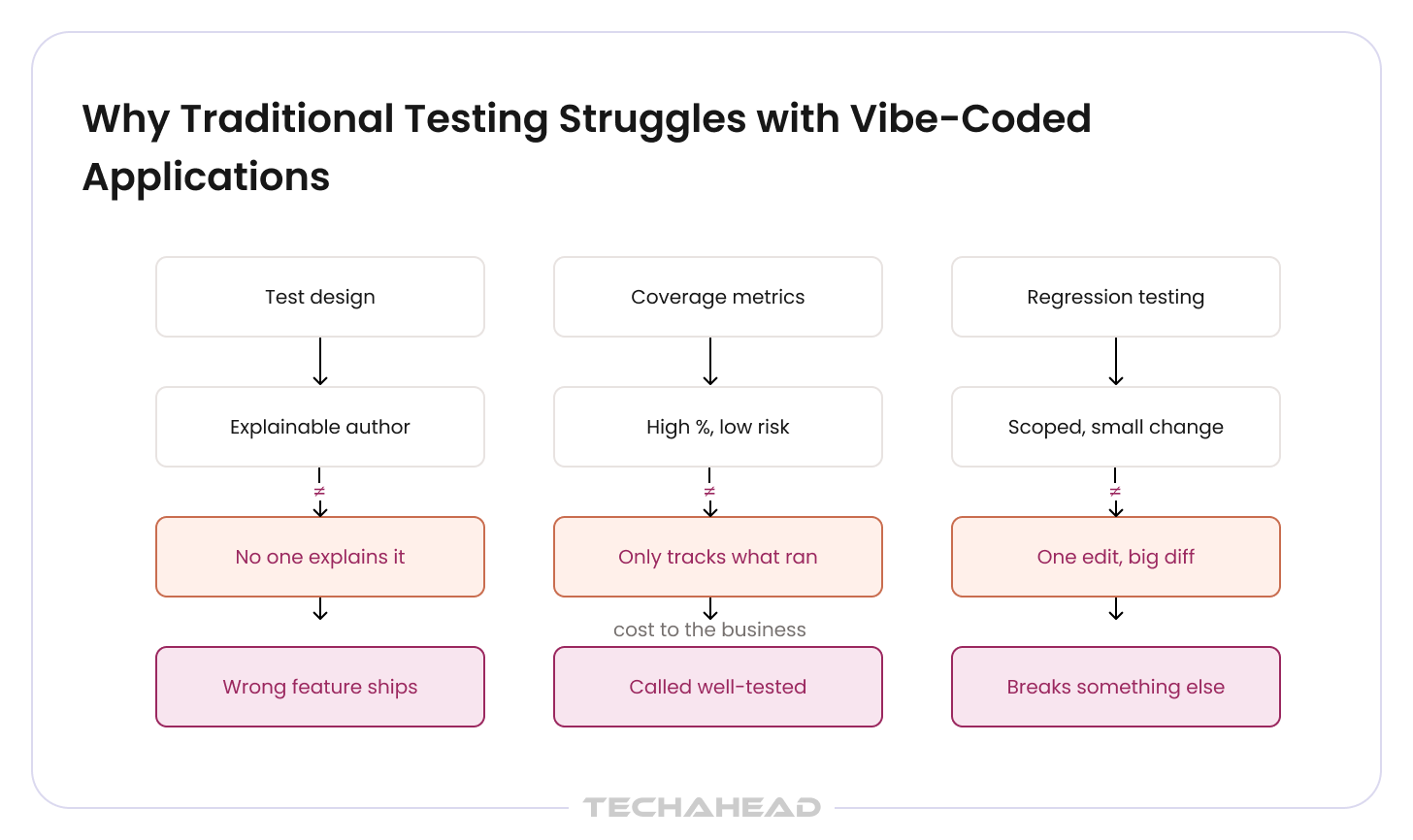
Traditional testing is structurally mismatched to what AI-assisted development demands, in three specific ways that go well beyond running slower.
Classic test case design starts with a conversation: what was this built to do, and why this way. Vibe-coded features frequently arrive with no one able to answer that question in useful detail, which leaves test design working from guesses instead of intent.
Unit and integration coverage percentages track which code paths executed. They say very little about which reasoning paths were sound. A feature can hit 90% coverage and still enforce business rules that were inferred incorrectly from an ambiguous prompt.
Traditional regression testing works well when a change is scoped and understood. A single prompt adjustment in a vibe-coded workflow can produce a large, semantically scattered diff touching several unrelated areas, which breaks the assumptions most regression suites are built on.
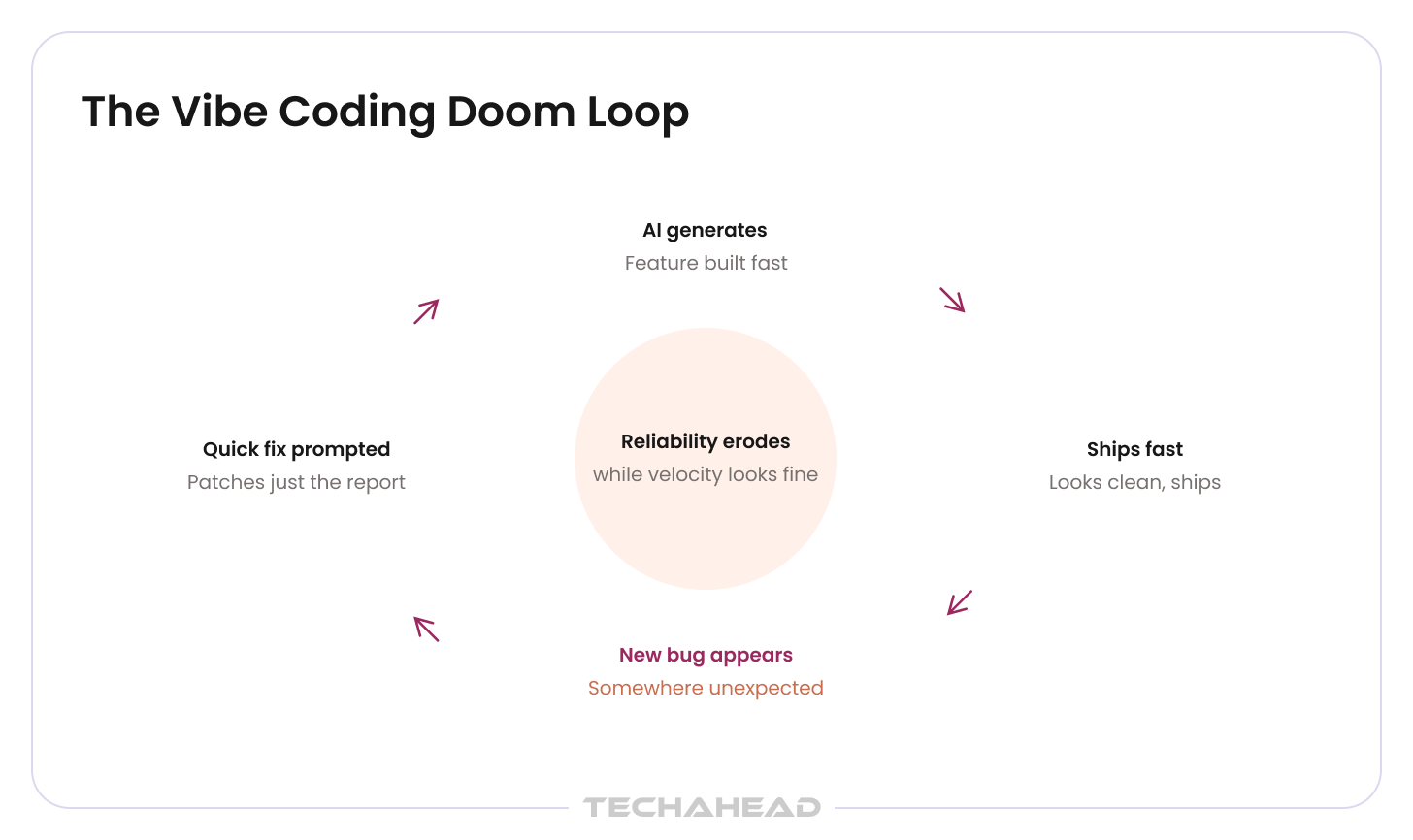
The single most important pattern to understand here is what we call the Vibe Coding Doom Loop, and it deserves attention because it hides inside the metrics leadership trusts most.
The loop runs like this: prompt the AI, generate the feature, review it briefly because it looks clean, ship it. A bug surfaces in production. The team prompts the AI to fix that specific bug. The fix resolves the reported issue and quietly introduces a new one somewhere the prompt never mentioned. The cycle repeats.
Every single pass through this loop looks like progress. Velocity metrics stay high. Feature throughput climbs. Meanwhile, the actual reliability of the system erodes with each iteration, invisibly, because nothing in the loop is measuring reasoning integrity across cycles. This is precisely why the doom loop is so seductive for leadership: the dashboards that usually signal trouble are the last place this kind of decay shows up.
As per research on more than 100 large language models across 80 coding tasks, it was found that AI-generated code introduced security vulnerabilities in 45% of cases, with the flaw rate holding steady even as the models themselves improved. That finding matters here because it confirms the doom loop as a measurable, repeatable pattern across the industry, one that persists regardless of how much the underlying models improve
Beyond the doom loop, three other challenges define this category:
Every one of these challenges is precisely what a deliberate vibe coded app testing strategy is designed to catch before it reaches production.
Most enterprises testing AI-assisted applications today are still running checklists designed for a world where every line of code passed through a human mind that could explain its own reasoning. That world is receding quickly, and the shortcomings this creates are specific and concrete. Such gaps in reasoning and accountability require a vibe-coded app testing strategy designed to surface them on purpose.
An AI tool solves each screen, function, or ticket in isolation. The logic behind a validation rule on one screen may contradict the logic behind a similar rule two screens later, because no single reasoning process governed both.
AI models frequently solve more than what was asked, adding extra validation, extra states, or extra error handling that felt reasonable to the model and was never reviewed for intent.
Vibe-coded output often reads as polished: sensible naming, tidy structure, helpful comments. That polish lowers the reviewer’s guard exactly where scrutiny matters most.
Human-authored code carries a paper trail of tradeoffs in commit messages, code review comments, and team memory. Vibe-coded features often arrive without any of that context, so the “why” behind a piece of logic can vanish the moment the chat session that produced it ends.
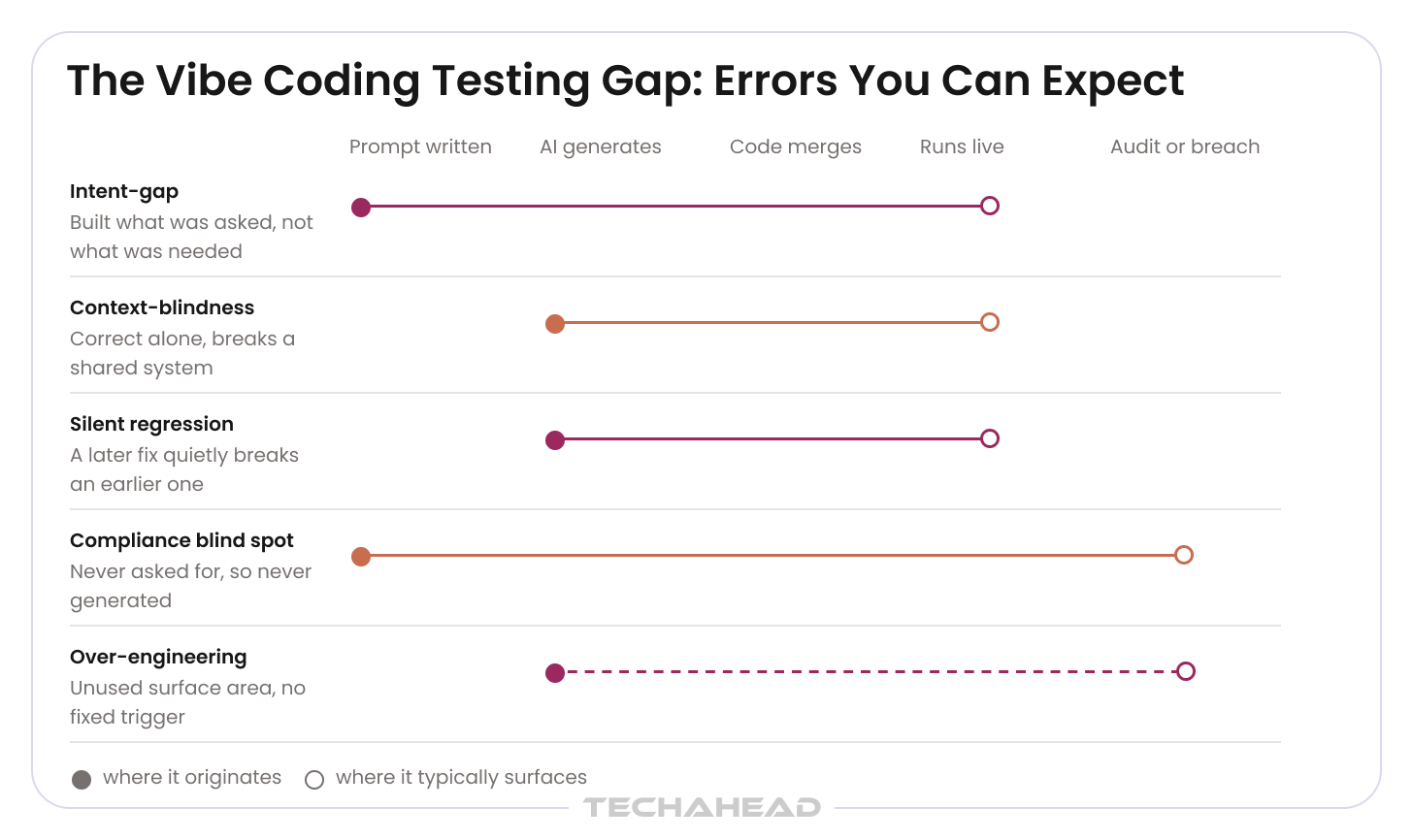
The most useful way to think about vibe-coded errors is by origin, because origin determines which technique catches them. Treat this as a field guide.
Every enterprise trying to build a vibe-coded app testing strategy runs into the same problem. It looks like a testing question, but it is a set of decisions that must be made before any test gets written.
Here is what to watch for, at each stage.
Before any testing begins, someone needs to define what correct actually means for this specific application and its users. Without that definition, a test suite can pass in full while the product still fails the people using it.
A marketing page and a payments flow carry entirely different consequences when something breaks. A vibe coded app testing strategy that applies the same scrutiny everywhere ends up under-testing the features that matter most and over-testing the ones that do not.
If it is unclear who signs off on a piece of AI-generated code before it merges, review quality varies by whoever happens to be free that day. Ownership needs to sit with a specific role, not with “whoever reviews the pull request.”
Reviewing whether code runs correctly is a different exercise from reviewing whether it matches what was asked for. Compare the output against the original prompt or specification directly, and treat any drift between the two as a defect in its own right.
AI can generate adversarial and edge-case scenarios at a scale no manual team can match. Leaving that capability unused means catching only the failures the team happened to imagine, rather than the ones the system can produce.
A change that touches authentication, global settings, or a shared data model needs a context-integrity check every single time. Skipping this once is usually how a change that looks correct in isolation breaks something several steps removed from it.
Fresh-eyes testing loses its value the moment the reviewer already knows what the feature was built to do. Keep exploratory testing in the hands of testers who never saw the prompt, and watch for this pattern creeping in under deadline pressure.
If the original prompt never mentioned access control, audit logging, or data handling rules, assume the AI never generated them. Verify deliberately, rather than discovering the gap during an audit or a breach.
Vibe-coded logic degrades quietly as the rest of the codebase keeps changing around it. Stability needs a re-audit on a schedule, never an assumption that holds simply because nothing broke recently.
McKinsey’s research on generative AI in software development found that developers using AI-based tools completed several common coding tasks up to twice as fast, with the productivity upside for the function estimated at 20 to 45% of current spending. That upside is real, and it is exactly why these watch points matter. Speed without a strategy built to catch these specific failure modes simply moves risk downstream instead of removing it.
The vibe-coded app testing strategy checklist:
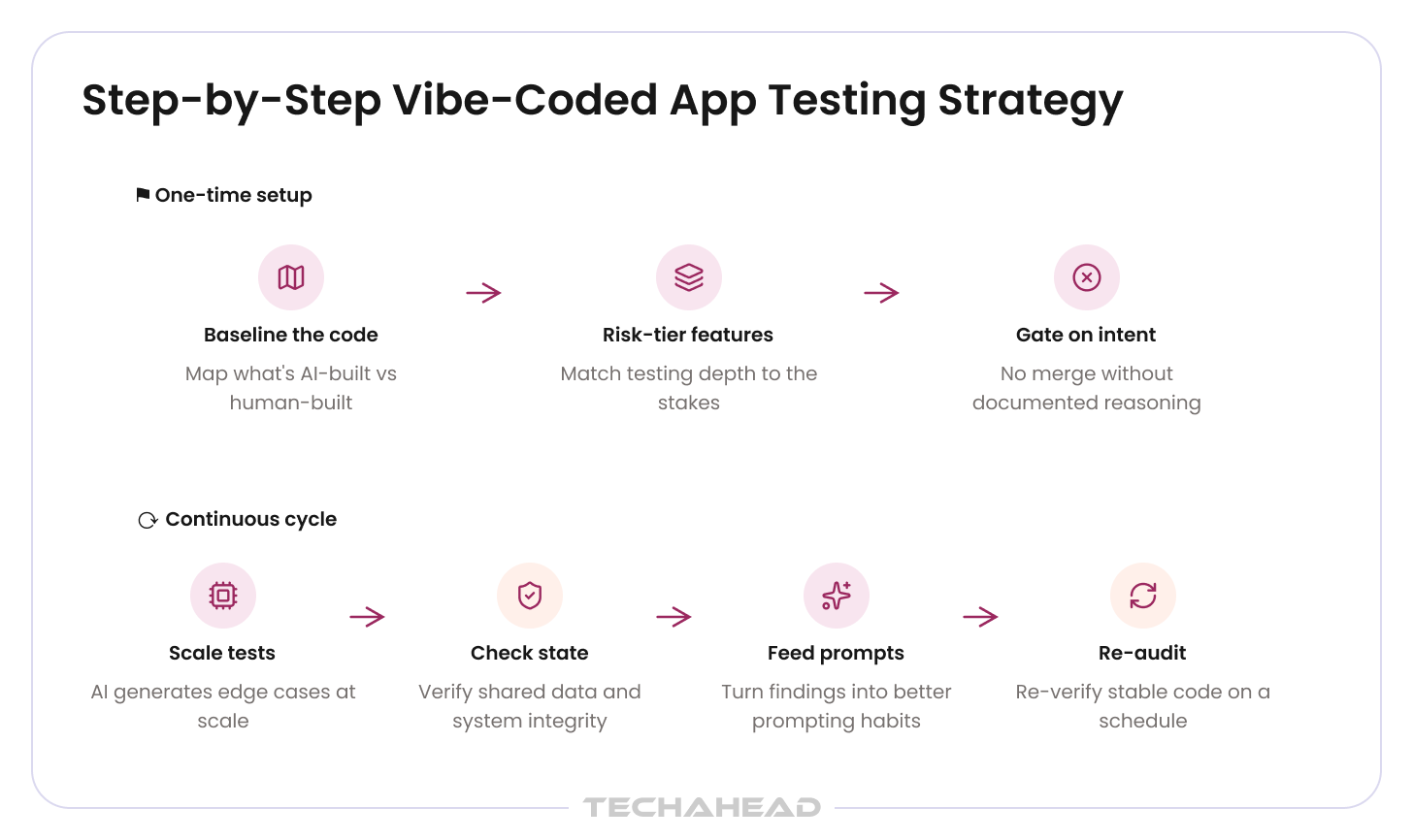
A vibe coded app testing strategy works best as a phased rollout rather than a flat checklist, since maturity builds in stages.
Testing, as a discipline, has drifted heavily toward frameworks, structure, and rigidity over the past decade. That drift produced real gains in consistency. It also produced a QA culture that can feel mechanical, running the same scripted paths regardless of what the product needs from its testers.
Vibe coding, oddly enough, is forcing a useful correction. Even treated as a thought experiment, vibe testing surfaces genuinely valuable ideas: intuitive exploration by testers who bring fresh eyes unclouded by implementation knowledge, AI used to generate test scenarios at a scale no manual team could match, and a willingness to approach the product the way a real user would.
The answer lies beyond choosing intuition over frameworks, or frameworks over intuition. It is finding where they amplify each other. TechAhead, as an experienced AI development company pairs deep, structured QA discipline built over more than 16 years of enterprise engineering with AI-native testing tools, to generate coverage at a scale; manual testing alone could never reach. We pair that scale with human testers who are deliberately kept unfamiliar with the implementation, so their read on the product mirrors what a real user will experience.
Every enterprise now shipping AI-assisted software is running some version of this experiment already. The organizations that pull ahead will be the ones that pair their speed with a vibe-coded app testing strategy, rather than discovering the gaps in production. If your team is ready to build that strategy, talk to TechAhead.
A complete strategy defines upfront parameters (risk tolerance, ownership, acceptable AI authored surface area), pairs AI-scale test generation with human exploratory testing, verifies intent against the original specification, checks context integrity across shared systems, and sets a recurring cadence for re-auditing code that already shipped.
This usually happens because of environment mismatches: different environment variables, missing API keys, database connections, or dependency versions between your local setup and the live server. AI tools generate code assuming a “perfect” environment, but production servers rarely match that, so configs, secrets, and build steps need to be set up manually.
You need targeted refactoring of the parts under real load: database queries, API structure, and authentication. A developer can audit the codebase, fix the bottlenecks, and layer in proper architecture around your existing code rather than starting over, as long as the core logic is sound.
These tools are built for fast prototyping and rapid MVP development. They are excellent for validating an idea or building a demo, but most vibe-coded apps need a security review, performance optimization, and proper hosting setup before they can safely handle paying customers. For a production-grade infrastructure, you need to move the code to a traditional development environment. You can hire experienced developers to ensure a smooth transition without losing any of your progress.
The most common risks associated with vibe-coded applications are exposed API keys, weak authentication, unvalidated user inputs, and missing rate limiting. These are the issues AI tools often skip because they optimize for “it works,” not “it’s secure.” Without a security audit, vibe-coded apps are especially vulnerable to data leaks and unauthorized access once they’re public.
Costs vary widely, but fixing an existing vibe-coded app (patching bugs, hardening security, optimizing performance) is almost always cheaper than a full rebuild; often a fraction of the cost, since a developer is repairing specific issues rather than re-architecting everything. A full rebuild only makes sense if the core logic is fundamentally broken. Contact us if you want to assess your application and know the cost of fixing/rebuilding it.
We use cookies to ensure our website functions properly, improve performance, and provide a personalized experience. You can choose which types of cookies to allow below.
Required for core functionality such as security, network management, and accessibility. These cannot be disabled.
Help us understand site traffic and user interactions so we can improve performance and usability.
Enable enhanced functionality and personalization such as language or region preferences.
Used to deliver relevant ads, track campaign performance, and measure advertising effectiveness.