


 Copy Link
 Share on X
 Share on Facebook
 Share on LinkedIn
Always Active
Required for core functionality such as security, network management, and accessibility. These cannot be disabled.

Uncover the transformative potential of digital and mobile solutions for your industry.





 Last Updated: Oct 7, 2026
Oct 7, 2026
Last Updated: Oct 7, 2026
Oct 7, 2026  16
16  21 min. Read


Key Takeaways
Your fintech product has users, working integrations, and a roadmap worth protecting. Then a banking partner asks for security evidence. A larger customer wants to understand your access controls. Transaction volume increases, and a payment that timed out leaves your support team unsure whether the money moved.
If AI coding tools helped build the application, the next decision is practical: which parts can you keep, which need hardening, and what evidence will show that the changes worked?
Fintech application security hardening assesses and improves the controls that protect customer information, financial operations, and service reliability. For an AI-built product, that work combines code review with architecture analysis, transaction testing, infrastructure assessment, and verified remediation. The objective is a product your team can operate and extend with confidence grounded in specific test results.
In its July 2025 software engineering outlook, Gartner predicted that 90% of enterprise software engineers would use AI code assistants by 2028. It also emphasized human oversight matched to business criticality, risk, and workflow complexity.
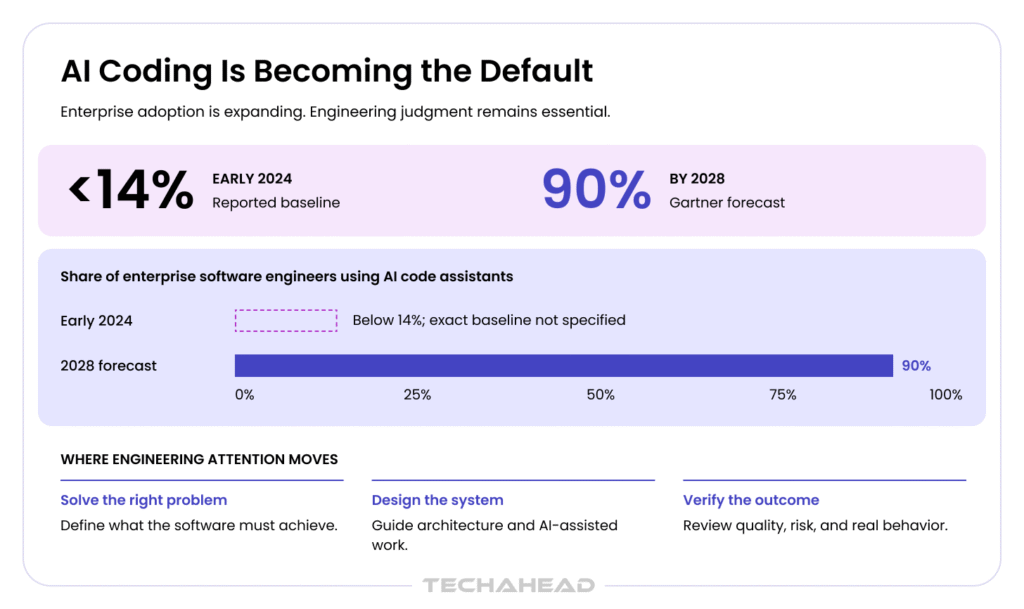
For fintech leaders, that puts the emphasis on reviewing the system AI helped produce, including how it behaves when requests fail or arrive twice.
At TechAhead, we assess your existing system, prioritize the work, implement agreed improvements, and transfer the evidence and operating knowledge to your team. We start with the commitment your product must support next and shape our engagement around that requirement.
Related: How to Secure an App Built With Claude Code for Enterprise Use
Your functioning application demonstrates that a workflow can succeed. In our fintech security assessment, we examine whether it remains correct when identities change, providers become unavailable, requests overlap, or infrastructure fails.
The strongest reason to commission an assessment is a concrete decision: approving a launch, enabling another payment workflow, signing an enterprise customer, or increasing transaction capacity. We define that decision with you before broad testing begins. It gives your team a useful boundary for both the review and the remediation budget.
We recommend a focused review when you encounter these signals:
These signals do not establish that AI caused the weakness. They identify behavior or uncertainty worth examining, regardless of how the code was written.
Also Read: AI-Generated Code Security Risks Guide
An internal team can handle isolated defects when it understands the architecture and has enough capacity to implement and independently review changes. An external assessment is useful when leadership needs a separate view of risk. Assessment plus remediation fits situations where the problem crosses application, cloud, and transaction boundaries or the internal team needs delivery support.
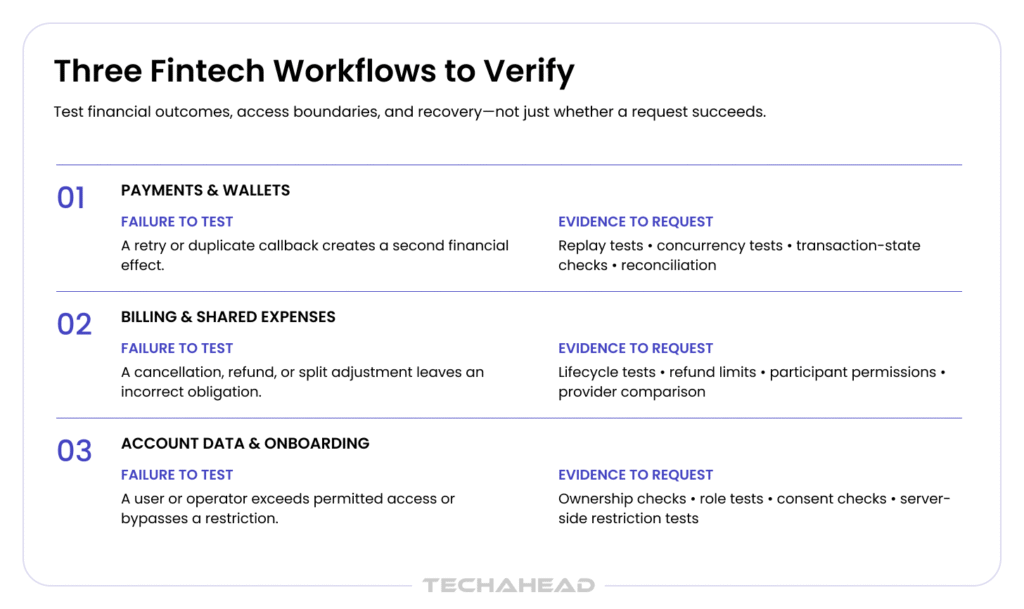
We follow your real business operations from request to outcome. Our review prioritizes payments and wallets, recurring billing, and account-data integrations where they are relevant to your product. Each combines security requirements with operational behavior that ordinary feature testing can miss, and API vulnerabilities can expand the attack surface for fintech applications across those workflows.
| Workflow | Question the assessment must answer | Evidence to request |
| Payment or wallet transfer | Can retries, concurrency, or provider failures create an unauthorized or duplicate financial effect? | Replay and concurrency tests, transaction-state checks, reconciliation results |
| Recurring billing and shared expenses | Can cancellations, refunds, or split adjustments leave an incorrect charge or obligation? | Lifecycle tests, approval checks, provider-to-application comparison |
| Account-data access and onboarding | Can a user or operator exceed permitted access or bypass a required restriction? | Role and ownership tests, consent and restriction checks, data-flow review |
Authentication confirms who is making a request. Access controls should enforce multi factor authentication for user login sessions and administrative access, rather than relying on SMS OTPs that are vulnerable to SIM-swap and SS7 attacks. Authorization determines whether that person may view an account, initiate a transfer, alter a beneficiary, export a statement, or approve an exception.
Our fintech API security review tests those decisions at the API and service layers. Changing an account identifier must not expose another customer’s information. An operator who can review onboarding documents should not automatically gain permission to approve payments. Sensitive administrative actions need appropriate authentication, authorization, and traceable approvals.
For higher-risk sensitive operations, stronger factors such as biometrics and device binding should be required. Use short-lived tokens for session management, review token storage in platform-native secure hardware, and tie access review to zero trust architecture, which 56% of organizations prioritize for security.
Threat modeling connects those checks to plausible abuse paths: account takeover, stolen service credentials, excessive operator permissions, and unauthorized access through an integration. We use OWASP ASVS to define applicable technical verification requirements, then add your product’s financial rules and partner expectations, including protection of authentication credentials and mobile controls from OWASP MASVS.
A transfer request reaches the provider, but its response is lost. Your application retries. The engineering question is whether both requests represent one intended transfer and how the system establishes the final outcome.
Stripe’s idempotency documentation describes how keys support safe retries without repeating the same operation. Its webhook guidance also addresses duplicate events and event ordering. These are useful integration-specific references; your own transaction identifiers, database changes, and provider contracts still need review.
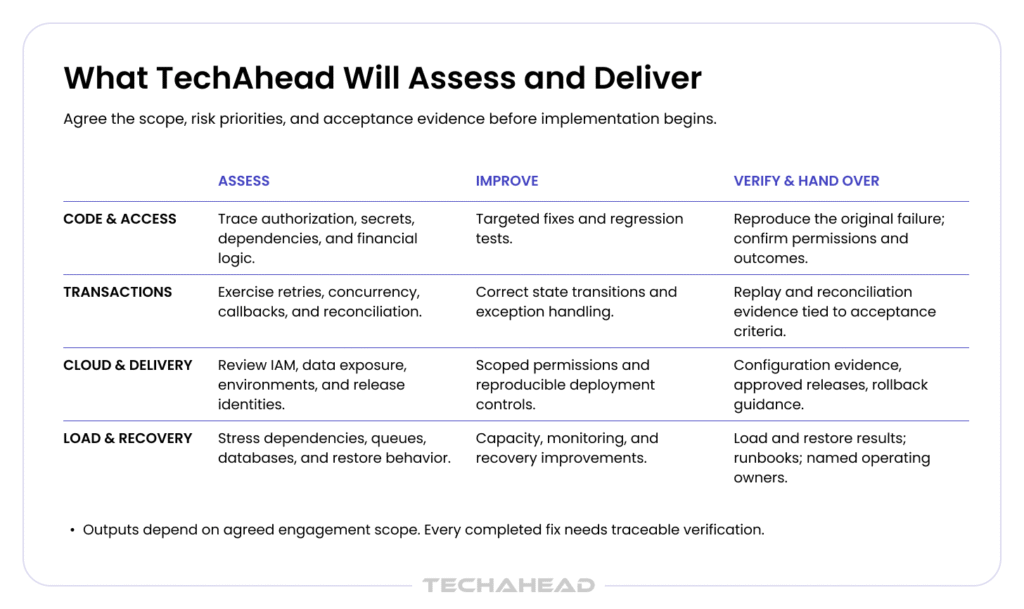
Our payment application security testing covers concurrent requests, repeated callbacks, delayed confirmations, refund limits, currency precision, and interrupted updates. If your product maintains a ledger, we verify the relevant accounting invariants. If a partner owns the ledger, we test how your application mirrors status and reconciles against that authoritative record.
| We partnered with RaspberryFX on a Canada–Nigeria payment application with CAD and NGN wallets, FXtag transfers, QR payments, payment links, tiered onboarding, and biometric login. These workflows illustrate the connected payment, identity, and integration concerns we examine in your review. |
Recurring payments introduce states beyond a successful charge: pending collection, failed collection, cancellation, partial refund, adjustment, and dispute. Shared expenses add participant permissions and changing obligations.
We review how each state is represented, who can change it, and which external record confirms the financial outcome. A customer-facing success message should agree with the underlying operation. A refund should not exceed the refundable amount simply because two requests arrived together.
| Our work with GetWellPaid spans bill management, automated bill splitting, and payment-related workflows. We bring that workflow context to your review, particularly where a billing change affects multiple participants and records. |
McKinsey’s payments resilience analysis connects expanding payment rails with more complex fraud and control challenges. For your product, we identify the source of truth at each integration boundary and test how exceptions reach an accountable owner.
As a dedicated fintech development company, our fintech application security hardening services connect each review activity to a business risk and a verification method. We combine penetration testing with examination of your code, architecture, cloud settings, and failure behavior according to the agreed scope.
In our AI-generated code security review, we examine the controls that protect your financial workflows:
We review your architecture for trust boundaries, data ownership, service coupling, and how a financial operation moves between systems. Fintech apps should encrypt sensitive data at rest and in transit, using TLS 1.3 for data in transit and AES-256 for data at rest.
Must Read: Building a Secure CI/CD Pipeline for AI-Generated Code
Maintainability matters because your engineers must understand the fix and preserve it through later releases. We assess module boundaries, dependency support, test reliability, migration history, and reproducible builds. AI-assisted development/vibe coding policies should also address what code and customer data may enter coding tools and who approves generated changes.
Our cloud security configuration review covers the infrastructure and delivery controls your application relies on:
End-to-end encryption protects sensitive data during transmission.
An application can enforce good customer permissions while a broadly privileged deployment credential exposes the same data. We examine both access paths.
We record the reviewed repositories, deployed versions, environments, and integrations. Without that scope, a finding can be accurate while leadership misunderstands how much of the product was examined. Runtime Application Self-Protection (RASP) is a runtime control that detects attacks in real time.
We use threat modeling to identify the assets and abuse paths worth prioritizing. Our fintech penetration testing investigates whether weaknesses are exploitable within the agreed scope, including business logic flaws that require manual review. We manually test business logic around beneficiary changes, duplicate withdrawals, approval bypasses, and unauthorized refunds.
Before testing, we agree with you on environments, test identities, safe transaction limits, third-party exclusions, and escalation procedures. Organizations also need documented plans for security incidents and backup procedures before testing begins. Provider sandboxes are useful for exercising integrations; they do not establish how every production dependency will behave.
For remediation, we trace the original finding to its code or configuration change and retest result. We close a ticket when the evidence shows that the original failure is addressed and important neighboring workflows still behave correctly. If validation is involved, server-side input handling should prevent injection attacks. Regular penetration testing and periodic external audits also support ongoing regulatory compliance.
Related: Enterprise AI Compliance & Governance Guide 2026
Scalability means maintaining acceptable financial outcomes as work increases. Faster response times alone do not establish that transfers remain correct.
For your fintech application scalability assessment, we build a workload from expected transaction patterns, including bursts, retries, webhook traffic, reconciliation jobs, and administrative activity. Scalability reviews should also account for continuous monitoring of approval flows and account activity to detect anomalies in real time. We measure:
Real-time fraud detection systems can flag suspicious activity as it occurs, often using AI and machine learning with data pipeline integration and Security Information and Event Management analysis; in practice, machine learning models also automate risk scoring and support security responses.
We test recovery after a worker restart, queue interruption, database failover, or restore. With your business owners, we define recovery point and recovery time objectives (RPO and RTO), then test them. We document how restored records are reconciled with external transactions that may have continued during the interruption.
We preserve your valuable product when its foundations support controlled change. Our assessment makes the case for fintech application remediation or rebuilding explicit, based on verified findings.
| Path | Findings that support it | Work and verification to expect |
| Harden the existing product | Core workflows are understandable; weaknesses are contained; financial outcomes can be tested | Targeted code and configuration fixes, regression tests, retesting, updated controls |
| Selectively rebuild a subsystem | A bounded component creates systemic risk while surrounding workflows remain useful | New component boundaries, migration and reconciliation plan, staged cutover, rollback validation |
| Broader rebuild or replacement | Trust boundaries or financial records cannot support the required controls through manageable changes | Requirements baseline, transition architecture, data validation, continuity plan, explicit acceptance gates |
For example, a billing interface may remain useful while its payment-state engine needs replacement. An account-data application may need stronger ownership checks and credential isolation without changing the customer experience. A wallet whose records cannot explain balances may require deeper work before growth is approved.
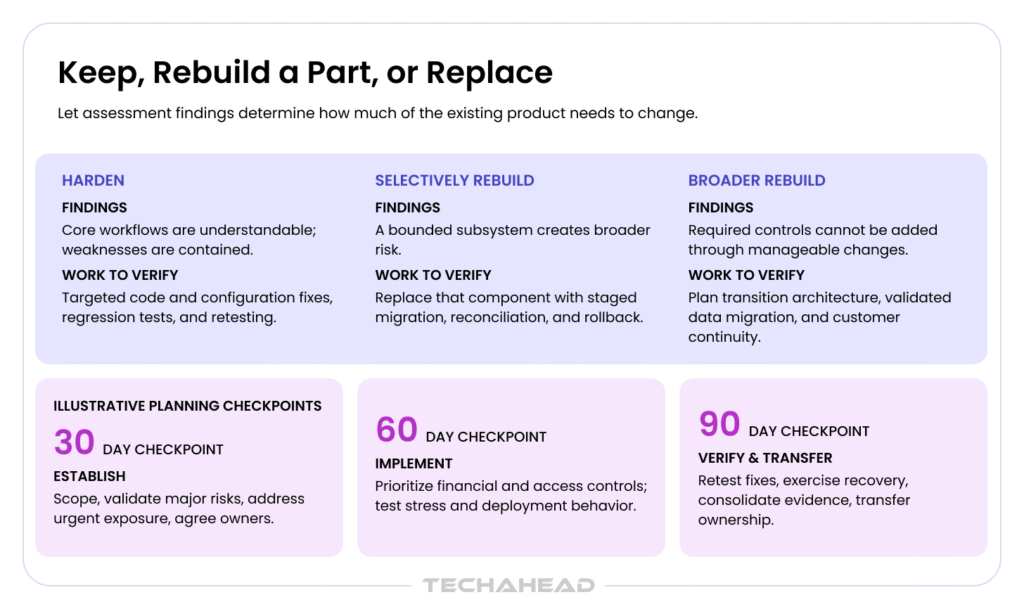
We show you the evidence behind our recommended path, its dependencies, and the implications for operating your current service. We compare the whole transition, including data migration and customer continuity, so you can evaluate what each option requires.
Ask an assessment partner to explain what evidence would change its recommendation. That question tests whether the proposed work follows the findings or simply reflects the partner’s preferred delivery model.
We start discovery with your next business commitment, current architecture, critical workflows, known incidents, existing test results, and relevant customer or partner requirements. This gives our review a purpose your leadership and engineering teams can both evaluate.
For your initial consultation, we can work from architecture diagrams and a product description without production access. To assess your code and infrastructure meaningfully, we need scoped repository access, dependency manifests, configuration visibility, deployment information, and appropriate test environments.
We request named, time-limited accounts and read-only permissions where they support the task. For parts of your review, configuration exports may replace direct console access. We use synthetic or appropriately masked customer data wherever practical and agree separately on remediation permissions and release approvals.
We capture access restrictions in your report and distinguish verified behavior from assumptions we could not test.
We make each finding in your risk register actionable by recording:
We prioritize using exploitability, financial exposure, data sensitivity, operational impact, and your next business commitment.
For example, an unauthorized beneficiary change deserves attention because it can redirect funds. A duplicate callback deserves attention if it creates a second financial effect. An inefficient query becomes urgent when it blocks settlement processing under the expected workload.
Leadership needs the resulting decisions: what must be resolved before the next commitment, what can proceed with constraints, and who accepts any remaining risk. Engineering needs the backlog and evidence required to close each item.
These checkpoints illustrate sequencing; they are not assessment durations or promised completion dates.
Some work can finish earlier. A subsystem replacement, partner dependency, or unresolved data discrepancy can require a different sequence. We set your actual schedule after reviewing access readiness, codebase complexity, testing constraints, and remediation scope.
We specify outputs for your decision-makers and implementers in the statement of work. Your assessment deliverables can include:
When you engage us for implementation, we add the agreed code and configuration changes, regression tests, penetration-test retest results, load and recovery evidence, deployment documentation, and residual-risk record. We define acceptance criteria with you before work starts.
We shape the engagement around your team’s capacity and the work identified:
We discuss these scope options with you and agree on staffing and service responsibilities for your product. For ongoing support, we define escalation, release authority, and ownership explicitly.
In our handoff, we explain why critical controls exist, which tests protect them, and how your team can investigate failures. Our knowledge transfer includes applicable runbooks for:
We walk your team through the operational tasks. A useful handoff lets an engineer trace a disputed transaction, reproduce a finding, deploy an approved change, and identify the person responsible for a remaining risk.
Your compliance requirements depend on the financial services you provide, the data you handle, and your contractual responsibilities. We work with your legal and assurance specialists to identify the applicable scope, then connect our engineering work to the controls and evidence you need.
Depending on your product and business, we help you address:
Our fintech application security hardening work connects identified gaps to implemented changes and verification results. Your engineering team receives actionable remediation tasks, while your leadership team gains visibility into completed work, remaining risks, and ownership.
If your application also contains AI features, we separately review:
We also help you maintain review evidence through agreed penetration testing, control checks, documentation updates, and evidence collection. The schedule follows your applicable requirements, partner commitments, and product changes.
We combine fintech product engineering with cybersecurity and DevSecOps expertise to help you move from assessment findings to implemented, tested improvements. Our work spans application architecture, cloud controls, APIs, quality engineering, and operational support – the connected areas your existing product needs to withstand growth.
Our payment and billing experience includes RaspberryFX’s multi-currency wallets, transfers, onboarding, and administration workflows, alongside GetWellPaid’s connected bills and shared-payment journeys. We bring that domain context to your assessment while testing the behavior of your own application.
Our published security credentials give you vendor-governance evidence to evaluate alongside the scope and results of your engagement. They include:
Our technology partner credentials and relationships include:
Your application’s readiness rests on its own controls and test evidence. We make the required deliverables explicit in your statement of work so you can evaluate the improvements against agreed acceptance criteria.
Bring your next milestone, a high-level architecture diagram, your critical payment or account-data workflows, and any existing security findings. We use that first discussion to establish the decision you need to make and the assessment scope needed to support it.
Contact TechAhead to discuss security and scale for your AI-built fintech application. We will help you identify what can be preserved, what needs to change, and how your team will verify and own the result.
Our scope can include code and architecture review, cloud configuration assessment, threat modeling, penetration testing, transaction-integrity checks, load testing, remediation, and documentation. We define the applicable activities around your workflows, integrations, risks, and next business milestone.
Access depends on scope. We typically need repositories, dependency manifests, deployment configuration, architecture documentation, and a representative test environment. We use scoped, time-limited permissions and synthetic data where practical, documenting restrictions that limit verification of your critical workflows.
Duration depends on codebase complexity, integration count, access readiness, testing constraints, and whether remediation is included. We establish your schedule after scoping. A 30-, 60-, and 90-day roadmap illustrates sequencing rather than guaranteeing assessment or delivery completion dates.
Yes, when the assessment shows that existing foundations support targeted remediation and reliable verification. We preserve your usable workflows while improving specific controls. Where a subsystem creates broader risk, selective rebuilding may provide a more practical path than incremental fixes.
We give your leadership team a decision summary, prioritized risks, recommended delivery path, and residual-risk visibility. Your engineers receive reproducible findings, remediation tasks, acceptance criteria, and architecture documentation. Implementation adds agreed changes, test evidence, operating guidance, and knowledge transfer.
Consider a broader assessment when your concerns include duplicate transactions, reconciliation differences, scaling limits, unclear architecture, or recovery gaps. A penetration test investigates exploitable weaknesses within scope; additional engineering review examines financial correctness, operational resilience, maintainability, and implementation priorities.
An assessment can identify gaps and produce supporting technical evidence. PCI DSS obligations depend on the applicable environment and validation requirements. SOC 2 involves a separate assurance examination. Confirm the required scope with your compliance, legal, and assurance advisers.
Test idempotency, concurrent requests, webhook duplication, transaction-state changes, and reconciliation at representative load. Define financial invariants and dependency limits before increasing capacity. Performance acceptance criteria should include correct financial outcomes and recovery behavior alongside latency, throughput, and error rates.
Ask how they scope critical workflows, validate business-logic findings, prioritize remediation, and retest changes. Request explicit deliverables, access requirements, acceptance criteria, and ownership boundaries. Their proposal should explain the evidence behind preserving existing code or recommending a subsystem replacement.
No. Development-tool choice alone does not establish application security. Review implemented controls, dependencies, financial behavior, deployment settings, and test evidence. AI-assisted development warrants clear review and data-handling practices, while assessment findings should reflect the actual system rather than assumptions.
We use cookies to ensure our website functions properly, improve performance, and provide a personalized experience. You can choose which types of cookies to allow below.
Required for core functionality such as security, network management, and accessibility. These cannot be disabled.
Help us understand site traffic and user interactions so we can improve performance and usability.
Enable enhanced functionality and personalization such as language or region preferences.
Used to deliver relevant ads, track campaign performance, and measure advertising effectiveness.