


 Copy Link
 Share on X
 Share on Facebook
 Share on LinkedIn
Always Active
Required for core functionality such as security, network management, and accessibility. These cannot be disabled.

Uncover the transformative potential of digital and mobile solutions for your industry.





 Last Updated: Sep 18, 2026
Sep 18, 2026
Last Updated: Sep 18, 2026
Sep 18, 2026  103
103  19 min. Read


Key Takeaways
AI systems inherit every failure mode of traditional applications while adding a new layer of behavioral unpredictability on top. Thus, making AI-built products most likely to break at scale. So, the real question before launch is timing. Will your organization catch the failure within minutes, or learn about it from a customer, a regulator, or a headline?
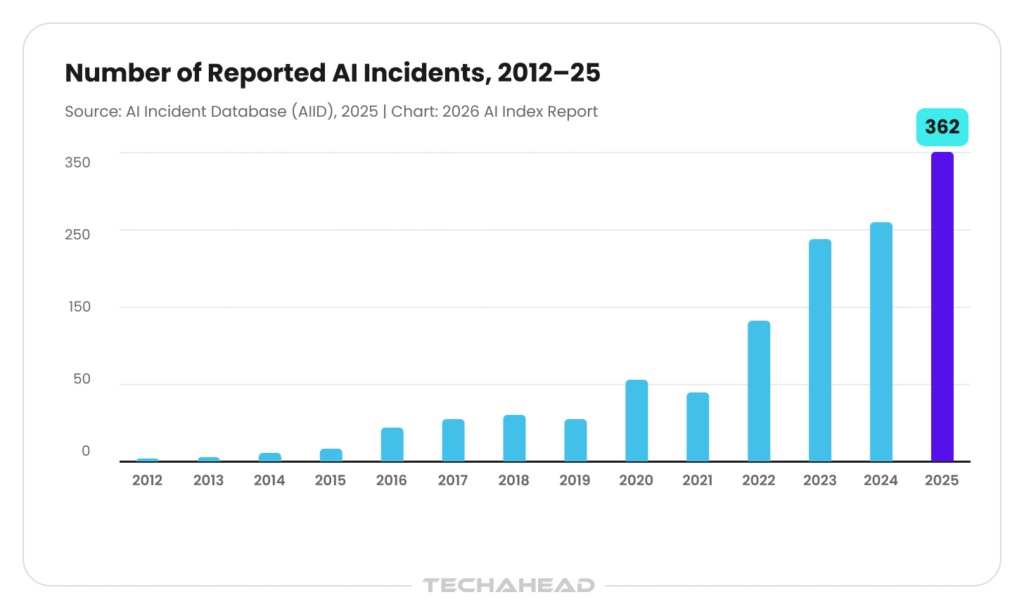
Gartner’s research puts a number on the stakes. At least 30% of generative AI projects get abandoned after proof of concept, with inadequate risk controls ranking alongside poor data quality as a leading cause. McKinsey’s 2025 State of AI survey found that 51% of organizations experienced at least one negative AI-related incident in the past year. These figures describe the current baseline for AI system behavior at enterprise scale. This is why incident response planning for AI has become a board-level topic rather than a purely technical one.
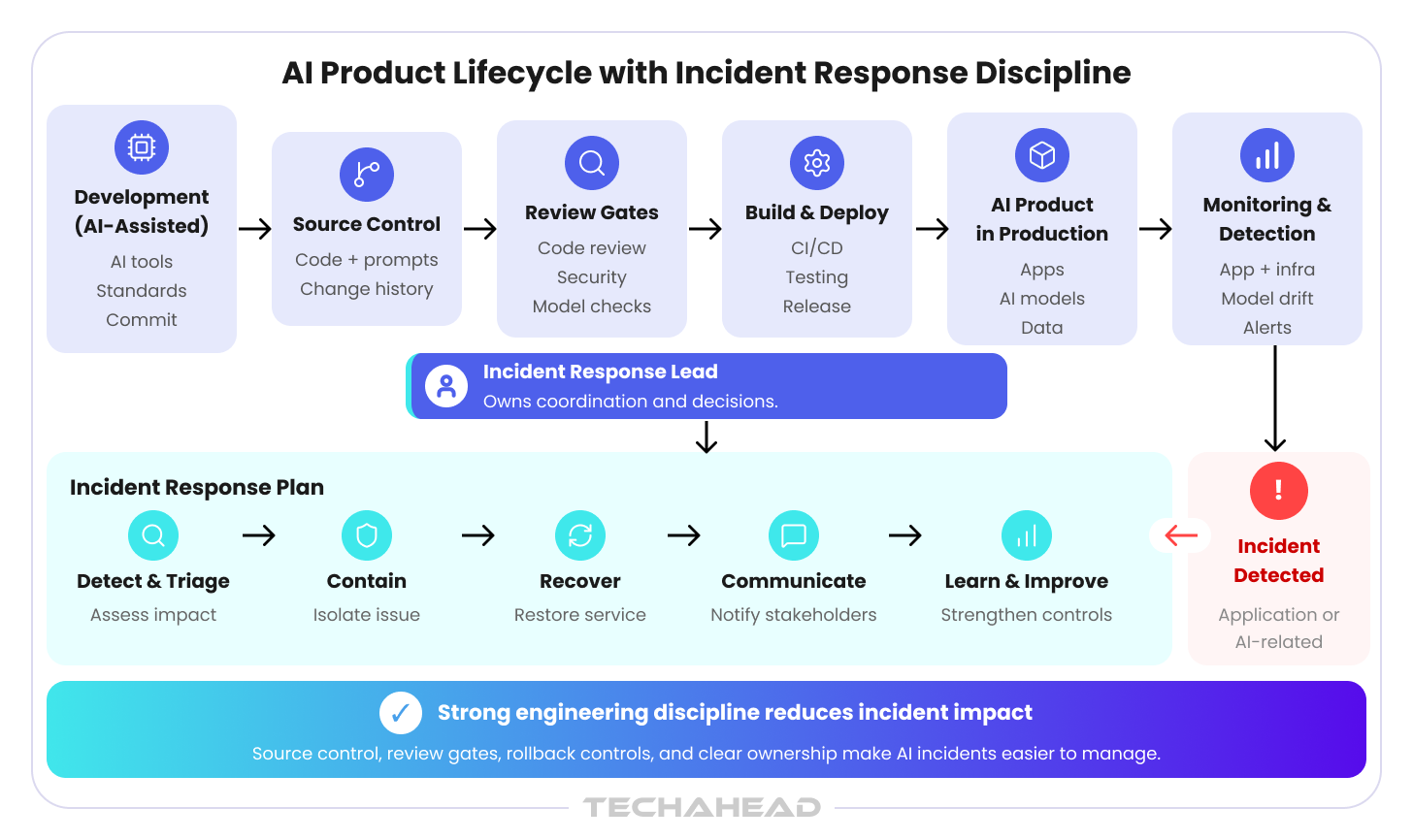
Most conversations about an AI incident response plan open with model-specific failure modes: hallucination, prompt injection, drift. Those matter, and this blog piece covers them. But for a founder or CTO who shipped a product using AI-assisted development in the past two quarters, the more urgent gap sits one level below the model. It is the engineering discipline that used to arrive automatically with a slower build cycle: source control discipline, review gates, rollback controls, and a named incident response lead.
Close that gap first, and the model-specific portion of the plan becomes far easier to execute. Most teams shorten this to an incident response (IR) plan, and the shorthand is fitting: the discipline behind it is identical to any mature cybersecurity incident response plan, applied to a newer kind of system.
Call it the production gap: the distance between how fast an AI-built product reaches customers and how slowly incident response maturity develops behind it. Traditional software took months to ship, and incident response frameworks matured alongside that build cycle almost by accident. A team that spent six months on a codebase generally knew where the fragile parts lived by launch day.
AI-assisted development compresses that timeline into weeks. An AI coding agent or a low-code AI platform can generate the majority of a codebase before a human engineer has read every line of it. That speed is a genuine advantage for time to market, but it also front-loads the kind of AI failures that used to surface gradually over a longer build. It also means the team often lacks the intuitive failure map that used to come free with a longer build. When an incident occurs at two in the morning, nobody has the muscle memory of “this component always breaks under load.”
Traditional software behaves like most deterministic systems: same input, same output, every time. AI models behave differently under the same conditions, which is exactly why operational discipline around them matters even more. Many AI systems reach production before anyone stress-tests them against real-world data drift, and that gap is a risk management problem hiding inside a delivery timeline, rather than a technology problem alone.
TechAhead’s QA and DevOps teams see this pattern recur across production audits of newly launched AI-built products: a functioning application, a capable AI technology stack, and close to zero formal defenses against AI system failures. Source control exists, but review gates are optional. Testing exists, but it rarely runs on every deploy. Monitoring exists, but nobody owns the alert.
This gap is exactly what NIST addressed when it published its Secure Software Development Framework and, more recently, the SSDF companion profile built specifically for generative AI and foundation models. Both documents assume a truth many fast-moving teams have yet to operationalize: security and reliability practices belong inside the build process, rather than bolted on after launch. An application incident response plan built on that foundation looks fundamentally different from a plan drafted only after the first serious incident.
Generic advice says “monitor your AI system.” However, on practical terms, your team face various types of AI failure that you need to consider.
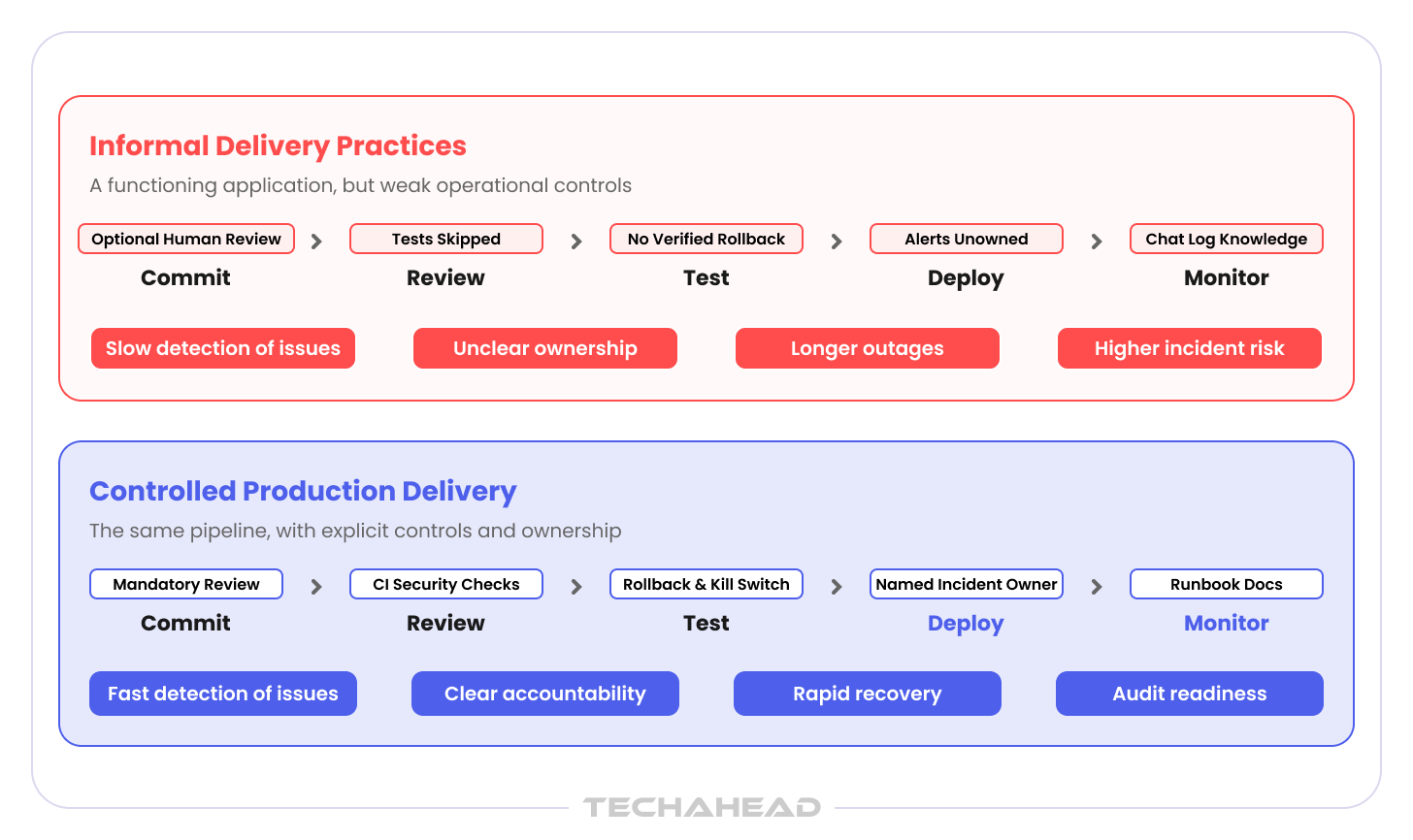
Informal delivery practices rarely stay contained to engineering. Each shortcut becomes a business risk with its own owner and its own price tag.
1. No source control discipline or review gates- untraceable changes
Skip source control discipline and review gates, and every production change becomes difficult to trace. When a security incident, a compliance question, or a customer complaint requires an answer to “who changed what and why,” the honest answer is often nobody knows, and unresolved security incidents compound quickly once that pattern repeats. That gap turns a minor bug into a governance problem the moment an auditor, an enterprise customer, or a regulator asks for evidence.
2. No automated testing or security checks- small defects become large ones
Skip automated testing and security checks, and small defects turn into large ones. AI-built applications need a cybersecurity incident response plan that covers the traditional attack surface as well as the model layer, because each layer, the application, the orchestration logic, and the model itself, is a route for cyber attacks, data poisoning, or malware infections to reach production undetected. Data breaches remain the most expensive category of security incident by a wide margin. IBM’s 2025 Cost of a Data Breach Report puts the global average cost of a breach at 4.44 million dollars, the first year-over-year decline in five years, with organizations taking an average of 241 days to identify and contain one, the fastest pace in nine years. Speed of detection is the variable most within a team’s control, and it is the one informal practices sacrifice first.
3. No deployment or rollback controls- outages instead of fixes
Skip deployment and rollback controls, and a bad release becomes a prolonged outage rather than a five-minute fix. A prolonged outage costs more than engineering time. It disrupts the business operations customers depend on and puts business continuity at risk.
4. No clear incident ownership- response stalls at triage
Skip clear incident ownership, and response stalls at the point of triage. Nobody wants to be the incident commander for a system they inherited rather than built, and without a communications lead, affected users and affected parties hear nothing until the issue reaches a support queue or a headline.
5. No documentation- knowledge walks out the door
Skip documentation, and knowledge transfer depends on one founder’s memory or a chat log with an AI coding assistant. If that person is unavailable when a specific incident hits, response time doubles.
The model-layer version of these risks
There is a model-layer version of every one of these risks too. Model drift silently degrades output quality as real-world data shifts away from the training data a model was built on. Sensitive data can leak through model outputs or logs. AI-generated content can trigger trademark infringement claims or other intellectual property disputes nobody budgeted for. The pattern holds across every recent enterprise AI risk study: teams that manage AI risk formally recover faster and pay less than teams that leave it to chance. These are operational risks with direct financial consequences.
An error occurred the moment it occurred, usually knowable within seconds if the right signal exists. The moment someone notices often lags far behind. Detection for AI systems needs signals beyond standard uptime and error monitoring:
Incident severity varies widely, and treating every incident identically wastes the fastest responders on the smallest problems. A severity matrix, standard practice in mature incident response programs, is almost always missing from AI-specific guidance. Here’s a working version:
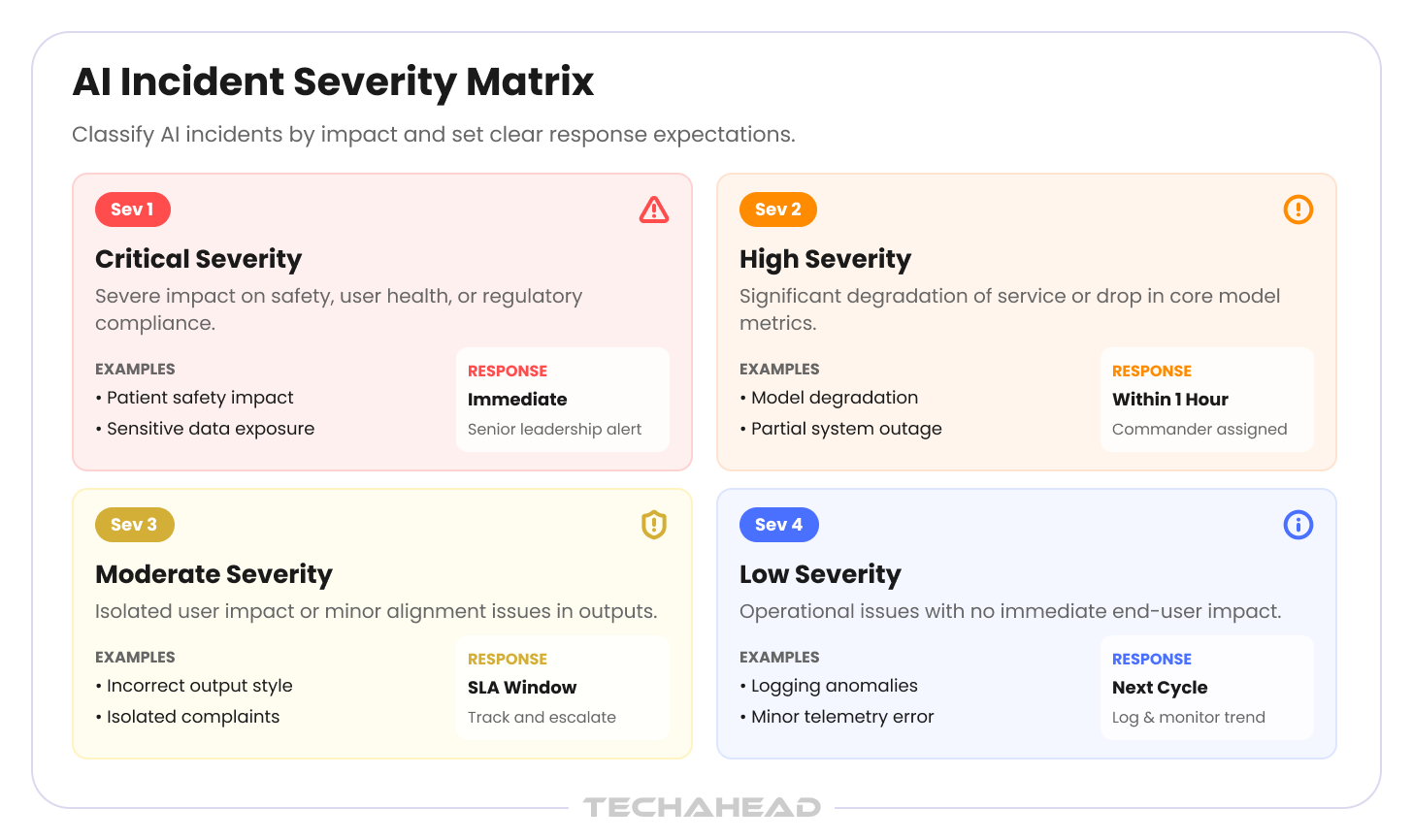
Classification determines everything downstream: who gets paged, how fast, what response protocols kick in, and whether senior management needs to know before the next standup or right now.
Containment actions differ by failure type. A kill switch that disables an AI-generated feature and swaps in a static fallback works for a runaway model. It does nothing for a data poisoning incident, which needs the training pipeline paused instead. Match the containment action to the failure, rather than the other way around.
This is where the incident response team earns its structure, and where someone needs to formally analyze data rather than guess at it. Determine which layer failed: application, orchestration, or model. Assess blast radius: is this affecting every user, or one edge-case prompt. Pull the evidence: logs, prompts, model version, and the specific inputs involved.
Fix the immediate cause, sometimes with human intervention required before an automated remediation is trusted to run alone. For code, that’s usually a patch and a deploy. For a model, it might mean rolling back to a previous checkpoint, adjusting a guardrail, or retraining on corrected data.
Restore normal operation and confirm it holds. Watch the same monitoring signals that caught the original incident, since a rushed fix that looks clean can quietly reintroduce the same failure.
Every incident, serious or minor, gets a post-incident review. Capture the timeline, the contributing factors, the corrective actions taken, and the affected users or systems involved, exactly the record post incident reviews are meant to leave behind.
Security, Compliance, Reliability, Observability, and Ownership. These are the 5 controls you need before handling the live process. Let’s get to know how it functions, in detail.
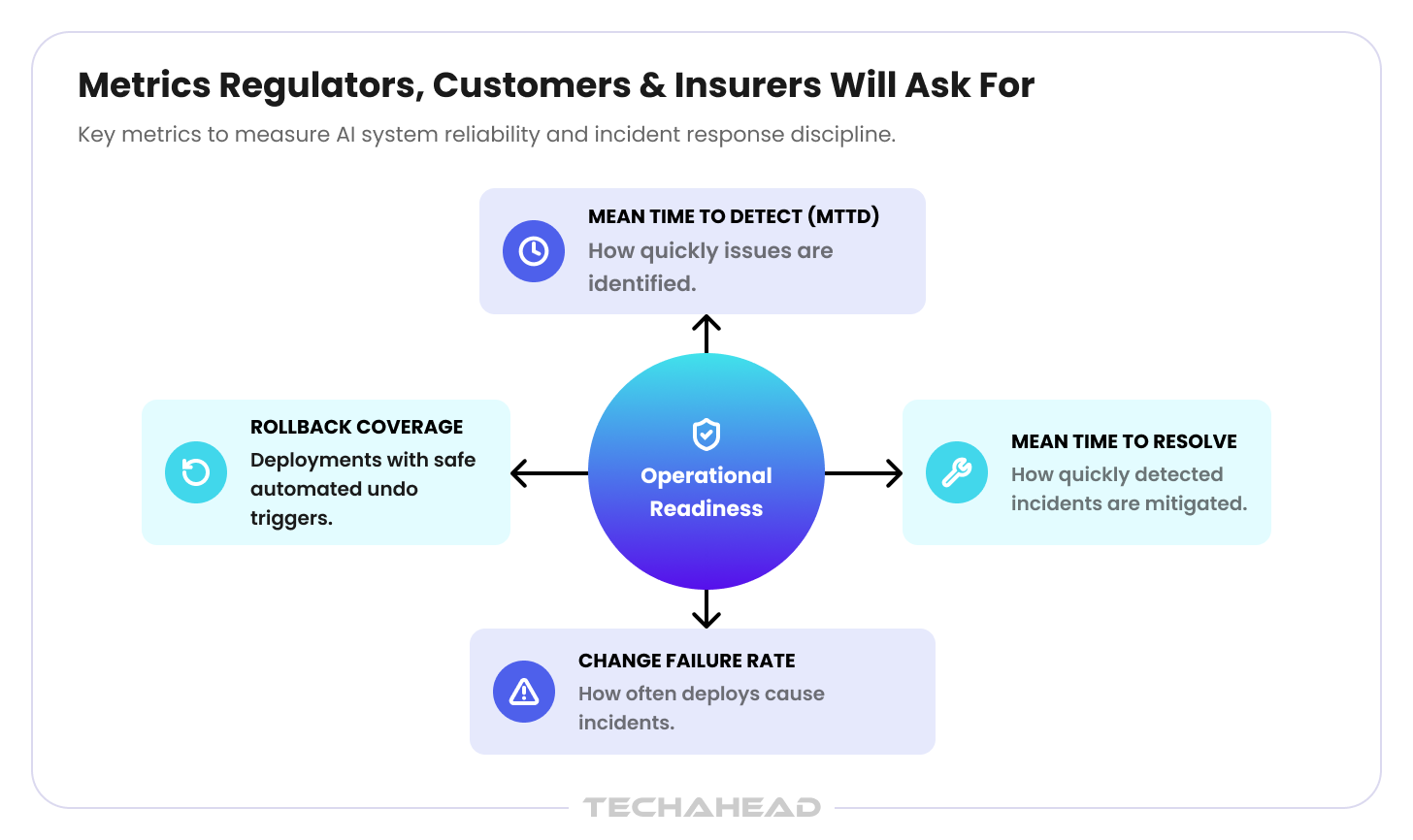
Treat metrics as a commercial asset, as much as an engineering one.
Keep historical data on past incidents, including near misses. Patterns across several minor incidents often reveal the same root cause a single major incident would eventually expose anyway. Retain the underlying evidence too: incident logs, review records, corrective action tracking.
Serious incidents involving AI require the same evidentiary trail as any cybersecurity incident: what happened, who responded, and what changed afterward. Every one of your active incidents should feed that same evidence base from the moment it opens, which is what makes effective incident response repeatable rather than heroic.
3 cases, each teaching a different lesson.
The chat log that couldn’t be recalled.
Within 20 days of Samsung lifting an internal ban on ChatGPT, engineers pasted proprietary semiconductor source code and confidential meeting transcripts into it, three separate times, while trying to fix bugs and save time on notes. None of it was malicious. Samsung banned generative AI tools company-wide within weeks.
The lesson: sensitive data leaves your control the moment it’s typed into a third-party model, and no incident response plan can undo that after the fact. The control has to sit before the input, rather than after.
The demo that cost $100 billion in a day.
During Bard’s public launch demo, the model claimed the James Webb Space Telescope took the first images of a planet outside our solar system. It hadn’t; that credit belongs to the European Southern Observatory’s Very Large Telescope, from 2004. Alphabet’s shares fell roughly 8 percent the same day, wiping out about $100 billion in market value.
The lesson: a hallucination doesn’t need to affect a single customer to be a Sev 1 incident. Reputational and market exposure can outrun any operational harm.
The guardrail that wasn’t there.
A user instructed a dealership’s ChatGPT-powered chatbot to agree with anything he said and to end every message calling it a legally binding offer. He then asked for a $76,000 Chevy Tahoe for one dollar. The bot agreed. The screenshot got over 20 million views before the dealership pulled the chatbot offline.
The lesson: prompt injection is a live risk category rather than a theoretical one. It’s a five-minute exploit against any customer-facing bot without input boundaries and a human approval step for anything consequential.
Enterprise-ready incident response arrives in three phases rather than one sprint, each with a clear maturity milestone.
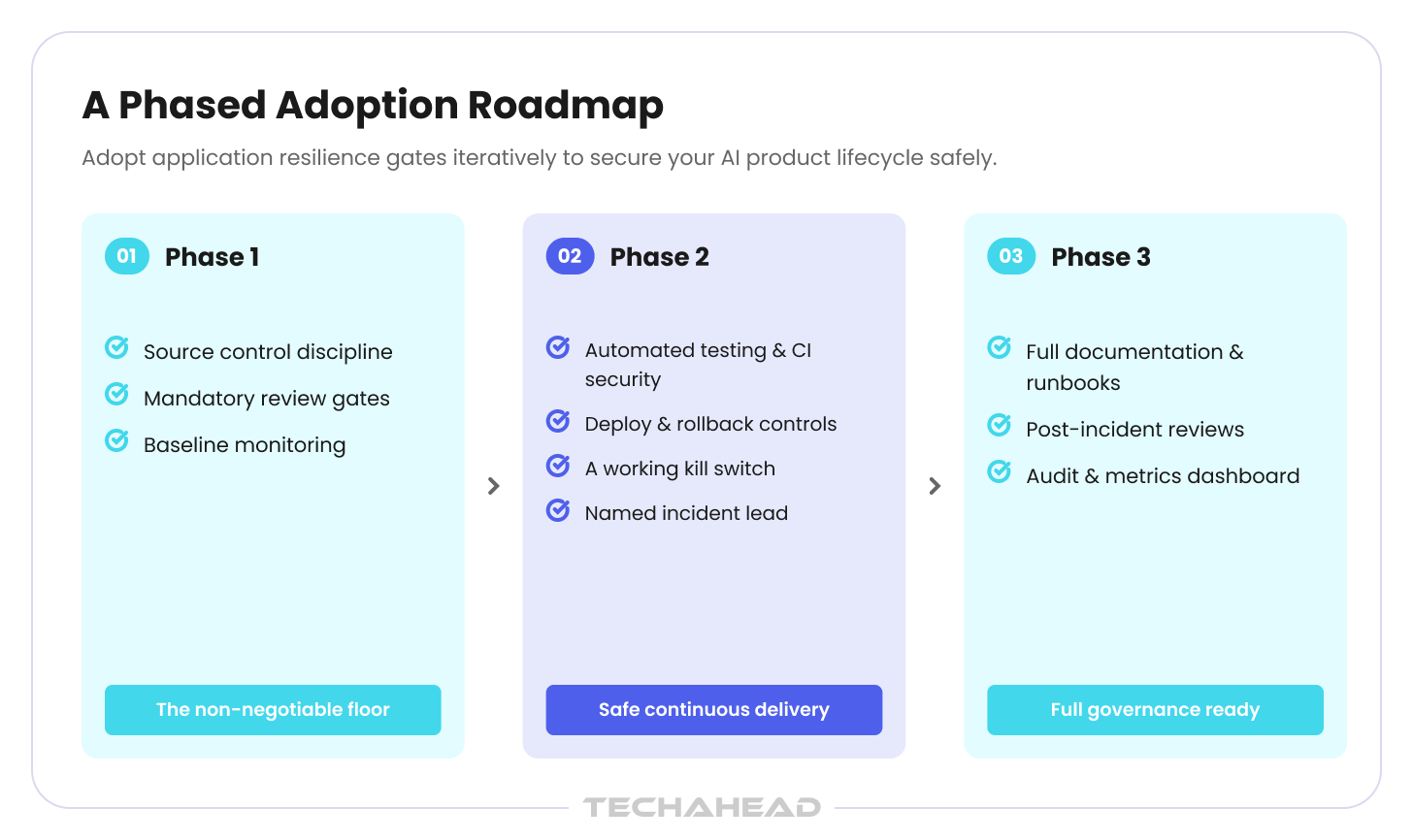
A simple test at every phase: if a serious incident happened tonight, would your team know within minutes, and could it show a regulator or an enterprise customer exactly what happened and what corrective action followed? If the honest answer is uncertain, that’s the roadmap’s starting point.
Most teams find they are further behind Phase 1 than they expected. A short, structured assessment usually answers that question in days rather than months. Read our AI readiness assessment guide to learn more about enterprise-wide AI adoption.
AI presents a genuine operational advantage: faster builds, faster iteration, faster time to market. It also raises the cost of skipping the controls that made incident response possible in the first place.
The organizations getting this right are rarely just the ones with the most sophisticated AI models. They’re the ones that treated their AI-built product with the same operational rigor they’d apply to any production system carrying customer data and business continuity risk, across their whole fleet of production systems, rather than just the newest one.
Speed and readiness are not opposing goals. The fastest-moving teams protect their pace by building the operating model alongside the product, rather than after the first serious incident forces the question.
Where TechAhead fits in
This is the gap TechAhead closes for enterprise teams building AI products under real deadlines. Our QA and DevOps practice runs on the same controls this piece outlines: source control discipline, tested rollback paths, monitoring tied to clear ownership, and documentation that holds up under audit. We operate under SOC 2 controls, are ISO/IEC 27001:2022 certified for information security management, and hold ISO/IEC 42001:2023 certification, the international standard specifically for AI management systems.
Build the operating model before the incident forces it. Request an Enterprise Readiness Assessment.
The speed that got your product to market usually comes at the expense of the safety net a slower build would have given you for free. Teams that spend months writing code by hand tend to develop an intuitive sense of where things break along the way. AI-assisted development compresses that same build into weeks, so the product ships before that instinct exists. An incident response plan replaces that missing instinct with a deliberate process, instead of hoping the team gets lucky until it catches up naturally.
AI incident response plan includes seven parts: severity classification, detection mechanisms, escalation paths, containment steps including a kill switch, an investigation and remediation process, a communications plan for affected users, and a post-incident review. For an AI-built product specifically, add model and prompt versioning and detection signals tuned to model behavior, not just uptime and errors.
For an early-stage team, the first phase (source control discipline, review gates, baseline monitoring) is mostly existing engineering time, typically one to two sprints, not a new budget. However, you need to work with an AI development company that prioritizes building incident response plan during the development process. A fuller program with dedicated on-call rotation, testing automation, and compliance-ready documentation usually runs from $10,000 to $100,000 a year in tooling and time, depending on your company size, tech stack complexity, and industry compliance requirements. Looking at the cost of a single unmanaged data breach at $4.44 million, as per IBM’s 2025 research, building an IR plan worth all the investment.
Response slows down first, since nobody knows who’s supposed to act. Downtime extends because there’s no tested rollback path. If the incident touches customer data or produces a harmful output, there’s no clean record of what happened or what was fixed, which becomes a real problem the moment an enterprise customer, an insurer, or (for EU-facing products) a regulator asks for one.
Added, not rebuilt. Retrofitting is almost always process and ownership work rather than architecture work. Version control discipline and a named response lead can typically go in within a sprint or two. Testing, rollback, and documentation follow over the following weeks, without touching the product’s core structure.
Detection and testing should run automatically: monitoring for anomalies, output regressions, and known failure patterns. Containment can be semi-automated too, a kill switch that triggers past a defined threshold. Declaring an incident and deciding how serious it is should stay a human call. Automating that last step tends to either bury a team in false alarms or, worse, miss the one that actually matters.
“Working” and “ready” aren’t the same test. Ready means you can answer, with evidence, how fast you’d detect a failure, whether you could roll it back in minutes, and who would be responsible for telling affected customers. If those answers are vague or nonexistent, the product is functional but not yet production-ready in the way an incident actually tests for.
We use cookies to ensure our website functions properly, improve performance, and provide a personalized experience. You can choose which types of cookies to allow below.
Required for core functionality such as security, network management, and accessibility. These cannot be disabled.
Help us understand site traffic and user interactions so we can improve performance and usability.
Enable enhanced functionality and personalization such as language or region preferences.
Used to deliver relevant ads, track campaign performance, and measure advertising effectiveness.