


 Copy Link
 Share on X
 Share on Facebook
 Share on LinkedIn
Always Active
Required for core functionality such as security, network management, and accessibility. These cannot be disabled.

Uncover the transformative potential of digital and mobile solutions for your industry.





 Last Updated: Sep 30, 2026
Sep 30, 2026
Last Updated: Sep 30, 2026
Sep 30, 2026  83
83  13 min. Read


Key Takeaways
AI now writes a growing share of the code behind business software. Gartner expects 90% of enterprise software engineers to use AI code assistants by 2028, up from less than 14% in early 2024. Veracode’s 2026 GenAI Code Security Report found that roughly 44% of AI code generation tasks introduced a known vulnerability. IBM puts the average cost of a data breach at a record $4.99 million globally and $11.5 million in the United States.
Together, these figures describe a clear picture. Adoption is rising quickly, security performance is still catching up, and the financial impact of a single incident is high. For organizations, that raises practical questions. Which parts of our product involve AI-generated code? Who reviews it? How do we protect sensitive data and API keys along the way?
The CI/CD pipeline that carries every code change to production is the most effective place to answer them. This guide explains building a secure CI/CD pipeline for AI-generated code in business terms, so your teams keep the speed, and your leadership gains confidence in what ships.
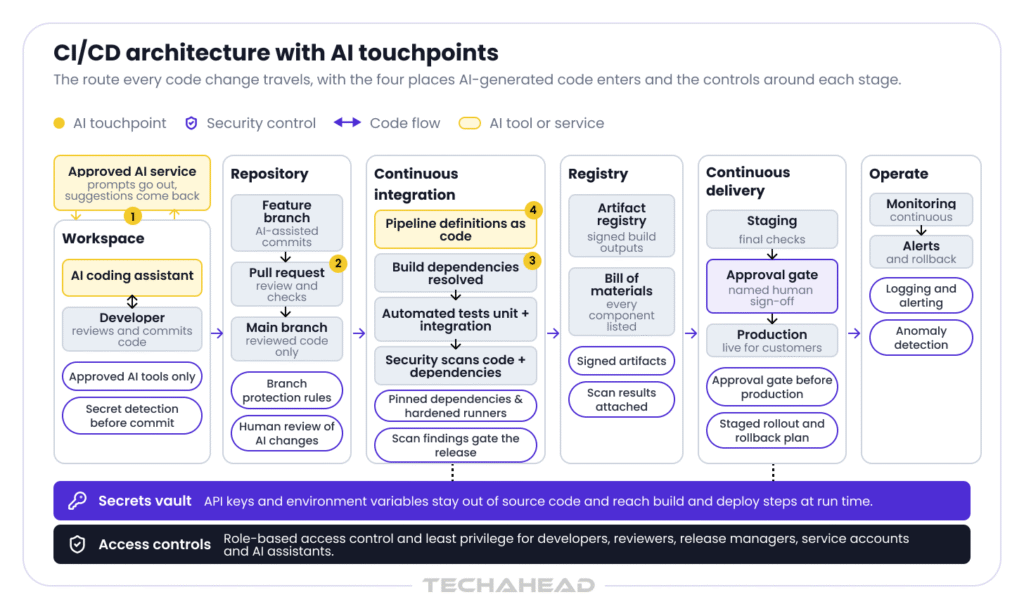
A CI/CD pipeline is the automated route that carries a code change from a developer’s screen to your live product. Continuous integration merges and tests each change as it arrives. Continuous delivery prepares approved changes for release, and continuous deployment sends them to production environments automatically. Together they form the backbone of modern software delivery and DevOps automation strategies.
AI-assisted development adds a new contributor to that route. AI suggested code arrives through the same pull request as human work, in greater volume and at higher speed. Review capacity grows steadily while code output grows quickly, and that difference is where quality and security can slip. A well-built CI/CD pipeline closes the difference, because it applies one standard to every change, every time, at machine speed.
Three reasons make this a leadership topic as well as an engineering one.
Modern AI models are remarkably good at helping engineers write code that runs. Passing a demo is a different bar from meeting a security standard, and the two are easy to confuse. Working code and secure code are separate standards, and only the second protects the business.
An early Stanford University study illustrates the point well. Developers who used an AI assistant were more likely to believe their code was secure, even in tasks where the assisted group produced more security vulnerabilities. The tools have advanced since then, and the lesson holds: confidence and correctness are separate things, which makes independent, automated verification so valuable.
Three factors explain the gap.
Traditional security tools and manual processes were built around a steadier pace of human authorship. Periodic audits and end-of-cycle reviews leave a growing window between the moment code is written and the moment someone examines it. The practical answer is to embed verification in the development process itself, so that checking keeps pace with generation.
Code quality follows the same principle. Consistent code quality across a large codebase depends on shared standards, automated tests and review on every pull request. AI coding assistants amplify the process around them, so a disciplined development process produces strong results at speed.
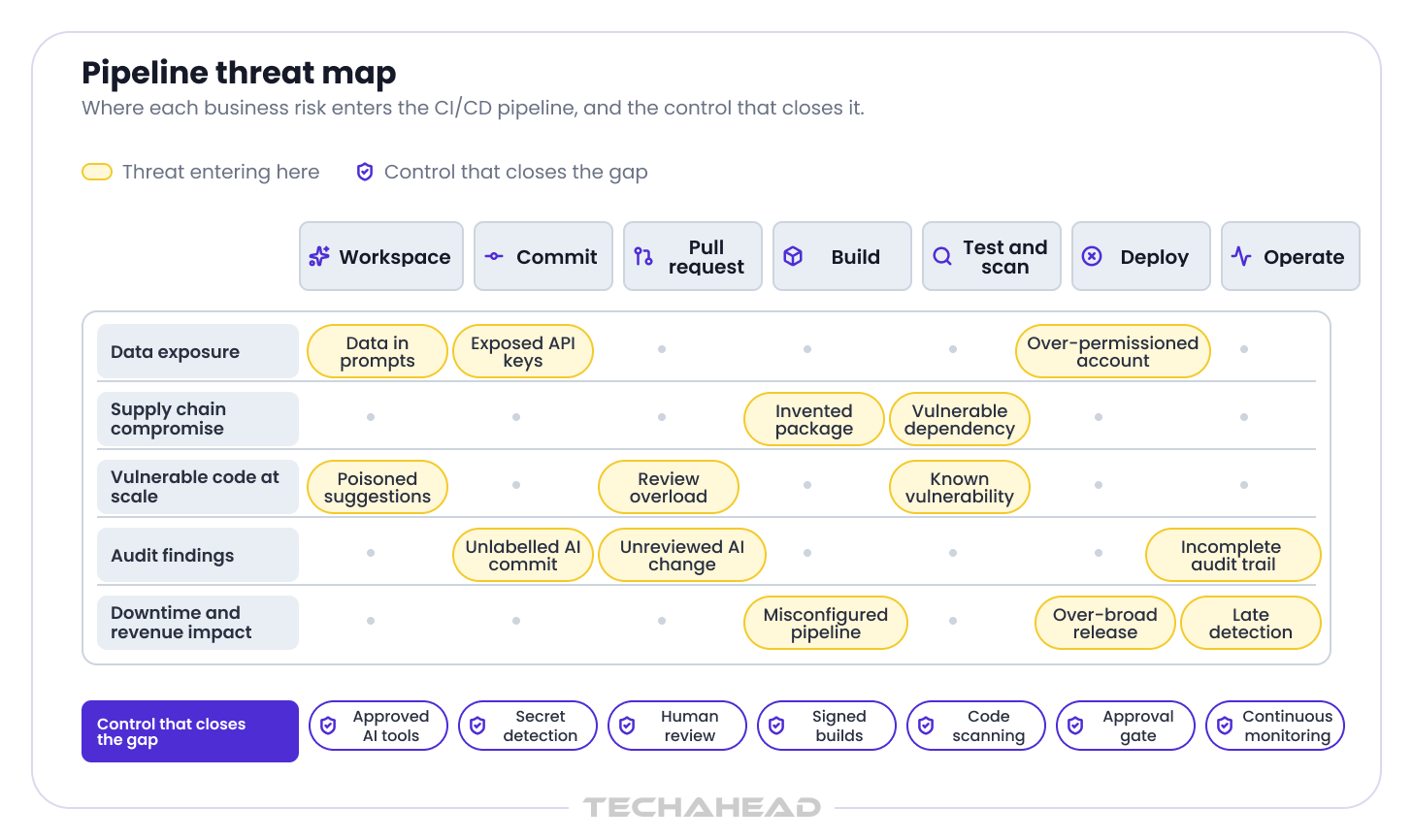
Security risks in AI-assisted development fall into five groups. Each one carries a business consequence, which makes these significant risks relevant to the executive team as well as to engineering.
Shadow AI deserves the first mention. It describes employees using unapproved AI tools, often through personal accounts. Sensitive data, API keys, and internal source code can travel into prompts that sit outside the visibility of your security teams, and leaders lose the ability to answer a simple question: where did our information go?
| Risk | What it looks like | Business impact |
| Shadow AI | Unapproved AI tools receive sensitive information | Data exposure and higher incident cost |
| Malicious code and dependencies | Assistants suggest outdated or invented packages, and attackers publish malicious code under those names | Software supply chain compromise |
| Data poisoning | Tampered training data or machine learning models shape what an assistant suggests | Vulnerable code delivered at scale |
| Compliance exposure | AI generated changes reach customers with an incomplete audit trail | Audit findings and delayed enterprise deals |
| Production disruption | Unreviewed AI generated changes reach production environments | Downtime and revenue impact |
Attackers study these routes closely. Potential attack vectors now include poisoned training data, tampered dependencies, and prompts crafted to steer an assistant toward vulnerable code. The OWASP Top 10 for LLM Applications catalogs these patterns, including prompt injection, supply chain weaknesses, and data and model poisoning, and it gives leaders a shared vocabulary with their technical teams. Emerging threats such as these reward organizations that assess risk continuously and keep their security measures current.
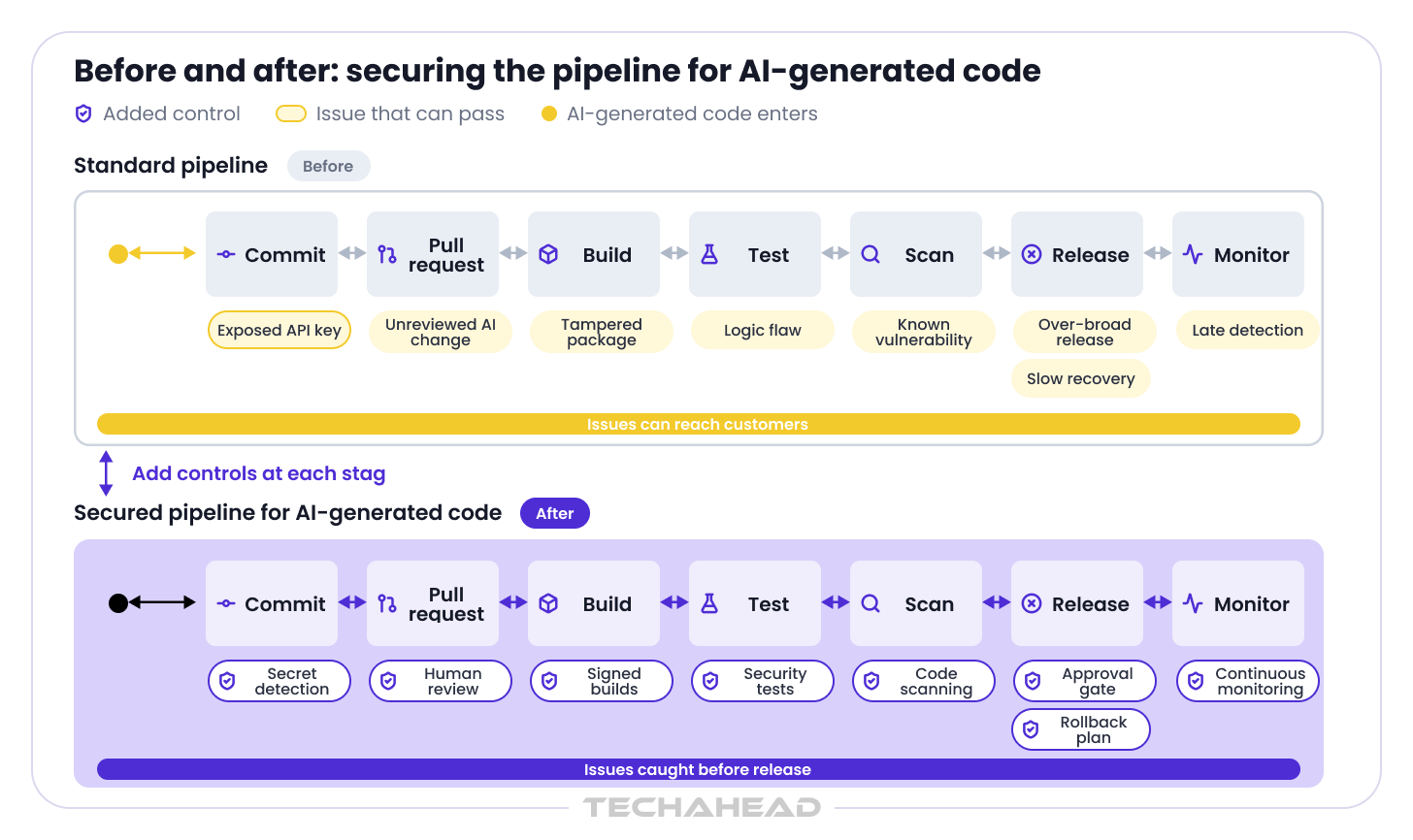
Building a secure CI/CD pipeline for AI-generated code comes down to six checkpoints. Each answers a leadership question, and each relies on automated tools, so that speed stays intact. The NIST Secure Software Development Framework offers a widely used reference for these practices, including analyzing code to identify vulnerabilities, testing executable code, and protecting build environments with least privilege.
The question: does a qualified reviewer see every AI generated change?
Require a pull request for every change, label AI-assisted work, and run secret detection on each commit so that API keys and credentials stay out of source code. This stage protects sensitive data at the earliest point.
The question: is what we ship identical to what we reviewed?
Hardened build processes, pinned dependencies and signed artifacts protect the organization from tampered components, malicious code hidden in third-party packages and known vulnerabilities.
The question: does the software behave as intended, including under unusual input?
Unit tests and integration tests confirm behavior on every change through continuous integration, helping DevOps teams maintain software quality at scale.
The question: can we identify vulnerabilities before release?
Static analysis reads new code, dependency scans flag known vulnerabilities, and configuration files and infrastructure definitions receive the same scrutiny. Findings reach the responsible engineer within minutes, so security issues get resolved while the context is fresh.
The question: who authorizes release, and how large is the deployment risk?
Approval gates, staged rollouts and rollback plans match the level of review to the level of exposure. Low-risk changes flow automatically, and changes to authentication or payment logic receive named human sign-off. This is how teams assess risk in a repeatable way
The question: how quickly will we learn if something changes in production?
Logging, alerting, anomaly detection, and continuous monitoring are foundational DevSecOps practices that shorten the time between an event and a response. This keeps the cost and disruption of any security incident contained. A rehearsed response process turns monitoring into action.
Pipeline definitions and pipeline configurations deserve the same care as product code, since AI assistants increasingly write them too. Version control, peer review and policy checks keep the pipeline itself trustworthy across the software lifecycle.
Leaders benefit from a one-page view of all this. Four measures tell the story: the share of AI generated changes that receive review, the time taken to resolve scan findings, the number of secrets caught before release, and the time needed to roll back a release. Together they give executives and security teams a shared picture of the organization’s security posture.
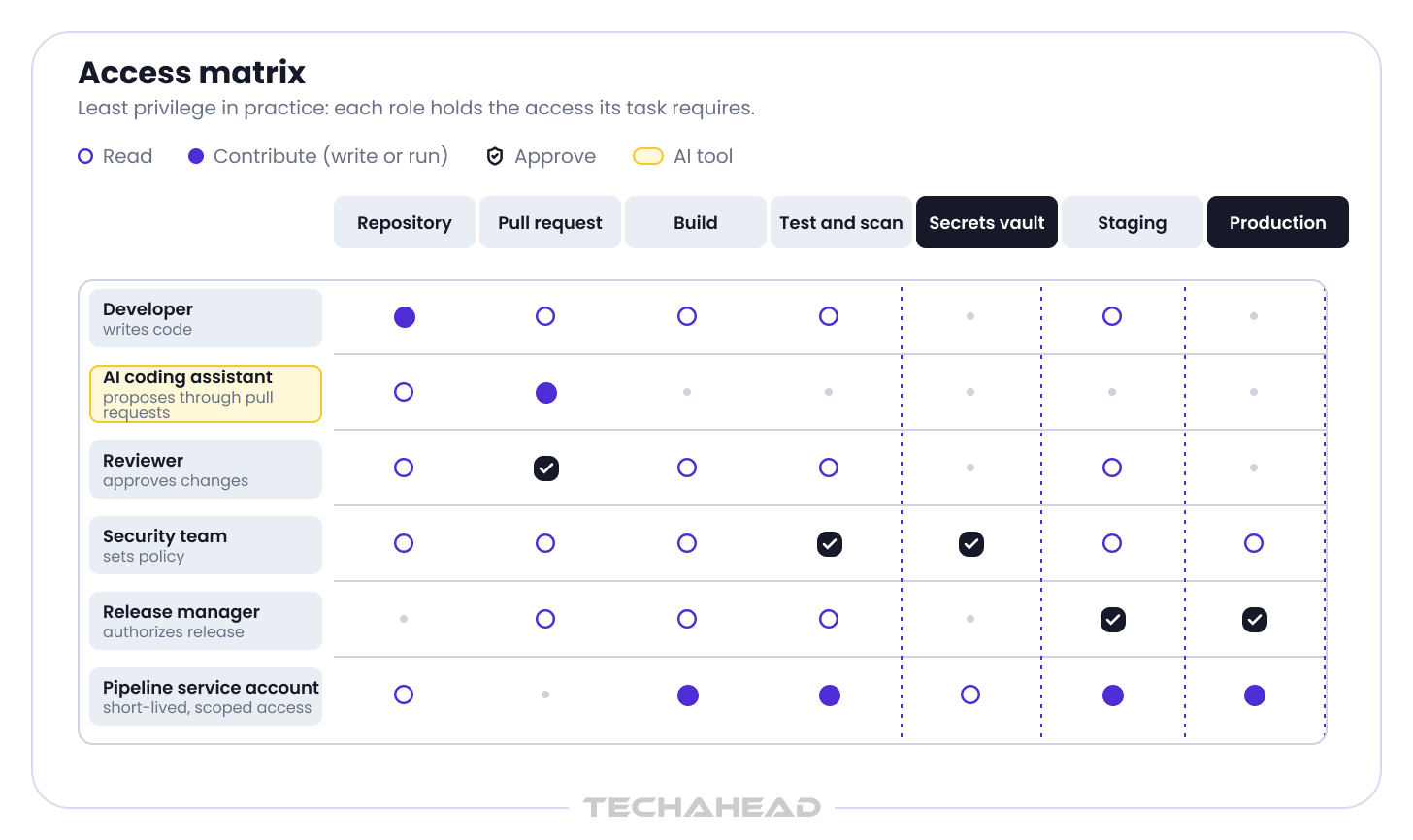
These governance controls are a critical part of a mature DevSecOps operating model, ensuring security remains integrated throughout the software development lifecycle. Technology sets the pace, and governance sets the direction. Four practices give leadership control while teams keep moving.
Role-based access control. Assign permissions by job function, so developers, reviewers, release managers and AI systems each hold the access their role requires.
Least privilege access. Every person, service account and AI assistant receives the minimum privilege access needed for its task, supported by short-lived tokens and multi-factor authentication mechanisms. This is central to preventing unauthorized access to cloud platform accounts and production environments.
Secrets management. Store API keys and environment variables in a managed vault and inject them at run time, which keeps sensitive information out of code repositories.
Written security policies. Publish an approved list of AI tools, rules on what sensitive data may enter a prompt, a requirement to disclose AI generated changes in the pull request, and a named executive owner. Cross-functional ownership works best, with engineering, security, legal and the business owner reviewing the policy together.
Frameworks such as NIST SSDF, the OWASP Top 10 for LLM Applications, and SOC 2 give the organization a shared vocabulary for these security measures. Teams building custom AI apply differential privacy techniques and careful handling of training data to protect customer information inside machine earning models, and they add safeguards against data poisoning to keep those models dependable.
Strong security processes of this kind improve the overall security posture and give security teams a clear view across the development lifecycle, including the AI systems that contribute to it.
These questions turn strategy into a practical checklist. Clear, quick answers indicate a strong security posture, and detailed follow-ups point to the next improvement.
1. How do we identify which code changes involve AI assistance?
2. Which AI tools are approved, and how do we monitor their use?
3. What happens automatically when an API key appears in a commit?
4. Which automated tests and security scans run before every release?
5. Who approves changes to authentication and payment logic?
6. How is access to production environments granted and reviewed?
7. How quickly can we roll back a release?
8. What is our plan for responding to security incidents, and when did we last rehearse it?
TechAhead is an AI development company that builds advanced web and mobile applications and custom AI software for businesses across industries. Our teams design CI/CD pipelines with security built into every stage, from secret detection and code scanning to role-based access control and continuous monitoring, so allowing teams to use AI tools becomes a source of confidence for leadership. A pipeline security assessment is a practical first step. It maps your current controls, highlights quick wins and produces a phased roadmap.
AI is now a permanent contributor to software delivery, and leaders who pair its speed with a secure pipeline gain a durable advantage. Building a secure CI/CD pipeline for AI-generated code lets your organization ship faster, protect customer trust and scale AI development with clarity.
Contact us to start with a pipeline security assessment.
It can be, when it passes the same checkpoints as every other change. Automated tests, code scanning and human review inside the pipeline give leadership the confidence to release.
AI coding assistants can produce functional code that still contains security vulnerabilities, outdated patterns, or risky dependencies. Automated security scanning and human review help verify that generated code meets the organization’s security standards before release.
A phased approach works well. Core controls such as secret detection, code scanning and access controls come first, followed by policy automation and continuous monitoring. Timelines depend on the size of your code repositories and existing tooling, and an assessment provides a precise plan.
Organizations reduce shadow AI risks by maintaining an approved list of AI tools, defining clear policies for handling sensitive data, monitoring usage, and requiring disclosure of AI-assisted code changes during reviews.
A secure CI/CD pipeline should include static application security testing (SAST), dependency scanning, secret detection, configuration analysis, and infrastructure security checks. Running these scans automatically helps identify issues before deployment.
Secret detection tools should run on every commit and pull request to identify exposed credentials before they enter source repositories. Organizations should also store secrets in dedicated vaults rather than hard-coding them into applications.
Organizations should establish approved AI tool lists, define rules for handling sensitive information, require disclosure of AI-assisted work, and assign clear ownership for AI governance policies.
Unapproved AI tools can create visibility gaps and increase the risk of sensitive information being shared outside approved environments. This can lead to data exposure, compliance concerns, and higher incident costs.
We use cookies to ensure our website functions properly, improve performance, and provide a personalized experience. You can choose which types of cookies to allow below.
Required for core functionality such as security, network management, and accessibility. These cannot be disabled.
Help us understand site traffic and user interactions so we can improve performance and usability.
Enable enhanced functionality and personalization such as language or region preferences.
Used to deliver relevant ads, track campaign performance, and measure advertising effectiveness.