


 Copy Link
 Share on X
 Share on Facebook
 Share on LinkedIn
Always Active
Required for core functionality such as security, network management, and accessibility. These cannot be disabled.

Uncover the transformative potential of digital and mobile solutions for your industry.





 Last Updated: Oct 7, 2026
Oct 1, 2026
Last Updated: Oct 7, 2026
Oct 1, 2026  107
107  19 min. Read


Key Takeaways
You can build an app with Claude Code and reach users before you have answered a harder question: can the product meet the security and operational requirements of larger customers or a wider rollout as usage grows?
The question often arrives at an inconvenient time. A potential customer asks about access controls and data separation just as you are adding integrations. Or your live product starts showing slow requests, fragile deployments, or support issues that were manageable with its first users. The application works, but you have not yet tested whether its protections hold across different users, organizations, and failure conditions.
The sensible next step is a production-readiness assessment of the application you have.
At TechAhead, we use it to establish which risks need immediate containment, which parts of your codebase can be strengthened, and which architectural decisions need more substantial work. We can then help you implement and verify the prioritized changes in your existing product. Claude Code can help you build and review code; it cannot, by itself, establish that your deployed product meets a particular customer’s requirements. Anthropic describes its automated security review as a complement to existing security practices and manual review.
Gartner predicts that by 2027, more than 65% of engineering teams using agentic coding will treat the IDE as optional, shifting more governance and validation to automated platforms.
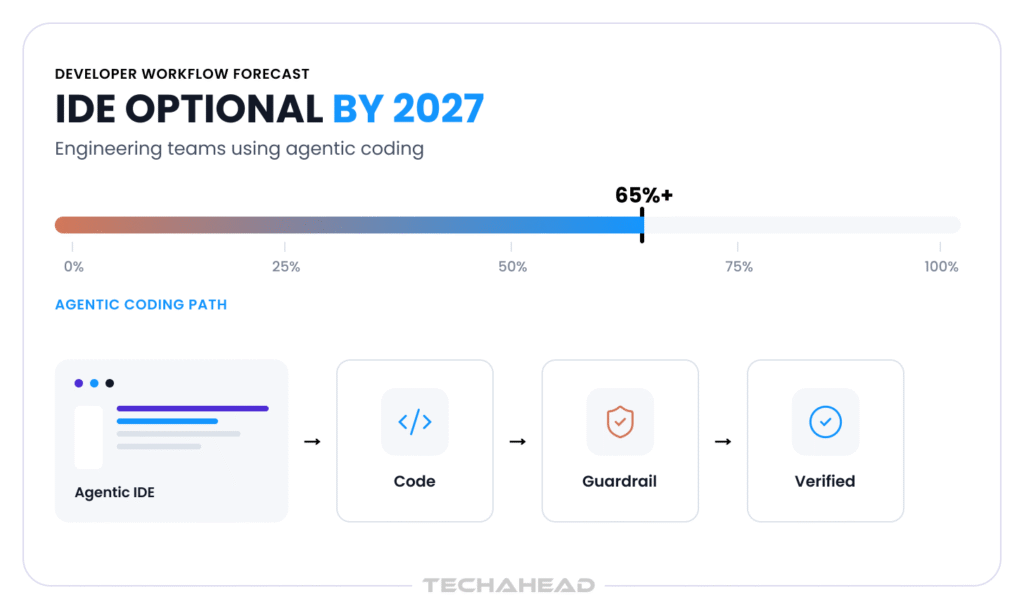
That is a forecast about teams using agentic coding, not a measured security outcome for Claude Code-built apps. For you, it reinforces a practical point: as building changes, ownership of review and release still needs to be explicit.
We explain how to make that assessment and turn it into a prioritized engineering roadmap. It applies whether Claude Code helped build most of your app or only accelerated parts of its development. The app itself does not need to contain AI features.
Related: How to Harden an Application Built with Cursor App
Whether a larger organization is considering your app or your own team is reviewing a live product, “is it secure?” is too broad a question. The people responsible for security and operations need to understand where data goes, who can access it, how changes reach production, and what happens when something fails. You need to know whether you can answer those questions with evidence from the current system.
Before we review individual files, we define the decision the assessment must support:
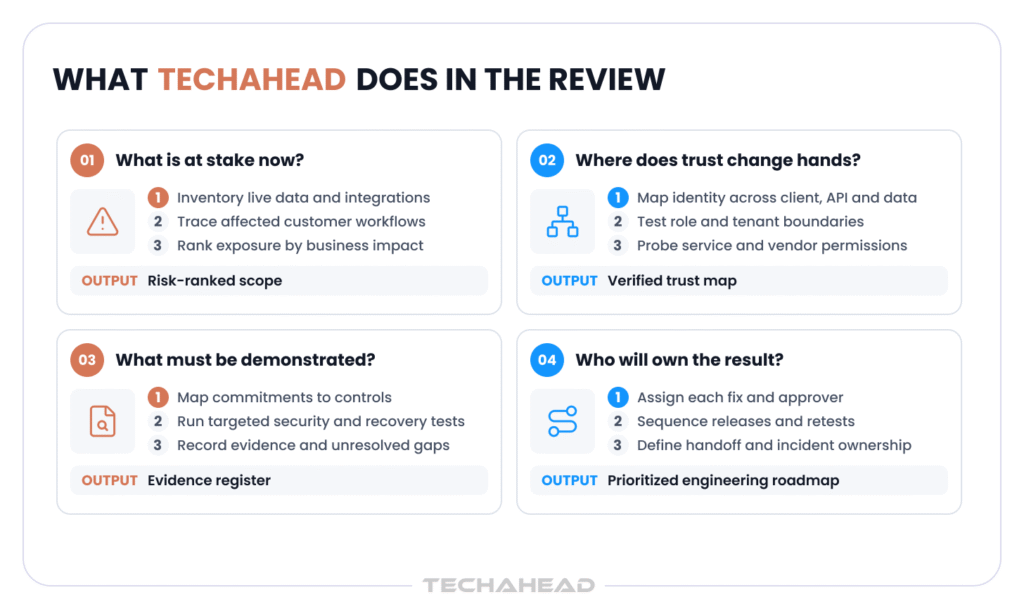
We document what we inspected, what we tested, what remains unknown, and what decision the findings support. OWASP’s Application Security Verification Standard can help us define testable technical security requirements for web applications; the appropriate depth still depends on your product’s risk and customer commitments.
If you are a founder, this establishes what you can promise your next customer or commit to in a wider rollout. If you lead engineering, it gives you a bounded set of claims to verify rather than a vague mandate to “make it enterprise grade.” We also identify where an answer depends on a future change so nobody mistakes a plan for a completed control. That distinction is part of the value of an independent engineering assessment: we tell you what is already working as well as what requires intervention.
Also Read: Cost to Make a Vibe Coded App Production Ready
A Claude Code app security review should examine your application as users and administrators actually experience it. Reading source code matters, but an access rule can look plausible in a repository and still fail in the deployed environment. We trace important workflows through code, configuration, infrastructure, and tests, then reproduce the highest-risk behaviors in a controlled environment.
Even when asked directly to look for security issues, an AI model can miss them. In a 2026 peer-reviewed study of 56 manually confirmed vulnerabilities across 114 source files, Claude Opus 4.1 identified 45 and fixed 43. The researchers tested the model on source files, not Claude Code or a deployed app, so those results are not a predicted failure rate for your product. They do show why we verify findings independently and test whether protections hold in the running application.
Related: Best AI Models for Developers
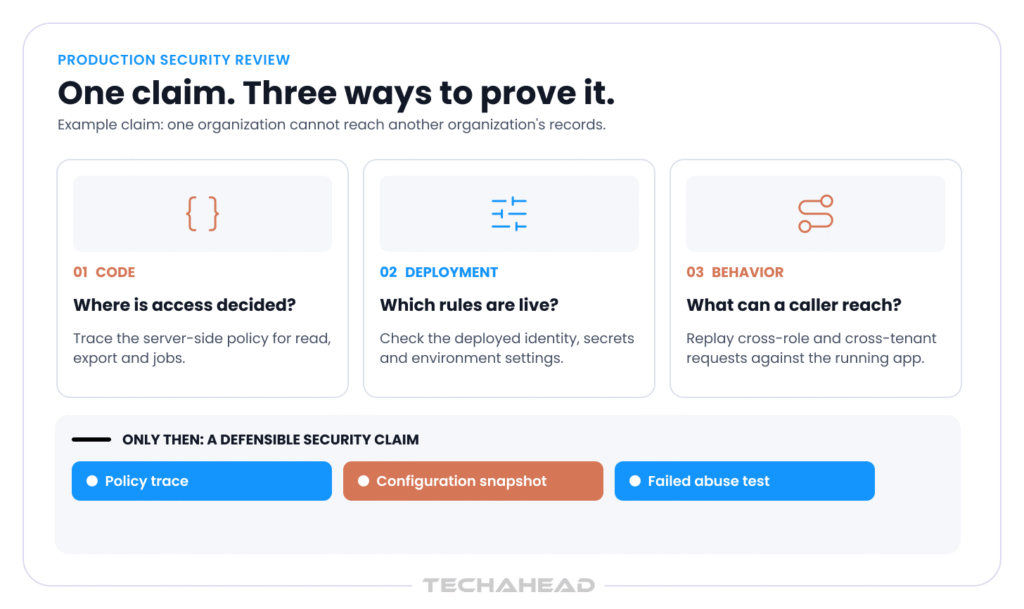
We list the roles your product really has: end user, organization administrator, support operator, service account, and any others. Then we test what each role can read and change through the UI and through direct API requests. A hidden button is not an authorization control.
For example, if a team member can view an invoice only within their organization, we change the invoice ID and organization ID in a test request. We check whether your server derives authority from the authenticated session and enforces the object’s ownership, rather than trusting an ID supplied by the client. We include invitation, password-reset, account recovery, and administrator workflows; these paths often sit outside the happy-path demo.
If a larger customer or internal rollout requires single sign-on or user provisioning, we assess your existing identity design before you commit to either feature. The work may be a bounded integration, or it may expose deeper assumptions about how accounts and organizations are represented.
In a multi-tenant app, we identify how tenant context enters every request, query, file operation, job, cache entry, export, and webhook. We test with two distinct organizations and a mix of roles, trying to read and modify the second organization’s resources through direct requests, search endpoints, background tasks, and downloaded files.
The failure may be a missing query filter, an overprivileged service credential, or a support workflow that bypasses tenant checks. The remedy depends on the data model and access paths. OWASP’s multi-tenant guidance emphasizes enforcing isolation throughout the application and testing for cross-tenant access, rather than assuming a tenant identifier in the UI provides protection.
We identify where credentials are stored or exposed across repositories, configuration files, build settings, runtime environments, logs, browser bundles, and relevant local development tools. Secrets should be blocked before they are committed or transmitted. We identify each third-party integration’s permissions and whether you can rotate a credential without interrupting unrelated customers. We check outbound requests, incoming webhooks, file uploads, and administrative APIs for validation and least-privilege access.
Must Read: An Ultimate Guide to Developing Robust APIs
A useful review does more than report “a secret was found.” We establish whether the credential was exposed, what it could access, whether you must revoke it, how its replacement reaches production, and how you can prevent a repeat; secrets must never be hardcoded in source control. Store API tokens and other secrets in secure keychains rather than plaintext configuration files. Store API keys securely in environment variables or dedicated secrets managers. Dependency and software-supply-chain review belong here as well. OWASP’s guidance for AI-assisted coding calls out dependency, tool, and rules-file risks in the development process.
We review your deployment history, environment separation, database migrations, backups and restoration, monitoring, alert ownership, and rollback procedures. We test the paths that matter to your customers: login, a core transaction, data export, and recovery after a failed deployment. We measure performance using realistic data and concurrency before deciding that the architecture has a scaling problem.
These checks are particularly relevant if your app is already live. A flaw in a deployment or recovery path can affect your customers even when no attacker is involved. Evidence might include a restore exercise, a release rollback, a load-test result with defined assumptions, or an incident runbook your team has actually used. Where you lack that evidence, we distinguish a documented procedure from one that has been exercised. TechAhead’s role can extend from finding a gap to improving the deployment or monitoring path and verifying that your team can operate it.
Consider Ventus Networks. Its teams were managing cellular and IoT devices across multiple carriers through disconnected monitoring systems, creating visibility gaps and inefficient troubleshooting. We engineered Genesis, a unified operations platform with real-time device monitoring, diagnostics, integrated ticketing, remote updates, and three-tier access control. The resulting system centralized management of thousands of devices and gave operations teams a clearer way to detect and investigate problems. That is the kind of engineering depth an expanding app needs when its first working deployment becomes an ongoing operational responsibility. |
We also examine how you make changes. Claude Code can read files, edit code, run commands, and connect to development tools. Those capabilities make your working environment and review process relevant, especially when you built the app quickly. Prompt injection is a significant risk in AI coding assistants, and AI assistants can leak sensitive information when malicious instructions are embedded in trusted inputs.
Also Read: Building a Secure CI/CD Pipeline for AI-Generated Code
We check whether you have defined who can approve changes, how generated changes receive human review, which repositories and external tools are connected, and whether development sessions have claude code access to production credentials or sensitive files.
We review permissions through the permission system, including allow, ask, and deny rules, project instructions such as CLAUDE.md, hooks, and MCP servers where used. Deny rules take precedence over ask and allow rules, so deny rules should be audited for sensitive paths. We also verify that file reads, edits, and shell actions follow least-privilege defaults. We restrict AI tool operations to specific project subdirectories to enforce working directory boundaries. We treat instructions as guidance to the agent and verify important restrictions with actual permissions, isolation, and release controls. We also recommend running sessions in containers to limit lateral movement and network access.
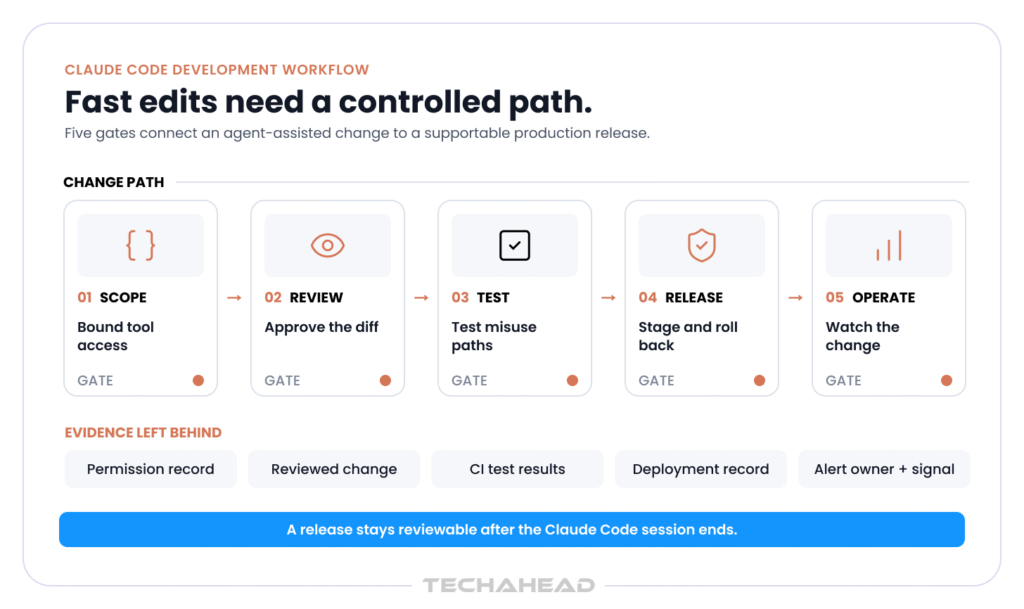
Claude Code’s /security-review may surface useful code findings. We still check your deployed configuration, customer-specific access rules, operational practices, and the business logic the tool may not know. We want you to retain development speed while making consequential changes reviewable and repeatable. If you continue to use Claude Code, we can fold the resulting test cases and approved patterns into the team’s normal development workflow.
A list of vulnerabilities does not tell you what to do on Monday. We connect each finding to an affected workflow, realistic impact, verification method, owner, and proposed change. Together, we rank work using exposure, consequence, exploitability, customer commitments, and dependency on other fixes.
A severe-looking issue in an unreachable test component may come after a less dramatic cross-tenant access flaw affecting live users.
| Decision | When it fits | Example of the next engineering move |
| Contain now | A credible exposure affects current customers or sensitive data. | Restrict the route or integration, revoke and rotate a credential, preserve evidence, then test the containment. Follow the organization’s incident process if an incident is suspected. |
| Harden the existing system | Core architecture is sound and weaknesses have bounded fixes. | Add server-side authorization, tests across roles and tenants, safer deployment controls, and verified recovery. |
| Replace a weak subsystem | A particular component blocks requirements while the rest of the app remains usable. | Redesign identity, tenant-aware data access, or a brittle integration behind a clear interface; migrate in stages. |
| Re-architect deliberately | Security or scale problems arise from assumptions spread throughout the system. | Define target boundaries and a staged transition that preserves essential workflows and data. |
| Pause an enterprise rollout | A required control cannot yet be demonstrated or a critical finding remains unresolved. | Close the gap and gather evidence before making a customer commitment. |
None of these decisions follows automatically from the fact that you used Claude Code. We ask whether your current system can support the required behavior and whether you can maintain that behavior through future releases. If we recommend replacing a subsystem, we should show you the affected interfaces, data migration, validation plan, and release implications. “Rebuild” cannot stand in for that explanation.
If your product is gaining enterprise traction, the most useful outcome is a production-readiness assessment paired with a prioritized engineering roadmap. We would shape the work around five connected steps:
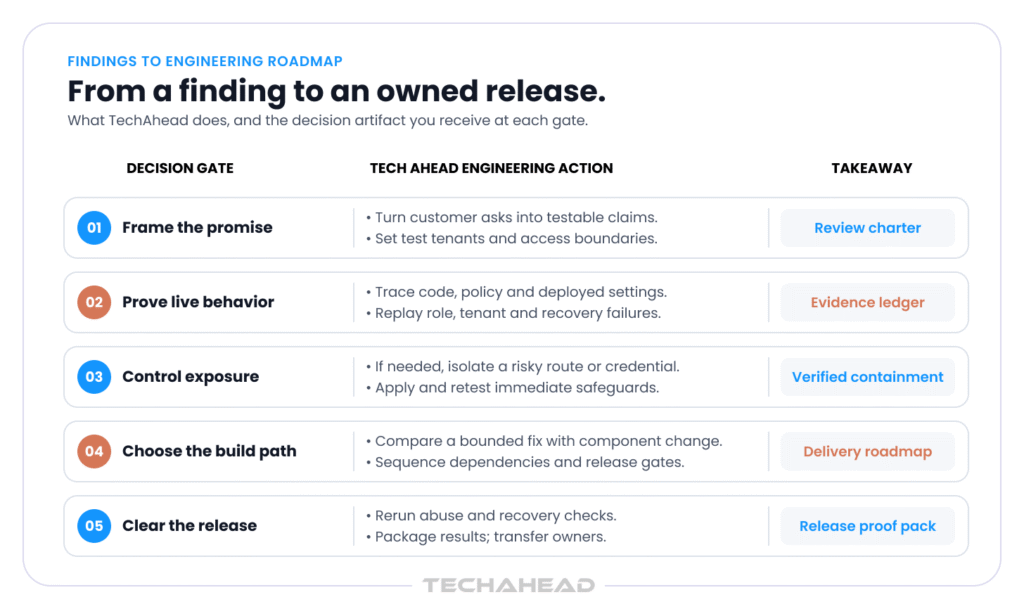
The scope and order change with the number of tenants, sensitivity of data, breadth of integrations, maturity of tests, deployment setup, and whether your app is already serving customers. If you face an active cross-tenant exposure, we address that before a future-facing platform improvement. If your immediate need is a customer security review, we first establish which requested controls exist and which claims need evidence. The assessment should produce a specific sequence, not a universal timetable.
You should be able to challenge the roadmap. Ask which finding blocks a customer commitment, which change reduces risk without changing the architecture, which work depends on a migration, and how we will know a fix worked. We would make those answers visible in a shared findings register, then agree on release gates for the next increment. That gives your team a way to keep shipping while preventing the same class of gap from reappearing.
This is where TechAhead, an enterprise app development company, becomes an engineering partner rather than the author of a checklist. We can assess your existing codebase, prioritize work with your product team, implement targeted changes, and verify the resulting controls and operating procedures. You can retain the parts of the app that serve you well while we address the parts that prevent the next stage of growth.
Take ERIN: as its employee-referral platform expanded, it needed to support more than a quick referral. We developed its cross-platform experience, added internal mobility and recognition modules, and supported integrations with more than 30 ATS, HRIS, and payroll systems. That work helped ERIN serve broader hiring workflows for large organizations. |
Your answers should match what you have actually tested and can continue to maintain. We help you organize the supporting evidence so a customer’s security team or your own technical leadership can inspect the relevant claims. The exact package varies by product and the reason for review, but a useful starting set includes:
| Question you may face | Evidence to prepare |
| Who can access our data? | Role and tenant-access design, targeted authorization test results, and the process for granting or removing access. |
| How is our data protected? | Data-flow and integration inventory, handling of credentials and sensitive data, and verified retention or deletion behavior where relevant. |
| How do you release safely? | Review and approval process, CI checks, migration plan, deployment history, and rollback evidence. |
| Can you recover from failure? | Monitoring and escalation ownership, backup configuration, a tested restoration procedure, and relevant incident records or exercises. |
| What remains open? | A dated findings register with severity, ownership, mitigation, verification status, and an agreed plan for residual risk. |
We would not present a scanner’s “pass” as proof that your whole product is secure. Equally, we would not ask you to claim a certification, compliance status, or service level before your organization has established it. We can help your team assemble a defensible record of completed work, test results, ownership, and remaining risks, so your customer conversations reflect the actual state of the product.
The real outcome of securing your app built with Claude Code is a defensible engineering decision: what your existing product can support, what must change before your next commitment, how we will verify those changes, and who will keep the system reliable afterward. You retain a product that has already proven its value and gain a clearer basis for operating and extending it as enterprise demands grow.
At TechAhead, we bring over 15 years of software engineering experience across enterprise applications, integrations, and cloud platforms.
Our ISO/IEC 27001:2022 certification, Claude & OpenAI Services Partner and AWS Advanced Tier Services Partner status, including Security Services and Cloud Operations competencies, reinforce that technical depth with recognized security and operational credentials.
Securing your Claude Code-built app begins with a clear view of what it can support today and what must change before its next stage of growth. TechAhead can assess the product you have, prioritize the engineering work, and verify fixes before release. Connect with us to turn that assessment into a roadmap your team can own and execute.
Yes, if it assesses the deployed application, its code, configuration, access boundaries, and operating procedures together. The outcome should identify launch blockers, verified controls, and unresolved risks, and because Claude Code requires regular validation of generated code outputs, not one-time acceptance, the review process should also verify both generated code and claude generated code on an ongoing basis. Claude Code’s built-in scan can contribute findings, but cannot establish production readiness alone.
Start with server-side authorization, cross-tenant data access, exposed secrets, API routes, and recovery from failed deployments. Test the running application with user roles and organizations, then prioritize findings by actual exposure and customer impact rather than scanner severity alone.
Yes. TechAhead can review your current repository, infrastructure, integrations, and release process before recommending changes. We preserve working components where they meet requirements, then prioritize targeted remediation or subsystem replacement according to verified risks and your product’s next commitments.
Move to custom architecture when access boundaries, data models, or scaling assumptions are spread across the system and cannot be corrected safely through bounded changes. A review should compare staged replacement with re-architecture, including migration dependencies and verification gates.
There is no useful fixed duration without knowing the application’s scope. TechAhead first maps tenants, integrations, data sensitivity, environments, and available tests, then defines the review sequence and deliverables. Urgent live exposure is assessed before broader architecture and operational improvements.
No. Anthropic says automated security reviews complement existing security practices and manual review. Use /security-review to surface code findings, then independently test authorization, tenant isolation, deployment configuration, recovery, and business logic in the running product before making customer-facing assurances. Avoid piping untrusted content into AI context windows because it raises prompt injection risk. Teams should also inspect and sanitize all responses generated by AI before using them in the application or release workflow.
Create two test organizations and accounts with different roles. Attempt direct API access, modified resource identifiers, exports, file downloads, background jobs, and actions across their boundaries. Confirm the server enforces tenant context and add regression tests for every verified denial.
Prepare access-control evidence, data-flow and integration maps, test results, deployment and rollback procedures, incident ownership, and a remediation register. TechAhead can help connect each claim to a verified control, distinguish completed work from planned changes, and organize evidence for review.
No. SOC 2 concerns controls at a service organization and requires an independent examination; using Claude Code or Anthropic’s credentials does not confer it on your product. Assess which customer requirements apply, then document your own controls and evidence.
Assign ownership for Claude Code permissions, connected tools, project instructions, human approval, release gates, and prompt design practices such as structural separation in prompts. For ongoing code generation, structured outputs and input validation help defend against prompt injection across AI systems that provide AI assistance. Keep production credentials outside routine development access, avoid shared credentials, and use identity-provider-backed authentication where possible. Add role and tenant regression tests, and re-test high-risk changes after deployment. Review controls as the codebase evolves. Teams can also implement AI guardrails to block inappropriate or off-brand language where outputs reach users or internal stakeholders.
We use cookies to ensure our website functions properly, improve performance, and provide a personalized experience. You can choose which types of cookies to allow below.
Required for core functionality such as security, network management, and accessibility. These cannot be disabled.
Help us understand site traffic and user interactions so we can improve performance and usability.
Enable enhanced functionality and personalization such as language or region preferences.
Used to deliver relevant ads, track campaign performance, and measure advertising effectiveness.