


 Copy Link
 Share on X
 Share on Facebook
 Share on LinkedIn
Always Active
Required for core functionality such as security, network management, and accessibility. These cannot be disabled.

Uncover the transformative potential of digital and mobile solutions for your industry.



 Last Updated: Oct 19, 2026
Oct 19, 2026
 8
 19 min. Read


Key Takeaways
A patient uploads a referral letter. Your application stores the document, sends a confirmation, records an error when processing fails, and makes the file available to the care team. One action has now involved storage, messaging, monitoring, and staff access. Each connection needs attention before you can decide whether that workflow is ready for patient information.
If you built the application with tools such as Cursor, Claude Code, Lovable, or Replit, the immediate question is what your existing code and platform can support. Generated endpoints, database policies, service integrations, and deployment settings need to be checked against the healthcare workflow you intend to operate. Using AI tools neither establishes readiness nor makes the application unsuitable.
The concern is reflected in healthcare investment priorities. In Deloitte’s 2026 Global Health Care Outlook, 35% of surveyed US health system executives identified cybersecurity and data privacy as a top concern for 2026.
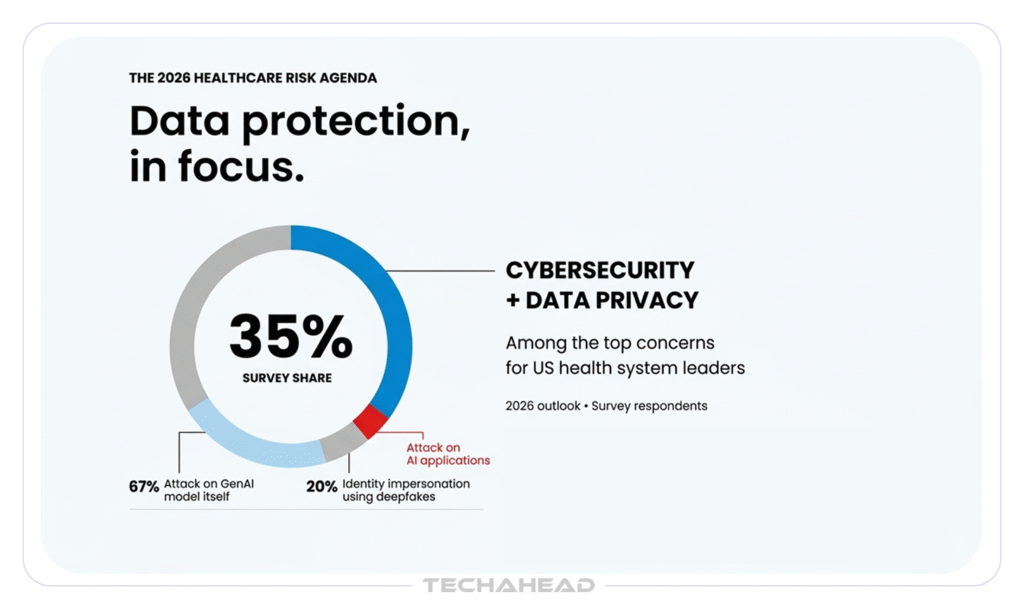
For your application, addressing that concern means showing how patient information is protected across the services and workflows a healthcare organization will use.
At TechAhead, our HIPAA compliant app development work includes assessing an inherited codebase and implementing the agreed changes: repairing authorization, protecting patient-data paths, replacing unsuitable integrations, and strengthening deployment and recovery. We support prototypes preparing for patient data and live applications preparing for a new customer, integration, or wider rollout.
HIPAA readiness here means preparing the technical system and supporting evidence for that use. Your organization’s applicable policies, workforce practices, agreements, and compliance decisions remain part of the wider program. We work with your stakeholders to connect those responsibilities to the software we deliver.
Must Read: HIPAA-Compliant AI Architecture (2026 Healthcare Guide)
The intended healthcare use determines what we need to examine. Before changing code, we establish the patient-data workflows, organizational relationships, and environments the engagement must cover.
Start with the people and organizations the application will serve. A provider’s patient portal, a health-plan workflow, and an independently operated consumer wellness app can have different regulatory relationships. HHS’s health-app scenarios illustrate why the application’s purpose and relationship with covered entities matter under HIPAA regulations, including the Privacy Rule that governs how protected health information can be used and disclosed.
With your security and compliance stakeholders, we establish:
Your stakeholders help resolve the applicable obligations. Our healthcare development team translates the requirements into implementation and acceptance criteria. For a live product, we also agree how to contain urgent exposure and release fixes without interrupting essential workflows.
An assessment can begin with repository access, architecture documentation, configuration visibility, and synthetic records. Production patient data should not become the default material for demonstrations or routine debugging.
We check whether patient records or production credentials entered coding sessions, connected development tools, repositories, or test fixtures. Where needed, we remove inappropriate data copies through an agreed process, rotate exposed credentials, separate environments, and restrict development access. Suspected exposure is escalated to your security and compliance owners for assessment.
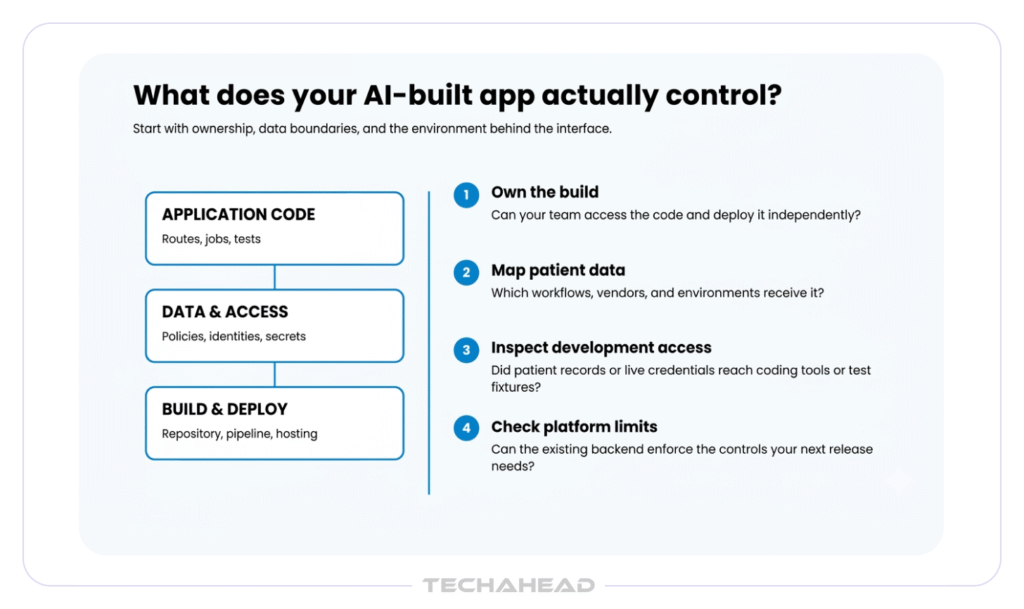
We also establish whether your team controls the source code, database policies, build process, and deployment. A generated interface may be reusable while a platform limitation requires moving the backend or replacing an integration.
Related: How to Secure an App Built With Claude Code for Enterprise Use
Consider an illustrative intake workflow: a patient submits information, uploads a document, receives a notification, and waits for a care-team review. Following that record reveals how application behaviour and infrastructure interact.
Our healthcare application code review follows generated code, database policies, configuration, and integrations through that journey. We verify the deployed behaviour and implement fixes at the layer responsible for enforcing each control.
We inspect how the application establishes identity and associates submissions with a patient, including whether a hipaa compliant application uses stronger authentication such as multi-factor authentication with biometrics and one-time codes. Tests include whether:
Automatic session timeouts help prevent unauthorized access after inactivity on mobile devices or shared devices.
Also Read: A Guide to AI-Generated Code Security Risks
For example, a generated screen might hide another patient’s documents while its API accepts any document identifier. We repair the server-side authorization and storage policy, then test direct requests from another patient and an unauthorized staff account. We also inspect alternate download routes and error responses.
Generated tests receive the same scrutiny. A test that confirms a successful upload does not establish access isolation. We add negative cases and check that they fail when the relevant control is deliberately removed in a controlled test environment.
Patient, clinician, scheduling, billing, support, and administrator access should reflect the actual workflow, with role based access control so each person only sees what their actual responsibilities require. A broad “staff” role may be convenient during prototyping but unsuitable for the way the organization operates.
We check for inconsistent rules across generated routes, background jobs, and exports. If each feature implements its own version of patient access, we can consolidate the policy and update the affected paths. The work includes role permissions, assignments, session controls, access controls, and audit trails for sensitive administrative actions.
Also Read: B2B SaaS Enterprise Readiness (What to Know)
Caregiver access follows the approved relationship and scope. We also test changes: a worker’s reassignment, a revoked delegation, or an administrator’s permission update must reach the relevant enforcement points.
For auditability, we agree the actor, record reference, action, outcome, and timing details to capture as audit logs. We implement and protect those events without unnecessarily copying clinical content into logs. Retention follows applicable requirements and the agreed policy, and under HIPAA rules those records may need to be kept for at least six years.
The patient-data path often extends beyond the database. A notification payload, failed API request, support attachment, or analytics event can carry information into another service.
We inspect generated request handlers, debug statements, analytics calls, and SDK configuration. Where these expose patient information, we change the payloads, remove unnecessary collection, or replace the integration. Vendor review identifies BAA requirements by assessing third-party vendors, vendor compliance, and whether business associates handling healthcare data or patient health information match the intended data flow, service coverage, and configuration. A vendor unwilling to sign a BAA creates compliance risk.
HHS’s cloud guidance explains that a cloud provider maintaining encrypted ePHI can still be a business associate even without the decryption key. Encryption and contractual responsibilities therefore need separate consideration. BAAs should be reviewed and updated regularly as integrations and responsibilities change.
For EHR integration, we review permissions, patient matching, mappings, failed exchanges, and synchronization behaviour. We can address the relevant API or HL7 FHIR integration alongside the application changes.
We inspect whether database policies enforce patient and organization boundaries and whether privileged service credentials bypass protections unnecessarily. Remediation can include policy changes, server-side credential isolation, dependency updates, data encryption, secure data storage for protected health information, and removal of unused endpoints. We then test storage access and recovery.
HIPAA security and technical safeguards require end-to-end encryption for all PHI, with AES-256 at rest and TLS 1.2 minimum in transit. We then test storage access and recovery.
Recovery testing should check more than whether records reappear. After restoration, do patient assignments, access rules, attachments, and audit records remain consistent? Can interrupted processing resume without creating duplicate records or losing a submission?
Our HIPAA remediation services connect these findings to implementation and retesting within the agreed scope:
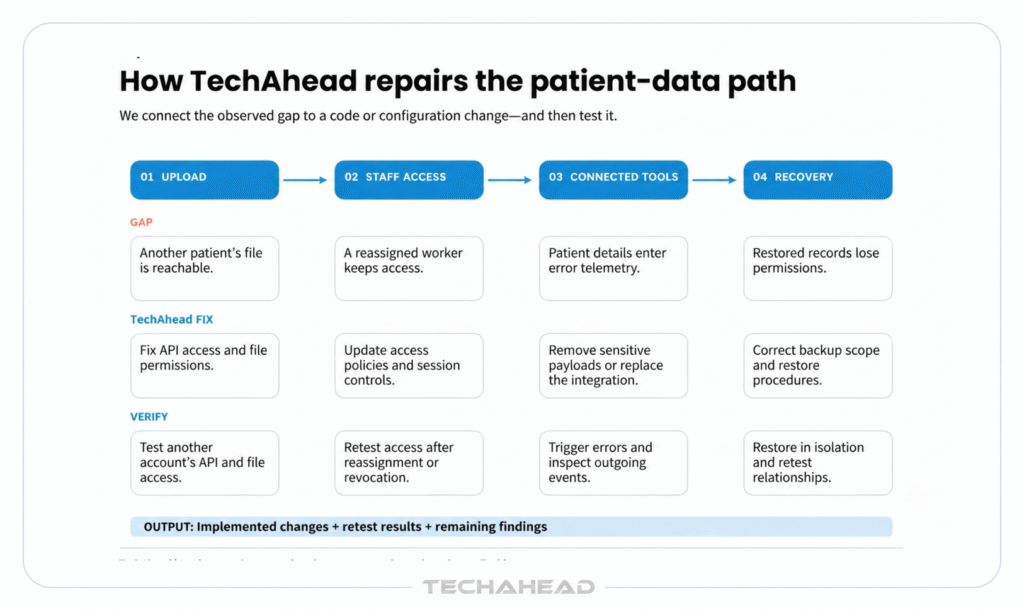
These examples illustrate the engineering work. The assessment establishes which findings apply to your product.
We connect the changes to the relevant safeguards and evidence described in the HHS Security Rule summary:
This gives your team a traceable record of what was implemented and tested, which gaps remain, and which organizational actions sit outside the engineering scope.
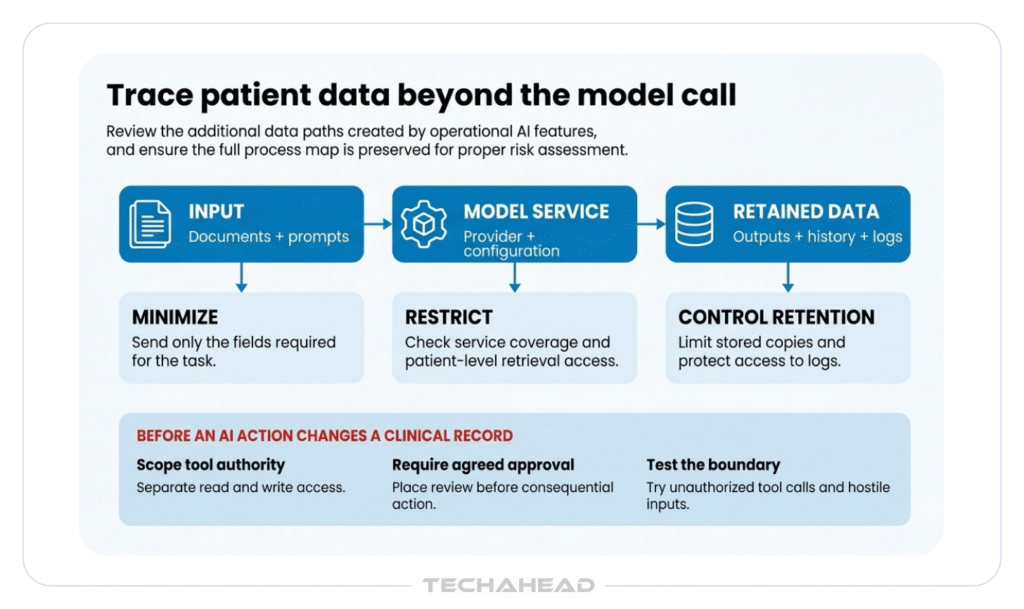
A stabilized AI-built application does not necessarily contain AI features. If your product does use summarization, retrieval, conversational assistance, or agents, those components add data paths and actions to examine.
A summarization feature may retain patient information in source documents, prompts, outputs, history, and logs. We trace those copies alongside retrieval stores and connected services.
The risk includes how people interact with the running AI feature. In a Gartner survey published in September 2025, 32% of respondents reported an attack on AI applications that leveraged application prompts during the previous 12 months. The survey covered 302 cybersecurity leaders across industries.
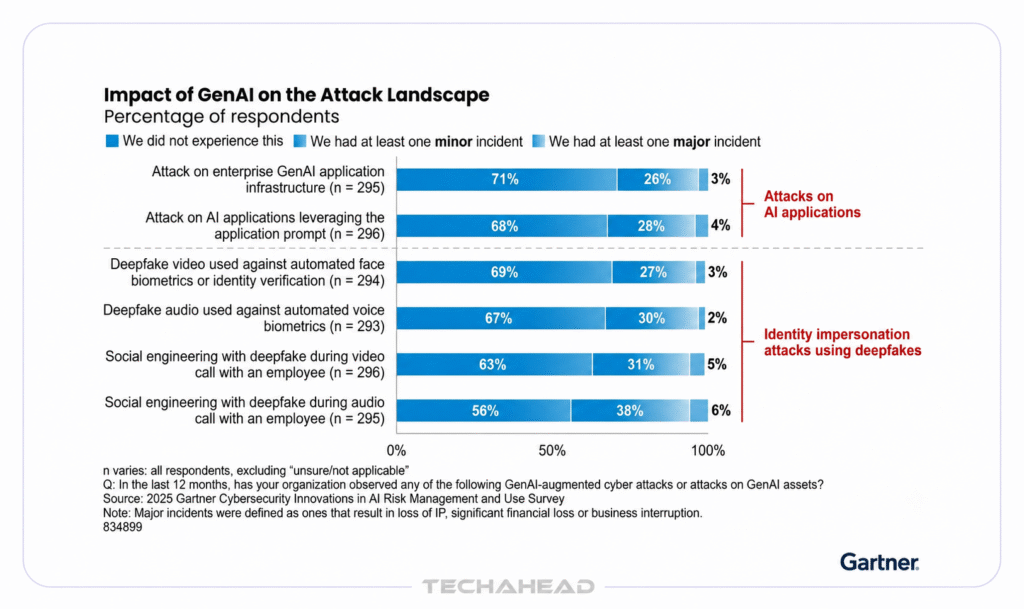
For a healthcare AI feature, that finding supports testing whether manipulated inputs can expose patient information or cross an access boundary.
We can reduce transmitted fields, change unsuitable provider integrations, restrict retrieval by patient and organization, and revise logging and retention configuration. Tests attempt cross-patient retrieval and unauthorized data access; a prompt instruction alone does not enforce those boundaries.
An assistant that drafts text has a different authority boundary from an agent that changes a record or triggers an external action.
For relevant healthcare AI architectures, we can restrict tools, separate read and write authority, implement approvals, and record consequential actions. Testing includes instructions in retrieved documents and attempts to invoke unauthorized tools.
Clinical evaluation remains a separate requirement appropriate to the use case. Our HIPAA compliant AI software development process implements the agreed data controls and review workflow with your clinical and compliance stakeholders.
Verification should match the release you are planning: a first deployment, a fix to a live application, or expansion to another healthcare organization. Our healthcare application security assessment defines the relevant roles, integrations, and failure cases for that decision.
For a portal, we test patient and caregiver access, account recovery, attachments, and access changes. For telehealth, the scope may also include session entry, messaging, recordings, and transcripts where those features exist.
For a live product, changes must also account for existing sessions, stored attachments, and previously issued links. We test that the corrected controls protect those paths as well as newly created records.
Remote monitoring introduces device and ingestion behaviour. A delayed reading should retain its relevant timing information; a retry should not silently create duplicate events.
Our tests cover:
Performance tests should reflect the ingestion and alert workflows your deployment requires.
For documentation tools, establish who reviews a draft, how corrections are handled, and when information reaches the clinical system.
Where documentation uses generative AI, the acceptance process needs particular care. In McKinsey’s April 2026 healthcare research, based on its fourth-quarter 2025 US healthcare survey, 43% of respondents identified risk and safety concerns as a roadblock to implementation.
Those concerns included inaccuracies or bias, security, and regulatory compliance. We separate application-control tests from clinical review so the release decision addresses both.
We test permissions and integration behaviour around those transitions, including failed write-back and repeated submissions. The release decision should identify unresolved issues and the responsible owner.
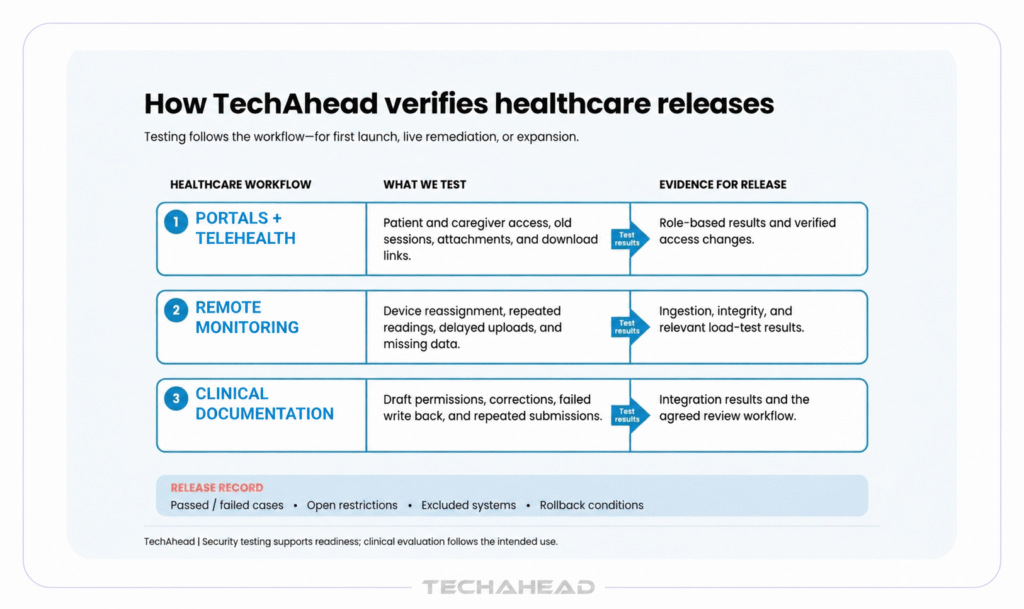
The healthcare application security testing scope can combine penetration testing, integration tests, regression cases, load tests, and recovery exercises. Your release record identifies passed and failed cases, remaining restrictions, excluded systems, and rollback conditions. For live remediation, we plan deployment and data changes around service continuity.
The effort to improve an existing application depends heavily on application complexity and the state of the inherited platform, so HIPAA-compliant software rarely has a one-size-fits-all price. Missing configuration may be corrected through a bounded change. Developing a HIPAA-compliant healthcare app often falls between $60,000 and $300,000, and security testing and quality assurance can add roughly $20,000 to $50,000 to the budget. Access rules scattered across many endpoints can require broader refactoring and testing.
We compare the work needed to meet the requirements with the risks of replacing components. The interface and validated workflow may remain useful even when storage, identity, or integration components need to change.
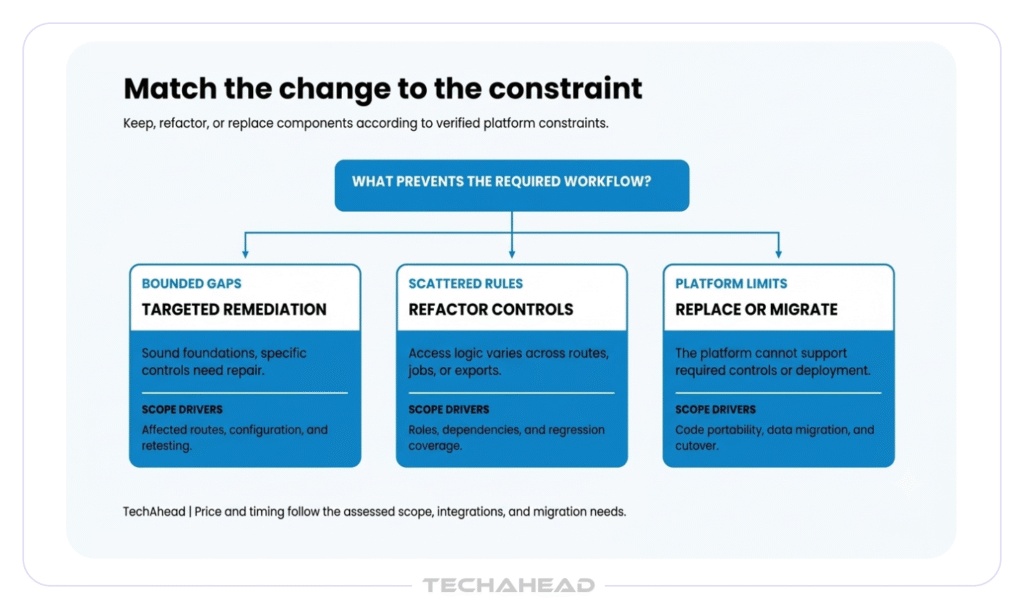
We explain those tradeoffs before committing you to implementation. Healthcare software modernization should solve demonstrated constraints and account for the disruption the change could introduce.
You may need an assessment with a defined backlog, a team to implement and verify that backlog, or continuing engineering capacity as the product develops. For planning, continuing external support in healthcare app development may be more flexible than hiring in-house healthcare app developers at $80,000 to $150,000 per year or freelancers at $50 to $150 per hour. We can scope these options around your internal team and ownership requirements.
We estimate the work after examining the codebase, deployment, integrations, and intended use. Your proposal should distinguish:
Confirm how newly discovered issues and additional requirements will be estimated. A low initial review fee can leave substantial implementation work unpriced. We can agree the assessment first, then use its evidence to define the engineering commitment.
For planning, an illustrative 30-, 60-, and 90-day sequence could look like this:
These are planning checkpoints. Application complexity, integration access, vendor agreements, migration, and customer review can change the sequence or extend delivery beyond them.
A new clinic, caregiver role, AI provider, or integration can change the application’s access and data-handling requirements. The handover needs to equip your team to manage those changes and establish where continuing engineering support belongs.
Your team receives the agreed code and configuration changes, test results, data-flow documentation, unresolved findings, and documentation for ongoing data handling practices and data management. We also document how to build and deploy the application from the controlled repository. If AI tools remain part of development, generated changes go through the same review and release gates.
Also Read: How to Build a Secure CI/CD Pipeline for AI-Generated Code
We organize the handover around practical responsibilities:
The operating team should also maintain an Incident Response Playbook for security breaches affecting sensitive data.
Knowledge transfer should let the responsible team operate and extend the application. A report alone cannot provide that capability.
HHS’s January 2026 hardening guidance describes patching, disabling unnecessary services, configuring protections, and revisiting their effectiveness as controls and workflows change over time for maintaining HIPAA compliance. We connect that continuing work to the way your application is maintained.
HHS risk-analysis guidance addresses risks across the organization’s ePHI environment. Our technical findings contribute to that wider process, including risk assessment activities and regular risk assessments across healthcare operations; their usefulness depends on the agreed scope and current system. The HIPAA Security Rule works alongside the Breach Notification Rule, which requires notice to affected individuals and the Department of Health and Human Services after a breach of unsecured PHI.
We can provide healthcare application maintenance, integration changes, performance improvements, and security updates through an agreed support arrangement with continuous monitoring after launch. The engagement should define coverage, escalation, response expectations, and responsibility for third-party services.
Healthcare delivery experience matters when code and security changes affect patient and staff workflows. We bring healthcare engineering, application security, and deployment expertise together around the product you already own.
In our published Lyn Health telemedicine work, we describe communication and care-coordination capabilities alongside authentication, encryption, and privacy controls. That work demonstrates relevant healthcare product experience; your application’s remediation scope is established through its own assessment.
Our custom healthcare software development capabilities are supported by application and cloud security assessment and implementation, plus performance and load testing. Your engagement can bring those disciplines together around the application you already own.
TechAhead lists ISO/IEC 27001:2022 and ISO/IEC 42001:2023 certifications and AWS Security Services and Cloud Operations competencies. We connect relevant experience and capabilities to your proposed scope, while verifying the controls implemented for your product.
To scope an initial discussion, bring:
We can establish the assessment scope, identify the implementation decisions, and agree how the completed work will be verified.
Discuss your healthcare application assessment and remediation needs with TechAhead.
Yes. An application built with these tools can be engineered for HIPAA-regulated use. Readiness depends on its data flows, safeguards, vendor arrangements, and operating practices. The coding tool alone does not determine whether those requirements are met.
No. Application hardening addresses technical weaknesses, while HIPAA compliance also involves risk management, policies, workforce practices, agreements, and ongoing evaluation. HIPAA compliant app development should support those responsibilities with implemented controls and documented verification.
TechAhead can assess your existing code, architecture, and deployment before recommending changes. HIPAA remediation services may involve targeted fixes, access-control refactoring, or component replacement. Broader rebuilding should follow demonstrated platform constraints and migration considerations.
A healthcare application security assessment begins by scoping patient-data workflows, roles, integrations, and environments. Engineers review code and configuration, test relevant failure cases, prioritize findings, and define remediation tasks with acceptance criteria and verification responsibilities.
No. HIPAA-eligible hosting addresses only part of the system. Your application still needs appropriate authorization, authentication, audit controls, secure data handling, vendor agreements, and operating procedures. Configuration and application behavior must be evaluated together.
A BAA is generally required when a vendor creates, receives, maintains, or transmits PHI on behalf of a covered entity or business associate. Review the actual relationship and data flow, including cloud, communications, and AI services.
Often, an initial review can use source code, configuration, architecture documentation, synthetic records, and test accounts. Production access should be justified, appropriately controlled, and covered by applicable agreements. Synthetic testing alone cannot establish production readiness.
Trace patient information through prompts, retrieval stores, model services, outputs, and logs. HIPAA-focused AI application development should control access, limit unnecessary data sharing, review vendor arrangements, and test unauthorized retrieval or actions. Clinical validation remains separate.
TechAhead can provide implemented changes, security test and retest results, updated data-flow documentation, and a prioritized record of remaining findings within scope. Evidence should connect each claimed control to verification and identify unresolved customer responsibilities.
TechAhead can support healthcare application maintenance, security updates, integrations, monitoring, and release improvements through an agreed engagement. Define ownership, escalation, review requirements, and regression testing so future AI-generated changes receive appropriate scrutiny before deployment.
We use cookies to ensure our website functions properly, improve performance, and provide a personalized experience. You can choose which types of cookies to allow below.
Required for core functionality such as security, network management, and accessibility. These cannot be disabled.
Help us understand site traffic and user interactions so we can improve performance and usability.
Enable enhanced functionality and personalization such as language or region preferences.
Used to deliver relevant ads, track campaign performance, and measure advertising effectiveness.