


 Copy Link
 Share on X
 Share on Facebook
 Share on LinkedIn
Always Active
Required for core functionality such as security, network management, and accessibility. These cannot be disabled.

Uncover the transformative potential of digital and mobile solutions for your industry.





 Last Updated: Oct 14, 2026
Oct 14, 2026
Last Updated: Oct 14, 2026
Oct 14, 2026  16
16  20 min. Read


Key Takeaways
Your SaaS product already works for paying customers. The next prospect wants to connect its identity provider, restrict administrative access, review recovery procedures, and understand how its data stays separate from everyone else’s. Your team can add the requested features. What is harder to establish is whether those features will hold together across the platform you operate today.
That uncertainty affects what you can promise during the sale and what you need to resolve before onboarding. You must assess inherited assumptions, correct tenant boundaries, validate larger workloads, and produce evidence for the customer’s security team while keeping your product roadmap moving.
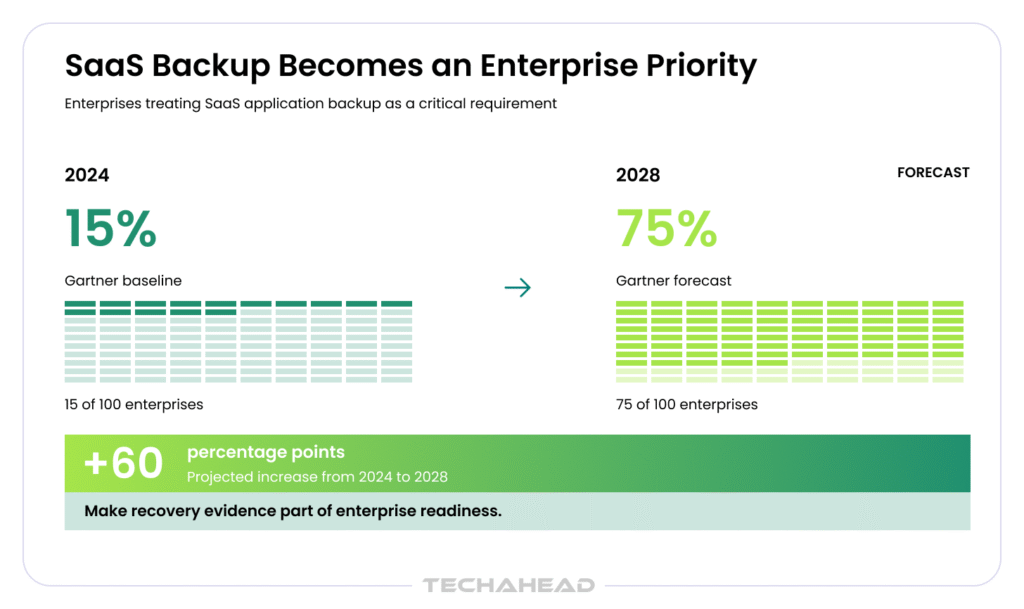
Recovery is one example of how those expectations are changing. In a forecast published in August 2024, Gartner predicted that 75% of enterprises would treat SaaS application backup as a critical requirement by 2028, compared with 15% in 2024.
For your platform, the practical question is whether you can demonstrate how customer data is protected and recovered when something goes wrong.
B2B SaaS enterprise readiness means establishing that your product and operating practices can support the requirements of the enterprise customers you intend to serve. The scope depends on their workloads, data, access policies, integrations, and contractual expectations. A checklist can identify questions; a scoped engineering engagement determines the changes your platform needs and verifies them.
Also Read: Building a Secure CI/CD Pipeline for AI-Generated Code
Start with the customer commitment. A prospect asking for SSO is describing an identity requirement. A prospect asking for an availability commitment is asking about an operating capability. A prospect asking for dedicated infrastructure may be expressing a contractual preference, an isolation concern, or a workload requirement. Those requests need different investigations.
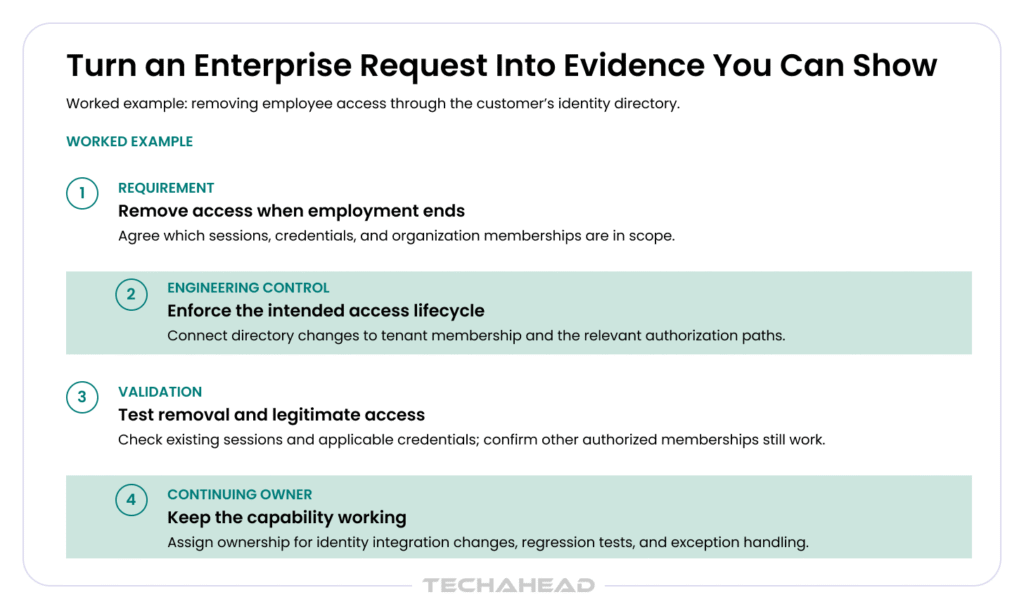
Translate each requirement into three questions: what must the platform do, where is that behavior enforced, and what evidence would demonstrate it under the agreed conditions?
A customer may need administrators to remove an employee’s access through its directory. Showing that account provisioning works does not answer what happens to an existing session, an API credential, or access through another organization membership. The review must establish the intended behavior and test the applicable paths.
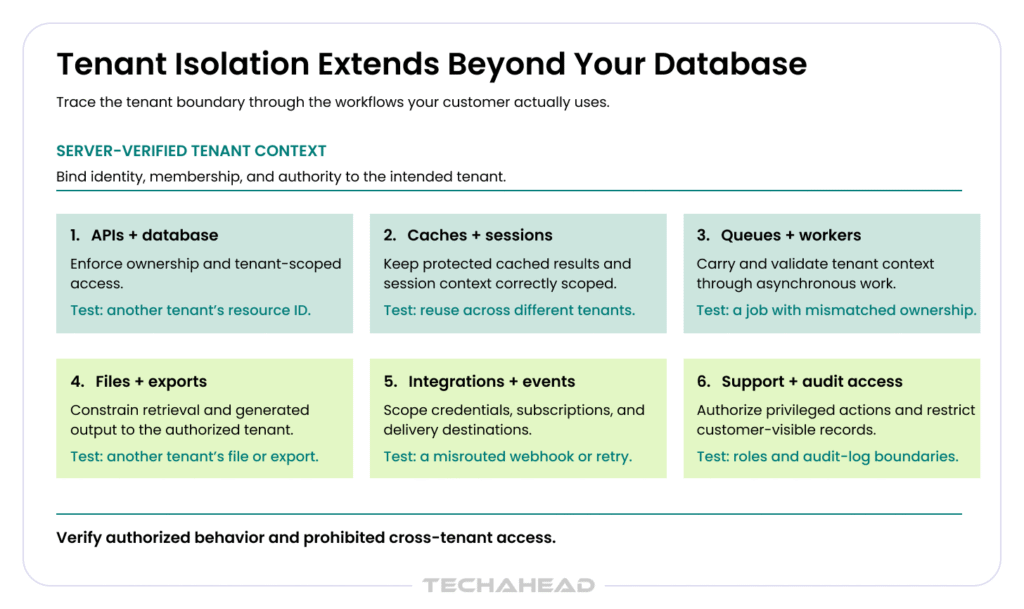
Similarly, adding a tenant identifier to database records does not prove that exports, integrations, and administrative tools respect the same boundary. AWS distinguishes tenant isolation from authentication and authorization: a user can be authenticated and authorized yet still reach resources belonging to another tenant if isolation is insufficient.
Your first deliverable should therefore be a defined readiness scope. B2B SaaS enterprise readiness means establishing what your enterprise SaaS platform can support for enterprise clients, including the flexible procurement processes and custom Master Services Agreements (MSAs) that are often expected. It should make four things clear:
You can then decide which promises your platform can support now and which require further work.
Include the existing customer experience in that scope. An enterprise-specific identity policy may affect users who belong to several organizations. A new retention setting may change which records appear in historical reports. A dedicated deployment may introduce a separate upgrade path. These consequences matter even when the requested feature is straightforward.
That uncertainty affects what you can promise during the sale, especially when enterprise buyers may involve 11 to 20 decision-makers and longer sales cycles can run from several months to years. Effective enterprise sales depend on a clear sales process that helps sales teams set the right expectations early. In enterprise SaaS sales, that matters because enterprise clients often evaluate risk, operations, and support in parallel before agreeing to move forward.
Ask the prospect to clarify ambiguous requirements before building around them. “Data isolation” could refer to access boundaries, storage separation, or restrictions on administrative access. Record the interpretation and the acceptance conditions to support faster internal approvals across multiple stakeholders. That conversation helps your team avoid implementing a technically sound change that answers a different question from the one the customer intended.
Must Read: SaaS Application Development Guide
An enterprise opportunity can reveal assumptions that were reasonable when the product served smaller accounts. The important task is to identify which assumptions no longer fit.
Consider a reporting service that correctly scopes dashboard queries but places report-generation jobs into a shared queue. If the worker reconstructs tenant context incorrectly, the completed export may belong to a different organization. The dashboard can appear secure while the export workflow remains exposed, even when Single Sign-On (SSO) integration is part of enterprise identity and access management.
Or consider support access. A platform administrator may legitimately need to investigate customer issues. The review should determine how that authority is granted, limited, recorded, and revoked under clear security protocols. Customer roles and internal support roles should be assessed separately because they carry different responsibilities. Verify Role-Based Access Control (RBAC), Multi-factor authentication (MFA) enforcement for privileged access, and comprehensive audit logs so enterprises can meet governance and regulatory compliance expectations.
One customer imports a large dataset while others run interactive searches. Average response time remains acceptable, but enterprise applications also need high-performance architecture that can handle significant concurrent usage and substantial data volumes, especially in cloud based software. Aggregate monitoring can hide the affected customer experience.
A SaaS scalability assessment should examine representative mixed workloads and the resource controls around them. AWS discusses isolation in relation to both security and noisy-neighbor performance. Data boundaries and workload fairness therefore require separate validation to protect business operations and sustain operational efficiency.
Availability commitments also need recovery evidence, and enterprise buyers often expect a 99.99% uptime SLA for cloud based solutions. Uptime Institute’s Annual Outage Analysis 2026 reports that 57% of respondents to its 2025 annual survey said their most recent major outage cost more than $100,000. The report examines IT and data-center outages. System downtime can frustrate employees and halt work processes.
When assessing your SaaS, test the operating procedures behind the availability commitment: dependency failures, recovery actions, and the integrity of restored customer data. Include disaster recovery plans and verify recovery metrics such as Recovery Time Objective (RTO) and Recovery Point Objective (RPO).
Look for onboarding work that repeatedly depends on an exception:
These practices warrant investigation when they become dependencies for larger customers, because recurring exceptions in the sales process and onboarding usually signal missing standardization. The assessment should explain which exceptions you can standardize and which expose a deeper design problem, and automated testing helps ensure software stability and availability 24/7 while reducing manual data entry and adding a structured framework for onboarding checks improves repeatability.
A SaaS enterprise readiness assessment connects application behavior, infrastructure configuration, and operating procedures. Reviewing each in isolation can leave important dependencies unresolved.
Scope the following tests and acceptance criteria around your architecture and customer requirements.
| Review area | Question to resolve | Example acceptance evidence |
| Tenant isolation | Does the intended boundary hold across relevant data paths? | Authorized same-tenant operations succeed; prohibited cross-tenant operations fail |
| Identity and authorization | Do organization memberships, roles, and provisioning behave as intended? | Tests of identity configuration, role changes, and access removal |
| Support and administrative access | Is privileged access constrained and attributable? | Permission checks and reviewable administrative events |
| Workload isolation | Can a large tenant degrade agreed service for others? | Mixed-workload results with tenant-specific measurements |
| Recovery | Can the required records and services be recovered safely? | Restore exercise with integrity and isolation checks |
| Integrations | Are credentials, event destinations, and failure handling correctly scoped? | Routing, retry, and reconciliation tests |
| Delivery and maintainability | Can changes be tested, released, and reversed? | Regression coverage, migration checks, and rollback evidence |
A multi-tenant SaaS security assessment should follow the tenant’s information through the product and verify data protection, including data encryption at rest and in transit across relevant paths. Relevant paths may include APIs, queries, caches, asynchronous work, file storage, and audit access. OWASP’s multi-tenant security guidance provides a useful technical reference for these boundaries and for testing the roles and connection paths used by the deployed application.
The accompanying SaaS architecture review should examine whether ownership and enforcement are clear. If every endpoint implements a different access rule, a local fix may leave the next feature vulnerable to the same omission. If a migration depends on undocumented sequencing, adding infrastructure may leave releases just as fragile, and prioritizing security with clear support evidence helps build trust for long-term partnerships while reducing compliance risks.
Related: Cloud Security Architecture for Modern Business
Code quality matters where it affects your ability to change the platform reliably. Focus the review on:
Enterprise buyers also expect defined ongoing support structures, such as priority escalation processes and dedicated customer success ownership, because that clarity supports customer satisfaction.
Faster development needs its own evidence of quality. In McKinsey’s August 2026 research on agentic product development, respondents reported average time savings of 11.8% across product-development use cases, while average rework reduction was 6.2%.
These are distinct measures, but the difference reinforces why an assessment should examine testing, review, and maintainability alongside delivery speed, particularly when your product was vibe coded using AI.
AI-driven features in SaaS solutions can improve operational efficiency, but an AI-powered product or AI-native product also needs additional checks around the AI workflows it actually operates. The assessment should identify where those workflows introduce additional data paths or privileged actions, especially where AI supports smarter automation, predictive analytics, stronger customer insights, and real-time decision-making:
Salesforce’s integration of generative AI features in March 2024 is one sign these capabilities are becoming standard in enterprise platforms.
The following illustrative workflows show how requirements in specific industries change your assessment scope; healthcare is currently the fastest-growing vertical in the B2B SaaS market, which raises scrutiny around security and compliance expectations.
A provider’s staff need access to the appropriate patient records, while a platform support engineer needs enough visibility to diagnose a failed workflow. The scope should establish those boundaries, examine exports and integrations, and document recovery and incident responsibilities.
HHS cloud-computing guidance addresses business associate agreements, risk analysis, and responsibility allocation for services handling ePHI. It permits public, private, and hybrid configurations subject to applicable requirements. Dedicated infrastructure should therefore be evaluated against the actual requirements, rather than presented as a universal HIPAA obligation.
Must Read: HIPAA-Compliant AI Architecture
Suppose customers upload sensitive documents and connect external decisioning systems. The assessment should investigate staff permissions, document access, integration credentials, and regulatory compliance, especially in BFSI contexts, as well as the records needed to reconstruct significant changes. It should also review the connected external decisioning systems’ integration capabilities so teams understand how those systems connect and are governed.
For institutions within its scope, the FTC Safeguards Rule guidance addresses service-provider safeguards, contractual expectations, monitoring, and reassessment. Those responsibilities can shape the questions a customer asks its SaaS vendors. Applicability depends on the institution and activities involved.
One user may work with several carriers but hold different permissions in each. Claims documents, delegated access, and outbound events must follow the intended customer context. The review should also examine what happens when an adjuster’s assignment ends and how historical actions remain attributable.
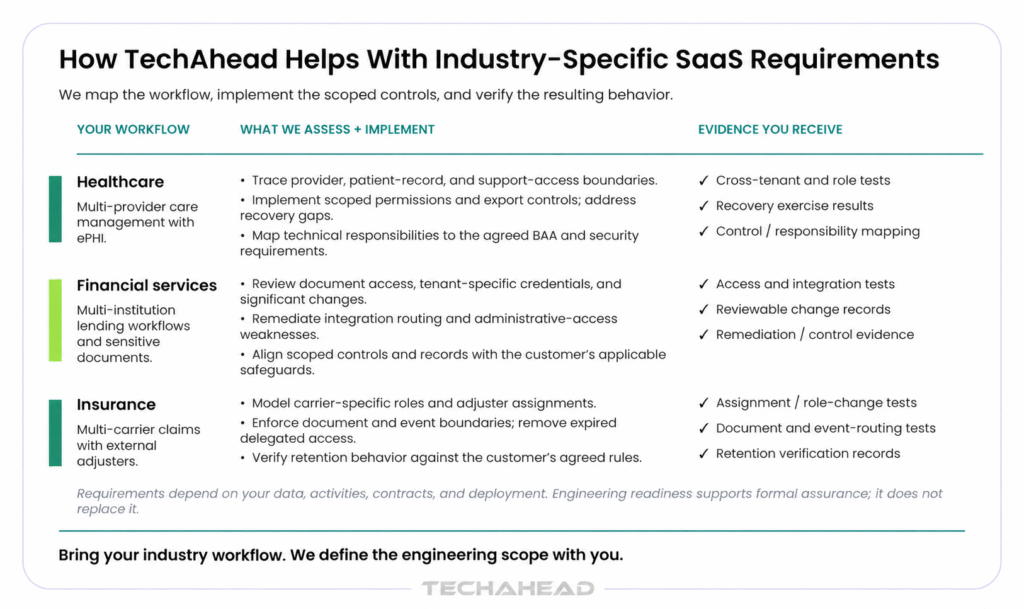
We begin with the product you have, the customer you need to support, and the commitments you are considering. We scope our SaaS engineering, cybersecurity, and DevSecOps capabilities around those requirements, so you can see how the proposed work supports your next customer commitment.
We agree the inputs with you before starting the review. Depending on scope, these may include:
We use those test tenants to investigate paths that a single account cannot demonstrate and connect observed behavior to the relevant code and configuration.
We agree access with you according to the activity. A review can begin with scoped repository and configuration visibility; implementation requires additional authority for the agreed environments. We use synthetic or appropriately de-identified data where it supports the tests. When sensitive data or production access is necessary, we establish its purpose, approval, handling, and duration with you.
We distinguish observed failures, incomplete controls, and areas we could not verify in your risk register. For each finding, we document:
You receive a record that supports both prioritization and implementation.
That distinction matters when access is limited. An untested recovery path is an evidence gap; an unsuccessful restore is an observed failure. Both need attention, but they justify different conclusions and next steps.
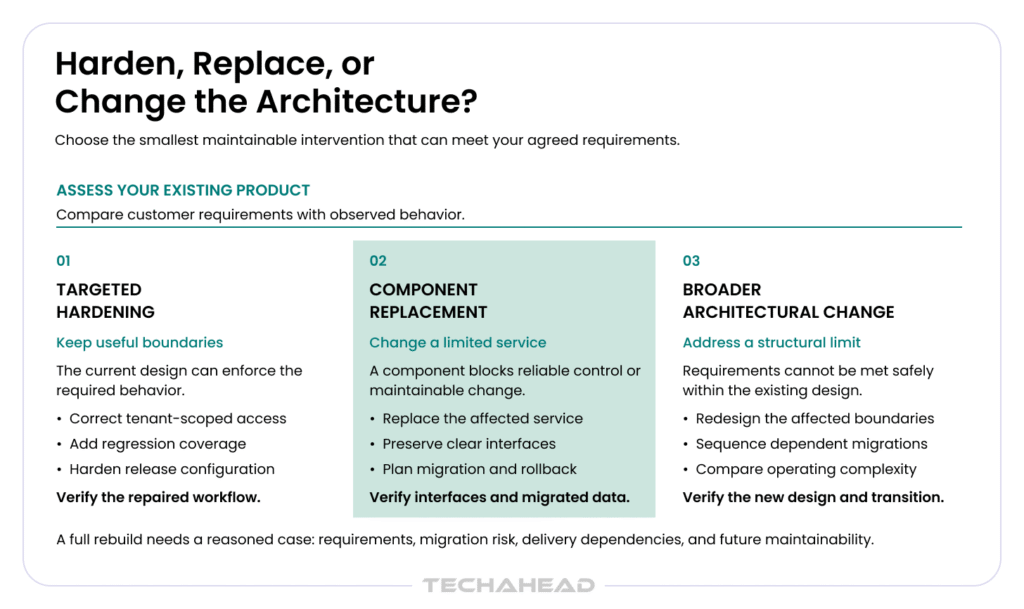
Targeted SaaS application hardening is appropriate when the required behavior can be enforced within maintainable existing boundaries. A shared service may need a tenant-scoped access policy and regression tests. A poorly coupled integration component may need replacement while the rest of the product remains useful.
We consider broader architectural work when your requirements cannot be met safely within the current design, or when repeated local fixes leave the same exposure elsewhere. We compare options with you against delivery dependencies, migration risk, operating complexity, and maintainability. If we recommend a full rebuild, you receive the reasoning behind that recommendation.
Related Read: How to Secure an App Built With Claude Code for Enterprise Use
We retest findings against the changed application and deployed configuration. We check permitted behavior as well as prohibited actions so a fix does not simply disable a legitimate workflow. You receive the recorded environment, conditions, results, and remaining limitations for the agreed validation scope.
Penetration testing, control-readiness work, and formal assurance engagements have different purposes. An engineering engagement can implement controls and assemble evidence; a formal SOC examination is a separate professional engagement.
You need deliverables you can use to implement changes and decide what to commit to next. We connect technical findings to the requirements and risks that affect those decisions, including how the output should support customer relationships after onboarding, not just initial commitments.
We agree the deliverables with you around the work being commissioned:
You also receive a concise account of verified capabilities, unresolved risks, and decisions affecting your next customer commitment. You can use it to assess what is ready, what remains conditional, and what further work you need to commission.
We connect each closed finding to its change and validation evidence. You can use that record in subsequent security reviews rather than relying on recollection or a ticket marked complete without supporting results.
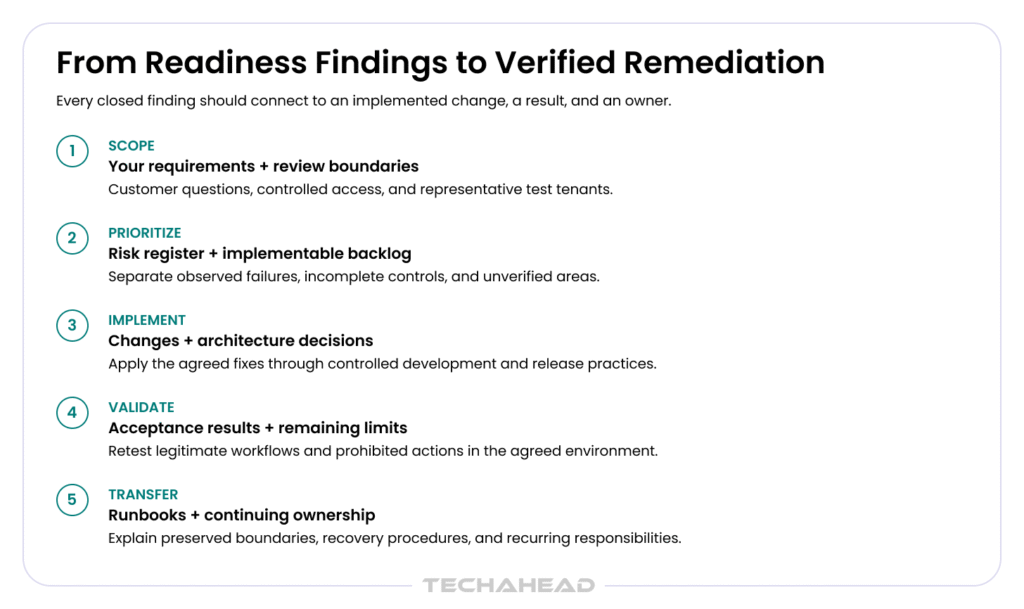
We walk you through the mechanisms that future changes need to preserve: where tenant scope is established, how privileged access works, which tests protect boundaries, and how recovery and incident procedures are exercised. We agree named owners with you for outstanding work and recurring controls, tying documented ownership to ongoing support and long-term customer satisfaction.
Sequence work around dependencies and customer exposure. Resolve the underlying identity and tenant models before adding capabilities that depend on them.
A 30-, 60-, and 90-day planning view can help communicate priorities, but each checkpoint should describe a decision or verified capability. For example, early work may establish the tenant boundary and address immediate exposure; subsequent work may validate identity integration and workloads; later work may exercise recovery and transfer operating ownership. The allocation depends on scope and findings, and should be revised as evidence develops.
| Engagement Model | Suitable Situation | Responsibilities to Establish |
| Assessment plus remediation | You need a scoped review followed by implementation | Findings, change authority, testing, acceptance, and handover |
| Embedded engineering support | Your team owns the roadmap but needs specialist capacity | Work allocation, code review, release approval, and escalation |
| Ongoing operations | Readiness depends on recurring operating work | Monitoring, patching, recovery exercises, incident coverage, and service expectations |
Through embedded engineering support, we bring specialists into your existing delivery practices. Our managed cloud services support continuing infrastructure operations. We help you select the model according to who will own implementation and maintain the resulting capability.
We discuss assessment duration and remediation duration separately with you. Repository access, system boundaries, integration availability, test environments, and the need for migration all affect planning. We establish your initial schedule after discovery and update it when findings change the work.
At TechAhead, we bring experience extending working products across enterprise workflows. Our published ERIN case study describes enterprise referral software and integrations with HR systems. In the Ventus Networks project, we developed a unified monitoring platform with real-time diagnostics and multi-tier access controls. These projects provide relevant context for the integration and operational-architecture work your platform may need, and peer case studies help prospects judge implementation relevance, create urgency when similar enterprise requirements are involved, and support consultation readiness for your sales or marketing team.
Our SaaS application development services combine multi-tenant architecture, enterprise integrations, and cloud engineering, supported by our AWS Advanced Tier Services Partner status and AWS Cloud Operations Services Competency. We apply these capabilities to your platform’s tenant separation, scalability, deployment, and ongoing operations, aligning the work with your enterprise requirements.
To make your consultation useful, bring:
We discuss which questions require evidence, what assessment access is appropriate, and how we would implement the agreed changes with your existing team.
Book an enterprise readiness consultation with TechAhead to discuss the gaps affecting your next enterprise customer and define the assessment and remediation scope around them.
Enterprise readiness covers tenant isolation, identity and authorization, security, scalability, recovery, integrations, maintainability, and operating ownership, while also accounting for the needs of enterprise buyers and the realities of multiple stakeholders. The engagement should connect customer requirements and contractual expectations from enterprise clients to prioritized remediation, validation evidence, and documented responsibilities for sustaining the agreed capabilities.
We scope access around your assessment: repositories, architecture, deployment configuration, monitoring, and representative test tenants may be needed. Implementation requires appropriate environment permissions. We agree the purpose, handling arrangements, approval, and duration of sensitive data or production access with you.
Duration depends on system boundaries, access availability, integrations, test environments, and remediation complexity. Separate the assessment schedule from implementation planning. Use agreed checkpoints and acceptance criteria, then revise the roadmap when findings reveal additional dependencies or migration needs.
We assess whether SaaS application hardening can meet your requirements within the existing architecture. Findings determine whether we recommend retaining components, replacing selected services, or undertaking broader changes. You receive the reasoning, including migration risk, validation needs, and future maintainability.
You receive a prioritized risk register, remediation backlog, architecture decisions, implementation records, reporting capabilities, and validation results for the agreed scope, which senior stakeholders can use to verify scope and commitments. We also explain readiness against your customer requirements, unresolved exposure, delivery dependencies, and ownership of remaining work and operating controls, so sales leaders and account executives can support accurate customer-facing commitments.
A SOC 2 report addresses controls within its defined scope; it does not answer every customer’s product or operational requirement. Assess tenant isolation, identity integration, workload behavior, recovery, and contractual expectations against the evidence relevant to your intended deployment.
Test relevant APIs, caches, asynchronous jobs, exports, file storage, integrations, and administrative surfaces using distinct test tenants. Verify permitted workflows and prohibited cross-tenant operations through representative deployment paths. Record scope and results so untested areas remain visible.
Evaluate dedicated infrastructure when contractual requirements, workload characteristics, data-location needs, or isolation expectations justify it. Compare pooled, siloed, and hybrid options against operational complexity and validation requirements. Dedicated resources still need effective identity controls, administration, deployment, and recovery procedures.
Some changes can be delivered incrementally with representative staging tests, controlled releases, monitoring, and rollback plans. Data migrations or architectural changes may require additional coordination. Assess each change’s dependencies and customer impact before committing to a release approach.
A penetration test investigates exploitable vulnerabilities within a defined scope. Enterprise readiness also examines architecture, identity lifecycle, performance, recovery, maintainability, and operating evidence. Testing informs the engagement, while remediation and validation establish the capabilities needed for the intended customer commitment.
We use cookies to ensure our website functions properly, improve performance, and provide a personalized experience. You can choose which types of cookies to allow below.
Required for core functionality such as security, network management, and accessibility. These cannot be disabled.
Help us understand site traffic and user interactions so we can improve performance and usability.
Enable enhanced functionality and personalization such as language or region preferences.
Used to deliver relevant ads, track campaign performance, and measure advertising effectiveness.