


 Copy Link
 Share on X
 Share on Facebook
 Share on LinkedIn
Always Active
Required for core functionality such as security, network management, and accessibility. These cannot be disabled.

Uncover the transformative potential of digital and mobile solutions for your industry.





 Last Updated: Oct 9, 2026
Oct 9, 2026
Last Updated: Oct 9, 2026
Oct 9, 2026  17
17  20 min. Read


Key Takeaways
AI coding tools have changed how fast enterprises can ship software. A customer portal that once took a year can reach production in a quarter, and many leadership teams have used that speed to win customers and expand their roadmaps. The next chapter begins once the app serves thousands of real users, because the operating demands change at that point.
Leaders tend to see the same signals. A routine release alters a reporting total in an unrelated module. Support tickets arrive faster than fixes. The engineering team can describe what the app does, yet explaining why it behaves that way takes extended investigation, because prompts served as the requirements and the generated code carries thin documentation. Enterprise buyers then send detailed security questionnaires, and several answers depend on facts that remain undocumented. Each signal points to the same underlying gap: ownership, evidence, and predictability have not kept pace with delivery speed.
The gap is widespread. McKinsey’s State of AI in 2025 reports that 88% of organizations use AI in at least one business function, while only about one-third are scaling it across the enterprise. In the same survey, 51% of respondents had already met at least one setback from AI use, and inaccuracy led the list at 30%. Between broad adoption and dependable operation sits a stability gap, and closing it has become a priority, underscoring the importance of AI application monitoring.
This blog offers a way across. It treats stabilization as a leadership program with an owner, a budget, a timeline, and board-level proof, and it answers one question: how do we make this stable while keeping the business moving?
Instability starts with ownership, so the plan starts there too.
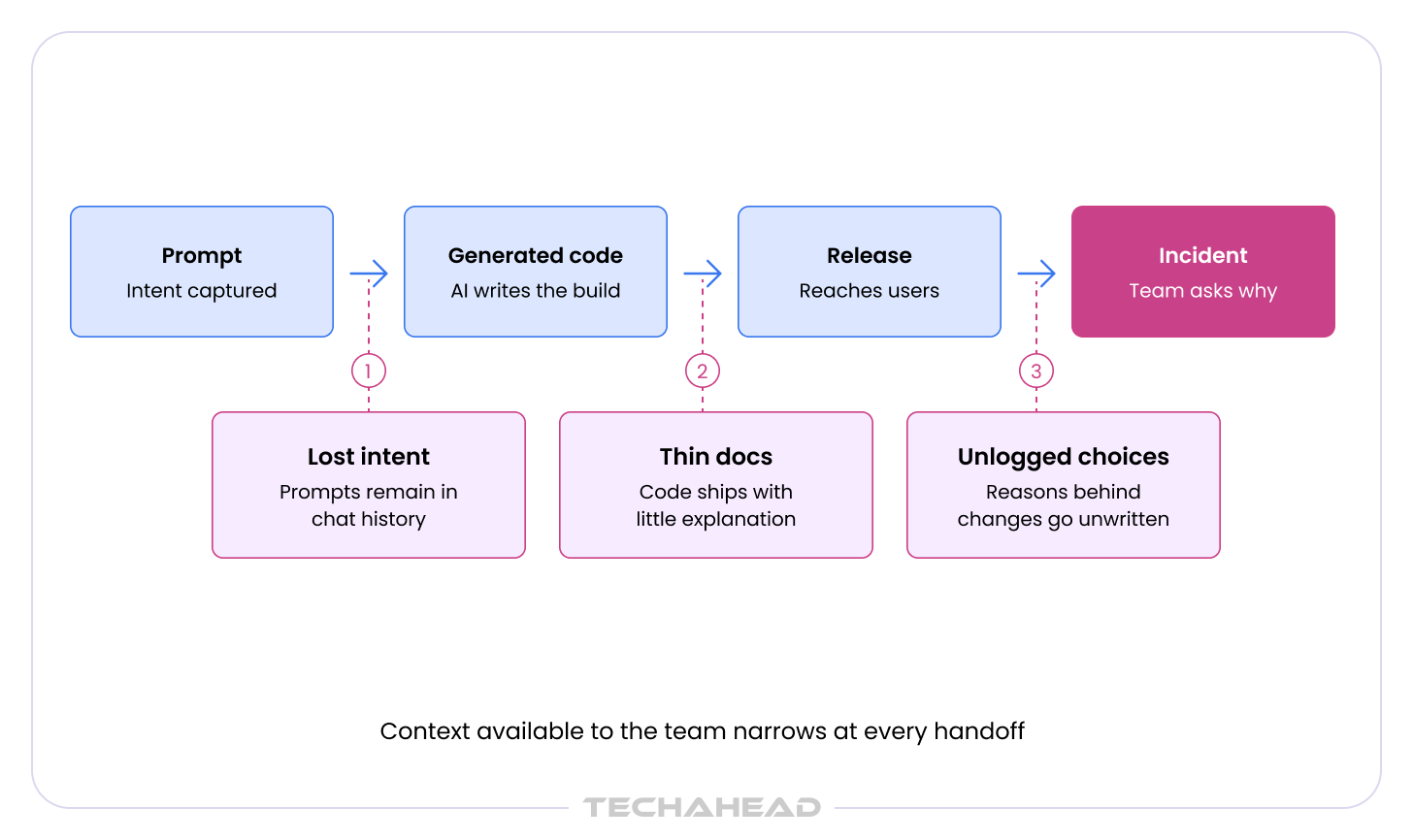
The root cause rarely lies in AI model quality. When prompts served as the requirements and generated code arrived with thin documentation, the organization ended up running a system that few people fully understand. Context drops out at each handoff: intent stays in chat histories, explanations stay with the tool, and the reasons behind a change go unwritten. By the time an incident arrives, the team has little to trace. Each new fix then touches code whose author is unclear, and regressions follow.
The business impact compounds quietly. Each week of instability adds cost, security exposure, and customer churn, while enterprise buyers and regulators increasingly ask for proof of control. Leaders who act early protect both revenue and reputation.
Four profiles help leaders focus. They serve different purposes in planning, since each calls for a different first response: tests and documentation, evals and version control, evals alone, or a refactor backlog.
| Code Type | AI-powered features | Conventional features |
| AI-built code | Compounding drift. Generated code and model behavior shift together, so the cause is hard to isolate. | Hidden fragility. Working code that few people understand, backed by thin tests. |
| Hand-built code | Behavior variance. Solid code wrapped around outputs that move with every prompt and model update. | Familiar debt. The well-understood legacy profile with established remedies. |
Seeing two or more of these together is a useful trigger to start the program.
Also Read: Building a Secure CI/CD Pipeline for AI-Generated Code
It makes sense to build a complete picture of the system before choosing any fix.
Score seven domains red, amber, or green: security and access, data integrity, deployment and rollback, reliability and performance bottlenecks, test coverage, observability, and AI behavior. Revisit the scorecard at every phase gate, so progress stays visible. In the diagnosis phase, ask the engineering team for four artifacts: an architecture map, a dependency inventory, a list of every place the app calls an AI model, and a record of recent incidents with their causes.
Green has a concrete meaning in each domain: least-privilege access with secrets in a vault, versioned schemas with regularly restored backups, a one-click rollback tested monthly, load-tested services, automated tests on critical paths, errors, latency, and cost visible on one dashboard, and output quality scored on a schedule.
Want to know whether your AI-built application is ready for real users? Read our blog Production Readiness Checklist for AI-Built Products to see whether they are production ready.
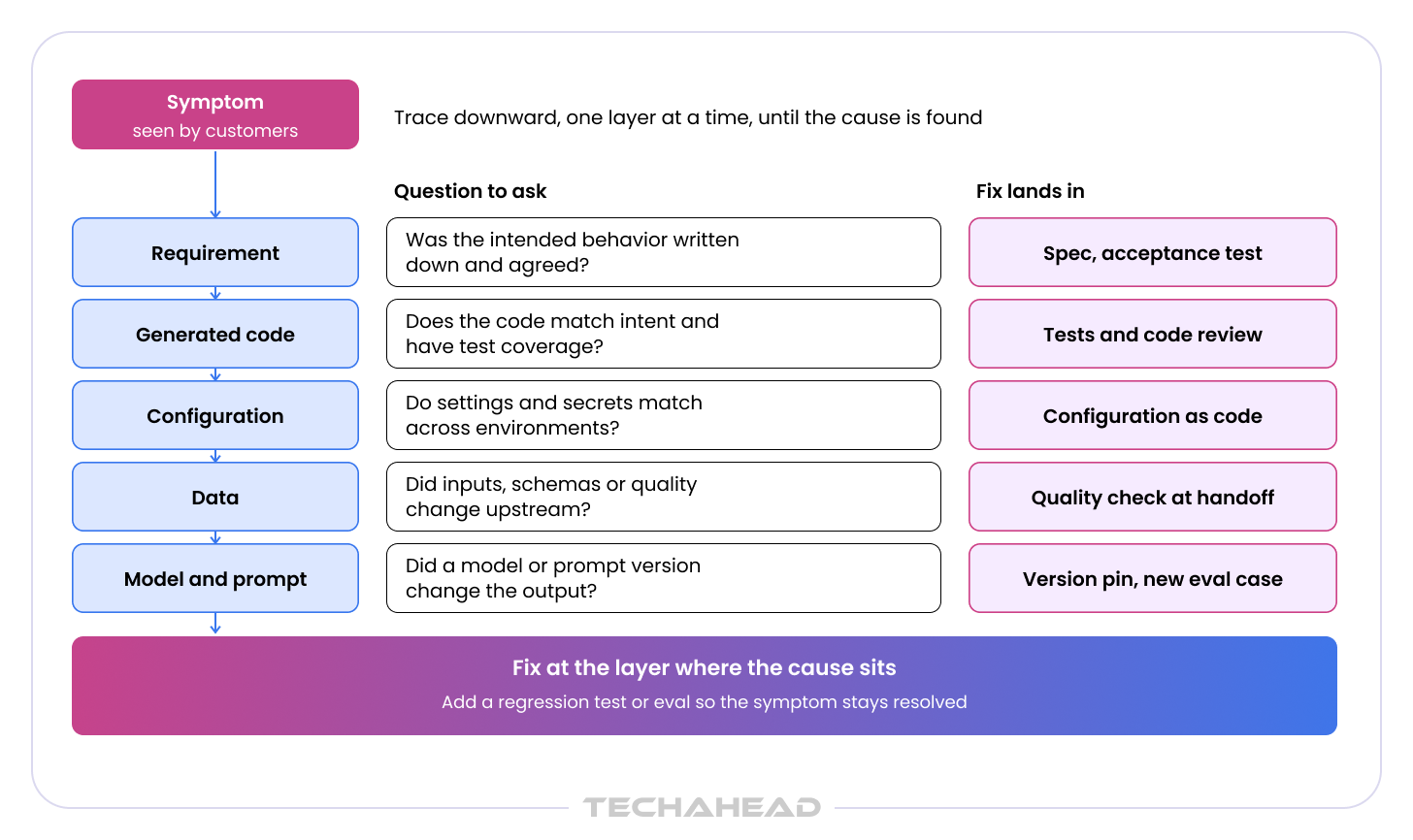
Teams find that symptoms return when fixes land in the wrong place. A root cause ladder prevents that. Start from the customer-facing symptom and descend through requirement, generated code, configuration, data, and model, asking one question at each layer, such as whether the intended behavior was written down or whether a prompt version changed the output. Fix at the layer where the cause sits, then add a regression test or eval. That is the difference between a fix that holds and a symptom that returns.
Most teams feel pressure to choose between patching forever and rewriting everything. A component-level view offers a better path. Rate each component on four criteria: change frequency, blast radius, data sensitivity, and test coverage. Stable components with strong coverage are retained.
Components that change often and rest on sound design are refactored. Components with a proven product alternative, or whose repair cost nears replacement cost, are replaced behind a clean interface. Components with a wide blast radius, sensitive data, and fragile structure are rebuilt in phases behind the live system. A useful working threshold: when the estimated repair cost reaches roughly two-thirds of replacement cost, hold a formal comparison.
Consider an illustrative customer portal with five components. The authentication module is stable and well tested, so it is retained. The reporting engine changes weekly and carries thin tests, so it is refactored. The notification service duplicates a commercial product, so it is replaced. The pricing logic touches sensitive data across three systems and sits at the center of revenue, so it is rebuilt in phases. The admin tool changes rarely and affects few users, so it is left alone. The result is a portfolio of targeted moves, and the business keeps running throughout.
A full rewrite is rarely the first answer, and patch-forever carries its own price in compounding cost and security exposure. The matrix replaces both extremes with evidence.
With the verdicts in place, the work shifts to evidence. Three tracks run side by side, and each one feeds the others.
AI application monitoring works best in two layers. The first is conventional: errors, latency, uptime, and performance issues. The second covers AI behavior: output quality, cost per request, and user feedback. The second layer reveals problems the first layer overlooks, because a response can arrive quickly and still contain inaccuracies. Production evals act as regression tests for AI output. A small set of representative inputs with expected qualities runs on every change and on a schedule, so the team can continuously monitor quality as models, prompts, and data evolve. Every inaccurate answer a customer reports becomes a candidate for a new eval case.
Route every alert to a named owner, using starting thresholds tuned to your baseline, and bring signals onto one dashboard. The best tool depends on your stack, so selection criteria matter more than a vendor list: coverage of both layers, support for your model providers, trace-level detail, role-based access, data residency options, and integration with incident workflows.
Starting thresholds give owners something concrete to tune. Typical examples include an error rate above 1 percent over 15 minutes, latency above the agreed service objective for 10 minutes, an eval pass rate that drops 3 points against the previous release, cost per request 20 percent above the weekly average, and two consecutive periods of declining user feedback. Each signal carries a named owner: the engineering lead for errors, the platform owner for latency, the AI lead for evals, and the product owner for cost and feedback.
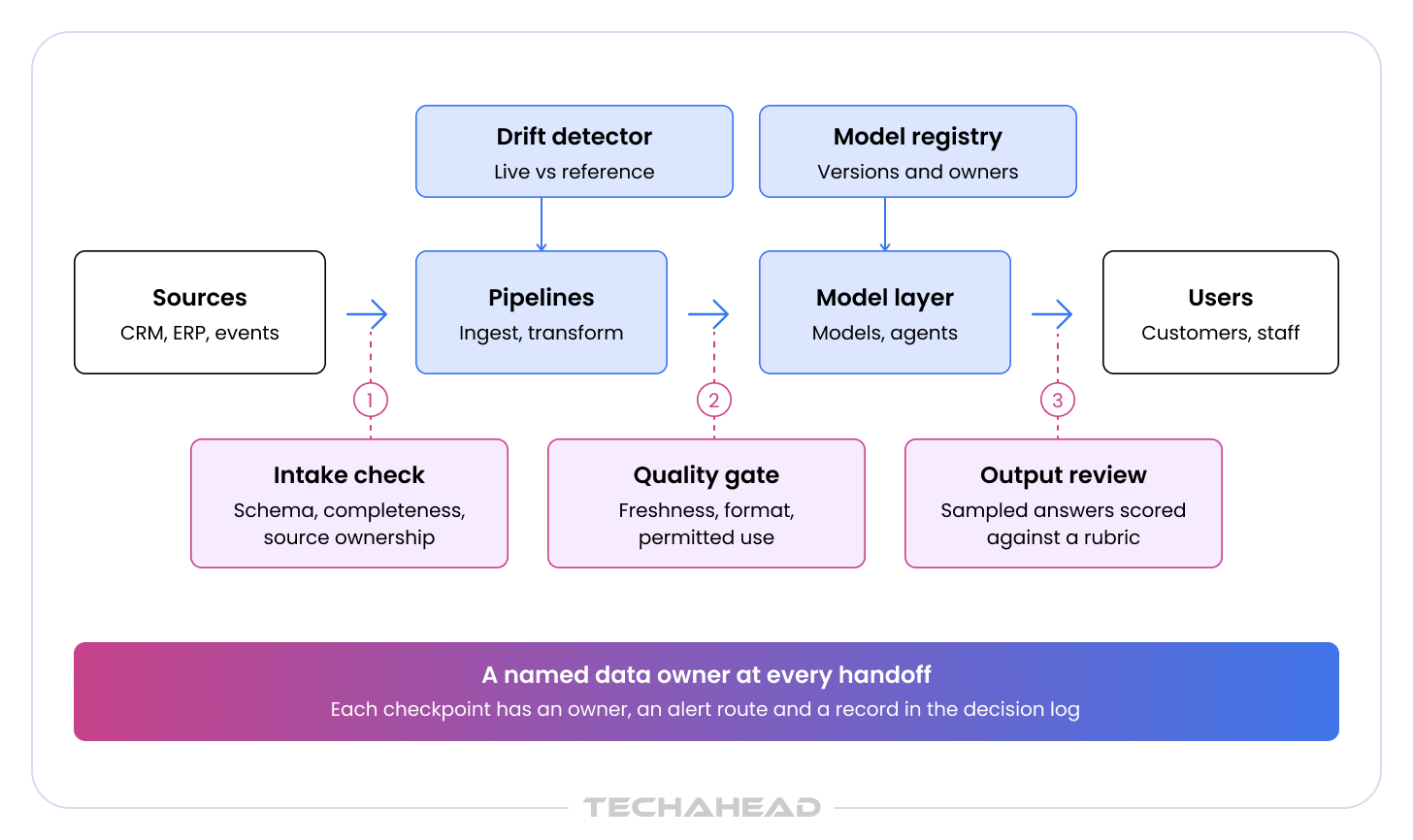
Map data flows end to end, from source systems through data pipelines to the places where models and users consume them. Place a checkpoint at each handoff: an intake check for schema and completeness, a quality gate for freshness, format, and permitted use, and an output review of sampled answers. Name a data owner at every handoff to keep data quality accountable.
Data drift deserves a plain explanation. Over time, real-world inputs shift away from the data a system was designed around, so machine learning and other AI models lose accuracy gradually while standard error dashboards stay green. Comparing live inputs with a reference profile brings drift into view early. A model registry earns its place once more than one model or prompt version reaches production, recording the version, grounding data, owner, and approval for release.
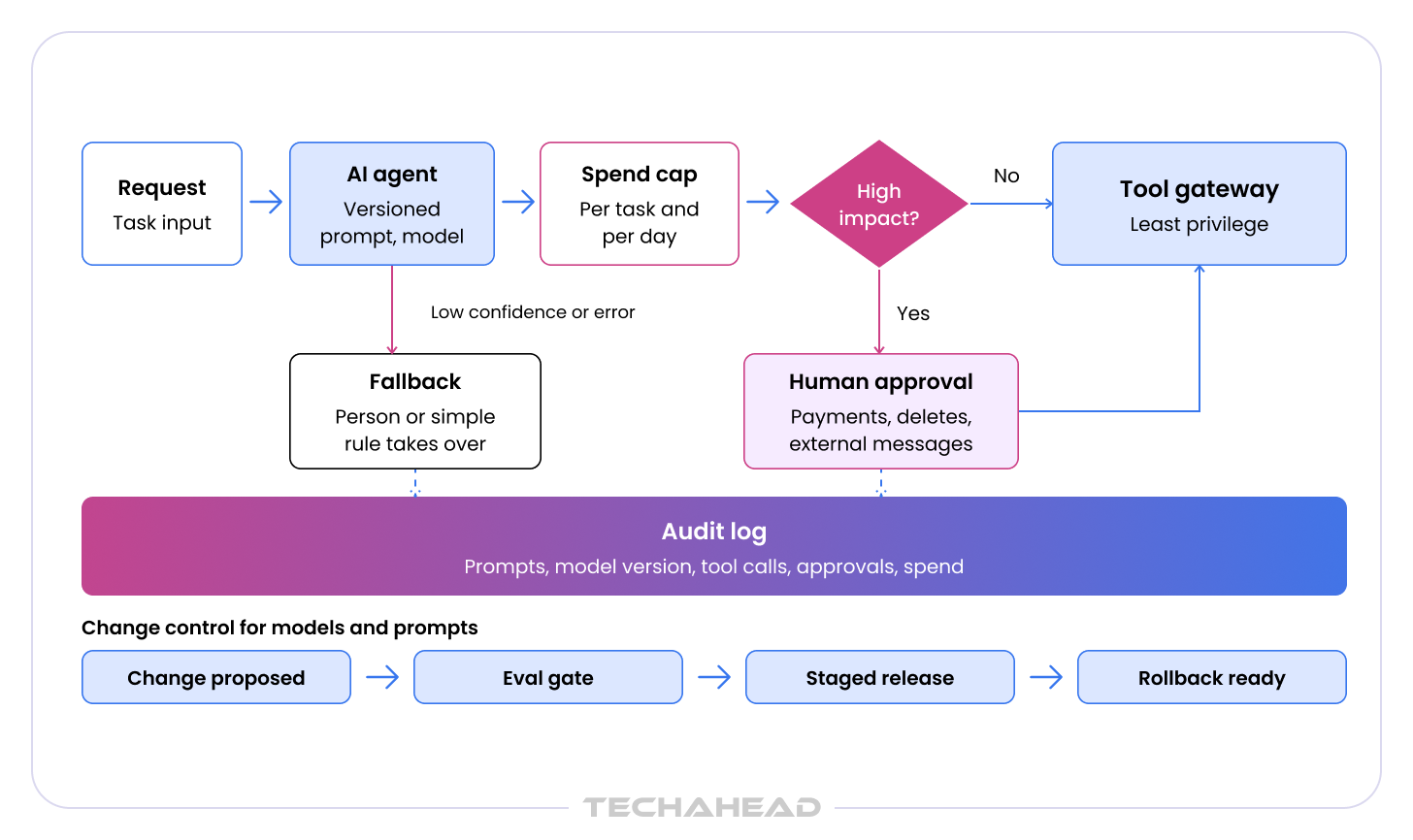
AI agents benefit from clear boundaries. Limit the tools each agent can call and the permissions each tool carries, set spend caps per task and per day, require human approval for high-impact actions such as payments, deletions, and external messages, and provide a fallback so a degraded agent hands work to a person or a simpler rule. Quality control closes the loop: sample outputs weekly, score them against a rubric, and feed each finding back into the production evals. Version every model and prompt change, so any release can be traced and reversed within minutes.
Governance converts good engineering into evidence, and a complete evidence set shortens sales cycles because buyers receive answers on the first request.
Log prompts, model versions, tool calls, approvals, and configuration changes, then set a retention period with legal counsel and limit access by role. Enterprise customers request penetration test summaries, access reviews, incident history, and data handling policies during due diligence, and the same records support all of them. Auditors look for documented ownership, a tested rollback, and proof that quality is measured continuously.
The EU AI Act asks organizations to classify each AI system, document it, and provide human oversight. The high-risk dates have moved: Gibson Dunn summarizes a provisional agreement that places stand-alone high-risk obligations at 2 December 2027 and product-embedded systems at 2 August 2028. Confirm the latest dates with counsel before planning around them.
Documentation that supports classification typically covers purpose, data sources, testing, and the points where people supervise outputs. Building this record during stabilization is far easier than assembling it under deadline, since the decision log and audit records already hold most of the facts.
Package the evidence into a one-page proof pack that leadership can hand to a customer, an auditor, or a board. It draws on audit trails, registry records, access reviews, test and eval results, incident history, and the decision log, and it receives a regular refresh so it stays current.
A customer, an auditor, and a board each read the proof pack differently. Customers look for a security summary and a data handling policy, auditors look for traceability and oversight evidence, and the board looks for metrics and a readiness posture.
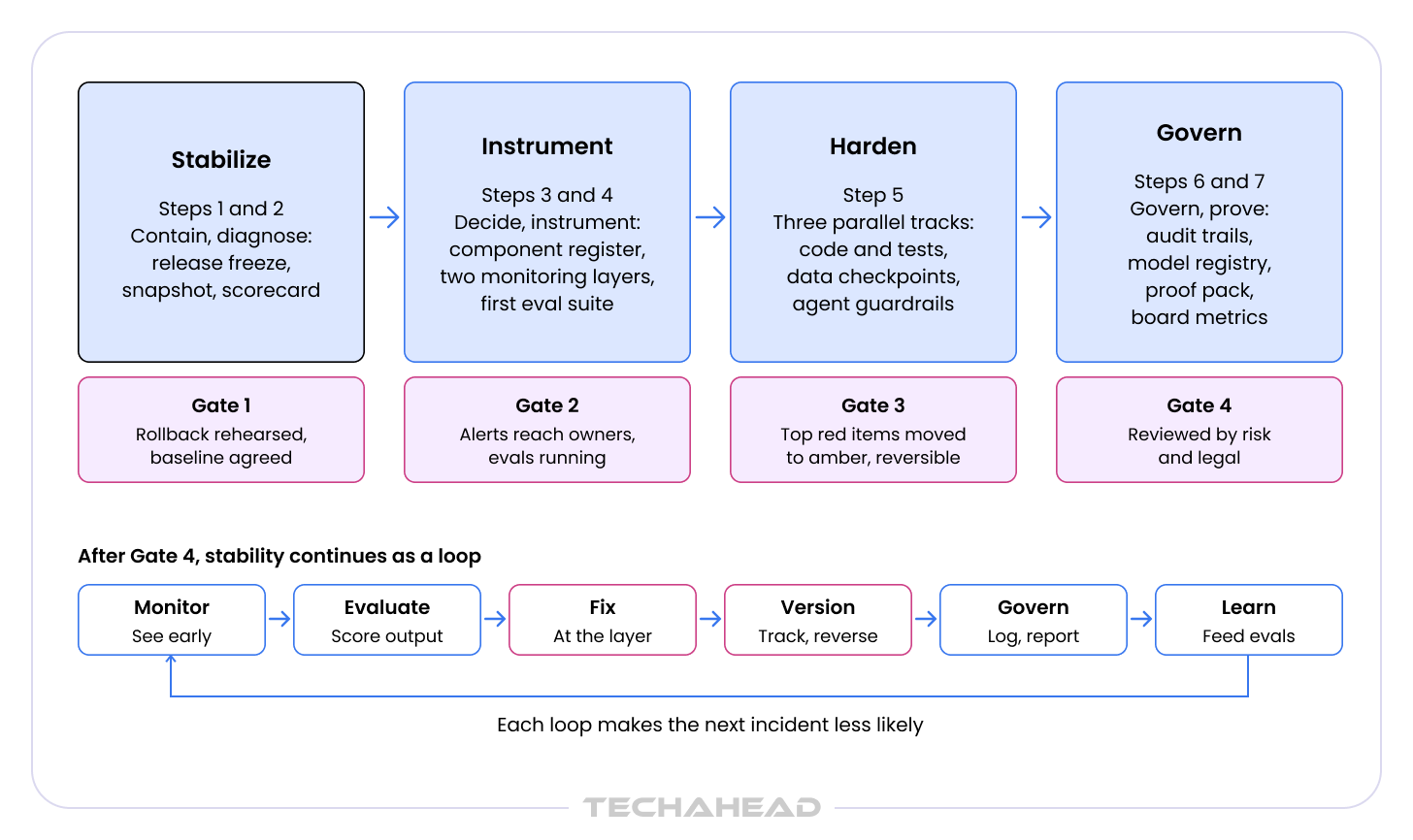
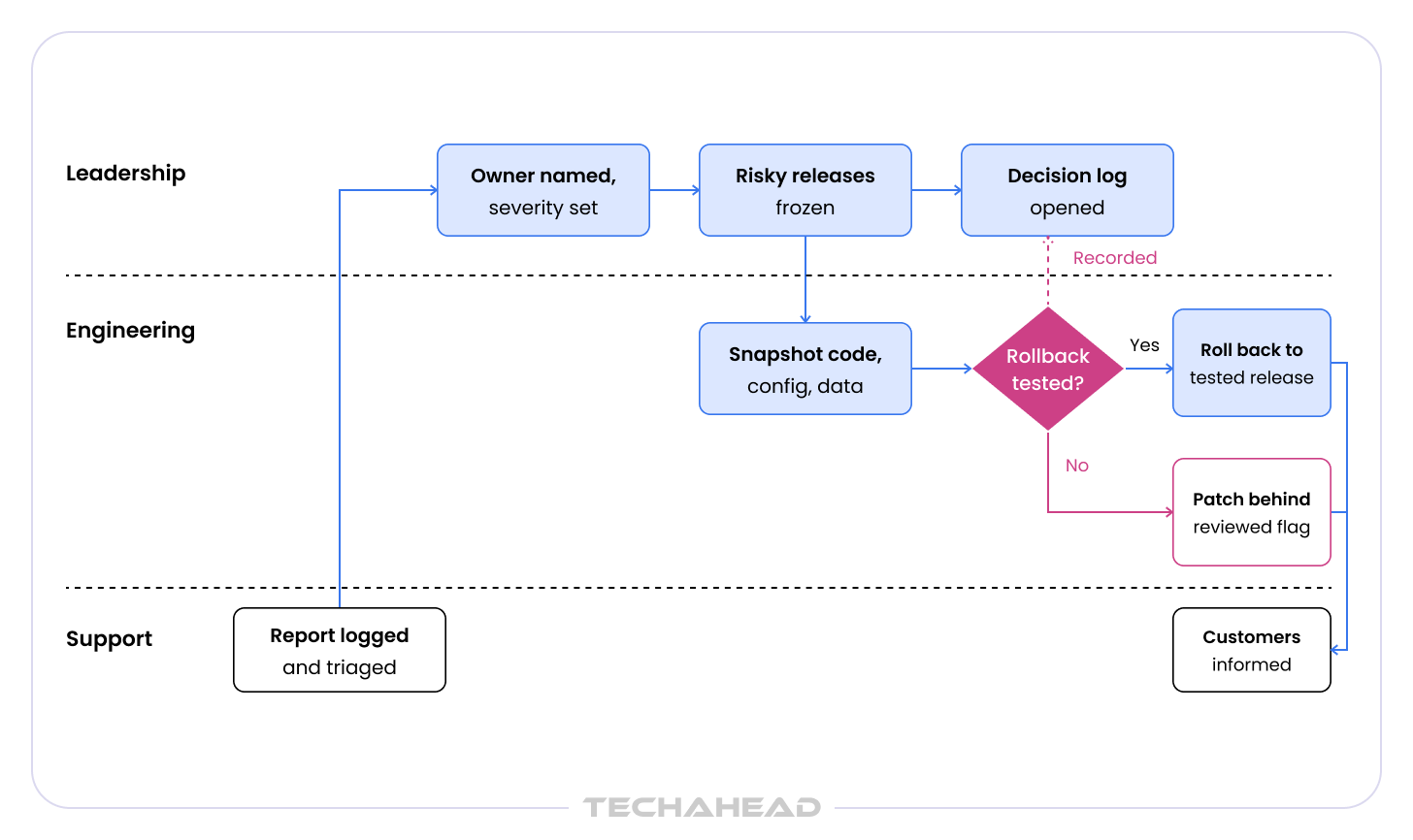
A clear timeline keeps executives, engineers, and customers aligned, and it works best when it rests on specific steps. Each step names its goal, key actions, owner, output, and completion test. Each phase ends at a gate, and the next phase begins once the gate criteria are met. Duration depends on app size, test coverage, and risk profile, so agree on a range for each phase at the start.
Steps within a phase often overlap, and leadership adds the most value at three moments: approving the freeze, funding the reserved capacity, and sponsoring the proof pack.
Step 1. Contain
Step 2. Diagnose
Gate 1: Rollback rehearsed and baseline scorecard agreed.
Step 3. Decide
Step 4. Instrument
Gate 2: Alerts reach named owners, first evals are running, and the component decision register is complete.
Step 5. Harden
Three tracks run side by side:
Gate 3: Top red items moved to amber or green, and every release is reversible.
Step 6. Govern
Step 7. Prove and sustain
Gate 4: Proof pack reviewed by risk and legal, and the board dashboard live.
What to expect along the way:
Early phases bring clarity, with a scorecard and a rehearsed rollback. Operational efficiency gains typically appear in the middle phases, as fewer incidents free engineering capacity and production workflows run with fewer manual interventions.
The final phase brings confidence from customers and the board. Evidence collection starts in Step 1, because the decision log feeds Step 6, and monitoring for the most critical workflows can begin during containment.
Stability needs people with clear roles: an executive sponsor who clears obstacles, a stability lead who runs the program, an on-call rota, and a monthly review cadence. To protect delivery speed, agree a fixed share of each sprint for stability work, for example one fifth of capacity, and adjust as the scorecard turns green.
Whether to build in-house, partner, or blend both depends on available talent and urgency. When evaluating a partner, look for key capabilities in five areas: legacy and AI-generated code analysis, AI application monitoring, data engineering, security and compliance, and the ability to work alongside your team.
The review cadence works best as a short, fixed agenda: scorecard movement, open red items, incident learnings, and the next gate. Keeping it brief and regular builds the habit that sustains stability after the program ends.
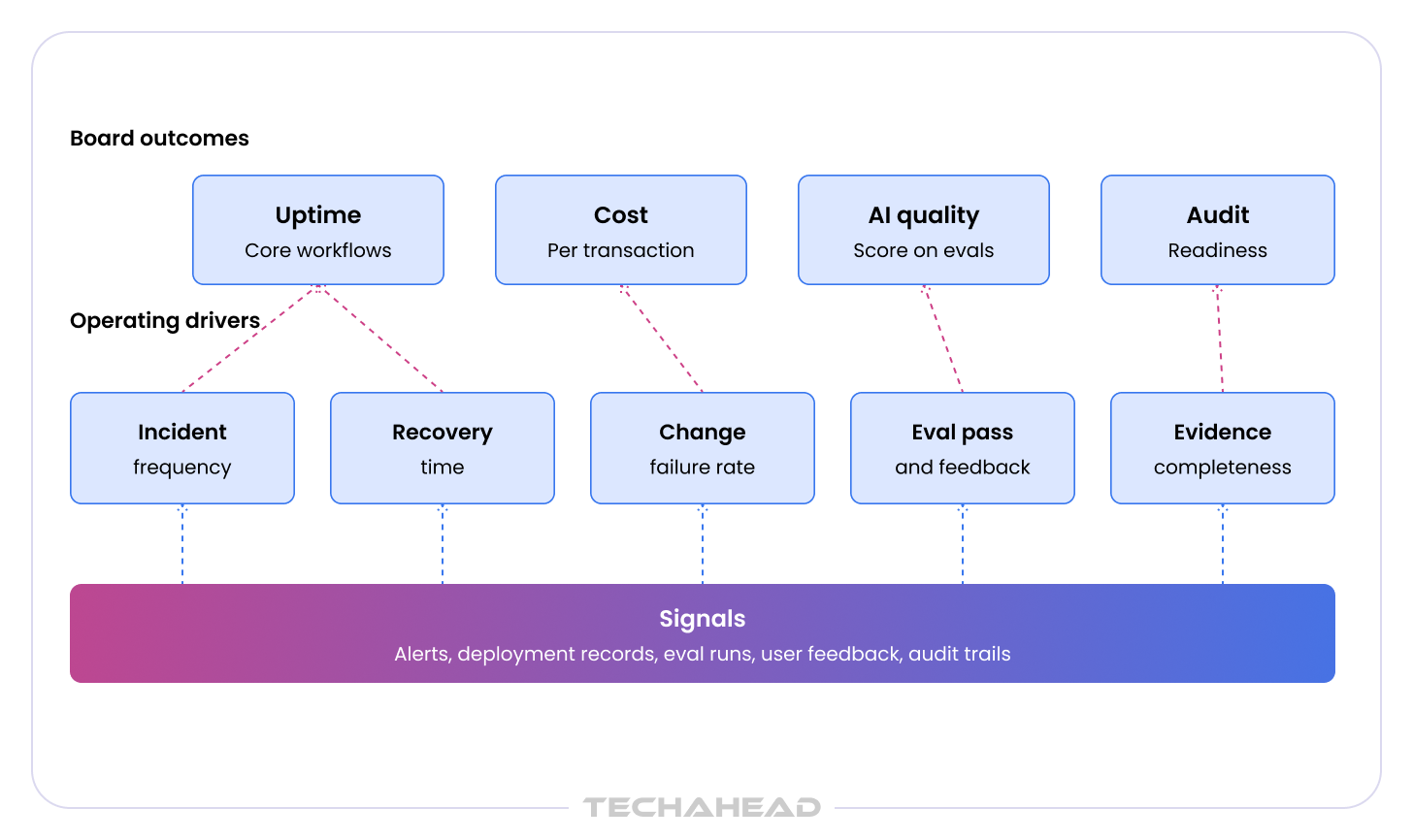
Seven measures give a board what it needs: incident frequency, recovery time, change failure rate, production workflows uptime, AI quality score, cost per transaction, and audit readiness. The DORA research program offers widely used definitions for change failure rate and recovery time, which makes benchmarking straightforward. Baseline each measure before the program begins, then present all of them on a single board-level dashboard with a trend line, so improvement is visible at a glance.
Together, the measures answer the questions a board asks: is the business protected, is it efficient, is the AI dependable, and is the evidence ready?
| Metric | What it shows | Direction |
| Incident frequency | How often users feel an issue | Down |
| Recovery time | How quickly service returns | Down |
| Change failure rate | Share of releases that need a fix | Down |
| Production workflows uptime | Availability of revenue-critical paths | Up |
| AI quality score | Eval pass rate and sampled review | Up |
| Cost per transaction | Efficiency at scale | Down |
| Audit readiness | Proof pack completeness | Up |
As an AI app development company, TechAhead helps enterprises address the technical risks that emerge after AI-built applications go live. Recurring defects, unexplained behavior, and gaps in security documentation can make every new fix more complex without resolving the underlying issues. A complete rewrite may not be necessary. The first step is to identify which components need attention, what can be retained, and where targeted improvements will make the greatest difference.
With a structured assessment and phased roadmap, your team can strengthen application reliability while maintaining business continuity.
Is your AI application ready for enterprise scale? Request an enterprise readiness assessment. We will evaluate your application’s stability, identify critical risks, and outline a practical roadmap to improve reliability, security, and governance while keeping your business moving.
Yes. Most components respond to targeted refactoring and added tests, and the decision framework identifies the few that merit replacement or a phased rebuild.
Duration depends on app size, test coverage, and risk profile. A phased roadmap delivers visible control early, and governance evidence follows in the later phases.
Cost follows app complexity, the state of existing tests and documentation, and the level of governance your customers require. A scorecard review produces a reliable estimate.
An executive sponsor sets priorities and clears obstacles, and a stability lead runs the program with the engineering team. A partner can add depth where capacity is needed.
They look for audit trails, documented ownership, a tested rollback, access reviews, and proof that quality is measured continuously.
Track incident frequency, recovery time, change failure rate, AI quality score, and audit readiness. Rising trends in these measures show the program is delivering.
AI-built means the code was generated by AI tools, and AI-powered means the app contains AI models or agents. Each calls for different first responses, so identifying where your app sits shapes the whole plan.
The cost of stabilizing an AI-built application typically ranges from $35,000 to $500,000+, depending on the app’s complexity, risk profile, technical debt, and governance requirements. Smaller applications with limited integrations often require targeted refactoring, testing, monitoring, and documentation efforts. Large enterprise systems may need architectural changes, AI evaluation frameworks, observability tooling, security remediation, compliance controls, and phased component rebuilds. Key cost drivers include, application size and complexity, code quality, number of AI models, agents, and integrations, security, compliance, and audit requirements, data quality and governance maturity, and so on.
We use cookies to ensure our website functions properly, improve performance, and provide a personalized experience. You can choose which types of cookies to allow below.
Required for core functionality such as security, network management, and accessibility. These cannot be disabled.
Help us understand site traffic and user interactions so we can improve performance and usability.
Enable enhanced functionality and personalization such as language or region preferences.
Used to deliver relevant ads, track campaign performance, and measure advertising effectiveness.