


 Copy Link
 Share on X
 Share on Facebook
 Share on LinkedIn
Always Active
Required for core functionality such as security, network management, and accessibility. These cannot be disabled.

Uncover the transformative potential of digital and mobile solutions for your industry.





 Last Updated: Sep 18, 2026
Aug 24, 2026
Last Updated: Sep 18, 2026
Aug 24, 2026  346
346  19 min. Read


Key Takeaways


Most teams researching an AI agent development company aren’t shopping for a demo. They’re trying to solve a specific operational problem: a support queue that never clears, a sales pipeline drowning in manual follow-up, and an ops team reconciling data across five disconnected systems by hand; they’ve already concluded that a chatbot or a rules-based automation script won’t get them there.
AI agents are a different category of system. Instead of answering a single prompt and stopping, they reason through multi-step problems, call tools and APIs, hold context across a task, and in more advanced deployments, coordinate with other agents to execute an entire workflow without a human re-prompting at every step. TechAhead’s Agentic AI Development Guide breaks down that architecture in more depth, but the short version is this isn’t generative AI with a new label. It’s a genuine shift in how software operates.
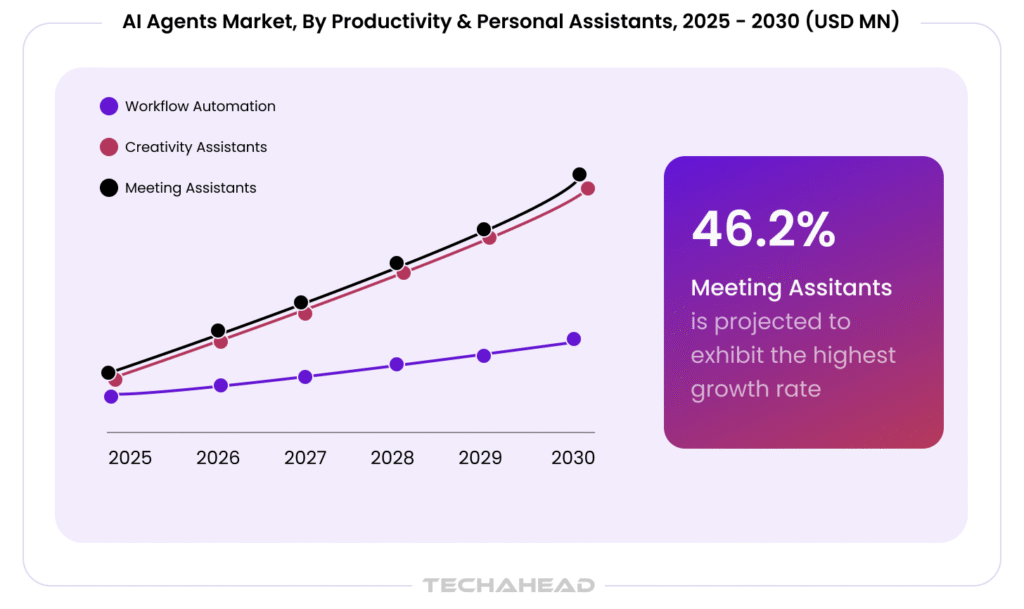
That shift is happening fast. The global enterprise agentic AI market was valued at roughly USD 7.84 billion in 2025 and is projected to reach USD 52.62 billion by 2030, registering a CAGR of 46.2%. Adoption is already mainstream: an estimated 96% of enterprises report using AI agents in some form today, giving it a compound annual growth rate of 46.2%.
The issue is that not every firm that has added “AI agents” to its webpage in the past 18 months can truly build one that survives interaction with production data, legacy systems, and real users. This is because the vendor landscape has expanded at an equally rapid pace. Selecting an unsuitable partner can be costly in ways that don’t become apparent for months, such as fragile integrations, agents that make confident but incorrect judgments, and the lack of an audit record when anything goes wrong. A list of AI agent development companies that can withstand that level of inspection is shortlisted for you.
Before comparing vendors, it helps to know what a real build looks like, because this is exactly where weaker providers start cutting corners. A production-grade AI agent isn’t just a model with a prompt in front of it. It’s a sequence of deliberate decisions, and skipping any one of them is usually why a pilot never makes it to production.
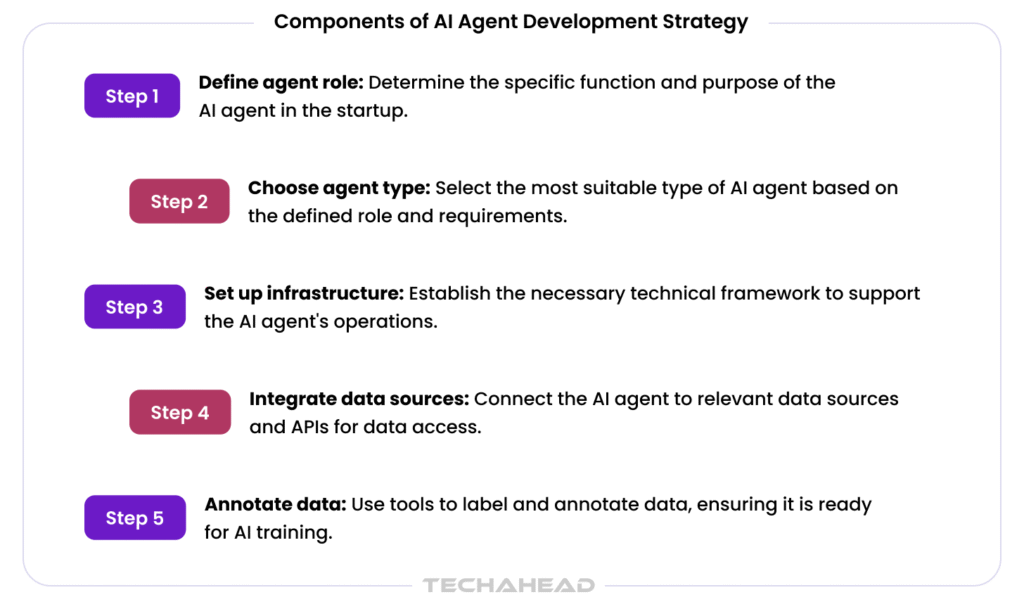
Define the agent’s role. Every good build starts by pinning down exactly what the agent is responsible for and what decisions it can make on its own. Vendors who skip this step tend to hand you an agent that tries to do everything and does none of it well.
Choose the right agent type. A single-purpose agent, a multi-agent system, and a fully autonomous workflow engine are three different builds with three different price tags. The right choice depends on your process, not on what the vendor happens to be good at selling.
Set up the infrastructure. This is the unglamorous part: compute, hosting, and the technical scaffolding the agent runs on. It rarely shows up in a sales pitch, but it’s the difference between an agent that scales and one that falls over under real traffic.
Integrate the data sources. An agent is only as useful as what it can see. Connecting it to your live systems and APIs, securely, is where a lot of vendors quietly underdeliver.
Annotate and prepare the data. Clean, labeled data is what keeps an agent from guessing. This step is easy to underestimate and expensive to skip.
Ask any vendor on this list to walk you through how they handle each of these five stages before you sign anything. Their answer will tell you more than their case studies will.
We evaluated each company against eight factors that actually predict whether an agent survives production, not just whether it demos well.
| Evaluation Factor | What We Looked For |
| AI expertise | Depth in LLMs, RAG, and true agentic (not just generative) AI |
| Technical depth | Fluency across frameworks such as LangChain, LangGraph, CrewAI, and AutoGen |
| Agent architecture | Real planning, memory, tool-calling, and orchestration; not a scripted chatbot |
| Enterprise integration | Ability to connect agents to CRM, ERP, APIs, and internal databases |
| Security & governance | Certifications such as SOC 2, ISO 42001, and documented data-handling practices |
| Production experience | Verifiable deployments and case studies, not just pilots |
| Scalability | Cloud infrastructure and MLOps maturity to support growth |
| Post-launch support | Monitoring, retraining, and optimization after go-live |
TechAhead is an agentic AI development company that builds autonomous, multi-agent systems designed to plug directly into a client’s existing technology stack—ERP platforms, CRMs, internal databases, third-party APIs, and cloud data lakes—rather than operate as an isolated chatbot bolted onto a website. The company is an OpenAI Services Partner and Claude partner, holds SOC 2 Type II certification and ISO 42001 governance, and carries AWS Advanced Tier status. With 16+ years of enterprise engineering behind it, TechAhead has shipped AI-powered systems for brands including Disney, American Express, AXA, JLL, and ESPN F1.
Best for: Enterprises that need AI agents wired into existing business systems and governed under real compliance requirements, not a standalone chatbot experience.
Key AI agent services:
Notable strengths: OpenAI and Claude partnership status; SOC 2 Type II and ISO 42001 certifications; production deployments for Fortune 500-scale brands.
Ideal customer: Enterprises with legacy systems, compliance obligations, and a need for agents integrated into day-to-day operations rather than a proof of concept.
Unlike most suppliers on this list, LeewayHertz adopted a different strategy. Instead of creating each agent from the ground up, IBM spent years developing ZBrain, a unique platform with integrated assessment suites and real-time observability for designing, deploying, and tracking AI agents at scale. You are not restricted to a completely proprietary black box since its multi-agent orchestration layer, known as Agent Crew, operates on well-known frameworks like LangChain, LangGraph, CrewAI, and AutoGen. After The Hackett Group purchased LeewayHertz in 2024, purchasers now have access to both the platform and the support of a much bigger business consulting firm.
Best for: Enterprises that want a proprietary orchestration platform backed by a larger consulting organization.
Key AI agent services:
Ideal customer: Financial services, manufacturing, or retail organizations that want a packaged platform rather than a fully bespoke build.
Early on, Markovate took a calculated risk by focusing on a small number of businesses where the issues are so unique that a horizontal AI solution never truly fits, rather than attempting to be a generalist AI provider. This is evident in the products that the team has deployed, such as a CAD-to-BOM classifier that automatically creates bills of materials by reading construction drawings and an AI-powered takeoff tool that reduces the time required for manual cost estimating from days to minutes. The trend is consistent among more than 300 deployed AI solutions: rather than being a general-purpose helper, agents are created around a single, costly manual operation.
Best for: Mid-market companies in manufacturing, construction, and healthcare that want an agent built around a specific vertical workflow rather than a generic assistant.
Key AI agent services:
Ideal customer: A mid-market manufacturer, contractor, or healthcare operator that needs an agent shaped around one high-value, industry-specific process.
Azilen’s proposal is based on a distinction that is more significant than it may seem: it approaches agentic AI as product engineering rather than as an AI layer added to pre-existing software. The business, which employs more than 400 engineers in the FinTech, HRTech, InsurTech, retail, manufacturing, and clean tech sectors, is often brought in when a client’s AI agent must be a true component of the product roadmap rather than a side project. As a result, it received the “Best AI Development Services USA – 2025” award, and it has a wider geographic reach than other boutique AI stores thanks to distribution hubs in Antwerp, Newark, and India.
Best for: Companies that want an agent built with the same product-engineering rigor as their core software, not a stand-alone AI add-on.
Key AI agent services:
Ideal customer: A product-led company that wants its AI agent treated as a first-class part of the software, not a separate workstream.
Azumo solved a challenge many US businesses face when working with AI vendors: finding a team that’s reasonably priced and accessible during regular business hours. With a pricing structure that undercuts most onshore agencies without the friction that typically accompanies offshore outsourcing, their approach focuses only on nearshore engineering—dedicated teams in Latin America that overlap with US time zones for real-time collaboration. The firm is SOC 2 certified, has worked with companies including Meta, Discovery, and Zynga, and has deployed more than 100 AI projects covering agentic AI, computer vision, NLP, RAG, and MLOps.
Best for: Companies that want dedicated AI agent engineering talent at nearshore rates without sacrificing real-time collaboration.
Key AI agent services:
Ideal customer: A US company that wants a dedicated nearshore team building production AI systems, not an offshore project handed off and returned.
Intuz adopts a rather unconventional stance in this field: customers shouldn’t have to learn how to utilize AI agents; instead, they should be seamlessly integrated into the products they already use. With over 700 deployed products, 16 years of experience, and ISO 9001:2015 certification, the team focuses on integrating agents into backend, web, and mobile infrastructure rather than building a stand-alone AI interface. Identified implementations include manufacturing (QuickShift), healthcare (DrugVista AI), and transportation (TransIQ Logistics), showing real flexibility across industries rather than duplicating a single template.
Best for: Companies that need an agent living inside an existing app or platform, not a separate interface.
Key AI agent services:
Ideal customer: A product team that needs an agent embedded in an app users already use daily.
AI agents that run on or alongside blockchain infrastructure are a true niche that SoluLab fills, one that the majority of businesses on this list don’t address. The team can create an agent that reasons over both traditional and on-chain data in the same workflow, which is a huge benefit if your company currently uses decentralized systems, tokenized assets, or anything else that needs an unchangeable audit trail. Its partner position with Microsoft (Silver tier), Google Cloud, AWS, OpenAI, and Hyperledger, along with ISO, SOC 2 Type II, and CMMI Level 3 certifications, indicates a degree of process maturity that is not typical of Web3-adjacent firms.
Best for: FinTech, healthcare, or SaaS companies whose AI agent use case overlaps with blockchain, tokenization, or decentralized infrastructure.
Key AI agent services:
Ideal customer: A fintech or healthcare company building AI agents on top of blockchain-based data or transaction systems.
Unlike other companies here, Kanerika takes a distinct approach to agentic AI, prioritizing conversational interface after data engineering. Instead of writing SQL or waiting on a BI team for another dashboard, its agents sit on top of massive, often disorganized business datasets and let users query, analyze, and act on that data in plain English. Instead of approaching agentic AI as a stand-alone product line, this data-first DNA permeates the company’s broader business, including analytics, RPA, and AI.
Best for: Companies whose agent use case is fundamentally about interpreting and acting on enterprise data, not customer conversation.
Key AI agent services:
Ideal customer: A data or analytics team that wants an agent layered over existing dashboards and datasets.
Conversational experience design is the foundation around which Master of Code Global built its entire practice. This team treats chat and voice applications, LLM integration, and connectors into CRM and customer-engagement systems as the product, whereas many AI vendors treat them as an afterthought bolted onto backend logic. This way, the agent not only answers correctly but also sounds like your brand. This matters more than it seems: a technically perfect agent with cumbersome conversational design still irritates clients and slows adoption.
Best for: Companies whose main AI agent requirement is a customer-facing conversational or voice experience.
Key AI agent services:
Ideal customer: A customer experience or marketing team prioritizing a refined conversational interface over back-office automation.
EY is a strong choice for large organizations looking to introduce agentic AI across complex business operations. Its approach combines AI agents with enterprise data, industry expertise, governance, and human oversight. Through its EY.ai ecosystem, EY supports organizations from agentic AI strategy through custom agent development and enterprise deployment. Its services include agent-assisted workflows, managed agentic services, and custom agent build-as-a-service.
Best for: Large enterprises looking to deploy AI agents across complex, highly regulated, or data-intensive business operations.
Key AI agent services:
Ideal customer: A consumer or enterprise mobile app team looking to add agentic capability without rebuilding the product from scratch.
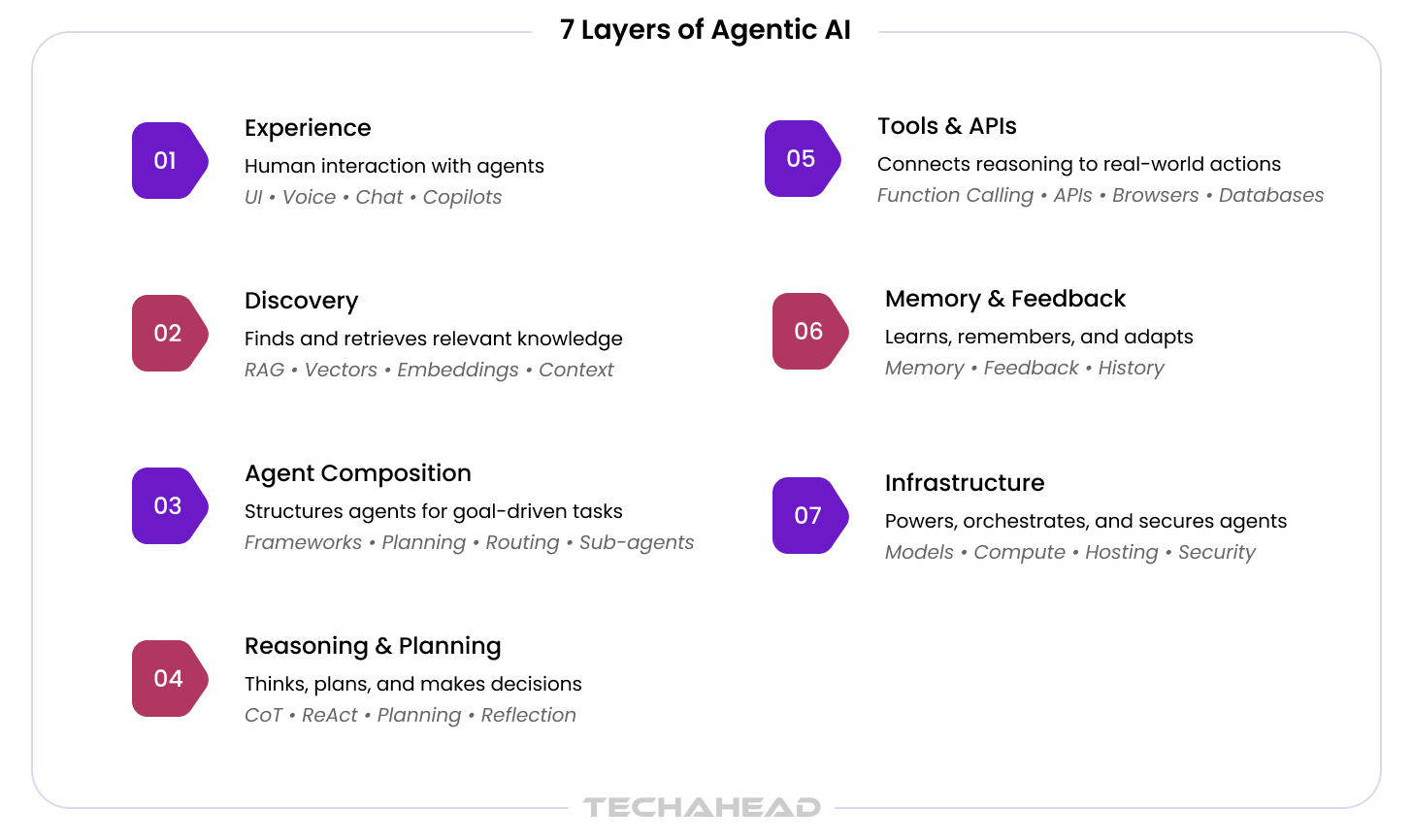
Agent architecture gets discussed a lot in the abstract. In practice, every serious agent build is really seven layers stacked on top of each other, and a vendor that’s only strong in one or two of them will hand you something that looks impressive in a demo and breaks the first time it meets a real edge case.
| Layer | What It Does |
| Experience Layer | Where people actually interact with the agent, whether that’s a chat window, a voice assistant, an embedded product feature, or a Slack integration. |
| Discovery Layer | How the agent finds and retrieves relevant information, typically through retrieval-augmented generation (RAG), vector databases, and embedding models. |
| Agent Composition Layer | How the agent’s structure and role behavior are designed, including planner-executor loops and how sub-agents are chained together. |
| Reasoning & Planning Layer | The decision-making core: how the agent breaks down a goal, plans steps, and reflects on whether its approach is working. |
| Tool & API Layer | Where reasoning turns into action, connecting the agent to real tools, webhooks, databases, and file systems so it can actually do something. |
| Memory & Feedback Layer | How the agent remembers past interactions, learns from outcomes, and improves instead of repeating the same mistakes. |
| Infrastructure Layer | The technical foundation underneath all of it: model hosting, compute, orchestration, security, and rate limiting at scale. |
Most businesses on this list can discuss layers 1 and 2 convincingly. In particular, layers 6 and 7, where agents either develop into reliable business tools or are discreetly discarded after the pilot, have seen far fewer genuine systems implemented across all seven. It’s worth asking a vendor directly which of these seven layers they manufacture themselves and which they assemble from a third party’s product. For enterprise-scale deployments, TechAhead’s enterprise-grade AI and generative AI expertise are worth looking at as well.
Cost is where most vendor conversations get vague, so it’s worth pushing past that early. According to TechAhead’s own AI Agent Development Cost breakdown, a production-ready single-agent MVP typically starts between $50,000 and $70,000, while a fully autonomous, multi-agent enterprise platform, complete with memory, tool-use, orchestration logic, human-in-the-loop guardrails, and compliance controls, routinely exceeds $1.5 million. Broader Enterprise AI Development Cost data puts the full range of enterprise AI projects (agentic and non-agentic) between $50,000 and over $1 million, with labor accounting for 60 to 75% of total spend.
| Agent Type | Typical Cost Range |
| Single-purpose AI agent (support triage, lead qualification) | $50,000 to $70,000 |
| RAG-based enterprise agent with knowledge integration | $70,000 to $250,000 |
| Multi-agent orchestrated workflow system | $250,000 to $750,000 |
| Full enterprise agentic platform with compliance and governance | $750,000 to $1.5M+ |
What actually moves the number:
A useful sanity check: 60% of AI projects exceed their original cost estimate by 30 to 50%, almost always because of undisclosed integration work or compliance remediation discovered mid-build. For a full breakdown of where software budgets typically go off track, TechAhead’s Software Development Cost Guide is a useful companion read.
TechAhead’s spot on this list isn’t just a ranking convenience. The differentiators hold up under diligence:
Explore the full Agentic AI Development Services offering, or read the AI Development Guide 2026 for a broader look at how TechAhead approaches enterprise AI decisions beyond agents specifically.
The right AI agent development company should do more than ship an impressive prototype. It needs to understand how your workflows actually run today, integrate with the systems you already depend on, put real governance around what the agent is allowed to do, and stay involved after launch instead of disappearing at go-live. The ten companies above each solve a different version of that problem. The right fit depends on whether your priority is deep enterprise integration, vertical specialization, nearshore cost efficiency, or a conversational front end.
For enterprises weighing agents that need to operate inside real business systems under real compliance requirements, TechAhead is built to solve that specific problem.
An AI agent development company designs and builds autonomous AI systems that can reason through tasks, use tools and APIs, access business data, and complete multi-step workflows with limited human intervention.
AI agent development can cost from $50,000 to $1.5 million or more, depending on the agent type, number of agents, integrations, data requirements, security, compliance, memory, and infrastructure.
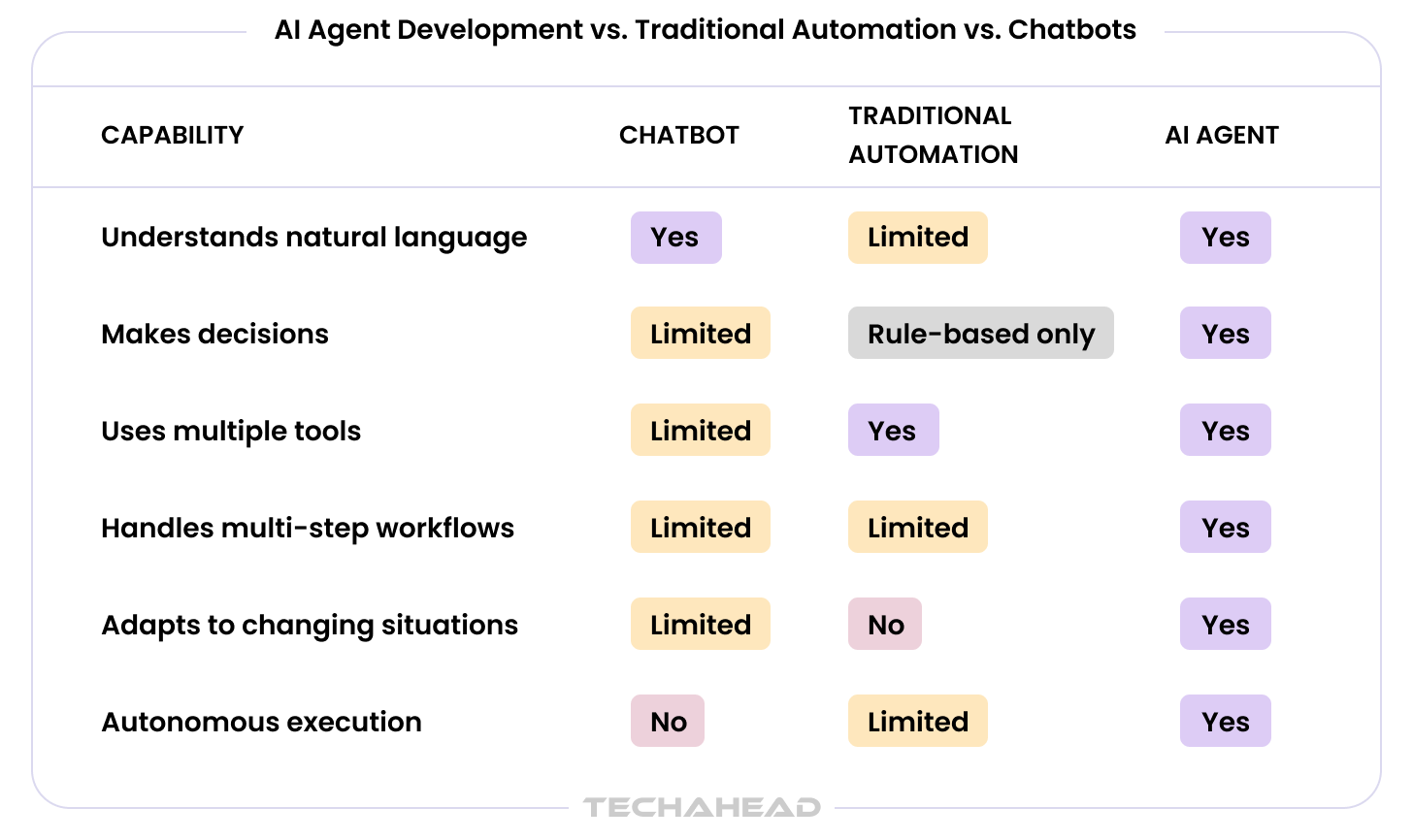
A chatbot primarily responds to user prompts, while an AI agent can reason, plan, access information, call tools, use APIs, remember context, and execute multi-step tasks. This makes AI agents better suited for complex business automation.
Look for proven expertise in agentic AI development, LLMs, RAG, multi-agent architecture, API integration, enterprise systems, security, scalability, and post-launch monitoring rather than choosing a vendor based only on an impressive AI demo.
Yes. Production AI agents can connect with CRMs, ERPs, internal databases, APIs, cloud data lakes, and other business systems to retrieve information and perform actions within existing workflows.
Companies can build single-purpose AI agents, RAG-based enterprise agents, multi-agent systems, conversational AI agents, data-driven agents, multimodal agents, and fully autonomous workflow agents, depending on the business use case.
The development timeline depends on the agent’s complexity, integrations, data preparation, security requirements, and whether the project involves a single agent or a multi-agent architecture. A production deployment typically requires considerably more work than an AI proof of concept.
AI agent development commonly involves LLMs, RAG, vector databases, LangChain, LangGraph, CrewAI, AutoGen, APIs, cloud infrastructure, memory systems, orchestration, and observability tools. The right technology stack depends on the agent’s workflow and enterprise requirements.
They can be, provided the system is designed with appropriate security, governance, access controls, compliance, monitoring, and audit trails. These requirements become especially important when agents interact with sensitive enterprise data or make business decisions.
AI agents can support businesses with customer support, sales automation, operations, data analysis, internal knowledge management, workflow automation, lead qualification, and decision support where teams currently handle repetitive multi-step processes manually.
We use cookies to ensure our website functions properly, improve performance, and provide a personalized experience. You can choose which types of cookies to allow below.
Required for core functionality such as security, network management, and accessibility. These cannot be disabled.
Help us understand site traffic and user interactions so we can improve performance and usability.
Enable enhanced functionality and personalization such as language or region preferences.
Used to deliver relevant ads, track campaign performance, and measure advertising effectiveness.